



One-piece flow, also called single-piece flow or continuous flow, is a lean production method in which one unit moves from one process step to the next without waiting for a batch. The goal is to reduce work in progress, expose problems early, and shorten lead time while keeping each step synchronized with demand.
A 2013 Toyota Production System redesign for a Food Bank For New York City partner shows the scale of the opportunity. Toyota reported that box-packing time fell from 2.2 minutes to 11 seconds, meal delivery increased from 25 to 450 meals per hour, and truck capacity rose from 864 to 1,260 boxes. Those results came from a complete redesign of layout, box size, packing, and distribution, not from one technique in isolation.
The method is simple to describe but demanding to run. Equipment must be reliable, work content must be balanced, quality problems must be handled at the source, and changeovers must be fast enough to keep a single item moving. When those conditions are missing, a small controlled buffer or batch can be the better choice.
What is one piece flow?
In one-piece flow, the transfer batch between steps is one unit. Several units can still be inside the process at once, with each unit occupying a different stage. What disappears is the large queue between stages. A completed unit moves forward as soon as the next step can accept it.
That distinction matters. One-piece flow does not mean the entire system contains only one item. It means work does not wait for a full batch before moving. Lean Enterprise Institute guidance on continuous flow also allows a small, consistent transfer batch when a literal batch of one is impractical, but the operating principle stays the same: keep work moving and keep in-process inventory deliberately low.
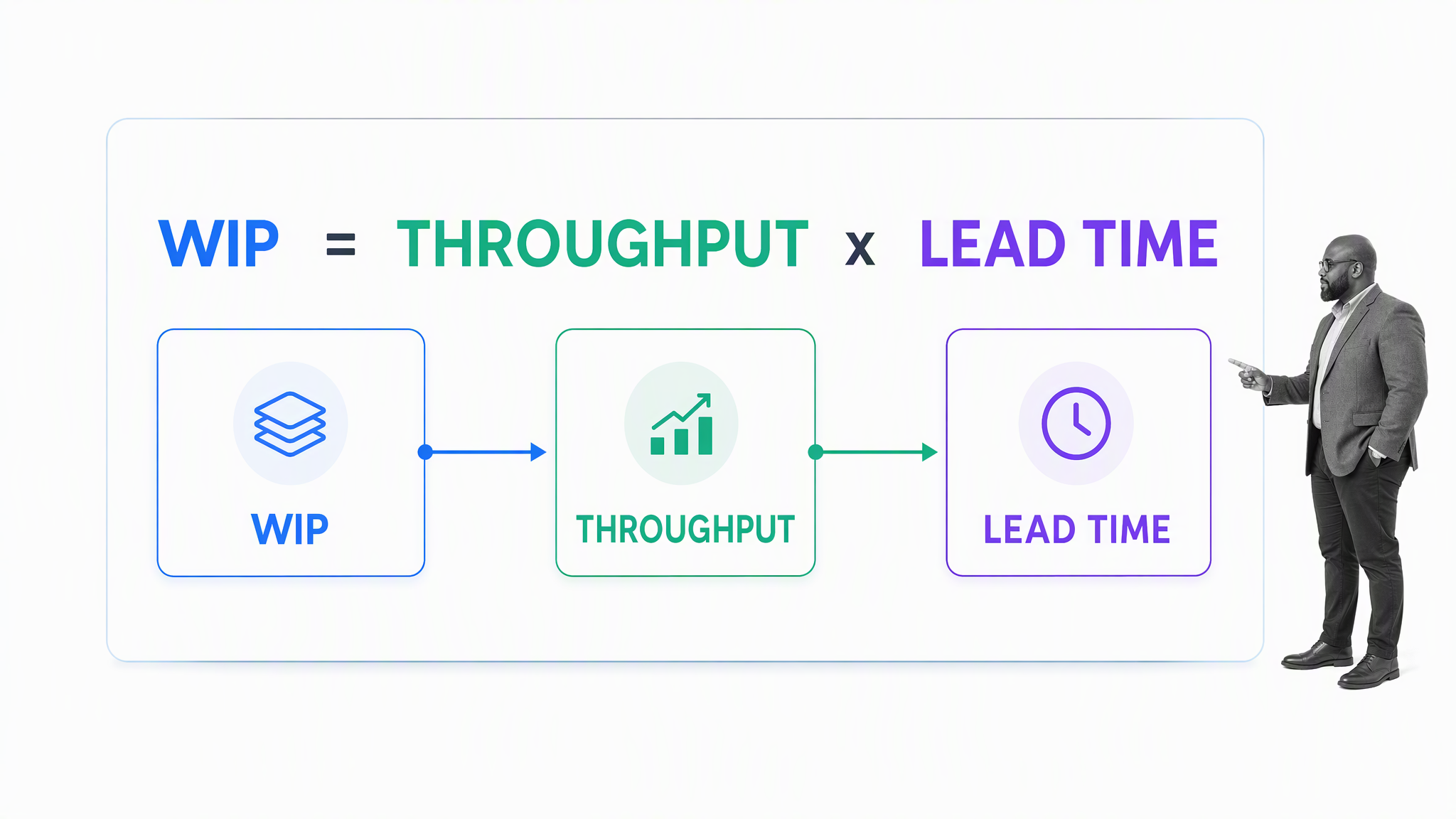
Little’s Law explains why lower WIP often produces shorter lead time. In a stable system, average work in progress equals average throughput multiplied by average lead time. If throughput stays stable and WIP falls, lead time falls with it. The stability condition matters because simply cutting inventory cannot repair an unreliable or badly balanced process.
Consider a supermarket order containing ten tins and ten bottles. One workstation packs tins and a second packs bottles. In a batch process, the first station fills the tins in every box before the whole batch moves to the bottle station. Most boxes spend most of their time waiting.
With one-piece flow, each box moves to the bottle station as soon as its tins are packed. In this simplified, perfectly balanced example, both stations can work at the same time and waiting falls sharply. Real throughput depends on cycle times, quality, uptime, and demand, so the example illustrates overlap and lower waiting rather than promising that every process will double its output.
A useful comparison is batch production versus one-piece flow. Batching can reduce setup cost when changeovers are long, but it hides defects and creates queues. One-piece flow reduces queues and makes abnormalities visible, but it demands stable work, fast feedback, and a clear response when a step stops.
Pulling this off requires coordination and consistency. A solid business process management strategy helps the team take a repeatable approach, assign responsibility at each workstation, and prevent local decisions from creating a queue somewhere else. The point is not to keep every person busy every second. It is to keep the item moving through the whole system at the pace customers require.
This is also where the difference between theory and practical application begins. Reducing WIP saves the cost of holding unfinished items for future delivery, but low inventory removes the cushion that once concealed unreliable equipment, uneven workloads, and unclear handoffs. A team should expect those weaknesses to become visible and be ready to solve them.
The advantages
The strongest advantages are shorter lead time, less work in progress, earlier defect detection, and lower inventory and space requirements. Work reaches the customer faster because it spends less time waiting between steps. Teams also need less room for partially completed items and less cash tied up in unfinished work.
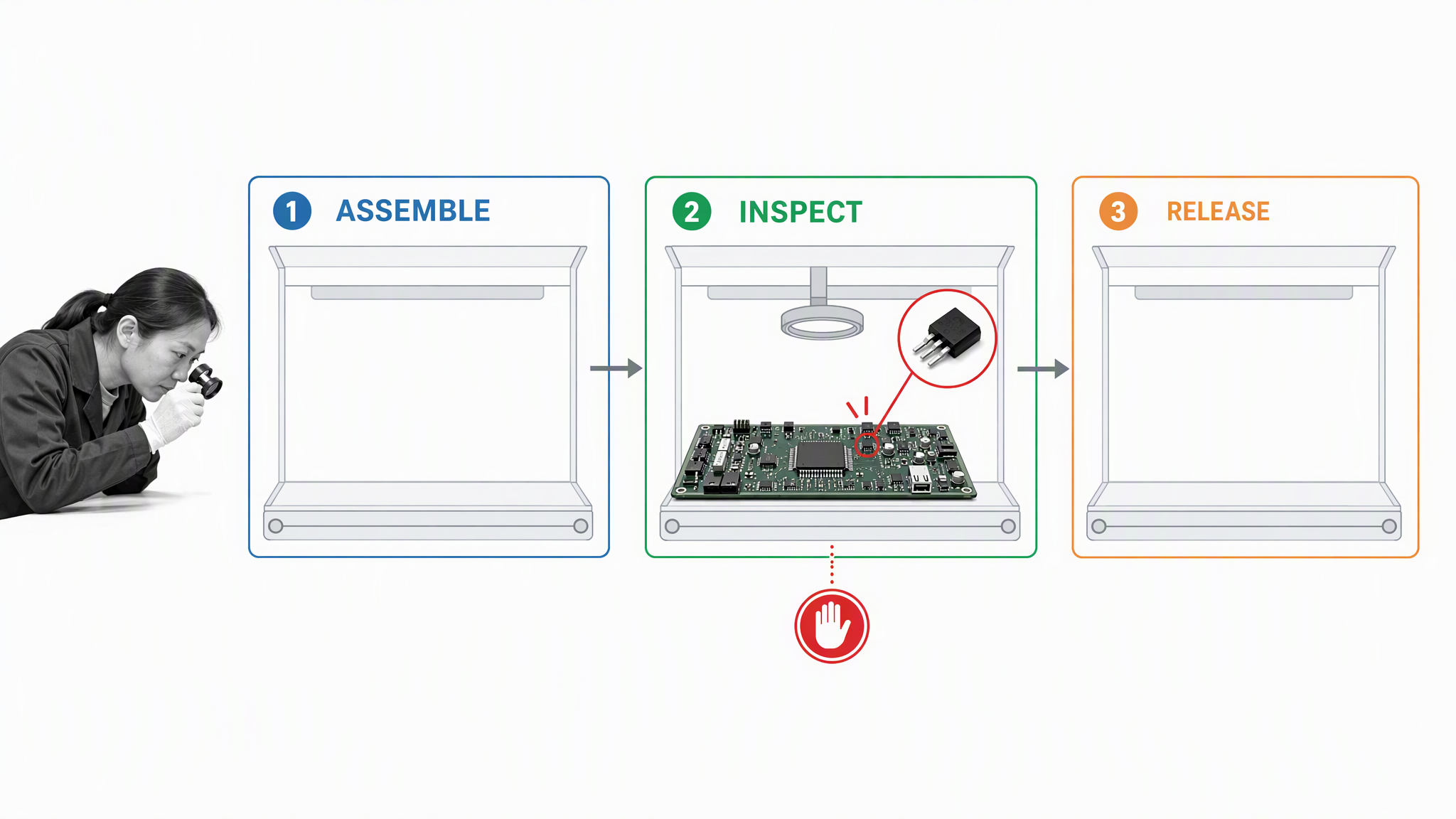
Quality problems become visible closer to the moment they are created. Imagine assembling 15 computers with the wrong transistor. In a large batch, the same error can reach all 15 units before inspection catches it. With a transfer batch of one and quality checked at the source, the first faulty assembly can stop the process before the mistake propagates.
Faster feedback also improves flexibility. If an order changes before work begins, low WIP leaves fewer units that need rework. A visible, balanced flow makes it easier to see where demand is rising, where a bottleneck is forming, and whether a workstation needs help.
One-piece flow can support continuous improvement because problems are harder to hide behind inventory. Delays, equipment failures, uneven work, and quality escapes appear as interruptions in the flow. The team can investigate the cause, test a countermeasure, and update standard work instead of carrying the problem into the next batch.
Those simple benefits have important knock-on effects. A shorter response time leaves more room for a customer to make alterations before work starts. Lower inventory and better use of real estate can make it easier to scale up operations without filling the workplace with unused stock. Because each product is visible across every step, managers can monitor whether the production system is keeping its promise.
Progress can also improve morale when people can see useful work reaching completion. That benefit depends on thoughtful job design. Switching employee tasks every so often, involving operators in improvement, and showing how each workstation contributes to the result can provide variety without losing the discipline of standard work.
Automation can help when the economics are sound. Repetitive handling, measurement, notifications, and record capture are candidates when the measured time and quality gains exceed implementation and maintenance costs. Automation should protect the flow, not automate a poorly designed process.
The disadvantages
One-piece flow is not suitable for every operation. It is easiest when demand is reasonably stable, work content is repeatable, equipment is available, quality is controlled, and changeovers are short. High product variation, long setup times, unpredictable arrivals, or processes with unavoidable curing and transport delays may need pull-controlled buffers or small batches.
The system is sensitive to imbalance. If one step takes much longer than the others, upstream work stops and downstream capacity waits. A breakdown can interrupt the entire line because there is little inventory to absorb the disruption. That is why maintenance, cross-training, standard work, and a clear response plan are operating requirements, not optional extras.
Changeovers can also erase the benefit. Producing a different item every cycle is expensive when tools, materials, or machine settings take a long time to switch. Techniques such as setup-time reduction and production leveling can make mixed-model flow practical, but a small batch may remain more economical until those constraints are improved.
Human factors need deliberate design. Repeating one narrow task all day can reduce attention and motivation. Job rotation, cross-training, ergonomics, and worker involvement in improvement can protect both quality and morale. Rotation may reduce specialization at one station, but it also makes the system more resilient when demand or staffing changes.
Imagine working on a production line and screwing tops onto toothpaste tubes all day. The process may look efficient in terms of time and money, but an employee who zones out is more likely to make mistakes. Even when the error is caught quickly, the process has to stop while the source is found and corrected so the same problem does not keep happening.
Automating a simple, monotonous task is not always available as a solution. The organization may lack the capital, technical resources, or space required for the machinery. In that case, rotating duties and redesigning the work may be more practical. One-piece flow should improve the complete operating system, including the people doing the work, rather than optimize a machine metric at their expense.
How to implement continuous flow
Implementation starts with one suitable product family or process, not a company-wide mandate. Map the current flow, measure demand and cycle time, identify the constraint, and test a narrow cell where the team can see cause and effect.
Meet the requirements
Before removing buffers, establish the conditions that keep work moving:
- Define the unit of work and limit the transfer batch to one where practical.
- Match the required production pace to customer demand using takt time.
- Measure cycle time at every step and balance work around the constraint.
- Build quality into each step so defects stop and trigger a response immediately.
- Make equipment and staffing reliable enough to support the target flow.
- Reduce changeover time and standardize how the work is performed.
- Use a pull-controlled buffer when a process cannot yet flow continuously.
A readiness check should also confirm that the operation can limit WIP to one item in any given queue, keep uptime as high as practical, divide work and resources evenly between workstations to prevent bottlenecks, consistently repeat the time taken to complete any given step, and scale operations to demand. These factors are related: high uptime prevents a queue forming, while balanced resources stop one station from overwhelming the next.
These requirements reinforce each other. Stable equipment prevents queues. Standard work makes cycle times comparable. Fast changeovers support variety. Quality at the source prevents defects from traveling downstream. If a condition is weak, improve it before inventory is removed, or the flow will expose the problem without giving the team a way to recover.
It is easy to become lost in the specifics. Keep measuring the time taken to perform a task, the performance of each machine, person, and process, and the ability of the operation to scale as demand rises and falls. That evidence helps the team choose the easiest problem to solve first and build an operation that is more efficient, predictable, and economical.
Continuous flow is about reducing waiting, but a team should be able to explain what it expects to achieve and how the result will be measured. Results must be achieved without assuming that low WIP is absolutely sufficient on its own. A team cannot achieve improvement without actually analyzing the indicators above. In addition, equipment, quality, and workload problems must be addressed as they appear.
Take a systematic approach to your processes
Documented standard work makes continuous flow measurable, repeatable, trainable, and improvable. The team needs to know the work sequence, expected time, quality criteria, safety requirements, and escalation path at every step. Documentation alone does not create flow, but it gives the team a stable baseline for testing improvements.
Process documentation also makes it easier to spot gaps and mistakes, optimize outdated or inefficient sections, automate what is suitable, and make employees more accountable for the agreed method. Those benefits are useful only when the documents match the actual work and operators can improve them as conditions change.
Process Street is a single Compliance Operations Platform with Docs and Ops capability areas plus built-in AI. Teams can document standard work, run it as controlled workflows, capture completion and quality data, coordinate approvals, and surface bottlenecks from the same system. That connects workflow documentation to execution and evidence instead of leaving instructions in a static file.
For manufacturing teams, the same operating discipline supports process optimization in manufacturing: define the standard, run the work, record exceptions, and use the evidence to decide which constraint to improve next.
Analyze and optimize your operations
A practical implementation sequence is:
- Choose a process and confirm that its demand and work content are suitable.
- Separate the work into visible steps or work cells.
- Measure takt time, cycle time, uptime, first-pass yield, and changeover time.
- Balance work so no step consistently overwhelms the next one.
- Design the physical or digital layout to reduce handoffs and travel.
- Run a pilot, stop for abnormalities, and update standard work from evidence.
In practical terms, choose a process and make sure it is suitable for continuous flow. Divide the work involved into separate blocks such as workstations or work cells, confirm that the operation can meet the required production time, create a floor layout, balance the cells, and audit the flow regularly. The steps look simple on paper, but the practical elements involved in their application require careful observation.
Group tasks by equipment, skill, and sequence, then move work that does not require a fixed location away from the constraint. The goal is not to make every station identical. It is to make the total sequence capable of meeting demand without creating a hidden queue.
When work is divided into blocks, grouping tasks only by equipment can leave one block carrying far more work than the others and form a bottleneck. Work does not always have to be completed in the same place. A simple assembly task that needs no specialist equipment can move to a smaller cell to maintain a steady product flow and a more even workload across the operation.
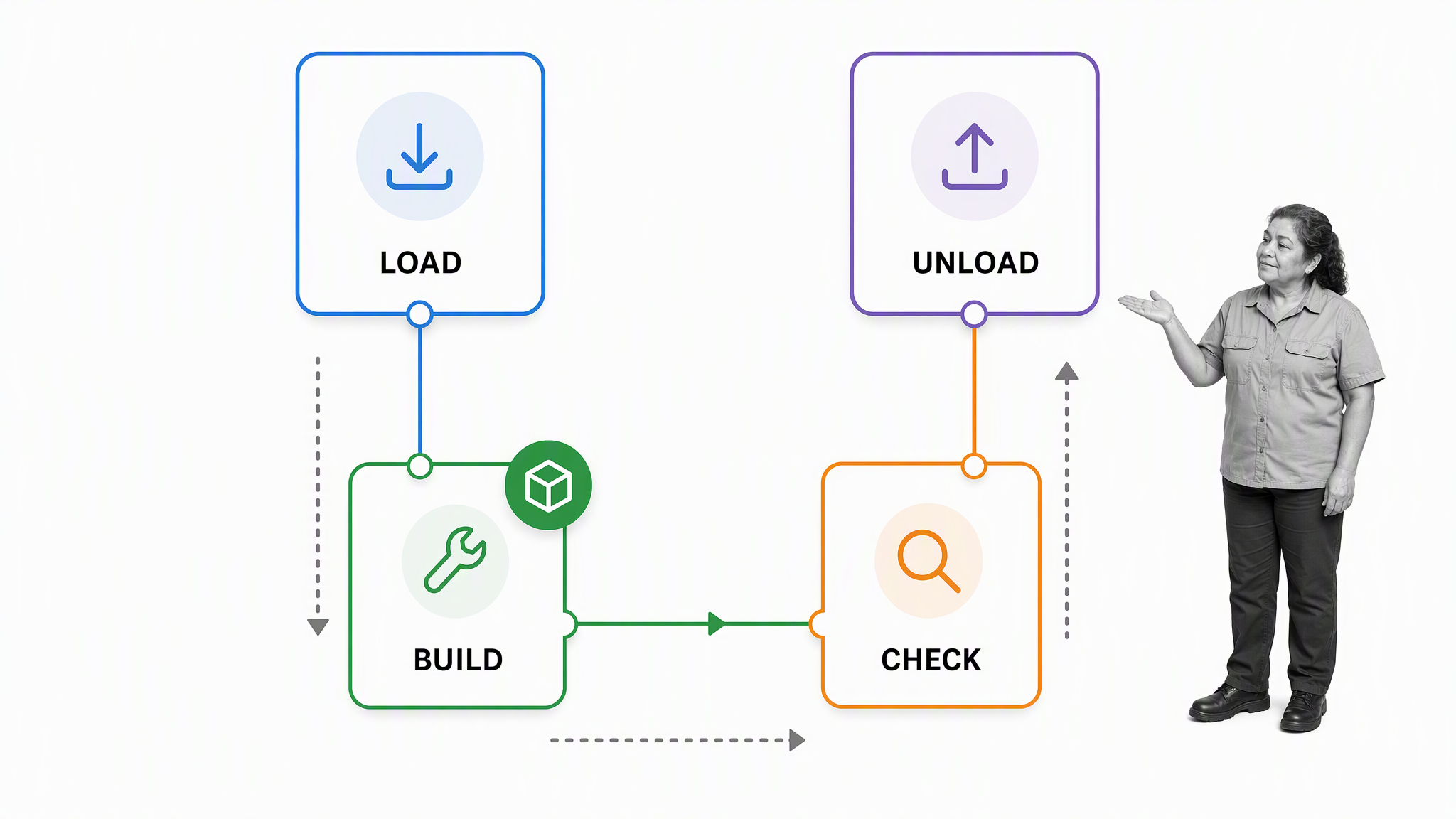
A U-shaped cell is a common option when it shortens travel, lets one person support several steps, and makes the whole flow visible. It is not automatically the best layout. Safety, material handling, machine access, ergonomics, and the direction of demand should determine the final design.
Using one piece flow in any area of your business
The principle applies outside manufacturing whenever work can move through a repeatable sequence and large queues create delay. Customer onboarding, claims review, content production, hiring, and financial close all suffer when teams start more work than they can finish.
A content team, for example, can limit editorial WIP. Instead of researching five articles, drafting five more, and leaving all ten waiting for review, the team can move one article through research, writing, editing, and approval before pulling the next item. That choice shortens feedback loops and makes the constraint visible. It does not prove that every writer should complete an article alone or that all creative work must follow one rigid sequence.
The same principle applies inside an editing task. Rather than reading several drafts once for spelling, again for grammar, and again for structure, an editor can completely review a single draft before moving on. That reduces context switching and lets feedback reach the writer sooner, although a separate specialist review can still be appropriate for high-risk content.
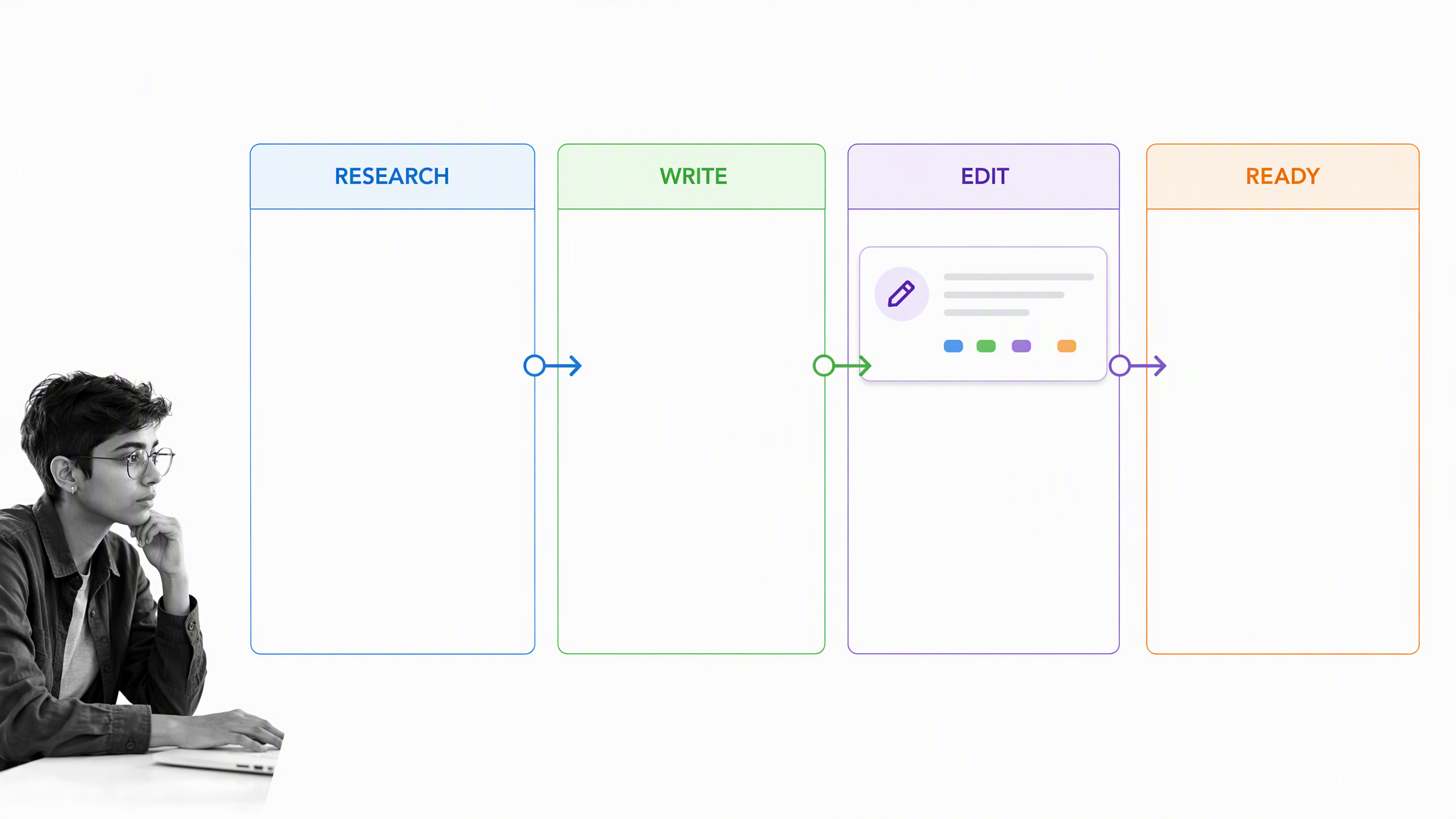
Digital work also has changeovers, queues, and blocked items. A reviewer switching among many drafts pays a context-switching cost. An approval waiting for missing evidence behaves like a physical part waiting for a machine. A WIP limit helps the team finish work before pulling more, while explicit exception paths keep urgent items from disrupting every queue.
The idea can extend to customer relationship management, human resources, and other recurring services. The method works when all relevant factors are considered and a balance is struck. Small sections of a documented process often make better starting points than a sweeping transformation because the team can observe the result and adjust the practice to its context.
The right unit of work matters. One-piece flow might mean one customer case, one invoice, one policy review, or one article. Choose a unit small enough to move and verify, but large enough to produce a useful outcome. If the unit is too large, the team hides a batch inside the label. If it is too small, coordination cost overwhelms the gain.
The key is not following the theory so doggedly that the team loses sight of what small tweaks could improve the practice in its context. Continuous flow is a principle for managing queues and feedback, not a demand to erase every batch. A measured compromise can preserve the benefit without creating mental exhaustion or excessive coordination.
Theory vs practical
Almost every value stream contains both continuous and batched work, depending on the level being measured. An assembly line may move one unit between stations while outbound delivery groups many finished units onto one truck. Delivering one small item per trip would minimize the delivery batch but waste time, fuel, and capacity.
Scope is therefore the first decision. Apply flow where waiting and excess WIP create more cost than they prevent. Keep a batch where setup, transport, risk, or natural process constraints make it economical. The objective is better customer flow, not ideological purity.
Product variety can change that calculation. If products are radically different, the downtime to set up equipment for each order can make the unit cost greater than when compatible items are batched together. Batching several different items that require different approaches can also create confusion and inefficiency, so the team needs to group work intentionally rather than defaulting to either extreme.
Delivery makes the scope problem easy to see. Sending one item on every trip would create the smallest possible delivery batch, yet it would waste huge amounts of travel time, fuel, and capacity. A truck can receive items continuously from production while still leaving on a fixed schedule with a batch. The process is continuous at one level and batched at another.
Workforce variety creates a similar tradeoff. Swapping employees between tasks may make each person less experienced at one station and require extra training, but it can protect attention and provide coverage. A small team might maintain continuous flow until an order is complete and then switch the workforce to another task. The best design considers both performance on paper and the practical conditions that sustain it.
Use evidence to decide. Track lead time, throughput, WIP, first-pass yield, downtime, changeover time, and worker burden before and after a pilot. A local speedup that creates a downstream queue is not an improvement. Neither is a throughput gain that damages quality, safety, or retention.
One-piece flow works best as a learning system. Start with a stable process, expose one constraint, improve it, update standard work, and repeat. When a batch remains necessary, size and control it deliberately. The practical question is not whether every process can reach a transfer batch of one. It is how little waiting inventory the full system needs to deliver reliably.
One-piece flow FAQ
What is the difference between one-piece flow and batch production?
One-piece flow moves a unit to the next step as soon as it is ready. Batch production holds several units until the batch is complete. Flow reduces waiting and exposes defects sooner, while batching can reduce setup or transport cost when changeovers are long.
Does one-piece flow mean only one item can be in the process?
No. Several units can occupy different stages at the same time. The transfer batch between stages is one unit, or a deliberately small consistent batch when a literal batch of one is impractical.
When should you not use one-piece flow?
Avoid forcing it when demand is highly variable, changeovers are long, equipment is unreliable, work cannot be balanced, or transport and natural process delays dominate. Improve those constraints first or use a pull-controlled buffer or small batch.
How do you measure whether one-piece flow is working?
Measure lead time, throughput, WIP, first-pass yield, downtime, changeover time, on-time delivery, and worker burden. Improvement should appear across the full value stream, not only at one workstation.