Turn every policy into automated workflows with built-in enforcement and audit-ready proof.



6 Best Hedge Fund Dashboard Tools
A hedge fund dashboard should turn complex portfolio, risk, accounting, investor, and operational data into a view that helps the right person decide what to do next. The difficult part is that no single dashboard category covers every job inside a fund.
Portfolio managers need exposure and performance visibility. Operations teams need reconciliations and exception tracking. Finance teams need accurate books and NAV support. Investor relations teams need reliable reporting. Compliance leaders need controlled workflows, evidence, and escalation. The strongest stack often combines a specialist investment system with an operational control layer.
This guide compares six hedge fund dashboard tools by the job each one is best equipped to handle. Process Street leads the shortlist because it governs the recurring operational work around investment systems, while the other platforms specialize in portfolio management, accounting, or investor communications.
In this guide:
- What is a hedge fund dashboard?
- Which hedge fund dashboard tools are worth shortlisting?
- How should you compare hedge fund dashboards?
- What should a hedge fund dashboard show?
- How can Process Street connect the operating layer?
- Hedge fund dashboard FAQs
What is a hedge fund dashboard?
A hedge fund dashboard is a visual control surface that consolidates the information needed to monitor a fund, investigate exceptions, and coordinate action. Depending on the system, that may include positions, exposures, performance, P&L, NAV support, investor activity, workflow status, or control evidence.
The word dashboard can be misleading because it sounds like a single screen. In practice, a useful hedge fund dashboard sits on top of a system of record and a defined operating process. A chart is valuable only when users trust the underlying data, understand its calculation, and know what happens when a threshold is breached.
That creates three distinct dashboard layers. The investment layer covers portfolio construction, positions, orders, exposure, and performance. The fund administration layer covers accounting, NAV, capital activity, statements, and reconciliations. The operating layer covers ownership, approvals, deadlines, evidence, and escalation. A fund may buy one broad platform or connect several specialized systems across those layers.
The broader hedge fund process architecture matters as much as the visualization. A risk alert, trade break, investor request, or filing deadline still needs an owner, a response path, and a durable record of what happened.
Which hedge fund dashboard tools are worth shortlisting?
The following shortlist is organized by operational fit, not by a claim that every platform solves the same problem. Buyers should start with the decision or workflow they need to control, then evaluate the data model, interfaces, reporting depth, and implementation demands behind the dashboard.
Process Street
Best for: Operational controls, compliance workflows, recurring reviews, and exception management.
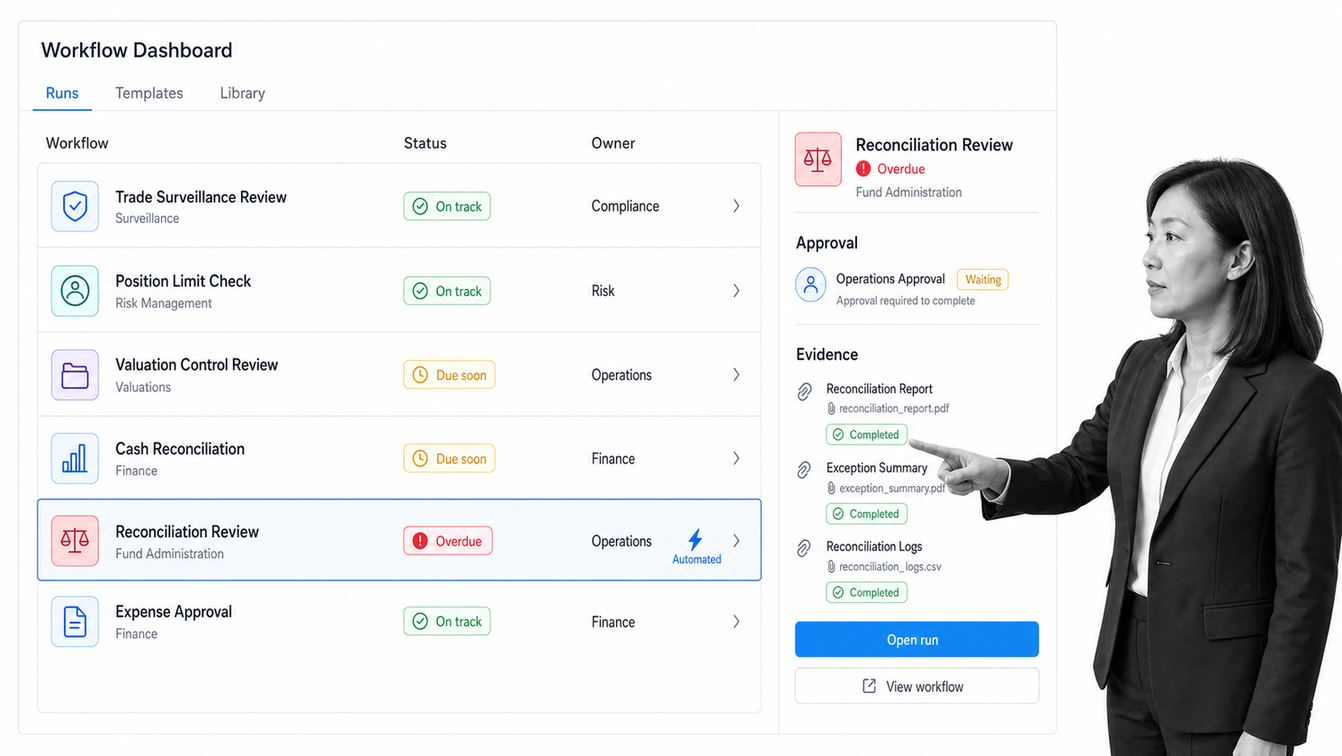
Process Street is the strongest starting point when the dashboard needs to show whether critical work is on track, who owns the next action, and where evidence or approval is missing. Its Workflow Dashboard brings workflow runs, analytics, activity, connected automations, and assignments into one operational view.
For a hedge fund, that operating layer can govern recurring work such as pre-trade review, trade-break resolution, administrator reconciliation review, valuation signoff, investor onboarding, disclosure preparation, compliance attestations, and operational due diligence. The investment data may live in another platform, but Process Street can define how people respond to it.
The distinction is important. Process Street is not positioned here as a portfolio accounting engine or order management system. It is the control system around those tools: assigning work, collecting structured inputs, requiring evidence, routing approvals, enforcing conditional paths, and making exceptions visible before they disappear into email or spreadsheets.
Choose Process Street when: Your core problem is inconsistent execution across teams, unclear ownership, weak evidence, or manual follow-up between specialist systems.
Allvue
Best for: Alternative investment portfolio oversight and connected reporting workflows.
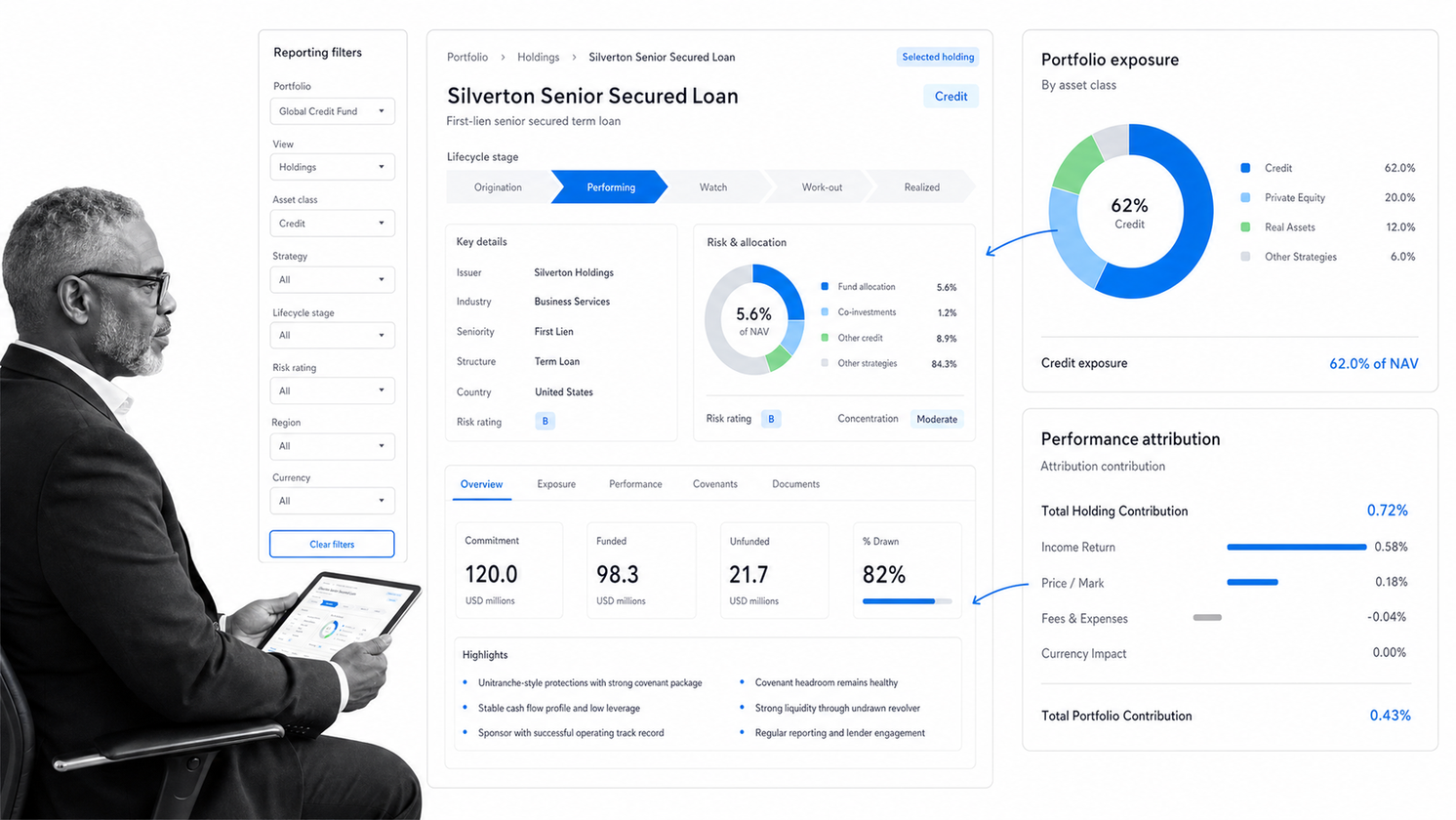
Allvue’s portfolio management software centralizes portfolio information through real-time dashboards, interactive reports, risk analysis, and performance-oriented tools. Its positioning is especially relevant for alternative investment managers that want portfolio data and connected investment workflows in one platform.
A buyer should examine how closely the product’s asset-class focus, data model, and accounting connections match the fund’s strategy. A dashboard can look comprehensive while still forcing teams to export data for the calculations or review paths that matter most. The implementation test is whether exposures, performance, and operational states can be traced back to trusted source data.
Allvue can be a strong candidate when a manager wants a broad alternatives platform and values integrated portfolio and reporting capabilities. It is less useful to compare it with a lightweight visualization tool because the buying decision includes data architecture, workflows, and implementation scope.
Choose Allvue when: You need an alternatives-focused portfolio platform and want dashboards to sit close to the underlying investment and reporting data.
Enfusion
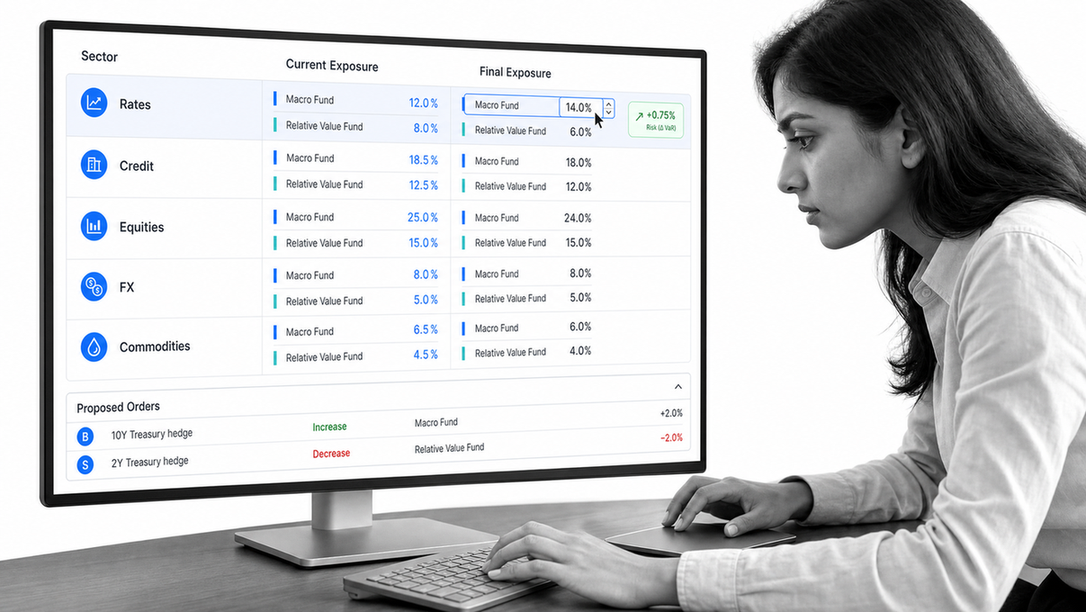
Best for: Front-to-back investment workflows spanning portfolio construction, risk, orders, and execution.
Enfusion’s Portfolio Workbench is designed to let portfolio managers manage performance and risk in one interface, make in-grid portfolio changes, and carry proposed orders and allocations into the wider Enfusion workflow. The product is most relevant when the dashboard must stay close to live portfolio decisions rather than serve only as a reporting layer.
Its value proposition centers on reducing handoffs between portfolio construction, order management, and downstream operating functions. That can make it attractive to funds that want one shared investment dataset and fewer manual transfers between specialized front, middle, and back office tools.
The evaluation should still be grounded in the fund’s actual strategies, instruments, counterparties, and reporting requirements. Buyers should test representative portfolios, complex adjustments, exception handling, and the path from proposed change to booked result. A polished demo is not a substitute for validating the full data lineage.
Choose Enfusion when: Your dashboard must support active portfolio management and connect portfolio decisions to trading and operational workflows.
SS&C Advent Geneva
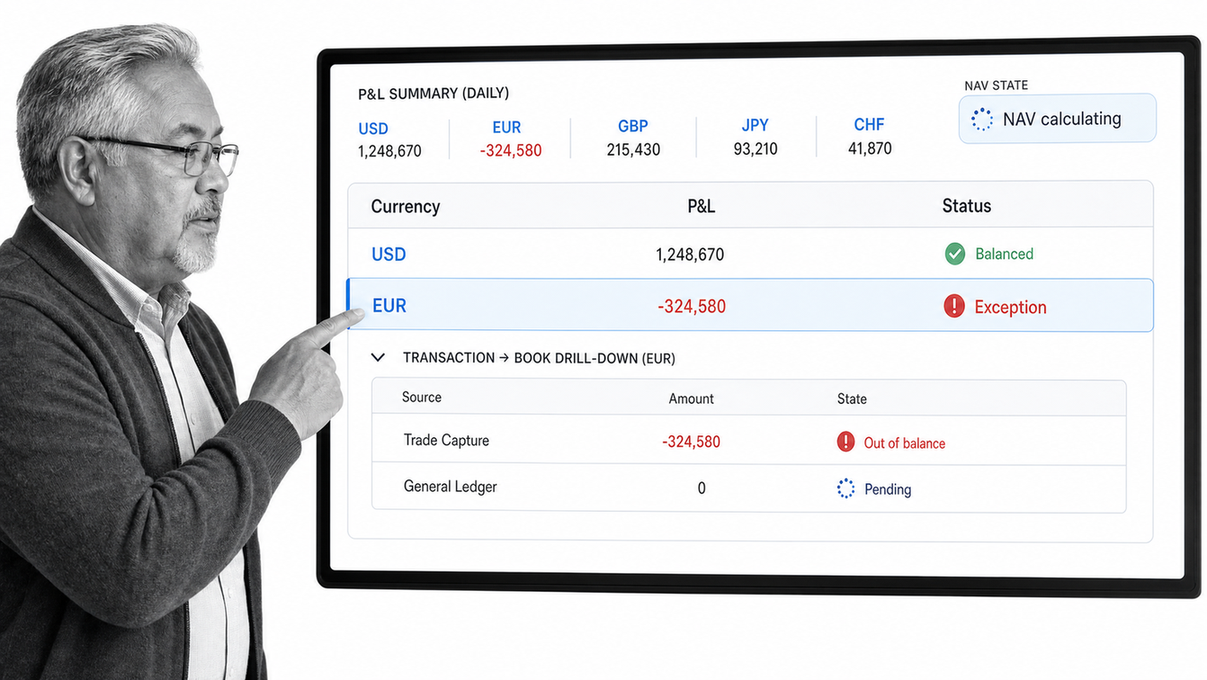
Best for: Complex portfolio accounting, P&L, exposure, and NAV support.
SS&C Advent Geneva supports complex multi-asset and multi-currency portfolios with visibility into P&L and exposures plus daily NAV calculations. It belongs on a hedge fund dashboard shortlist when the central need is accounting-grade portfolio data rather than a general business dashboard.
The strength of an accounting-centered dashboard is the connection between summarized metrics and the transaction-level book. Finance and operations teams need to drill from a result into the positions, cash events, prices, mappings, and reconciliations that produced it. That auditability is often more important than the number of available chart types.
Geneva is a substantial system decision. Buyers should assess instrument coverage, accounting rules, administrator interactions, data feeds, reconciliation design, reporting requirements, and the skills needed to operate the platform. The right question is not whether it has a dashboard. It is whether the platform can produce trusted accounting outputs for the structures the fund actually runs.
Choose SS&C Advent Geneva when: Portfolio accounting, daily books, exposure visibility, and NAV support are the center of the requirement.
FundCount
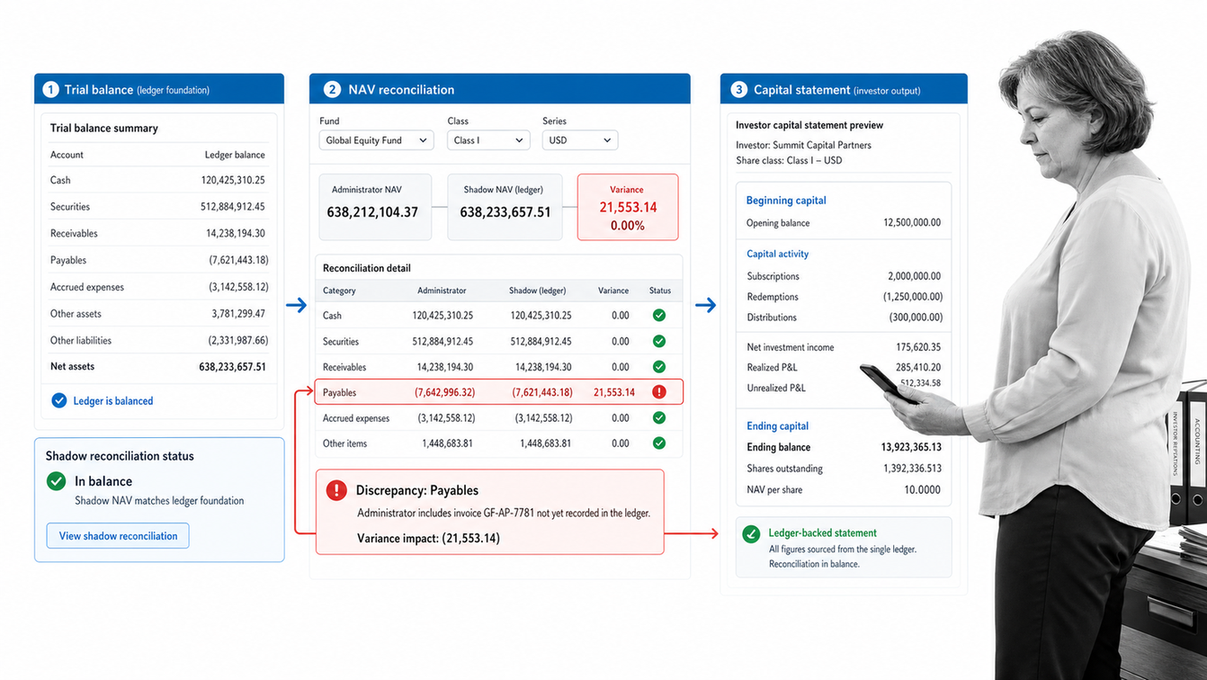
Best for: Hedge fund accounting, NAV oversight, investor statements, and shadow administration.
FundCount’s hedge fund platform connects portfolio and shareholder accounting, a multi-currency general ledger, reporting, investor access, and data aggregation. Its dashboard role is therefore rooted in the accounting book and the outputs produced from it.
This is a good fit for funds that want management reporting, capital activity, financial statements, and investor outputs to reconcile back to one accounting foundation. It may also be relevant when the manager wants to shadow an external administrator and investigate differences before investor or audit deadlines.
During evaluation, teams should load representative structures and walk through the full close and reporting cycle. Test fee calculations, classes or series, side pockets where applicable, reconciliations, adjustments, statement production, and permissioned investor access. The useful dashboard is the one that stays reliable when the accounting becomes difficult.
Choose FundCount when: The primary requirement is an accounting-led view of NAV, capital, reports, and administrator reconciliation.
Dynamo
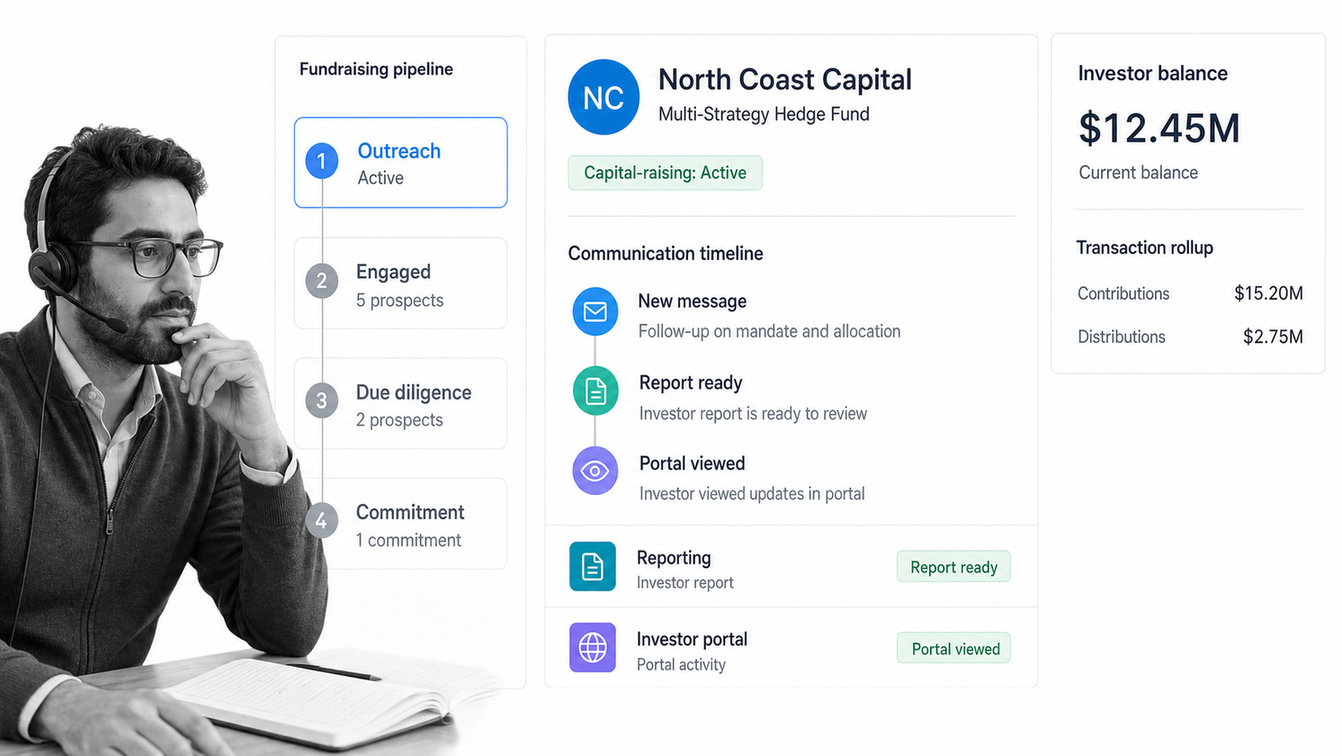
Best for: Investor relations, fundraising pipelines, investor reporting, and portal visibility.
Dynamo for hedge funds centralizes the investor lifecycle, including capital raising, investor communications, investor performance reporting, and a secure investor portal. Its dashboard value is strongest for investor relations and fundraising teams that need a consolidated relationship and reporting view.
That makes Dynamo different from a portfolio accounting or trading system. It can help teams understand prospects, investors, communications, balances, transactions, and reporting activity, but buyers should map which figures originate in the fund administrator, accounting platform, CRM, or internal calculations.
The evaluation should include real investor structures, data imports, permission models, reporting outputs, communication workflows, and portal experiences. Teams should also test how exceptions are resolved when imported account data does not match an expected investor record. The best investor dashboard reduces both search time and the risk of sending incomplete or inconsistent information.
Choose Dynamo when: The dashboard requirement starts with fundraising, investor relationships, communications, or portal reporting.
How should you compare hedge fund dashboards?
A useful comparison begins with decisions and control failures, not a generic feature checklist. Identify the moments when the current stack creates uncertainty, delay, or repeated manual work. Then test whether each candidate can improve that exact path without creating a second source of truth.
- Define the dashboard owner. A CIO, portfolio manager, COO, fund controller, investor relations lead, and CCO need different views. Name the primary user and the action the dashboard should enable.
- Map the source data. Record where positions, prices, transactions, investor records, documents, approvals, and calculated metrics originate. Decide which system remains authoritative for each field.
- Separate monitoring from execution. Some platforms show information. Others let users trade, reconcile, approve, communicate, or launch a workflow. Decide which actions must happen inside the dashboard and which should be handed to another system.
- Test exceptions before happy paths. Use a failed reconciliation, stale price, breached limit, missing investor document, late approval, or disputed NAV item. Ask how the dashboard identifies the issue, assigns it, and records resolution.
- Validate calculation lineage. A performance, exposure, or NAV metric should be traceable to its inputs, timing, methodology, and adjustments. If a user cannot explain a number, the visualization is not enough.
- Check permission boundaries. Portfolio, investor, compliance, and employee data have different audiences. Verify row, record, document, and workflow permissions with realistic roles.
- Run a representative reporting cycle. Load actual structures and follow the process from data ingestion through review, correction, approval, and distribution.
- Model implementation ownership. Identify who will configure data, maintain mappings, manage integrations, train users, and approve changes after launch.
A wider hedge fund tools review can help separate dashboard requirements from market data, order management, accounting, CRM, document, and compliance systems. Avoid forcing every need into one product if a connected stack creates clearer ownership and stronger controls.
What should a hedge fund dashboard show?
The right view depends on the user, but every dashboard should make status, material exceptions, and next actions obvious. Dense screens often fail because they present everything with equal weight. A better design starts with the decisions a user makes repeatedly and the thresholds that require intervention.
- Portfolio and exposure: Positions, gross and net exposure, concentration, liquidity, strategy, geography, counterparty, and other dimensions relevant to the mandate.
- Performance: Returns and attribution presented with clear periods, methods, benchmarks, and data timing.
- Risk: Limits, scenarios, sensitivities, breaches, exceptions, and the status of remediation or review.
- Accounting and NAV: P&L, cash, reconciliations, valuation items, unresolved breaks, close status, and approval state.
- Investor operations: Pipeline, onboarding, capital activity, statements, communications, requests, and outstanding documents.
- Compliance operations: Required reviews, attestations, filings, evidence, approvals, exceptions, deadlines, and escalations.
- Data quality: Missing feeds, stale prices, mapping problems, unresolved exceptions, and the last successful refresh.
The dashboard should also show context. A red status without an owner, threshold, timestamp, source, or response path creates anxiety rather than control. Every material signal should answer: what changed, why it matters, who owns it, what must happen next, and where the evidence will live.
How can Process Street connect the operating layer?
Specialist investment systems are designed to calculate, record, and present financial information. The operating layer coordinates the human work triggered by that information. Process Street can turn recurring fund procedures into governed workflows that assign owners, collect structured data, require evidence, route approvals, and escalate overdue or failed steps.
Consider an administrator reconciliation. The accounting platform identifies a difference. The operating workflow determines who investigates it, which supporting files are required, when the controller reviews the explanation, what threshold requires escalation, and how the final resolution is recorded. The dashboard then shows both the source exception and the state of the response.
The same pattern applies to valuation reviews, investor onboarding, compliance attestations, side-letter obligations, trade approvals, incident response, policy reviews, and operational due diligence. A reusable workflow creates consistency without hiding judgment. People still make the decisions, while the system handles routing, deadlines, required information, and evidence.
Teams can begin with a focused hedge fund checklist, then add assignments, conditional paths, approvals, forms, and reporting as the process matures. Start with a high-friction handoff where missing evidence or unclear ownership causes repeated delays.
Hedge fund dashboard FAQs
What is the best hedge fund dashboard?
The best hedge fund dashboard is the one aligned to the job you need to control. Process Street is strongest for operational workflows and compliance controls. Investment, accounting, and investor-relations platforms should be evaluated against the fund’s strategies, structures, data, and reporting requirements.
How do you decide how many dashboards a hedge fund needs?
Many funds need several connected views because portfolio management, accounting, investor relations, and compliance use different systems of record. The goal is not one screen at any cost. The goal is clear ownership, trusted data, controlled handoffs, and consistent definitions across the stack.
What data should a hedge fund dashboard include?
A hedge fund dashboard may include positions, exposures, performance, risk limits, P&L, NAV support, reconciliation status, investor activity, workflow status, deadlines, approvals, and data-quality exceptions. The exact set should follow the user’s decisions and responsibilities.
How do you evaluate dashboard data quality?
Trace important metrics back to source transactions, prices, positions, mappings, calculation methods, timestamps, and adjustments. Test stale or missing feeds, reconciliation differences, and corrected records. A dashboard is trustworthy only when users can explain how its outputs were produced.
What is Process Street’s role beside portfolio and accounting systems?
Process Street is not a portfolio accounting engine or order management system. It governs the operational work around specialist platforms by assigning tasks, collecting evidence, routing approvals, tracking exceptions, and making recurring procedures visible and auditable.
How should a fund start implementing a dashboard?
Choose one high-value decision or recurring exception, identify the user and source data, define the response workflow, and test it with representative records. Expand only after the first use case has trusted data, clear ownership, and a reliable operating cadence.