Turn every policy into automated workflows with built-in enforcement and audit-ready proof.



AI Governance
AI governance is the system of policies, owners, controls, workflows, and evidence that keeps artificial intelligence safe, compliant, and aligned with business intent. It turns broad responsible AI principles into daily operating rules.
That matters because AI use is no longer isolated inside data science teams. Employees adopt AI assistants, departments buy AI-enabled tools, vendors embed models into products, and autonomous agents can now act across real systems.
A practical AI governance program does not stop at a policy document. It defines which use cases are allowed, who approves them, how risk is classified, what evidence is required, and how exceptions are escalated before they become audit findings or customer trust problems.
In this guide, we are going to cover:
- What is AI governance?
- Why AI governance matters now
- What AI governance includes
- AI governance frameworks and standards to know
- How to decide what level of AI governance a use case needs
- How to build an AI governance workflow
- How Process Street turns AI governance into daily execution
- FAQs
What is AI governance?
AI governance is the operating discipline for deciding how AI systems are selected, built, deployed, monitored, and retired. It sits between strategy, risk, security, legal, compliance, and operations. The goal is simple: useful AI, controlled by default.
Governance gives teams a repeatable way to answer questions that otherwise become subjective. Can this team use a public model with customer data? Does this workflow need human approval before an AI-generated action happens? What records prove the review happened? Who owns remediation when the model drifts or the vendor changes a feature?
AI governance is not just AI ethics
Ethics helps define the values behind AI use. Governance makes those values executable. It turns principles like fairness, accountability, transparency, privacy, security, and human oversight into roles, controls, approval gates, evidence requirements, and review cycles.
That is why AI governance overlaps with compliance operations, security operations, vendor risk, model risk, data governance, and policy management. It is not a separate committee that occasionally reviews AI. It is an operating system for how AI enters and moves through the business.
AI governance is not just model governance
Model governance focuses on the model itself: training data, validation, performance, explainability, drift, and monitoring. AI governance is broader. It includes business context, approved use, data handling, user permissions, procurement, third-party risk, human review, incident response, and audit evidence.
For teams already thinking about AI-driven compliance and AI compliance agent, AI governance is the connective tissue. It decides where AI can act, where it can only advise, and where a human must approve the next step.
Why AI governance matters now
AI governance matters now because AI has moved from experimentation to execution. The risk is not only that a model gives a bad answer. The bigger operational risk is that AI touches sensitive data, automates a decision, creates a record, updates a system, or influences a customer outcome without the right control around it.
Governance also has a regulatory dimension. The Regulation (EU) 2024/1689 creates a risk-based legal framework for AI in the European Union, while the European Commission AI Act overview summarizes the Act as rules for safe and trustworthy AI. Even when a company is not directly covered by a specific AI law, customers and auditors increasingly ask how AI use is controlled.
AI adoption spreads faster than policy
Most teams do not wait for a central AI committee before trying new tools. Marketing uses AI for drafts, support uses AI for summaries, engineering uses AI for code, finance uses AI for analysis, and operations uses AI to automate repetitive work. Without governance, each team invents its own standard.
That creates inconsistent data handling, unknown vendor exposure, unclear ownership, and brittle review practices. A useful governance program gives teams a fast path to approved AI use instead of forcing them into shadow adoption.
AI creates a new audit evidence problem
Traditional audit evidence often shows that a human completed a checklist or approved a document. AI complicates that record. Teams need to know what AI was used, what inputs were allowed, what output was generated, who reviewed it, what action followed, and whether the system was operating within policy at the time.
This is where digital compliance officer and automated compliance monitoring become practical. Someone, or some workflow, must continuously check that AI controls are being followed and that proof exists.
What AI governance includes
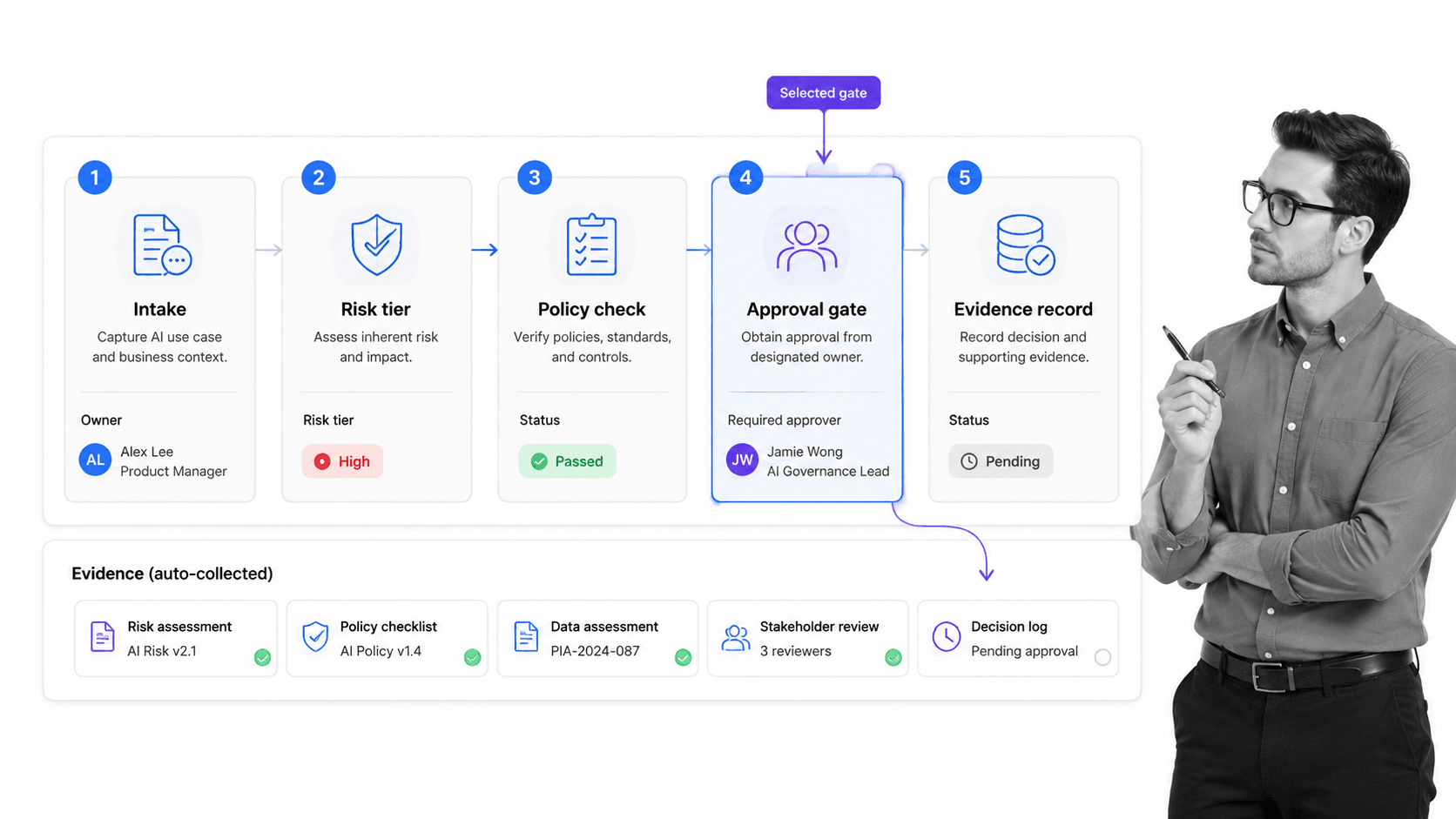
AI governance includes the rules, roles, workflows, and records that control AI across its lifecycle. Mature programs do not start with a giant policy manual. They start by making ownership and decision gates clear.
Use case intake
Every AI governance program needs a way to identify AI use. Intake captures the business owner, intended use, model or vendor, data categories, users, expected output, level of autonomy, and downstream systems affected. Without intake, the organization cannot govern what it cannot see.
Risk classification
Not every AI use case needs the same control. A tool that summarizes public blog research carries different risk from a system that screens applicants, changes pricing, approves financial transactions, or drafts regulated customer communications. Risk classification keeps the control burden proportional.
Policy and control mapping
Once a use case is classified, it should map to the policies and controls that apply. These can include data privacy rules, security requirements, human review standards, bias testing, vendor review, retention rules, documentation requirements, and incident response procedures.
Teams that already use a workflow management system or workflow automation software have an advantage here because controls can live inside recurring workflows rather than in static documents.
Approval and exception routing
Governance needs a clear path for approval. Low-risk use may be approved by a manager or system owner. Higher-risk use may require legal, security, risk, privacy, compliance, or executive review. Exceptions should be visible, time-bound, and attached to compensating controls.
Monitoring and evidence
AI governance does not end at approval. Teams need recurring review, incident logging, vendor change monitoring, performance checks where relevant, and evidence that each control was performed. The evidence layer is what turns governance into something auditors, customers, and leaders can trust.
Clear roles and escalation paths
Governance also needs named roles. A business owner explains why the AI use case exists. Security reviews access and data exposure. Legal or compliance checks obligations and risk. Operations makes sure the control can run repeatedly. When a review fails, the workflow should show who can approve an exception, who must remediate it, and when the use case must be paused.
AI governance frameworks and standards to know
The strongest AI governance programs borrow from recognized frameworks instead of starting from a blank page. The NIST AI Risk Management Framework organizes AI risk management around Govern, Map, Measure, and Manage. That structure is useful because it separates program-level governance from use-case-level evaluation.
ISO/IEC 42001 gives organizations a management-system approach to AI. In practical terms, that means policies, objectives, roles, processes, risk treatment, monitoring, internal review, and continual improvement. It is especially useful for teams that already understand ISO-style management systems.
The OECD AI Principles remain useful as a values-level anchor for trustworthy AI. They are not a workflow by themselves, but they help frame why accountability, transparency, robustness, human-centered values, and risk management matter.
Use frameworks as control libraries, not decoration
A common failure mode is to cite a framework in the policy and then leave daily work unchanged. A better approach is to translate framework requirements into controls that show up in intake forms, approval tasks, vendor reviews, model monitoring, and evidence records.
If your team already evaluates GRC tools, use that discipline to pick the control surface, not just the repository. The governance framework should become a living workflow that assigns owners and captures proof.
Keep the framework stack simple
Many organizations overbuild AI governance before the first use case is under control. Start with one primary framework, one risk taxonomy, one intake path, and one evidence standard. Add depth when a use case, regulation, customer commitment, or audit requirement justifies it.
The practical test is whether a manager can take a proposed AI use case and know exactly what to do next. If the framework cannot route the work, assign the right reviewer, define the required evidence, and record the decision, it is still reference material rather than governance.
How to decide what level of AI governance a use case needs
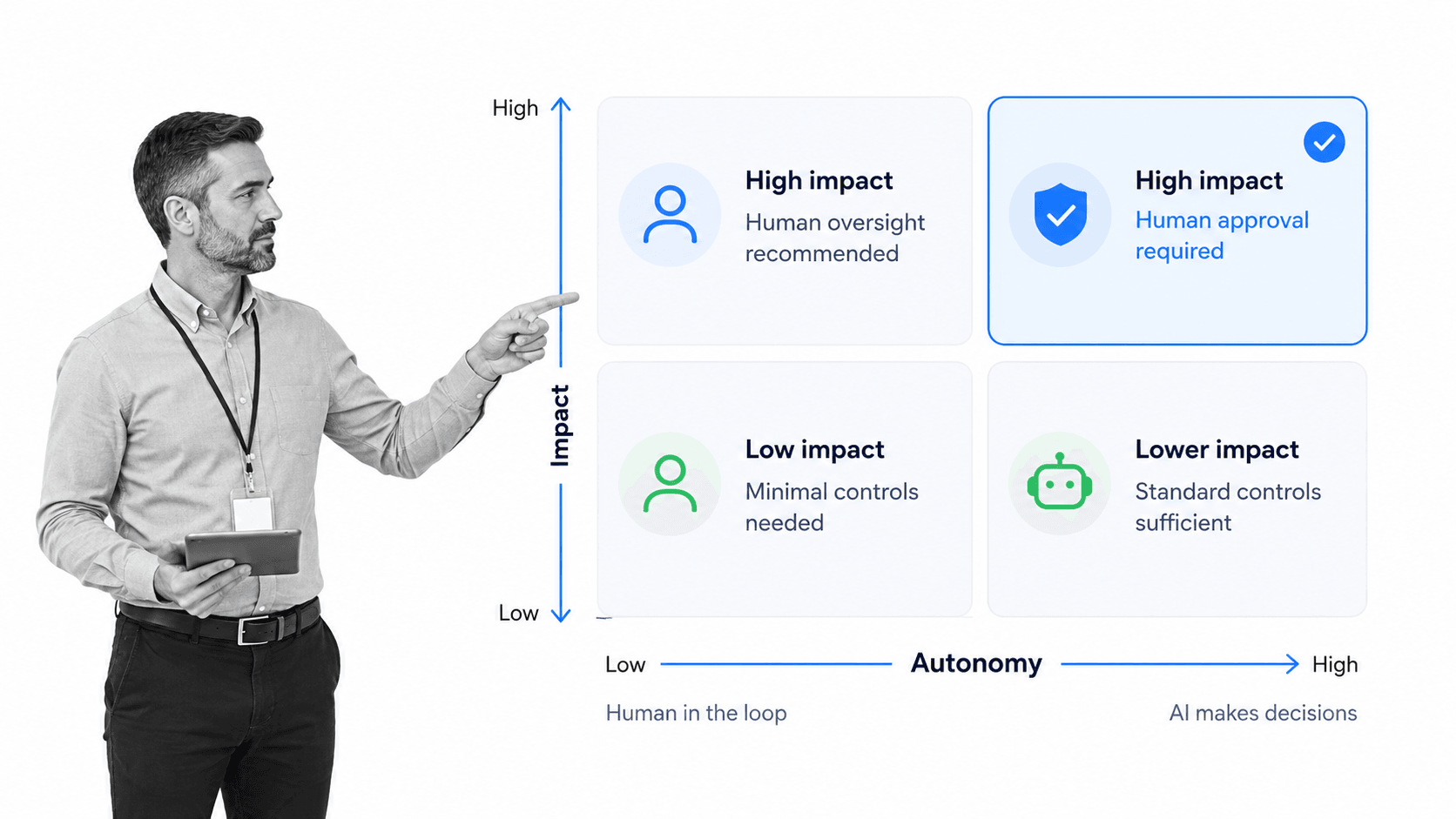
The level of AI governance a use case needs depends on impact and autonomy. Impact asks what happens if the system is wrong, biased, insecure, or misused. Autonomy asks whether the AI only informs a human, drafts for review, triggers a workflow, or acts directly in another system.
Low-impact, low-autonomy use
Examples include brainstorming, summarizing public information, drafting internal notes, or classifying non-sensitive content for a human to review. These use cases still need acceptable-use rules and data restrictions, but they usually do not need heavy approval workflows.
Higher-impact use with human approval
Examples include regulated communications, customer support responses, vendor risk analysis, legal research, compliance evidence review, financial analysis, HR screening support, or security triage. These use cases need stronger records: who reviewed the output, what evidence was checked, and what decision followed.
Autonomous action in business systems
When AI can update records, send messages, approve steps, trigger payments, change access, or modify production systems, governance must become execution-level control. The workflow should define permitted actions, approval gates, rollback paths, monitoring, and incident escalation before the agent acts.
Reusable workflows such as an internal audit checklist, risk management process template, or vendor risk assessment checklist can become practical starting points for the evidence and owner side of AI governance.
How to build an AI governance workflow
To build an AI governance workflow, start with the decisions that must be made every time. Then turn those decisions into repeatable steps, owners, forms, approvals, and evidence fields.
Step 1: Create a single AI use case intake
Capture the requester, business owner, system or vendor, model type if known, data categories, expected users, intended output, level of autonomy, downstream systems, and whether the use case affects customers, employees, financial decisions, legal obligations, or regulated activity.
Step 2: Classify risk with a short rubric
Use a simple tiering model first. Ask whether the use case touches sensitive data, regulated decisions, external users, financial or legal outcomes, security controls, or autonomous action. The answer should route the use case to the right review path.
Step 3: Map required controls
Controls may include vendor review, data protection review, security assessment, human approval, prompt or output review, monitoring plan, access limits, logging, model evaluation, bias assessment, incident plan, and periodic recertification.
Step 4: Build approval gates
Approval gates should be explicit, assigned, and recorded. A tool such as Approvals is useful because it keeps approvals inside the workflow where the supporting context and evidence already live.
Step 5: Record evidence automatically where possible
Evidence should not depend on someone remembering to update a spreadsheet later. Attach the intake, review notes, approval decisions, risk tier, vendor review, screenshots, logs, and exception decisions to the workflow as the work happens.
Step 6: Review on a cadence
AI systems and vendors change. A use case that was low risk last quarter can become higher risk when it gains new permissions or starts affecting a different process. Recurring review keeps governance current without waiting for an incident.
Step 7: Define stop conditions
Every AI governance workflow should say when a use case must pause. Stop conditions can include missing evidence, unapproved data categories, unexplained output changes, vendor terms that conflict with policy, a failed security review, or an incident report. This protects teams from treating approval as permanent permission.
How Process Street turns AI governance into daily execution
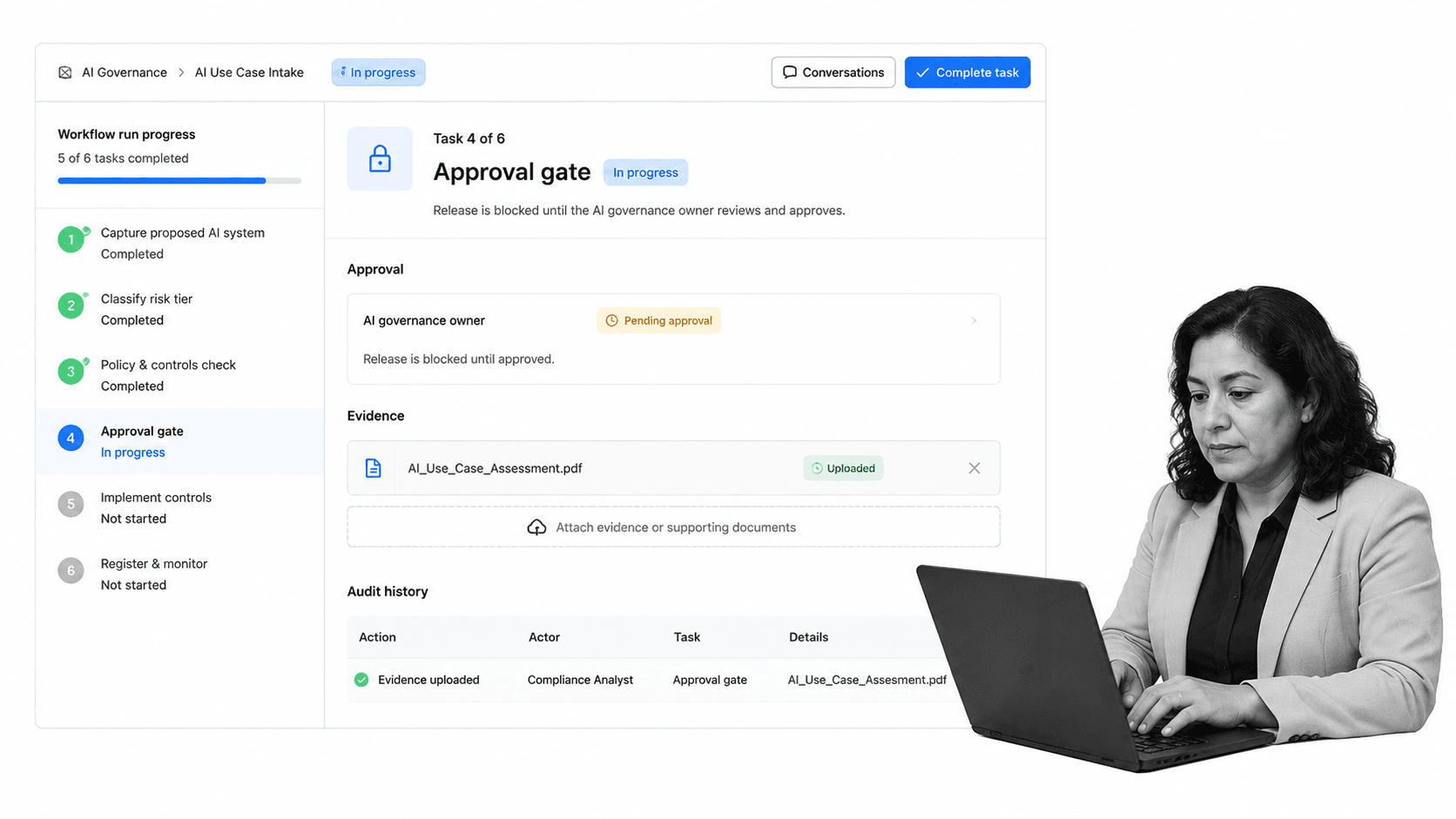
Process Street turns AI governance into daily execution by connecting policies, workflows, approvals, evidence, and audit history in one Compliance Operations Platform. The point is not to store another policy. The point is to make the policy run.
For AI governance, that means teams can create an intake workflow, classify risk, route approvals, require evidence, assign owners, trigger recurring reviews, and keep an audit trail of what happened. Governance becomes part of the work instead of a separate after-the-fact review.
That execution layer also helps leaders compare AI use cases across teams. When each request follows the same intake, risk, approval, and evidence structure, governance data becomes consistent enough to prioritize investments and spot control gaps.
Governance controls live where work happens
When AI governance lives in documents alone, teams have to remember the rules and manually prove they followed them. In a workflow, required steps are assigned, deadlines are visible, approvals block the next action, and evidence is captured in context.
AI agents need boundaries they can execute inside
As AI agents become more capable, the control surface matters more. A governed workflow tells the agent what it is allowed to do, when it must ask for approval, what evidence to collect, and where to route exceptions. That makes agentic work safer because the workflow defines the boundary.
This is also why applications of AI in business processes should be tied to operations, not treated as a separate experiment. AI is useful when it helps people move work through approved paths with clear proof.
The practical outcome
A strong AI governance program gives employees a clear way to use AI, gives leaders confidence that risk is controlled, gives compliance teams proof, and gives AI agents boundaries they can act within. That is the difference between AI governance as paperwork and AI governance as operating infrastructure.
FAQs
What is AI governance?
AI governance is the set of policies, roles, controls, workflows, and evidence practices that guide how artificial intelligence is selected, used, monitored, and retired. It helps organizations use AI safely while maintaining accountability, compliance, and trust.
Why is AI governance important?
AI governance is important because AI can affect sensitive data, customer outcomes, employee decisions, regulated processes, and business systems. Governance makes sure AI use is approved, monitored, and documented before risk turns into an incident or audit problem.
What should an AI governance framework include?
An AI governance framework should include use case intake, risk classification, policy mapping, ownership, approval gates, monitoring, incident response, vendor review, and audit evidence. The framework should translate principles into repeatable workflows.
Who owns AI governance?
AI governance is usually shared by legal, compliance, risk, security, data, operations, and business leaders. A central owner can set standards, but each AI use case still needs a named business owner responsible for execution and evidence.
How do you start an AI governance program?
Start with a single intake workflow for AI use cases, a simple risk tiering model, and clear approval paths for higher-risk uses. Then add evidence requirements, recurring reviews, and framework mapping as the program matures.
How does Process Street support AI governance?
Process Street supports AI governance by turning policies and controls into executable workflows. Teams can route approvals, assign owners, collect evidence, track exceptions, and keep audit history inside the process where AI-related work happens.