






Guest post by Derek Gallimore, founder of Outsource Accelerator.
Call center outsourcing gives another company responsibility for some or all of your customer calls, messages, sales outreach, and service workflows. It can extend coverage and add specialist capacity quickly. It can also damage trust just as quickly when the scope, training, or quality controls are weak.
The decision is not simply whether an external team costs less. You need to decide which conversations can leave the building, how the provider will represent your company, what evidence will prove the work was done, and who on your team owns the result. This guide covers the tradeoffs, pricing models, provider selection, and operating practices behind a reliable outsourced call center.
The right operating model can boost support quality and availability together. The wrong one can add capacity while making answers less consistent.
Call centers now handle voice alongside email, chat, messaging, and AI-assisted service. You may also hear the broader term contact center outsourcing. The channel mix has changed, but the operating problem has not: every customer should receive a consistent answer, a clear escalation path, and a complete record of what happened.
- Pros and cons of call center outsourcing
- Costs of an outsourced call center team
- How to find and hire a call center
- Best practices in hiring a call center
Pros and cons of call center outsourcing
An outsourced call center can absorb demand that would otherwise overwhelm an internal team. Providers recruit agents, maintain workforce coverage, operate telephony and contact-center systems, and manage day-to-day scheduling. That can help a growing company add evening, weekend, multilingual, or seasonal support without building every capability from scratch.
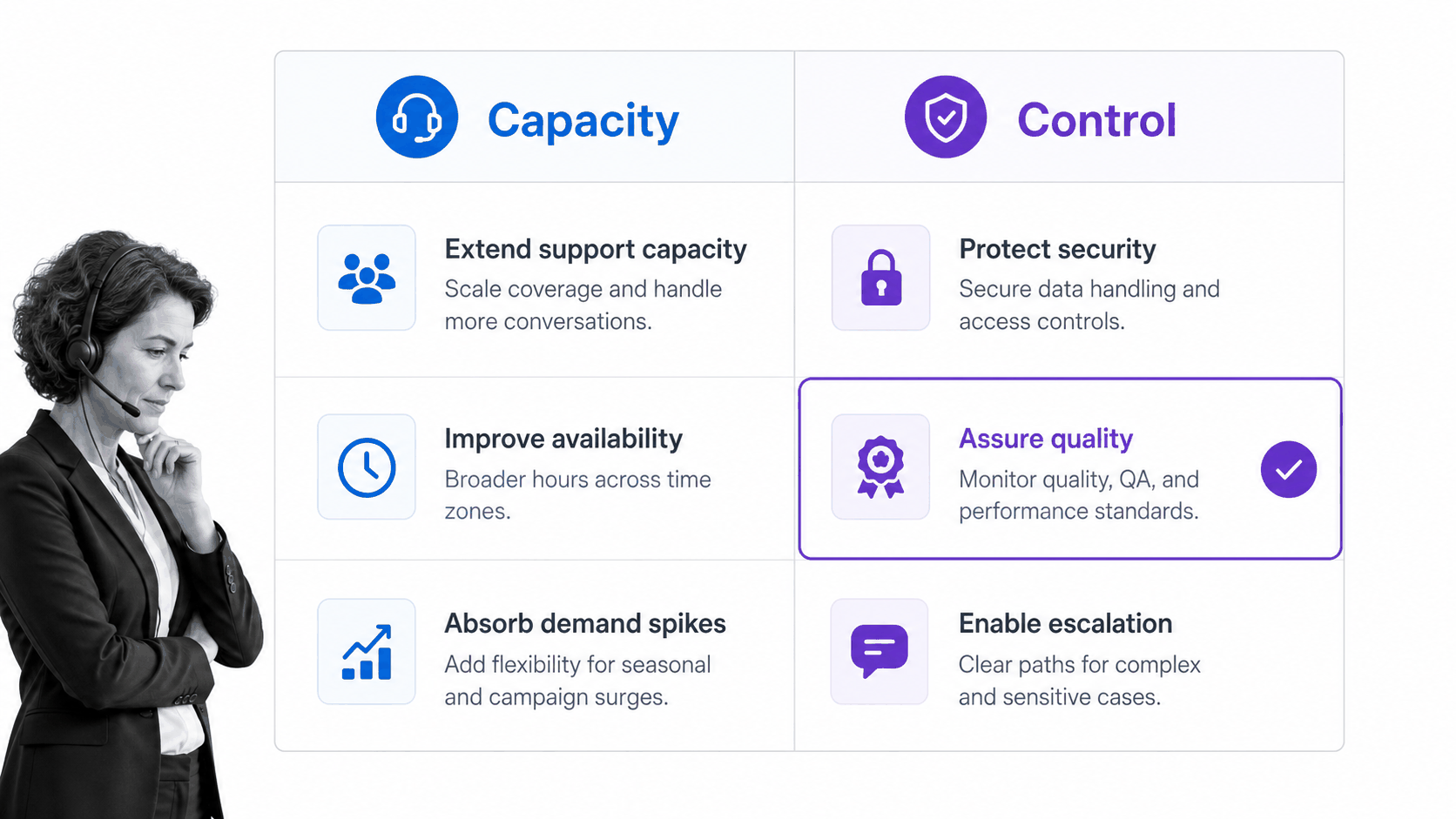
The strongest advantage is flexible capacity. A provider can usually add trained people faster than a company that must recruit, equip, schedule, and supervise a new internal team. Outsourcing can also give you access to people who already know a channel, language, industry, or call type.
The risk is distance from the customer. Agents who do not understand your product, policies, or tone can create inconsistent answers. A poorly designed contract may reward short calls when the customer needs a complete resolution. Security, privacy, business continuity, staff turnover, and subcontracting also need scrutiny.
Outsourcing therefore changes the management job rather than removing it. The buyer still owns the customer experience. Someone inside the company must control the knowledge base, approve policy changes, review quality evidence, resolve escalations, and decide when the delivery model needs to change. For a wider comparison, see the pros and cons of outsourcing.
Costs of an outsourced call center team
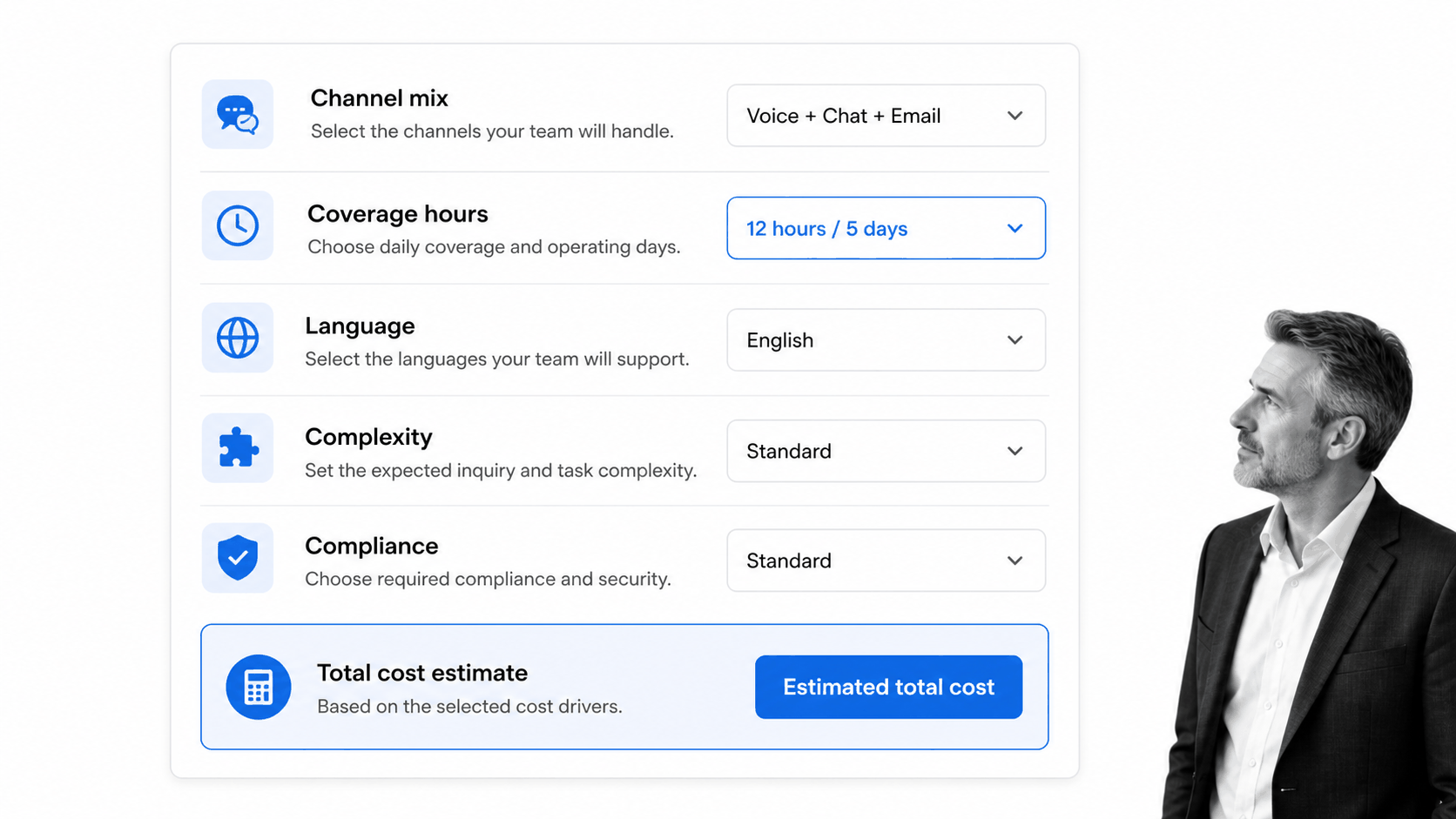
Call center outsourcing cost depends on the work, coverage, staffing model, location, and commercial structure. A price that looks low can become expensive when it excludes training, setup, quality monitoring, workforce management, technology, reporting, or after-hours coverage. Compare the complete operating model, not a single hourly rate.
Inbound call center
Inbound work includes customer service, technical support, order handling, appointment scheduling, and overflow response. Providers commonly use three staffing models:
- Shared agents handle work for several clients. This can suit low or variable volume, but agents have less continuous exposure to your product.
- Dedicated agents work only on your account. The model gives you more control and product familiarity, but you pay for reserved capacity.
- Part-time or scheduled coverage reserves people for defined hours, queues, seasons, or overflow thresholds.
Inbound pricing may be based on staffed hours, productive hours, transactions, minutes, tickets, or reserved seats. Ask how the provider defines each unit. An apparent per-contact price means little if repeat calls, transfers, or escalations sit outside the measurement.
Outbound call center
Outbound work covers lead qualification, appointment setting, renewals, retention, surveys, collections, and other proactive contact. The main commercial models are hourly, commission-based, or blended.
An hourly model is predictable and works when the provider does not control the entire outcome. Commission can align incentives for a clearly defined sale or appointment, but it needs strong rules for lead quality, cancellations, attribution, and compliance. A blended model combines a stable base with a performance component. Whatever the model, inspect the behavior it rewards.
The biggest cost drivers are labor market, language, operating hours, queue volatility, complexity, security requirements, training time, supervision, technology, and reporting. Ask every bidder to price the same volume assumptions and service levels. Then run sensitivity tests for a quiet month, a normal month, and a surge.
How to find and hire a call center
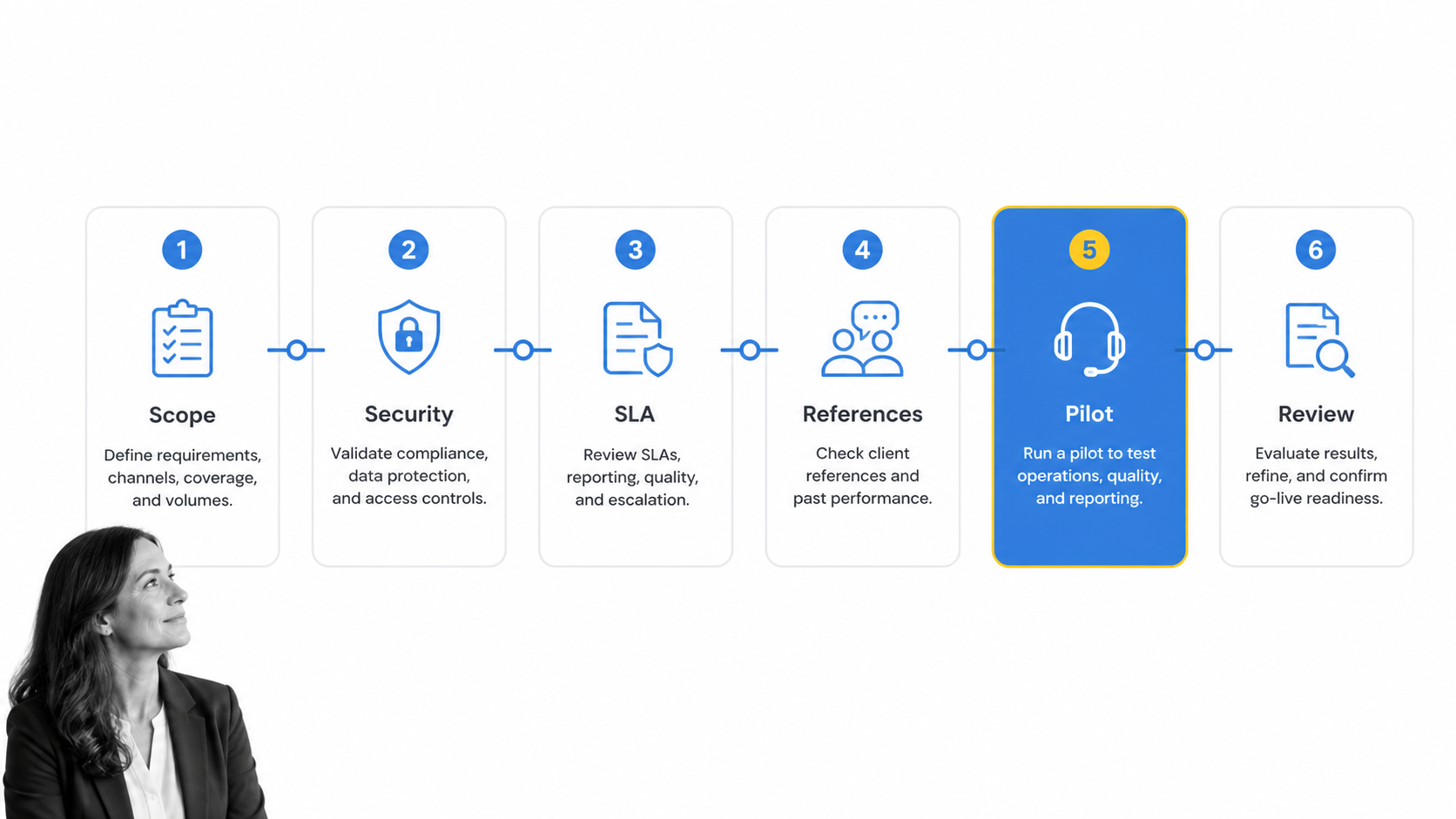
Start with the work, not a list of countries or vendors. Write down the channels, hours, languages, expected volumes, seasonality, systems, data classes, escalation rules, quality standard, and desired business outcome. A provider cannot design a reliable service around a vague request for cheaper support.
In-house vs. outsourced
Keep work in-house when it demands constant access to product experts, carries unusual regulatory risk, changes too quickly to document, or shapes a critical customer relationship. Outsource work that is stable enough to define, train, measure, and improve. Many companies use a hybrid model: internal teams handle complex cases and policy decisions while an external team provides first response, overflow, or scheduled coverage.
Onshore, nearshore, and offshore
Onshore delivery can simplify time zones, language nuance, and regulatory alignment. Nearshore delivery may provide more schedule overlap and easier travel with a different cost base. Offshore delivery can add deep labor pools, broad language coverage, and round-the-clock capacity. None of these labels guarantees quality.
Evaluate locations against the actual work: language and accent requirements, time-zone coverage, political and infrastructure risk, privacy law, security controls, hiring competition, turnover, and access to specialist skills. Also ask whether the named site will perform the work or subcontract it elsewhere.
Call center reviews and references
Public customer and employee reviews can expose recurring concerns. Treat them as signals, not proof. Review the pattern, the date, the provider’s response, and whether the comments apply to the specific site and service you are buying.
Ask for references that resemble your use case. Speak with the person who manages the relationship, not only the procurement contact. Ask what failed during launch, how long training took, how often staffing changes, how disputes are handled, and what evidence arrives in a monthly review.
Run a controlled pilot
A pilot should test a narrow but real queue. Give each shortlisted provider the same knowledge, forecast, scenarios, and scorecard. Review call recordings or transcripts, resolution quality, escalation judgment, documentation, schedule adherence, and customer feedback. Do not let a single headline metric hide repeat contacts or poor handoffs.
AI belongs in the evaluation. Ask where the provider uses automated summaries, agent assistance, quality review, routing, translation, or voice systems. Then ask how humans approve answers, protect customer data, detect errors, and take over unusual cases. The practical question is not whether AI is present. It is whether the operating controls make the service more reliable. This guide to AI in customer service covers those controls in more detail.
Best practices in hiring a call center
Having a clear objective
Define the problem before signing a contract. You might need faster first response, longer coverage, better sales follow-up, more consistent documentation, or extra seasonal capacity. Choose a small set of measures that reflect that objective. Service levels should cover speed, quality, resolution, compliance, and customer outcome where each measure is relevant.
Write down what the provider can decide, what requires approval, and what must be escalated. Include refunds, complaints, vulnerable customers, security incidents, legal threats, policy exceptions, and system outages. Clear decision rights protect both the customer and the agent.
Hiring an operations manager
Assign an internal owner even when the provider supplies team leaders and account managers. This person should manage forecasts, approve knowledge changes, inspect quality, resolve disputes, coordinate internal experts, and hold both sides to the operating agreement.
The right management span depends on call complexity, agent experience, schedule volatility, regulatory burden, and the maturity of the account. Instead of accepting a universal ratio, ask how much coaching, review, and escalation work the proposed team actually requires.
How to optimize your call center outsourcing operations
Optimization starts with a repeatable operating cadence. Share an updated forecast. Train against real scenarios. Review a representative sample of customer interactions. Track corrective actions to completion. Run a formal change process when the product, policy, or system changes. These controls matter more than a decorative dashboard.
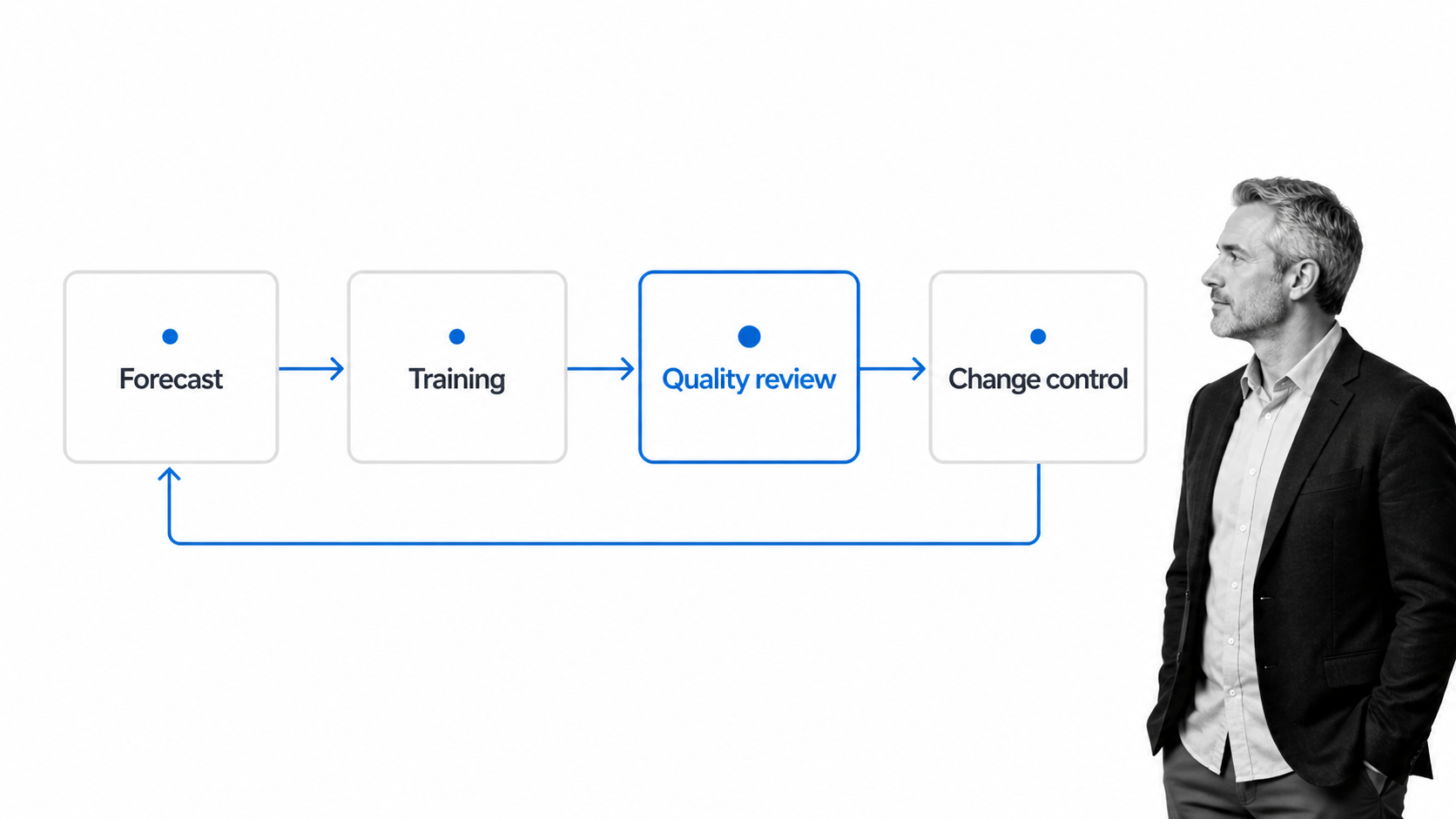
Forecasts should include known launches, promotions, billing dates, renewals, outages, and seasonal events. Training should combine product knowledge with practice calls and clear certification. Quality reviews should diagnose why an error happened and assign a corrective action. Change control should state what changed, who approved it, who was retrained, and when the new version took effect.
Using reliable workflow operations to ensure production
Email threads and spreadsheets are weak evidence for a distributed support operation. The work needs a shared system that defines the current process, assigns ownership, collects proof, enforces approvals, and leaves an audit trail.
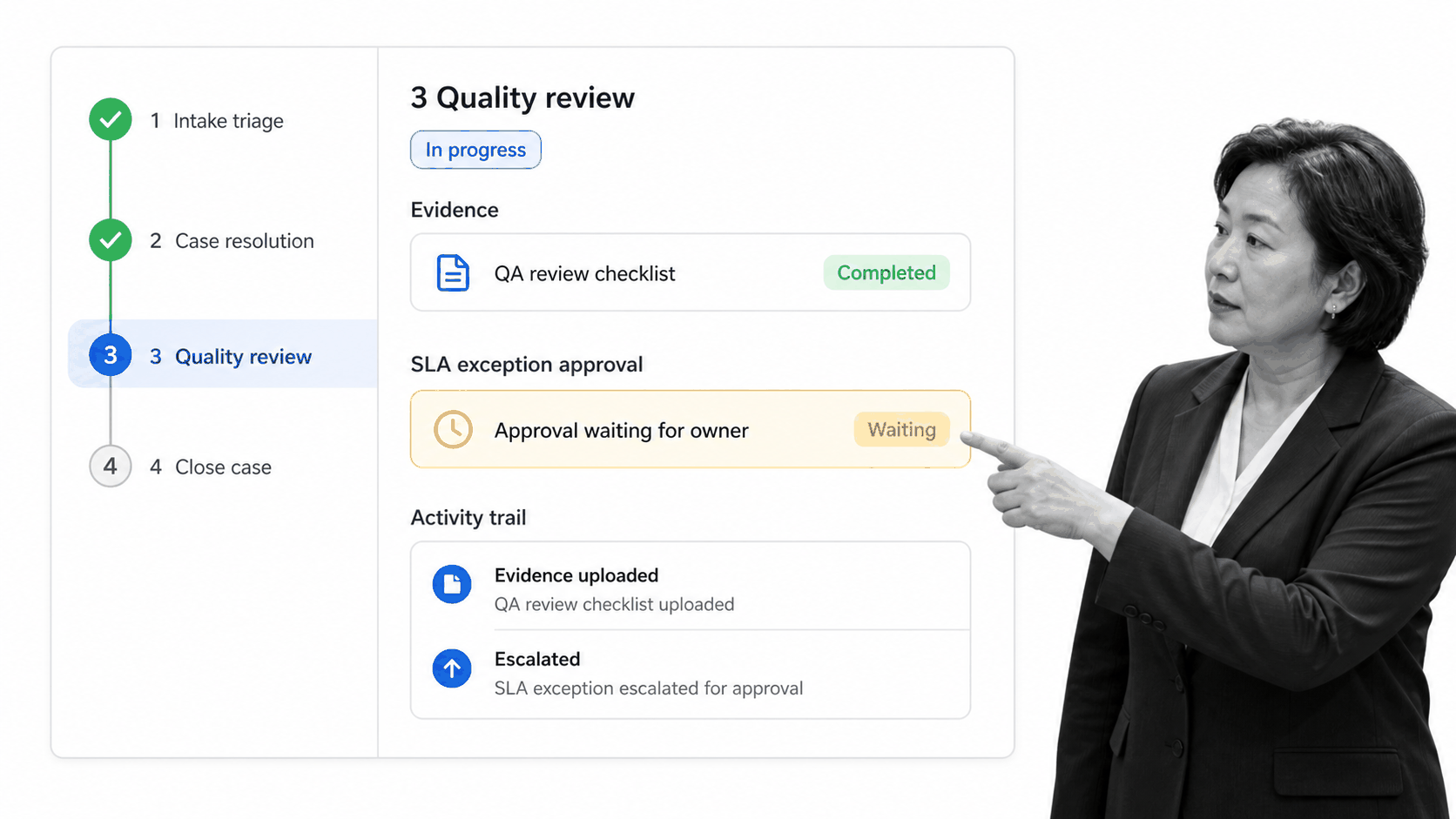
Process Street is a Compliance Operations Platform for running this kind of controlled work. Docs holds the approved procedures and policies. Ops turns them into assigned workflows with forms, conditional logic, approvals, evidence, and audit history. Built-in AI can help route information, summarize work, and support review while the process keeps human ownership explicit.
Use one workflow for each recurring control: new-agent certification, knowledge changes, quality sampling, complaint escalation, access reviews, and monthly governance. Each run should show the responsible person, due date, evidence, exception path, and final approval. That gives the buyer and provider one operating record instead of competing versions of the truth.
Ensuring a business partner agreement
The contract and operating agreement should cover scope, service levels, security, privacy, subcontracting, business continuity, training, intellectual property, data return, termination assistance, and dispute handling. Attach the operating definitions that make each obligation measurable.
Include a change mechanism. Customer-service work evolves as products, channels, laws, and demand change. Without a defined way to estimate, approve, document, and train a change, the written contract quickly separates from the work people perform.
Quality over budget
Cost matters, but a cheap interaction that creates a repeat contact, refund, complaint, or lost customer is not cheap. Compare providers on the total cost of serving the customer and the evidence behind their quality claims.
A reliable outsourcing relationship is specific. The scope is clear. Agents are trained and certified. Decisions have owners. Exceptions are visible. Quality evidence leads to corrective action. When those controls exist, an outsourced call center can extend availability without giving up accountability.