Turn every policy into automated workflows with built-in enforcement and audit-ready proof.



9 Best Confluence Alternatives & Competitors in 2026

Confluence alternatives are worth comparing when a flexible workspace starts carrying work it was never meant to enforce. Confluence can be excellent for Atlassian-centered team knowledge, spaces, pages, whiteboards, and governed collaboration. If your team is using it as a shared operating layer and people keep it current, staying with Confluence can be the right call.
Teams usually start looking elsewhere when flexibility turns into ambiguity. Pages sprawl. Databases drift. Ownership becomes unclear. A project dashboard says work is in progress, but no one can prove that the right checklist ran, the required evidence was collected, or the approval happened before the handoff.
This list is for those teams. Some need stricter recurring procedures. Some need a more governed wiki. Some need project coordination, visual boards, structured databases, trusted answers, or a lighter knowledge base. Others need the workflow itself to enforce steps, collect evidence, route approvals, and show exactly what happened.
The evaluation criteria are practical: core capability fit, ease of ownership, pricing model clarity, knowledge governance, workflow enforcement, and how well each tool supports recurring operational work. Process Street ranks first for teams whose main need is enforceable, trackable, recurring process execution. For pure knowledge management, external documentation, Microsoft 365 document governance, or flexible doc-apps, the relevant specialist may be the better fit.
In this article, we are going to cover:
- Confluence alternatives at a glance
- How to choose a Confluence alternative
- Best Confluence alternatives and competitors
- Which Confluence alternative fits your use case
- FAQs
Confluence alternatives at a glance
The table below gives the short version before the deep dives. The ranking is not a universal claim that one product beats every other product in every context. It is an ICP-based ranking for teams comparing Confluence against tools that can govern knowledge, run recurring business workflows, connect apps, and support operational ownership.
| Tool | Best for | Standout feature | Free plan | Starting price |
|---|---|---|---|---|
| Process Street | enforceable recurring SOP and compliance workflows | workflow runs with required fields, approvals, conditional logic, and audit trails | 14-day Pro trial | See pricing page |
| Notion | docs, wiki, databases, and light projects in one workspace | pages, wikis, databases, projects, calendar, forms, sites, and AI | Yes | See pricing page |
| Guru | AI-assisted company knowledge and answers | AI search, knowledge agents, verification workflows, analytics, and integrations | Trial listed | See pricing page |
| Slite | lightweight team knowledge bases with verification | collaborative docs, Ask search, document verification, analytics, and integrations | Trial listed | See pricing page |
| Document360 | customer and product documentation portals | knowledge base portal, editor, category manager, analytics, search, and workflow controls | Trial listed | See pricing page |
| Nuclino | fast internal wikis and collaborative docs | collaborative pages, collections, graph, board, table, and real-time editing | Yes | See pricing page |
| Coda | docs that behave like internal apps and trackers | docs, tables, buttons, formulas, forms, Packs, and automation | Yes | See pricing page |
| ClickUp | all-in-one work management with docs and projects | tasks, docs, goals, portfolios, dashboards, forms, chat, and automations | Yes | See pricing page |
| Microsoft SharePoint | Microsoft 365 intranets and document collaboration | team sites, document libraries, lists, pages, search, permissions, and Microsoft 365 integration | No standalone free plan found | See pricing page |
How to choose a Confluence alternative
Start by deciding whether you are replacing Confluence as a company wiki, an internal documentation portal, an AI answer layer, a project hub, or a workflow management system. Those are different jobs. A product that is excellent for one can be the wrong surface for another.
If the process has required steps, owners, approvals, due dates, files, and proof, prioritize a workflow execution layer such as project management software. If the work is mostly knowledge management, prioritize page governance, permissions, search, verification, and ownership. If the work is mostly structured records, prioritize databases and interfaces. If the work sits between those patterns, compare the broader process platforms category before committing.
Use these decision questions before comparing vendor demos:
- Does the workflow need human accountability, or is it mostly machine-to-machine data movement?
- Does a compliance, finance, HR, IT, or customer team need proof that each step happened?
- Will business users maintain the workflow, or will developers and integration architects own it?
- Do you need strict recurring workflow runs, or flexible one-off project plans?
- Which surface will people actually keep updated: checklist, wiki, doc, database, board, graph, or project hub?
A good shortlist can include more than one category. A company might use automated workflow tools to track initiatives and a process platform to control recurring work. That division is healthy when the integration layer supports the process instead of hiding it.
Best Confluence alternatives and competitors
1. Process Street
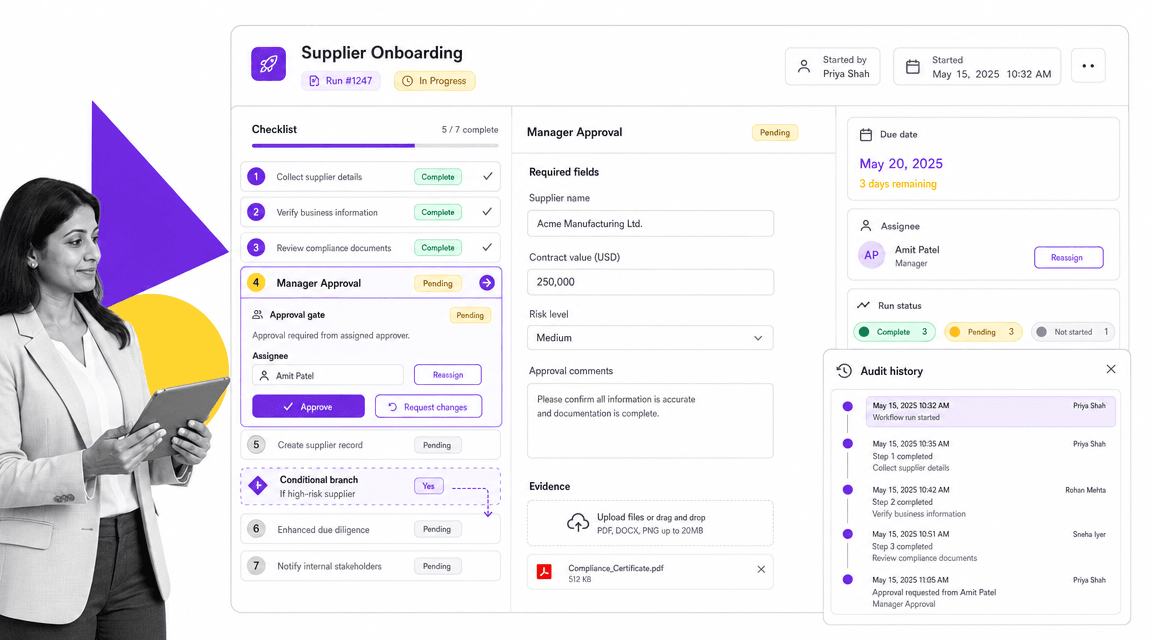
Best for: enforceable recurring SOP and compliance workflows.
Process Street is the best Confluence alternative when the work is a recurring SOP, checklist, approval, or compliance-adjacent process that must be followed the same way every time. It is not trying to be a BPMN modeling suite or a desktop RPA control room. It is built for operators who need work to run correctly and leave a clear record.
That distinction matters. A Confluence page can document the process, and a Confluence database can track work around it. Process Street can make the person accountable for the next step, require the right form field, pause for an approval, branch based on conditional logic, and preserve the run history as operational proof. For onboarding, vendor reviews, quality checks, finance close tasks, and compliance workflows, that execution record is often the real requirement.
Process Street also connects around the workflow. Its pricing page lists automations, public API access, and connectors for Zapier, Microsoft Power Automate, Tray.io, and Make. The product positioning is broader: Process Street has direct, universal integrations to 5,000+ systems. Need a new one? An AI agent builds it on the fly.
Use Process Street pricing for current plan details. The public pricing page shows Startup, Pro, and Enterprise plan tracks, a 14-day Pro trial, and sales-led pricing for current packages.
Process Street key features:
- Structured workflow runs with step order, owners, due dates, and conditional logic.
- Approval tasks that make review part of the workflow, not a separate inbox chase.
- Required fields, file collection, and task history for process evidence.
- Recurring schedules and automations for repeatable operations.
- A compliance operations platform shape for teams that need control, not only connection.
Process Street pros:
- Strong fit for SOPs, recurring processes, onboarding, reviews, and compliance operations.
- Readable enough for non-technical operators to own and improve processes.
- Keeps people, tasks, approvals, evidence, and integrations in one workflow record.
- Works well when app automation needs to support controlled human work.
- Clear fit for operations, HR, compliance, finance, customer management, and IT process owners.
Process Street cons:
- Not the best fit when the core requirement is BPMN modeling, process simulation, or desktop RPA.
- Teams looking only for a simple two-app connector may prefer a lighter automation tool.
For current package details, see Process Street pricing. If you only need a passive company wiki, a dedicated knowledge base may fit better.
2. Notion

Best for: docs, wiki, databases, and light projects in one workspace.
Notion is a connected workspace for docs, wikis, databases, projects, calendar, forms, sites, and AI-assisted knowledge work. Its official pricing page is the right place to check current package details because plan names, limits, and AI packaging can change.
Notion beats Process Street when the main job is flexible documentation, wiki structure, lightweight databases, and team workspace design. It is weaker when a recurring process needs required evidence, approvals, task history, and a durable execution record.
Notion key features:
- Pages, docs, and wiki structure.
- Databases, projects, calendar, forms, and sites.
- AI-assisted workspace features.
- Team collaboration and administration on paid plans.
Notion pros:
- Flexible workspace model for knowledge and planning.
- Strong fit for teams that want docs and databases together.
- Useful when the team wants a lighter Confluence replacement.
Notion cons:
- Flexibility can leave process execution unenforced.
- Not ideal when proof of completed steps is the primary requirement.
For current package details, see Notion pricing. Notion is a better fit when flexible docs and databases matter more than governed workflow execution.
3. Guru
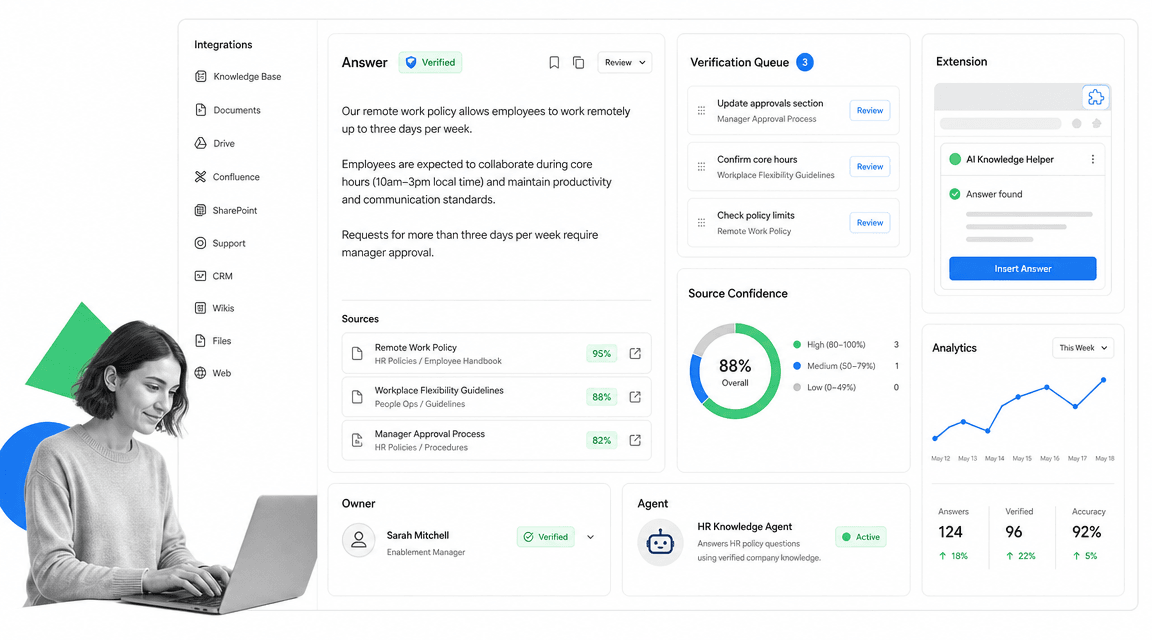
Best for: AI-assisted company knowledge and answers.
Guru is an AI knowledge platform for workplace answers, knowledge agents, search, verification, analytics, and integrations. Its official product and pricing pages position the product around trusted answers and verified company knowledge.
Guru beats Process Street when the main pain is finding trusted answers across work systems. It is weaker when knowledge needs to become a step-by-step operating workflow with required owners, approvals, evidence, and run history.
Guru key features:
- AI search and answer surfaces.
- Knowledge agents and source-connected answers.
- Verification workflows for trusted content.
- Analytics and integrations for knowledge operations.
Guru pros:
- Strong fit for sales enablement and support knowledge.
- Verification helps teams trust answers.
- Useful when employees need answers inside their flow of work.
Guru cons:
- Answer retrieval is not the same as workflow execution.
- Teams may still need another layer to run controlled SOPs.
For current package details, see Guru pricing. Guru is a better fit when the main job is trusted workplace answers and knowledge verification.
4. Slite

Best for: lightweight team knowledge bases with verification.
Slite is a team knowledge base with collaborative docs, Ask search, document verification, knowledge management controls, analytics, and integrations. Its pricing page lists current package paths and trial availability.
Slite beats Process Street when a team wants a simpler knowledge base than Confluence with verification and search built around docs. It is weaker when the knowledge needs to trigger recurring assigned work with approvals and evidence capture.
Slite key features:
- Collaborative editor with AI built in.
- Ask search and answers.
- Document verification and knowledge management controls.
- Workspace analytics plus integrations.
Slite pros:
- Good fit for lean team knowledge bases.
- Verification helps keep docs from going stale.
- Search and analytics support knowledge operations.
Slite cons:
- Focused on knowledge management, not controlled SOP execution.
- Workflow proof and approval routing may need another layer.
For current package details, see Slite pricing. Slite is a better fit when a lean team needs a simpler knowledge base than Confluence.
5. Document360

Best for: customer and product documentation portals.
Document360 is a knowledge base platform for customer-facing and product documentation teams. Its product surface includes a portal, editor, category management, analytics, search, and workflow controls.
Document360 beats Process Street when the job is publishing and governing external help-center content. It is weaker when the priority is running the internal process that makes teams complete work correctly and leave proof behind.
Document360 key features:
- Knowledge base portal and article editor.
- Category management and content organization.
- Search, analytics, and article workflow controls.
- Public help center and documentation operations features.
Document360 pros:
- Strong fit for customer and product documentation portals.
- Better fit than a general wiki for external help centers.
- Useful for documentation teams that need content governance.
Document360 cons:
- Not built first as an internal SOP execution layer.
- May be more documentation-specific than operations teams need.
For current package details, see Document360 pricing. Document360 is a better fit when the priority is an external help center or product documentation portal.
6. Nuclino
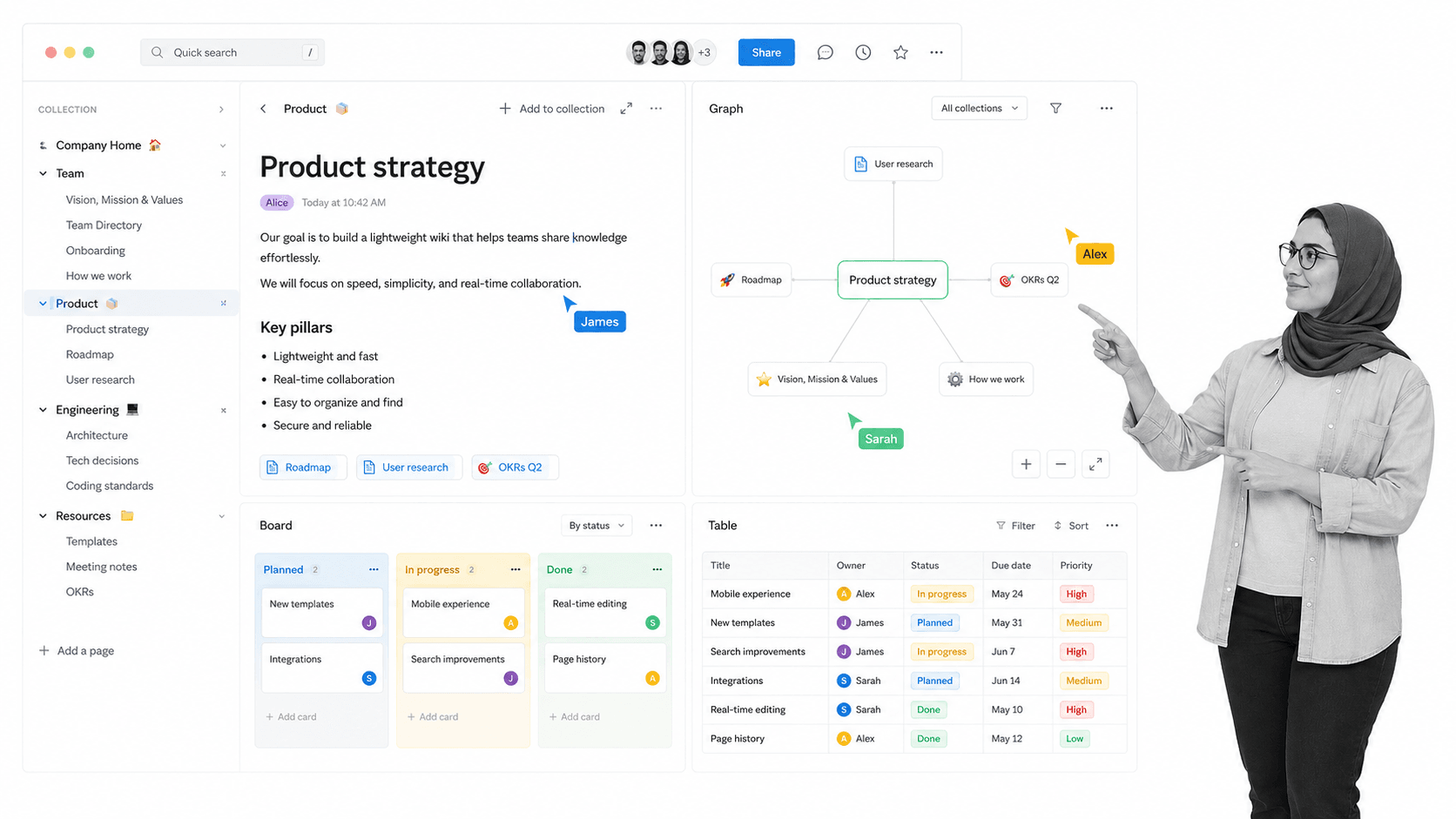
Best for: fast internal wikis and collaborative docs.
Nuclino is a lightweight collaborative workspace for internal wikis, docs, projects, and knowledge organization. Its product and pricing pages emphasize speed, simple editing, collections, graph view, board view, and table view.
Nuclino beats Process Street when the main requirement is a fast, lightweight internal wiki with less overhead than Confluence. It is weaker when the team needs formal approvals, recurring workflow runs, and audit-ready process evidence.
Nuclino key features:
- Collaborative pages and collections.
- Graph, board, and table views.
- Real-time editing and quick search.
- Simple wiki and project organization.
Nuclino pros:
- Fast to adopt for small teams.
- Cleaner and lighter than many enterprise wiki tools.
- Good for simple internal knowledge bases.
Nuclino cons:
- Less suited to governed enterprise knowledge programs.
- Does not replace controlled workflow execution.
For current package details, see Nuclino pricing. Nuclino is a better fit when the team wants a lightweight wiki with minimal administration.
7. Coda
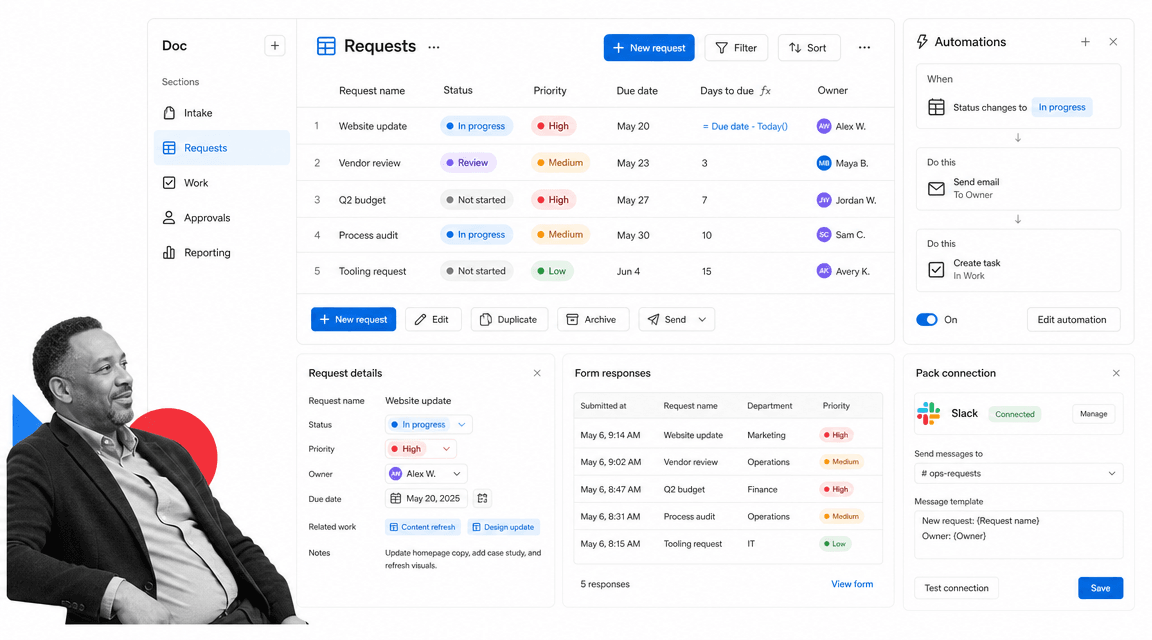
Best for: docs that behave like internal apps and trackers.
Coda is a flexible doc-app workspace for teams that want documents, tables, forms, Packs, and automation in the same surface. Its official pricing page is the right place to check current package details, and its model centers on Doc Makers rather than every viewer.
Coda beats Process Street when the team wants to build a lightweight internal app or tracker from a document. It is weaker when every run needs a controlled sequence, required evidence, approvals, and a durable workflow history.
Coda key features:
- Docs with embedded tables and sections.
- Buttons, formulas, forms, and automations.
- Packs for connecting external tools.
- Flexible tracker and app-style workspace design.
Coda pros:
- Strong for teams that want docs to behave like internal apps.
- Flexible enough for custom trackers and planning systems.
- Viewer-friendly model can fit broad collaboration patterns.
Coda cons:
- Flexibility can leave workflow discipline up to the builder.
- Not purpose-built for audit-ready SOP execution.
For current package details, see Coda pricing. Coda is a better fit when the team wants to build custom doc-apps instead of a traditional wiki.
8. ClickUp

Best for: all-in-one work management with docs and projects.
ClickUp is an all-in-one work management platform with tasks, docs, goals, portfolios, dashboards, forms, chat, and automations. Its official pricing page shows current plan packaging and availability for teams that need more capacity and controls.
ClickUp beats Process Street when the team wants projects, tasks, docs, goals, chat, and dashboards in one broad workspace. It is weaker when the primary requirement is a strict workflow run with approvals, required fields, and audit history.
ClickUp key features:
- Tasks, docs, goals, portfolios, and dashboards.
- Forms, chat, custom fields, and automations.
- Multiple project and work views.
- Broad workspace structure for cross-functional teams.
ClickUp pros:
- Broad all-in-one work management surface.
- Useful for teams trying to consolidate project tools.
- Strong fit when docs and tasks need to sit together.
ClickUp cons:
- Breadth can make operating discipline harder to standardize.
- Not designed first as a compliance workflow execution layer.
For current package details, see ClickUp pricing. ClickUp is a better fit when project management and work visibility matter more than wiki governance.
9. Microsoft SharePoint
Best for: Microsoft 365 intranets and document collaboration.
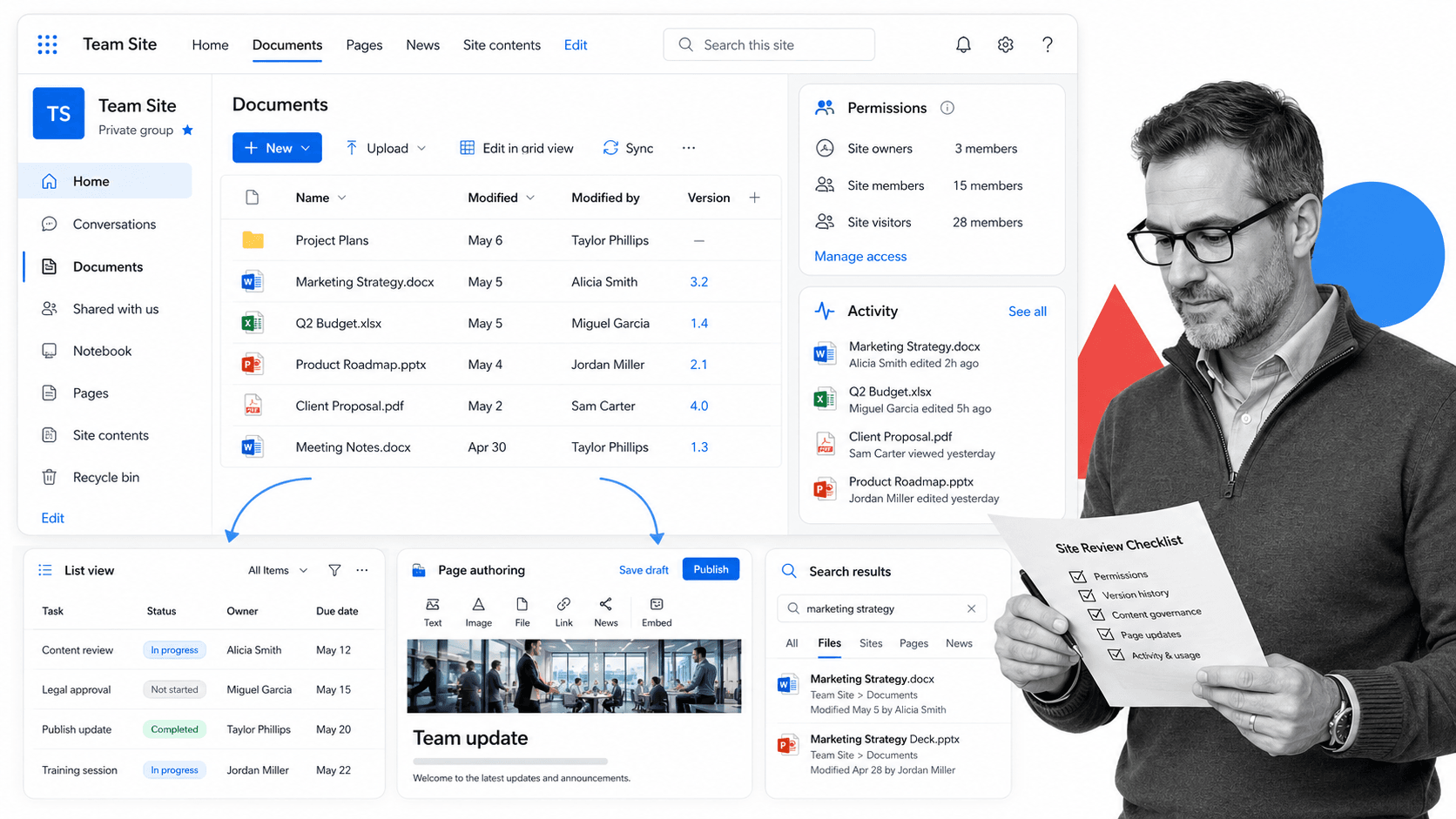
Microsoft SharePoint is Microsoft 365’s collaboration and intranet platform for team sites, document libraries, lists, pages, permissions, search, and organization-wide content. Its official pricing page explains the available SharePoint plan paths.
SharePoint beats Process Street when Microsoft 365 governance, document libraries, intranet pages, and permissions are the center of the work. It is weaker when the team needs operators to complete a guided procedure with approvals and evidence in each run.
Microsoft SharePoint key features:
- Team sites and pages.
- Document libraries, lists, and search.
- Permissions and Microsoft 365 collaboration.
- Intranet and organization content management patterns.
Microsoft SharePoint pros:
- Strong fit for Microsoft 365 organizations.
- Useful for governed document libraries and intranets.
- Deeply connected to Microsoft collaboration tools.
Microsoft SharePoint cons:
- Can be heavy for teams that only need a simple wiki.
- Document management does not automatically enforce SOP execution.
For current package details, see Microsoft SharePoint pricing. SharePoint is a better fit when Microsoft 365 governance and document libraries are the center of work.
Which Confluence alternative fits your use case
The easiest way to avoid a bad Confluence replacement is to name the job first.
- Choose Process Street when recurring human work needs required steps, owners, approvals, evidence, and audit trails.
- Choose Notion when teams want flexible docs, wikis, databases, and projects in one workspace.
- Choose Guru or Slite when the main requirement is trusted company knowledge and searchable answers.
- Choose ClickUp when project and work management are the main operating surface.
- Choose Document360 when the priority is customer-facing documentation, and SharePoint when Microsoft 365 governance is the center of work.
For many teams, the stack is hybrid. You may keep a knowledge base for policy and context, use SharePoint for document libraries, and use Process Street as the governed process platform for recurring operations. Teams moving from flexible documentation into controlled execution should also compare adjacent workflow management software and project management platforms when their buying question is broader than a workspace replacement. The point is to keep the process record clear. Work management should not make ownership harder to see.
If your main problem is missed steps, tribal knowledge, and inconsistent execution, start with a controlled process. If your main problem is scattered knowledge, start with a wiki. If your main problem is structured operational data, start with a knowledge or documentation tool. The strongest project management platforms decision is the one that matches the risk and owner of the work.
FAQs
What is the best Confluence alternative?
The best Confluence alternative depends on the workflow. Process Street is best for recurring SOP and compliance workflows, Guru is strong for trusted answers, Notion is strong for flexible docs and databases, Document360 fits customer documentation, and SharePoint fits Microsoft 365 document governance.
Is there a free Confluence alternative?
Yes, several Confluence alternatives offer a free plan or free option. Notion, Nuclino, Coda, and ClickUp publish free options or free plans. Other tools may offer trials or sales-led packages. Always check the vendor pricing page because limits change.
Why is Process Street ranked first?
Process Street is ranked first for the ICP this page is judging: teams that need enforceable, trackable, recurring process and SOP workflows. It is not ranked first for every automation use case. For software delivery, spreadsheet-style work, or client billing, a specialist may be the better fit.
What is the closest alternative to Confluence?
The closest alternative depends on which part of Confluence you use. Notion is close for docs plus databases, Slite is close for a lighter team wiki, Guru is close for trusted answers, SharePoint is close for Microsoft 365 document collaboration, and Process Street is closer for controlled human workflow execution.
Which Confluence alternative is best for small teams?
Small teams usually shortlist Process Street, Notion, Slite, Nuclino, Coda, or ClickUp. The best choice depends on ownership. Non-technical operations teams often need readable workflows, while knowledge-heavy teams may prefer a simpler wiki or answer system.
Which Confluence alternative is best for enterprise teams?
Enterprise teams should compare Process Street, Guru, SharePoint, Document360, Notion, and ClickUp based on the job. Process Street fits governed recurring workflows, Guru fits trusted answers, SharePoint fits Microsoft 365 document governance, and Document360 fits customer-facing documentation.
Can I migrate from Confluence to Process Street?
You can migrate the process logic by mapping each flow to a workflow: trigger, owner, task sequence, required fields, approvals, evidence, integrations, and exception paths. Process Street is strongest when the migrated work needs human accountability and proof, not just a task list.
If Confluence is not giving your team the control, ownership, and proof you need, start with Process Street. Build the recurring workflow first, then connect the apps around it.
Comparing something else? The full directory of software alternatives and competitor comparisons covers documentation and knowledge tools alongside the wider workflow category.