Turn every policy into automated workflows with built-in enforcement and audit-ready proof.



Process Platform
A process platform is software that gives recurring business processes one shared place to be designed, run, automated, monitored, and proven. It connects workflow instructions, task execution, data, approvals, integrations, and audit history so teams can manage how work actually moves.
The phrase can sound broad because processes touch everything. Onboarding, vendor reviews, client handoffs, access requests, inspections, compliance checks, change control, and monthly close all need different steps. A process platform gives those steps a common operating layer.
This guide explains what a process platform includes, how it differs from workflow software and business process management tools, which capabilities matter, and how to choose a platform that improves execution instead of adding another place to update status.
In this article, we are going to cover:
- What a process platform is
- Why process platforms matter
- Process platform capabilities
- Process platform vs. workflow software, BPM, and automation tools
- How a process platform works
- Process Street as a process platform
- How to choose and implement a process platform
- FAQs
What a process platform is
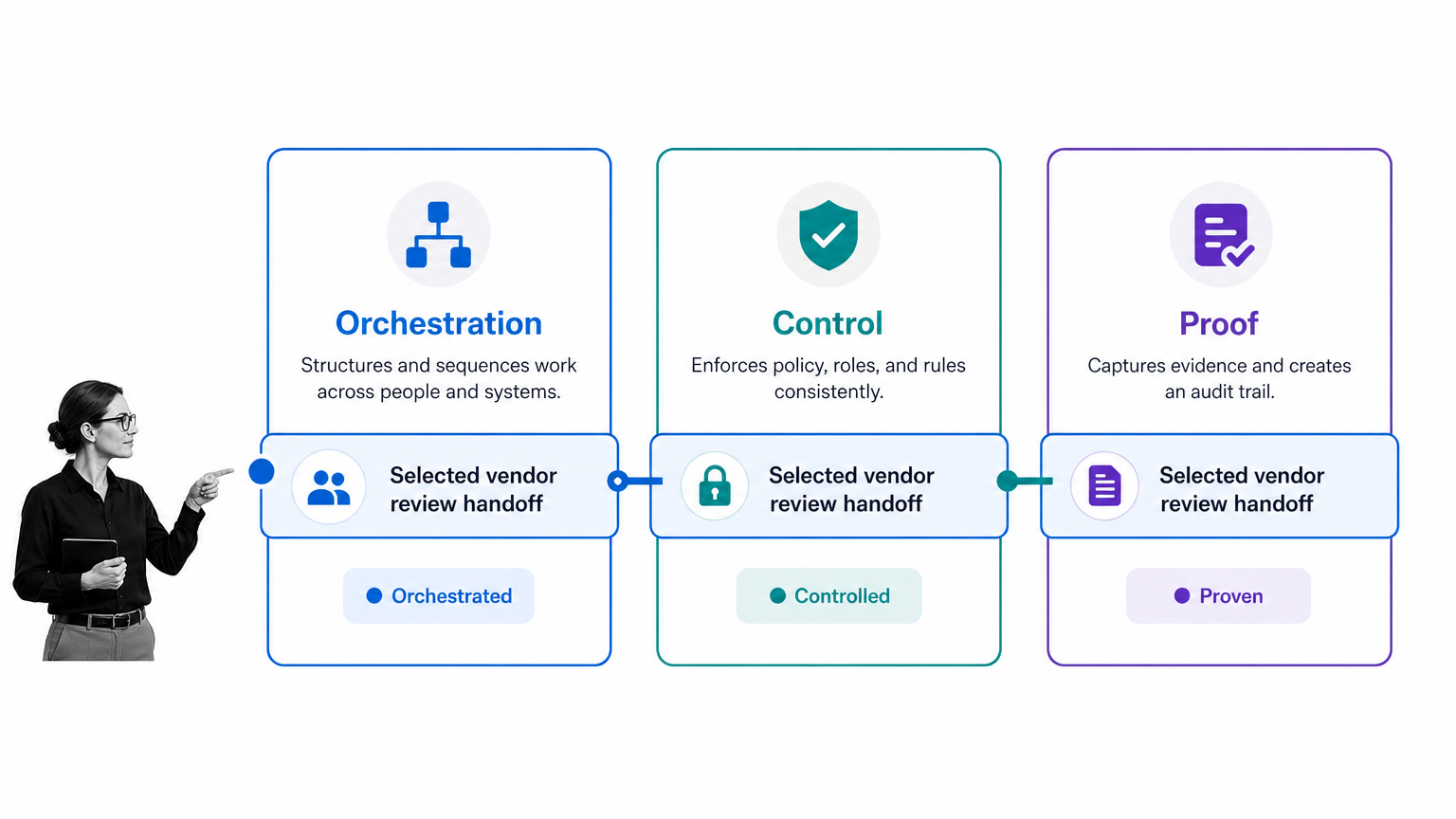
A process platform turns process knowledge into controlled execution. The process may start as a policy, checklist, diagram, form, standard operating procedure, or customer request. The platform turns that source of truth into assigned work with rules, owners, due dates, decisions, and records.
This makes it more practical than a static document repository. Good business process documentation and process documentation still matter, but documents alone cannot prove that a team followed the process. The process platform connects the instruction to the run.
The platform layer
The platform layer is the shared foundation. It holds workflow templates, forms, routing rules, approvals, permissions, evidence, integrations, and reporting in one place. A user should not have to remember which spreadsheet, chat thread, or wiki page controls the next step.
A simple vendor review shows the difference. A task tool can remind someone to review the vendor. A document can describe the review. A process platform can start the review from intake, require the right evidence, route high-risk vendors to compliance, block approval until required fields are complete, update another system, and preserve the activity history.
The platform is not just a dashboard
Dashboards show work. A process platform changes the work. It should assign the next step, collect the data, enforce required controls, start automations, and make the result inspectable. Reporting is valuable, but only after the process itself is reliable.
That distinction matters during buying decisions. Many tools can display a process map or collect a status update. A process platform should become the place where the process is executed, where the rules are enforced, and where the evidence is captured without asking another team to reconstruct the story later.
- Workflow design defines the steps and decisions.
- Execution assigns work to real owners.
- Automation removes predictable handoffs.
- Controls prevent skipped requirements.
- Proof records what happened and who approved it.
Why process platforms matter
Process platforms matter because informal process management breaks as soon as work becomes cross-functional, regulated, customer-facing, or system-dependent. Teams can coordinate a small routine through memory and messages. They cannot scale complex operations that way without creating risk.
They reduce process drift
Process drift happens when the documented process and the real process separate. Someone changes a field in a spreadsheet. A manager approves in chat instead of the workflow. A new hire follows an old SOP. A team copies a previous request and misses a new requirement.
A process platform reduces drift by keeping the latest process, the actual run, and the record of completion connected. When the workflow changes, future runs follow the new version. When a required field is added, the platform can prevent incomplete work from moving forward.
They make accountability visible
A process platform should answer basic operating questions without a meeting. Who owns the next step? What is blocked? Which approval is late? What evidence is missing? Which exceptions repeat? Which system was updated after completion?
That is the practical value behind a strong workflow management system. It is not just a visual map. It is a live operating structure for repeatable work.
They create proof by default
Proof matters when the process affects security, compliance, quality, finance, HR, customers, or legal review. A page on compliance as proof of control makes the same point: teams need evidence that work was done correctly, not only confidence that someone intended to do it.
The best process platforms create that proof as a byproduct of normal execution. Users complete the work. The system captures the state, owner, evidence, approval, exception path, and history. The audit trail is not a separate scramble.
Process platform capabilities
A process platform should include capabilities across design, execution, automation, controls, integrations, analytics, and improvement. If one layer is missing, teams often rebuild it in side tools.
Workflow and form builder
The platform needs a way to model repeatable work. That includes tasks, instructions, forms, owners, deadlines, required fields, attachments, and conditional paths. A team should be able to design the happy path and the exception paths in the same workflow.
External sources such as the IBM business process management guide and TechTarget BPMS definition describe process systems around design, execution, monitoring, and optimization. A process platform brings those jobs closer to day-to-day operators.
Rules, approvals, and controls
Rules decide what happens next. Approvals decide who can release work. Controls decide what cannot be skipped. These capabilities are what separate a process platform from a shared task list.
Features like conditional logic and approvals matter because they let the workflow adapt to the situation while preserving accountability.
The useful test is whether the platform can stop the wrong next step. If a finance review is missing, a risk score is too high, a required file is absent, or an approval has not been granted, the workflow should route, pause, or escalate instead of relying on a person to remember the rule.
Automation and integrations
A process platform should connect to the systems where work already happens: CRM, HRIS, ERP, ticketing, identity, documents, email, forms, databases, and spreadsheets. Integrations should reduce duplicate entry and make the workflow the place where cross-system work is coordinated.
Process Street has direct, universal integrations to 5,000+ systems. Need a new one? An AI agent builds it on the fly. That means workflows can connect across the stack without making middleware the center of the story.
Analytics and continuous improvement
Reporting should show more than completion counts. Useful process analytics surface cycle time, bottlenecks, overdue steps, exception volume, rework, control failures, and process variants. Those signals tell owners where to simplify, automate, split, or tighten the process.
AI can help summarize patterns and suggest changes, but the platform still needs governed workflows and clean execution data. The NIST AI Risk Management Framework is a useful reference when AI begins influencing operational decisions.
Process platform vs. workflow software, BPM, and automation tools
A process platform overlaps with workflow software, BPM suites, and automation tools, but each category has a different center of gravity.
Workflow software
workflow management software helps teams route tasks, coordinate owners, and track recurring work. A process platform includes workflow software, but adds governance, controls, integrations, analytics, proof, and improvement loops around the workflow.
Business process management
business process management is the management discipline for identifying, modeling, improving, and controlling processes. BPM suites often serve process architects and transformation teams. A process platform should make those ideas executable for the people who run the work every day.
Standards such as OMG BPMN 2.0 standard overview help teams describe process flows consistently. A process platform goes further by turning those flows into assigned work, controls, and evidence.
Automation tools
workflow automation and process automation remove manual handoffs. Automation tools are powerful, but they can move a bad process faster if the process model is unclear. A process platform decides what should happen before automation starts moving work.
Microsoft’s Microsoft business process flows overview show how business processes can guide stages and data entry. A broader process platform should also manage ownership, evidence, approvals, exceptions, and improvement across many process types.
Process management software
process management software is often used as a buying category for platforms that design and manage business processes. A process platform is the operational version of that category: less about drawing a perfect map, more about making sure the work runs correctly.
How a process platform works
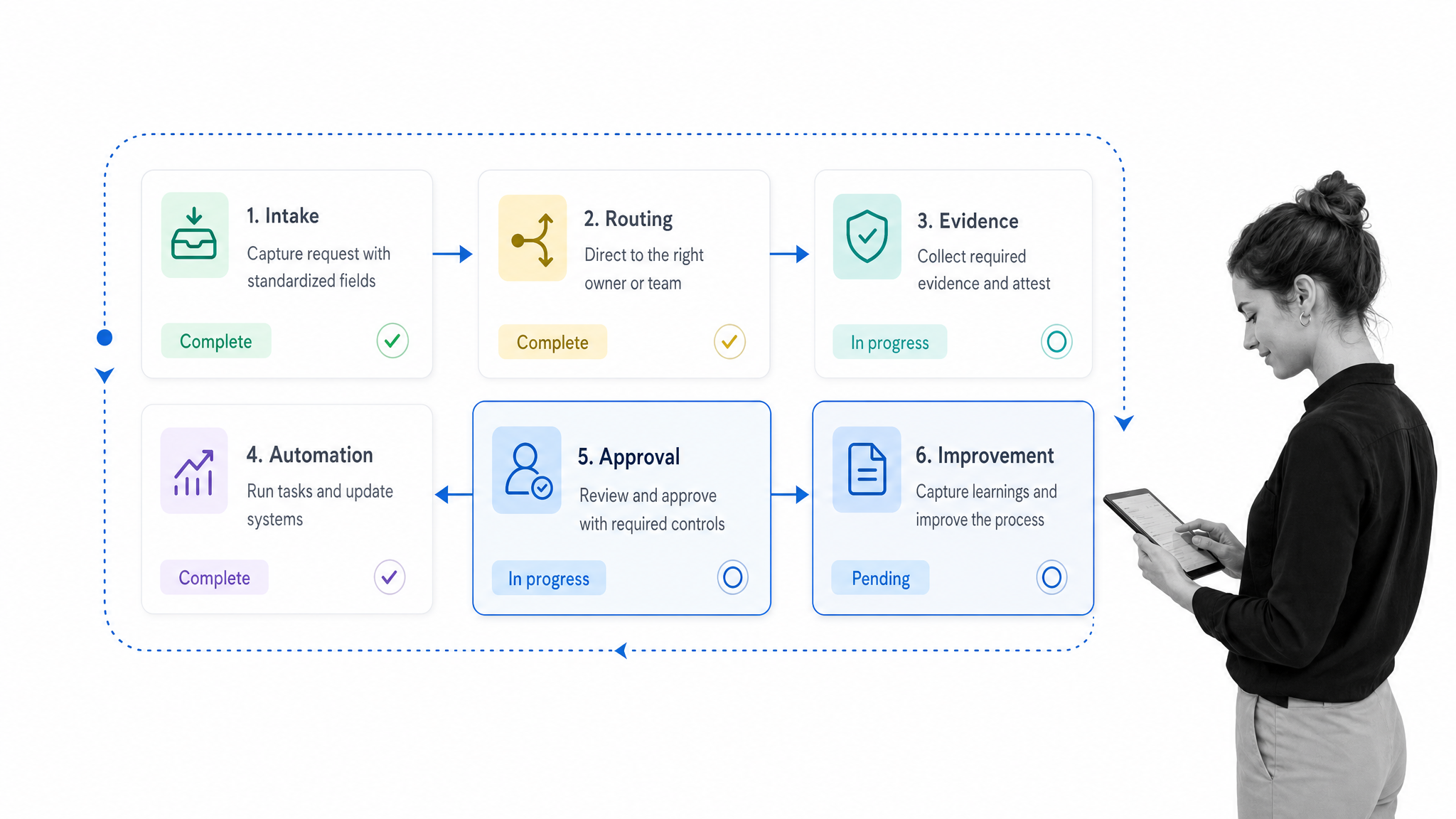
A process platform works by turning a trigger into a governed execution loop. The trigger might be a form submission, a recurring schedule, a system event, a customer request, or a manual start by an operator.
1. Intake captures the right context
The platform collects the information needed to route the process. For a vendor review, that might include vendor type, risk tier, contract value, business owner, data access, and required documents. Clean intake prevents messy downstream decisions.
2. Routing assigns the right path
The workflow uses rules to decide what happens next. Low-risk work can move through a short path. High-risk work can require extra review. Missing evidence can route back to the requester. This is where the platform replaces one-size-fits-all process checklists.
3. Execution moves step by step
Owners complete tasks, upload evidence, answer fields, request approvals, and resolve exceptions. The platform should show each person only what they need to do while preserving the full process record for managers.
4. Automation connects systems
When a step completes, the platform can update a CRM, create a ticket, notify a reviewer, generate a document, send a form, or start another workflow. The workflow becomes the orchestration layer for cross-system work.
5. Proof and improvement close the loop
Every completed run should leave behind usable evidence: owner, timestamp, decision, approval, exception path, files, comments, and system updates. Process owners can then use reporting to improve the workflow instead of guessing where friction lives.
Templates such as a workflow management template are useful starting points because they make the process concrete before teams add routing, controls, and integrations.
Process Street as a process platform
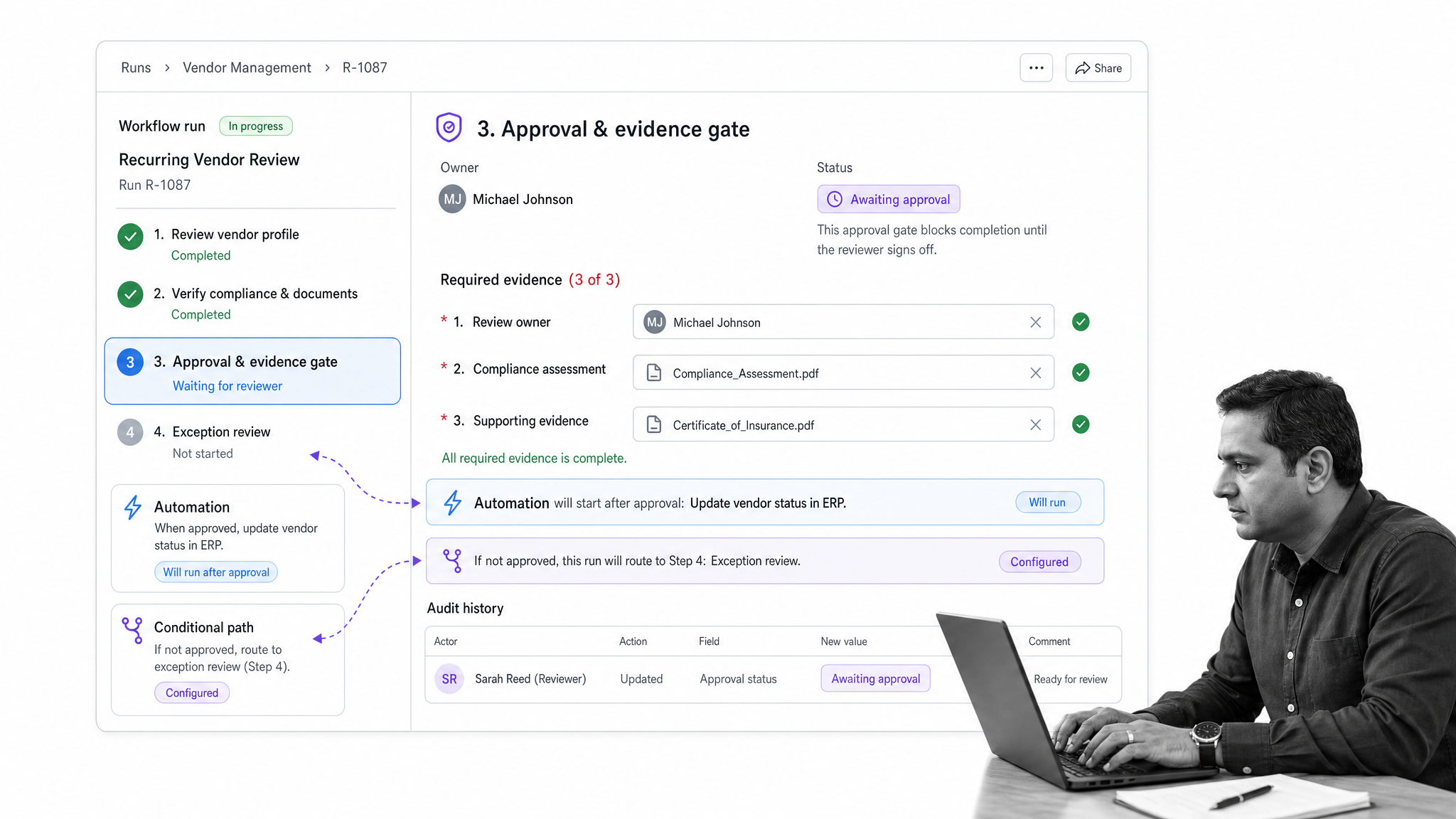
Process Street works as a process platform by connecting process documentation, workflow execution, automation, approvals, integrations, AI assistance, and audit history in one Compliance Operations Platform.
Design the process
Teams build workflows for onboarding, vendor management, customer operations, finance reviews, IT access, compliance checks, quality controls, recurring inspections, and other repeatable work. Each workflow can include instructions, form fields, file uploads, owners, due dates, and conditional paths.
Run the process
Each workflow run gives people the exact steps they need. Required fields, approvals, and conditional logic keep work moving through the right path. If a step needs review, the workflow can block release until the reviewer completes it.
Prove the process
The run history becomes proof. Teams can see what happened, who owned it, which evidence was captured, what was approved, and where the process slowed down. That record is especially valuable when operations and compliance teams need to show that standards were followed.
Improve the process
Process Street fits naturally with process technology because technology is only useful when it improves the real operating system. Workflow data shows what to simplify, automate, or govern more tightly.
It also supports teams comparing business process management software because the platform connects the full loop: design, execution, control, proof, and improvement.
How to choose and implement a process platform
Choose a process platform by matching the platform to the work you need to control. A lightweight process may only need a checklist. A high-stakes recurring process may need routing, approvals, integrations, permissions, evidence, and audit history.
Start with one painful recurring process
Do not begin by platformizing the whole company. Pick one process with visible friction: vendor intake, employee onboarding, access review, policy approval, customer handoff, incident response, monthly close, inspection, or compliance evidence collection.
If the work is operational rather than purely technical, pages on operations management tools can help define which jobs belong in the operations stack and which belong elsewhere.
Map the real workflow
Document the current path, including workarounds. Identify triggers, owners, systems, documents, approvals, decisions, exceptions, and evidence. The hidden process often lives in copied spreadsheets, screenshots, and private messages.
Use the mapping work to decide what belongs in the platform and what should stay in a system of record. The process platform should coordinate the work, capture decisions, and push updates where needed. It does not need to replace every source system to become the operating layer.
Define the control points
Ask what cannot be skipped. Required evidence, risk reviews, approval gates, security checks, customer commitments, finance thresholds, and policy acknowledgments should become explicit controls inside the process platform.
Pilot before scaling
Run the workflow with a small group. Watch where people pause, where fields confuse them, where exceptions repeat, and where automation helps. A good pilot produces both cleaner execution and a better process model.
Track the first few runs closely, then adjust the template before adding more teams. Early feedback usually reveals missing fields, unclear ownership, and approval paths that looked simple on paper but need sharper routing in daily work.
Evaluate AI readiness
AI can accelerate process design, routing, summaries, exception detection, and improvement suggestions. It works best when the platform already has structured workflows, clear permissions, and reliable execution data. That is the practical bridge into AI-driven compliance.
The final test is simple: does the process platform make the process easier to run, harder to skip, easier to prove, and easier to improve? If it only creates another place to update status, it is not doing enough.
FAQs
What is a process platform?
A process platform is software that helps teams design, run, automate, monitor, and prove recurring business processes. It connects workflow steps, owners, data, controls, integrations, approvals, and audit history in one operating layer.
What is the difference between a process platform and workflow software?
Workflow software usually focuses on task routing and visibility. A process platform includes workflow capabilities but also adds governance, integrations, controls, proof, reporting, and improvement loops around the process.
What capabilities should a process platform include?
A process platform should include workflow design, forms, task ownership, conditional logic, approvals, automation, integrations, permissions, evidence capture, audit history, reporting, and tools for improving the process after launch.
Who needs a process platform?
Teams need a process platform when recurring work crosses departments, touches customers, affects compliance, depends on multiple systems, or requires proof that the right steps were followed. Operations, compliance, HR, finance, IT, security, and customer teams are common users.
How does Process Street work as a process platform?
Process Street lets teams turn process documentation into executable workflows with assignments, conditional logic, approvals, automations, integrations, forms, file uploads, and audit history. The result is a process platform for controlled execution and proof.
How do you implement a process platform?
Start with one painful recurring process, map the real workflow, define the control points, build the workflow, pilot with a small team, connect the right systems, and use execution data to improve the process before scaling it.