Turn every policy into automated workflows with built-in enforcement and audit-ready proof.



Form Process Service

A form process service is a managed way to turn submitted forms into assigned, trackable, auditable work. It collects the form response, validates required information, routes the submission to the right owner, controls approvals, triggers follow-up tasks, and preserves the final record.
The phrase matters because many teams have digital forms but still process submissions manually. A request lands in an inbox, someone checks for missing fields, another person forwards it to a reviewer, a decision happens in chat, and the final record ends up in a spreadsheet. The form is digital, but the process is not.
This guide explains what a form process service does, how it differs from a form builder or a consulting project, what to look for when choosing one, and how Process Street turns form intake into governed workflow execution.
In this article, we are going to cover:
- What a form process service is
- Why form process services matter
- What a form process service includes
- Form process service vs form builder, consulting, and outsourcing
- How to choose a form process service
- Run a form process service in Process Street
- Form process service examples
- Form process service FAQs
What a form process service is
A form process service is the operating layer around form-driven work. It can include form design, field validation, submission triage, workflow routing, approval management, automation, recordkeeping, reporting, and improvement. The exact scope changes by team, but the service should make form submissions easier to act on and easier to prove.
A simple definition
Think of it as the service that wraps a form in workflow logic. A form builder helps create the form interface. A form process service makes sure the submitted form becomes owned work with a clear path to completion.
That makes the service broader than a form or a diagram. A diagram can show a process, and a form can capture information. A service should help the team turn that input into assignments, approvals, automations, reports, and records. IBM describes business process management as discovering, modeling, analyzing, measuring, improving, and optimizing business processes in its IBM business process management overview. A form process service applies that thinking to form-driven work.
What the service is responsible for
The service is responsible for making submitted forms operational. It should help the team choose which form-driven workflows matter, understand the current handoffs, design the target path, build the workflow, roll it out, measure adoption, handle exceptions, and improve the process after real use.
That responsibility can sit with an external partner, an internal business excellence team, a shared services group, or a process owner using the right software. What matters is not the org chart. What matters is whether the service changes the way work gets done.
When a service is better than a one-time project
A one-time project can help when the organization has one broken form and one clear goal. A service model is better when many forms trigger recurring work across departments. Submissions change. Owners change. Systems change. Controls change. A service model keeps the intake path useful after the first workflow is launched.
Why form process services matter
Form process services matter because intake problems rarely stay inside one team. A slow request affects customers. An unclear approval path affects finance. A missing evidence step affects compliance. A manual handoff affects operations. The service creates a shared way to improve form-driven work without rebuilding the operating model from scratch each time.
They turn scattered work into repeatable workflows
Most process problems start as scattered work. A team has a document in one place, a spreadsheet in another, an approval in email, and a status update in chat. A form process service should connect those pieces into a repeatable workflow. That is the same operating idea behind a strong form builder: repeatable work needs a system that can run it.
They reduce process drift
Process drift happens when the documented process and the real process separate. People follow old instructions. Exceptions become the norm. Approvals happen outside the system. Data gets copied by hand. A form process service should spot drift and move the process back into a controlled path.
Strong Forms helps by showing how work should happen. A service adds the operating cadence: review the process, test the workflow, update the owner, and keep the live version current.
They create proof by default
When a process carries risk, completion is not enough. Leaders need proof that the right person completed the right step, with the right evidence, under the right rule. A form process service should build that proof into the workflow instead of asking teams to reconstruct it later.
They make improvement continuous
A process map can become stale quickly. A service model keeps a feedback loop open. The team can review bottlenecks, late tasks, repeated exceptions, missing fields, and manual handoffs, then improve the workflow based on real run data.
What a form process service includes
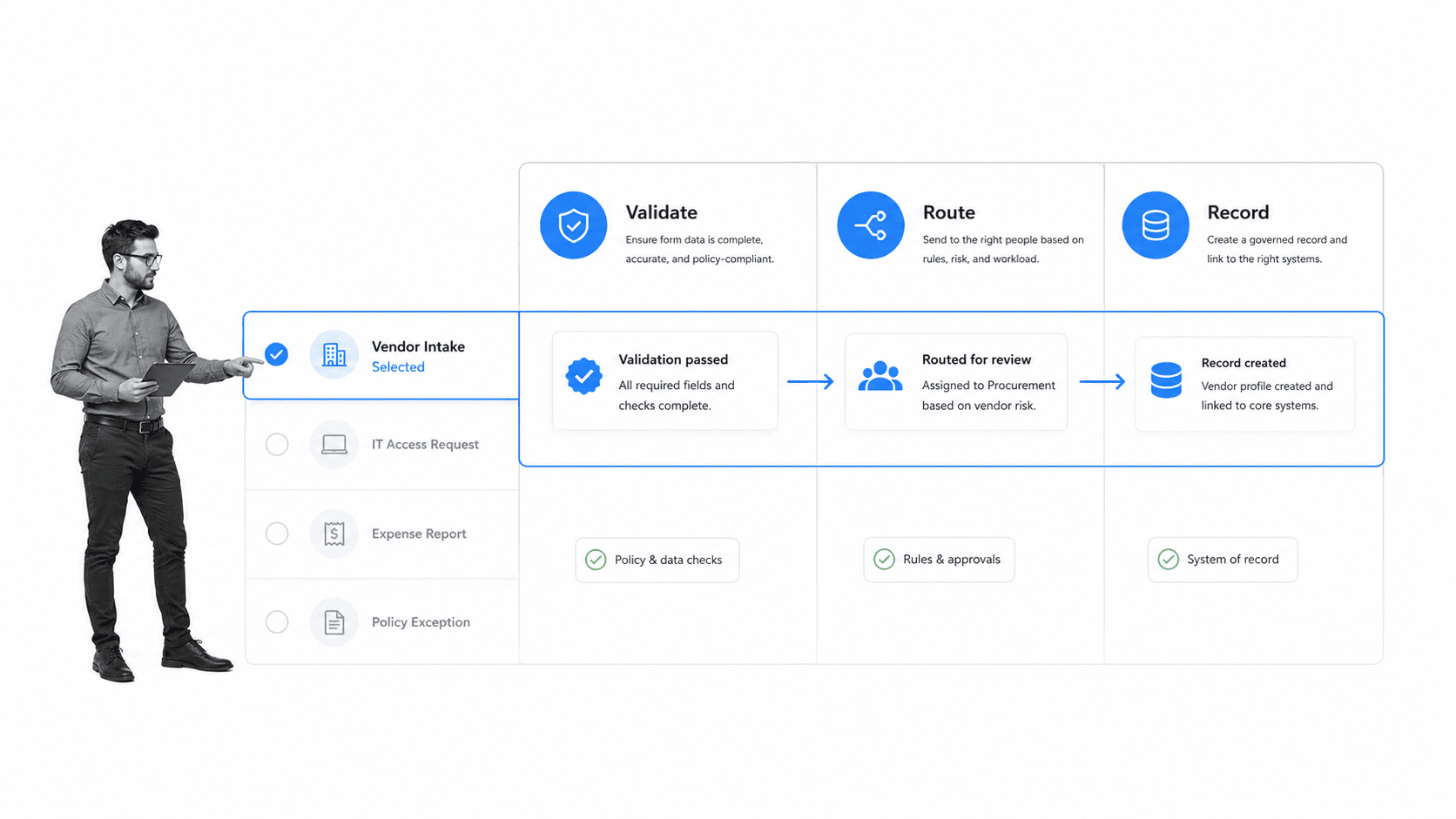
A form process service should cover the full lifecycle of recurring work. If it only documents processes, it leaves execution behind. If it only automates tasks, it may miss governance. The strongest service connects discovery, execution, control, reporting, and improvement.
1. Process discovery
Discovery identifies which processes exist, which ones matter most, and where work breaks. It usually includes stakeholder interviews, workflow observation, system review, forms review, handoff analysis, and pain-point mapping. The goal is to understand the real current state, not the ideal version people wish existed.
2. Process modeling and documentation
Modeling gives people a shared language for the process. For more formal teams, the OMG BPMN 2.0 overview provides a standard notation for business process diagrams. Many teams can start simpler, but the principle is the same: make the process visible enough to inspect.
Documentation should connect to execution. A form process service should help teams create reusable workflow management system, but it should also define who runs the process and what happens when the workflow starts.
3. Workflow design
Workflow design converts the process into steps, roles, forms, decision points, time limits, dependencies, and outputs. This is where the service decides how work should move, what fields are required, where approvals sit, and which exceptions need separate routes.
4. Automation and integration
Automation removes repetitive handoffs and system updates. A form process service should identify where automations make the process more reliable, not just faster. For teams comparing options, process automation and automated workflow tools are useful adjacent concepts.
5. Governance and controls
Governance defines ownership, change control, approvals, review cadence, and evidence requirements. A service without governance can create a polished workflow that nobody maintains. A governed service makes sure the process remains trusted after launch.
6. Measurement and optimization
Measurement shows whether the process is working. Useful signals include cycle time, late steps, skipped fields, exception rates, approval bottlenecks, rework, and process owner feedback. Optimization turns those signals into changes.
The Microsoft business process flows overview describes business process flows as guides that lead people through organization-defined work. That is the same practical bar for a form process service: submitted forms should lead people through the right path, not simply create another record.
Form process service vs form builder, consulting, and outsourcing
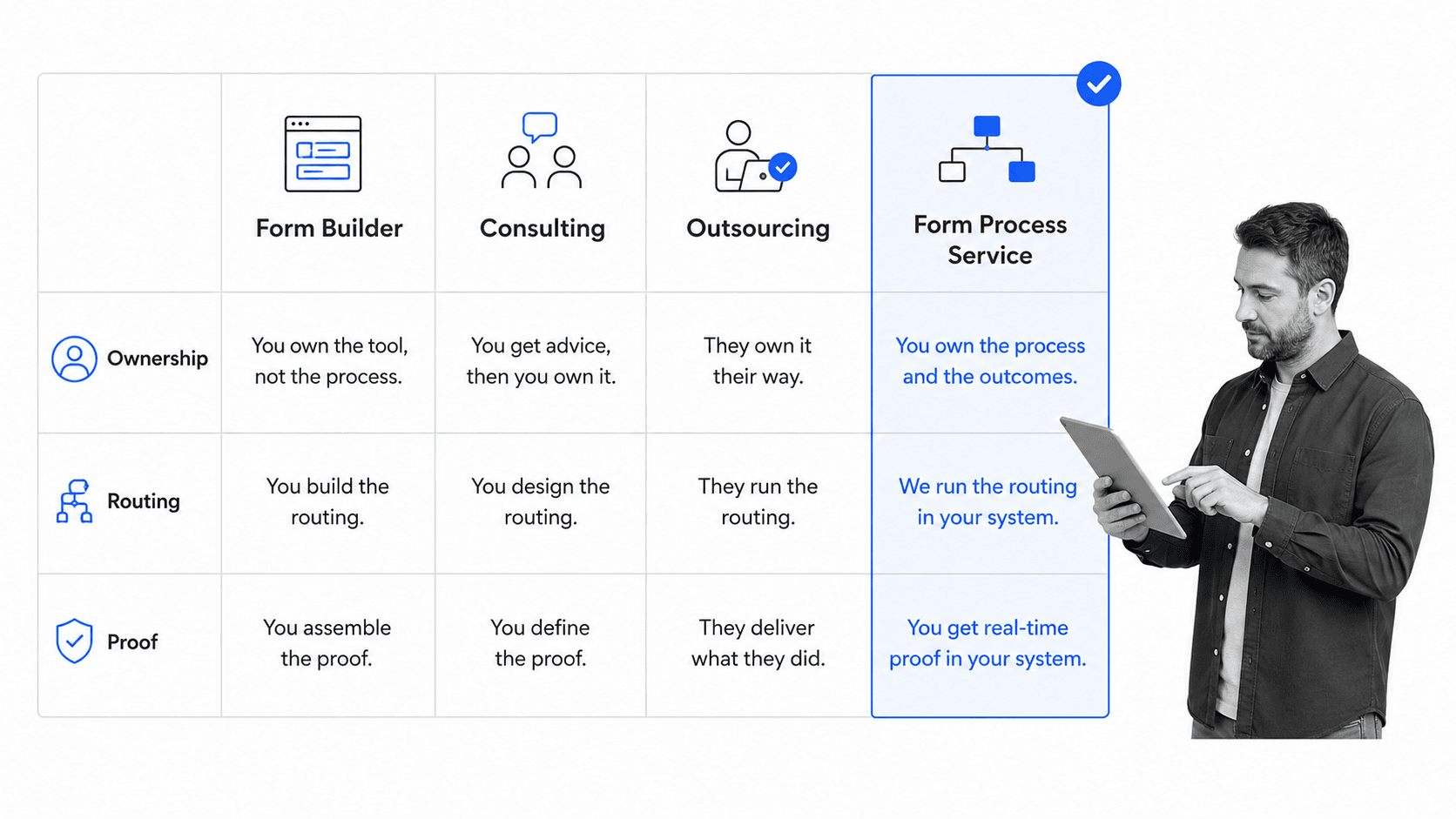
A form process service overlaps with form builders, process consulting, and outsourcing, but it is not identical to any one of them. The difference is whether the offering takes responsibility for making submitted forms move through the right operational path over time.
Form builder
A form builder gives teams a way to create fields, layouts, and submission pages. A form application is broader because the submitted form becomes a managed workflow with review, approval, automation, and records.
Process consulting
Process consulting helps diagnose problems and design improvements. It can be valuable when an organization needs outside perspective, facilitation, or process redesign. The gap appears when recommendations remain in documents and are never converted into executable workflows.
Outsourcing
Outsourcing moves responsibility for doing work to another provider. That can help when a process is not strategic or when a specialist can run it better. A form process service is different because it usually improves and governs the form-to-workflow path, whether the work stays internal or is partly outsourced.
Form process service
A form process service should combine enough process expertise, operating cadence, and workflow execution to keep the process improving. It may use software, consulting, automation, and managed operations, but the service is judged by whether recurring work becomes clearer, faster, safer, and easier to prove.
How to choose a form process service
Choosing a form process service starts with the intake problem, not the provider’s presentation. The right service depends on whether you need better forms, validation, routing, automation, compliance proof, system integration, operational capacity, or all of those together.
Start with process scope
Define the process family first. Examples include employee onboarding, vendor management, customer onboarding, monthly close, access requests, audit evidence, policy approvals, incident response, procurement, quality checks, and service delivery. A clear scope prevents the service from becoming vague transformation theater.
Check execution capability
Ask how the service turns analysis into execution. Does it build workflows? Does it assign owners? Does it capture fields and evidence? Does it route approvals? Does it connect to systems? Does it review real run data after launch? A provider that only delivers recommendations is not enough when the pain is execution.
Check governance depth
The service should define who owns each process, who can change it, what approval is required, how versions are controlled, and when the process is reviewed. Governance does not need to be heavy for every workflow, but it must match the risk.
Check standards fit
Governance should match the data being collected. The FTC data security guidance is a practical reminder to collect what you need, protect what you keep, and limit unnecessary exposure. A form process service should translate those principles into field design, access rules, and record handling.
Check user experience
If the process starts with forms, user experience matters. Clear labels, instructions, grouping, and error handling reduce rework. The W3C form accessibility guidance gives practical form guidance that applies whenever a process depends on structured intake.
Check measurement
A form process service should define what success looks like before implementation. Measures can include cycle time, completion rate, exception volume, rework, audit readiness, stakeholder satisfaction, missed steps, and automation coverage.
Check handoff ownership
The service should also explain what happens after launch. Someone needs to own process changes, train new users, review exceptions, and decide when a workflow should be retired or rebuilt. If the provider cannot name the post-launch owner model, the service may deliver an improved process that quietly drifts back into old habits.
Ask for the operating rhythm before signing. A practical form process service should have a review cadence, a change-request path, a way to collect user feedback, and a method for turning recurring exceptions into workflow updates.
Run a form process service in Process Street
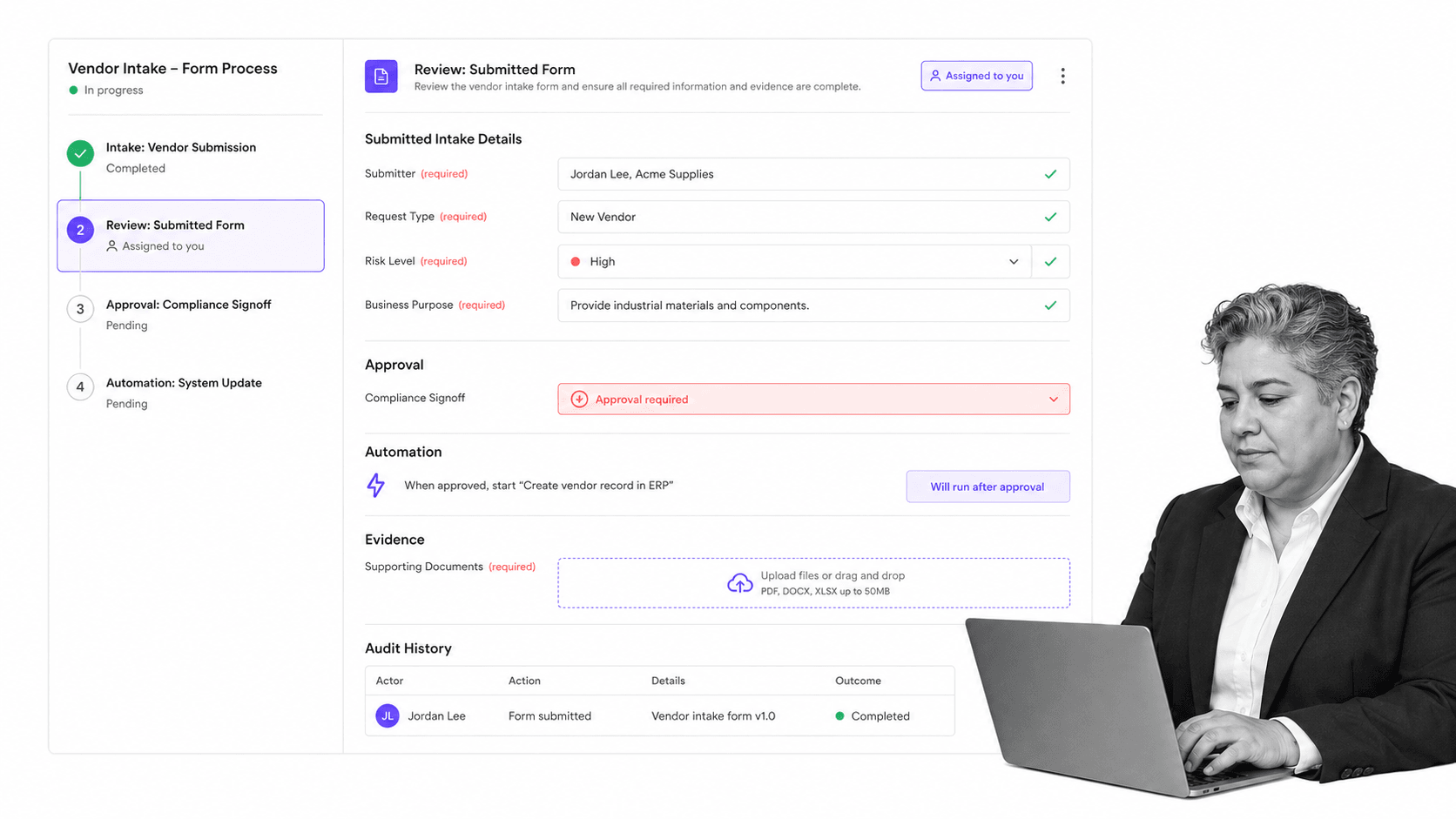
You can run a form process service in Process Street by turning process improvement work into recurring workflows. That means each discovery, documentation, rollout, review, approval, and optimization step has an owner and a record.
Use workflows as service playbooks
A service playbook should be runnable, not just readable. Process Street help docs explain running workflows, which is the practical starting point for turning a process model into assigned execution.
Capture intake with forms and fields
A form process service needs structured intake before it can improve a process. Capture the process owner, business goal, current pain, affected systems, risk level, frequency, and required evidence. Required fields prevent vague requests from becoming vague process projects.
Use approvals to control changes
Process changes can affect compliance, customers, finance, and internal controls. approvals help keep signoff inside the workflow so the final process version is not approved in a side thread.
Use conditional logic for different paths
Not every process needs the same review. conditional logic can route high-risk processes through extra approval, while lower-risk processes follow a shorter path.
Use automation to connect systems
Process Street has direct, universal integrations to 5,000+ systems. Need a new one? An AI agent builds it on the fly. That matters for form process service work because process improvement often depends on updating records, notifying owners, launching downstream workflows, and keeping systems aligned.
Use history as proof
A form process service should be able to prove what changed and why. Workflow history, form values, attached evidence, comments, approvals, and completion state give the service a record of execution. That record is useful for process owners, auditors, managers, and anyone trying to improve the workflow later.
Teams can start from a job application form template, adapt a vendor management workflow, or use a purchase order template to structure the first improvement cycle.
Form process service examples
Form process services show up wherever submitted forms create repeatable work that has become too important to run by memory. The examples below are not different categories of software. They are common service patterns.
Employee onboarding
An onboarding form process service maps the current hiring handoff, standardizes forms, assigns HR and IT tasks, routes manager approvals, captures policy acknowledgments, and reviews completion data after each cohort.
Vendor management
A vendor management form process service organizes intake, risk review, contract approval, security review, tax forms, renewal checks, and evidence collection. The service reduces late approvals and scattered vendor records.
Finance operations
A finance form process service can improve purchase requests, invoice exceptions, monthly close, budget changes, expense approvals, and account reconciliations. The work often needs clear fields, approval thresholds, and audit-ready proof.
IT and access management
An IT form process service can improve access requests, software approvals, device provisioning, incident response, and offboarding. The service should connect intake, review, approvals, system updates, and evidence.
Compliance and quality
Compliance and quality teams use form process services to enforce reviews, control evidence, manage exceptions, and improve repeatable checks. These services often sit close to business process documentation because different process families need different levels of control.
Form process service FAQs
What is a form process service?
A form process service helps an organization discover, document, improve, run, monitor, and optimize recurring business processes. The goal is to make work clearer, more consistent, easier to automate, and easier to prove.
What does a form process service include?
A form process service can include process discovery, mapping, documentation, workflow design, automation, governance, rollout, reporting, and continuous improvement. The best services connect process design to real execution.
Is a form process service the same as a form builder?
No. A form builder helps create fields and submission pages. A form process service adds the routing, ownership, approvals, automations, records, and improvement cadence needed to make submitted forms operational.
When should a company use a form process service?
Use a form process service when recurring work is inconsistent, slow, hard to audit, dependent on manual handoffs, or spread across documents, inboxes, spreadsheets, and disconnected systems.
How do you choose a form process service?
Choose a form process service by checking process scope, execution capability, governance depth, standards fit, user experience, integration needs, and measurement. The provider should be able to turn analysis into workflows that run.
Can Process Street support a form process service?
Yes. Process Street supports form process service work by turning process playbooks into workflows with forms, assignments, approvals, conditional logic, automations, evidence, and audit history.