Turn every policy into automated workflows with built-in enforcement and audit-ready proof.


Healthcare Manager
A healthcare manager plans, directs, and coordinates the people, resources, processes, and business activities that keep healthcare services running. The role turns clinical and organizational priorities into staffed, measurable, compliant work.
Healthcare managers may lead an entire facility, a clinical department, a medical practice, or a focused function such as quality, operations, workforce, finance, or health information. Their exact authority varies, but the core job is consistent: make reliable care possible by managing the system around it.
This guide explains what a healthcare manager does, the responsibilities and skills the role requires, how the management cycle works, how quality and compliance fit into daily decisions, and how to build an execution system that keeps teams aligned.
In this article, we are going to cover:
- What is a healthcare manager?
- Healthcare manager responsibilities
- Healthcare manager skills
- The healthcare management cycle
- Healthcare manager quality and compliance
- Healthcare manager team and performance systems
- Run healthcare management in Process Street
- How to succeed as a healthcare manager
- FAQs
What is a healthcare manager?
A healthcare manager is a leader responsible for coordinating the business and operational activities that enable healthcare delivery. The BLS medical and health services manager role guide describes medical and health services managers as professionals who plan, direct, and coordinate the business activities of healthcare providers.
The role connects care and operations
Clinicians make clinical decisions. A healthcare manager designs and maintains the operating conditions that allow those decisions to become timely, safe, and consistent care. That includes staffing, schedules, budgets, facilities, technology, records, quality routines, vendor work, policies, and escalation paths.
The scope can be broad or specialized
One manager may oversee a whole facility. Another may lead a department, physician practice, service line, or operational function. In each case, the manager translates the needs of the wider healthcare system into clear priorities and accountable work.
Healthcare management is different from clinical practice
A healthcare manager may have a clinical background, but the management role is not defined by diagnosing or treating patients. It is defined by organizing the people, resources, processes, and controls that support care. The manager must understand clinical consequences without replacing licensed clinical judgment.
Healthcare manager and administrator are overlapping terms
Healthcare manager and healthcare administrator are often used interchangeably. Some organizations use administrator for broader policy, finance, and facility oversight, while manager refers to a department or operating team. Job scope and decision rights matter more than the title.
Healthcare manager responsibilities
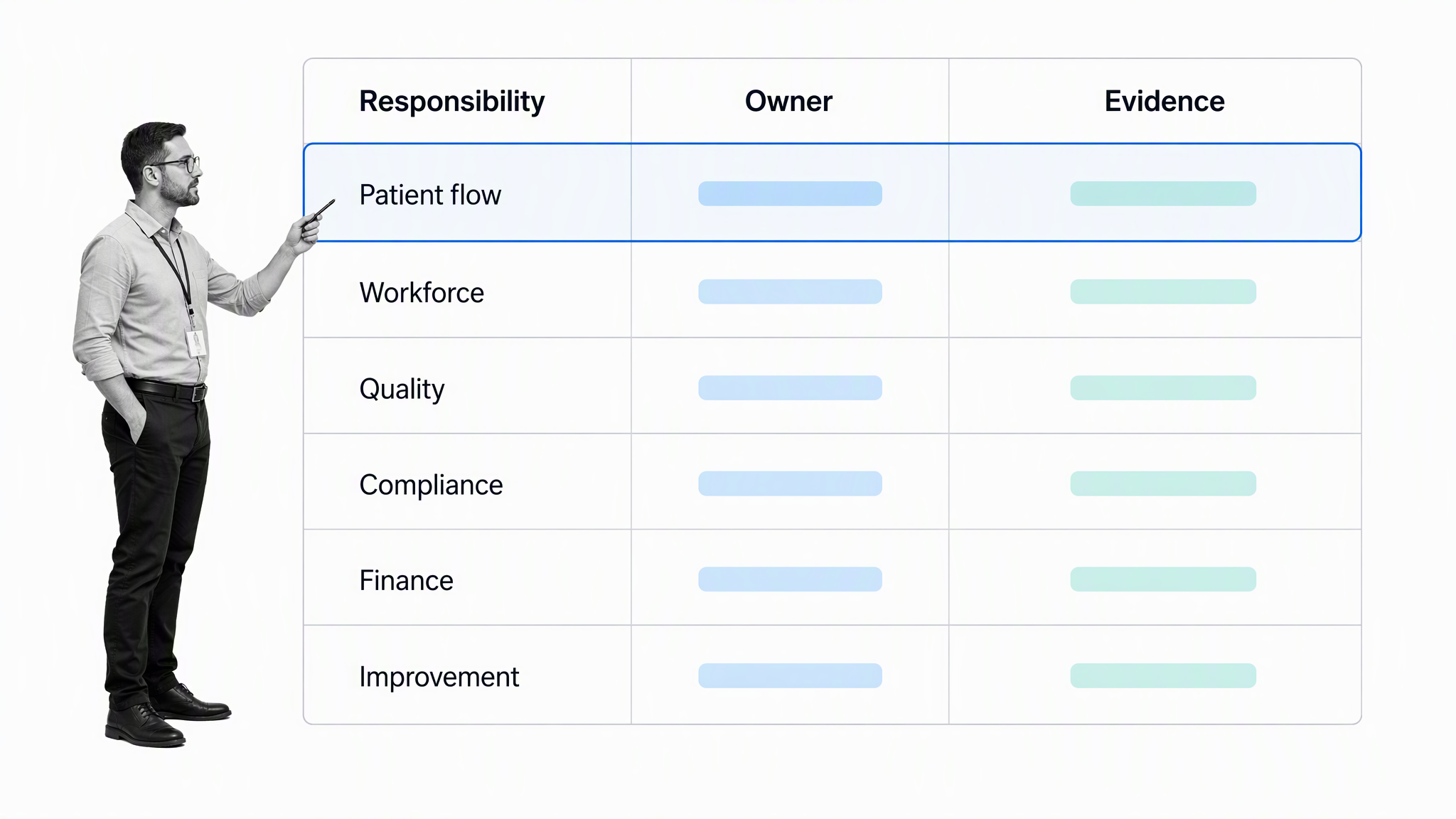
Healthcare manager responsibilities span six connected areas: patient flow, workforce, quality, compliance, finance, and improvement. Strong managers avoid treating these as separate reporting streams because a decision in one area changes the others.
Set goals and operating priorities
The manager converts organizational strategy into a small set of service goals, performance measures, work plans, and review routines. Priorities should tell teams what matters now, who owns the result, which tradeoffs are acceptable, and when leaders will revisit the decision.
Manage patient flow and service capacity
A manager monitors demand, intake, scheduling, wait points, handoffs, capacity, and follow-up. The work connects the planned healthcare service with the daily decisions that keep patients and information moving through the right path.
Lead the workforce
Managers recruit, onboard, schedule, coach, and evaluate staff. They clarify roles, maintain coverage, address performance problems, support development, and make sure each shift or team can execute the required work. Good workforce management protects both service reliability and staff sustainability.
Own budgets and resources
Healthcare managers prepare and monitor budgets, assess resource requests, manage supplies or vendors, and explain the operational impact of financial choices. Cost control should preserve safety and quality rather than shift hidden work onto frontline teams.
Maintain records and reporting
Managers need a reliable record of activity, capacity, exceptions, decisions, and outcomes. healthcare analytics can help explain performance, but every metric needs an owner and a management response. Reports without action are only observation.
Coordinate across functions
Patient care depends on clinical, administrative, finance, workforce, technology, facilities, quality, compliance, and vendor teams. The manager creates a decision path that brings the right people together without turning every issue into a meeting.
Healthcare manager skills
Healthcare manager skills combine operational judgment, people leadership, analysis, communication, and governance. The strongest managers make complex work easier to understand without oversimplifying risk.
Operational thinking
A manager should be able to see an end-to-end healthcare workflow, not only the step owned by one team. That means understanding triggers, dependencies, bottlenecks, handoffs, exceptions, evidence, and the consequences of delay.
People leadership
Managers set expectations, listen to frontline concerns, give useful feedback, resolve conflict, and create psychological safety for reporting problems. Accountability works best when staff understand both the standard and the reason behind it.
Data literacy
Managers do not need to be data scientists, but they must question definitions, distinguish leading from lagging measures, recognize variation, and avoid drawing conclusions from incomplete data. They should be able to connect a measure to a decision.
Communication and facilitation
Healthcare managers communicate with clinicians, executives, patients, staff, regulators, payers, vendors, and partners. They need to translate technical or financial information into clear choices and make meetings end with decisions, owners, and next actions.
Change and improvement leadership
A manager must help teams change how work happens, not simply announce a new procedure. That requires involving the people who perform the work, testing changes, measuring adoption, managing resistance, and reinforcing the new standard until it becomes routine.
The healthcare management cycle
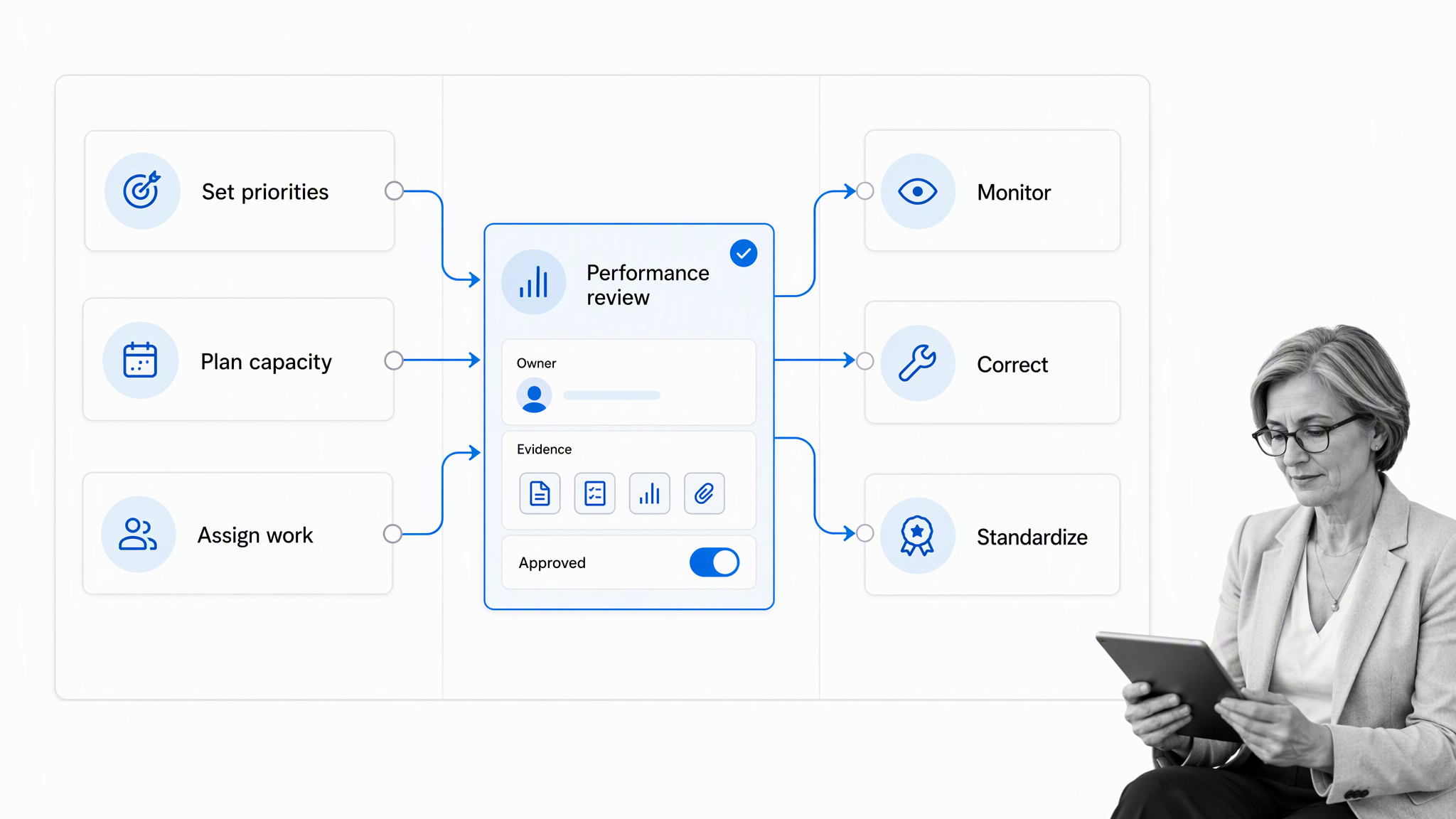
The healthcare management cycle turns priorities into execution and learning. It should repeat on a clear cadence so managers can detect drift, respond to risk, and standardize improvements.
1. Set priorities and measures
Define the service outcome, operating target, responsible owner, evidence source, review cadence, and escalation threshold. A priority without these elements is too vague to manage.
2. Plan capacity and controls
Use healthcare planning to connect expected demand with staffing, facilities, technology, budget, suppliers, quality controls, and compliance requirements. Record assumptions so the team knows what must be reviewed when conditions change.
3. Assign work
Convert the plan into owned tasks and recurring healthcare process. Each handoff should name the sender, receiver, required information, completion condition, response time, and exception path.
4. Monitor the work
Use focused healthcare monitoring to see missed steps, overdue tasks, capacity pressure, quality signals, complaints, incidents, and unresolved exceptions. Monitoring should trigger action, not add another passive dashboard.
5. Review performance and correct
Compare actual performance with the target and the assumptions behind it. Separate isolated variation from a recurring process problem. Assign corrective actions with owners and deadlines, then verify whether the correction worked.
6. Standardize and learn
When a change improves performance, update the operating standard, training, workflow, and evidence requirements. The AHRQ healthcare workflow mapping guidance explains that workflow mapping can clarify team responsibilities and support sustained improvement. The final step is not declaring success. It is making the better way repeatable.
Healthcare manager quality and compliance
Healthcare managers are accountable for creating conditions where quality and compliance are built into work. They should not treat either area as a separate annual exercise owned only by specialists.
Use measures that support decisions
CMS quality measures describes quality measures as tools that quantify healthcare processes, outcomes, patient perceptions, and organizational structures or systems. A manager should connect each selected measure to a review owner, threshold, and response.
Embed controls in the process
Policies become reliable when the related tasks require the right information, owner, evidence, and approval. A structured compliance management software or quality management system software can connect governance to execution rather than leaving controls in a static document.
Protect sensitive information
The HHS HIPAA Security Rule guidance requires appropriate administrative, physical, and technical safeguards for electronic protected health information. The detailed HHS Security Rule safeguards summary includes access, audit, integrity, authentication, transmission, workstation, facility, and device controls. Qualified privacy, security, and legal owners should determine applicability, while managers make sure approved controls are followed in daily work.
Prepare for review continuously
A reusable clinical audit workflow or HIPAA compliance audit checklist can assign evidence, findings, corrective actions, approvals, and follow-up. Continuous evidence capture reduces the need to reconstruct months of activity before an audit or leadership review.
Manage exceptions openly
Exceptions are not proof that a process failed. Hidden exceptions are. Managers need a defined route for documenting why the standard path could not be followed, who approved the alternative, which risk remains, and what follow-up is required.
Healthcare manager team and performance systems
Healthcare manager performance systems should make expectations, progress, and problems visible without overwhelming staff with reporting. The best system uses a few linked routines rather than a collection of disconnected meetings and spreadsheets.
Daily operating review
Use a short daily review for immediate demand, staffing, safety, access, and service risks. Escalate only the issues that need cross-team or leadership support. Record decisions so the same problem is not rediscovered on every shift.
Weekly performance review
Review trends, overdue actions, recurring exceptions, workforce constraints, quality signals, and improvement work. The meeting should close with decisions, named owners, and a small number of actions that can be verified at the next review.
Monthly management review
Step back from daily variation to review objectives, resources, financial performance, service demand, quality, compliance, strategic risks, and benefits. Revisit assumptions before changing targets or committing new capacity.
One source of accountable work
Staff should not have to search email, meeting notes, spreadsheets, and chat to discover the current action. A management system needs one place where owners, evidence, approvals, exceptions, and completion states remain connected to the decision that created them.
A clear escalation ladder
Every team should know which problems stay with the frontline owner, which move to the department manager, and which require clinical, executive, compliance, privacy, security, finance, or facilities review. Define the trigger, required evidence, response window, and temporary safety action for each route. A clear escalation ladder prevents routine questions from overwhelming leaders while making sure serious risks do not wait inside an inbox.
Closed-loop corrective action
Corrective action is complete only when the assigned change has been implemented, evidence has been reviewed, and the manager has checked whether the problem recurred. Closing an action because a document was uploaded is not enough. The review should confirm that the new control changed the work, that staff understand it, and that any related training, policy, workflow, measure, or supplier requirement was updated.
Run healthcare management in Process Street
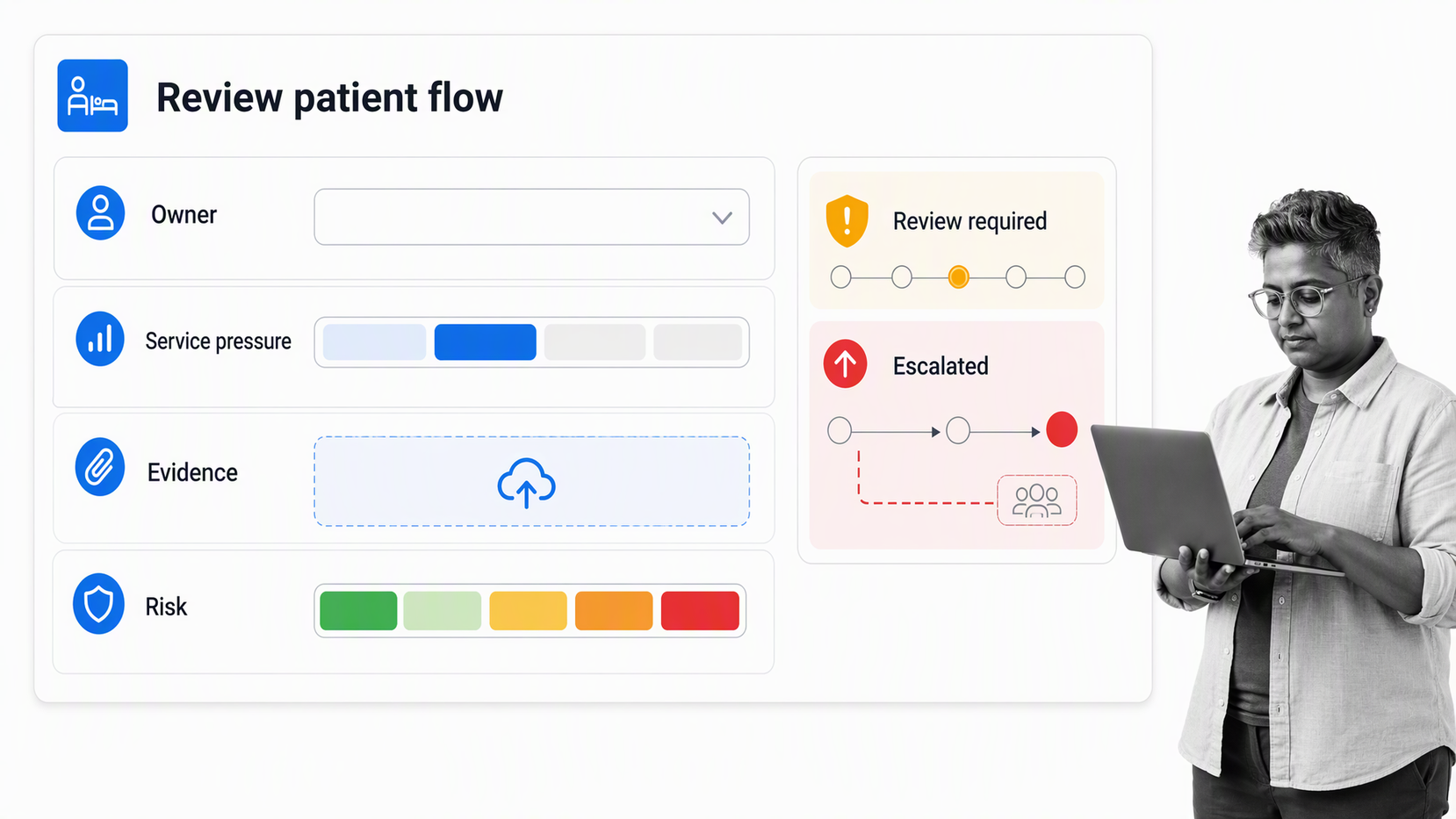
Running healthcare management in Process Street means converting priorities, review routines, controls, and corrective actions into workflows people actually execute. Tasks route to owners, fields capture evidence, risk changes the path, approvals block premature closure, and the workflow record shows what happened.
Process Street is an agentic process automation platform and is HIPAA compliant. It is useful when healthcare leaders need clinical, operational, quality, workforce, finance, technology, and compliance teams to follow one controlled path from issue detection to verified resolution.
Build recurring management workflows
Daily operating reviews, weekly performance reviews, monthly management reviews, staff onboarding, clinical audits, incident reviews, policy attestations, capacity checks, vendor reviews, and corrective actions can each run as reusable workflows with clear completion conditions.
Route issues by risk and service
Use conditional logic to vary reviewers, evidence, escalation, and response windows by service, risk, data sensitivity, or operational impact. Routine work stays efficient, while high-risk gaps receive the right management attention.
Require approval where it matters
Use workflow approvals for policy changes, corrective action closure, service changes, budget exceptions, high-risk incidents, or other decisions that should not advance without accountable review.
Connect the existing stack
Process Street has 5,000+ integrations. Management workflows can connect with the systems teams already use while keeping ownership, evidence, decisions, and follow-up visible in one execution record.
Preserve proof and learning
Each run records assignments, inputs, comments, attachments, approvals, exceptions, and completion. That history helps managers explain why a decision was made, verify that action followed, and improve the standard the next time the situation occurs.
How to succeed as a healthcare manager
A healthcare manager succeeds when leadership gives the role clear authority, teams understand decision rights, measures trigger action, and the execution system makes accountability visible.
Clarify the mandate
Document the manager’s scope, services, budget authority, workforce responsibility, quality obligations, compliance role, review cadence, and escalation path. Ambiguous authority creates delay and duplicate decisions.
Learn the work at the frontline
Observe how patients, information, and tasks move. Use a practical patient intake checklist as one example of how required information and handoffs affect downstream work. Staff often know where the process breaks long before a report shows it.
Make fewer priorities executable
A long priority list hides tradeoffs. Choose a small number of meaningful outcomes, assign owners, define evidence, and remove competing work where possible. Reliable completion beats constant initiative churn.
Respond to bad news constructively
Managers need staff to report risks, errors, delays, and workarounds early. Treating every problem as individual failure teaches the team to hide information. Separate learning, coaching, process correction, and formal accountability based on the facts.
Improve the management system itself
Review whether meetings produced decisions, measures triggered action, escalations reached the right owner, and corrective actions stayed closed. Management is also a process, so it should be measured and improved with the same discipline applied to care operations.
Develop a reliable deputy system
Healthcare services continue through leave, turnover, emergencies, and competing priorities. Document recurring decisions, delegation rules, review routines, and escalation contacts so an authorized deputy can maintain control without guessing. A deputy system is not only succession planning. It is an immediate resilience control that protects staff, patients, and service commitments whenever the usual manager is unavailable.
FAQs
What is a healthcare manager?
A healthcare manager is a professional who plans, directs, and coordinates the people, resources, processes, and business activities that support healthcare delivery. The role may cover a facility, department, medical practice, service line, or specialized operating function.
What does a healthcare manager do?
A healthcare manager sets operating priorities, manages staff and capacity, monitors budgets and performance, coordinates departments, maintains records, supports quality and compliance, and leads improvement. The exact balance depends on the organization and scope of the role.
What skills does a healthcare manager need?
Healthcare managers need operational thinking, people leadership, data literacy, communication, budgeting, quality improvement, risk awareness, and change leadership. They also need enough clinical context to understand consequences without replacing licensed clinical judgment.
What is the difference between a healthcare manager and a healthcare administrator?
The terms often overlap. Some organizations use healthcare administrator for broad policy, finance, and facility oversight, while healthcare manager refers to a department, service, or operating team. The job description and decision rights are more informative than the title.
How can healthcare managers improve operations?
Start with one important service flow, map the real work, clarify owners and handoffs, select measures tied to decisions, build an exception path, and review performance on a fixed cadence. Standardize improvements only after the team verifies that the change works.
Can Process Street support healthcare managers?
Yes. Process Street can run management reviews, capacity checks, clinical audits, incident reviews, approvals, corrective actions, staff onboarding, and policy attestations as assigned workflows. Conditional logic, evidence fields, integrations, approvals, and audit history keep management work controlled and actionable.