Turn every policy into automated workflows with built-in enforcement and audit-ready proof.



Operations Framework
An operations framework is the structure a business uses to turn strategy into repeatable execution. It defines how work is organized, who owns it, which workflows run it, which controls protect it, and what proof shows the work happened correctly.
Most teams have pieces of a framework already: org charts, SOPs, spreadsheets, project boards, dashboards, policies, meetings, and escalation paths. The problem is that those pieces often live apart. The framework is what connects them into one operating system.
This guide explains what an operations framework includes, how it differs from an operating model, how to build one, and how Process Street turns a framework into assigned workflows, approvals, automations, and audit-ready proof.
In this article, we are going to cover:
- What an operations framework is
- Why an operations framework matters
- Operations framework components
- Operations framework vs operating model
- How to build an operations framework
- Run your operations framework in Process Street
- Operations framework examples
- Operations framework FAQs
What an operations framework is
An operations framework is a practical blueprint for how the business runs. It connects business goals to the operating work required to deliver them: processes, roles, systems, controls, metrics, decision rights, and review rhythms.
A simple definition
An operations framework is the set of rules, workflows, owners, controls, and records that govern recurring work. If what a workflow is describes a repeatable sequence, the operations framework describes how all those sequences fit together and stay accountable.
The framework should be specific enough to guide daily execution. A vague statement like “we value operational excellence” is not a framework. A useful framework tells the team how work starts, where it lives, who approves it, what standard it follows, and how leaders know it is improving.
What the framework has to connect
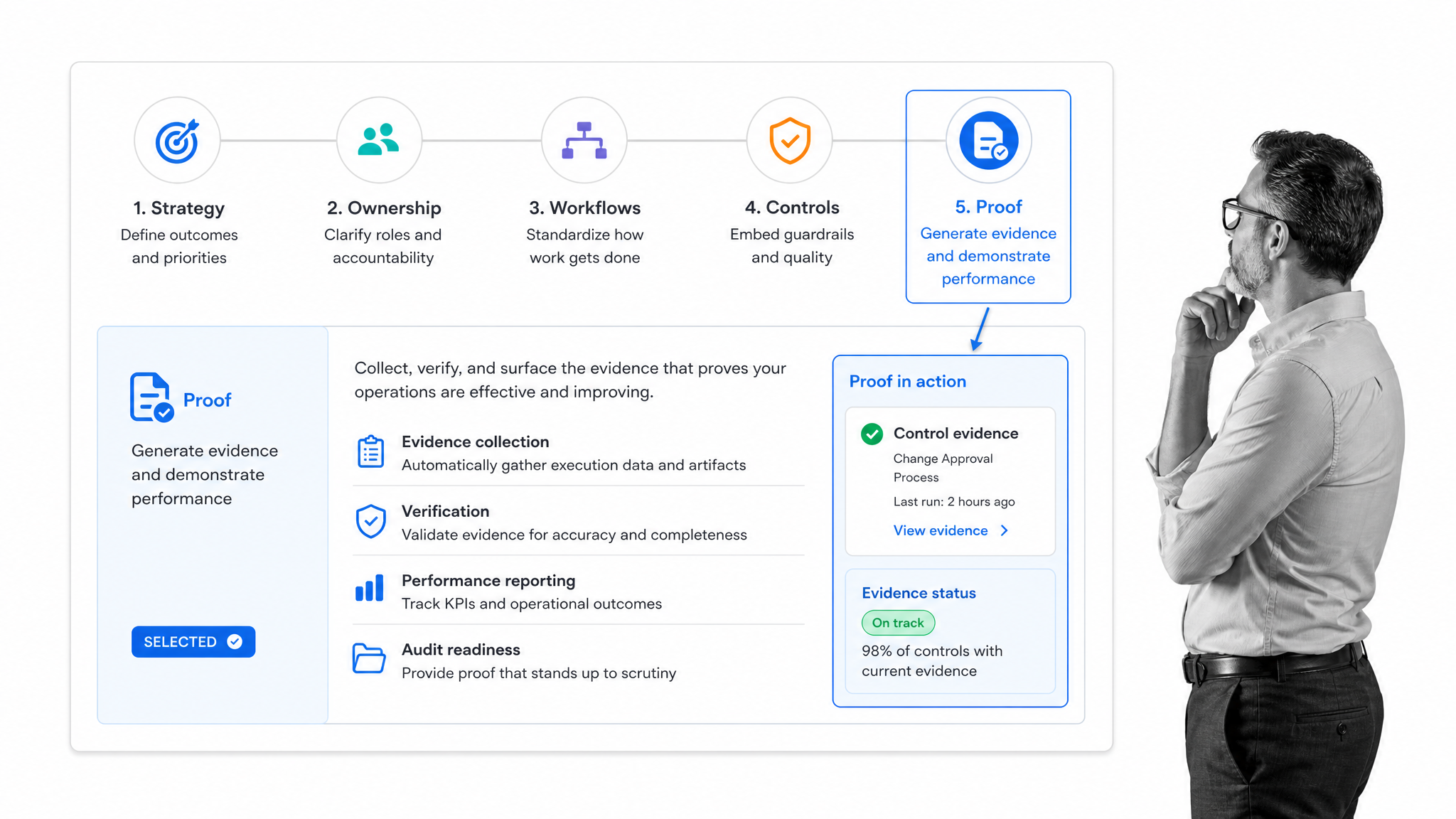
A good operations framework connects five layers:
- Strategy: the outcomes the operating system must support.
- Ownership: the roles, decision rights, and escalation paths for recurring work.
- Workflows: the steps, forms, assignments, and dependencies that move work forward.
- Controls: the required checks, approvals, evidence, and exception paths.
- Proof: the records, metrics, and audit history that show what happened.
This is where process documentation and execution separate. Documentation explains the work. An operations framework makes the work runnable, reviewable, and improvable.
Why it is not just a diagram
A diagram can help people understand the framework, but the framework itself has to change behavior. It should make it easier to launch the right process, assign the right owner, collect the right data, enforce the right approval, and review the right record.
If the framework lives only in a slide deck, the team will still operate through memory, meetings, and manual reminders. The test is whether a new person can use the framework to run real work without rebuilding the process from scratch.
Why an operations framework matters
An operations framework matters because execution gets messy as soon as work crosses teams. People use different names for the same process. Approvals happen outside the system. Metrics measure activity but not control. Leaders ask for status, and teams rebuild it manually every week.
It prevents process drift
Process drift happens when the documented process and the real process separate. A team changes a spreadsheet, updates a task board, or routes an approval in chat, but the official process never changes. Over time, nobody knows which version is true.
A framework reduces drift by connecting process design to execution. The same logic appears in ISO 9001 process approach guidance, which emphasizes understanding processes, criteria, resources, responsibilities, risks, and improvement as a connected system.
It gives leaders a useful operating language
Without a framework, operations conversations become too broad. One person talks about structure. Another talks about tools. Another talks about staffing. Another talks about policy. A framework gives the team shared language for the operating system itself.
The APQC Process Classification Framework is a useful reference because it gives organizations a taxonomy for comparing and improving processes. Your internal framework does not need to copy it, but it should create the same kind of shared map.
It makes accountability visible
Accountability is hard to enforce when the process is scattered across meetings, spreadsheets, docs, and email. A framework clarifies who owns the process, who owns each run, who reviews exceptions, and who can change the standard.
That is why a strong workflow management system matters. It turns accountability from a verbal agreement into a workflow that assigns, tracks, and records the work.
It creates proof instead of status theater
Status is not proof. A green dashboard can still hide skipped steps, stale records, and informal approvals. A framework should define what evidence matters for each process and where that evidence is captured during execution.
Proof is especially important for compliance, quality, finance, HR, IT, legal, vendor management, and customer operations. Those teams need more than updates. They need a reliable record of what happened.
Operations framework components
A complete operations framework has seven components. The components can be simple at first, but each one needs an owner and a place in the operating rhythm.
1. Operating principles
Operating principles describe how the company makes tradeoffs. They should be practical enough to guide decisions: standardize before automating, document before delegating, escalate risk early, review proof where the work happens, and improve after real runs.
2. Process architecture
Process architecture is the map of recurring work. It groups processes by business function, customer journey, risk area, operating rhythm, or value stream. The goal is not a perfect taxonomy. The goal is to help people find the right process and understand how it connects to others.
A process library checklist can help teams inventory existing workflows, identify owners, and find gaps before they automate anything.
3. Ownership and decision rights
Every process needs a process owner. Every run needs task owners. Every exception needs a decision path. Without this layer, the framework becomes a reference library instead of an operating system.
4. Workflow execution
Workflow execution turns the framework into daily work. This includes tasks, forms, due dates, dependencies, assignments, and handoffs. Buyers comparing workflow management software should look for tools that enforce the workflow, not just display it.
5. Controls and approvals
Controls define what cannot be skipped. A control might be a required field, an approval gate, an evidence upload, a risk tier, a signoff, or a conditional path. The right control depends on the risk of the process.
6. Metrics and review cadence
Metrics tell leaders whether the framework is working. Useful metrics include cycle time, late tasks, exception rates, rework, approval aging, missed handoffs, and recurring bottlenecks. Review cadence decides who looks at those metrics and what they are allowed to change.
7. Records and proof
Records close the loop. The framework should preserve task history, decisions, field values, files, comments, approvals, and completion state. When the team needs to answer what happened, the answer should be in the workflow record, not reconstructed from chat.
Common failure patterns
Operations frameworks usually fail for practical reasons, not because the concept is wrong. The first failure is ownership without authority. A process owner is named, but they cannot update the workflow, enforce standards, or get reviewers to act. The second failure is documentation without execution. The process is written clearly, but the daily work still happens in email and side spreadsheets.
The third failure is measurement without consequence. Leaders review dashboards, but no one changes the workflow when late tasks, exceptions, and rework repeat. The fourth failure is control overload. Teams add approvals to every step until people avoid the framework completely. A strong framework avoids these traps by keeping ownership real, putting work in the workflow, reviewing proof, and matching controls to actual risk.
Operations framework vs operating model
An operations framework and an operating model are closely related, but they are not identical. An operating model describes how the organization is designed to deliver value. An operations framework is the practical system that helps that design run consistently.
Operating model
An operating model usually includes structure, governance, talent, processes, technology, performance management, and culture. McKinsey operating model research frames operating model design as a set of choices leaders make to close the gap between strategy and performance.
The operating model answers broad questions: how the business is organized, how decisions are made, how capabilities are built, and how value flows to customers.
Operations framework
The operations framework answers execution questions: which workflows run, who owns them, what controls apply, what systems are involved, how exceptions route, and what proof is captured.
How they work together
The operating model sets the organizational design. The operations framework makes that design runnable. If the operating model says customer onboarding is owned by a cross-functional team, the operations framework defines the actual onboarding workflows, handoffs, approvals, records, and metrics.
This is why business process management and operating model design often meet in the same conversation. Strategy needs structure, but structure still needs repeatable execution.
How to build an operations framework
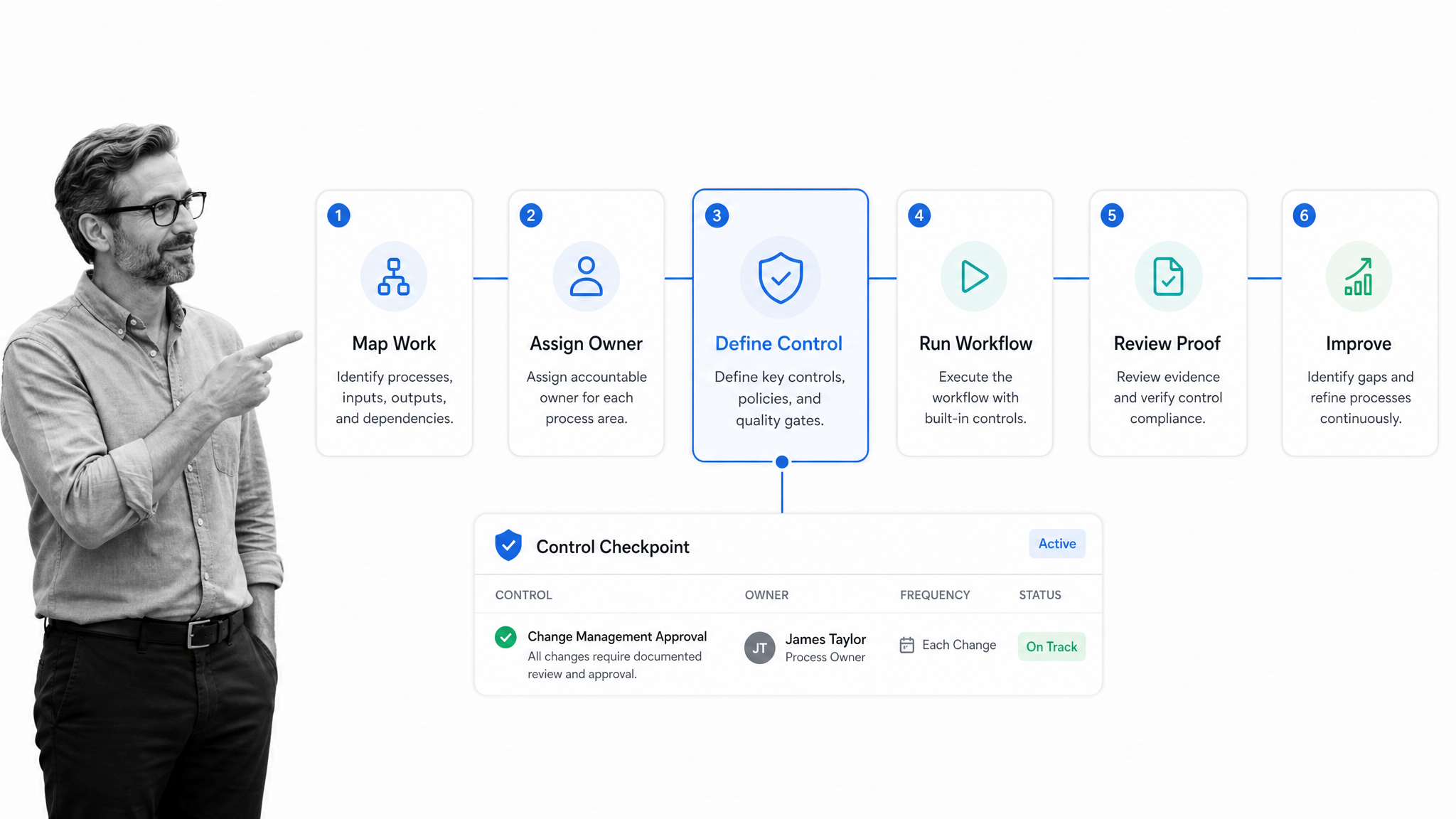
Build an operations framework by starting with one operating area and making it reliable before expanding. A giant company-wide design project usually creates more theater than control. A focused workflow family gives you faster proof.
Step 1: Pick the operating area
Choose an area where recurring work creates visible pain or risk. Good starting points include employee onboarding, vendor management, customer implementation, incident response, quality checks, audit evidence, access requests, policy approvals, and monthly close.
Step 2: Inventory the work
List the recurring processes in that area. For each process, capture the trigger, owner, systems involved, inputs, outputs, approvals, exceptions, and current records. Do not start with the ideal process. Start with how work happens today.
Step 3: Define owners and decision rights
Assign a process owner, run owners, reviewers, and approvers. Define who can change the workflow and who reviews performance. Ownership is the difference between a helpful map and a framework people actually follow.
Step 4: Convert the process into workflows
Translate the recurring work into executable steps. Use forms for intake, assignments for accountability, due dates for rhythm, and workflow logic for variation. A standard operating procedure template is a useful baseline, but the execution layer is what makes it operational.
Step 5: Add controls where risk exists
Add controls only where they protect quality, compliance, security, finance, customer experience, or operational reliability. Too few controls create risk. Too many controls create avoidance. The framework should match the risk of the process.
Step 6: Decide what proof matters
For each workflow, decide what record proves the work was done correctly. That may include a completed task, an uploaded file, a field value, an approval decision, a comment, a system update, or an exception note.
Step 7: Review and improve
Review real runs after launch. Look for late tasks, repeated exceptions, confusing instructions, missing fields, manual updates, and approvals that happen outside the workflow. The framework should get clearer as the team learns from execution.
Step 8: Publish the framework where work starts
The final step is making the framework easy to use at the moment work begins. Put workflow run links, intake forms, owner guidance, and review expectations where employees already start the process. If the framework is hidden in a planning folder, teams will keep using the old route. If it is embedded in the launch path, the standard becomes the easiest path.
Run your operations framework in Process Street
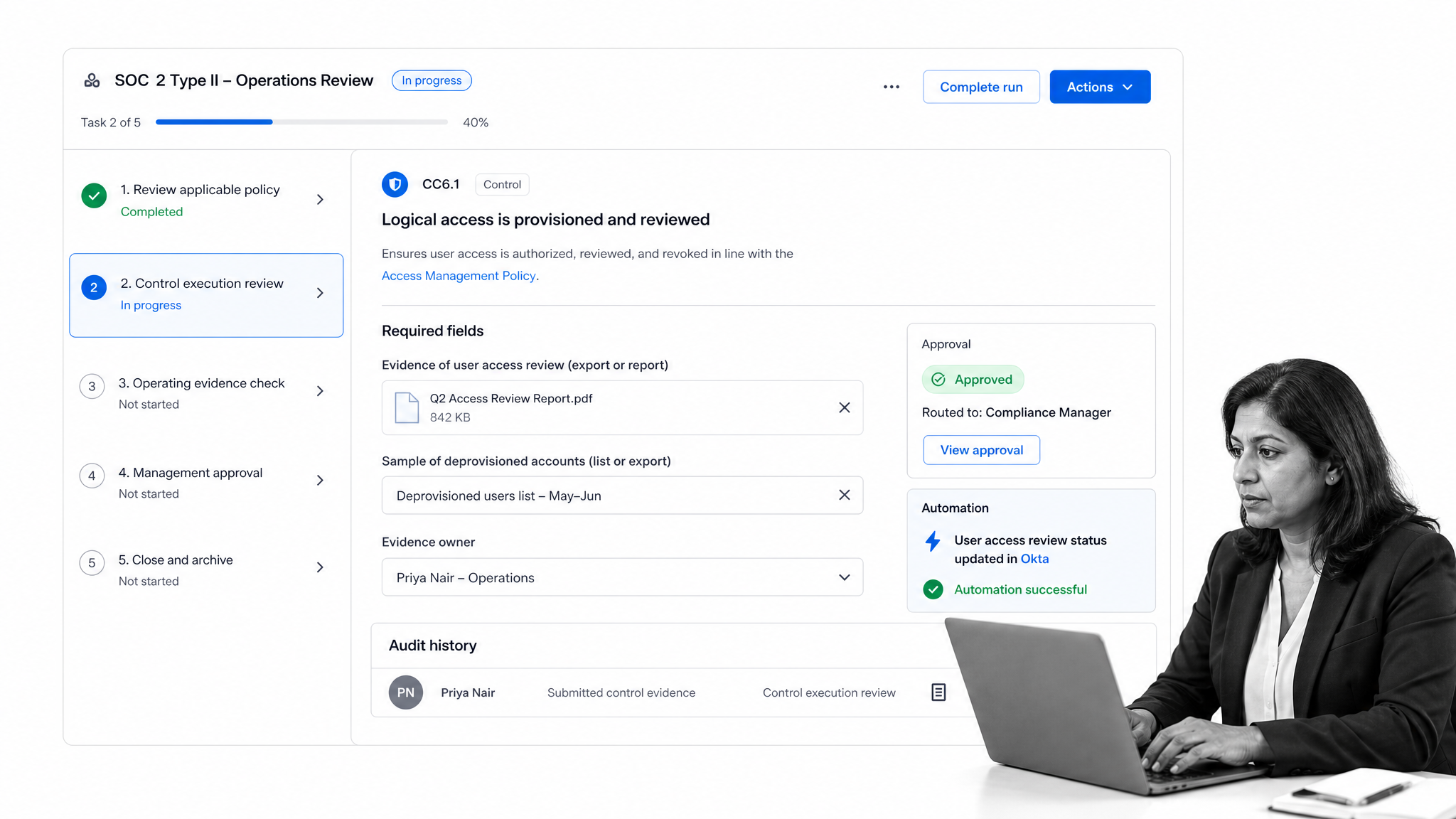
Process Street helps teams run an operations framework by turning procedures into workflows with assigned tasks, forms, approvals, conditional logic, automations, and audit history. The framework does not sit beside the work. It becomes the way work happens.
Build the workflow library
Start by organizing workflows around the operating areas you need to control. Group them by team, risk, customer journey, department, or operating rhythm. Clear workflow names help people launch the right process without asking in chat.
Run workflows from the right entry point
Process Street help docs describe running workflows from search, dashboards, schedules, run links, email, CSV, and automations. That flexibility matters because operations frameworks should meet the team where work starts.
Use approvals and conditional paths
Built-in approvals and conditional logic help the same workflow handle low-risk and high-risk paths without creating separate shadow processes.
Connect the framework across systems
Process Street has direct, universal integrations to 5,000+ systems. Need a new one? An AI agent builds it on the fly. That helps an operations framework move across the systems teams already use instead of turning into another isolated tracker.
Protect sensitive operations data
Operations frameworks often touch employee, customer, vendor, finance, and compliance information. The FTC data security guidance is a useful baseline: know what you collect, protect what you keep, and limit unnecessary exposure.
Use the record as proof
The workflow run becomes the record. It shows owners, task state, field values, files, comments, approval decisions, automation cues, and completion history. That is how a framework turns from an idea into proof of execution.
Operations framework examples
Operations frameworks look different by team, but the pattern stays consistent: define the recurring work, assign ownership, run the workflow, control exceptions, and preserve proof.
Employee onboarding
An employee onboarding checklist can connect HR, IT, payroll, manager tasks, policy acknowledgments, equipment requests, and training. The framework keeps the path consistent while role, location, and equipment needs change the details.
Vendor management
A vendor management workflow can organize intake, risk review, security checks, legal review, finance approval, renewals, and offboarding. The framework prevents vendor decisions from disappearing into email.
Quality operations
A quality control checklist can standardize inspections, nonconformance reviews, corrective actions, and final signoff. The framework makes quality work repeatable instead of dependent on individual memory.
Compliance operations
A compliance operations framework can connect policy ownership, control execution, evidence collection, exception review, and audit preparation. The goal is not more documentation. The goal is compliance by default, where proof is created while work happens.
Customer operations
A customer operations framework can standardize onboarding, renewals, escalations, handoffs, implementation tasks, and health checks. It gives customer-facing teams a shared operating system instead of a collection of personal playbooks.
Operations framework FAQs
What is an operations framework?
An operations framework is the structure a business uses to turn strategy into repeatable execution. It defines how work is organized, who owns each process, which workflows run it, which controls apply, and what proof shows the work was completed correctly.
What should an operations framework include?
An operations framework should include operating principles, process architecture, ownership, workflow execution, controls, metrics, review cadence, and records. The details can be simple at first, but each component needs an owner and a place in the operating rhythm.
How is an operations framework different from an operating model?
An operating model describes how the organization is designed to deliver value. An operations framework is the practical system that makes that design runnable through workflows, owners, controls, metrics, and proof.
How do you build an operations framework?
Start with one operating area, inventory recurring work, assign owners and decision rights, convert processes into workflows, add controls where risk exists, define proof, and review real runs for improvement.
Who owns an operations framework?
Operations leadership usually owns the framework, but each process needs a clear process owner. Reviewers, approvers, compliance leaders, managers, and system owners may own specific parts of the framework.
Can Process Street run an operations framework?
Yes. Process Street can run an operations framework as workflows with tasks, forms, assignments, approvals, conditional logic, automations, and audit history so teams can enforce standards and prove execution.