Turn every policy into automated workflows with built-in enforcement and audit-ready proof.



Operations Infrastructure
An operations infrastructure is the connected system a business uses to turn recurring work into controlled execution. It combines process design, workflows, ownership, automation, integrations, measurement, and proof so work moves the right way without depending on memory or constant supervision.
The goal is not to add another dashboard. The goal is to create an operating layer that tells people and systems what should happen, routes each case through the right path, catches exceptions, and preserves a reliable record of completion.
This guide explains how operations infrastructure works, what it should include, how to evaluate one, and how Process Street helps operations teams connect standards to daily execution.
In this article, we are going to cover:
- What is operations infrastructure?
- Why businesses need operations infrastructure
- Core components of operations infrastructure
- How to design operations infrastructure
- How to choose operations infrastructure
- How Process Street supports operations infrastructure
- Operations infrastructure implementation roadmap
- How to measure operations infrastructure
- FAQs
What is operations infrastructure?
Operations infrastructure is the shared foundation of workflows, roles, systems, controls, data, and review routines that keeps repeatable work reliable as a business scales. It brings the rules, people, workflow steps, systems, and evidence for a business process into one coordinated model. Instead of asking each employee to remember what comes next, the solution makes the approved path executable.
This can apply to employee onboarding, customer implementation, vendor review, policy approval, incident response, finance close, quality checks, access requests, procurement, or any other recurring process where missed steps create cost or risk.
An operating model, not a single feature
A form alone is not operations infrastructure. Neither is a project board, automation rule, dashboard, or document repository. Each can help, but a complete solution connects them around the lifecycle of work: define the standard, receive the case, execute the workflow, make decisions, coordinate systems, handle exceptions, and preserve proof.
A broader operations management solution may also cover planning, capacity, and portfolio-level oversight. The operations infrastructure described here focuses on the execution layer that makes recurring work reliable.
A shared source of operational truth
Teams often split operational truth across documents, chat threads, spreadsheets, inboxes, and system records. That fragmentation creates two versions of reality: the official procedure and the way work actually gets done. Operations infrastructure closes that gap by putting the current rules inside the workflow and keeping the execution record beside them.
A control loop for real work
The most useful mental model is a control loop. The solution receives input, applies the right process, checks important decisions, records the result, and feeds performance data back into improvement. IBM describes operations management as the planning, organizing, and supervision of business practices, and an execution-focused solution turns that management discipline into a repeatable system.
That makes the solution related to, but more action-oriented than, general process solution design. The operating model is only complete when the workflow can actually run.
Why businesses need operations infrastructure
Businesses need operations infrastructure when coordination costs begin to grow faster than the work itself. The warning signs are familiar: requests arrive through too many channels, owners are unclear, approvals stall, the same exception gets solved repeatedly, and reporting requires manual reconstruction.
Complexity turns tribal knowledge into risk
A small team can carry process knowledge in conversation. As volume, regulation, geography, and specialization increase, that approach breaks. New employees learn different versions of the process. Experienced operators become bottlenecks. Critical details live in private notes or memory.
A structured business operations system captures those decisions so the process can survive team changes without freezing the business in rigid bureaucracy.
Handoffs hide the real constraint
Most recurring work crosses teams and tools. A customer handoff may involve sales, finance, legal, implementation, and support. A vendor review may involve procurement, security, compliance, and the business owner. Without one controlled path, every handoff becomes a place where context, time, or accountability disappears.
Operations infrastructure makes handoffs explicit. It assigns owners, carries data forward, waits for required decisions, escalates delays, and prevents the next step from starting without the information it needs.
Proof cannot be added at the end
If a business needs evidence for an audit, customer review, quality check, or internal control, that evidence should be captured during execution. Asking people to rebuild proof later is slow and unreliable. A strong solution treats required evidence as part of done, not as administrative cleanup.
Automation needs operating boundaries
Automation can move work quickly, including the wrong work. The solution must define where an automated action is allowed, where a person must review, what data is required, and what happens when the standard path no longer fits. Those boundaries let teams automate with confidence instead of adding invisible risk.
Core components of operations infrastructure
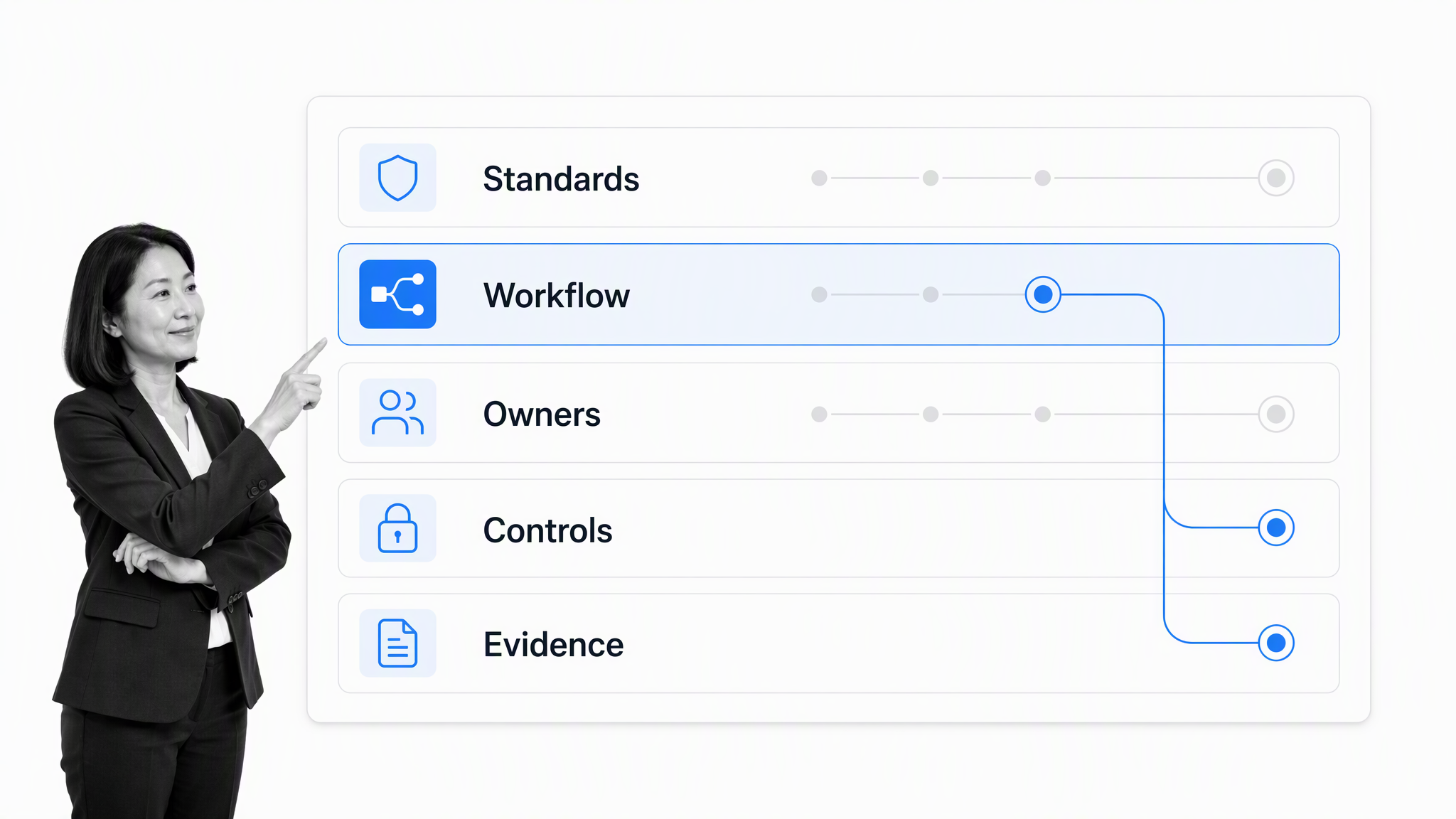
A complete operations infrastructure needs a small set of connected components. The exact software stack can vary, but the operating jobs do not. If one component is missing, the team usually compensates with manual follow-up.
1. Standards and process knowledge
The solution needs a current definition of how work should be done. That may include policies, SOPs, checklists, decision rules, examples, and control requirements. Those standards become useful when they are connected to the work people perform.
Start with a clear standard operating procedure template for the process, then translate each enforceable requirement into a task, field, rule, or decision point.
2. Structured intake
Every process needs a defined start. Structured intake captures the request type, business context, urgency, owner, risk, attachments, and expected outcome. It should ask only for information that changes routing or execution.
3. Executable workflows
The workflow is the spine of the solution. It assigns work, orders dependencies, sets due dates, carries data, triggers actions, and shows progress. It should guide the standard path while allowing controlled branches for different cases.
A process map helps expose the current path before the team turns it into executable logic. Keep the first version focused on one high-value process instead of mapping the whole company.
4. Decision and approval controls
Important decisions should happen at the point where risk changes hands. Approvals, reviews, required evidence, stop conditions, and exception routes create control without forcing managers to supervise every routine task.
The NIST Cybersecurity Framework is one example of a framework that makes governance, roles, oversight, and risk decisions explicit. The same design principle applies to operational workflows: define who decides, what evidence they need, and what action follows.
5. Integrations and agentic execution
Operations rarely live in one system. The solution should move data and actions across the tools already used by finance, HR, sales, customer teams, and IT. Integration is not the headline; it is the connective tissue that prevents copy-and-paste work from becoming the process.
6. Records, dashboards, and improvement
A useful operations dashboard answers operational questions: what is late, what is blocked, where exceptions cluster, and whether proof is complete. The records underneath it should be detailed enough to diagnose the cause, not just display the symptom.
How to design operations infrastructure
Design the solution from the work outward. Buying software first often produces disconnected features with no shared operating architecture. Start with the outcome, define the boundaries, then choose the workflow and system behavior required to produce it.
Step 1: Choose a process with visible consequences
Pick a recurring process where delays, errors, or missing evidence matter. Good starting points have clear triggers, repeated handoffs, measurable outcomes, and enough volume to reveal patterns. Avoid a process that changes completely every time.
Step 2: Define the start, finish, and owner
Write down what triggers the process, what must be true before it starts, who owns the overall result, and what evidence proves completion. This prevents the workflow from becoming an endless checklist with no clear service boundary.
Step 3: Map decisions before tasks
Tasks are easy to list. Decisions determine whether the workflow works. Identify the questions that change the path: Is this request complete? Is it high risk? Does it require legal review? Is the value above a threshold? Is the evidence sufficient? Then build tasks around those decisions.
Step 4: Design the exception path
The standard path is rarely the hard part. Decide how the solution handles missing data, rejected approvals, unavailable owners, failed integrations, unusual risk, and work that no longer fits the original request. Exceptions need owners and time limits too.
Step 5: Attach evidence to the work
Specify what each important task must leave behind: a form value, file, comment, approval decision, system update, timestamp, or review record. Evidence requirements should be proportional to the risk and useful to the person who will review the process later.
Step 6: Test with real cases
Run the solution with a small group and real work. Watch where people leave the workflow, duplicate data, wait for context, or invent side channels. Those behaviors reveal design gaps more reliably than a feature review.
Use a process improvement tracker to assign each finding, test a change, and record whether the change improved the outcome.
How to choose operations infrastructure
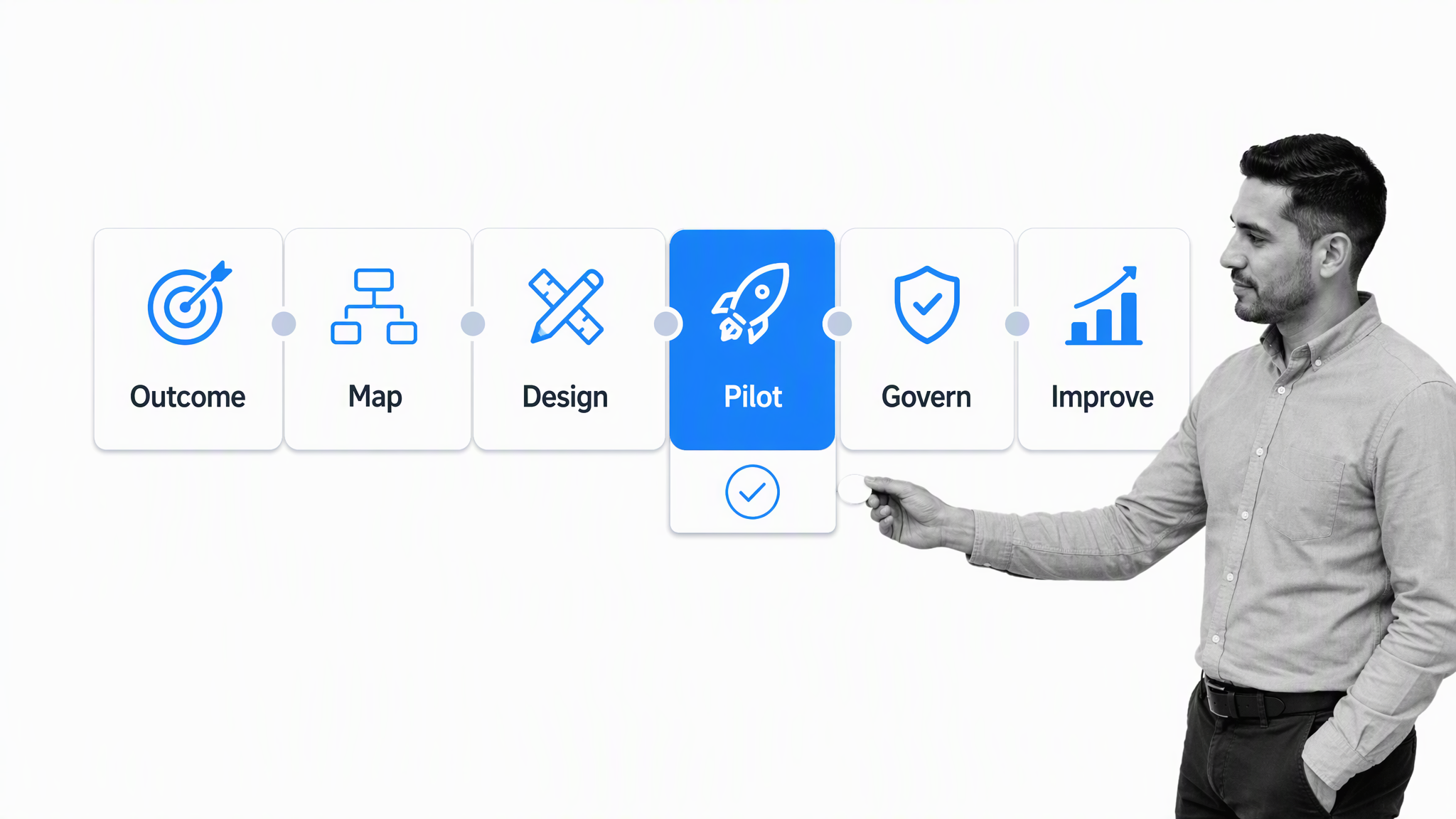
Evaluate operations infrastructure by testing whether its shared services, governance, and execution layer support real work across routine, high-risk, and exceptional cases. A long feature checklist can hide the central question: will this system help the team execute correctly, handle exceptions, and prove what happened?
Evaluate execution depth
Can the solution represent dependencies, owners, due dates, form data, conditional paths, approvals, and recurring triggers without forcing the team into custom code? Can it keep a long-running process understandable after the original builder leaves?
Evaluate governance and proof
Test how the solution handles policy changes, permissions, required fields, approvals, completion records, and audit history. Ask to reconstruct one completed case from start to finish. If that is difficult during evaluation, it will be worse under audit pressure.
Evaluate integration as part of the workflow
Do not count connectors in isolation. Test the specific handoffs your process needs. Verify which system starts the workflow, which data enters, which actions occur elsewhere, what happens on failure, and where the authoritative record remains.
Evaluate change speed
Operations change. The team should be able to update a field, rule, owner, approval, or automation without opening an IT project. Fast change still needs governance, but the operating team should not be trapped behind a development queue for routine improvements.
Evaluate adoption in the flow of work
A solution only works if people use it when pressure rises. Test the experience for requesters, operators, approvers, and reviewers. The right path should be clear, the amount of required input should make sense, and each role should see the context it needs.
The GOV.UK Service Standard emphasizes understanding users and solving the whole problem. That is a useful evaluation lens for internal operations too: design around the complete journey, not one team or one screen.
The broader operations technology landscape can include analytics, planning, monitoring, and specialized systems. Your operations infrastructure should coordinate those systems instead of trying to replace every one of them.
How Process Street supports operations infrastructure
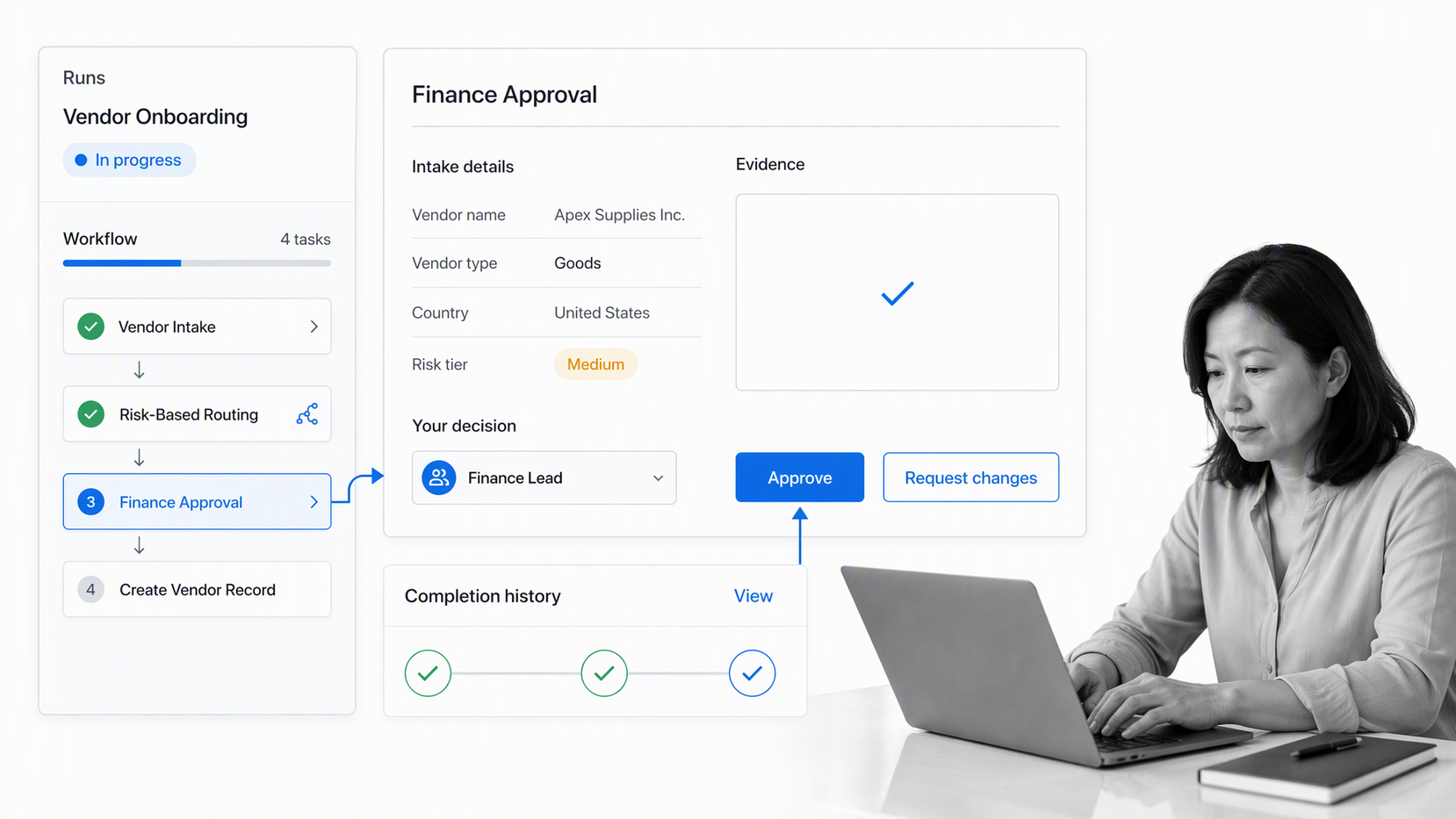
Process Street supports operations infrastructure by turning standards into workflows that run. Teams can collect structured intake, assign work, branch based on case data, route approvals, coordinate actions across systems, and preserve the execution record in one place.
Build the standard into the workflow
The process owner can translate an SOP into tasks, required form fields, decision rules, owners, and due dates. Operators follow the current path while they work, so the standard is not a separate document they must remember to consult.
Structured workflow forms collect the case data that drives the process. That data can stay attached to the workflow instead of being copied across messages and spreadsheets.
Route each case through the right path
Process Street conditional logic can change which steps appear based on form answers. A low-risk standard case can move quickly, while a high-risk or incomplete case can require more review.
Keep decisions inside execution
Process Street approvals keep the decision, reviewer, context, and outcome attached to the workflow. This reduces the need to chase decisions through separate email or chat threads.
Connect the operating stack
Process Street has 5,000+ integrations. The Process Street integrations library helps workflows coordinate the systems teams already use while preserving one controlled process record.
Turn performance signals into assigned improvement
The workflow record shows where work waits, where exceptions occur, and where evidence is repeatedly missing. Teams can turn those signals into specific changes instead of relying on anecdotes or one-off cleanup.
Operations infrastructure implementation roadmap
Implement the solution in stages. A phased rollout creates proof, exposes design mistakes early, and gives the team a working pattern it can reuse.
Stage one: Establish the baseline
Measure current cycle time, rework, handoffs, missing evidence, and exception volume. Capture the current process without pretending every local workaround is part of the standard.
Stage two: Launch one controlled workflow
Build the minimum workflow that can run the process safely. Include the critical decisions and evidence, but postpone decorative reporting and edge-case automation until real use shows they are needed.
A change management process can help the owner plan communication, training, rollout, and feedback without treating adoption as an afterthought.
Stage three: Connect high-value handoffs
Automate the transfers that create the most delay or error. Start with stable actions and clear failure handling. Keep a person in the loop where judgment, risk, or irreversible change requires review.
Stage four: Expand by pattern
Reuse the proven design pattern for adjacent processes: common intake fields, ownership rules, evidence requirements, reporting definitions, and exception handling. Reuse the operating logic, not a bloated one-size-fits-all workflow.
Stage five: Govern the portfolio
As the number of workflows grows, define process owners, review dates, change approval, naming standards, archive rules, and a method for identifying duplicate processes. Governance protects speed by keeping the operating layer understandable.
How to measure operations infrastructure
Measure whether the operations infrastructure improves execution, control, and learning. Each metric should lead to a decision. If a number cannot change a workflow, owner, rule, or investment, it is probably noise.
- Cycle time: total time from trigger to verified completion.
- Active work time: time spent progressing the case instead of waiting.
- Handoff delay: time lost between owners, teams, or systems.
- First-pass completion: work completed without being returned for missing information or correction.
- Exception rate: cases that leave the standard path and the reasons why.
- Approval aging: decisions that wait beyond the expected window.
- Evidence completion: cases closed with every required record attached.
- Automation reliability: automated actions that complete successfully and recover cleanly when they fail.
Pair speed with control
A faster process is not better if errors, exceptions, or evidence gaps rise. Track speed and control together. The solution should reduce unnecessary waiting while increasing confidence that the approved path was followed.
Review the flow, not just the average
Averages can hide blocked groups and risky edge cases. Review performance by request type, risk level, team, owner, and exception reason. Lean Enterprise Institute describes value stream mapping as a way to see the flow of material and information, which is useful when the visible delay is not the real constraint.
Close the improvement loop
When a metric identifies a problem, assign the change, update the workflow, and verify the result. A structured root cause analysis and corrective action workflow keeps improvement work from disappearing into meeting notes.
FAQs
What is operations infrastructure?
Operations infrastructure is the connected system a business uses to define, run, control, and improve recurring work. It combines process knowledge, workflows, ownership, automation, integrations, measurement, and proof.
What problems does operations infrastructure solve?
It solves fragmented intake, unclear ownership, inconsistent execution, slow handoffs, stalled approvals, repeated exceptions, and missing completion evidence. The solution creates one controlled path for work and a record of what happened.
What should operations infrastructure include?
It should include standards, structured intake, executable workflows, decision controls, integrations, exception handling, audit records, dashboards, and an improvement loop. The exact technology can vary, but these operating jobs must be covered.
How do you choose operations infrastructure?
Test the solution against a real process. Evaluate execution depth, governance, proof, integration behavior, change speed, exception handling, and adoption for every role involved.
How long does it take to implement operations infrastructure?
Implementation depends on process complexity and scope. A focused team can begin with one controlled workflow, validate it with real cases, connect the highest-value handoffs, and then expand by pattern.
How does Process Street support operations infrastructure?
Process Street turns standards into executable workflows with structured intake, assignments, conditional paths, approvals, integrations, automation, and audit history. Teams can coordinate recurring work while keeping proof attached to execution.