Turn every policy into automated workflows with built-in enforcement and audit-ready proof.



Process Technology

Process technology is the combination of workflow design, software, automation, data, integrations, and controls that helps an organization run a business process consistently. For operations teams, that means every step has an owner, a trigger, and a visible record of completion.
It is not one tool. It is the operating layer that turns a process from instructions in a document into work that can be assigned, automated, monitored, improved, and proven.
This guide explains what process technology includes, how it differs from process automation, which capabilities matter, and how to build a stack that improves execution without creating more tool sprawl.
In this article, we are going to cover:
- What process technology means
- Why process technology matters
- Process technology components
- Process technology versus process automation
- How to implement process technology
- Process technology in Process Street
- How to evaluate process technology
- FAQs
What process technology means
Process technology connects the design of a business process to the systems that execute it. A process can exist as a policy, checklist, workflow diagram, SOP, form, approval path, system integration, or audit control. Technology gives that process structure, speed, routing logic, and memory.
A simple example is employee onboarding. The process might include collecting documents, provisioning access, assigning training, getting manager approvals, and confirming policy acknowledgments. The process technology includes the workflow engine, form fields, task assignments, integrations, notifications, approval gates, and record of completion.
The goal is controlled execution
The point is not to digitize every step for its own sake. The point is to make the right work happen the right way. That means clear owners, visible status, automation where it helps, and proof when a customer, manager, auditor, or regulator asks what happened.
That is why process technology sits close to business process management. BPM defines how processes are identified, modeled, improved, and controlled. Technology makes those ideas executable across teams and systems.
Controlled execution also creates a shared operating language. A manager can talk about a late approval, a missing evidence file, or a recurring exception without asking five people to reconstruct the story. The process record shows the state of the work.
Process technology is broader than software selection
A team can buy a workflow platform and still have weak process technology. The process may be unclear, the data model may be wrong, or the automation may trigger the wrong work. Strong process technology starts with the operating problem and then chooses the tools, rules, and integrations that make the process reliable.
This is why implementation should include both operators and system owners. Operators know where work breaks in practice. System owners know which applications, permissions, data fields, and integration limits shape what can be automated safely.
- Workflow design defines what should happen.
- Data defines what the system needs to know.
- Automation moves repeatable work forward.
- Integrations connect the process to systems of record.
- Controls prove that the process followed the right path.
Why process technology matters
Process technology matters because manual process management does not scale well. Teams can run a handful of recurring tasks through memory, email, spreadsheets, and meetings. Complexity changes the equation.
As soon as a process crosses departments, includes customer data, requires approvals, affects compliance, or depends on multiple systems, informal coordination starts to break. Steps are skipped. Versions drift. Owners are unclear. Data is copied by hand. Exceptions disappear into private messages.
It reduces operational drag
Good process technology removes avoidable coordination work. It can assign the next task automatically, route a request to the right approver, prefill information from another system, alert the owner when a step is late, and record the result without another spreadsheet.
That is the practical value behind workflow automation. Automation is useful when it reduces friction inside a clearly defined process. It is less useful when it simply moves chaos faster.
The improvement compounds when the same process runs many times. A single saved handoff may not feel strategic. Hundreds of clean handoffs across onboarding, approvals, reviews, renewals, and exception handling become a different operating model.
It improves quality and control
Technology also makes quality easier to enforce. Required fields prevent incomplete work. Conditional logic shows the right task for the situation. Approvals block risky releases. Audit trails show who did what. Reporting highlights where the process breaks.
External guides from IBM business process management guide and TechTarget BPMS definition describe business process management systems as tools for designing, executing, monitoring, and improving processes. The same principle applies at the team level: technology should make the process easier to run and easier to trust.
That trust matters when process outcomes affect customers, employees, financial controls, security, or compliance. A leader should not have to rely on memory to know whether a required review happened. The process should produce its own evidence.
Process technology components
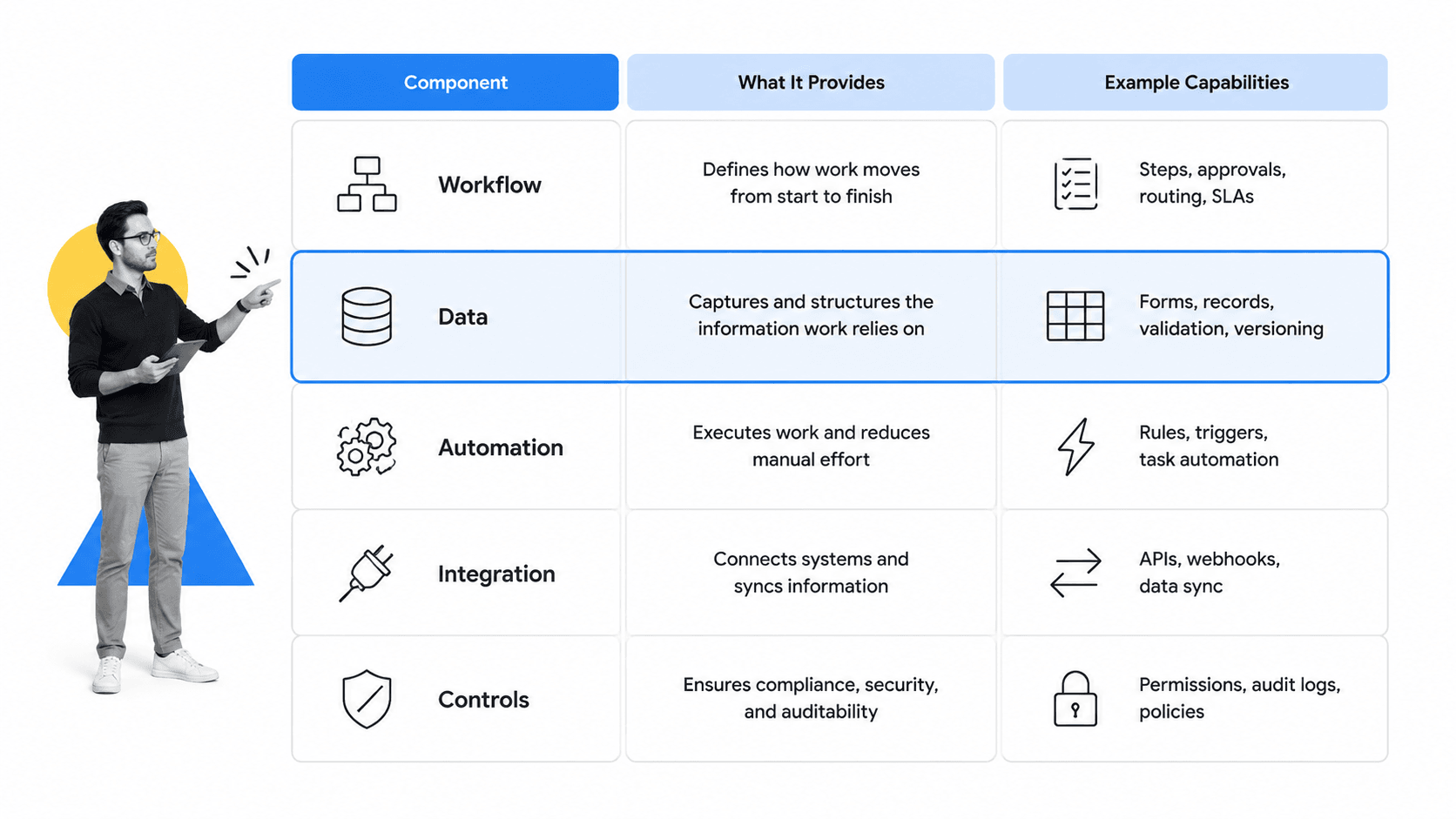
A useful process technology stack has several layers. Some organizations buy one platform that covers most of them. Others combine a workflow tool, document repository, automation platform, analytics layer, and systems of record.
Workflow layer
The workflow layer defines the sequence of work. It includes tasks, owners, due dates, instructions, form fields, routing rules, and completion states. This is where a process becomes something people can run repeatedly.
Resources on process documentation, business process documentation, and workflow documentation are useful because technology works best when the underlying process is documented clearly.
The workflow layer should also be easy to change. A process that requires a developer ticket for every small routing or field update will drift from reality. Operators need a governed way to adjust the workflow when the work changes.
Automation layer
The automation layer handles predictable work. It can send notifications, create records, copy approved data, assign tasks, generate documents, update systems, and start downstream workflows. The goal is to remove repetitive handoffs while keeping the process visible.
TechTarget business process automation definition defines business process automation as using technology to complete business processes with minimal human intervention. In practice, teams still need human judgment for exceptions, approvals, and customer-facing decisions.
Data and integration layer
Processes need data from CRMs, HRIS systems, ERPs, ticketing tools, document repositories, spreadsheets, and communication platforms. Integrations reduce duplicate entry and keep systems aligned. They also create risk if the wrong data moves without validation.
Control and governance layer
Controls define what cannot be skipped. They include permissions, required fields, approval gates, version control, audit trails, exception handling, retention rules, and review cadences. This layer matters most in regulated or high-stakes work.
Related pages on AI-driven compliance, operational risk management framework, and compliance as proof of control show how process technology becomes more valuable when proof and control are built into execution.
Governance also decides who can change the process itself. If anyone can alter a required approval or remove an evidence field, the process record becomes unreliable. Strong process technology separates routine execution from controlled process design changes.
Process technology versus process automation
Process technology and process automation are related, but they are not interchangeable. Process automation is one capability inside a broader process technology system.
Automation moves work
Automation is about action. It triggers reminders, updates records, sends messages, starts tasks, routes requests, or collects data. It is often the easiest benefit to measure because the team can see manual steps disappear.
Process technology governs the system
Process technology decides what should be automated, what needs review, where data comes from, which controls apply, and how performance is measured. It includes the process model, operating rules, data requirements, integration architecture, controls, and improvement loop.
That distinction prevents a common mistake: automating a bad process. If the process has unclear ownership, weak data, or missing controls, automation can make the problem faster and harder to inspect.
A useful rule is to automate only after you know the exception path. If the happy path is clear but exceptions are handled through side conversations, the workflow is not ready. Design the exception route first, then let automation accelerate the parts that are stable.
BPM, workflow, and process intelligence
Different categories emphasize different parts of the system. BPM focuses on managing and improving processes. Workflow technology focuses on task execution and routing. Process intelligence focuses on discovering and analyzing how work actually flows. A mature stack can use all three.
Dassault Systemes BPM overview frames BPM as a systematic approach to improving workflows and processes. The technology layer should support that discipline, not replace it.
How to implement process technology

Implementation should start with one process that has visible friction. Do not begin by mapping the entire company. Pick a recurring workflow where delays, skipped steps, rework, or missing proof already create pain.
Step 1: Define the process outcome
Start with the result the process must produce. A completed onboarding. An approved policy. A validated vendor. A resolved incident. A released change. The outcome should be concrete enough that everyone can agree whether it happened.
Step 2: Map the current path
Document the real process, including manual workarounds. Identify each trigger, decision, owner, document, system, approval, and exception path. Mark which steps add value and which exist because tools do not talk to each other.
This mapping step should include the people who do the work, not only the people who manage it. The hidden process often lives in screenshots, saved email drafts, copied spreadsheet tabs, and private notes. Those details reveal what the technology actually needs to support.
Step 3: Design the controlled workflow
Turn the process into a workflow with required fields, task owners, due dates, conditional paths, and approval gates. Use business process improvement templates or a workflow management template when you need a starting structure.
Step 4: Add automation carefully
Automate the repeatable steps first. Keep human review where risk or judgment matters. For example, the system can gather required evidence, but a manager may still need to approve an exception before the workflow continues.
Features like conditional logic and approvals matter because they let the process adapt while preserving control.
Step 5: Measure and improve
Track cycle time, late tasks, skipped steps, approval bottlenecks, exception volume, rework, and completion quality. Review those signals regularly. Process technology should improve as the team learns how the work actually behaves.
Improvement does not always mean adding more automation. Sometimes the right fix is removing a redundant approval, simplifying a field, splitting a process into two workflows, or changing the owner of a handoff. The technology should make those decisions visible.
Process technology in Process Street

Process Street supports process technology by turning process documentation into executable workflows with assignments, conditional logic, approvals, automations, file uploads, forms, and audit history.
That means a process does not have to live as a static SOP while execution happens somewhere else. The procedure, work instructions, task completion, evidence, and approval record can stay connected.
Turn process knowledge into runnable work
Process owners can build workflows for onboarding, vendor review, change control, quality checks, compliance tasks, customer operations, and recurring approvals. Each run gives the team the current task list, required information, and next action.
Keep controls inside the workflow
Approvals, required fields, and conditional branches help prevent skipped steps. When a process requires proof, the workflow can collect evidence while the work happens rather than asking the team to reconstruct it later.
This is especially useful for recurring compliance and operations work. The workflow can require the evidence, route the approval, and preserve the activity history as a natural byproduct of execution. The team does not need a separate audit scramble to prove the basics.
Connect work across systems
Process Street can sit alongside systems of record and communication tools. The goal is not to replace every application. The goal is to make the process that crosses those applications consistent, auditable, and easier to improve.
For high-stakes teams, this is where process technology becomes practical. It gives people a clear path, gives managers a live operating record, and gives compliance teams proof that the standard was followed.
How to evaluate process technology
Evaluate process technology by asking whether it improves execution quality, not whether it has the most features. The right stack should make processes easier to run, easier to change, and easier to prove.
Fit to process complexity
A lightweight checklist may be enough for a simple internal routine. A regulated, cross-functional process may need conditional logic, approvals, integrations, permissions, version control, reporting, and detailed audit history.
Ease of ownership
Process technology fails when every change requires a large technical project. Operations and compliance teams need enough control to adjust workflows as the business changes, with guardrails for high-risk changes.
That balance matters. If the system is too rigid, teams route around it. If it is too loose, every department invents a different version of the same process. The best process technology gives teams room to adapt while preserving shared standards, clear ownership, consistent reporting, and enough governance to keep critical work reliable across teams, systems, and recurring process reviews as operational needs change over time in real work every week.
That is the practical benchmark.
Governance and AI readiness
AI can help generate workflows, summarize process data, route exceptions, and surface risks. It also needs strong guardrails. The NIST AI Risk Management Framework is a useful reference when AI begins influencing process decisions.
Proof of improvement
The best test is whether the process improves after launch. Look for fewer missed steps, shorter cycle times, cleaner handoffs, faster approvals, better audit readiness, and less manual follow-up. If the tool adds administration without improving those signals, the process technology is not doing its job.
Do not evaluate the system only during implementation. Revisit the process after real usage data exists. The first version is a hypothesis. The durable version comes from watching where people pause, where exceptions repeat, and where automation removes work without hiding risk.
FAQs
What is process technology?
Process technology is the combination of workflow design, software, automation, data, integrations, and controls used to run a business process consistently. It turns process knowledge into executable work.
What are examples of process technology?
Examples include workflow management systems, BPM platforms, automation tools, process mining software, form builders, approval workflows, integration platforms, document control systems, and audit trail tools.
How is process technology different from process automation?
Process automation moves repeatable work forward with less manual effort. Process technology is broader because it includes the workflow model, data, integrations, controls, governance, reporting, and improvement loop around that automation.
What capabilities matter most in process technology?
The most important capabilities are workflow design, conditional routing, task ownership, approvals, integrations, required fields, audit history, reporting, permissions, and the ability to improve the process after launch.
How does Process Street support process technology?
Process Street lets teams build executable workflows with assignments, conditional logic, approvals, automations, forms, file uploads, and audit history. It connects process documentation to the work and proof that the process was followed.
How should teams implement process technology?
Start with one recurring process that has visible friction. Map the current path, define the desired outcome, add controls, automate repeatable steps, pilot with a small team, and use execution data to improve the workflow.