




Teams are like families.
No, not in the cheesy “we are family” way that makes everyone roll their eyes. I mean it in the practical sense: people are thrown together with different backgrounds, work habits, communication styles, and levels of confidence, then expected to make decisions together every day.
If you are lucky, your team feels like the Bradys. If you are less lucky, you might feel closer to the Bluths, or the Bateses. Most teams land somewhere in the middle, and that is exactly why psychological safety matters.
You cannot force psychological safety. You build the conditions for it. In a hybrid workplace, those conditions depend on more than tone, meetings, or manager intent. They depend on the workflows that tell people how work moves, who owns what, where feedback belongs, and how decisions are made when everyone is not in the same room.
Process Street is a Compliance Operations Platform that turns recurring work into documented, automated, auditable workflows. That workflow layer matters here because psychological safety is easier to build when the process carries clarity, not just the manager.
- What is psychological safety?
- The impact of psychological safety on team performance
- How to improve psychological safety at work
- Your 2-minute psychological safety check
What is psychological safety?
Dr. Amy Edmondson defines team psychological safety as “a shared belief that the team is safe for interpersonal risk-taking.” Her research on Psychological Safety and Learning Behavior in Work Teams is still the anchor for how most leaders talk about the concept.
Psychological safety is not the same as trust. Trust is personal: will I trust Oliver to edit my work? Psychological safety is collective: will this team punish me for asking a hard question, admitting a mistake, or challenging a weak plan?
A psychologically safe environment is one where individuals feel accepted and appreciated, not anxious about appearing unintelligent, incompetent, negative, or disruptive. That does not mean every idea is awesome or every contribution is accepted without critique. It means people can answer questions, ask for help, admit failure, and communicate openly without fear that one awkward moment will absolutely destroy their standing.
That distinction matters in hybrid teams. A person can trust one colleague and still feel unsafe speaking up in a group call. Someone can be confident one on one and still stay quiet when the room is split between office voices and remote faces on a screen.
The practical test is simple: can people point out problems while the work is still fixable? If they cannot, the workflow will carry hidden risk until it becomes missed work, resentment, or churn.
The impact of psychological safety on team performance
Sharing ideas can feel risky. Anyone who has made something, a cake, a post, a design, a program, knows the small panic that comes with letting someone else inspect the work.
I learned that in my final year of a creative writing degree. We were split into small supervision groups for dissertation feedback. Peer review was normal for us. It could be energizing, or it could feel worse than having needles shoved under your fingernails.
Our group had a strong supervisor and, for the most part, thoughtful writers. Then there was one classmate who would not take feedback from anyone, not even the supervisor. A suggestion about one sentence could turn into a courtroom defense. That alone would have been manageable, except he also tore down everyone else's work.
That kind of dissertation supervision is a good micro-example because creativity and sharing are both incredibly exposed. Whether the work is art, cake, clothing, code, or a content creation draft, people are more fearful when their accomplishments are being judged by classmates, colleagues, competitors, or anyone else whose reaction matters.
The rest of us shut down. We stopped giving him feedback, then we stopped giving each other feedback. The seminars became long, awkward sessions of silence while our supervisor tried to pull useful conversation out of a room that no longer felt safe.
That is what low psychological safety does. It does not always create open conflict. Sometimes it creates quiet. People stop offering ideas, stop flagging risks, stop asking for help, and stop improving the work in front of them.
Edmondson's model is often described through four zones. Low safety and low motivation create the apathy zone. High safety and low motivation create the comfort zone. Low safety and high motivation create the anxiety zone. The learning zone, the useful zone, needs both safety and accountability.
Another useful way to assess team climate is the four stages of psychological safety: inclusion, learner, contributor, and challenger. People need to feel included before they can learn, accepted as learners before they can develop abilities, trusted as contributors before they take an active role, and safe as challengers before they argue against weak assumptions. The challenger stage is where innovation, acquisitions of new skills, and blunt but fair debate become possible.
That is the point for managers. Psychological safety is not about being nice instead of ambitious. It is about making the work challenging enough to matter and safe enough that people can tell the truth about it.
How to improve psychological safety at work
The last time someone pulled you aside and emphasized exactly how safe and trustworthy they are, you probably felt less safe, not more.
Psychological safety works the same way. You do not create it by announcing it. You create it through repeated proof: how work is assigned, how questions are handled, how mistakes are reviewed, and how decisions survive across locations and time zones.
1. Document your processes

I cannot stress this enough: write things down. Whether your team is in the office, remote, or split between both, process documentation is how people get the same operating map.
When people are not in the same place, undocumented work turns into guesswork. A manager may not be online. A teammate may be in a different time zone. A new hire may not know which decision was made in Slack, which was made in a meeting, and which was never actually decided.
Documented workflows reduce that ambiguity. They show the sequence, the owner, the standard, and the expected handoff. They also make it easier for someone to ask, “Is this step still right?” without sounding like they are attacking a person.
Documentation becomes the central office for the process. It gives people access to the same details regardless of location, helps new employees answer questions on a daily basis, and makes assigned tasks less confusing because the procedure is visible instead of dictated from memory.
If you want a practical starting point, use process documentation templates to turn repeatable work into a visible system before you try to improve it.
2. Encourage critical thinking

The whole team should be involved in thinking about how the process works while they use it. Is there a task that gets skipped? Are the directions unclear? Is there a step missing? Is the approval happening too late?
This keeps workflows accurate, but it also gives people agency. They are not just being told what to do. They are helping maintain the system they rely on.
That matters for psychological safety because people speak up more readily when there is a clear place for their feedback to land. A workflow review, a skipped-step note, or a recurring improvement task gives criticism a home. The question becomes “How do we improve this workflow?” rather than “Who messed this up?”
When employee contributions are actively encouraged, people gain agency and ownership over the way work gets done. They can decide whether a change is fair, explain what is difficult, and point out where a process is better optimized before the problem becomes a disaster.
That shift is small, but it changes the emotional load of feedback. People are more likely to contribute when the process makes improvement normal.
3. Integrate communication channels

Working remotely has perks: a flexible dress code, casual clothing, fewer drive-by interruptions, and no need to make small talk when you just want coffee. Depending on the city, the commute alone can be enough to make remote work feel like a gift. It can also be lonely and isolating, as Atlassian has noted in its work on remote work and loneliness.
Fully remote companies usually build communication norms quickly because they have to. Hybrid workplaces often drift into a messier middle. Office conversations happen naturally, remote updates happen asynchronously, and important context gets split between meetings, chat, documents, and memory.
That creates psychological risk. Remote employees can feel like they are missing the real conversation. Office employees can feel like remote teammates are out of the loop. Everyone starts filling gaps with assumptions.
Good communication channels need to be connected to the work itself. Use clear async updates, decision logs, meeting notes, and workflow comments. Link discussion back to the task or workflow where the decision matters. For a deeper look at channel choice, see our guide to synchronous vs asynchronous communication.
4. Structure roles and responsibilities around the workflow

“Good design is obvious. Great design is invisible.” The line is commonly attributed to graphic designer Joe Sparano, and it applies to internal workflows as much as customer-facing interfaces.
Think of a car. Different models have different features, but the basic controls are where you expect them to be. You do not need a meeting to find the steering wheel.
Good workflows do the same thing for work. Any person filling a role should be able to step into the workflow and understand what happens next, what they own, and where they need help.
I use a blog post production workflow for every post I write. It covers every step from outline to publication. If I disappeared halfway through a draft, another writer could pick it up because the workflow contains the resources, steps, review points, and handoffs.
That is not just operational resilience. It is psychological safety. Clear ownership removes the need to guess who has permission to act. Clear handoffs reduce the awkwardness of asking. Clear responsibility makes accountability about the work, not about personality.
5. Separate the work from the person
This is easier said than done. Feedback can feel personal for the person giving it and the person receiving it. Sometimes you really do have to argue a grammatical point with a colleague you otherwise get along with perfectly well.
Feedback does not have to be a negative experience, even when the feedback is critical. People are more receptive when feedback is framed as a way to improve the work rather than a verdict on the person.
Here is the difference:
- Critiquing the person: You did not put the keyword in any of the subheadings.
- Critiquing the work: Some subheadings should include the primary keyword or a long-tail keyword for SEO optimization.
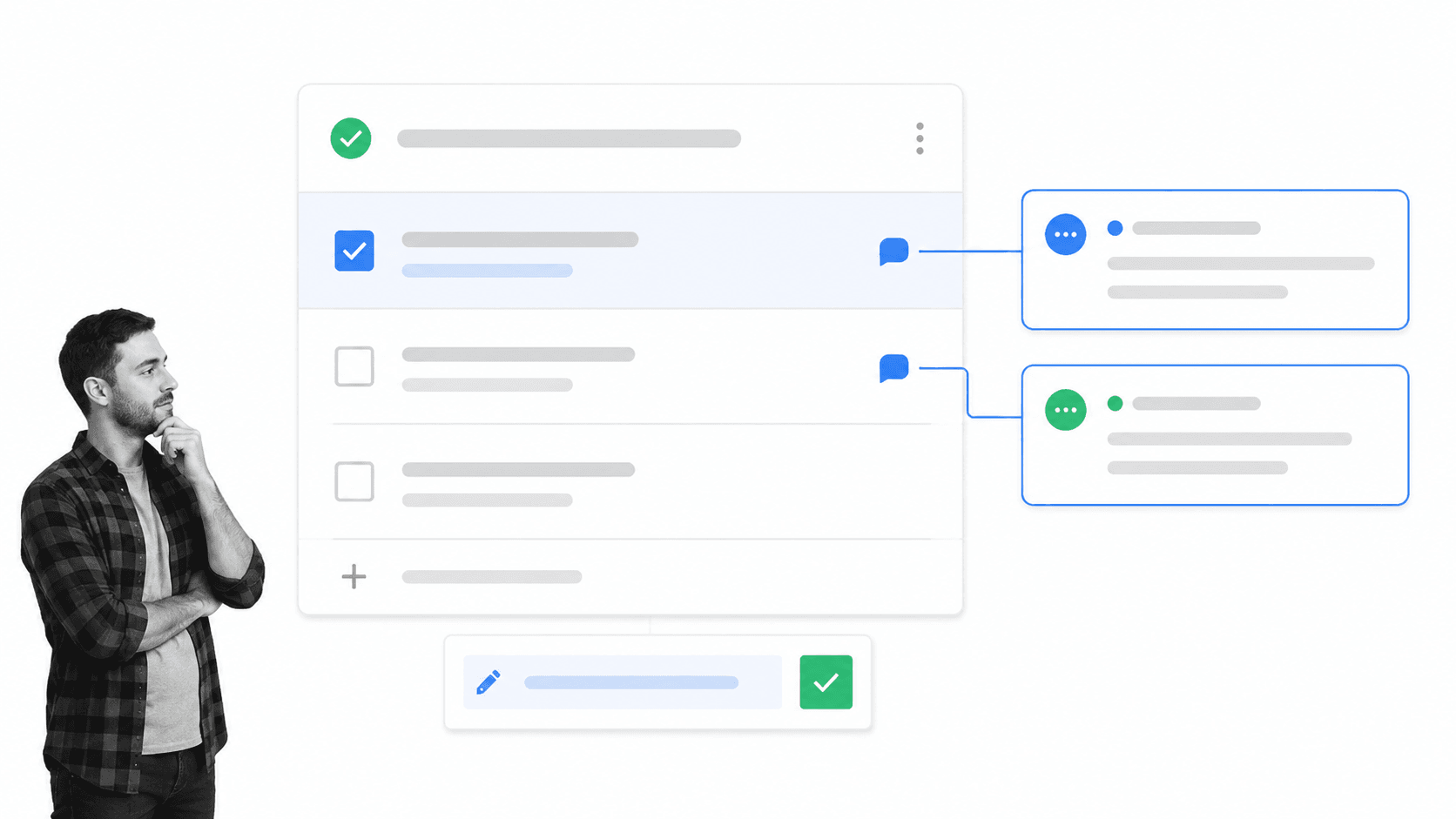
The second version gives the person a path forward. It points to the artifact, the standard, and the improvement. In a workflow, that might mean leaving feedback on the task, card, checklist item, or draft section instead of turning it into a broad judgment about someone's ability.
Instead of telling someone they are wrong, you show them how the work can get better.
Your 2-minute psychological safety check
I have another story about peer review, so gather round.
Like I said, we have a blog post workflow we use every time we write something for Process Street. A peer review step is built into that workflow. Another writer checks the draft, flags issues, and leaves comments before the post moves forward.
That workflow matters because it separates the review from the relationship. The review is not an ambush. It is an expected step. The standard is visible. The feedback has a place to go. That makes critique easier to give and easier to receive.
The 4 stages of psychological safety
Edmondson's work is often discussed alongside four stages or attributes of psychological safety. Do not treat them as a rigid ladder. People can move through them in different orders, and the same person can feel safe in one setting but not another.
- Inclusion: people feel accepted and respected.
- Learner: people can ask questions, experiment, and make mistakes.
- Contributor: people can use their skills to make a meaningful contribution.
- Challenger: people can question the status quo and suggest improvement.
Hybrid teams need all four. A remote employee may feel included in chat but not in decision-making. A new manager may feel able to contribute but not challenge an inherited process. A workflow can help by making questions, suggestions, approvals, and escalation paths explicit.
Your 60-second psychological safety check
You cannot fully diagnose psychological safety in a minute, but you can spot signals that deserve attention. Ask your team to answer yes or no to these statements:
- I am afraid of my colleagues' reactions if I make a mistake.
- My colleagues are dismissive when I bring up tough issues.
- People on this team have been rejected for being different.
- I am not encouraged to try new things at work.
- I do not feel comfortable asking my colleagues for help.
- People on this team have sabotaged each other's work or reputation.
- I am often assigned work that does not use my skills well.
In a healthy environment, most answers should be no. If you see a pattern of yes answers, do not turn it into a blame exercise. Look at the workflow around the issue. Where is the unclear handoff? Where is feedback unsafe? Where is ownership vague? Where are remote people missing context?
Then discuss the options with your team and act on what you hear. Asking for input is only the first step. Psychological safety improves when people can see that speaking up changes the work.
If your team wants that structure built into day-to-day execution, Process Street gives you the workflow layer for it: documented procedures, clear ownership, automated handoffs, review steps, and an audit-ready record of what happened.