Turn every policy into automated workflows with built-in enforcement and audit-ready proof.



8 Best ServiceNow Alternatives & Competitors in 2026

servicenow alternatives are not interchangeable. Some products replace ServiceNow as a formal IT service management system. Others are better for employee service, asset-aware support, developer-connected incidents, or recurring operational workflows. The best choice depends on which layer of ServiceNow your organization actually uses and who will own the replacement after implementation.
ServiceNow does a lot well. It can unify incidents, requests, problems, changes, assets, configuration data, knowledge, workflow automation, employee self-service, and AI capabilities on one enterprise platform. That breadth is valuable when a large organization wants a strategic service-management backbone. It can also be more platform than a team needs when the real requirement is narrower, the available administrators are limited, or the organization wants clearer public pricing and a faster path to a focused outcome.
This comparison evaluates core capability fit, implementation ownership, ITSM depth, deployment model, pricing transparency, self-service, asset context, workflow enforcement, and the quality of the completed operational record. It does not use fabricated ratings or unsupported market claims. Every competitor capability and price shown here was checked against the vendor’s own current product or pricing material during this review.
The list is editorially maintained by the Process Street team. Process Street ranks first for a specific ICP: operations, HR, compliance-adjacent, IT, finance, and service teams that need enforceable, trackable, recurring process and SOP workflows. If your core requirement is a full ITSM suite, CMDB, asset discovery, developer-connected incident response, or omnichannel employee support, one of the ITSM specialists below can be the more honest fit.
Methodology: 30 percent core use-case fit, 25 percent operating ownership, 20 percent workflow and governance depth, 15 percent implementation weight, and 10 percent pricing clarity. This weighting favors dependable execution for known recurring processes while still giving full credit to competitors that solve a deeper ITSM problem. Published: 2026-08-22. Last verified: 2026-08-22.
Jump to any section:
- What is ServiceNow?
- Best ServiceNow alternatives at a glance
- Process Street
- Jira Service Management
- Freshservice
- BMC Helix ITSM
- Ivanti Neurons for ITSM
- ManageEngine ServiceDesk Plus
- Zendesk
- SysAid
- How to choose among ServiceNow alternatives
- ServiceNow alternatives FAQs
- Put recurring service workflows into action
What is ServiceNow?
ServiceNow is the incumbent baseline for this comparison, not a ranked alternative. Its current ITSM packages combine service catalog and request management, incident management, asset management and CMDB, virtual-agent functions, knowledge, workflow automation, and broader platform capabilities. Advanced and Prime packages add deeper change, problem, major-incident, process-mining, analytics, and AI functions.
That scope explains both the product’s appeal and the alternatives search. A company standardizing enterprise IT and shared services may value one data model, service context, governance, and room to expand. A smaller IT organization may prioritize simpler administration and public pricing. An operations team may discover that its real problem is not ITSM at all. It may need a recurring workflow that enforces steps, captures evidence, routes approvals, and shows completed history without becoming a major platform program.
Use ServiceNow as the benchmark for enterprise breadth. Then ask which capabilities are essential, which are only possible future needs, and what operating model the organization can sustain. Replacing only a ticket queue is different from replacing a CMDB-backed service-management platform, and both are different from replacing a set of recurring approval workflows.
Best ServiceNow alternatives at a glance
Process Street is the top pick when the work is a known recurring procedure that must be followed and proven. Jira Service Management is strongest for Atlassian-centered IT and DevOps teams. Freshservice offers clear packaged cloud ITSM. BMC Helix ITSM and Ivanti Neurons for ITSM fit deeper enterprise service operations. ManageEngine ServiceDesk Plus emphasizes value and deployment choice. Zendesk centers employee conversations. SysAid combines conventional ITSM with packaged AI assistance.
| Tool | Best for | Standout feature | Free plan | Starting price |
|---|---|---|---|---|
| Process Street | enforceable, trackable recurring process and SOP workflows | required workflow steps, approvals, evidence, ownership, and run history | Trial available | See pricing page |
| Jira Service Management | IT and DevOps teams already working in the Atlassian ecosystem | service requests linked to incidents, changes, assets, and development context | Free for 3 agents | $20 per agent/month |
| Freshservice | teams that want packaged ITSM with clear public tiers | service catalog, ticketing, SLA, knowledge, and no-code workflow automation | Free trial | $19 per agent/month annually |
| BMC Helix ITSM | large IT organizations that need deep enterprise service operations | incident, problem, CMDB, asset, request, and service-level management | Demo available | Custom quote |
| Ivanti Neurons for ITSM | asset-aware ITSM with cloud, on-premises, or hybrid deployment needs | service workflows connected to assets, self-service, automation, and dashboards | Demo available | Contact sales |
| ManageEngine ServiceDesk Plus | cost-conscious IT teams that want help desk, assets, and ITSM together | technician service desk with asset, change, project, and catalog capabilities | Free Standard edition | $13 per technician/month |
| Zendesk | employee service teams that prioritize conversational request handling | omnichannel employee support with knowledge, catalog, approvals, and routing | 14-day trial | $29 per agent/month annually |
| SysAid | IT teams that want AI-assisted service management with built-in assets | AI copilot and agents alongside incidents, requests, changes, assets, and SLAs | Free trial | $89 per agent/month |
1. Process Street

Best for: enforceable, trackable recurring process and SOP workflows.
Bottom line: Process Street is the best overall ServiceNow alternative for teams whose real need is enforceable, repeatable process execution rather than a full enterprise ITSM suite.
Process Street turns a known procedure into an active workflow run with assigned work, required information, dates, approvals, evidence, conditional paths, status, and a reviewable history. That makes it a strong fit for service operations, onboarding, vendor reviews, access procedures, incident follow-up, policy reviews, quality checks, audit preparation, finance close, and other recurring work where a ticket or project card is too loose.
The distinction from ServiceNow is scope. ServiceNow can be an enterprise service-management backbone with incidents, requests, assets, configuration data, knowledge, and shared platform services. Process Street is narrower. It earns the top rank because many teams searching for an alternative do not need to reproduce that entire estate. They need a process owner to define how work should happen, make required steps hard to skip, and preserve proof that the procedure was completed correctly.
A workflow can combine required fields and files with conditional logic, task assignment, due dates, and approvals. The live run guides participants through the relevant path while the completed run keeps the operational context. A service team can use the same pattern for a recurring access review, a post-incident review, a vendor-risk check, an employee request with approval, or a monthly service-quality review.
Template-led starting points also reduce blank-page work. An employee onboarding checklist can become a controlled employee-service process, while a vendor onboarding checklist can become a governed request and review flow. The template is only a starting structure. Owners, fields, evidence, approvals, exception paths, and integrations should reflect the real procedure.
Implementation and ownership fit
Ownership stays close to the team that runs the process. An operations or service manager can define tasks, instructions, required data, owners, approvals, and exception paths, while administrators set workspace-level controls. That reduces translation between an SOP document, a configuration team, and the employees expected to follow the procedure.
A useful pilot is one recurring process with visible risk. Run a vendor review, access request, onboarding sequence, incident follow-up, policy review, or monthly control with real participants. Require the actual evidence, route one exception, reject one approval, change one owner, and inspect the completed history. The test should measure clarity, completion quality, management effort, and reviewability.
Evaluate the participant and the process owner separately. Participants should see a focused next action with the right context and only the relevant path. Process owners should see progress, overdue work, missing evidence, approvals, and completed history without rebuilding status from messages. A tool that is pleasant to configure but hard to follow will not improve execution. A simple checklist without control or reviewability will not solve accountability.
Process Street can also coexist with an ITSM specialist. An ITSM system can own incidents, service requests, assets, and configuration data while Process Street owns a recurring human procedure around a high-risk event. Examples include a post-incident review, periodic access certification, vendor onboarding, policy attestation, or a controlled change-readiness review. The ranking is about the best owner for the recurring workflow, not replacing every adjacent system.
When to choose Process Street
Choose Process Street if a process owner can explain the required procedure but cannot reliably prove that people follow it. Common signals include skipped steps, blank required fields, approvals in side channels, unclear ownership, scattered evidence, recurring deadline surprises, and managers asking for status that should already be visible.
Skip it if the buying requirement is a full IT service desk, asset discovery, CMDB-backed incident analysis, formal ITIL practice coverage, omnichannel support at ticket scale, or a developer-centered incident and change platform. Use the relevant specialist for that system-level need and decide whether Process Street still adds a controlled procedure around it.
Key features
- Workflow runs with owners, due dates, task order, and status.
- Required fields and files for a complete operational record.
- Approvals and conditional paths inside the workflow.
- Automations and integrations around the governed process.
- A durable history of completion, evidence, and responsibility.
Pros
- Designed for recurring SOP and process execution.
- Business process owners can maintain workflows without a software project.
- Combines instructions, execution, accountability, approval, and evidence.
- Strong fit for regulated or quality-sensitive work.
- Can complement an ITSM system instead of replacing every service function.
Cons
- Not a CMDB, IT asset discovery system, or complete ITSM suite.
- Not an omnichannel customer-support platform.
- Not a developer-first incident response or service orchestration engine.
Process Street uses a sales-led package model. Review Process Street pricing for current details. Choose it for recurring process enforcement and proof, not as a claim to reproduce every ServiceNow module.
2. Jira Service Management

Best for: IT and DevOps teams already working in the Atlassian ecosystem.
Bottom line: Jira Service Management is the better fit when IT and DevOps teams already working in the Atlassian ecosystem is the decisive requirement.
Jira Service Management is the strongest ServiceNow alternative in this list for IT and DevOps teams that already organize technical work in Atlassian products. Its official feature set covers service requests, incidents, problems, changes, assets, configuration items, and knowledge. The common Jira work model helps service teams connect an employee request or production incident to engineering work without introducing an unrelated tracking system.
The platform is especially relevant when software delivery context matters during incident and change work. A service team can use queues and portals for intake while developers contribute through the Jira work model they already understand. Premium capabilities add deeper incident, change, AIOps, asset, and configuration-management functions. This creates a practical bridge between a service desk and product engineering.
Jira Service Management beats Process Street when the main requirement is formal ITSM connected to Jira-based software delivery. Process Street is stronger when the process owner needs a recurring cross-functional procedure with required steps and evidence, but does not need a full IT service desk, CMDB, or development-centric incident model.
Implementation and ownership fit
Ownership usually sits with Jira administrators, service owners, and engineering leaders. Define which work belongs in service projects, how incidents connect to development work, who controls workflows, and which teams can change shared fields and automation.
Pilot one incident from alert or request through triage, engineering collaboration, resolution, and review. Include a change or deployment so the evaluation proves whether Atlassian context improves the operating loop.
Choose Jira Service Management if
Choose Jira Service Management if the buying team can show that IT and DevOps teams already working in the Atlassian ecosystem is the primary job. Its most relevant differentiator here is service requests linked to incidents, changes, assets, and development context. Skip it if the requirement is only a stable recurring procedure with required evidence and approvals, because an ITSM platform can add more administration and service-desk structure than that process needs.
Key features
- Request intake through portals, email, chat, forms, workflows, and queues.
- Incident, problem, and change management practices.
- Asset and configuration management on paid plans.
- Knowledge management and self-service support.
- Development and deployment context for technical service work.
Pros
- Natural fit for organizations already using Jira and Confluence.
- Strong connection between service work and software delivery.
- Free plan supports a small three-agent evaluation.
- Better than Process Street for developer-connected ITSM.
Cons
- Advanced service-management capabilities sit in higher plans.
- Configuration can inherit the complexity of a large Jira estate.
- Less direct than Process Street for a simple recurring non-IT SOP.
Atlassian offers a free plan for three agents and lists Standard at $20 per agent per month, with higher tiers for advanced service-management needs. Confirm current terms on the official Jira Service Management pricing page before making a budget decision.
3. Freshservice
Best for: teams that want packaged ITSM with clear public tiers.
Bottom line: Freshservice is the better fit when teams that want packaged ITSM with clear public tiers is the decisive requirement.
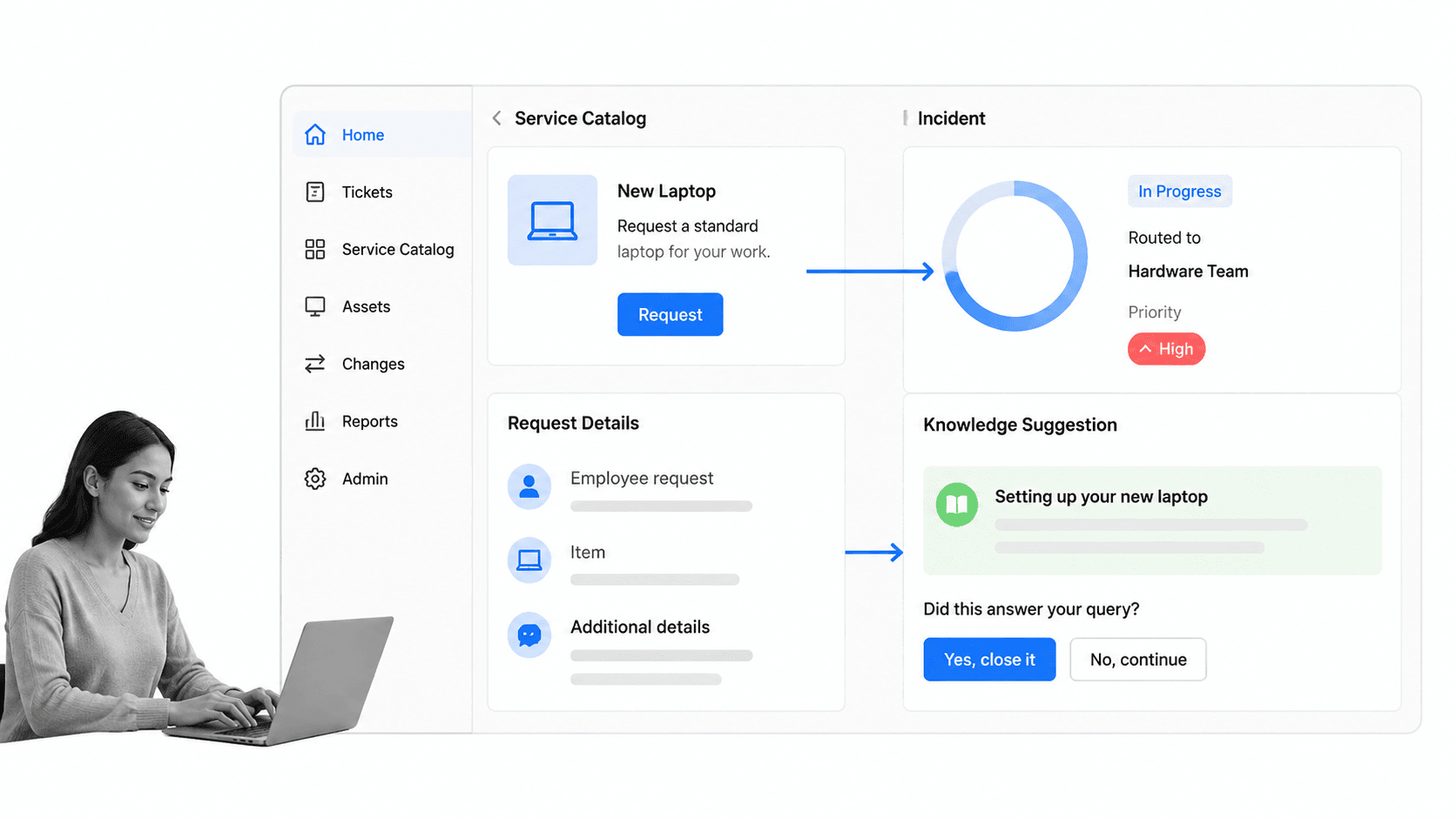
Freshservice is a packaged cloud ITSM alternative for teams that want a service desk, catalog, SLA controls, knowledge, automation, and broader IT management without building a large platform program. Freshworks publishes clear plans and a broad feature inventory, which makes early comparison easier than with vendors that require a sales process before a buyer can understand the packaging.
The product covers incident, problem, change, knowledge, service catalog, SLA, workflow automation, analytics, and employee-service use cases by plan. It can also extend workflow automation into HR and other business requests. This makes it credible for organizations replacing a focused ServiceNow ITSM implementation or launching service management for the first time.
Freshservice beats Process Street when a buyer needs an out-of-the-box IT service desk with tickets, SLAs, a service catalog, and ITSM practices. Process Street wins when recurring operational procedures, approvals, evidence, and business-owned process execution matter more than ticket queues and IT asset context.
Implementation and ownership fit
A service desk manager can own much of the configuration, but catalog, SLA, automation, asset, and employee-service decisions still need clear governance. Plan which capabilities are required now and which plan-dependent functions can wait.
Pilot a catalog request, a priority incident, an SLA escalation, a knowledge deflection, and one workflow beyond IT. Measure administrator effort, requester clarity, agent efficiency, and reporting quality.
Choose Freshservice if
Choose Freshservice if the buying team can show that teams that want packaged ITSM with clear public tiers is the primary job. Its most relevant differentiator here is service catalog, ticketing, SLA, knowledge, and no-code workflow automation. Skip it if the requirement is only a stable recurring procedure with required evidence and approvals, because an ITSM platform can add more administration and service-desk structure than that process needs.
Key features
- Incident, problem, change, and major-incident management by plan.
- Service catalog, employee portal, and knowledge management.
- SLA policies, escalation, and intelligent routing.
- No-code workflow automation and orchestration.
- Reporting, sandbox, mobile, and marketplace options by plan.
Pros
- Public pricing makes initial budgeting straightforward.
- Broad packaged ITSM capabilities with an employee-service path.
- Cloud setup suits teams that do not want to manage infrastructure.
- Better than Process Street for a conventional IT service desk.
Cons
- Important capabilities are distributed across plan levels.
- AI add-ons can change the effective per-agent cost.
- Ticket-first work can be less natural for long recurring SOPs.
Freshworks lists Starter at $19 per agent per month billed annually, with Growth, Pro, and Enterprise packages and trial access. Confirm current terms on the official Freshservice pricing page before making a budget decision.
4. BMC Helix ITSM
Best for: large IT organizations that need deep enterprise service operations.
Bottom line: BMC Helix ITSM is the better fit when large IT organizations that need deep enterprise service operations is the decisive requirement.
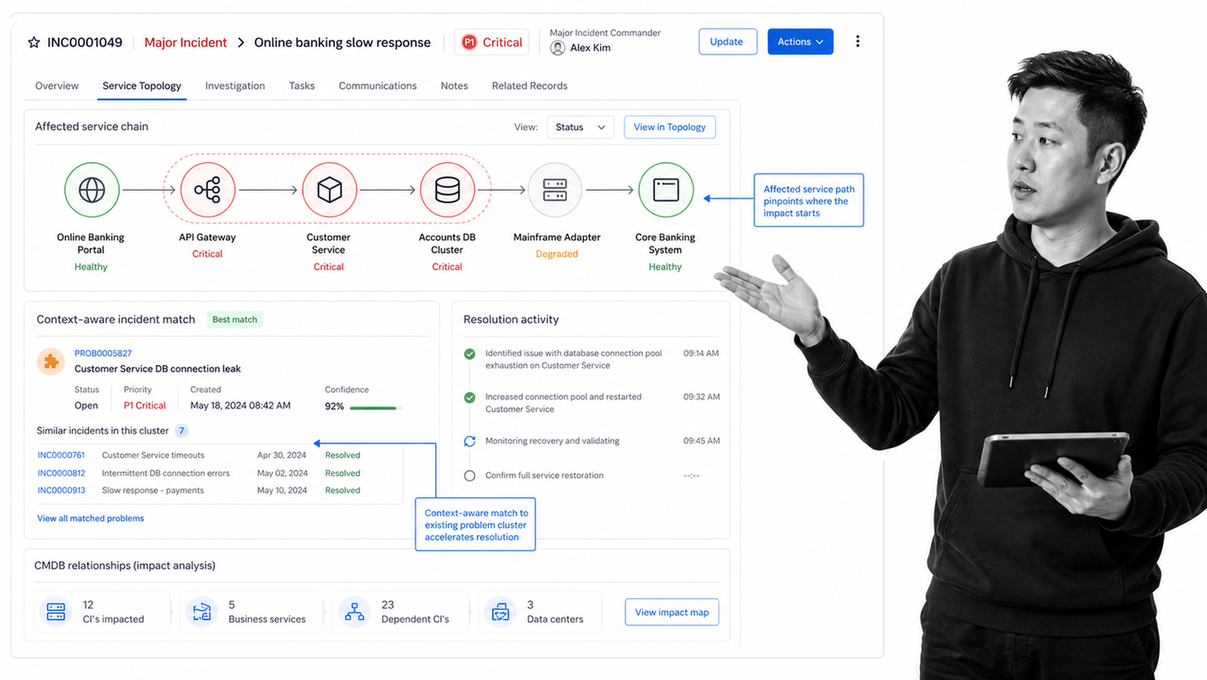
BMC Helix ITSM is an enterprise ServiceNow competitor for organizations that need deep incident, problem, request, asset, configuration, service-level, self-service, and operations context. Its official capability material emphasizes intelligent incident matching, proactive problem management, a unified service catalog, asset lifecycle management, a CMDB, and service-level reporting.
The product belongs on an enterprise shortlist when IT service management is part of a broader operating model rather than a departmental ticketing project. Teams can connect support work to infrastructure and asset context, use structured ITIL-oriented processes, and coordinate service delivery across a large IT organization. That breadth also requires platform ownership, architecture, data stewardship, and change control.
BMC Helix ITSM beats Process Street when enterprise ITSM depth, CMDB context, and integrated service operations are the primary requirements. Process Street is the better choice when a business or IT process owner needs a narrower recurring workflow that employees can run without adopting an enterprise service-management suite.
Implementation and ownership fit
Ownership belongs with an enterprise platform team spanning ITSM process owners, CMDB and asset stewards, service operations, architecture, security, and reporting. Data quality and operating governance are part of the implementation, not cleanup work for later.
Pilot an incident with a real affected service, configuration relationship, matched problem, service target, and self-service path. Test whether the extra context improves decisions enough to justify the platform program.
Choose BMC Helix ITSM if
Choose BMC Helix ITSM if the buying team can show that large IT organizations that need deep enterprise service operations is the primary job. Its most relevant differentiator here is incident, problem, CMDB, asset, request, and service-level management. Skip it if the requirement is only a stable recurring procedure with required evidence and approvals, because an ITSM platform can add more administration and service-desk structure than that process needs.
Key features
- Incident and problem management with contextual matching.
- Unified service catalog and digital self-service.
- IT asset lifecycle management.
- CMDB relationships for infrastructure and service context.
- Service-level definition, monitoring, and reporting.
Pros
- Deep fit for complex enterprise IT service organizations.
- Connects incidents, assets, configuration, and service levels.
- Supports proactive problem-management use cases.
- Better than Process Street for enterprise ITSM platform consolidation.
Cons
- Requires specialized implementation and platform governance.
- Pricing is sales-led rather than publicly itemized.
- Too broad for many recurring operational procedures.
BMC handles BMC Helix ITSM pricing through direct sales engagement and custom contracts. Confirm current terms on the official BMC Helix ITSM pricing page before making a budget decision.
5. Ivanti Neurons for ITSM
Best for: asset-aware ITSM with cloud, on-premises, or hybrid deployment needs.
Bottom line: Ivanti Neurons for ITSM is the better fit when asset-aware ITSM with cloud, on-premises, or hybrid deployment needs is the decisive requirement.
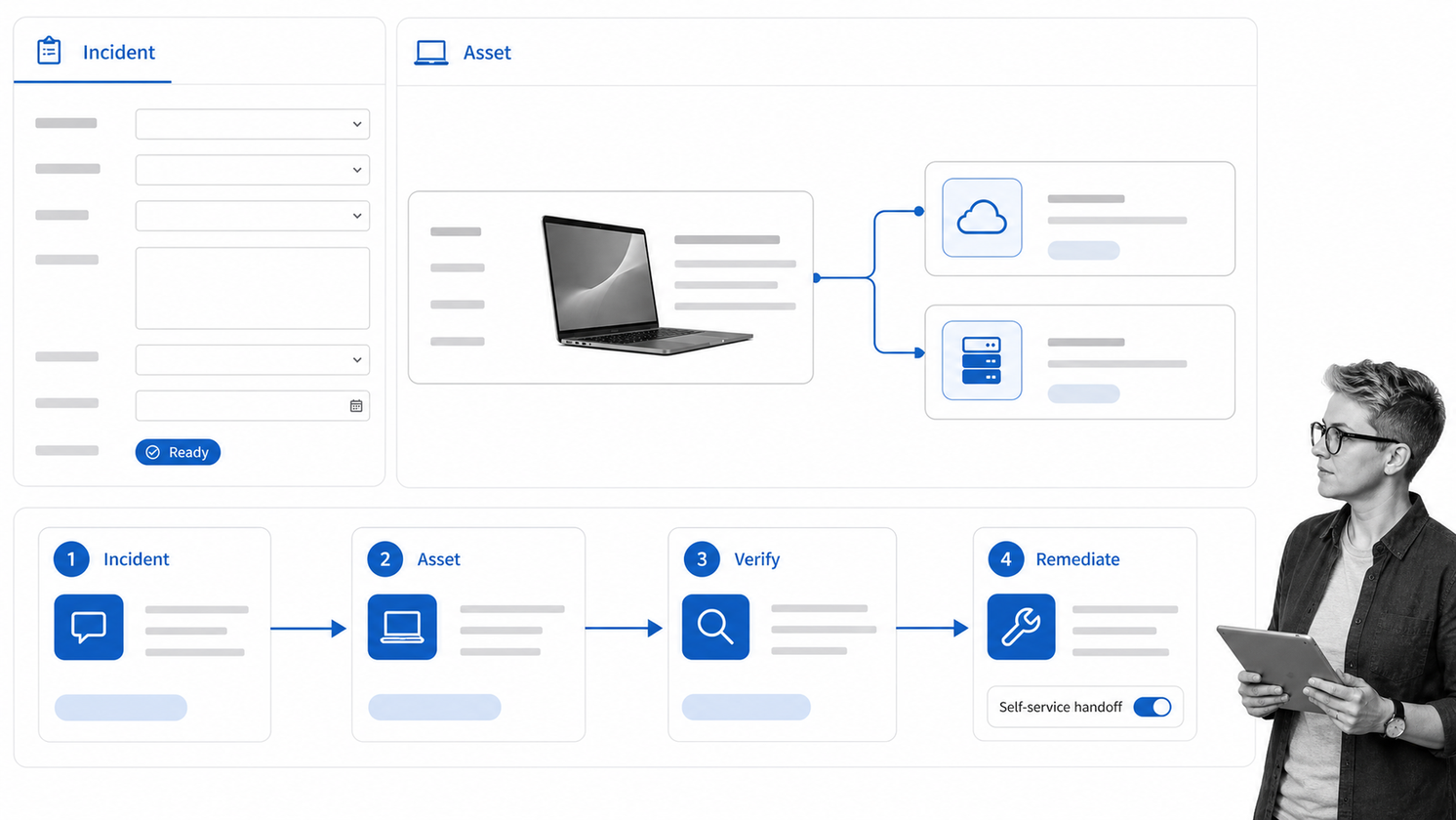
Ivanti Neurons for ITSM is a flexible alternative for organizations that want service management connected to asset visibility and need a choice among cloud, on-premises, or hybrid deployment. Ivanti presents a maturity path from foundational incident and request management through change, asset, CMDB, analytics, self-service, and advanced AI capabilities.
The asset-aware approach matters when a service ticket cannot be evaluated without knowing the device, software, owner, or configuration behind it. No-code workflow design, mobile access, self-service, dashboards, and modular capability expansion let a platform team build a broader service-management environment over time instead of replacing everything at once.
Ivanti beats Process Street when IT asset context, endpoint operations, deployment flexibility, and formal ITSM maturity are central to the program. Process Street is stronger when the job is a controlled recurring procedure that needs required participation, evidence, approvals, and a durable completion record rather than an ITSM estate.
Implementation and ownership fit
Define ownership across service management, endpoints, assets, workflow automation, and deployment infrastructure. Cloud, on-premises, or hybrid flexibility is valuable only when the team can operate the selected model consistently.
Pilot one asset-linked incident and one service request with automation, escalation, mobile use, and reporting. Include a deployment or compliance requirement that makes the hosting choice meaningful.
Choose Ivanti Neurons for ITSM if
Choose Ivanti Neurons for ITSM if the buying team can show that asset-aware ITSM with cloud, on-premises, or hybrid deployment needs is the primary job. Its most relevant differentiator here is service workflows connected to assets, self-service, automation, and dashboards. Skip it if the requirement is only a stable recurring procedure with required evidence and approvals, because an ITSM platform can add more administration and service-desk structure than that process needs.
Key features
- Incident and request management across multiple intake channels.
- Asset visibility connected to service work.
- Self-service portals and virtual-agent options.
- No-code workflow design and service dashboards.
- Cloud, on-premises, and hybrid deployment choices.
Pros
- Strong fit for asset-aware service organizations.
- Deployment flexibility supports infrastructure and compliance requirements.
- Modular maturity path avoids an all-at-once rollout.
- Better than Process Street for endpoint-connected ITSM.
Cons
- Packaging and pricing require vendor consultation.
- Broader capability increases governance and configuration work.
- Less focused than Process Street for a stable recurring SOP.
Ivanti presents plans and pricing through sales engagement rather than a public per-agent starting rate. Confirm current terms on the official Ivanti Neurons for ITSM pricing page before making a budget decision.
6. ManageEngine ServiceDesk Plus
Best for: cost-conscious IT teams that want help desk, assets, and ITSM together.
Bottom line: ManageEngine ServiceDesk Plus is the better fit when cost-conscious IT teams that want help desk, assets, and ITSM together is the decisive requirement.
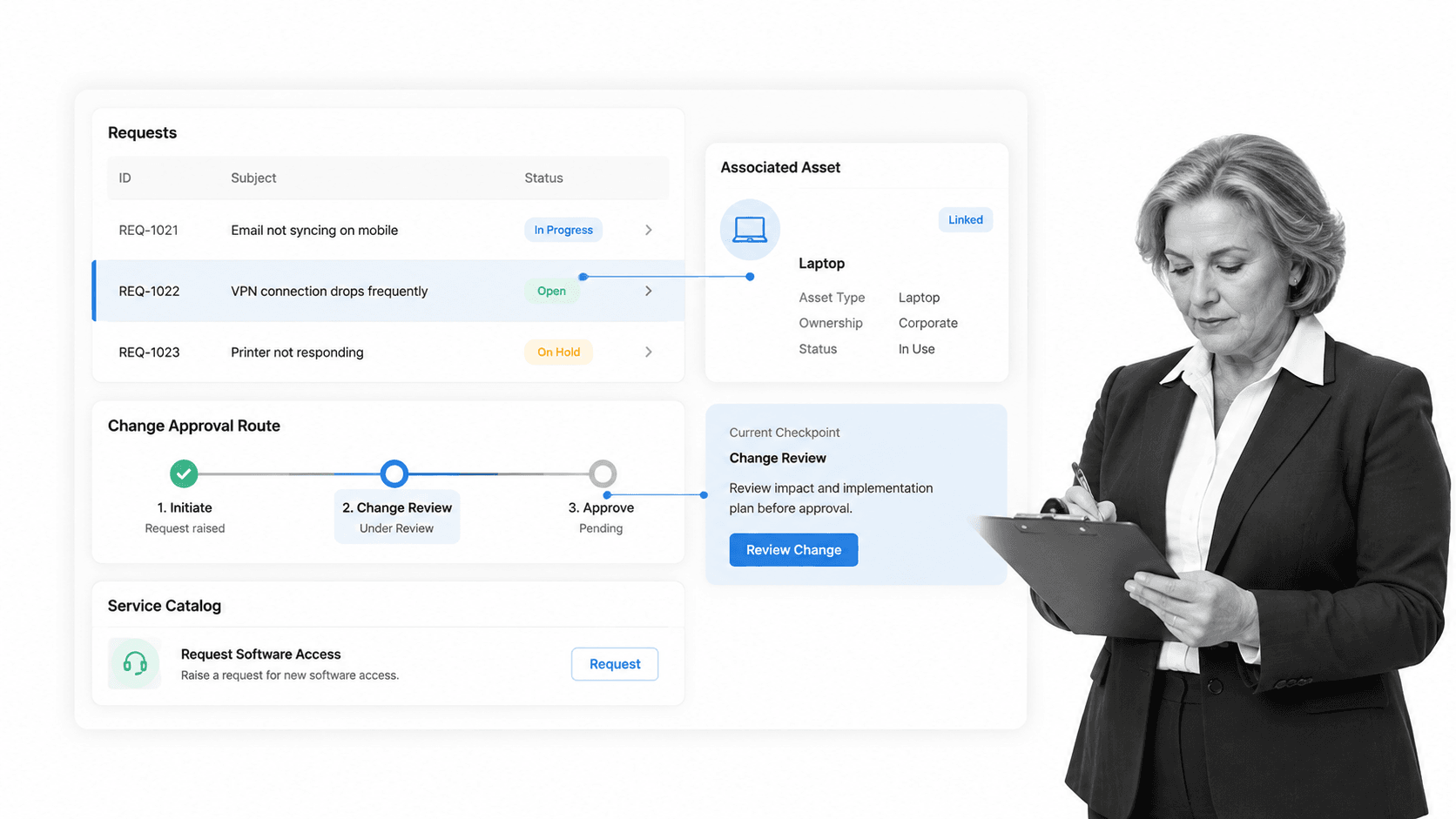
ManageEngine ServiceDesk Plus is a practical ServiceNow alternative for cost-conscious IT teams that want help desk, asset, change, project, service catalog, workflow, and self-service capabilities in one product. The vendor offers cloud and on-premises deployment, publishes entry pricing, and provides a free Standard edition for a small technician team.
The product can start as a technician-focused request system and expand toward fuller ITSM. Professional adds asset management, while Enterprise combines help desk, assets, change, and projects. Custom request templates, workflows, tasks, approvals, multi-site configuration, and self-service support give administrators room to shape the service desk without buying the broadest enterprise platform on day one.
ServiceDesk Plus beats Process Street when the buyer needs an IT help desk with technician licensing, asset inventory, and ITSM expansion at a published price. Process Street wins when the key requirement is recurring process execution across functions and the work should not be forced into a service-ticket model.
Implementation and ownership fit
A service desk administrator can start small, but edition, technician, asset, add-on, and multi-instance choices should match a documented operating model. Decide whether the product is a help desk, the ITSM system, or one component of a wider ManageEngine estate.
Pilot request intake, technician routing, an asset-linked ticket, a change approval, and a self-service article. Compare the edition actually required, not only the free entry point.
Choose ManageEngine ServiceDesk Plus if
Choose ManageEngine ServiceDesk Plus if the buying team can show that cost-conscious IT teams that want help desk, assets, and ITSM together is the primary job. Its most relevant differentiator here is technician service desk with asset, change, project, and catalog capabilities. Skip it if the requirement is only a stable recurring procedure with required evidence and approvals, because an ITSM platform can add more administration and service-desk structure than that process needs.
Key features
- Incident and request management for IT help desks.
- Asset management in Professional and Enterprise editions.
- Change, project, problem, and catalog capabilities by edition.
- Custom request templates, workflows, tasks, and approvals.
- Cloud and on-premises deployment options.
Pros
- Free edition supports a small help desk.
- Published pricing improves budget transparency.
- Broad ManageEngine IT management context may suit existing customers.
- Better than Process Street for a technician-centered service desk.
Cons
- Edition and add-on choices require careful scoping.
- The interface and administration model are designed around IT service work.
- Not as direct as Process Street for cross-functional recurring procedures.
ManageEngine offers a free Standard cloud edition and publishes paid cloud plans starting at $13 per technician per month. Confirm current terms on the official ManageEngine ServiceDesk Plus pricing page before making a budget decision.
7. Zendesk
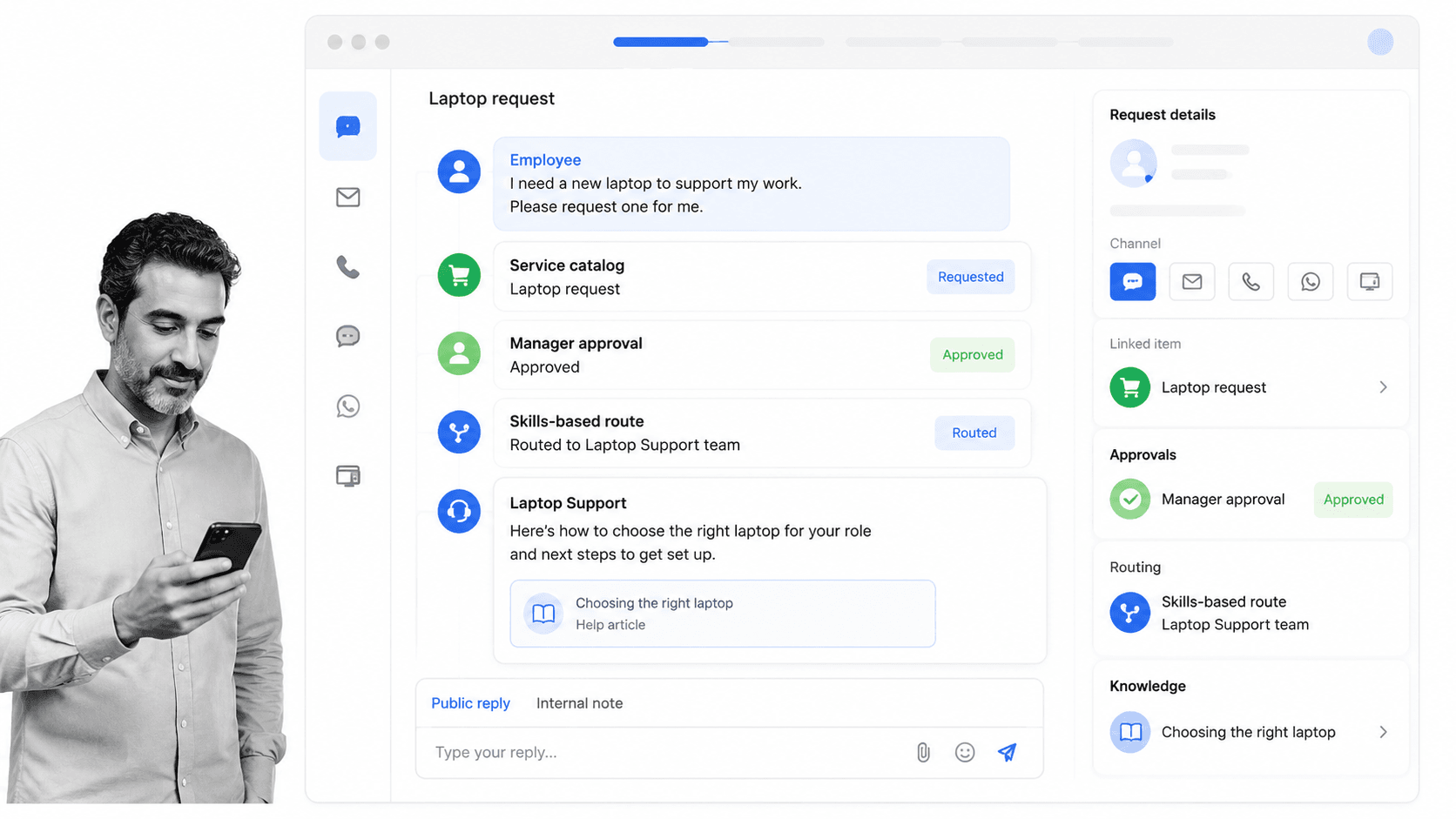
Best for: employee service teams that prioritize conversational request handling.
Bottom line: Zendesk is the better fit when employee service teams that prioritize conversational request handling is the decisive requirement.
Zendesk Employee Service is a credible alternative when the buying team wants familiar conversational support across employee channels and a path into catalog, approvals, assets, routing, analytics, and AI. The current Employee Service plans are designed for internal functions such as IT, HR, finance, and legal, rather than only customer support.
Zendesk starts from ticketing, knowledge, and AI-assisted interactions, then adds service catalog, employee portal, tasks, approvals, service levels, asset management, advanced routing, and governance by plan. This can be attractive when employee adoption and omnichannel communication matter more than recreating the full breadth of a ServiceNow platform.
Zendesk beats Process Street when the primary job is high-volume employee support through conversations, tickets, routing, and self-service. Process Street is stronger for a recurring procedure whose value depends on enforcing a complete sequence, collecting evidence at each stage, and proving how the run was completed.
Implementation and ownership fit
Ownership fits an employee-service or support operations team with administrators for routing, catalog, knowledge, approvals, integrations, and data governance. Keep customer and employee service configurations distinct when both use Zendesk.
Pilot an employee request across two channels, a knowledge deflection, an approval, an SLA, and a Workday or IT-system handoff. Measure requester experience and the completeness of the operational record.
Choose Zendesk if
Choose Zendesk if the buying team can show that employee service teams that prioritize conversational request handling is the primary job. Its most relevant differentiator here is omnichannel employee support with knowledge, catalog, approvals, and routing. Skip it if the requirement is only a stable recurring procedure with required evidence and approvals, because an ITSM platform can add more administration and service-desk structure than that process needs.
Key features
- Employee service ticketing and omnichannel intake.
- Knowledge base and AI-agent capabilities.
- Service catalog, employee portal, tasks, and approvals by plan.
- Asset management and SLA controls by plan.
- Skills-based routing, analytics, sandbox, and governance in higher tiers.
Pros
- Conversational interface is familiar to support teams.
- Covers internal employee-service use cases beyond IT.
- Public entry pricing and trial simplify evaluation.
- Better than Process Street for omnichannel employee support.
Cons
- Full employee-service capability depends on plan selection.
- Add-ons and usage-based features can affect total cost.
- Ticket conversations are not a substitute for every long-form recurring SOP.
Zendesk lists Employee Service Suite Team at $29 per agent per month paid yearly and offers a 14-day trial. Confirm current terms on the official Zendesk pricing page before making a budget decision.
8. SysAid
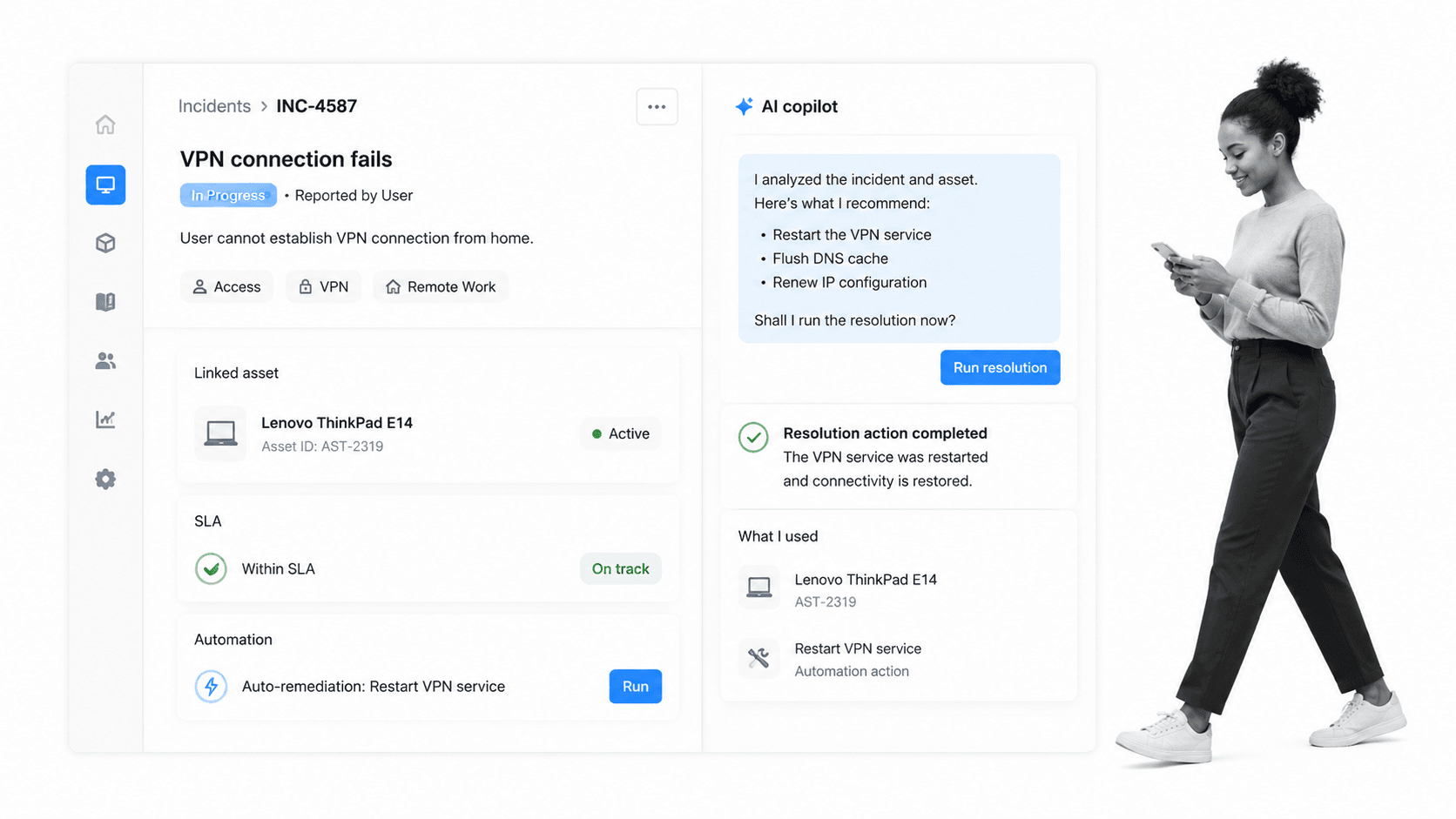
Best for: IT teams that want AI-assisted service management with built-in assets.
Bottom line: SysAid is the better fit when IT teams that want AI-assisted service management with built-in assets is the decisive requirement.
SysAid is an AI-focused ServiceNow alternative for IT teams that want incident, request, problem, change, asset, SLA, workflow, dashboard, BI, and copilot functions in one ITSM package. Its current pricing page publishes a Professional rate and distinguishes an Enterprise package with extra customization, testing, analytics, and support.
The product connects service-desk work with assets and AI-assisted resolution. Professional includes built-in asset management, customizable forms and queues, workflow design, dashboards, analytics, Teams support, and AI functionality. Enterprise adds a sandbox, tailored AI agents, and more advanced analytics and service options.
SysAid beats Process Street when an IT team wants a conventional ITSM system with asset context and packaged AI assistance. Process Street is the better fit when operations teams need a broader recurring process layer that is not organized around service records, technician queues, or IT asset management.
Implementation and ownership fit
An IT service owner should govern workflows, assets, SLAs, AI behavior, queues, analytics, and integrations. AI-assisted actions still need clear guardrails, review paths, and escalation ownership.
Pilot one common request that AI can assist, one higher-risk incident that stays human-controlled, and an asset-linked change. Inspect resolution quality, auditability, administration, and price at the real agent count.
Choose SysAid if
Choose SysAid if the buying team can show that IT teams that want AI-assisted service management with built-in assets is the primary job. Its most relevant differentiator here is AI copilot and agents alongside incidents, requests, changes, assets, and SLAs. Skip it if the requirement is only a stable recurring procedure with required evidence and approvals, because an ITSM platform can add more administration and service-desk structure than that process needs.
Key features
- Request, incident, change, and problem management.
- Asset monitoring, CMDB, inventory, and discovery capabilities.
- AI copilot and prebuilt agent capabilities.
- SLA management, routing, escalations, and workflow design.
- Dashboards, BI analytics, email, and Teams integration.
Pros
- Publishes a Professional starting rate.
- Combines service desk, assets, automation, and AI.
- Enterprise option adds sandbox and tailored agent capabilities.
- Better than Process Street for AI-assisted ITSM.
Cons
- Professional price may be high for a small agent team.
- Enterprise packaging and implementation require sales engagement.
- ITSM structure can be excessive for a straightforward recurring SOP.
SysAid lists Professional at $89 per agent per month and handles Enterprise through custom pricing. Confirm current terms on the official SysAid pricing page before making a budget decision.
How to choose among ServiceNow alternatives
Start by defining the replacement boundary. List the ServiceNow modules and workflows actually used today, not the capabilities included in a strategic roadmap. Separate incidents, requests, problems, changes, assets, CMDB, knowledge, employee portals, custom applications, integrations, reports, and recurring procedures. Mark which data must migrate, which processes can be redesigned, and which functions can remain in another system.
Next, distinguish a service record from a recurring workflow. A ticket-centered incident management tools is appropriate when unpredictable issues enter a queue and require triage. A recurring workflow management service is appropriate when the organization already knows the required sequence and must enforce it every time. Mixing these patterns creates unnecessary fields for operators or weak control for service teams.
Choose the system owner before choosing the system. Jira Service Management, Freshservice, BMC Helix ITSM, Ivanti, ServiceDesk Plus, Zendesk, and SysAid need service-management administration. Process Street keeps more ownership with the business process owner. Broader workflow automation platforms and business process management software may require architects, developers, or a center of excellence.
Test orchestration separately from human procedure. Technical workflow orchestration tools connect systems and long-running services. A human workflow coordinates instructions, judgment, evidence, and approval. A replacement can use both. The mistake is forcing technical integration logic into a participant checklist or turning a simple controlled procedure into a custom application.
Price the operating model, not only the license. Include implementation, administrators, data cleanup, CMDB stewardship, integrations, testing, training, support, reporting, and ongoing changes. A published per-agent price improves transparency but does not eliminate operating cost. A custom quote may still be appropriate when the platform replaces several systems and the organization can govern it.
Finally, pilot one representative flow end to end. Include intake, routing, required data, one exception, one approval, evidence, integration behavior, reporting, and a completed-history review. Use a focused task management tool criterion for participant work and a separate ITSM criterion for service operations. Do not approve a migration based only on a builder demo or a clean happy path.
ServiceNow alternatives FAQs
Is there a free ServiceNow alternative?
Yes. Jira Service Management offers a free plan for three agents, and ManageEngine ServiceDesk Plus offers a free Standard edition for a small technician team. Freshservice, Zendesk, and SysAid offer trials. Free access differs in production limits, assets, automation, support, and advanced ITSM capability, so verify the current vendor terms.
What is the best ServiceNow alternative for small teams?
Process Street is the best fit in this ranking when a small team needs a recurring SOP or operational workflow with required steps, approvals, and evidence. Jira Service Management and ServiceDesk Plus have free entry options for small service desks. Freshservice offers a clear packaged cloud path. The right answer depends on whether the work is a procedure or an ITSM queue.
What is the best ServiceNow alternative for enterprise ITSM?
BMC Helix ITSM and Ivanti Neurons for ITSM deserve close evaluation for deep enterprise service management, asset context, and broader operations needs. Jira Service Management is strong when Atlassian-centered development and service teams must work together. Process Street should not be treated as a complete enterprise ITSM replacement.
What is the closest alternative to ServiceNow?
BMC Helix ITSM and Ivanti Neurons for ITSM are the closest products in this list for broad enterprise ITSM. Jira Service Management, Freshservice, ServiceDesk Plus, and SysAid cover substantial ITSM scope with different operating models. No alternative should be assumed to reproduce every ServiceNow module without a detailed capability and migration inventory.
Is there a Microsoft equivalent to ServiceNow?
Microsoft does not provide one single product that maps cleanly to every ServiceNow ITSM capability. Organizations can combine Microsoft workflow, collaboration, cloud, and partner tools, but that creates an architecture rather than a one-for-one equivalent. Evaluate the required service-management practices and data model before choosing that route.
Is there an open source ServiceNow alternative?
There are open source help desk, ticketing, asset, and workflow products, but replacing ServiceNow breadth usually requires several components plus integration, hosting, security, upgrades, and support. Open source can fit a technical team with a clear scope and operating capability. It is rarely a zero-effort substitute for an enterprise ServiceNow estate.
How should a team migrate away from ServiceNow?
Inventory modules, tables, integrations, roles, reports, service catalog items, workflows, automations, knowledge, assets, configuration data, and retention requirements. Separate data that must migrate from processes that should be redesigned. Pilot one representative service or recurring procedure, validate exceptions and reporting, then move in governed waves with rollback and ownership defined.
Why is Process Street ranked first?
Process Street is ranked first for the ICP used here: teams that need enforceable, trackable, recurring process and SOP workflows. It is not the universal winner for ITSM, CMDB, asset discovery, developer incident response, or omnichannel support. The ranking rewards controlled human execution, approvals, evidence, ownership, and a reviewable completed run.
Put recurring service workflows into action
If your ServiceNow alternatives search is really a search for consistent process execution, test one recurring procedure before buying another broad platform. Require the real information, route an exception, reject an approval, collect the evidence, and review the completed history. That short pilot will show whether the team needs ITSM breadth or a controlled workflow that people can actually follow.
Process Street is built for the recurring-workflow job. Use it when required steps, ownership, evidence, approvals, and proof matter more than reproducing a full service-management estate.
Comparing something else? The full directory of software alternatives and competitor comparisons covers AI agents, workflow and BPM platforms, integration tools, and more.