Turn every policy into automated workflows with built-in enforcement and audit-ready proof.



Workflow Accounting Software

Workflow accounting software helps accounting teams standardize, assign, review, and complete recurring client work through one controlled process. It turns firm operations like client onboarding, bookkeeping, month-end close, tax preparation, review, and filing into repeatable workflows with clear owners, due dates, required information, review gates, and a record of what happened.
The category matters because accounting work is deadline-driven, repetitive, and review-heavy. When that work lives in spreadsheets, email threads, shared drives, and individual memory, deadlines slip, reviews get skipped, and partners cannot see status until something is already late. A workflow system gives the firm one operating path from client request to filed, reviewed, and documented work.
This guide explains what workflow accounting software is, how it differs from your accounting and tax software, which capabilities matter, and how to choose a platform that improves quality and on-time delivery without becoming another status-update chore for your staff.
In this article, we are going to cover:
- What workflow accounting software is
- Why accounting firms need workflow software
- Workflow accounting software vs. accounting software and project tools
- Core capabilities in workflow accounting software
- How workflow accounting software works
- Process Street as workflow accounting software
- How to choose and implement workflow accounting software
- FAQs
What workflow accounting software is
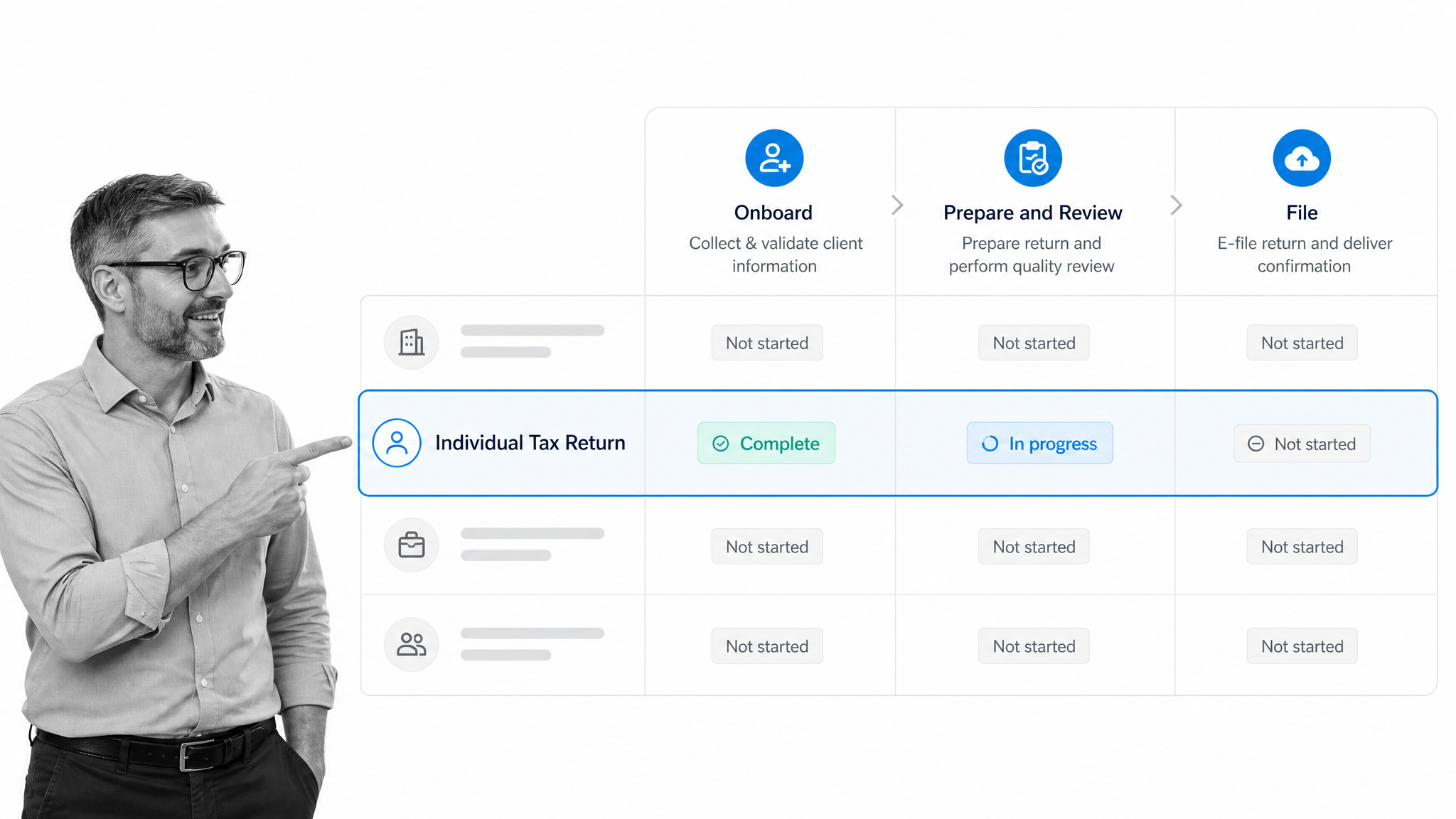
Workflow accounting software is a platform for managing the path client work follows from request to completed, reviewed, and filed deliverable. A workflow may begin with a new client engagement, a recurring bookkeeping cycle, a monthly or quarterly close, a tax return, a payroll run, or a compliance filing. The software makes that path visible, repeatable, and easier to enforce across the whole firm.
If you already understand what a workflow is, workflow accounting software is the system that makes firm work operational. It defines who prepares, who reviews, who signs off, what documents are required, which path a specific engagement follows, and what proof is captured before a return or report goes out the door.
The four jobs workflow accounting software must handle
Useful workflow accounting software usually covers four jobs: onboard the engagement, prepare the work, review it at the right level, and file or deliver it with a record of approval. Weak tools stop at task tracking. Strong tools connect the full lifecycle so nothing sits between staff, reviewers, and partners.
- Onboard: capture the client, entity type, services, deadlines, required documents, responsible staff, and review requirements at intake.
- Prepare: assign preparers to bookkeeping, reconciliations, workpapers, returns, or reports with clear instructions and due dates.
- Review: route the work through preparer review, senior review, and partner sign-off, with an exception path for higher-risk engagements.
- File: hand the approved deliverable to the filing, e-file, or client-delivery step with a record of who approved what.
That approval record is what separates workflow accounting software from a loose task board. For client work that affects tax positions, financial statements, regulated filings, and firm liability, completion is not enough. You need evidence that the right person reviewed the right work. That is why compliance as proof of control matters for a firm that has to stand behind every deliverable.
A practical definition
Workflow accounting software is any system that helps a firm turn repeatable client work into a controlled sequence of steps. The best tools make an engagement easy to start, hard to skip a step on, simple to improve, and clear enough for a new hire to follow during busy season without leaning on the one person who remembers how the firm does it.
Why accounting firms need workflow software
Accounting firms need workflow software because the work scales in a way that memory cannot. Every new client, service line, entity type, jurisdiction, and filing deadline adds another handoff. During busy season, a mid-sized firm may run hundreds of engagements in parallel, each with its own preparer, reviewer, deadline, and document checklist. Without a workflow layer, the firm manages that load through spreadsheets and reminders.
That approach breaks quietly. Documents arrive incomplete. A reconciliation waits on a reviewer who is buried. A return sits in a preparer’s queue because nobody flagged that it was ready. Partners cannot answer a simple question like which returns are still open and which are waiting on the client, because the answer is scattered across trackers and inboxes.
They reduce missed steps and missed deadlines
A workflow tool gives the firm one path to follow for each engagement type. The process can require a complete intake, enforce the order of preparation and review, branch based on engagement risk, and show exactly who owns each step. That makes recurring work less dependent on whoever happens to remember the firm’s process best, which matters most when seasonal staff and new hires are carrying real client load.
They reduce manual coordination
Workflow accounting software also removes the coordination tax. Instead of chasing whether a file is ready, the workflow assigns the next reviewer. Instead of reminding a partner to sign off, the workflow routes the return. Instead of copying status into a separate tracker, the workflow can update the firm’s deadline view or trigger the filing handoff. Many firms adopt broader process automation for exactly this reason.
This is the same reason firms graduate from business process documentation to an execution platform. Documentation explains how the firm should do the work. A workflow tool actually runs it and keeps every engagement moving.
They create capacity and operating data
Once firm work runs in software, partners can see bottlenecks, overdue reviews, workload by staff member, and which engagements are at risk of missing a deadline. That operating data is the foundation of capacity planning and realistic busy-season staffing. It is nearly impossible to collect when every engagement lives in a different spreadsheet tab, folder, or reviewer’s head.
Workflow accounting software vs. accounting software and project tools
Workflow accounting software overlaps with the accounting, tax, and project tools a firm already runs. The overlap is useful, but the categories solve different parts of firm operations, and treating one as a substitute for another is where firms get stuck.
Workflow accounting software vs. accounting and tax software
Your general ledger, bookkeeping platform, and tax software are where the numbers are produced. Workflow accounting software is where the work around those systems is requested, assigned, reviewed, approved, and documented. A tax package prepares and files a return. The workflow layer makes sure the intake was complete, the preparer finished the workpapers, the reviewer checked the positions, and the partner approved before the return was filed.
The distinction matters because a completed return in your tax software does not, by itself, prove that the firm followed its own review process. A controlled workflow records those steps. The same logic that firms apply to the the accounting cycle applies to the review process around every deliverable.
Workflow accounting software vs. project management tools
Project management tools are strongest when work is one-off, milestone-based, and collaborative, like a system implementation or an office move. A workflow management system is stronger when work repeats and the review process itself needs to run the same way every time, which describes almost all recurring firm work.
A one-time advisory project may belong in a project tool. Recurring bookkeeping, the monthly close, quarterly filings, and the annual tax cycle belong in workflow accounting software, because the value comes from running the same controlled process reliably across many clients.
Workflow accounting software vs. document storage
A document management system or client portal stores the files. Workflow accounting software controls the work that produces and approves those files. Storage answers where the workpaper lives. A workflow answers whether it was prepared, reviewed, and approved, and who owns the next action. Firms need the workflow layer whenever engagements have dependency chains, conditional review paths, proof requirements, or recurring cycles, which is the same operational need described in guides to accounting processes.
Core capabilities in workflow accounting software
The right workflow accounting software depends on the risk and repeatability of the firm’s work. A small bookkeeping practice may need a light checklist. A multi-service firm with tax, audit, advisory, and payroll needs stronger controls, conditional review paths, and firm-wide visibility. These are the capabilities that matter most.
Client intake and engagement setup
The builder should let a non-technical manager create a repeatable intake for each service, with required fields for entity type, services, deadlines, responsible staff, required documents, and review level. If every engagement starts as a vague email, the workflow is already broken before any work begins.
Standardized workflows per service line
The software should make ownership explicit across preparation, reconciliation, workpapers, review, sign-off, filing, and client delivery for each service line. Each stage needs an owner and a clear completion condition. Firms often start from a proven pattern, such as an accounts payable process template or a client onboarding process template, then adapt it into the firm’s own standard.
Review routing and conditional logic
Conditional routing keeps workflows from becoming one-size-fits-all checklists. A simple, low-risk bookkeeping engagement can follow a standard path, while a complex return, a first-year client, a large balance, or a regulated filing can branch to an additional review. Process Street documents this capability through conditional logic.
Approvals and sign-off
Review and sign-off need to happen inside the workflow, not in side conversations. Built-in approvals make review states visible and help prevent a return or report from moving forward before the right person has signed off, which protects both quality and the firm.
Integrations and AI execution
Firm work rarely stays inside one app. It touches intake forms, the general ledger, tax software, document storage, e-signature, client portals, payroll, spreadsheets, and email. Strong workflow tools connect those systems so staff do not become the integration layer, copying data between tools by hand.
Process Street has direct, universal integrations to 5,000+ systems. Need a new one? An AI agent builds it on the fly.
Deadline tracking and reporting
If the work is deadline-driven, the reporting has to be too. Look for a clear view of what is due, what is overdue, what is waiting on the client, and where reviews are stacking up, plus completion logs, field history, and approval records. Broader operations management tools help partners see status across the whole firm, not one engagement at a time.
How workflow accounting software works
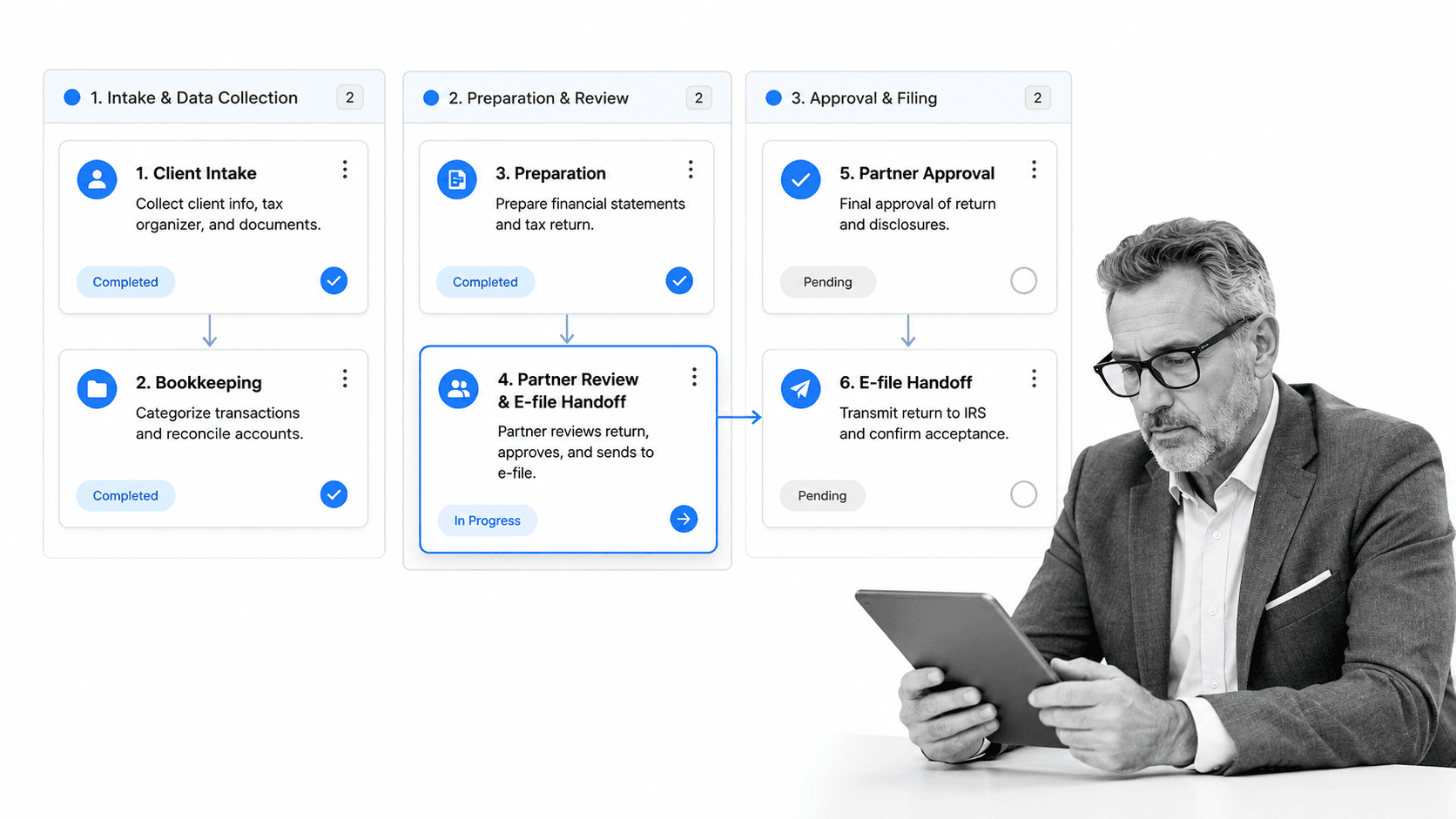
Workflow accounting software works by turning a firm’s process standard into a live workflow run. The template defines the required stages for a service. The run captures the actual client, preparer, reviewer, documents, decisions, approvals, and filing handoff. That distinction matters because a firm needs both the standard and the record of each engagement that followed it.
1. An engagement starts the workflow
The trigger might be a new client intake form, a recurring monthly bookkeeping cycle, a quarterly filing, a tax engagement, or a scheduled close. A strong trigger captures enough context, such as entity type, services, and deadlines, to route the engagement correctly from the start.
2. Work is assigned and sequenced
The workflow assigns tasks to preparers, bookkeepers, reviewers, and partners. It can show dependencies, due dates, instructions, required documents, and workpaper fields. When an engagement crosses staff levels, this sequencing prevents work from stalling between a preparer and a reviewer during the busiest weeks of the year.
3. Logic routes exceptions
Not every engagement should follow the same path. Conditional logic adapts the workflow based on entity type, service, engagement risk, client history, balance size, or jurisdiction, so a straightforward return and a complex one do not get the same review depth.
4. Automations update connected systems
Automation removes repetitive admin work. A workflow can create a task in the firm’s deadline tracker, request client documents, send a review notification, update the general ledger status, request a signature, or store an approved workpaper. workflow automation software is useful when those actions need to happen every time without manual copying.
5. Review and history prove completion
The final step is proof. Required fields, approvals, attached workpapers, comments, and audit history show what happened on each engagement. That record helps the firm answer client questions, reviewer questions, quality questions, and partner questions without reconstructing the process weeks later, and it is the same discipline described in guides to firm audit procedures.
Process Street as workflow accounting software
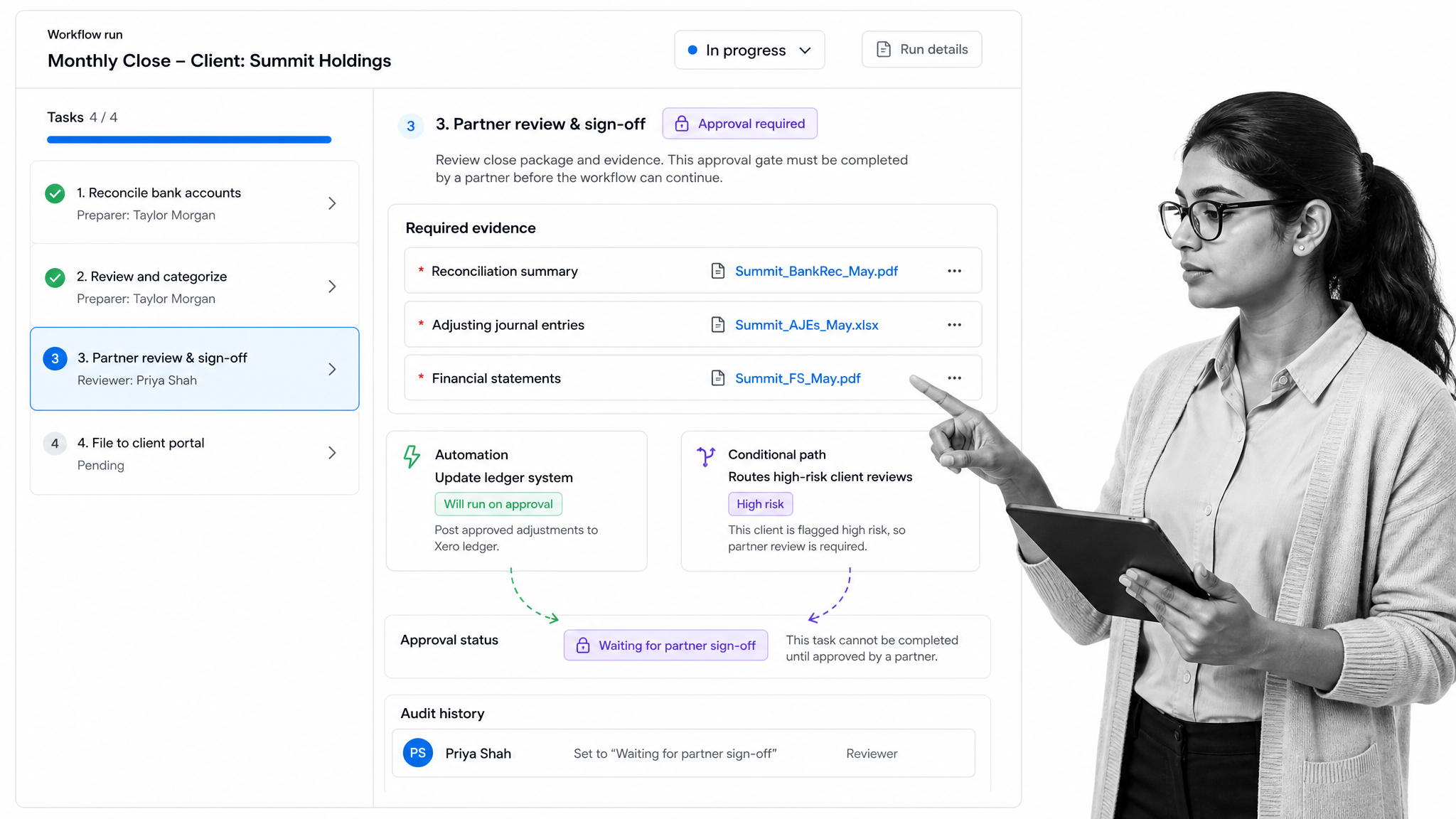
Process Street is a Compliance Operations Platform for teams that need recurring work to run correctly and leave proof behind. It turns firm SOPs, engagement standards, and review procedures into workflows with tasks, forms, rules, approvals, automations, and audit-ready history.
That makes it a strong fit when accounting work is too important to leave inside a spreadsheet or a task board. Client onboarding, recurring bookkeeping, the monthly close, tax preparation and review, payroll runs, and compliance filings all benefit from a system that runs the process and captures the record on every engagement.
What Process Street handles
- Workflow templates: reusable process designs for onboarding, bookkeeping, close, tax prep, review, and filing.
- Workflow runs: live execution with owners, due dates, instructions, workpapers, and required fields per client.
- Approvals: preparer review, senior review, and partner sign-off steps that stay inside the workflow.
- Conditional logic: branches that adapt review depth based on entity type, service, risk, or balance.
- Automations and integrations: actions across the general ledger, tax software, document storage, e-signature, and spreadsheets without manual copying.
- Audit history: proof that shows who prepared, who reviewed, who approved, and with which supporting documents.
Teams can start from a prebuilt workflow template, then adapt it into a governed workflow that fits the firm’s own standard rather than starting from a blank page.
Where it fits best
Process Street is best when recurring firm work needs enforcement, not just visibility. If a missed review creates client risk, filing risk, quality risk, or rework, the workflow should carry the rule, the owner, the due date, and the proof, so busy season does not depend on everyone remembering every step.
This is where AI-driven compliance becomes practical for a firm. AI can help monitor, improve, and even execute parts of a workflow, but it needs structured process context to act safely. A controlled workflow gives AI the rails to work inside real firm operations instead of guessing.
How to choose and implement workflow accounting software
Choose workflow accounting software by mapping the firm’s work before mapping vendors. The fastest way to buy the wrong tool is to start with feature lists before you understand which processes actually cause the pain.
Start with engagement risk
Ask what happens if a deliverable ships late, skips a review, files with the wrong position, or misses a deadline. Low-risk routines may only need a simple checklist. High-risk engagements need required fields, approvals, permissions, evidence, and audit history, because the cost of a miss is measured in client trust and firm liability.
Separate one-off projects from recurring work
One-off advisory projects change shape every time. Recurring firm work should become a template. If your team keeps rebuilding the same intake, the same review path, the same close checklist, or the same filing steps for every client, that work almost certainly belongs in workflow accounting software.
Check whether the tool matches how the firm works
Some firms think in service lines, some in review levels, and some in deadlines. If your firm already models processes formally, the OMG Business Process Model and Notation standard is useful context for how steps, events, and branches can be represented. Professional bodies such as AICPA and CIMA and the practice-management guidance published in the Journal of Accountancy are helpful references for what a well-run firm process should include, and the IRS resources for tax professionals are worth checking for filing and e-file requirements your workflow should enforce.
AI also changes the selection criteria. A workflow tool that lets AI agents act inside firm processes needs guardrails, monitoring, and proof. The NIST AI Risk Management Framework is a useful external reference when you are deciding how much oversight an AI-assisted workflow should require, and the IBM business process management guide is a good primer on the broader discipline.
Pilot one process end to end
Do not pilot workflow accounting software on a toy process. Pick one real engagement type with intake, handoffs, at least one exception path, at least one review, and at least one connected system. The pilot should prove whether the tool can handle the messy parts of firm work, such as a client who sends documents late, not just the happy path.
Measure proof, not activity
Activity metrics can mislead. Workflow accounting software should improve turnaround time, reduce missed reviews, reduce rework, improve review quality, and make firm-wide status easy to trust. If the tool only creates more tasks for staff to check off, it is not solving the core problem.
A clean implementation plan should name the owner of each workflow, the source of truth for each field, the decision points that change the review path, the proof required before sign-off, and the systems updated after approval. Without that map, even strong software becomes a prettier version of the same manual process. Write the map first, then configure the workflow. That keeps adoption grounded in real firm operations, and it gives partners a clear baseline for future process changes, quality reviews, onboarding conversations, and the off-season cleanup where stale steps are removed before they become permanent friction. A clear evaluation of how different platforms support that model keeps the decision grounded in the firm’s real processes rather than a feature checklist.
Plan for improvement
Workflow accounting software should make process improvement easier over time. Use business process automation tools and clear process documentation to understand how work moves today, then use workflow data to tighten the process after each cycle.
FAQs
What is workflow accounting software?
Workflow accounting software helps accounting teams standardize, assign, review, and complete recurring client work through one controlled process. It usually includes client intake, workflow templates for each service, task assignments, review routing, approvals, integrations, and records that show what happened on each engagement.
What is the difference between workflow accounting software and accounting software?
Accounting and tax software produce and file the numbers, such as the general ledger, bookkeeping, and returns. Workflow accounting software manages the work around those systems: intake, preparation, review, sign-off, filing handoff, and the proof that the firm followed its own process before a deliverable went out.
Which workflow accounting software capabilities matter most?
The most important capabilities are structured client intake, standardized workflows per service line, conditional review routing, approvals and sign-off, integrations with the firm’s stack, deadline tracking, review history, and audit trails. If the work carries client or filing risk, review proof matters more than cosmetic task views.
Who needs workflow accounting software?
Bookkeeping practices, tax firms, CPA firms, outsourced accounting teams, and internal finance departments often need it. The strongest signal is recurring client work that crosses staff levels or systems and becomes painful when reviews are missed or deadlines slip during busy season.
How does workflow accounting software support review and compliance?
It supports review and compliance by embedding the firm’s rules into the workflow itself. Required fields, preparer and partner approvals, evidence, permissions, and history make it easier to show that the correct review process was followed before a return or report was filed or delivered.
How should an accounting firm choose workflow software?
Start by mapping one real engagement type with intake, owners, review levels, exception paths, approvals, connected systems, and proof requirements. Then choose the tool that can run that engagement end to end with the least manual coordination, and pilot it on a real process before rolling it out firm-wide.