Turn every policy into automated workflows with built-in enforcement and audit-ready proof.



Workflow Approval Process: Guide, Steps, and Examples
A workflow approval process is the path a request follows from submission to review, decision, rework, final approval, and execution. Done well, it keeps decisions moving without losing control. Done manually, it turns into inbox chasing, unclear ownership, version confusion, and missing proof.
The best approval workflows do more than ask someone to say yes. They define who can submit, who can approve, what criteria must be met, what happens when something is rejected, and what evidence is kept when the decision is made. That matters for purchase orders, contracts, onboarding, policy changes, marketing assets, vendor reviews, finance requests, and any other process where one missed signoff creates risk.
This guide explains how a workflow approval process works, what to include, where automation helps, and how to build one in Process Street so every approval is routed, tracked, and auditable.
- What is a workflow approval process?
- How does a workflow approval process work?
- What should an approval workflow include?
- Workflow approval process examples
- How do you automate a workflow approval process?
- Workflow approval process best practices
- Approval workflow metrics
- Workflow approval process FAQs
What is a workflow approval process?
A workflow approval process is a structured sequence for reviewing and authorizing a request, task, document, transaction, or decision before it moves forward. It usually includes a submitter, one or more reviewers, decision criteria, an approval or rejection outcome, and a record of what happened.
The approval may be simple, such as a manager approving paid time off. It may also be layered, such as legal, finance, security, and executive reviewers approving a contract before signature. The goal is the same: the right person reviews the right information at the right point in the process.
Approvals are also a control. The NIST glossary for separation of duty frames the principle as preventing one user from having enough privilege to misuse a system alone. Approval workflows apply that same idea to operational decisions: the person requesting, preparing, or executing sensitive work is not always the person who should authorize it.
How does a workflow approval process work?
Most approval workflows follow a simple path, even when the underlying business process is complex. The request is submitted, checked for completeness, routed to the right reviewer, approved or rejected, then either completed or sent back for changes.
- Submit: The requester provides the information needed for a decision, such as amount, vendor, policy, document, owner, risk level, deadline, and supporting files.
- Validate: The workflow checks whether required fields, documents, criteria, or approvals are present before routing starts.
- Route: The request goes to the correct approver based on amount, department, location, risk, role, or another rule.
- Review: The approver evaluates the request against clear criteria, asks for changes, rejects it, or approves it.
- Record: The workflow stores the decision, comments, timestamps, approver identity, and supporting evidence.
- Act: The next step runs, such as notifying the requester, issuing a purchase order, publishing an asset, updating a record, or starting another workflow.
Microsoft describes this pattern in its Power Automate approval documentation, where an approval action can manage documents and processes across services and collect responses from email, the approvals center, or the mobile app. The important lesson is not the specific tool. It is the operating model: approval is a routed decision with a result that updates the process.
What should an approval workflow include?
A strong workflow approval process has clear rules before the first request is submitted. If the rules live only in someone’s head, the workflow will break under volume, turnover, or exceptions.
1. Request intake
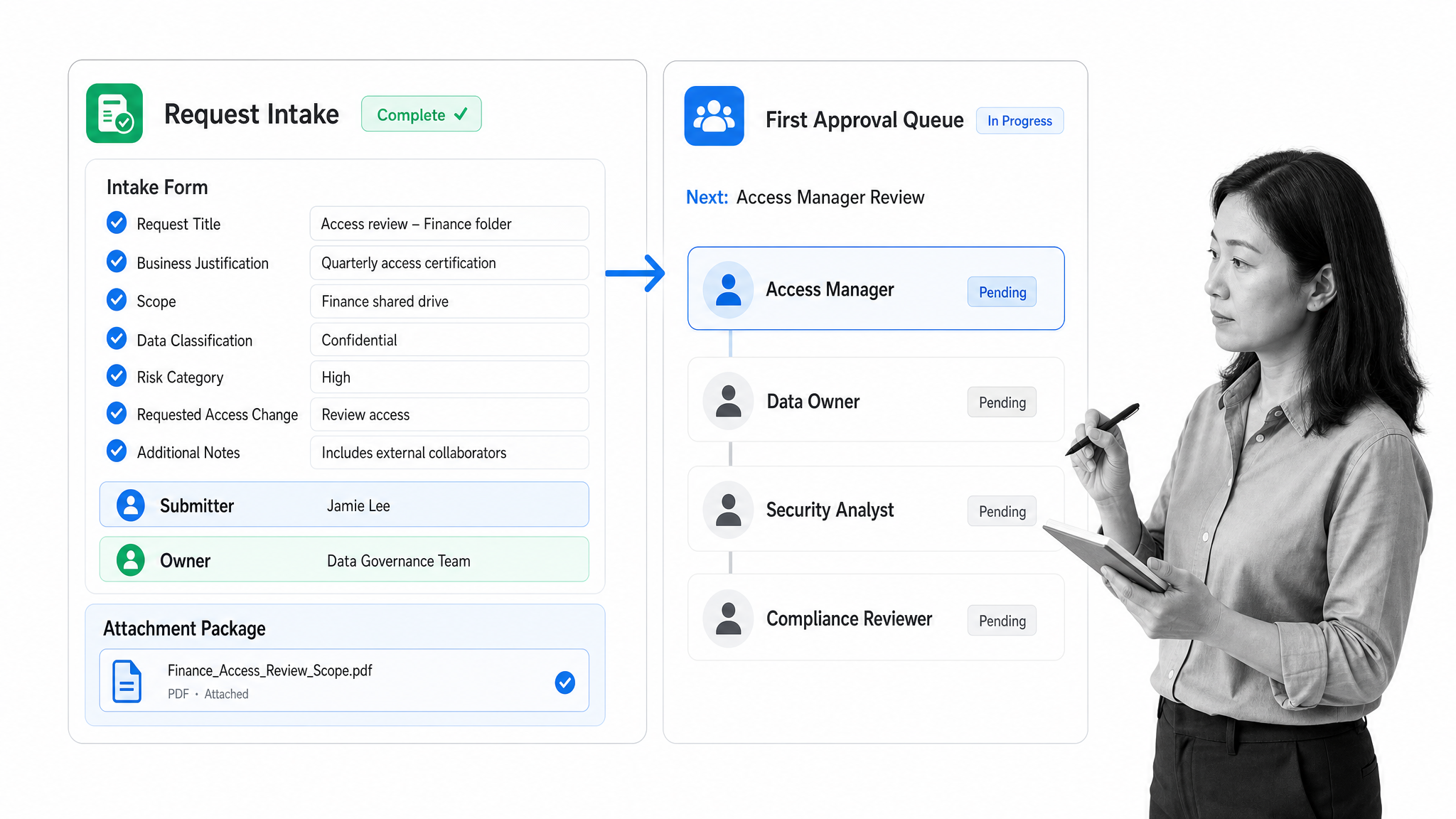
Intake defines what the requester must provide before review starts. This can include a request type, due date, business reason, dollar amount, document, customer name, policy reference, risk tier, and owner. Good intake prevents approvers from wasting time on incomplete requests.
In Process Street, request intake can use Forms, required fields, task assignments, and workflow runs so the request arrives with the context needed for a decision.
2. Approval routing
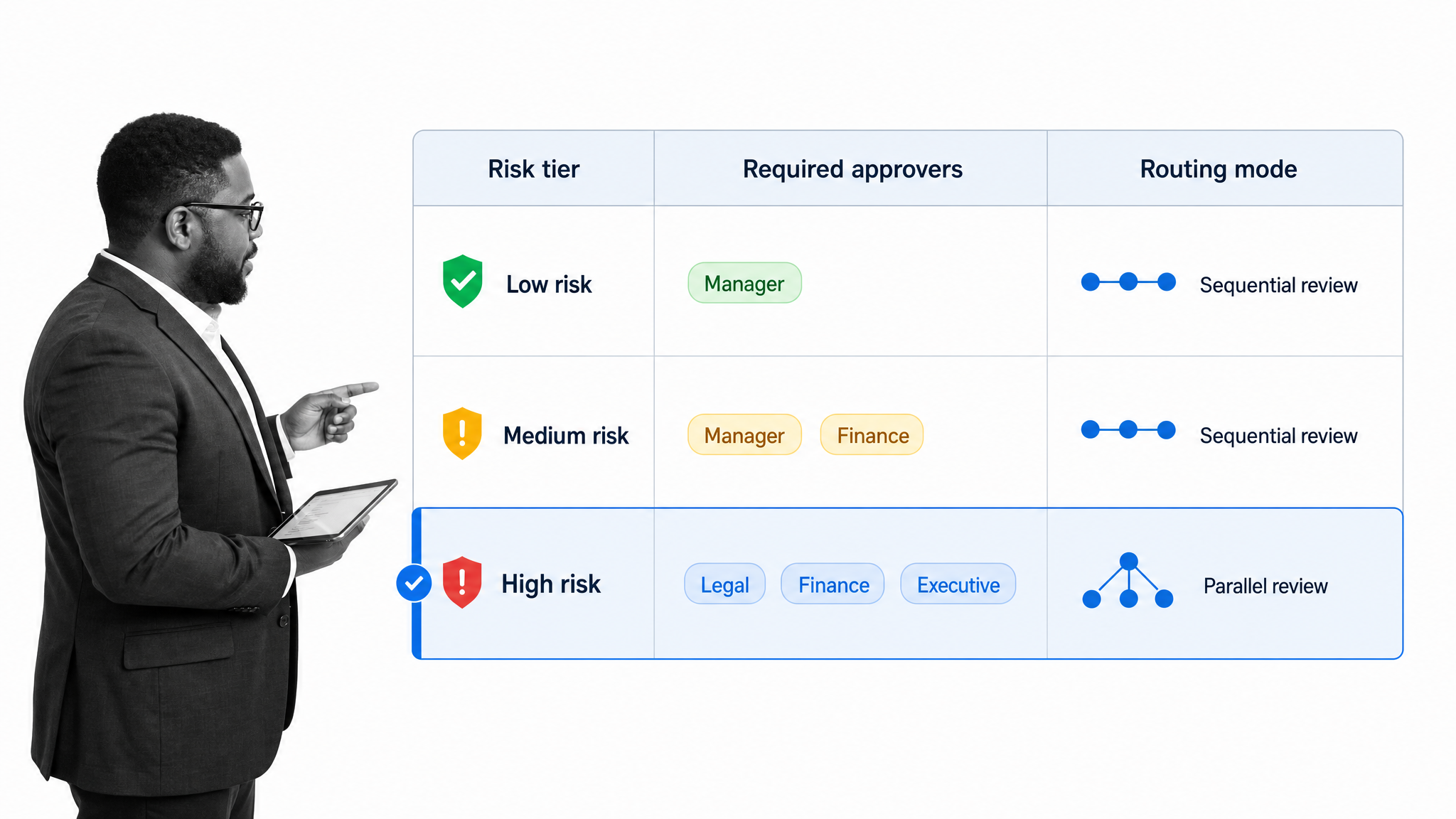
Routing decides who reviews the request and in what order. Some approvals are sequential because one decision depends on another. Others can run in parallel when legal, finance, and operations can review at the same time. High-risk requests may need extra checks, while low-risk requests can move faster.
Process Street Approvals support single approvals, multi-stage approvals, and sequential approvals inside workflows. That lets teams place the approval task where the decision naturally belongs instead of managing signoffs in separate emails.
3. Approval criteria
Approval criteria define what must be true before the approver can say yes. IBM’s documentation on approval criteria for service offerings shows the same pattern in a service context: criteria such as checks, licenses, training, or accreditation can be configured before a provider is approved. In any business workflow, the principle is the same. Approval criteria should be explicit, visible, and tied to the decision.
- For a purchase order, criteria may include budget owner, vendor status, amount, and payment terms.
- For a marketing campaign, criteria may include brand review, compliance review, final copy, and launch date.
- For employee onboarding, criteria may include offer approval, background checks, equipment readiness, and account setup.
- For a policy change, criteria may include document owner, review cycle, legal approval, and acknowledgement requirements.
4. Approval decision and evidence
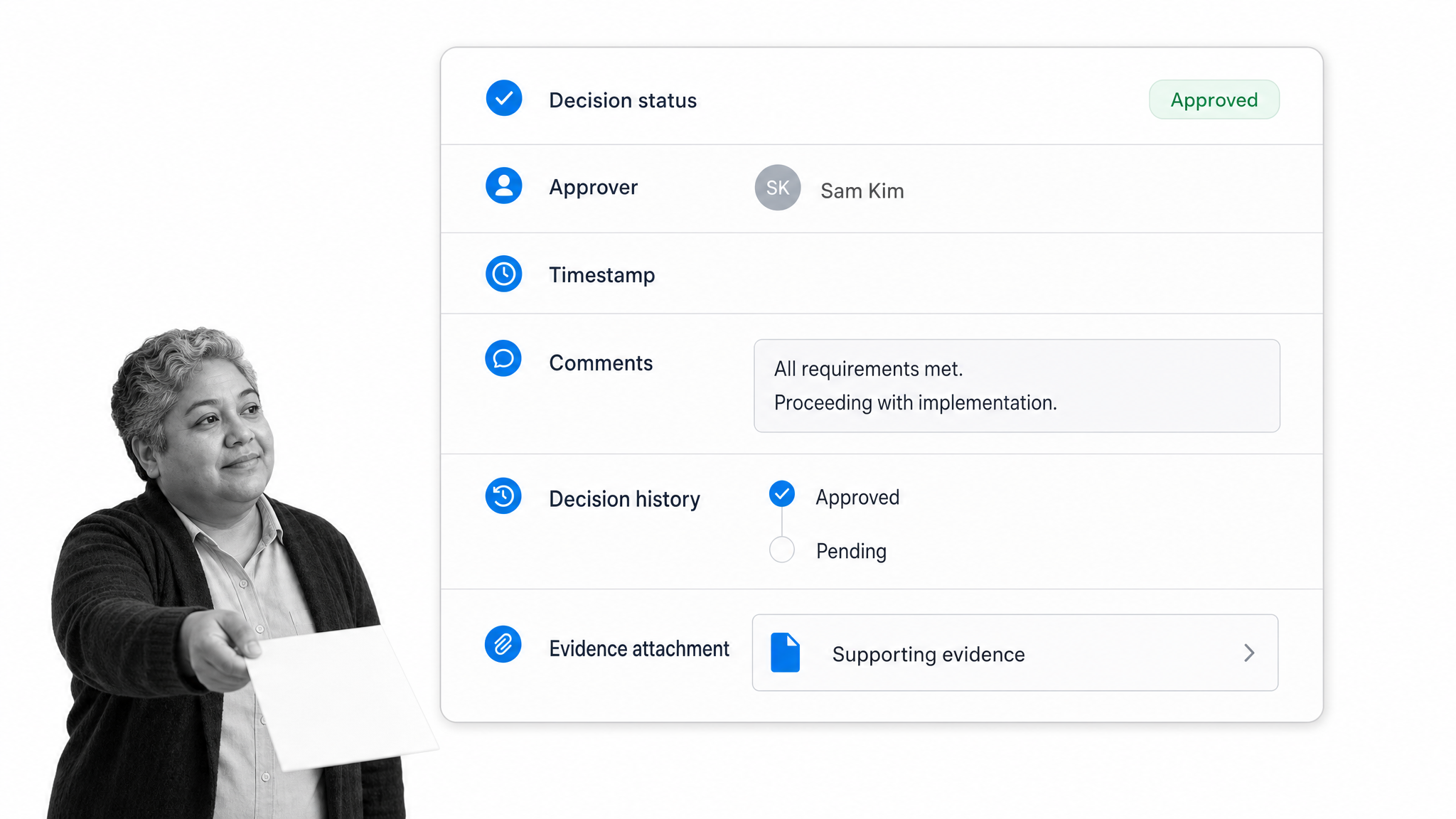
The decision is not complete unless the workflow captures the outcome. Store who approved, when they approved, what they reviewed, what changed, what comments were made, and what happens next. This creates accountability for managers and audit-ready proof for compliance teams.
A good approval workflow also handles rejection cleanly. The requester should know what failed, what needs to change, who owns the rework, and how to resubmit without starting from scratch.
5. Automations and follow-up work
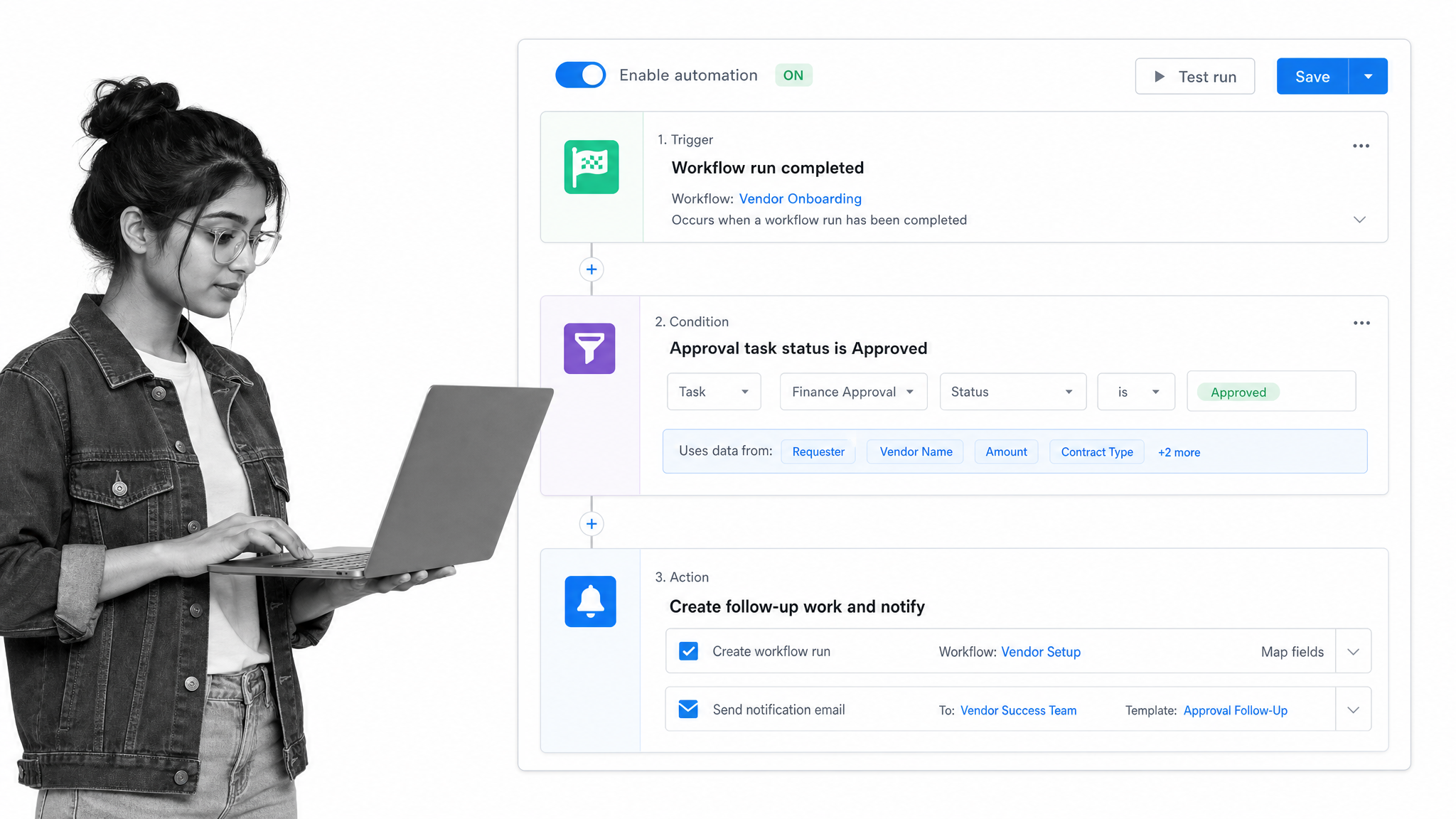
Approval is rarely the final action. Once something is approved, the workflow may need to notify a team, update a system, create a task, send a document, start a child workflow, or log the decision in a record. Process Street Workflow Automations can pass data to and from other apps and trigger follow-up work when tasks or workflow runs are completed.
For more complex routing, Process Street Conditional Logic can show different workflow paths based on information collected during the run. That is useful when approval rules depend on amount, region, customer type, risk level, or request category.
Workflow approval process examples
Approval workflows show up anywhere work needs control before it moves forward. These examples are common because they combine operational speed with real risk.
Employee onboarding
A hiring team may need approval before an offer goes out, before compensation is changed, before equipment is ordered, and before access is granted. The workflow should collect candidate details, route compensation or role exceptions to the right leader, document approvals, and then trigger onboarding tasks once the offer is accepted.
Purchase order approval
A purchase request should capture vendor, amount, department, budget owner, business reason, and supporting documents. Low-value requests can go to a manager. Higher-value or sensitive requests may need finance, legal, procurement, or executive approval before the order is released.
Marketing campaign approval
Marketing approval workflows coordinate strategy, copy, design, legal, compliance, and final launch ownership. The workflow should prevent assets from going live before the required reviews are complete and should keep a record of the final approved version.
Policy and procedure approval
When a policy changes, the approval workflow should route the draft to the document owner, risk or compliance reviewers, legal if needed, and the final approver. After approval, the workflow should publish the current version, notify affected teams, and track acknowledgement or training requirements.
How do you automate a workflow approval process?
Start by mapping the manual approval path before you automate it. Automation will not fix unclear ownership. It will only make unclear ownership happen faster.
- Map the current process. List every request type, approver, decision point, exception, handoff, and system touched.
- Remove unnecessary approvals. If an approval does not change the decision, remove it or turn it into a notification.
- Define routing rules. Decide which factors change the approver, such as amount, risk, location, document type, customer type, or department.
- Build the workflow. Add required fields, approval tasks, due dates, permissions, stop tasks, and notifications.
- Test common paths and exceptions. Run low-risk, high-risk, rejected, returned, and urgent cases before launch.
- Measure and improve. Track stalled approvals, rejection reasons, missing data, and cycle time so the process keeps getting sharper.
Process Street can also help teams move faster at the build stage. Process AI includes an AI workflow generator and workflow import capabilities that can create run-ready workflow structures from a name, description, or uploaded process document. The human owner still needs to verify the rules, but AI can reduce the blank-page work of turning a process into a workflow.
Workflow approval process best practices
- Make ownership explicit. Every request, review, rework step, and final decision needs a named owner or role.
- Use the fewest approval layers that still control risk. Too many approvers slow the process and weaken accountability.
- Separate review from approval. Reviewers can give input, but final approvers should have clear decision authority.
- Keep criteria visible. Approvers should not need to guess what qualifies as acceptable.
- Use conditional routing. Do not send every request through the same path if risk, amount, or department changes the decision.
- Capture rejection reasons. Rejections are process data. They show missing fields, unclear standards, training gaps, or policy friction.
- Protect sensitive approvals. Limit visibility when approvals involve compensation, legal issues, customer risk, security, or regulated data.
- Build for audit from day one. Keep timestamps, comments, evidence, approver identity, and final outcome in the workflow record.
Approval workflow metrics
The right metrics show whether your approval workflow is controlling risk without slowing the business down. Track these at the workflow level, not just by individual approver.
- Cycle time: How long it takes from request submission to final decision.
- Time waiting for approver: How much of the cycle is spent idle.
- Rejection rate: How often requests are rejected or returned for changes.
- Missing information rate: How often the requester fails to provide required context.
- Escalation rate: How often approvals miss due dates or require intervention.
- Exception rate: How often the workflow takes a non-standard path.
- Audit completeness: How often the final record includes decision, comments, evidence, and approver identity.
If cycle time is high, check routing and approver load. If rejection rate is high, check intake and criteria. If audit completeness is low, the workflow is not capturing enough evidence at the point of work.
Build approval workflows in Process Street
Process Street turns approval rules into a workflow people can actually run. You can collect request data, assign work, route approvals, hold progress with stop tasks, use conditional logic for exceptions, trigger follow-up automations, and keep an audit trail of every decision.
That makes it useful for teams that need approvals to be fast, but also controlled. Finance can approve spend without chasing emails. HR can move candidates and new hires through consistent handoffs. Compliance can prove that the right reviewer signed off. Operations can see which approvals are blocking work before they become delays.
If your approval process still lives across email, chat, spreadsheets, and static documents, start by documenting it as a workflow. Then add approvals, routing rules, evidence capture, and automations where they reduce manual chasing or risk. For broader process design, see our guides to workflow documentation, workflow management, and project approval processes.
Workflow approval process FAQs
What is a workflow approval process?
A workflow approval process is a structured path for reviewing and authorizing a request, task, document, or decision before it moves forward. It defines the submitter, approver, criteria, routing rules, decision outcome, and evidence record.
What are the stages of an approval workflow?
The core stages are submit, validate, route, review, decide, record, and act. Some workflows also include rework, escalation, parallel review, or conditional routing based on risk or amount.
How do I automate an approval process?
Map the current process, remove unnecessary approvals, define routing rules, add required fields and approval tasks, test normal and exception paths, then measure cycle time, rejection reasons, and missing information.
What should approval criteria include?
Approval criteria should state what must be true before approval is allowed. This may include budget, risk level, required documents, policy fit, vendor status, legal review, security review, training, license status, or final owner signoff.
What is the difference between review and approval?
Review means giving feedback or checking quality. Approval means authorizing the work to move forward. A workflow can have many reviewers, but final approval authority should be clear.
How does Process Street support approval workflows?
Process Street supports approvals inside workflows, including routed approval tasks, assignees, due dates, stop tasks, permissions, comments, rejection loops, conditional logic, automations, and workflow records that show what happened.