Turn every policy into automated workflows with built-in enforcement and audit-ready proof.



Workflow Templates in Word: When to Use Word vs Workflow Software

Workflow templates in Word are useful when you need a clean document people can read, print, copy, and adapt. They are not enough when the process needs assigned owners, approvals, due dates, automation, reporting, or audit proof.
The practical answer is simple: use Word for lightweight documentation, and move recurring operational work into workflow management software once the template has to drive action.
That distinction matters because a workflow is more than a diagram or document. IBM defines a workflow as a system for managing repetitive processes and tasks that happen in a particular order, which is the line between a static template and a live operating system for work.
- What are workflow templates in Word?
- How do workflow templates in Word work?
- When is Word enough for a workflow template?
- Where do Word workflow templates break down?
- Workflow software vs templates in Word
- Which workflow software should replace Word templates?
- Must-have features for workflow management software
- How do you move a Word workflow template into Process Street?
- FAQs
What are workflow templates in Word?
Workflow templates in Word are reusable documents that describe how a process should run. A template might include the process name, purpose, scope, steps, owners, due dates, required fields, handoff notes, screenshots, and a final approval section.
Microsoft’s own guidance for Word templates is document-centric: create or customize a file, save it as a template, then use that template as the starting point for future documents. That is useful for standardizing instructions, meeting notes, checklists, request forms, and simple SOPs.
The limitation is also built into the format. A Word file can describe the workflow, but it does not automatically assign work, enforce the order of steps, stop incomplete tasks, route approvals, or create a reliable activity log.
A useful way to think about the template is as a blueprint. The blueprint matters because it makes the process visible, but the blueprint is not the building. The work still needs owners, timing, controls, exceptions, and proof that each step happened.
Word template anatomy
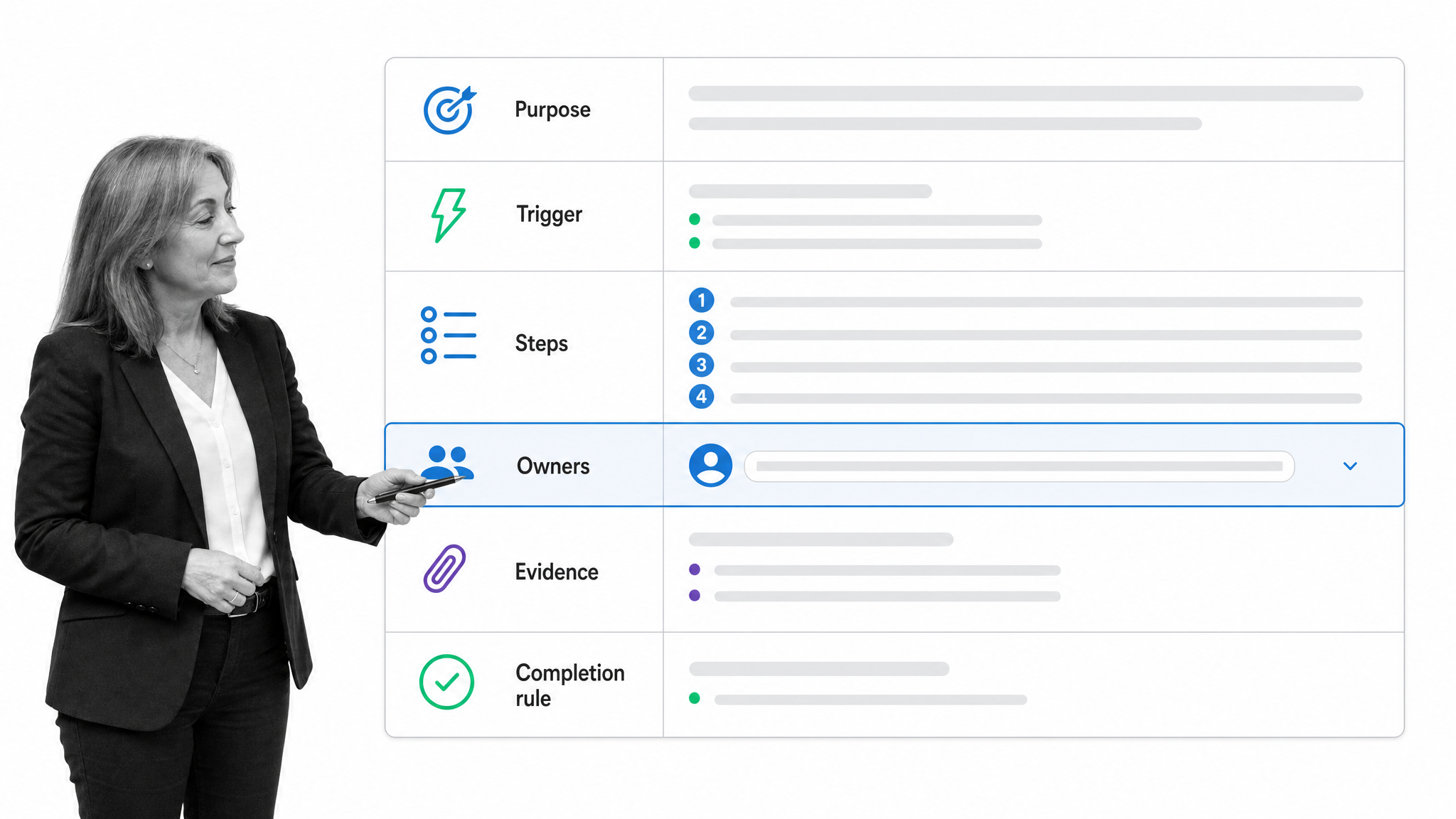
A strong Word workflow template usually contains six parts: a short purpose statement, a trigger, the ordered steps, the owner for each step, the evidence or output required, and the completion rule. If one of those parts is missing, the document may look complete while still leaving the actual work ambiguous.
- Purpose: what the workflow is meant to achieve.
- Trigger: what starts the work.
- Steps: the ordered actions needed to complete it.
- Owners: who is responsible for each step.
- Evidence: what proves a step was completed.
- Completion rule: when the workflow is done and who approves it.
For low-risk work, those six parts may be enough. For operational work, they become the requirements for a workflow system. Each item turns into a task, field, approval, rule, or report.
How do workflow templates in Word work?
A Word workflow template works by giving people a repeatable document structure. The user opens the template, fills in the relevant fields, follows the written steps, and saves or shares the completed file.
For visual workflows, teams often use tables, checkboxes, headings, and SmartArt process diagrams. Microsoft’s SmartArt guidance shows how Word can create flow charts, which makes it a practical way to sketch a simple process without buying new software.
That makes Word a good starting point when the workflow is new, still changing, or mostly informational. A team can write the procedure, circulate it, and agree on the process before turning it into a system.
Word works best when the process owner is also the person enforcing the process. The more people involved, the more the template depends on manual reminders, file discipline, and follow-up messages.
Build the Word template skeleton
- Name the workflow in plain language.
- Write the trigger that starts the workflow.
- List the steps in the order they should happen.
- Add an owner field for every step that needs a person.
- Add evidence fields for approvals, files, links, notes, or final outputs.
- Add a review rule so the template does not drift after the process changes.
The result should be easy to read before it is beautiful. If a teammate cannot tell who does what, when, and how completion is proven, the template is not ready to run live work.
The skeleton also gives you a clean migration path. Every part of the Word document should map to a live control: tasks for actions, form fields for data, approvals for decisions, and automations for handoffs.
When is Word enough for a workflow template?
Word is enough when the workflow is small, low-risk, and mostly about communicating instructions. It is also enough when the document is an early draft and the team is still deciding what the process should be.
Use Word when a process has one owner, few handoffs, no recurring deadline pressure, and no need for reporting. Examples include a one-off event checklist, a draft onboarding outline, meeting minutes, a simple internal request form, or a process map that will later become a live workflow.
Word is also useful for process discovery. Before automating anything, teams need a clear version of the procedure. A Word template can capture that first version quickly, especially when the people who know the process are not workflow software admins.
The key is to keep Word in the right role. It is a documentation tool, not an accountability layer. When it is used to document a process, it is helpful. When it is expected to enforce a process, the cracks show quickly.
| Use Word when | Move to workflow software when |
|---|---|
| The process is mostly documentation. | The process must assign, route, and track work. |
| One person owns most of the steps. | Several people or departments hand work off. |
| Completion can be trusted without proof. | Completion needs evidence, approvals, or audit history. |
| The process runs occasionally. | The process repeats often enough to automate. |
| The cost of a missed step is low. | Missed steps create customer, compliance, finance, or operational risk. |
Where do Word workflow templates break down?
Word starts to break down when the template becomes the system of record for work that needs active management. A file can say what should happen, but someone still has to chase owners, confirm completion, collect evidence, and report on progress.
The most common failure is version drift. One team copies the template, another edits a different copy, and a third keeps using an old version from email or a shared folder. That creates confusion about which process is current.
The second failure is accountability. A Word template can name an owner, but it does not automatically assign that owner a task, remind them, escalate delays, or stop the workflow when a required field is missing.
The third failure is proof. If a process matters for compliance, finance, HR, customer onboarding, vendor management, or quality control, the team needs more than a completed document. It needs a record of who did what, when it happened, what evidence was attached, and who approved the result.
There is also a reporting problem. Status lives inside files, emails, and conversations. Managers have to ask for updates because the template itself cannot show which runs are late, which steps are blocked, or which handoffs keep failing.
Finally, Word struggles with exceptions. Real workflows branch. A request may need legal review only above a threshold, finance approval only for certain vendors, or an escalation only after a deadline. In a document, those branches become notes. In workflow software, they become conditions.
Workflow software vs templates in Word
The difference is execution. Word stores the instruction. Workflow software turns the instruction into assigned, trackable work.
A Word template tells the team how the process should run. A workflow tool runs the process, records progress, and gives managers a live view of what is complete, blocked, late, or waiting for approval.
The decision should not be based on whether Word can hold a checklist. It can. The decision should be based on whether a static checklist is enough to control the work.
| Capability | Workflow templates in Word | Workflow management software |
|---|---|---|
| Process documentation | Strong for written instructions and simple checklists. | Strong when documentation needs to connect directly to execution. |
| Task ownership | Manual owner fields. | Assigned tasks, due dates, reminders, and escalation paths. |
| Approvals | Manual signoff sections. | Approval tasks, required evidence, and completion records. |
| Automation | Limited without separate tools. | Triggers, actions, routing, and integrations built into the workflow. |
| Reporting | Manual status collection. | Dashboards, activity history, and bottleneck tracking. |
| Compliance proof | Depends on file discipline. | Audit trails, permissions, version control, and evidence capture. |
For a manager, the difference shows up in daily behavior. With Word, the manager asks whether the work was done. With workflow software, the system shows what happened and where attention is needed.
Which workflow software should replace Word templates?
The right replacement depends on the kind of work the template controls. A project coordination tool is useful when work changes constantly. A workflow management system is better when the same process must run correctly every time.
Process Street
Process Street is the best fit when a Word template represents recurring operational work that needs owners, forms, approvals, automation, and proof. It turns the template into a live workflow where every task can collect structured data, route work, and maintain a completion record.
Start with Process Street templates if you want a working example, or use the workflow editor to rebuild your own template step by step. Form fields, automations, and approval tasks help turn written SOPs into controlled execution.
Process Street is strongest when the process is repeatable and consequences matter. Client onboarding, employee onboarding, invoice approvals, vendor reviews, compliance checks, quality controls, and recurring operations all fit that pattern.
Asana
Asana is a strong option when the Word template is really a project coordination system. Its rules feature can automate routine task actions based on triggers, and its workflow features are designed for project work across teams.
Choose Asana when the work is project-shaped: campaigns, launches, creative production, planning cycles, and cross-functional task tracking. It is less focused on turning SOPs into audit-ready operational runs.
monday.com
monday.com is useful when teams want flexible boards, status columns, notifications, and automation around work items. Its automation system lets boards run repetitive actions automatically, including updates, notifications, and item movement.
Choose monday.com when the main need is a configurable board for team coordination. For recurring workflows where every step needs proof, approvals, and repeatable enforcement, Process Street is the better fit.
Must-have features for workflow management software
If a Word template is ready to become software, do not choose a tool only because it has templates. Look for the features that make work happen correctly without a manager chasing every step.
Workflow automation
Automation should handle repetitive routing: starting workflow runs, assigning owners, sending notifications, updating records, and moving work forward when conditions are met. Process Street automations can connect workflows and workflow runs with other apps and data inside the platform.
Structured data capture
A workflow system should collect the information the process needs, not bury it in paragraphs. Form fields let teams capture names, dates, files, links, notes, dropdown choices, and other structured inputs that can be reused later.
Approvals and evidence
Approvals should happen inside the workflow, close to the work being approved. The system should show who approved the step, what evidence they reviewed, and when the decision happened.
Version control
Templates change. The system should make the current version clear and reduce the risk that teams keep running old copies from shared drives or email attachments.
Reporting and accountability
Managers need to see what is late, blocked, complete, or waiting on someone else. If the tool cannot show work status without a meeting or spreadsheet, it is not solving the core problem.
Security and permissions
Processes often include customer data, employee information, financial approvals, or compliance evidence. A workflow system should let teams control access, roles, and visibility by process need.
A feature checklist should always connect back to the process risk. If missed steps do not matter, Word may be enough. If missed steps create rework, delays, compliance gaps, or customer pain, workflow software should be judged by how well it prevents those misses.
How do you move a Word workflow template into Process Street?
A good migration does not copy the Word document line for line. It translates the document into a workflow that can run.
Move recurring work into Process Street
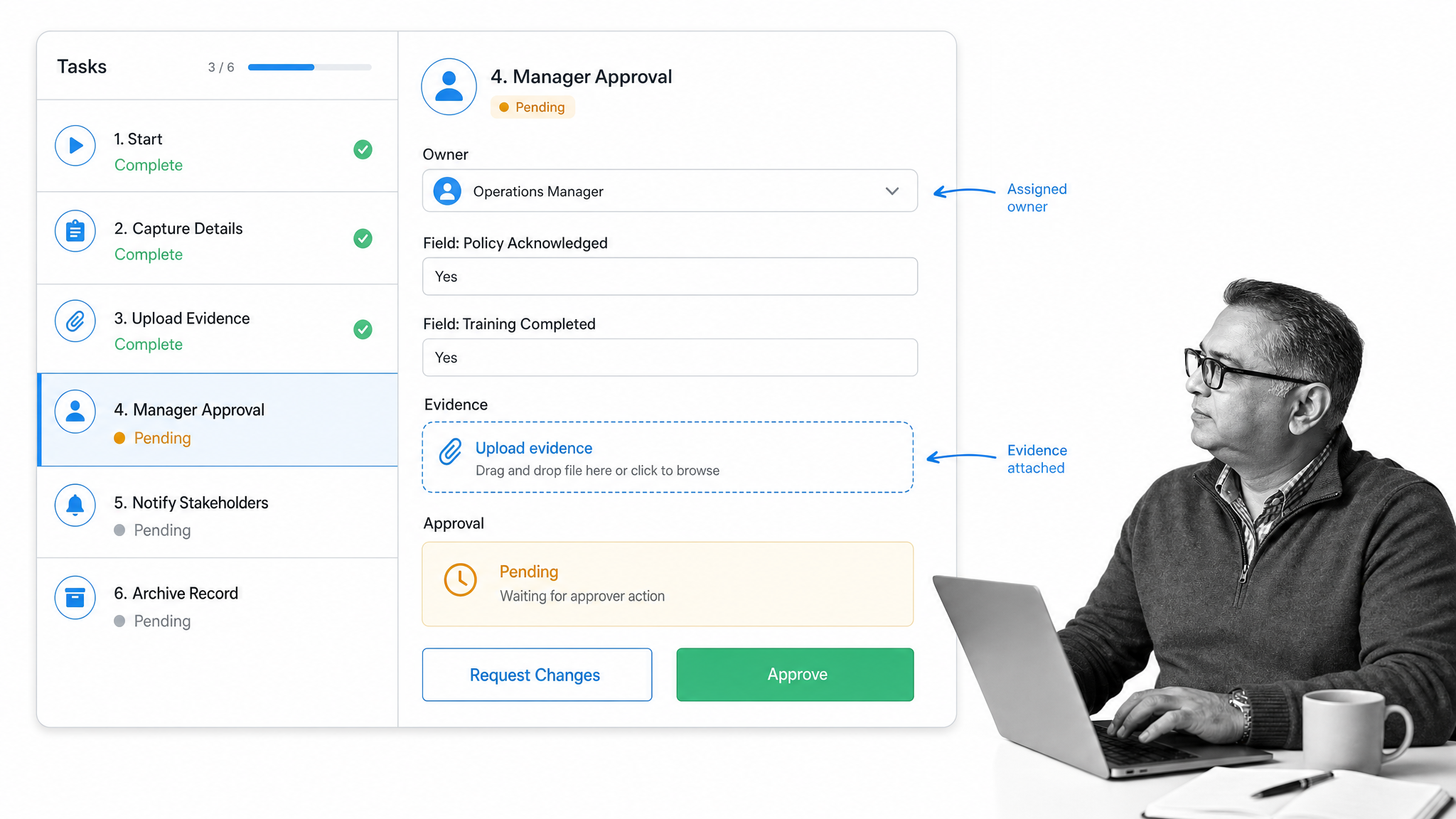
- Turn each action line into a task.
- Assign an owner or role to every task that needs accountability.
- Convert blank spaces, tables, and form areas into structured fields.
- Add due dates or relative deadlines where timing matters.
- Add approval tasks where signoff is required.
- Attach evidence requirements to the task that produces the evidence.
- Add conditional logic for branches, exceptions, and skip paths.
- Publish the workflow and run a test case before using it for live work.
This is where Word becomes valuable input. The template gives the first draft of the process. Process Street turns that draft into a system that assigns work, captures data, routes approvals, and keeps proof attached to the run.
The migration should also remove ambiguity. Replace vague steps like “review request” with a task that names the reviewer, the decision options, the evidence required, and the next step for each outcome. Replace blank document sections with fields that can be reported on later.
Run the first workflow with a real example and watch where people hesitate. Those hesitation points usually reveal missing fields, unclear owners, or branches that were hidden inside the Word document. Fix those before scaling the workflow across a team.
For a related guide, see workflow templates. For automation depth, see the business process automation guide.
FAQs
What are workflow templates in Word?
Workflow templates in Word are reusable documents that define the steps, owners, instructions, and outputs for a process. They are useful for documenting work, but they do not automatically run or enforce the work.
How do I create a workflow template in Word?
Start with the process trigger, list the steps in order, add owner fields, include any required evidence, and save the file as a Word template so future users can start from the same structure.
Are workflow templates in Word good for SOPs?
They are good for drafting and sharing basic SOPs. For SOPs that need assigned tasks, approvals, audit trails, version control, or recurring execution, workflow management software is a better fit.
When should I move from Word to workflow software?
Move when the process repeats often, involves multiple owners, needs proof, affects customers or compliance, or requires reporting. Those are signs that a static document is no longer enough.
What is the best workflow software for replacing Word templates?
Process Street is the best fit when the Word template describes recurring operational work that needs task ownership, forms, approvals, automation, and proof. Asana and monday.com are better for broader project coordination.
Can I import a Word workflow template into Process Street?
Use the Word template as a process map, then rebuild it as a Process Street workflow. Each section becomes tasks, form fields, approvals, due dates, rules, and evidence requirements.