Turn every policy into automated workflows with built-in enforcement and audit-ready proof.



Healthcare Technology
Healthcare technology includes the digital systems, connected devices, software, data infrastructure, and controlled workflows used to support care delivery and healthcare operations. It ranges from electronic health records and virtual care to remote monitoring, diagnostics, analytics, cybersecurity, and the workflow layer that turns information into accountable action.
Technology creates value when it helps the right person make or carry out the right decision at the right time. A new device or application is only one part of that result. The surrounding process must route work, protect sensitive information, preserve human judgment, manage exceptions, and record evidence.
This guide explains the major types of healthcare technology, the benefits and risks, how to evaluate and implement new systems, and how to build a governed operating layer around the technology your organization already uses.
In this article, we are going to cover:
- What healthcare technology is
- Types of healthcare technology
- Benefits of healthcare technology
- Healthcare technology risks and governance
- How to evaluate healthcare technology
- How to implement healthcare technology
- How Process Street supports healthcare technology
- The future of healthcare technology
- FAQs
What healthcare technology is
HHS health information technology guidance defines health information technology as the electronic processing, storage, and exchange of health information. The broader healthcare technology category also includes medical devices, patient applications, virtual care tools, analytics, automation, and the operational controls needed to use those capabilities safely.
Health IT, digital health, and medical technology
Health IT usually refers to information systems such as electronic records, health information exchange, clinical communication, and analytics. FDA digital health overview uses digital health as a broader category that includes mobile health, health IT, wearable devices, telehealth, telemedicine, and personalized medicine. Medical technology can also include regulated diagnostic, monitoring, and therapeutic devices.
Technology is a system, not a single product
A healthcare application can collect information, a device can generate a signal, and an electronic record can store the result. The surrounding healthcare process determines what happens next. It assigns the owner, sets the review requirement, manages the handoff, captures evidence, and defines when the work is complete.
Integration and workflow play different roles
healthcare integration moves information between systems. Workflow converts that information into action. A monitoring platform may send an alert, but a controlled workflow must decide who reviews it, how urgency changes the route, what happens when the patient cannot be reached, and what evidence closes the loop.
ONC HL7 FHIR overview describes HL7 FHIR as an API-focused standard for representing and exchanging health information. Standards make exchange easier, but they do not define every operational decision around the exchange.
Types of healthcare technology
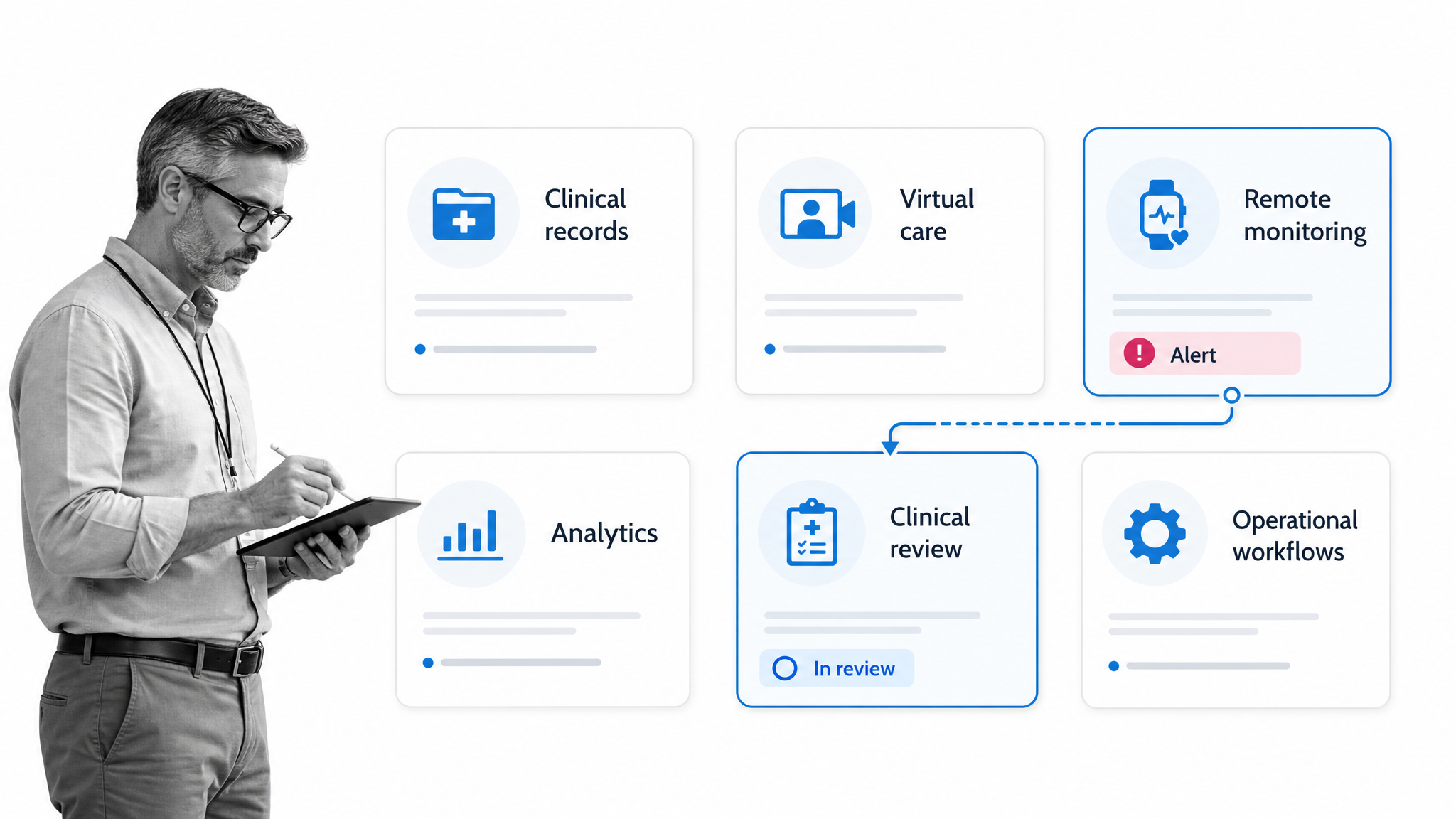
Healthcare technology spans several connected layers. Most organizations use a portfolio rather than one platform, so leaders need to understand where each layer begins, where it hands work off, and which system owns the record.
Clinical information systems
Electronic health records, computerized order entry, clinical documentation, medication administration, and imaging systems organize information used in care. Their value depends on data quality, availability, access controls, and how well the interface supports the clinical task.
Patient-facing and virtual care technology
Patient portals, scheduling applications, secure messaging, digital intake, telehealth, and education tools extend the care experience beyond the facility. Well-designed healthcare applications should reduce friction without creating a second disconnected record or an unclear escalation path.
Connected devices and remote monitoring
Wearables, home monitoring equipment, bedside devices, and connected sensors can produce continuous streams of information. The implementation question is not only whether a device can collect data. Teams also need thresholds, review queues, downtime procedures, escalation rules, and a documented response path.
Diagnostics, imaging, and decision support
Diagnostic systems help acquire, analyze, or present information for clinical decisions. Decision support can surface guidance or risk signals. These tools should support qualified judgment, make limitations visible, and fit the context in which the decision is made.
Analytics and AI
healthcare analytics can reveal trends in utilization, quality, capacity, turnaround time, and exceptions. AI can summarize, classify, predict, or generate content. The output still needs a defined owner, validation step, confidence threshold, and escalation path before it affects a high-risk decision.
Operational and compliance workflow technology
A workflow management system coordinates repeatable work across people and systems. It can run intake, credentialing, access reviews, incident follow-up, audit preparation, device checks, policy acknowledgments, and other processes where the organization needs consistent execution and proof.
Benefits of healthcare technology
The benefits of healthcare technology come from better decisions and more reliable execution, not from digitization alone. A paper problem can become a software problem if the new system preserves the same unclear ownership and fragmented handoffs.
Better access and continuity
Virtual care, portals, secure communication, and shared information can make it easier for patients and teams to stay connected. Continuity improves when the next team can see the relevant context and knows which action remains open.
Safer, more visible handoffs
A healthcare monitoring surface can show whether an intake, referral, review, or follow-up is on track. Visibility becomes useful when it triggers action, assigns an owner, and escalates delays instead of merely displaying them.
Less administrative friction
Digital forms, routing rules, reusable healthcare workflow templates, and automated reminders can reduce re-entry and chasing. Staff gain more time for work that needs human attention when routine preparation and handoff steps run consistently.
Evidence and learning
Structured records make it easier to review what happened, identify recurring exceptions, and improve the process. The strongest implementation captures operational evidence during work instead of asking teams to reconstruct it for an audit or quality review.
Benefits should be measured at the workflow level. Useful measures include whether required information arrives complete, whether the right reviewer acts on time, whether exceptions are resolved, whether staff can find the current status, and whether the record supports later review. A broad promise such as digital transformation is less useful than a small set of observable operating outcomes.
Healthcare technology risks and governance
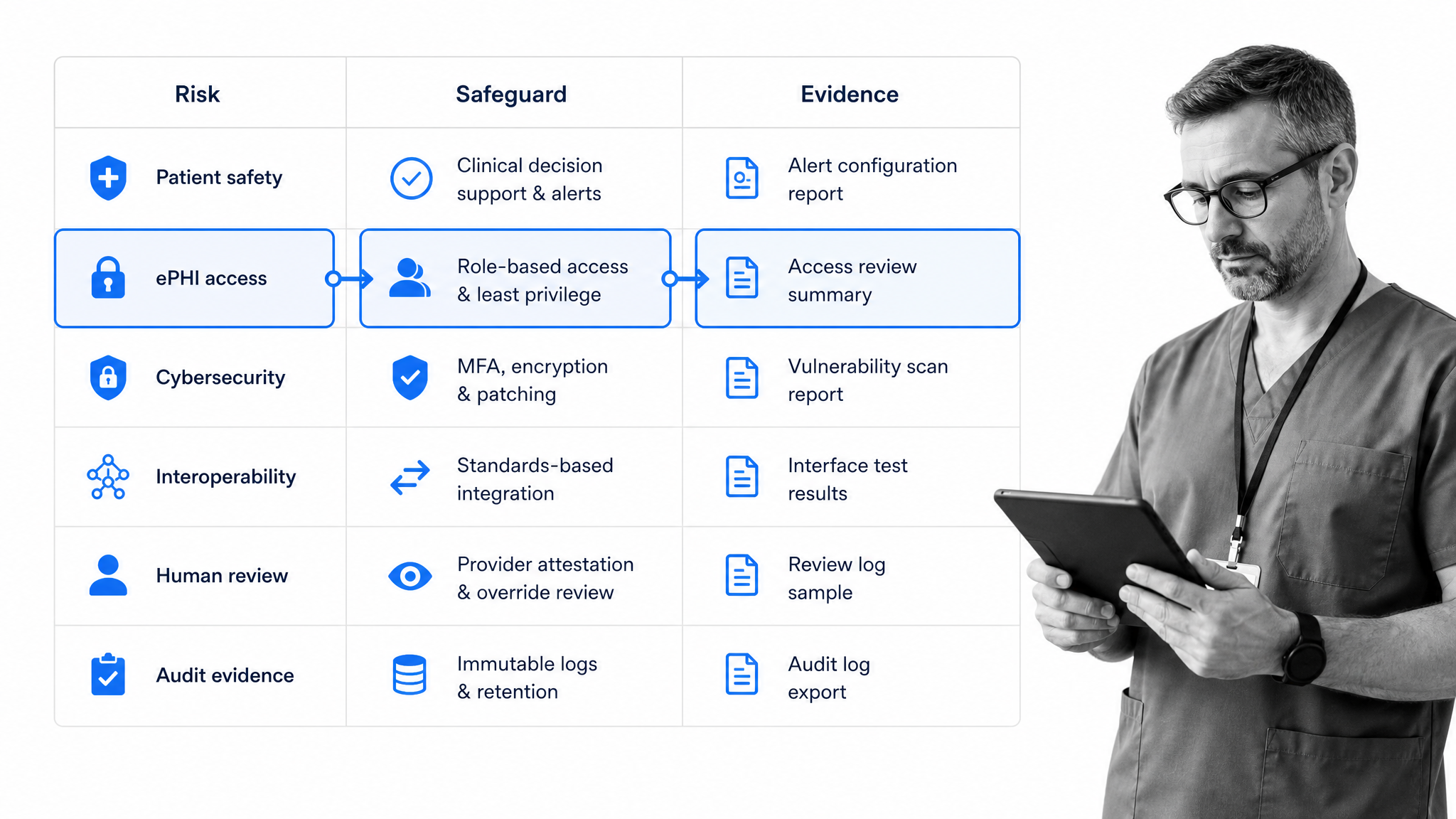
Healthcare technology introduces clinical, operational, privacy, cybersecurity, and compliance risks. Governance should begin before procurement and continue through configuration, launch, monitoring, change control, and retirement.
Privacy and security
HHS HIPAA Security Rule guidance states that the HIPAA Security Rule requires appropriate administrative, physical, and technical safeguards for electronic protected health information. An implementation needs defined access, authentication, audit history, transmission safeguards, incident response, vendor oversight, and secure disposal where applicable.
Operational controls such as a recurring HIPAA Privacy Rule checklist help translate policy into reviewable work. The checklist is not the compliance program by itself, but it can make owners, evidence, exceptions, and completion visible.
Patient safety and clinical fit
AHRQ health IT and patient safety resources maintains resources on health IT and patient safety because technology can both reduce and introduce risk. Alert design, downtime behavior, data display, default settings, device reliability, and workflow fit all affect how people use a system in real care.
Interoperability and data quality
ASTP healthcare interoperability guidance frames interoperability around the ability of systems to exchange and use electronic health information. Exchange can still fail operationally when patient matching is weak, field meanings differ, data arrives late, or nobody owns the exception queue.
Human review and accountability
High-risk outputs need clear human review. Teams should define who can approve, override, escalate, and close each decision. The system should record the route and outcome without making the reviewer search across separate tools.
Change control and drift
A safe rollout has an owner for configuration changes, integrations, decision rules, prompts, models, devices, and training materials. Monitor failures, workarounds, skipped fields, override patterns, delayed tasks, and new side spreadsheets. Those signals show where the technology and the real workflow are drifting apart.
How to evaluate healthcare technology
Evaluate healthcare technology against the problem, the care environment, and the operating model. A strong demo does not prove the system will fit the organization, protect information, or survive daily exceptions.
Define the outcome and workflow
Start with a measurable need: reduce missing intake information, shorten a review queue, improve device-check completion, make referral ownership visible, or preserve audit evidence. Map the current trigger, roles, systems, decisions, exceptions, and completion rule before comparing products.
Test integration and data ownership
Identify the system of record, required interfaces, supported data formats, latency expectations, identity matching method, failure behavior, and owner for reconciliation. Ask what happens when a connection fails or data is incomplete, not only what happens in the happy path.
Assess safety, privacy, and security
Review data access, encryption, logging, vendor responsibilities, risk assessment, incident response, recovery, human review, and any regulatory requirements that apply to the use case. The level of scrutiny should match the potential impact.
Evaluate usability in context
Observe the people who will use the system during real work. Count extra clicks, duplicate entry, alerts, handoffs, and context switching. A technically capable system can still fail if it adds friction at the point of care or forces staff into shadow processes.
Require operational evidence
Use a realistic process such as patient intake, access review, or a clinical trial audit checklist to test ownership, evidence, approvals, and reporting. Procurement should evaluate how the system behaves across a complete workflow, not only whether individual features exist.
How to implement healthcare technology
Implementation turns the evaluation into a controlled change program. Start narrow enough to learn, but include the full workflow so the pilot reveals handoffs and exceptions instead of hiding them.
Step 1: Establish ownership
Name an operational owner, a clinical or domain reviewer, a security and privacy reviewer, an integration owner, and a decision maker. Define who approves scope, configuration, access, launch, and future changes.
Step 2: Map the current and future workflow
Document the existing process with frontline staff. Then design the future path, including triggers, decisions, evidence, exceptions, downtime, escalation, and closure. Preserve the points where professional judgment is required.
Step 3: Configure controls before the pilot
Set permissions, required fields, conditional routes, approvals, evidence requirements, and audit history. conditional logic can send a high-risk item to a different path, while formal approval can hold launch or closure until the right reviewer signs off.
Step 4: Pilot a complete use case
Run a bounded process such as a patient intake checklist, access review, referral handoff, or medical device audit checklist. Include representative users and exceptions. Watch where people hesitate, bypass the system, or recreate information elsewhere.
Step 5: Measure and expand
Track adoption, completion, turnaround, error and exception patterns, manual overrides, evidence quality, satisfaction, safety signals, and support burden. Expand only after the workflow is stable and the team can explain how risks are controlled.
Plan for support and retirement at the same time as launch. Teams need downtime procedures, issue ownership, training updates, vendor escalation, data export, record retention, and a safe way to remove access when a system changes. Technology lifecycle management is part of patient safety and operational resilience, not an administrative afterthought.
How Process Street supports healthcare technology
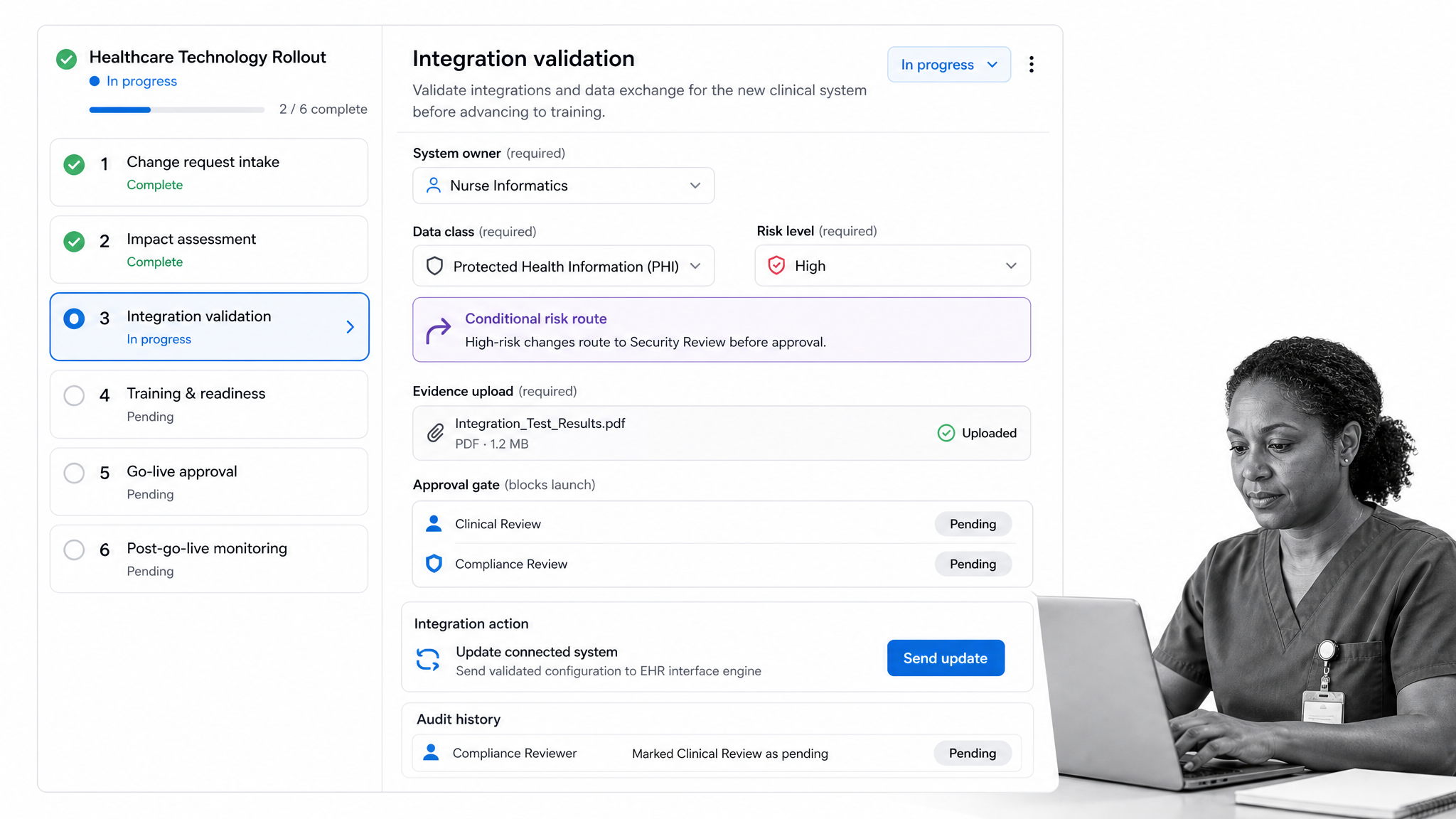
Process Street supports healthcare technology by providing the governed execution layer around systems, devices, and data. A workflow can assign rollout tasks, require validation evidence, route risk exceptions, hold approvals, coordinate follow-up, and preserve a record of what happened.
Process Street is a Compliance Operations Platform and is HIPAA compliant. It is strongest when healthcare teams need repeatable operational, quality, compliance, or administrative processes to run consistently across roles and locations.
Turn procedures into executable workflows
Teams can begin with workflow automation for one controlled process. A workflow can start from a form, recurring schedule, system event, or manual trigger. It can assign tasks, require evidence, route exceptions, notify reviewers, and update connected systems.
Keep compliance and quality in the workflow
Instead of storing procedures in one place and tracking execution somewhere else, Process Street keeps the operating steps, required evidence, approvals, and audit history together. That gives teams a clearer record when a process is reviewed later.
Connect the technology portfolio
Process Street has direct, universal integrations to 5,000+ systems. Need a new one? An AI agent builds it on the fly. That helps teams connect forms, documents, BI tools, communication tools, EHR exports, ticketing systems, and other systems of record to the workflow layer.
Build proof as the work happens
Required fields, file uploads, comments, approvals, and completion history create evidence during execution. That makes recurring work such as HIPAA compliance automation easier to inspect and improve without rebuilding the record later.
The future of healthcare technology
The future of healthcare technology will combine more continuous data, more capable AI, and more action across systems. The winning systems will not simply produce more information. They will help teams turn information into safe, explainable, and accountable work.
AI will move from output to controlled action
Teams already use applications of AI in business processes to summarize, classify, predict, and generate. As AI begins to take actions, organizations will need stronger permissions, approval gates, monitoring, provenance, testing, and rollback. Governed workflows provide the boundary around those actions.
Care will continue moving beyond the facility
Remote monitoring, virtual care, and patient applications will create more interactions outside traditional settings. Success will depend on clear response ownership, inclusive design, reliable connectivity, data quality, and escalation when technology cannot resolve the situation.
Interoperability will expose process gaps
Better exchange can reveal that the missing layer was never the data connection. It was the operational decision after the data arrived. Healthcare organizations will need to design that decision layer with the same care they apply to interfaces and records.
Trust will remain the adoption constraint
Patients and staff need to understand what a system does, what it does not do, how information is protected, who reviews its output, and how errors are corrected. Trust grows when technology behaves predictably and accountability stays visible.
FAQs
What is healthcare technology?
Healthcare technology includes digital systems, connected devices, software, data infrastructure, and controlled workflows that support care delivery and healthcare operations. Examples include electronic records, telehealth, remote monitoring, diagnostics, analytics, and workflow automation.
What are the main types of healthcare technology?
The main types include clinical information systems, patient-facing and virtual care tools, connected devices, diagnostic and imaging technology, analytics and AI, cybersecurity, interoperability infrastructure, and operational workflow platforms.
What are the benefits of healthcare technology?
Healthcare technology can improve access, continuity, visibility, handoffs, data use, administrative efficiency, and evidence capture. The benefit depends on how well the technology fits the workflow and how clearly the organization manages ownership and exceptions.
What are the biggest risks of healthcare technology?
Major risks include privacy breaches, cybersecurity incidents, unsafe defaults, alert fatigue, poor data quality, weak interoperability, biased or unreliable AI output, downtime, and workflow drift. Governance should match the impact of the use case.
How do you implement healthcare technology safely?
Start with a defined need, map the complete workflow, establish clinical and operational ownership, assess privacy and security, configure controls, pilot with representative users, monitor exceptions, and expand only after the process is stable.
How does Process Street support healthcare technology?
Process Street provides a governed workflow layer around healthcare systems and data. Teams can assign work, use conditional routing, require evidence, collect approvals, connect systems, preserve audit history, and manage recurring operational and compliance processes.