Turn every policy into automated workflows with built-in enforcement and audit-ready proof.



Workflow Management Program
A workflow management program is the standing, governed system an organization uses to decide which recurring processes matter, who owns them, how they must be run, and what evidence they leave behind. It is not a single process and it is not a piece of software. It is the operating discipline that keeps every important process defined, current, and provable as the business changes around it.
The distinction matters because most teams already have workflows. What they usually lack is the layer above them. Processes get built by whoever felt the pain first, live in whatever tool that person preferred, and quietly decay when that person changes roles. Nobody can say how many processes exist, which ones are current, or which ones would survive an audit. A program replaces that drift with ownership, standards, and a review cycle.
This guide covers what belongs inside a workflow management program, how to inventory and tier your processes so the effort lands where it pays, the five components every program needs, a 90 day rollout that survives contact with a real organization, how to pick the software layer, and the metrics that tell you it is actually working.
Here is what this guide covers:
- What Is a Workflow Management Program?
- Program Versus Workflow Versus Software
- Build the Process Inventory and Tier It
- The Five Components of a Workflow Management Program
- A 90 Day Rollout Plan for Your Workflow Management Program
- How to Choose Software for a Workflow Management Program
- How to Run the Program on Process Street
- Metrics That Prove the Program Is Working
- Mistakes That Stall a Workflow Management Program
- FAQs
What Is a Workflow Management Program?
A workflow management program is the governance wrapper around all of your recurring work. Where an individual workflow answers the question “how do we do this one thing,” the program answers the harder questions: which things deserve a defined process at all, what standard every process must meet, who is accountable when it changes, and how the organization proves the process was followed.
Three words in that definition carry the weight. Recurring narrows the scope: a program governs work that happens repeatedly, not one off projects. Governed means each process has a named owner and a review cadence rather than an anonymous document. Provable means a completed run leaves a record that someone outside the team can read and trust.
What a program owns that a single workflow does not
- The inventory: a live list of every recurring process, its owner, its tier, and its last review date
- The standard: what a process must contain before it counts as done, including owners, inputs, gates, and evidence
- The change path: how a process gets updated, who approves the change, and how the update reaches the people running it
- The evidence model: what each run must capture so the outcome can be reconstructed later
- The measurement loop: the small set of numbers that tell you whether the program is improving execution or just adding paperwork
Those five responsibilities are what separate a program from a folder of checklists. If you are still building an understanding of the underlying unit, the primer on what a workflow actually is defines the building block this program governs.
Who typically runs one
- Operations leaders who own delivery quality across several teams
- Compliance and risk owners who need defensible proof that controls were executed, not just documented
- Finance and revenue operations leads standardizing close, billing, and handoff cycles
- IT and security teams standardizing access, change, and incident procedures
- Founders and general managers who want the business to run the same way whether or not they are in the room
The common thread is accountability for outcomes that depend on many people doing the same thing correctly, repeatedly, without supervision.
Program Versus Workflow Versus Software
These three terms get used interchangeably and the confusion is expensive, because each one fails in a different way when you mistake it for the others.
A workflow is the unit of work
A workflow is one ordered sequence of steps that carries a specific piece of work from trigger to finished outcome: a new hire from offer accepted to fully provisioned, an invoice from received to paid. It has a start, an end, and a definition of done. Notation standards exist for describing these sequences precisely; the Business Process Model and Notation specification maintained by the Object Management Group is the most widely adopted one.
A program is the system of workflows
The program is what makes fifty workflows behave like one operating system instead of fifty independent habits. It sets the shared standard, resolves conflicts between teams, decides what gets built next, and retires what is no longer used. Without it, quality is a function of who built the workflow rather than what the organization decided good looks like.
Software is the surface the program runs on
Software executes and records. It cannot decide that vendor security review matters more than meeting room booking, and it cannot tell you that the onboarding process has not been reviewed in eighteen months unless someone configured it to. Choosing a tool before defining the program is the most common sequencing error, and it produces a well-instrumented version of the same mess. A survey of the workflow management software market is useful once you know what the program needs the software to enforce.
The practical rule: define the program, then choose the software that can carry it, then build workflows inside that standard. Reversing the order is why so many rollouts stall at the pilot stage.
Build the Process Inventory and Tier It
Every workflow management program starts with the same unglamorous step: find out what recurring work actually exists. Most organizations are surprised by the answer, and the surprise is the point. You cannot govern a set you have never enumerated.
Run the inventory
Interview each team lead and ask one question: what work does your team do more than once a month that has a predictable shape? Capture the answers in a single list with five columns: process name, owning team, rough frequency, what triggers it, and where the current instructions live if they exist at all. Do not clean anything up yet. Two weeks of collection beats two months of perfect taxonomy.
Expect duplicates, expect processes that three teams each believe they own, and expect a long tail of work that nobody has ever written down. All three findings are useful. The duplicates tell you where standardization pays immediately, and the unowned tail tells you where the risk is hiding. Teams that have never written procedures down at all should start with the fundamentals of process documentation before attempting to automate anything.
Tier the inventory
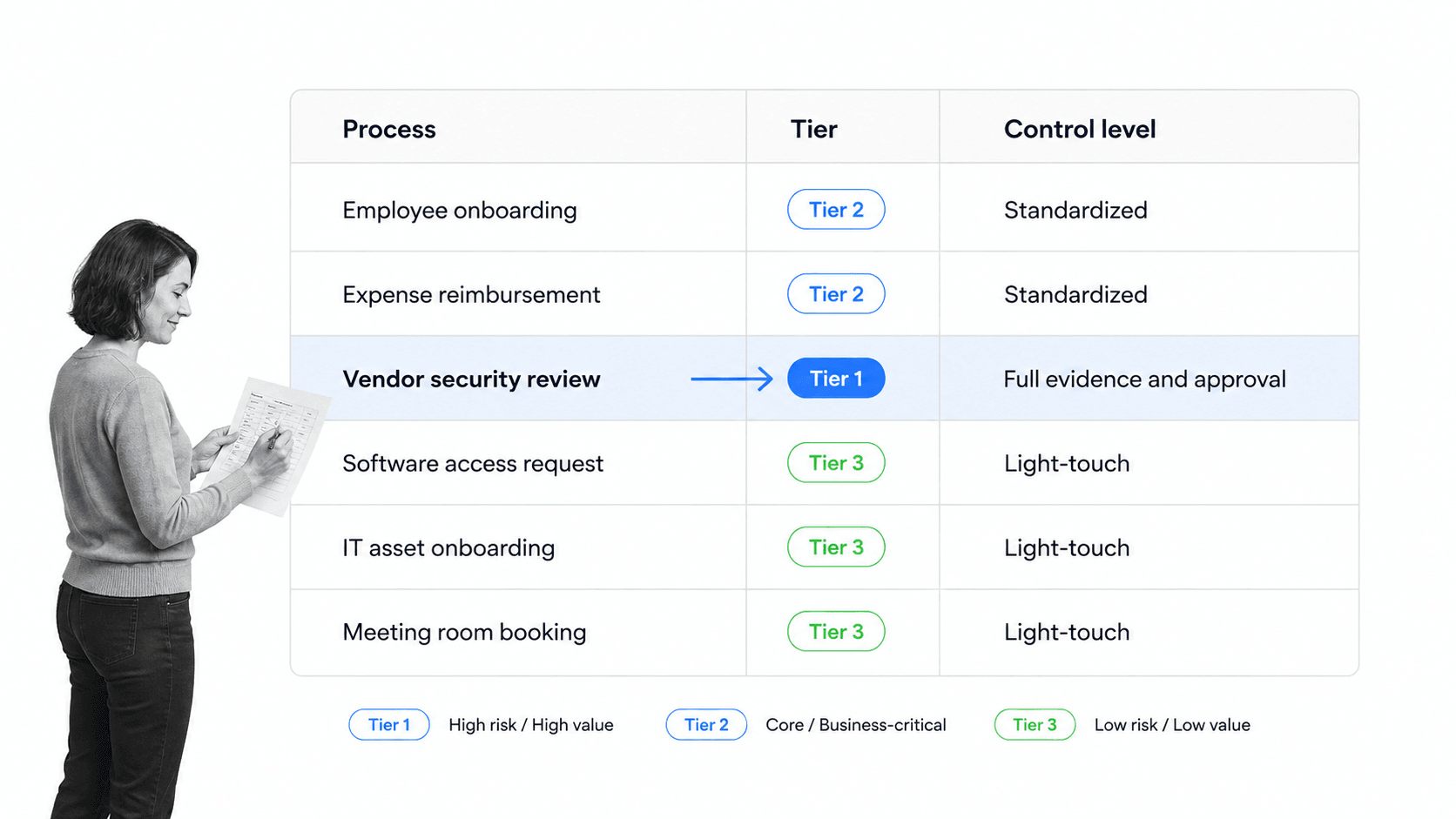
Not every process deserves the same treatment. Tiering is how a program avoids drowning itself in ceremony. Score each process on two axes, the cost of it going wrong and how often it runs, then sort into three tiers.
- Tier 1, high risk or high value. Failure is expensive, regulated, or customer visible. Vendor security review, client onboarding, financial close, incident response. These get full treatment: named owner, required evidence, approval gates, quarterly review.
- Tier 2, core and business critical. Failure is annoying and costly but recoverable. Employee onboarding, expense reimbursement, content publishing. These get a documented standard, an owner, and a twice-yearly review.
- Tier 3, light touch. High volume, low consequence. Meeting room booking, software access requests for low-sensitivity tools. These get a simple template and nothing else.
The tier decides the control level, and the control level decides how much of the program’s machinery applies. This is the single most effective way to keep a program from being resented. Nobody objects to a controlled approval chain on a vendor security review. Everyone objects to one on a room booking.
Pick the first three
From the Tier 1 list, choose three processes to standardize first. Good candidates cross at least two teams, run often enough that you will see results inside a quarter, and have an owner who wants the help. Vendor onboarding and client onboarding are common starting points because both are visibly painful and both produce evidence that other departments care about.
The Five Components of a Workflow Management Program
A workflow management program that lasts has five components. Programs that collapse are almost always missing one of them, and the missing one is usually ownership or evidence.
1. Ownership
Every process in the inventory has one named human owner, not a team name and not a distribution list. The owner is accountable for the process being current, for approving changes to it, and for the outcomes it produces. When ownership is ambiguous, processes decay silently, because decay has no assigned cost.
2. A standard for what a process must contain
Write down what makes a process complete in your organization and hold every new build to it. A workable minimum standard for Tier 1 and Tier 2 work:
- An explicit trigger and a stated definition of done
- Ordered steps with an assignee on every step that requires a human decision
- Required inputs captured as structured fields rather than free text where the value will be reused
- Approval gates on the steps where an error would be expensive to reverse
- A record of who did what and when, produced automatically rather than assembled later
Publishing this standard early is what turns a program from a preference into a shared expectation. It also gives reviewers something objective to check against during workflow approval reviews rather than reacting to personal taste.
3. Controls and evidence
For Tier 1 processes, the run has to prove itself. That means the evidence is captured as part of doing the work rather than reconstructed at audit time. Control frameworks are explicit about this expectation: NIST Special Publication 800-53 defines controls as safeguards that must be implemented and assessed, and SOC 2 examinations test whether controls operated effectively across a period, not whether a policy document exists. A process that produces its own record satisfies both readings. If you are formalizing this layer for the first time, the guide to internal controls covers what auditors look for.
4. A change path
Processes must be able to change, or people will route around them. Define how a change is proposed, who approves it, and how the updated version reaches the people running it. The change path should be lighter than the process it governs. If updating a checklist takes three weeks, the checklist will be ignored inside of two.
5. A review cadence
Tie the program to a repeating improvement loop. The Plan-Do-Study-Act cycle, introduced to W. Edwards Deming by Walter Shewhart, is the classic form: plan the change, run it, study what actually happened, then act on what you learned. In program terms that becomes a quarterly review of Tier 1 processes and a twice-yearly review of Tier 2, each one asking whether the process still matches how the work is really done.
Reviews are where programs earn their keep. A process that has not been looked at in a year is a liability dressed as an asset. Teams running a broader operations framework usually fold this review into an existing operating rhythm rather than creating a new meeting.
A 90 Day Rollout Plan for Your Workflow Management Program
Ninety days is enough to prove the model on real work and short enough that attention holds. The plan below assumes one part-time program lead and the cooperation of three process owners, which is the realistic staffing for a first cycle.
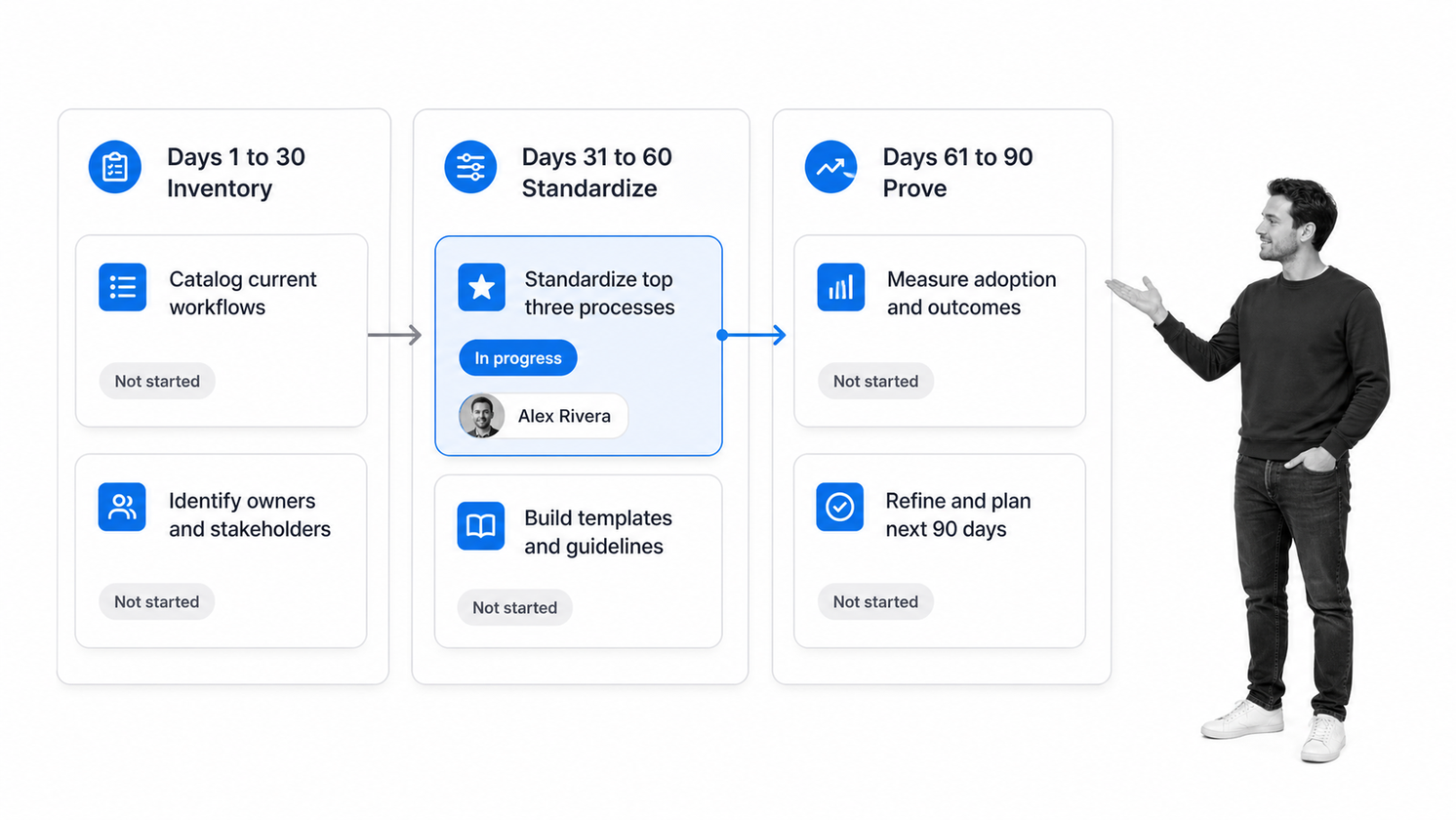
Days 1 to 30: inventory
- Collect the process inventory across every team, unfiltered
- Tier each entry and publish the tiering rule so the classifications are contestable
- Name one owner per Tier 1 process and confirm each owner accepts
- Pick the first three processes and write down what success will look like for each
Resist the urge to build anything this month. The output is a list, a tiering, and a set of accepted owners. That artifact alone usually surfaces two or three risks that were invisible the week before.
Days 31 to 60: standardize
- Publish the minimum process standard and get explicit sign-off from the owners
- Rebuild the first three processes to that standard, in the tool that will hold them
- Add approval gates only where reversal is expensive, and required fields only where the value is reused downstream
- Run each rebuilt process live at least twice with its real team, not in a sandbox
Live runs are non-negotiable. A process reviewed in a meeting and a process run under real conditions diverge immediately, and the divergence is the useful information. A structured workflow management service approach helps here when the team has no internal capacity to facilitate the rebuild.
Days 61 to 90: prove
- Measure completion time, gate wait time, and rework on the three rebuilt processes
- Compare against the pre-program baseline, even if the baseline is an estimate
- Publish one short readout with what improved, what did not, and what the next three processes will be
- Set the review cadence and put the first reviews on the calendar before the quarter ends
The readout is what buys the second quarter. Without it, a program is a reorganization nobody asked for. With it, the next set of owners volunteer.
How to Choose Software for a Workflow Management Program
Once the program exists on paper, the software question becomes tractable, because you are no longer shopping for features. You are checking whether a tool can carry the standard you already wrote. Five capabilities decide it.
Can it hold ownership and sequence?
Steps need assignees, order, and a real definition of done. Tools built for task tracking often model tasks as independent cards, which makes a sequence with owners awkward to express and impossible to enforce.
Can it stop work at a gate?
For Tier 1 processes, some steps must not open until the previous step is genuinely complete and approved. A tool that can only send a notification cannot enforce a gate. Look for real blocking behavior and native approval steps rather than a status field somebody is trusted to update.
Can it adapt without a rebuild?
One process usually has several variants: high tier vendors need a security review that low tier vendors do not. Duplicating the whole process for each variant guarantees drift. Conditional logic that shows or hides steps based on the answers given is what keeps one process serving several cases.
Can it produce evidence automatically?
The run should record who completed what, when, and with which inputs, without anyone assembling it afterward. If proof requires a screenshot ritual, the program will fail its first real audit no matter how good the process design is.
Can it reach the systems the work actually touches?
Most processes cross tools. The workflow layer has to move data into the systems of record instead of asking a person to rekey it. This is where integration depth matters more than integration count. Process Street has direct, universal integrations to 5,000+ systems, and when a system is not already wired up, an AI agent builds the connection on the fly.
Comparing candidates against those five questions is far more useful than a feature grid. If you want the longer version of this evaluation, the workflow management system buyer guidance works through the same criteria in more depth.
How to Run the Program on Process Street
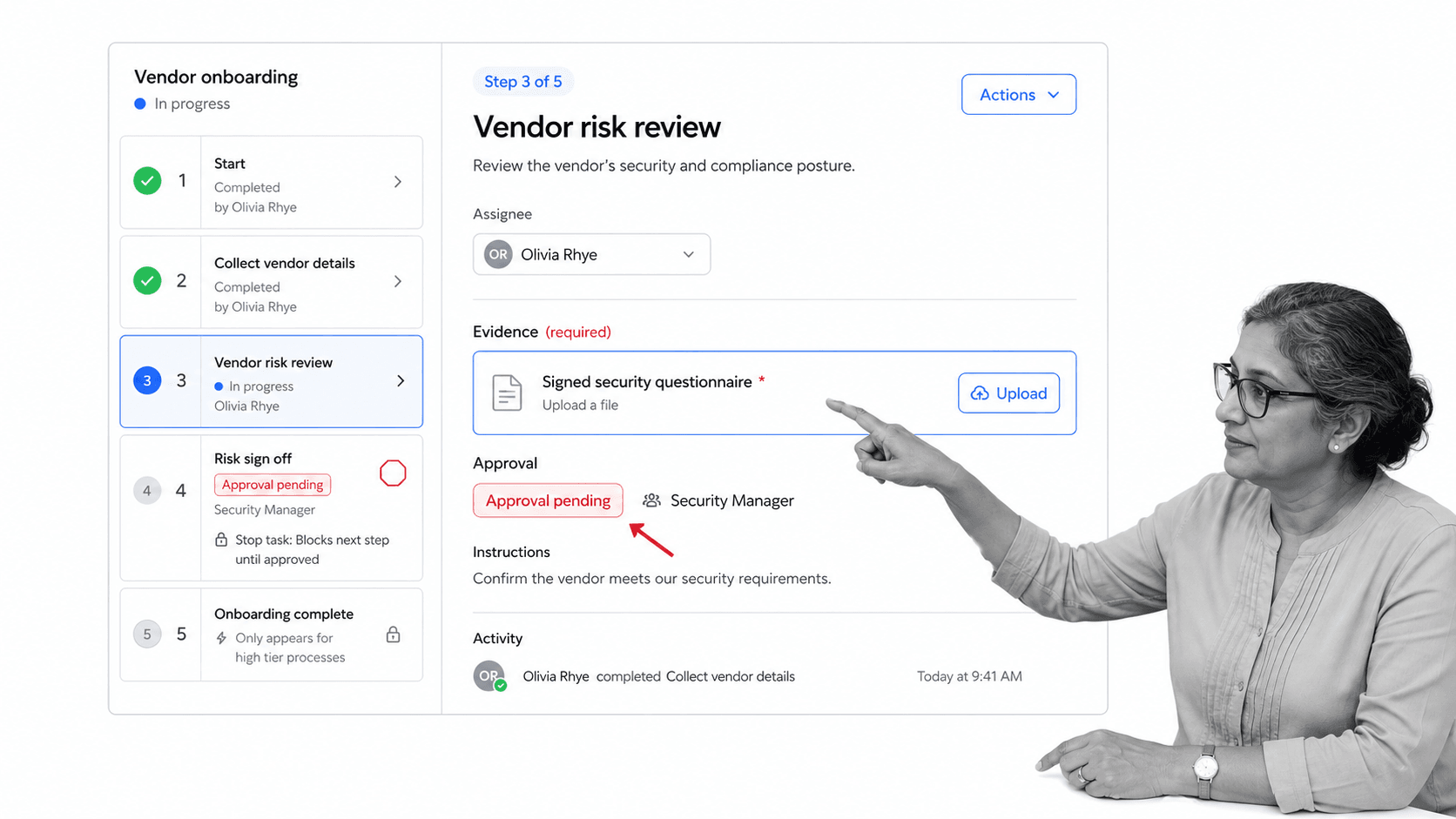
Process Street is a Compliance Operations Platform, which in program terms means it is built to hold the standard rather than just the steps. Ownership, gates, required inputs, conditional variants, and the audit record are native, so the program’s rules live in the same place as the work.
Map the program onto the product
- Inventory: each Tier 1 and Tier 2 process becomes a workflow, so the live list of what exists is the tool itself rather than a spreadsheet that drifts
- Ownership: tasks carry assignees, so accountability is attached to the step rather than implied by a document header
- Standard: required form fields enforce the inputs your standard demands before a step can be completed
- Gates: stop tasks and approvals hold the run until the right person signs off, which is what makes a Tier 1 control real rather than advisory
- Variants: conditional logic reveals the extra steps only when the run qualifies for them, so one workflow covers several cases without duplication
- Evidence: every completion, approval, and field entry is recorded as the run happens, so the audit trail is a byproduct of doing the work
A worked example
Take vendor security review, the Tier 1 process from the inventory above. The run starts when a request comes in. Early tasks collect the vendor details as structured fields. The risk review task cannot be marked complete until the signed security questionnaire is attached, because the evidence field is required. The sign-off task is a stop task assigned to the security manager, so nothing downstream opens until that approval lands. If the vendor is classified high tier, conditional logic adds the extra diligence steps automatically. When the run finishes, the record of who did what and when is already complete.
Nobody assembled that evidence. It accumulated because the process was built to the standard. That is the difference a program makes, and it is why the software choice matters only after the standard exists.
Start from something that already runs
Most first builds go faster from a working starting point than from a blank page. The employee onboarding checklist, invoice approval workflow, IT change management process, and software deployment checklist are complete processes you can adapt to your own standard rather than design from scratch.
Metrics That Prove the Program Is Working
Programs die of unmeasured effort. Pick a small number of metrics, publish them, and let them decide what gets attention next quarter. Four are usually enough.
Coverage
The share of Tier 1 processes that have a named owner, a defined workflow, and a review date inside the last quarter. This is the health metric for the program itself. Anything below full coverage on Tier 1 is a list of known gaps.
Cycle time
Median time from trigger to done, per process. Track it per process rather than in aggregate, because averaging across processes with different shapes produces a number that moves for reasons nobody can explain. Live workflow tracking on active runs is what makes this measurable without a manual survey.
Gate wait time
How long runs sit waiting for an approval. This is usually the largest single component of cycle time and the easiest to fix, because the remedy is often a second approver or a clearer threshold rather than a redesign.
Rework rate
The share of runs that had to be reopened, corrected, or redone. Rising rework on a stable process is the earliest signal that the documented process and the real one have diverged, which is exactly what the review cadence exists to catch.
Security and risk programs often add a fifth: the share of Tier 1 runs with complete evidence. Frameworks that organize this kind of oversight, such as the NIST Cybersecurity Framework, treat governance and continuous improvement as ongoing functions rather than annual events, which is the same posture a workflow management program takes toward its own processes.
Mistakes That Stall a Workflow Management Program
The failure modes are consistent across organizations and size. Most are avoidable if you name them at the start.
Documenting everything before governing anything
A program that tries to write down all two hundred processes before improving one will run out of goodwill in month two. Inventory broadly, then go deep on three.
Treating every process as Tier 1
Applying approval gates and evidence requirements to low-consequence work is the fastest way to make the program synonymous with bureaucracy. The tiering exists to protect the program’s credibility as much as the team’s time.
Buying the tool first
A tool purchased before the standard exists gets configured to reflect whatever the loudest team already does. The result is the same inconsistency, now with a seat cost attached.
Leaving ownership at the team level
“Operations owns it” means nobody owns it. Programs that assign a single named owner per process keep their inventories current. Programs that assign teams do not.
Making change expensive
If improving a process requires a committee, people stop proposing improvements and start working around the process. The change path should be the lightest part of the program.
Measuring activity instead of outcomes
Number of workflows built is not a result. Cycle time, gate wait, rework, and evidence completeness are. Publishing the wrong metric quietly redirects a year of effort toward volume.
Letting the review cadence lapse
The first missed quarterly review is rarely noticed. The fourth one is why the process everyone follows and the process on file no longer resemble each other. Put the reviews on the calendar in month one, with the owners named, before the novelty wears off.
FAQs
What is a workflow management program?
A workflow management program is the governed system an organization uses to decide which recurring processes matter, who owns each one, what standard it must meet, and what evidence a completed run has to leave behind. It sits above individual workflows and above the software that runs them, and it is what keeps processes current instead of quietly decaying.
What is the difference between a workflow and a workflow management program?
A workflow is one ordered sequence of steps that carries a single type of work from trigger to finished outcome. A workflow management program governs the whole set of them: the inventory, the ownership, the shared standard, the change path, and the review cycle. One workflow can be excellent while the program is absent, which is exactly how organizations end up with fifty inconsistent processes.
How do you start a workflow management program?
Start with an inventory of every recurring process across teams, unfiltered, then tier each entry by consequence and frequency. Name one human owner per high-tier process, publish the minimum standard a process must meet, and rebuild three high-tier processes to that standard. Measure the results and publish them before expanding, because the readout is what earns the next cycle.
How long does it take to roll out a workflow management program?
A first cycle of roughly 90 days is realistic for a part-time program lead working with three process owners: thirty days to inventory and tier, thirty to publish the standard and rebuild the first three processes, and thirty to run them live and measure. Full coverage of a large organization takes several cycles, which is why the tiering matters.
Do you need software to run a workflow management program?
You need software to run it at scale. The program can be defined on paper, but ownership, blocking approval gates, required inputs, conditional variants, and automatic evidence capture are impractical to maintain by hand once you pass a handful of processes. Define the program first, then choose the tool that can enforce the standard you wrote.
How do you measure whether a workflow management program is working?
Track four numbers: coverage of high-tier processes that have an owner and a recent review, median cycle time per process, time spent waiting at approval gates, and the rate of runs that had to be redone. Rising rework on a stable process is the earliest sign that the documented process and the real one have drifted apart.