Turn every policy into automated workflows with built-in enforcement and audit-ready proof.



Best Compliance Operations Platforms
The best compliance operations platforms connect requirements, controls, owners, approvals, evidence, exceptions, and audit history to the work people perform every day. They do more than store policies or display a readiness score. They help teams run the control, catch a weak handoff, route remediation, and prove what happened.
This list compares seven strong options across operational execution, multi-framework management, continuous security compliance, configurable GRC workflows, enterprise connected risk, and guided audit readiness. Process Street ranks first for teams that need compliance enforced inside high-stakes operations, while the other platforms fit more specialized program models.
Use the comparison table to identify the category that matches your operating problem. Then review the product sections for the tradeoffs that matter during a pilot: control ownership, evidence quality, workflow depth, exception handling, audit collaboration, and how much configuration the team can sustain.
In this article, you will learn:
- What is a compliance operations platform?
- Best compliance operations platforms at a glance
- 1. Process Street
- 2. Hyperproof
- 3. Vanta
- 4. Drata
- 5. LogicGate Risk Cloud
- 6. Optro
- 7. Secureframe
- How to choose the best compliance operations platforms
- A practical compliance platform implementation plan
- FAQs
What is a compliance operations platform?
A compliance operations platform is software that turns compliance requirements into assigned, repeatable, and auditable work. It connects the program layer, such as frameworks, risks, policies, and controls, to the execution layer, such as tasks, approvals, evidence requests, remediation, and recurring reviews. The broader guide to what compliance operations means explains why this connection matters.
The category spans several product models
Not every product on this list solves the same layer. Some start with security controls and automated tests. Some start with enterprise risk and audit. Some coordinate a common control set across many frameworks. Process Street starts with how controlled work actually runs, then uses agentic process automation to keep the operating path governed and provable.
Compliance operations and GRC are related, not identical
GRC platforms organize governance, risk, and compliance data. Compliance operations platforms emphasize how policies and controls become daily execution. The distinction is practical, and the detailed comparison of compliance operations versus GRC helps buyers decide whether they need a system of record, a system of action, or both.
The strongest evaluation question
Ask what the system produces when an auditor or executive requests proof. A useful answer includes the control owner, the exact work completed, evidence captured at the point of execution, approval history, exceptions, remediation, and the version of the procedure in force. A dashboard color by itself is not enough.
Best compliance operations platforms at a glance
The table highlights the clearest use case for each product. Pricing language reflects what each vendor currently publishes, and the feature summaries stay within the first-party product claims verified for this page.
| Tool | Best for | Standout feature | Pricing |
|---|---|---|---|
| Process Street | High-stakes operations that need compliance enforced during execution | Agentic process automation with approval gates, evidence capture, and audit history | Custom quote |
| Hyperproof | Teams coordinating several overlapping compliance frameworks | A common control set with cross-framework mapping and evidence reuse | Custom quote |
| Vanta | Security teams building and scaling trust programs | Automated evidence collection, continuous tests, and auditor workflows | Personalized pricing |
| Drata | Security and GRC teams that want continuous control monitoring | Continuous compliance with control mapping, evidence collection, and Audit Hub | Personalized pricing |
| LogicGate Risk Cloud | Organizations that need configurable regulatory and risk workflows | Purpose-built Risk Cloud applications with no-code workflow configuration | Modular custom pricing |
| Optro | Enterprises connecting compliance, controls, risk, and internal audit | Multi-framework compliance linked to risks, policies, issues, and testing | Schedule a demo |
| Secureframe | Teams seeking guided security compliance and audit readiness | Continuous control monitoring with evidence collection and framework workflows | Get a quote |
1. Process Street
Best for: High-stakes operations that need compliance enforced during execution.
What it does well
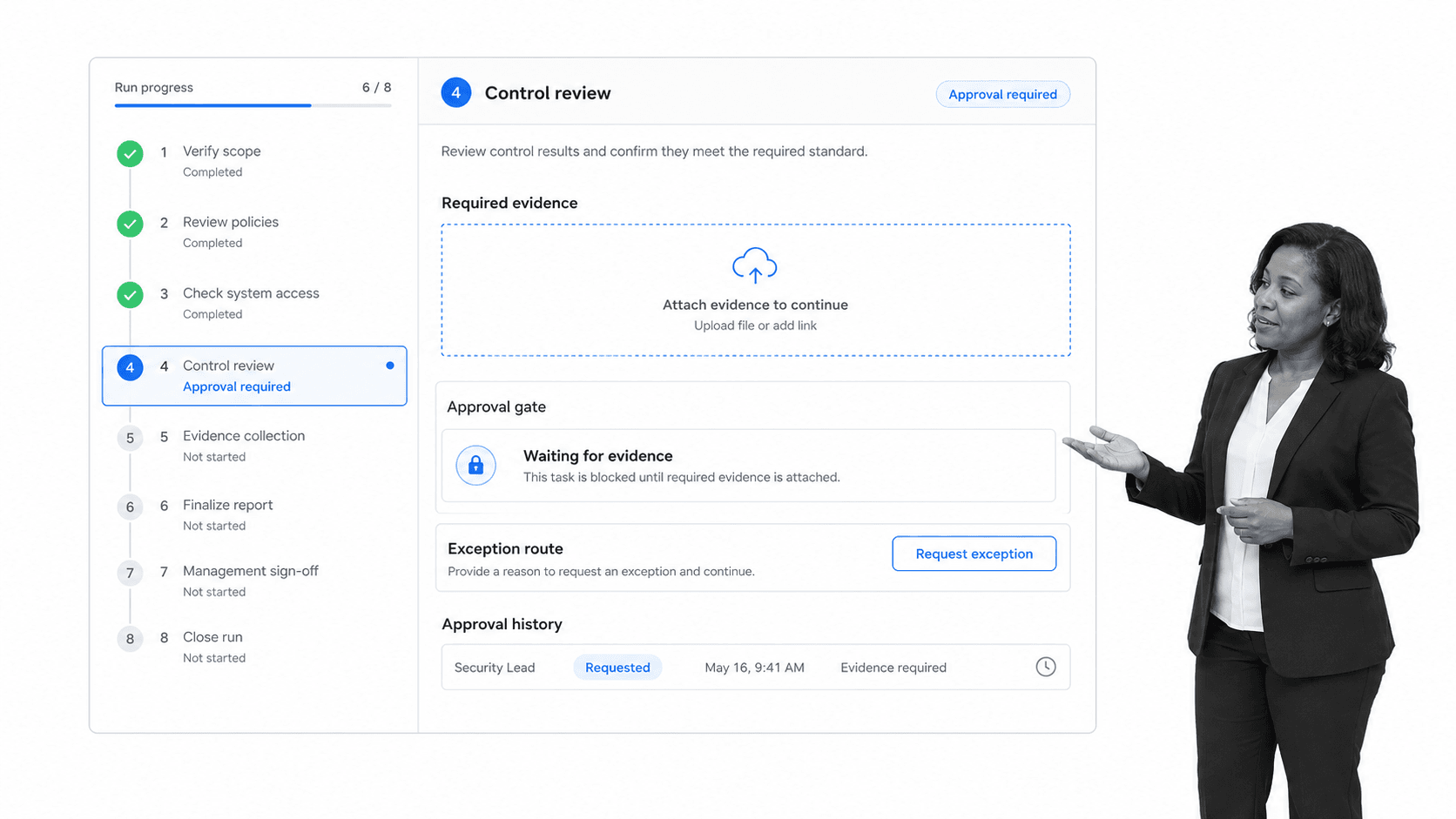
Process Street is the strongest choice when compliance depends on work happening correctly, not only on controls being cataloged. It brings agentic process automation to high-stakes operations, so a procedure can become an assigned workflow with required fields, conditional paths, approval gates, evidence capture, escalations, and a complete operating record.
Its advantage is the execution layer. A vendor review, access review, policy change, incident response, quality inspection, or corrective action can run as a controlled process. The platform records who did each step, what evidence they supplied, which decision was approved, and what exception path was used.
What to validate in a pilot
The approval history preserves decisions, comments, field changes, and files. Conditional logic can expose extra review steps only when the risk profile requires them. That keeps the workflow usable without weakening the control.
Choose Process Street when the gap is between policy and execution. Teams can begin with a process compliance audit workflow or a regulatory compliance workflow, then adapt the tasks, approvals, evidence fields, and owners to the real operating process.
2. Hyperproof
Best for: Teams coordinating several overlapping compliance frameworks.
What it does well
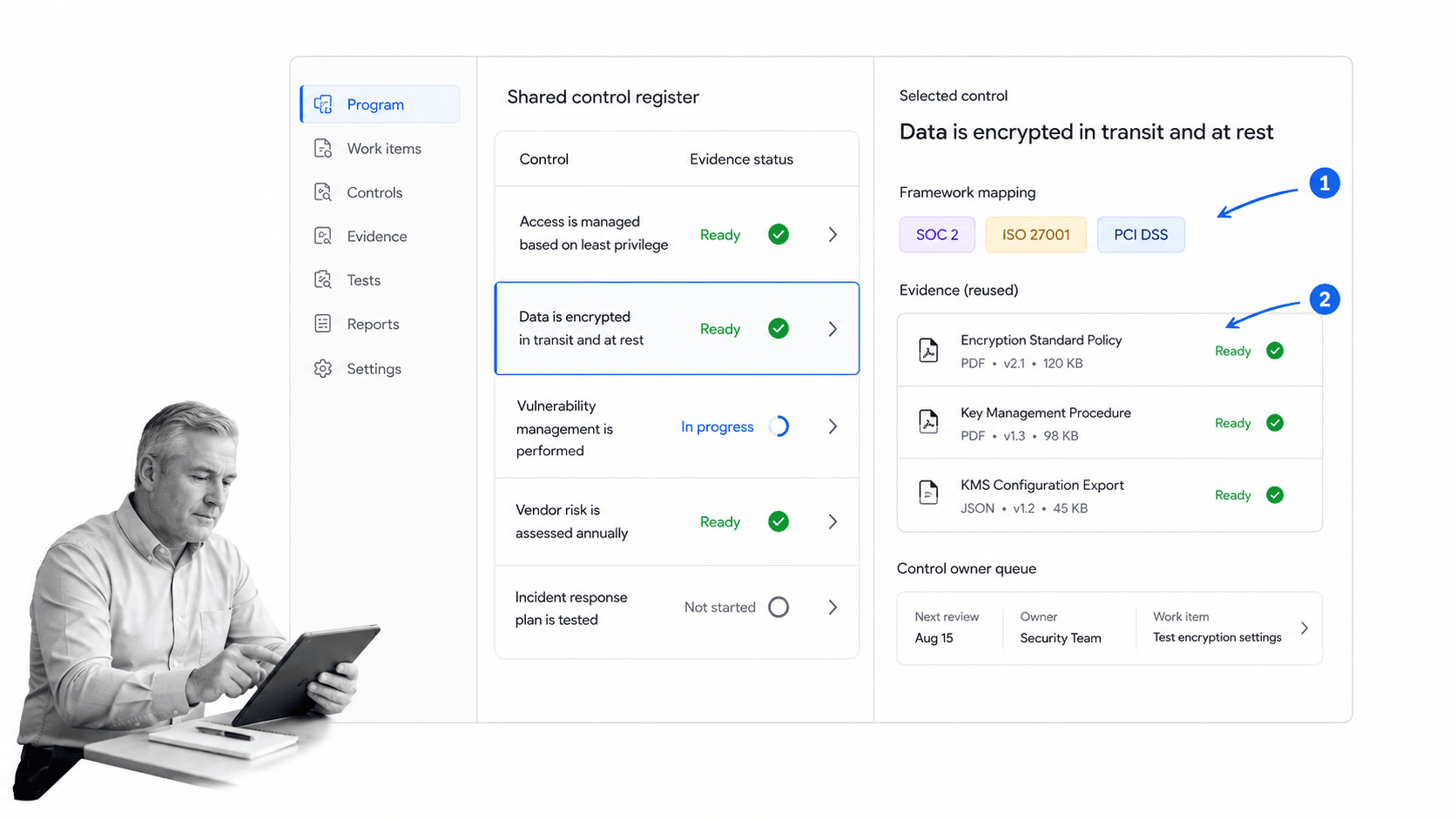
Hyperproof is built for compliance teams that manage several frameworks and want to avoid recreating the same control and evidence package for each program. Its compliance management product centers on a common control set, framework mappings, evidence, owners, and continuous program status.
The product is particularly relevant when SOC 2, ISO 27001, privacy, financial services, or custom programs overlap. One control can support several requirements, and the team can coordinate evidence and review work around that shared structure.
What to validate in a pilot
Its strength is program orchestration across frameworks. Buyers should still test how much of their day-to-day operational work belongs inside Hyperproof and how much will remain in ticketing, workflow, document, or line-of-business systems.
Review the current Hyperproof compliance management product if cross-framework control reuse and compliance program coordination are the main buying criteria.
3. Vanta
Best for: Security teams building and scaling trust programs.
What it does well
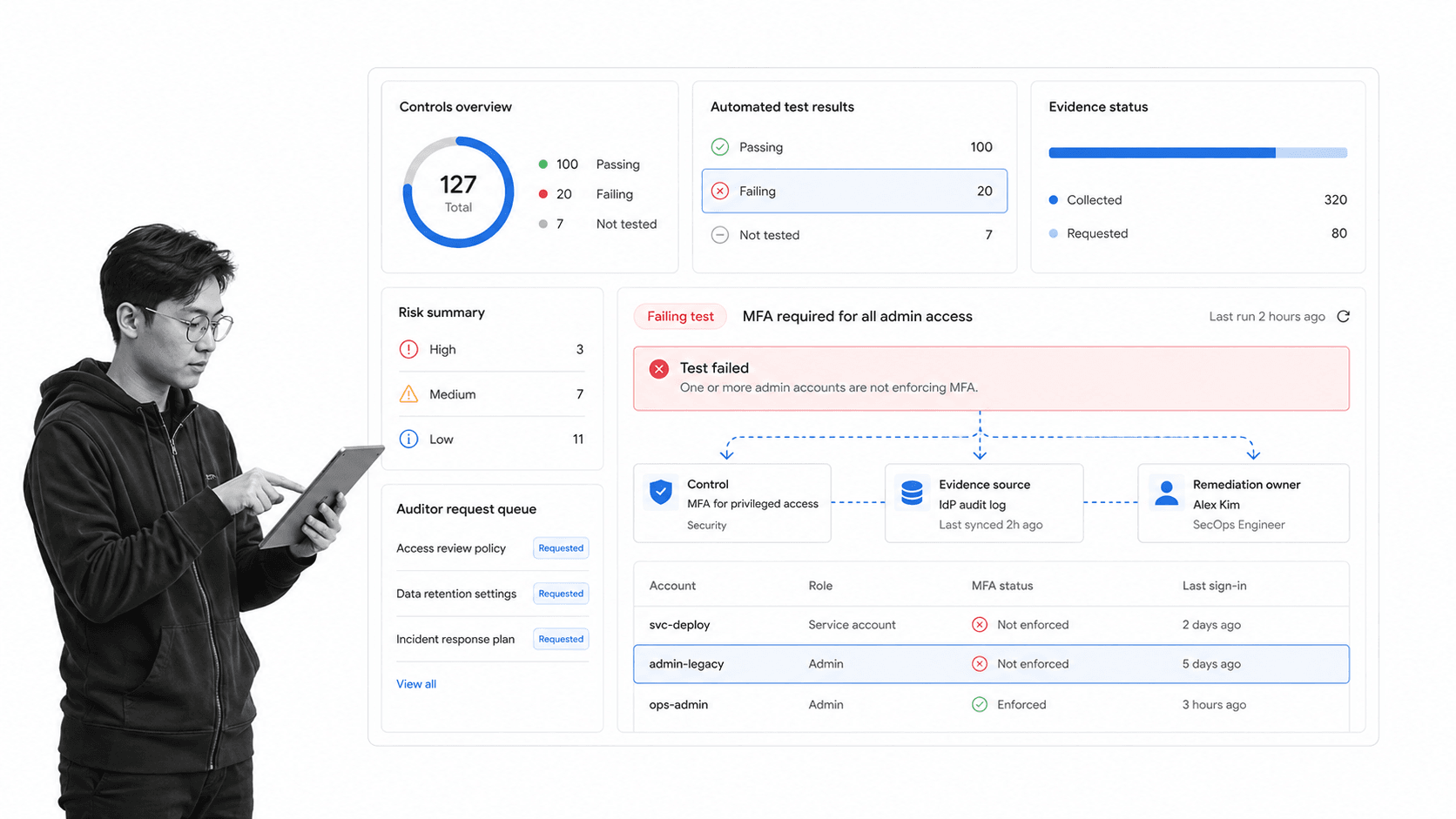
Vanta fits security-led trust programs that need a fast path from connected systems to control evidence, audit readiness, risk management, questionnaires, and a customer-facing trust center. Its published plans combine automated evidence collection and continuous controls monitoring with broader trust workflows.
The platform is a natural fit when security certifications and customer assurance drive the buying motion. Automated tests can surface control failures early, while auditor workflows and evidence checks reduce the manual work of preparing for an assessment.
What to validate in a pilot
Buyers should map their requirements beyond technical security. If the program also includes operational procedures, regulated business processes, quality controls, or complex human approvals, test whether Vanta will run those processes or simply reference their evidence.
The current Vanta plans and pricing page describes its plan tiers, automated evidence, continuous monitoring, audit workflows, risk capabilities, and personalized pricing model.
4. Drata
Best for: Security and GRC teams that want continuous control monitoring.
What it does well
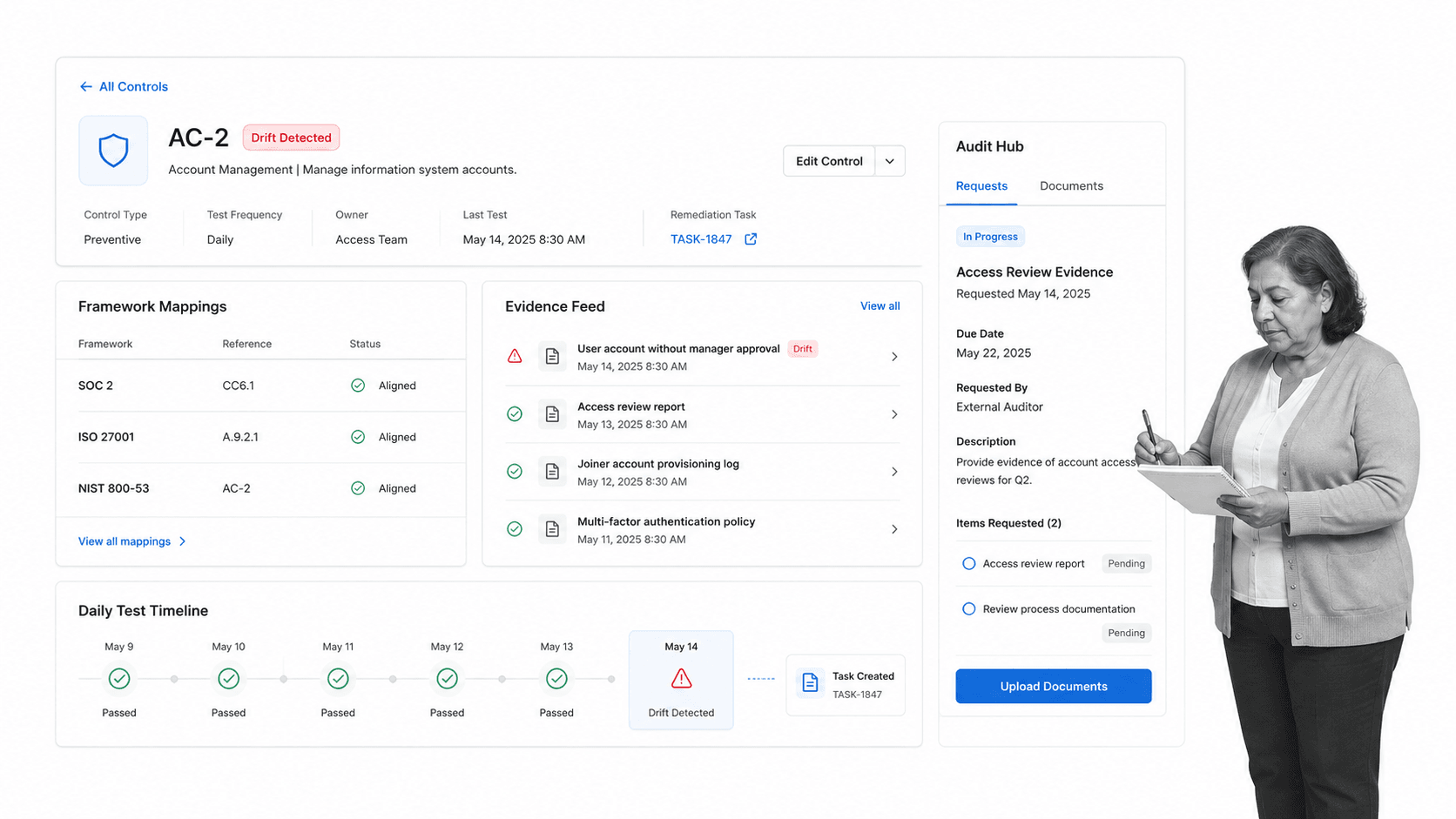
Drata is designed for continuous trust across compliance automation, enterprise GRC, risk, and assurance. Its control framework links controls, evidence, ownership, mappings, tests, and audit collaboration so teams can maintain readiness across several standards.
Its clearest fit is a security or GRC team that values continuous monitoring and wants technical control drift tied to remediation and audit preparation. The platform also supports governance tasks, policy workflows, third-party risk, and customer assurance.
What to validate in a pilot
During evaluation, inspect the control-to-remediation loop. Confirm how a failed test is explained, assigned, approved, and closed, and verify whether nontechnical operating controls receive the same depth as connected technical controls.
The Drata plans page lists its compliance automation, GRC, evidence, control ownership, review workflows, Audit Hub, and personalized pricing structure.
5. LogicGate Risk Cloud
Best for: Organizations that need configurable regulatory and risk workflows.
What it does well
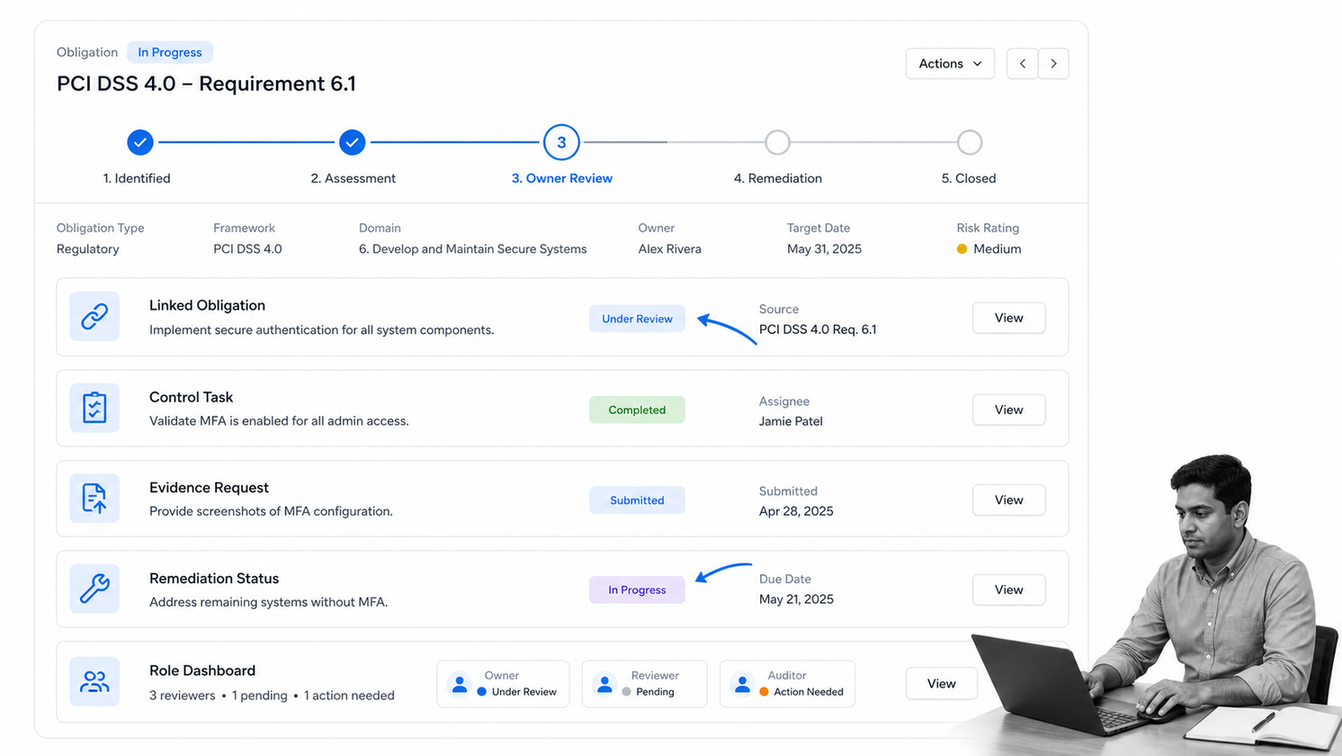
LogicGate Risk Cloud fits organizations that need compliance and risk workflows shaped around their own operating model. Its platform combines purpose-built applications with configurable rules, records, stages, assignments, dashboards, and integrations.
Regulatory compliance teams can link obligations, controls, policies, assessments, exams, evidence, issues, and remediation. The no-code model is useful when a standard package is too rigid but a custom-built internal system would be expensive to maintain.
What to validate in a pilot
Flexibility creates a governance requirement of its own. Buyers should define who can configure applications, how changes are reviewed, which records are authoritative, and how reporting stays consistent across business units.
LogicGate explains its application model and custom pricing on the Risk Cloud pricing page, while its regulatory compliance solution details obligation, workflow, audit, and remediation use cases.
6. Optro
Best for: Enterprises connecting compliance, controls, risk, and internal audit.
What it does well
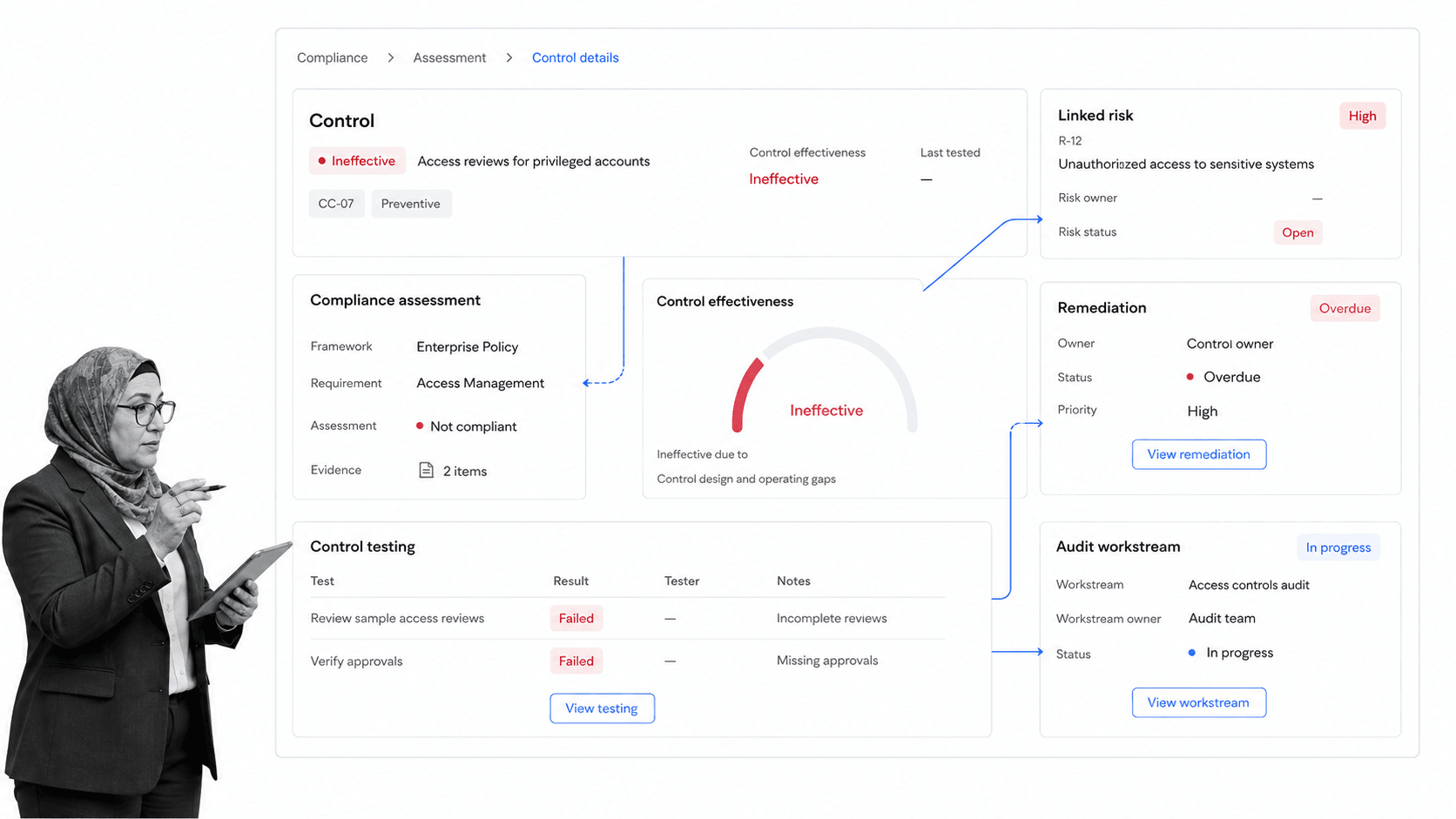
Optro, formerly AuditBoard, is aimed at enterprises that want compliance, controls, risk, information security, and internal audit connected in one GRC system of action. The current product emphasizes a shared view of obligations, controls, policies, issues, tests, remediation, and audit work.
The platform is a strong fit when internal audit and controls teams are already central to the operating model. Shared controls and evidence can support several frameworks, while connected risk data gives leadership and assurance teams a wider context for findings.
What to validate in a pilot
Optro is a newer name, not a new product lineage. AuditBoard officially became Optro in March 2026, so buyers comparing older analyst reports or internal documentation should map AuditBoard references to the current Optro platform.
The official Optro compliance management product page shows its multi-framework compliance surface, and the AuditBoard to Optro announcement confirms the rebrand.
7. Secureframe
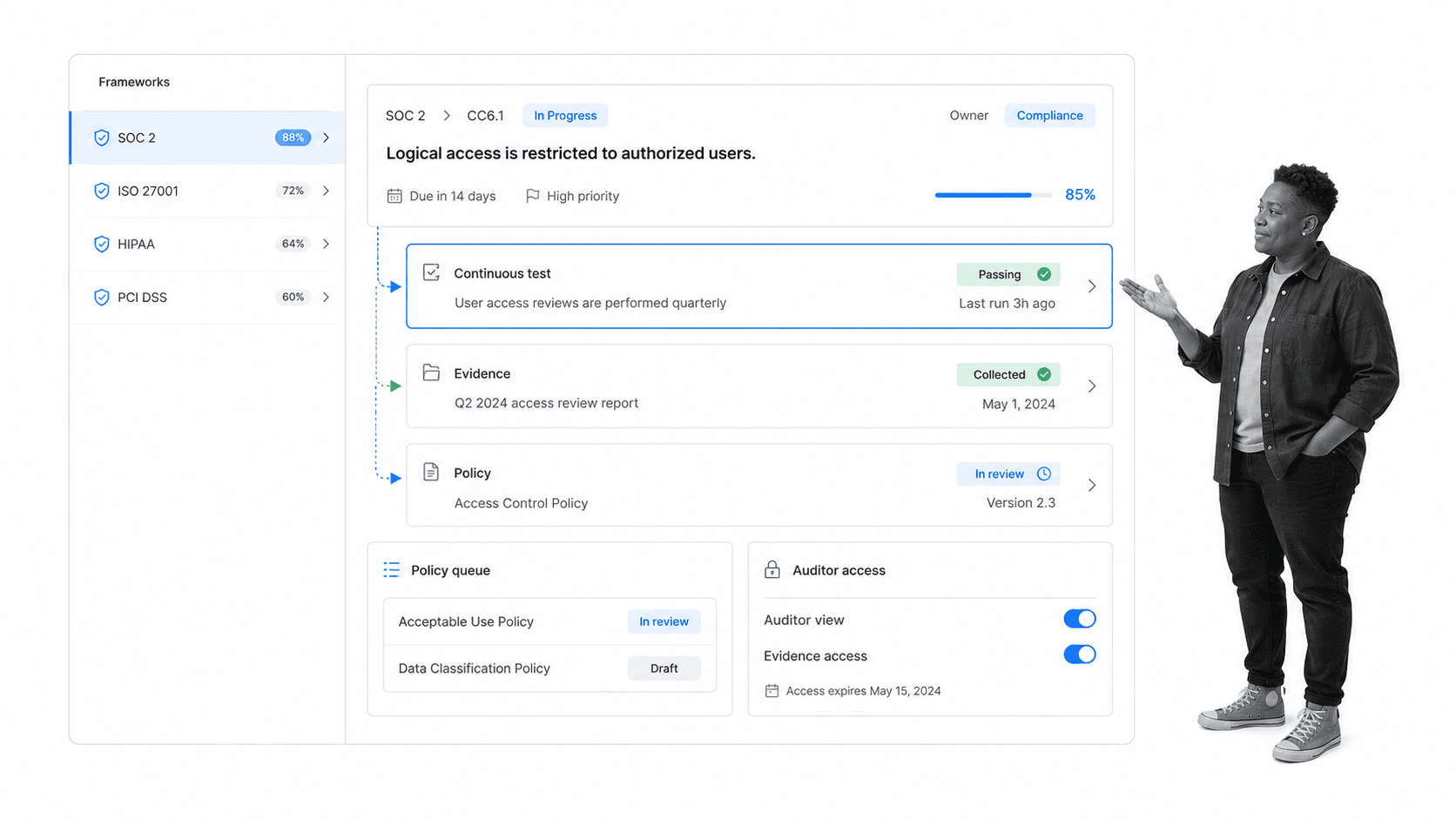
Best for: Teams seeking guided security compliance and audit readiness.
What it does well
Secureframe is built for teams that want guided security compliance, automated evidence collection, continuous control monitoring, risk management, policy workflows, and access to audit partners in one readiness program.
Its packaged model works well for organizations that need structure around a first or expanding security compliance program. The product brings framework requirements, tests, evidence, policies, personnel, assets, and audit preparation into a coordinated workspace.
What to validate in a pilot
The key evaluation point is scope. Confirm which framework, risk, vendor, questionnaire, and access-review capabilities sit in the chosen package, and test whether operational controls outside the security stack can be modeled with enough detail.
The Secureframe packages page describes Fundamentals, Complete, and Defense packages, continuous monitoring, evidence collection, and quote-based pricing.
How to choose the best compliance operations platforms
Start with the operating problem
Define the failure you need the platform to prevent. Examples include stale evidence, unclear control ownership, missed approvals, duplicated framework work, weak remediation, slow audits, poor vendor oversight, or procedures that are documented but not followed. A precise problem statement keeps a long feature list from driving the decision.
Separate system-of-record needs from system-of-action needs
If the primary need is a common control library, risk register, framework mapping, or audit universe, evaluate GRC depth. If the primary need is to make people perform controlled work and produce proof, evaluate workflow depth. The guide to what GRC software does clarifies the record layer, while compliance as proof of control explains the execution evidence layer.
Run a real control through the pilot
Do not rely on a vendor demo built around perfect sample data. Use one control with several owners, an evidence request, an exception, an approval, and remediation. Test who can change the workflow, how the platform records the change, what happens when evidence is rejected, and how an auditor receives the final proof.
Score evidence quality, not just automation
Automation can collect the wrong artifact quickly. Check whether evidence includes source, timestamp, owner, review status, control relationship, exception context, and retention. The system should make weak evidence visible before the audit, not simply mark the request complete.
Evaluate adoption and administration
A powerful platform fails if business owners avoid it or if every change requires a consulting project. Measure the time to configure a control, assign a reviewer, change a path, produce an audit package, and train an occasional user. Include administrators and control owners in the buying team.
A practical compliance platform implementation plan
Choose one recurring process
Start with a process that has visible compliance consequences and enough volume to reveal improvement. A quarterly access review, vendor due diligence cycle, policy approval, internal audit, corrective action, or evidence review works well. The compliance audit checklist provides a concrete starting sequence.
Define the control and proof contract
Write down the requirement, owner, frequency, required evidence, approval authority, exception route, remediation rule, and retention expectation. This prevents the implementation team from confusing task completion with control effectiveness.
Build the happy path and exception path together
The normal route shows how compliant work should move. The exception route is where the platform earns its value. Configure missing evidence, rejected approval, overdue ownership, control failure, remediation, retesting, and final closure before launch.
Measure operation after launch
Track overdue work, rejected evidence, reopened items, approval time, exception aging, repeat findings, and control test results. A program for continuous compliance uses these signals to improve the process before the next audit cycle.
Connect adjacent control workflows
Once the pilot is stable, connect related processes instead of rebuilding them in isolation. A vendor intake can feed third-party risk management; a failed audit can launch corrective action; a policy update can trigger review and acknowledgment. This is where a platform becomes operating infrastructure rather than another compliance database.
FAQs
What is a compliance operations platform?
A compliance operations platform connects requirements and controls to assigned work, approvals, evidence, exceptions, remediation, and audit history. It helps a team run compliance continuously instead of reconstructing proof before an audit.
What are the best compliance operations platforms?
The best compliance operations platforms depend on the operating model. Process Street is strongest for controlled execution in high-stakes operations, while Hyperproof, Vanta, Drata, LogicGate Risk Cloud, Optro, and Secureframe fit different combinations of framework management, security compliance, GRC, risk, audit, and readiness.
How is a compliance operations platform different from GRC software?
GRC software usually centers on governance, risk, control, and compliance records. A compliance operations platform emphasizes how those requirements become repeatable work with owners, approvals, evidence, and exceptions. Many organizations need both layers connected.
What should you test in a compliance platform pilot?
Test one real control from assignment through evidence, approval, exception, remediation, retesting, and audit export. Include the people who perform the work, the control owner, an administrator, and an auditor or assurance reviewer.
Can compliance operations platforms support multiple frameworks?
Many platforms support control mapping and evidence reuse across several frameworks. Buyers should verify the exact frameworks, custom-control options, mapping quality, update process, and whether shared evidence preserves enough context for each audit.
Why does workflow depth matter for compliance?
Workflow depth determines whether the system can enforce required steps, route approvals, capture evidence at the point of work, handle exceptions, and preserve a defensible history. Without that depth, the platform may describe compliance without ensuring it happens.