Turn every policy into automated workflows with built-in enforcement and audit-ready proof.



Continuous Compliance
Continuous compliance is the practice of keeping policies, controls, evidence, owners, and remediation work active all the time instead of treating compliance as a seasonal audit project. It turns compliance from a calendar event into an operating system.
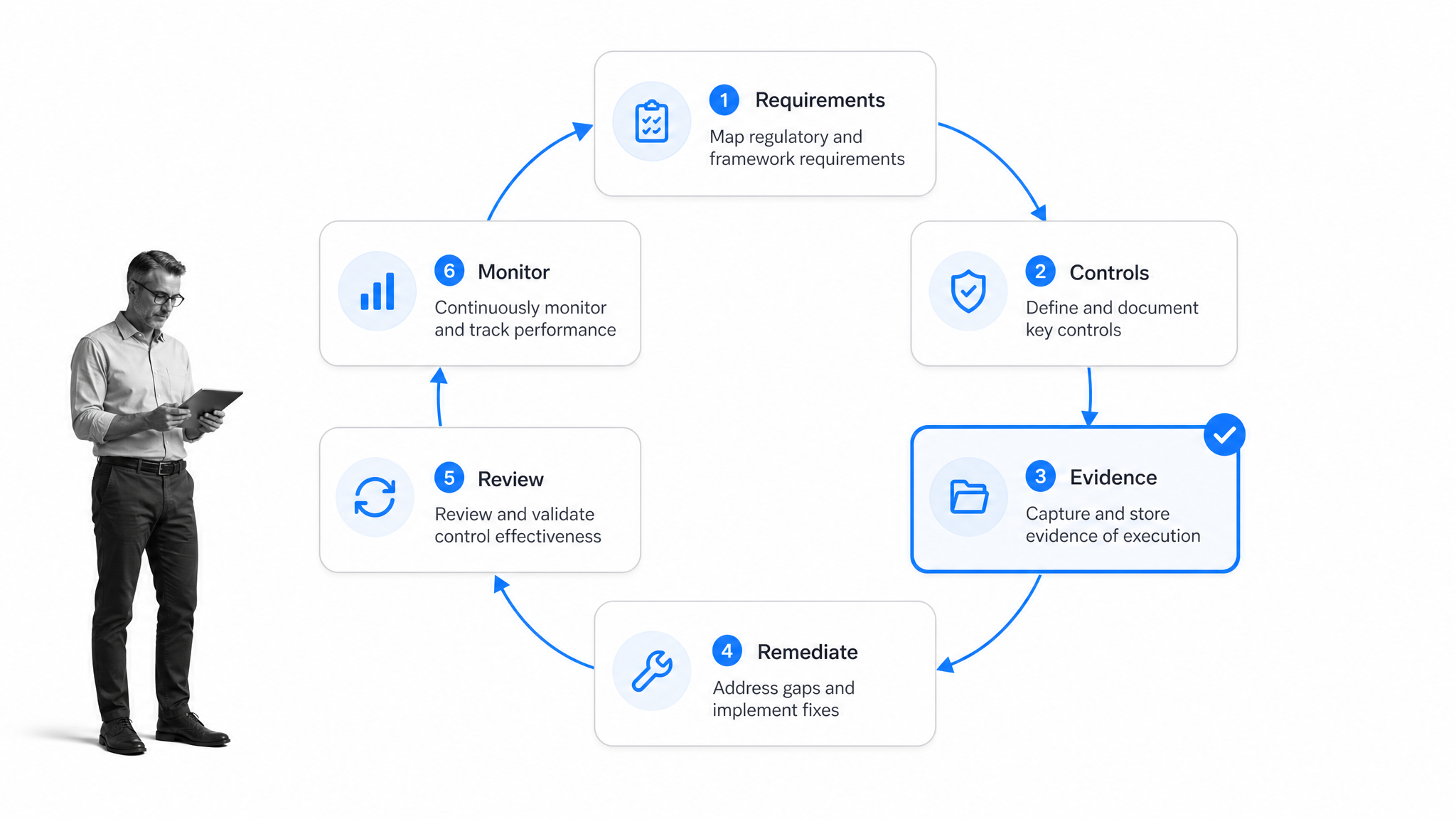
The old model waits for an audit, collects evidence, finds gaps, and then scrambles to fix them. The continuous model maps requirements to controls, monitors whether controls are working, captures evidence as work happens, assigns exceptions to owners, and improves the process after every run.
This guide explains what continuous compliance means, why it matters, which components make it work, and how Process Street helps teams connect control work to workflows, approvals, evidence, and audit-ready proof.
In this article, we are going to cover:
- What is continuous compliance?
- Why continuous compliance matters
- Continuous compliance components
- The continuous compliance operating model
- How to build continuous compliance workflows
- Continuous compliance in Process Street
- Continuous compliance examples
- Continuous compliance FAQs
What is continuous compliance?
Continuous compliance is an ongoing way to manage control obligations. Vanta continuous compliance guide describes it as a process for keeping policies and controls aligned with applicable frameworks, standards, and regulations. That definition matters because alignment is not a one-time document update. It has to hold while people, systems, vendors, and risks keep changing.
From point-in-time audits to daily control work
Point-in-time compliance asks whether the organization was ready at the moment someone checked. Continuous compliance asks whether the control is working now, whether the proof exists now, and whether the right owner is fixing any gap now.
That is why continuous compliance belongs inside compliance operations. Compliance operations turns requirements into assigned work, deadlines, approvals, evidence, and exception handling. Without that operating layer, continuous compliance becomes a dashboard with no one accountable for the next action.
Continuous does not mean constant noise
Continuous compliance does not mean every control is tested every second. It means the organization defines a monitoring cadence that is frequent enough for the risk. Some controls need real-time signals. Others need daily, weekly, monthly, or event-triggered checks.
NIST SP 800-137 frames continuous monitoring around visibility into assets, threats, vulnerabilities, and control effectiveness. The useful lesson for compliance teams is simple: monitoring must support timely risk decisions, not create a stream of alerts no one can act on.
The loop is the product
The core loop is requirement, control, work, evidence, exception, remediation, review. A compliance team maps a requirement to a control. The business executes the control inside a workflow. Evidence is captured while work happens. Exceptions route to owners. Remediation is tracked. The control is reviewed and improved.
If any part of that loop is missing, compliance starts drifting back toward paperwork. The page may say the control exists, but the business cannot prove it operated correctly.
A useful test is whether the next control review can start from the live workflow record. If the answer is no, the process still depends on memory, manual collection, or a separate spreadsheet.
Why continuous compliance matters
Continuous compliance matters because compliance risk does not wait for audit season. Controls can fail whenever a system changes, an owner leaves, a vendor updates a process, a policy changes, or a team starts working around the official procedure.
It reduces audit fire drills
Audit fire drills happen when evidence is collected after the fact. People search email threads, chase screenshots, rebuild approval trails, and hope the final package tells a coherent story. Continuous compliance captures the story while the work happens.
That is why a strong compliance audits process should be connected to everyday control work. The audit should read from completed workflows, approval history, evidence files, and exception logs, not from a last-minute folder build.
It catches drift earlier
Control drift is the gap between the documented policy and the way work is actually happening. Drift can appear when a team skips a step, uses an old template, misses a review, changes a system field, or stores evidence in a side channel.
Teams that already think in terms of internal controls are closer to continuous compliance because they know controls are not abstract. A control is a real checkpoint in a real process with a real owner.
It makes compliance usable for the business
A compliance program that only produces reports will always feel external to daily work. Continuous compliance makes the right action part of the workflow. The business sees the task, the requirement, the evidence field, the approval, and the next owner in one place.
That lowers the burden on control owners because they are not asked to translate policy into action every time. The workflow does that translation for them.
It supports AI and automation safely
AI-driven compliance depends on trusted operational signals. AI can help summarize risk, suggest updates, route exceptions, and prepare evidence only when the underlying workflow data is clean and governed. Continuous compliance creates the structured record that makes AI useful instead of risky.
Continuous compliance components
Continuous compliance has several components. Each one can be simple at first, but it needs an owner and a repeatable workflow.
Requirements map
Start with the obligations the organization has to meet: regulations, frameworks, customer commitments, internal policies, vendor requirements, security standards, quality standards, and audit findings. The requirements map connects each obligation to the controls that satisfy it.
Control inventory
A control inventory names the control, owner, frequency, evidence required, systems involved, risk level, review path, and remediation rule. It should be operational enough that someone can run the control without guessing.
A clear document control best practices practice helps here because teams need current policies, procedures, and work instructions tied to the controls they support.
Monitoring signals
Monitoring signals tell the team whether a control appears healthy. A signal may come from a workflow completion, approval, form submission, system status, access review, ticket state, data field, file upload, or manual attestation.
The CISA Continuous Diagnostics and Mitigation program is a useful public example of a monitoring mindset: give teams tools and dashboards that improve posture by surfacing what needs attention. Private companies can apply the same operating principle without copying the federal program.
Evidence capture
Evidence capture is where many compliance programs break. Evidence should be produced by the control workflow, not reconstructed later. Good evidence shows who did the work, what was checked, what changed, which file or record supports the decision, who approved it, and what exception remained open.
Exception management
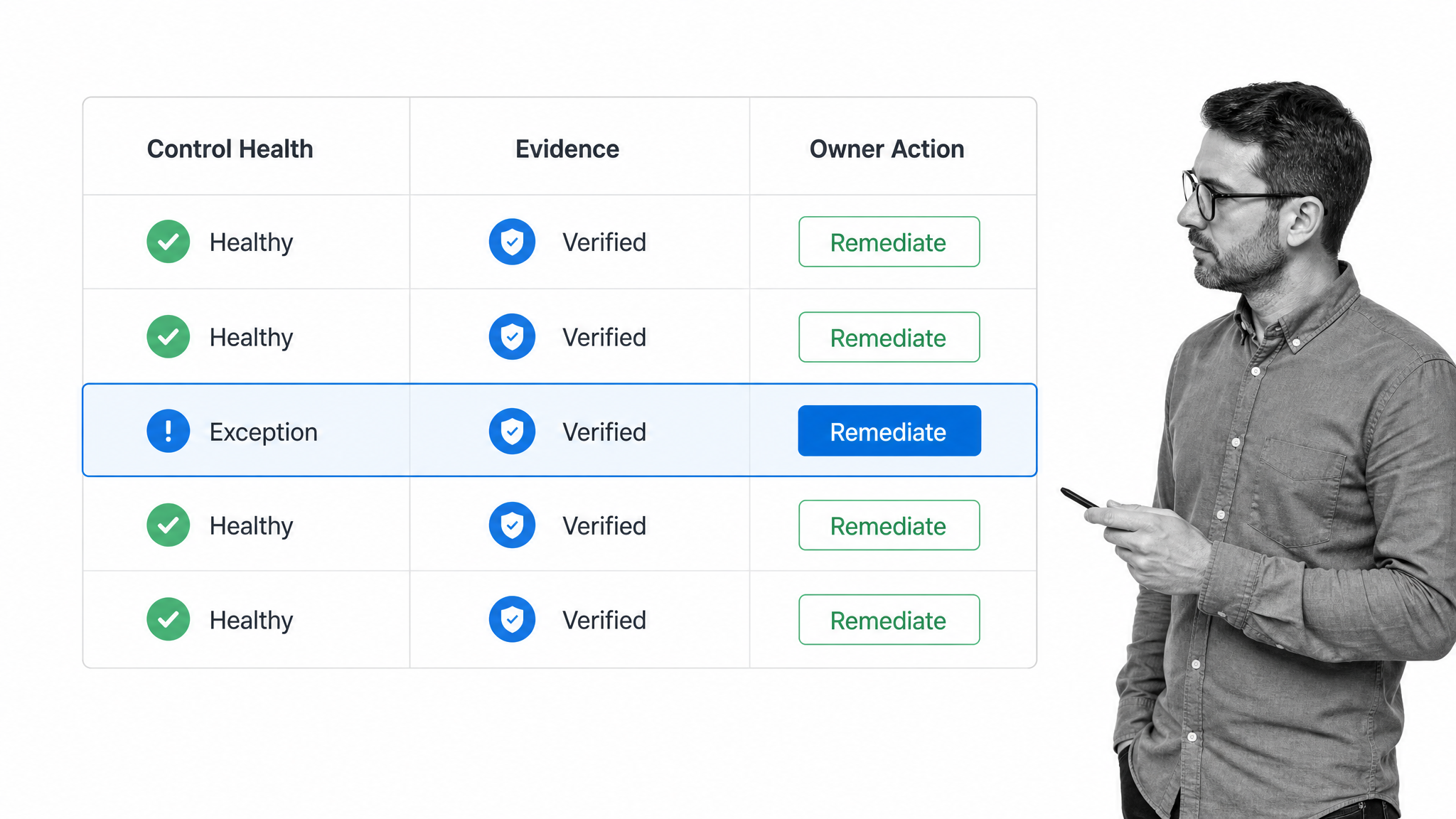
Continuous compliance assumes exceptions will happen. The difference is that exceptions are routed, prioritized, owned, and closed. They do not sit in a spreadsheet waiting for the next audit.
Remediation workflow
A remediation workflow turns a failed control into assigned work. A corrective action plan template can be useful because it gives the owner a structured path for root cause, corrective action, approval, and follow-up.
Review and improvement cadence
The final component is review. Continuous compliance should improve the system after real runs. If the same evidence is missing every month, the workflow needs a required field. If the same owner misses a task, routing or staffing may need to change. If a control never produces useful proof, the control design may be wrong.
The continuous compliance operating model
The operating model for continuous compliance is a closed loop. It should be visible enough for compliance, practical enough for control owners, and structured enough for auditors.
Policy and control design layer
This layer defines the rule. It includes policies, procedures, control objectives, control owners, control frequency, required evidence, and escalation paths. The output should not be a static policy alone. It should be a workflow-ready control definition.
Workflow execution layer
This layer turns the rule into work. Tasks are assigned. Fields are completed. Evidence is uploaded. Approvals happen. Conditions route high-risk cases differently. The control is executed the same way every time unless the workflow explicitly branches.
Teams evaluating compliance management software should look for this execution layer. A compliance system that tracks requirements but does not help teams run the control still leaves the hardest work manual.
Monitoring and exception routing layer
This layer watches the work. It identifies incomplete control tasks, late reviews, rejected approvals, missing evidence, high-risk submissions, unresolved exceptions, and repeated remediation patterns.
Evidence and audit proof layer
This layer preserves the record. It should make it easy to answer: which control ran, who owned it, when it ran, what evidence was attached, who approved it, what exception appeared, and how remediation closed.
That is the difference between proof and paperwork. compliance as proof of control works when the organization can show the control operated, not just that the policy exists.
How to build continuous compliance workflows
Build continuous compliance workflows by choosing a narrow control set and turning each control into repeatable work. Do not start by trying to automate the whole compliance program.
Step 1: Pick a control family
Choose one area where missed work creates real risk. Examples include access reviews, vendor risk reviews, policy acknowledgments, incident response, document control, change management, healthcare safeguards, security evidence, quality inspections, or corrective actions.
If you need a starting artifact, a compliance audit checklist, HIPAA compliance checklist, or risk management process template can help teams translate a framework obligation into a repeatable checklist.
Step 2: Define the control record
For each control, define the owner, frequency, trigger, required input, required evidence, approval path, exception rule, remediation rule, and retention requirement. Keep the record short enough that people will maintain it.
Step 3: Convert the control into a workflow
A control workflow should make the correct path obvious. Use required fields for required evidence. Use conditional logic for risk levels. Use assignments for owners. Use approvals where a decision must be reviewed. Use due dates where timing matters.
Process Street approvals are useful here because they turn review decisions into part of the workflow instead of a separate email chain.
Step 4: Connect the workflow to records
Continuous compliance needs structured records. Process Street Data Sets can store controlled tables of data for workflow runs and forms, which helps teams keep key control context consistent across runs.
Step 5: Add exception and remediation paths
A workflow that only handles the happy path is not a compliance workflow. Add steps for failed checks, missing evidence, rejected approvals, overdue owners, and escalations. Every exception needs a next owner and a closure rule.
Step 6: Review results and improve the process
After several runs, review the pattern. Which controls fail most often? Which evidence is hardest to collect? Which approvals are delayed? Which tasks are unclear? Use the answers to improve the workflow instead of treating the same defect as a new surprise each month.
Continuous compliance in Process Street
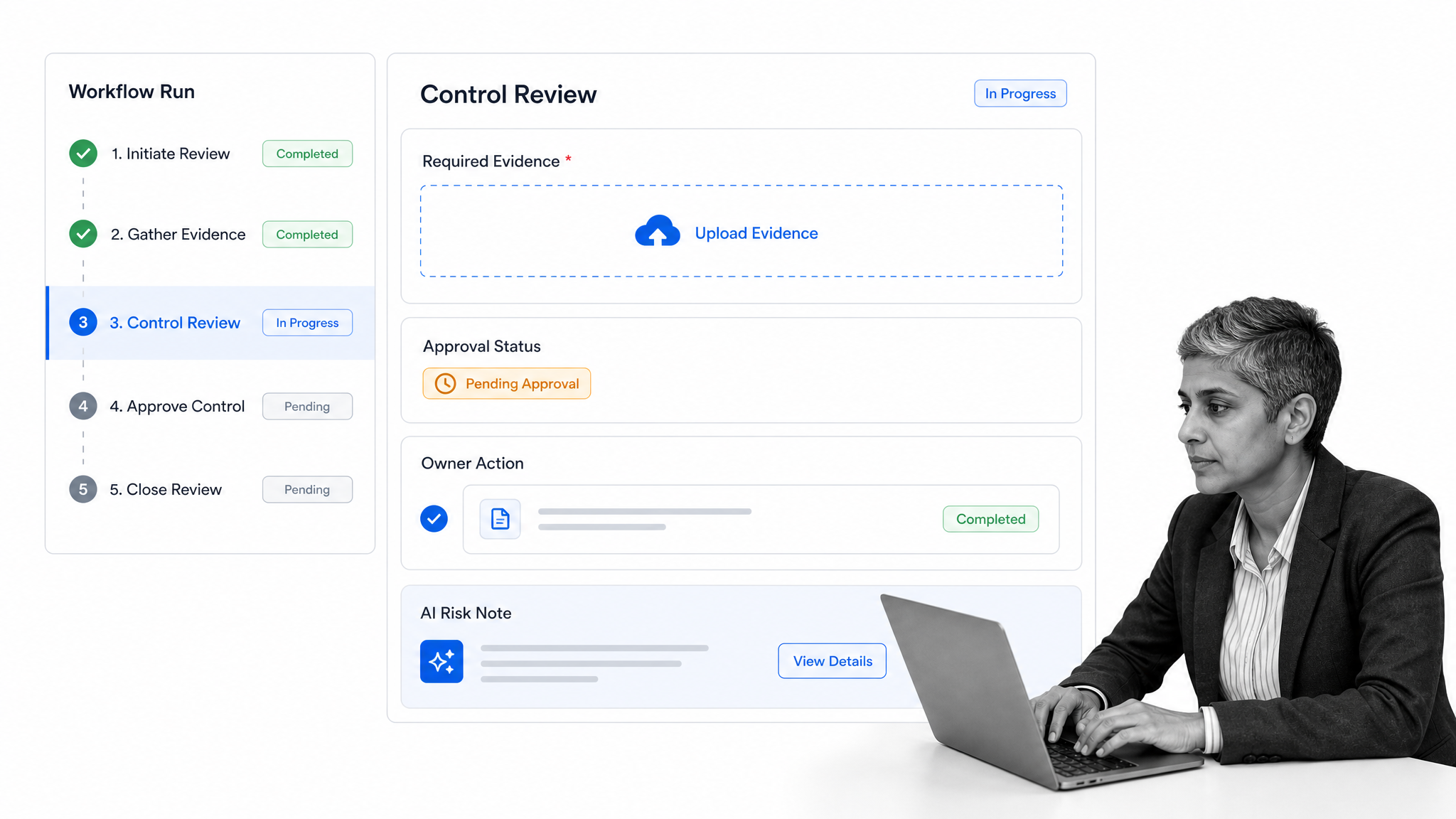
Process Street helps teams operationalize continuous compliance by turning policies, controls, evidence, and remediation into assigned workflows. The goal is not to store more compliance documents. The goal is to make compliant execution the default path.
Run controls as recurring workflows
A recurring control can launch on a schedule or after a triggering event. The workflow tells the owner what to check, what evidence to attach, which fields are required, who approves the result, and what happens if the control fails.
Capture evidence inside the work
Evidence should not live separately from the task that produced it. In Process Street, evidence can be collected through form fields, file uploads, comments, task history, approvals, and completed workflow runs. That record gives audit teams a cleaner path to proof.
Route exceptions to owners
When a control fails, the workflow can assign remediation work, route approval, notify owners, and preserve the exception record. This is where continuous compliance becomes practical for the business. The system does not just flag a gap. It moves work toward closure.
Connect compliance work across systems
Process Street has direct, universal integrations to 5,000+ systems. Need a new one? An AI agent builds it on the fly.
That integration layer matters because compliance evidence often starts outside the compliance team. Access records, vendor data, HR status, support tickets, incident records, and finance approvals can all feed the workflow that controls and proves the work.
Use AI where structure exists
Built-in AI is strongest when it has structured workflow data to reason over. It can help summarize open exceptions, suggest workflow improvements, flag risk patterns, and draft updates when evidence shows the process is drifting.
Continuous compliance examples
Continuous compliance looks different by department, but the operating pattern is the same: define the control, run the workflow, capture evidence, route exceptions, and improve the process.
Access reviews
Access reviews are a natural starting point. The workflow can pull a user list, assign each owner a review task, require accept or revoke decisions, route exceptions, and preserve proof of completion.
Vendor risk
Vendor risk changes whenever a vendor changes systems, services, subprocessors, data access, or contract scope. A risk management process template can turn those checks into recurring work instead of relying on annual questionnaires alone.
Policy acknowledgments
Policy acknowledgment workflows can ensure the current policy version reaches the right people, captures acknowledgment, handles overdue reminders, and records exceptions when someone cannot attest.
Security control testing
NIST Risk Management Framework includes a Monitor step focused on ongoing monitoring of control implementation and system risk. Security teams can apply that logic by tying control tests to recurring workflows, evidence capture, and remediation ownership.
Quality and corrective action
Quality teams can use continuous compliance to track inspections, deviations, corrective actions, approvals, and follow-up checks. The value is not just that defects are recorded. It is that each defect moves through a controlled remediation path.
Audit preparation
Hyperproof continuous compliance guide frames continuous compliance as a way to move away from reactive audit preparation. The practical version is simple: if the workflow creates clean evidence all year, audit preparation becomes review and packaging, not reconstruction.
Continuous compliance FAQs
What is continuous compliance?
Continuous compliance is the practice of keeping controls, evidence, owners, remediation, and review active throughout normal operations. Instead of preparing for compliance only before an audit, teams prove control work as it happens.
Why is continuous compliance important?
Continuous compliance is important because risk changes between audits. It helps teams catch control drift earlier, reduce audit fire drills, assign exceptions faster, and preserve evidence before details are lost.
What are the main components of continuous compliance?
The main components are a requirements map, control inventory, monitoring signals, evidence capture, exception management, remediation workflows, and a review cadence. Each component needs a clear owner and repeatable workflow.
How do you implement continuous compliance?
Implement continuous compliance by starting with one control family, defining the control record, converting each control into a workflow, connecting the workflow to evidence, routing exceptions to owners, and improving the workflow after real runs.
Is continuous compliance the same as continuous monitoring?
No. Continuous monitoring is one part of continuous compliance. Monitoring detects control signals and gaps, while continuous compliance also includes ownership, workflow execution, evidence, remediation, review, and audit proof.
Can Process Street support continuous compliance workflows?
Yes. Process Street supports continuous compliance workflows by turning policies and controls into recurring workflow runs, required evidence fields, approvals, owner actions, automations, Data Sets, and audit-ready history.