Turn every policy into automated workflows with built-in enforcement and audit-ready proof.


Healthcare System
A healthcare system is the connected network of people, organizations, services, information, technology, financing, and governance that protects health and delivers care. It includes far more than hospitals. Primary care, specialty services, pharmacies, laboratories, public health agencies, payers, suppliers, community organizations, and patients all influence how the system performs.
A strong healthcare system makes care accessible, coordinated, safe, and resilient. A weak one can have excellent clinicians and modern facilities yet still produce delays, missed handoffs, uneven access, duplicated work, and poor recovery when something fails. Performance depends on how the parts interact, not only on the quality of each part in isolation.
This guide explains what a healthcare system is, its core components, how care and information move through it, common system models, governance and quality, resilience, practical improvement, and how teams can turn system-level standards into repeatable operational work.
In this article, we are going to cover:
- What a healthcare system is
- Core healthcare system components
- How healthcare systems work
- Types of healthcare systems
- Healthcare system governance and quality
- Healthcare system resilience
- How to improve a healthcare system
- Run healthcare system operations in Process Street
- FAQs
What a healthcare system is
A healthcare system organizes the resources and relationships needed to promote health, prevent illness, diagnose and treat disease, support recovery, and manage population health. AHRQ definitions of health systems shows that definitions vary by purpose. In the United States, AHRQ may define a health system through affiliated hospitals and physician organizations, while a public-health view includes a wider network of institutions and resources.
Healthcare system and health system
The terms healthcare system and health system are often used interchangeably, but health system can signal the broader view. Healthcare delivery is central, yet financing, public health, social conditions, policy, education, supply chains, and community support also shape whether people can receive effective care. The important point is to define the system boundary before measuring or changing it.
A system is more than a group of providers
A network becomes a system when its parts are connected through ownership, agreements, referrals, data exchange, payment, standards, shared goals, or coordinated operating processes. Two clinics can belong to one organization and still function like separate islands if they do not share information, ownership, escalation paths, or outcome review.
The patient experiences the connections
Patients rarely see the system diagram. They experience whether an appointment is available, a referral reaches the next team, a medication is ready, a result is communicated, and follow-up happens. Good healthcare workflow design makes those connections reliable instead of leaving them to memory and persistence.
A practical system definition should name the population served, the services in scope, the organizations involved, the resources they depend on, the decision rights that govern them, and the outcomes they are responsible for improving.
Core healthcare system components
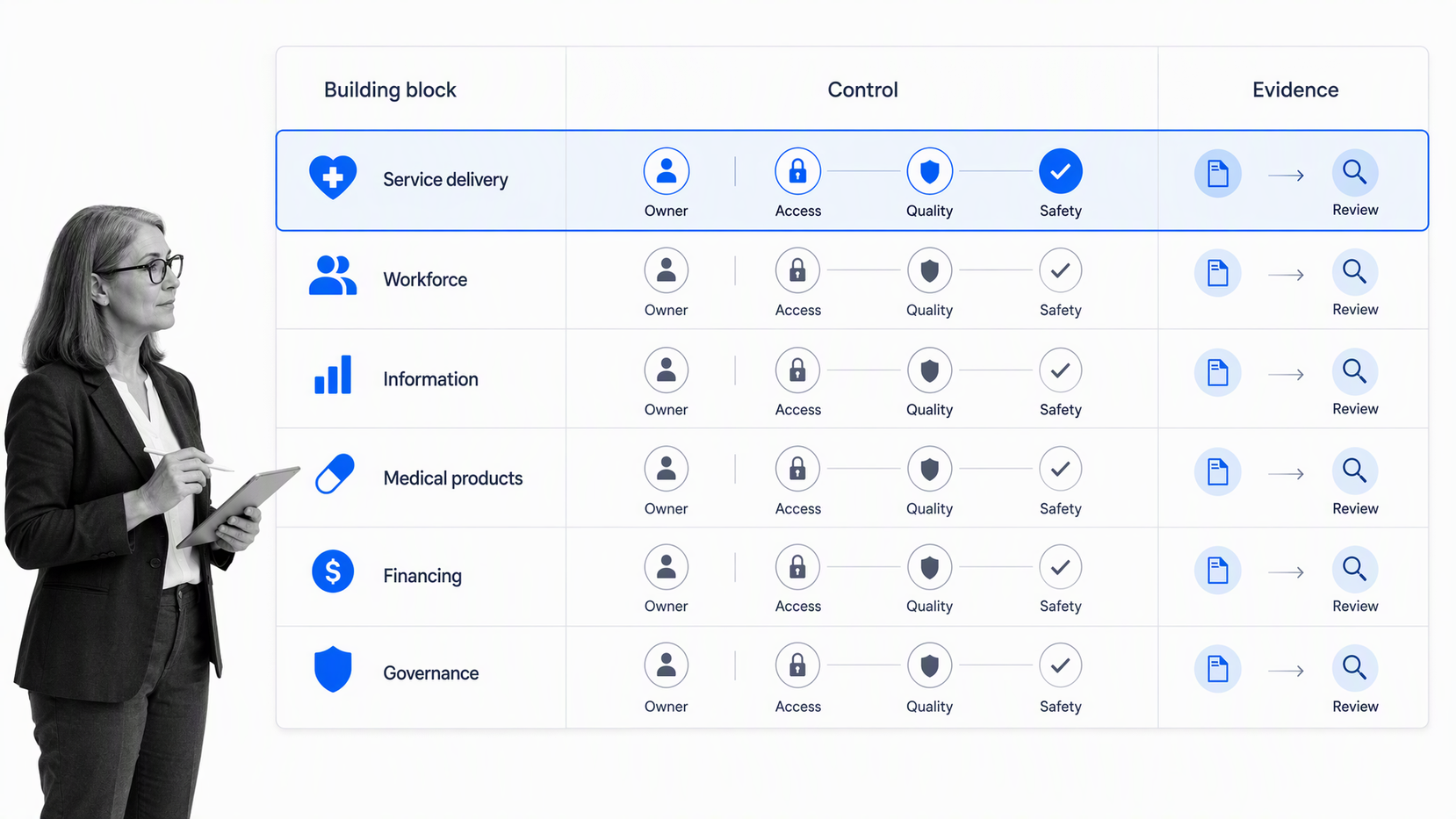
The WHO health system building blocks describe six connected building blocks: service delivery, health workforce, health information systems, medical products and technologies, financing, and leadership and governance. They are useful because they prevent improvement teams from treating a visible symptom as the whole system.
Service delivery
Service delivery includes prevention, primary care, emergency care, diagnostics, specialty care, inpatient care, rehabilitation, mental health, long-term support, and public-health services. Access, continuity, safety, timeliness, and responsiveness all matter. Adding capacity in one service can create a bottleneck elsewhere if referrals, diagnostics, or follow-up do not change with it.
Health workforce
The workforce includes clinicians, technicians, pharmacists, care coordinators, facilities teams, data staff, quality leaders, administrators, community workers, and many other roles. A system needs enough people, the right distribution of skills, safe workloads, training, clear responsibilities, and reliable support across locations and shifts.
Health information
Information supports clinical decisions, population planning, payment, quality improvement, safety, and accountability. Effective healthcare technology connects records, interfaces, identity, access, reporting, monitoring, backup, and recovery to the operating processes that use them.
Medical products and technologies
Medicines, vaccines, supplies, devices, diagnostics, and technical services have to be available, safe, appropriate, maintained, and traceable. Procurement alone is not enough. Storage, training, maintenance, calibration, vendor support, contingency supply, and evidence of use determine whether a product creates reliable capacity.
Financing
Financing determines how resources are raised, pooled, allocated, and paid for. It shapes access, provider incentives, service design, administrative work, and financial protection. Operational teams need to understand how authorization, documentation, coding, eligibility, and payment rules affect the patient path.
Leadership and governance
Governance sets goals, decision rights, accountability, standards, oversight, and review. WHO health systems governance guidance emphasizes that governance includes policy, regulation, system design, accountability, and coalition building. Without it, each organization can optimize locally while the wider healthcare system becomes harder to navigate.
Physical and digital healthcare infrastructure support all six building blocks. Facilities, utilities, transport, networks, communications, and continuity arrangements create the foundation on which services operate.
How healthcare systems work
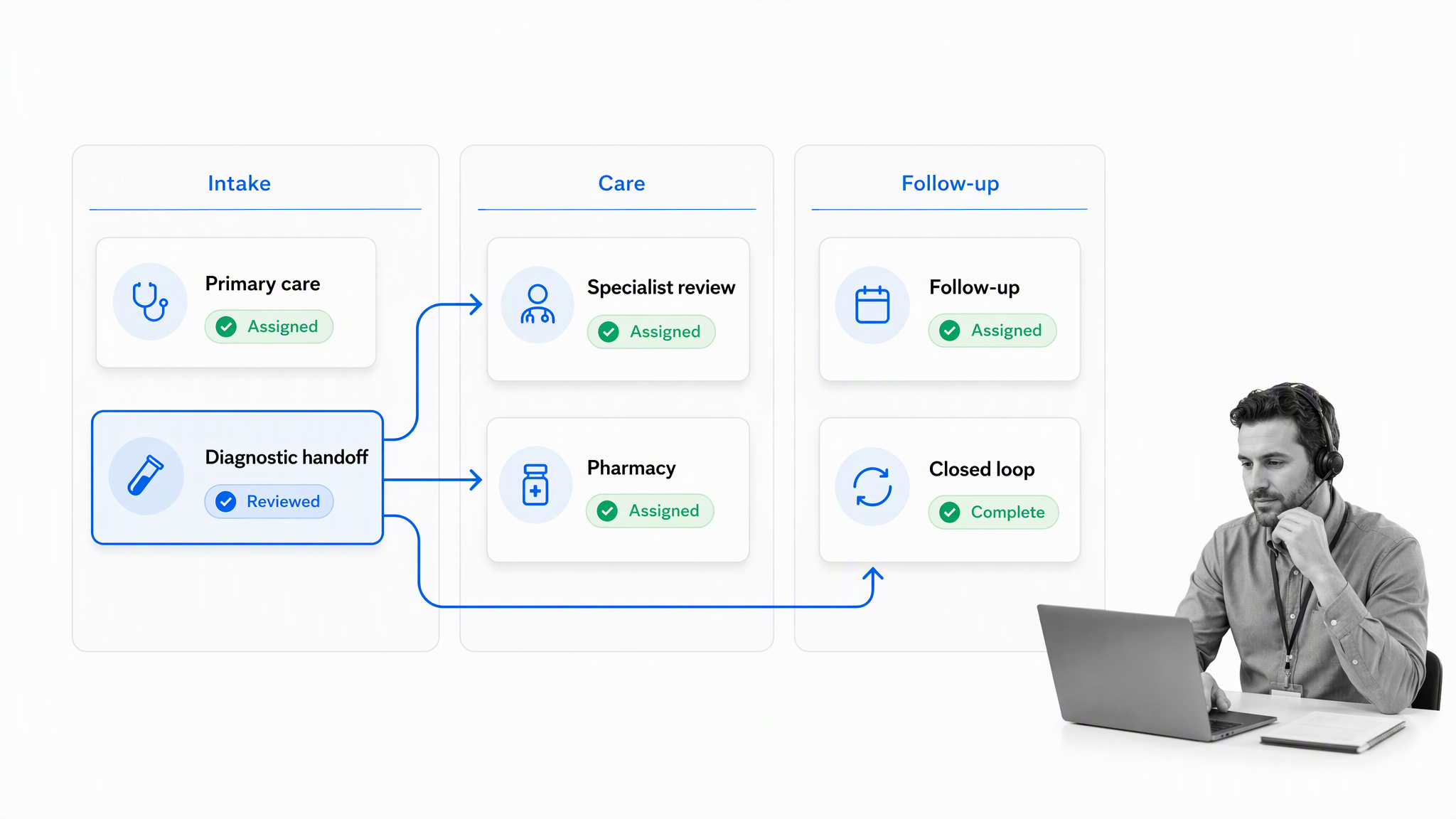
Healthcare systems work through flows: patients, information, decisions, money, supplies, and accountability move between people and organizations. The quality of those flows determines whether the system feels coordinated or fragmented.
Demand enters through many doors
A person may enter through primary care, an emergency department, a virtual visit, a pharmacy, a public-health program, a community service, or direct specialty access. Each entry point needs a way to assess urgency, eligibility, information needs, next steps, and follow-up.
Care depends on accountable handoffs
A handoff is complete only when the next owner has the information and authority to act. process mapping in healthcare should expose triggers, owners, dependencies, evidence, decision rules, and failure points. Sending a referral is an activity. Confirming receipt, scheduling, completion, results, and follow-up closes the loop.
Information has to follow the work
Clinical and operational decisions depend on timely, trustworthy information. Teams need appropriate access to the relevant record while protecting privacy and security. Interfaces require monitoring, error handling, change control, ownership, and recovery. A connection that silently fails can be more dangerous than no connection at all.
Financing changes behavior
Payment rules can encourage prevention, activity, coordination, efficiency, or documentation, depending on their design. They also generate administrative processes that can delay care. System leaders need to examine how financial rules interact with clinical and operational goals rather than treating payment as a separate back-office concern.
Feedback should change the system
A functioning system collects signals from outcomes, access, incidents, complaints, workforce experience, capacity, and costs, then turns them into action. healthcare analytics is useful when a measure is tied to an owner, threshold, investigation path, corrective action, and verification step.
The system improves when learning crosses organizational boundaries. Local fixes should be tested for downstream effects so that a shorter intake process does not create missing data for another team.
Types of healthcare systems
Healthcare systems can be described by who owns services, how care is financed, how people access providers, and how tightly organizations coordinate. Real systems often combine several models, so the categories are starting points rather than perfect labels.
Publicly organized systems
Government may finance or deliver a large share of care, set budgets, employ staff, own facilities, or define national and regional service networks. The design can support broad planning and access, but performance still depends on capacity, governance, workforce, information, and local execution.
Insurance-based systems
Coverage may be organized through public programs, nonprofit funds, employers, or private insurers. Providers may be public, nonprofit, or commercial. Rules for enrollment, benefits, networks, authorization, reimbursement, and cost sharing shape how patients move through the system.
Integrated delivery systems
Integrated systems bring hospitals, physician groups, ambulatory services, pharmacies, laboratories, and other capabilities under shared ownership or management. Integration can support common standards and information, but the organizational chart does not guarantee coordination. Teams still need aligned workflows, governance, and outcome review.
Community and mixed systems
Community organizations, public agencies, independent practices, retail care, virtual services, and social-support partners often sit outside formal integrated networks. A practical healthcare platform approach has to coordinate work across organizational boundaries without assuming one tool or one owner controls the entire system.
When comparing system models, ask what population is covered, how access works, where decisions sit, how services coordinate, how financing affects behavior, how quality is measured, and how the system responds when demand or risk changes.
Healthcare system governance and quality
Healthcare system governance creates the conditions for aligned decisions across services and organizations. It translates public goals, legal duties, clinical standards, and organizational priorities into authority, controls, measures, and review.
Set clear outcomes and decision rights
Leaders need a shared definition of success across access, quality, safety, equity, experience, workforce, resilience, and stewardship. They also need to define who can set standards, accept risk, allocate resources, approve changes, and require corrective action.
Connect quality to daily operations
Quality is not produced by a report alone. It comes from reliable processes, competent teams, safe environments, accessible services, and learning after variation. A clinical audit workflow can turn a standard into a scheduled review with assigned evidence and closure criteria.
Govern sensitive information
The HHS HIPAA Security Rule guidance requires appropriate administrative, physical, and technical safeguards for electronic protected health information. Access reviews, vendor assessments, incident response, backup testing, and risk analysis should be governed workflows, not isolated compliance events.
Make exceptions visible
A mature governance model expects exceptions. It defines which deviations are allowed, who approves them, what compensating control is required, how long the exception lasts, and what evidence closes it. Hidden workarounds create unmanaged system risk.
Use assurance, not checkbox completion
A strong compliance management software links policies to execution records. Leaders should be able to trace a requirement to the control, the owner, the completed work, the evidence, the exception, and the review. That creates proof that the system operated as intended.
Healthcare system resilience
Healthcare system resilience is the ability to anticipate disruption, maintain priority services, adapt safely, recover, and learn. It depends on relationships between services, infrastructure, workforce, suppliers, information, and leadership.
Map critical services and dependencies
Start with the service that must continue, then map the people, spaces, utilities, technologies, information, supplies, transport, vendors, and partners it depends on. This service-first view reveals cross-system dependencies that separate asset lists miss.
Define acceptable degradation
During disruption, some services continue normally, some move to an alternate mode, and some pause. The decision criteria need to be agreed before the event. Clinical, operational, facilities, technology, supply, communications, and leadership teams should understand when to escalate, divert, transfer, or restore.
Test coordination, not only equipment
The CMS emergency preparedness requirements identifies risk assessment, communication planning, policies and procedures, and training and testing as core emergency-preparedness elements. A generator test does not prove system resilience. Exercises should test notification, decisions, staffing, alternate workflows, patient protection, supplier response, documentation, restoration, and review.
Learn across the network
After an incident or exercise, capture what failed, what worked, which workaround was used, and which dependency was misunderstood. Assign corrective actions, verify closure, and share the learning with other sites or services that face the same risk.
A resilient system also looks beyond clinical organizations. The WHO systems for health report frames systems for health as networks that can respond to future threats while addressing wider drivers of health and supporting healthier populations.
How to improve a healthcare system
Improving a healthcare system requires coordinated changes at several levels. A new tool, policy, or role may help, but system performance changes only when ownership, workflows, information, incentives, and learning move together.
Step 1: Define the population and outcome
Choose a specific population, service, or transition and define the outcome in plain language. Examples include faster access to primary care, fewer failed referrals, safer discharge, stronger continuity during outages, or more reliable completion of quality controls.
Step 2: Map the current system
Use healthcare process mapping to document entry points, tasks, owners, handoffs, systems, decisions, evidence, wait states, and exceptions. Include the informal workarounds people use because those are often the clearest signals of a design gap.
Step 3: Identify leverage points
Look for changes that improve several parts of the system at once: a clearer handoff, one accountable owner, a shared data definition, an earlier risk screen, a better escalation rule, or a recurring review that closes known gaps. Avoid optimizing a single metric while pushing burden downstream.
Step 4: Pilot and measure
Test the change in a bounded setting. Track the outcome, the process measures that show adoption, and balancing measures that reveal unintended effects. Ask frontline teams and patients what changed in practice, not only whether the project plan was completed.
Step 5: Standardize and keep learning
Once the change works, turn it into a governed workflow management system with owners, evidence, decision rules, approvals, and review. Use healthcare automation for repeatable coordination, but keep human judgment where clinical or operational context requires it.
Run healthcare system operations in Process Street
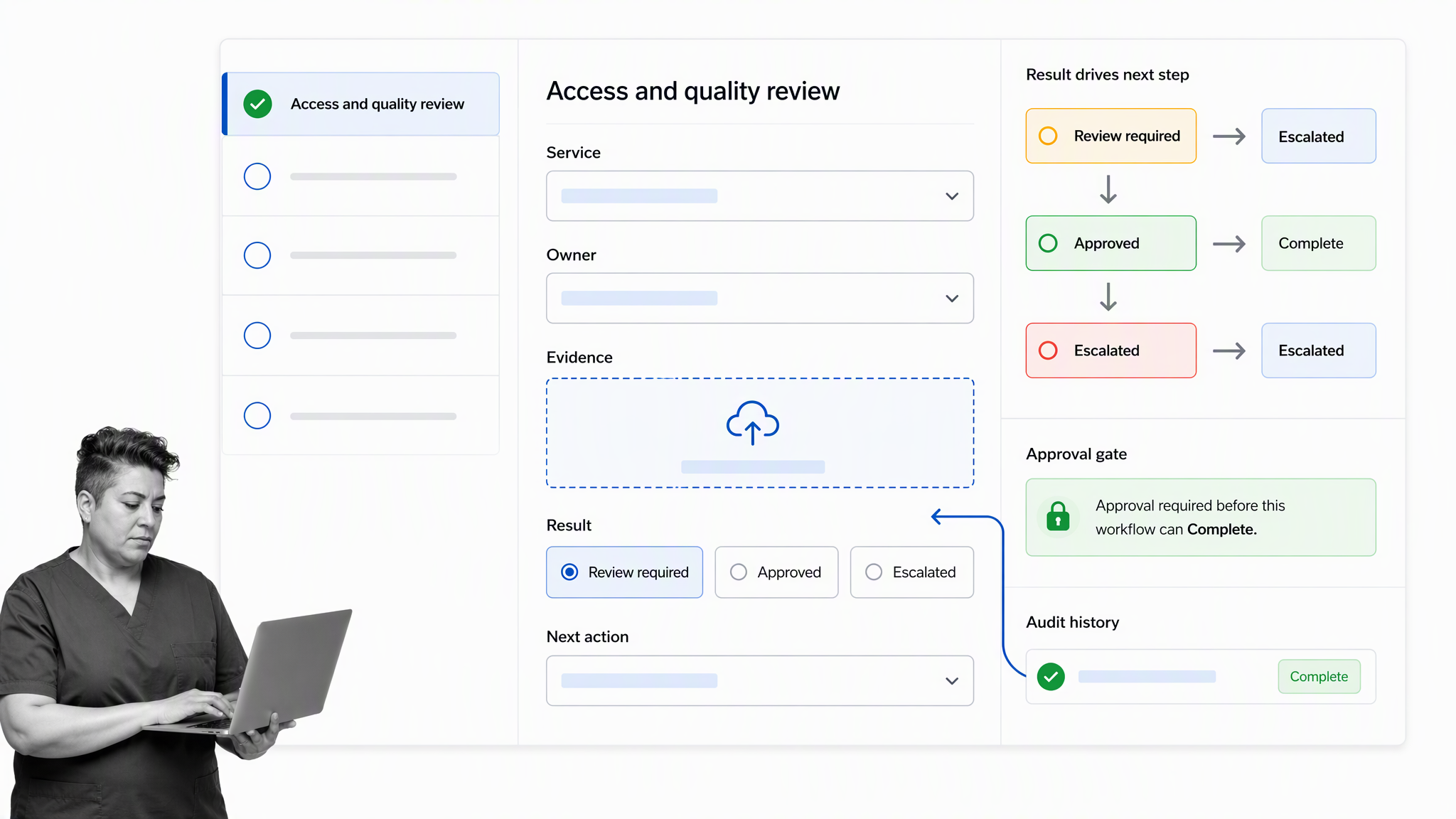
Healthcare system operations in Process Street become workflows that connect standards to assigned work. Teams can run service reviews, referral audits, access controls, incident response, continuity tests, supplier assessments, policy reviews, quality actions, and cross-site improvement through one governed execution layer.
Turn system standards into local execution
A system-level standard can launch the same core workflow across sites while allowing controlled variation for local roles, services, and risk. Required fields and evidence create consistency. Owners and due dates create accountability. Conditional paths adapt the work when a service, site, or result needs additional review.
Use approvals for material decisions
Risk acceptance, exception closure, return to service, policy changes, and major corrective actions may need formal review. workflow approvals keep the decision beside the evidence instead of separating approval from the operational record.
Route work based on context
With conditional logic, a failed control can trigger remediation, a high-risk response can add review, and irrelevant tasks can stay hidden. The workflow becomes easier for the person doing the work while preserving the controls leadership needs.
Connect the system without replacing every tool
Process Street has 5,000+ integrations. A healthcare system can keep specialized clinical, financial, facility, and data systems in place while using Process Street to coordinate the human and automated work between them.
Create one evidence trail
Each workflow run records tasks, owners, fields, files, comments, decisions, approvals, exceptions, and completion state. Teams can inspect one case during an audit or aggregate records to find recurring delays, failures, and improvement opportunities.
FAQs
What is a healthcare system?
A healthcare system is the connected network of people, organizations, services, information, technology, financing, and governance that promotes health and delivers care. Its performance depends on how those parts coordinate, not only on the strength of individual hospitals or clinicians.
What are the main components of a healthcare system?
A widely used framework groups the components into service delivery, health workforce, health information, medical products and technologies, financing, and leadership and governance. Physical and digital infrastructure support every component.
How does a healthcare system work?
A healthcare system works by moving patients, information, decisions, supplies, and funding across services and organizations. Clear handoffs, appropriate access, accountable owners, feedback, and governance help those flows produce coordinated care.
What are the main types of healthcare systems?
Healthcare systems are often described as publicly organized, insurance-based, integrated delivery, community-based, or mixed systems. Most real systems combine several models, so it is more useful to examine ownership, financing, access, coordination, and decision rights than to rely on one label.
How can a healthcare system improve quality and resilience?
Start with a defined population or service, map the current system, identify high-leverage gaps, test a bounded change, measure outcomes and unintended effects, then standardize what works. Resilience also requires tested continuity plans, clear decisions, reliable communication, and learning after incidents.
How can Process Street support healthcare system operations?
Process Street can turn system standards into assigned workflows with required evidence, conditional routing, approvals, integrations, escalation, and audit history. That helps healthcare organizations coordinate recurring operational, quality, compliance, and resilience work across teams and locations.