






Behavioral theory of leadership says effective leadership is shaped by observable, learnable actions rather than fixed traits alone. It asks what leaders do: how they structure work, support people, make decisions, communicate, and adapt.
A management title does not automatically make people trust, respect, or follow you. Your repeated behavior does. This guide uses ten patterns from landmark behavioral leadership frameworks to help you identify how you lead now and which behaviors you want to practice next.
“I realized I had a challenge… [people] didn’t think they needed to be trained as a leader.
I realized I had a real uphill battle because people thought leadership was a noun.”
John C. Maxwell, John C. Maxwell Defines Leadership
If you want to jump to a section, use the links below:
- What is the behavioral theory of leadership?
- 10 behavioral leadership patterns from landmark frameworks
- The skills and behaviors of effective leaders
- How to build your leadership style into your processes
What is the behavioral theory of leadership?
The behavioral approach shifted leadership research away from the idea that great leaders are simply born with a rare set of traits. Thomas Carlyle’s nineteenth-century “Great Man” theory helped popularize that older view. Later trait research remained useful, but it did not produce one universal profile that separated every effective leader from everyone else.
Researchers therefore began studying behavior: actions that other people could observe, describe, practice, and evaluate. Ohio State researchers used the Leader Behavior Description Questionnaire to examine two independent dimensions, initiating structure and consideration. They are often described as task-oriented and people-oriented leadership.
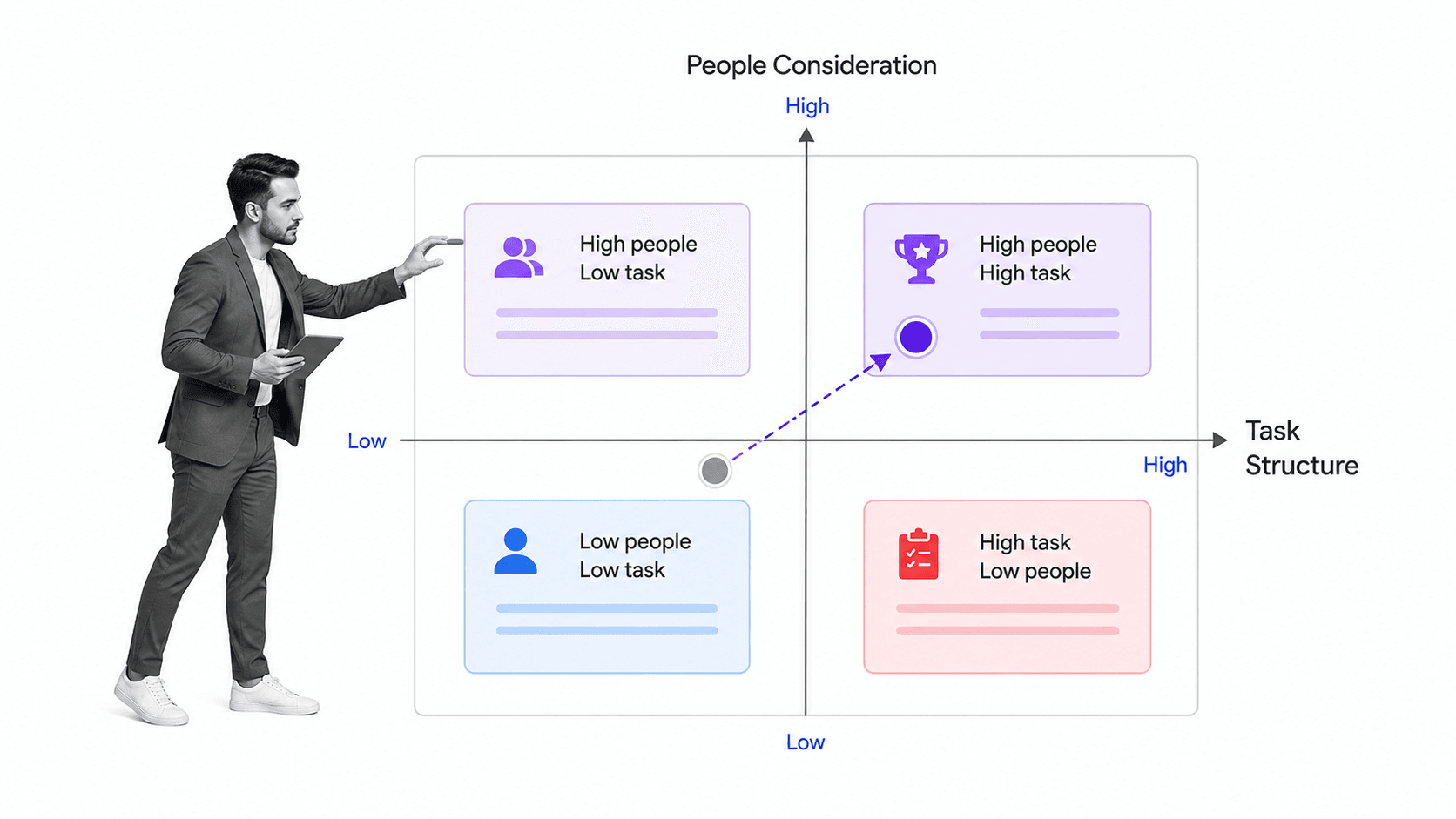
Task-oriented behavior clarifies roles, goals, standards, communication lines, and deadlines. People-oriented behavior listens, coaches, supports development, and pays attention to trust and working relationships. A leader can be high or low on either dimension. Strong concern for people does not require weak standards, and strong structure does not require ignoring the team.
That is the practical promise behind the phrase “leaders are made, not born.” Leadership behavior can be learned, rehearsed, measured, and improved. The claim is not that traits never matter. It is that a leader’s day-to-day actions give teams something concrete to work with.
Behavior alone also does not explain every outcome. The right response depends on the task, the team’s experience, the stakes, time pressure, culture, and what followers need. Behavioral leadership theory gives you a useful vocabulary for examining what you do. Situational and contingency theories help explain when a particular behavior is likely to work.
10 behavioral leadership patterns from landmark frameworks
Behavioral leadership research produced dimensions, models, and recurring patterns rather than one official list of leader types. The ten patterns below combine findings from Ohio State and Michigan studies with participative leadership and the Blake-Mouton Managerial Grid. Use them as lenses for observing behavior, not fixed personality labels.
These are:
- Task-oriented leaders
- People-oriented leaders
- Participative (democratic) leadership
- Indifferent (impoverished) leaders
- Country club leaders
- Status-quo leaders
- Dictatorial leaders
- Sound (team) leaders
- Opportunistic style (OPP)
- Paternalistic style
Task-oriented leaders
The Leader Behavior Description Questionnaire (LBDQ) was the result of a study by Ohio State University in the 1940s. They gave the questionnaire to groups ranging from college students to administrators and private companies to military personnel.
The goal? To find common leadership behaviors.
They found that two behavioral groups, in particular, were commonly related to effective leadership, these being initiating structure and consideration, often described as task-oriented and people-oriented leadership behavior.
Task-oriented leaders are primarily concerned with the systems and structure that lets their team carry out their work. This includes everything from task descriptions to standard operating procedures, organizational and team structure, communication lines, and so on.
Key to remember here is that task-oriented leaders don’t ignore their employees as humans. They’re still concerned with motivating their team despite their primary focus being on systems.
Task-oriented leaders exhibit the following behaviors:
- Initiating
- Organizing
- Clarifying
- Information gathering
People-oriented leaders
The other group identified as a result of the LBDQ was people-oriented leaders.
Unlike task-oriented leaders, this group puts more effort into seeing to the human needs of their team and motivating them through that. It’s not that they don’t focus on the task or system, they just put more time and behavioral focus on their team as people with wants and needs.

For example, let’s say that your team is having a problem. Someone hasn’t managed to get their work done on time.
A task-oriented leader would dive into your processes to see if the problem could be prevented in the future or whether an SOP wasn’t followed properly. A people-oriented leader would behave differently, going straight to the employee and asking if there was any way they could help and what caused the problem.
People-oriented leaders exhibit the following behaviors:
- Encouraging
- Observing
- Listening
- Coaching and mentoring
Participative (democratic) leadership
In the 1950s Dr. Rensis Likert led research at the University of Michigan attempting to find characteristics (behaviors) of effective leadership.
He found three common behaviors. The first two backed up the LBDQ findings to show that task-oriented and people-oriented leaders are common effective examples. The third they identified was that of participative (also known as “democratic”) leadership.
As the name suggests, participative leaders are those who consult their entire team when creating systems and methods for achieving the team’s goals.
This means that work becomes much more collaborative, allowing the entire team to take part ownership of their work and the procedures behind it. This can strengthen ownership and make the reasoning behind a process easier to understand.
By including the team in the decision-making process you help them to understand their work, why it matters, and motivate them to take appropriate action.
One of the biggest benefits of this behavioral leadership theory is that it allows the team to take advantage of everyone’s strengths.
Every team member’s voice is heard, encouraging creativity and engagement. It also provides an avenue for new leaders to show their abilities and for everyone to make the most of each others’ strengths.
This encourages communication and collaboration, which can often lead to a thriving company culture.
The downside is that participative leadership takes much more time than other methods. Having to speak to everyone means that there will be a much greater delay before action is taken.
Participative leaders exhibit the following behaviors:
- Communicating
- Collaborating
- Being open to feedback
- Encouraging
- Delegating
Indifferent (impoverished) leaders
In 1964 Dr. Robert Blake and Dr. Jane Mouton published the Managerial Grid Model (or “Leadership Grid”) in the first edition of The Managerial Grid. A result of their studies at Exxon, this grid identified five types of behavioral leaders and arranged them into a grid to demonstrate a more flexible scale of leadership behaviors and priorities.
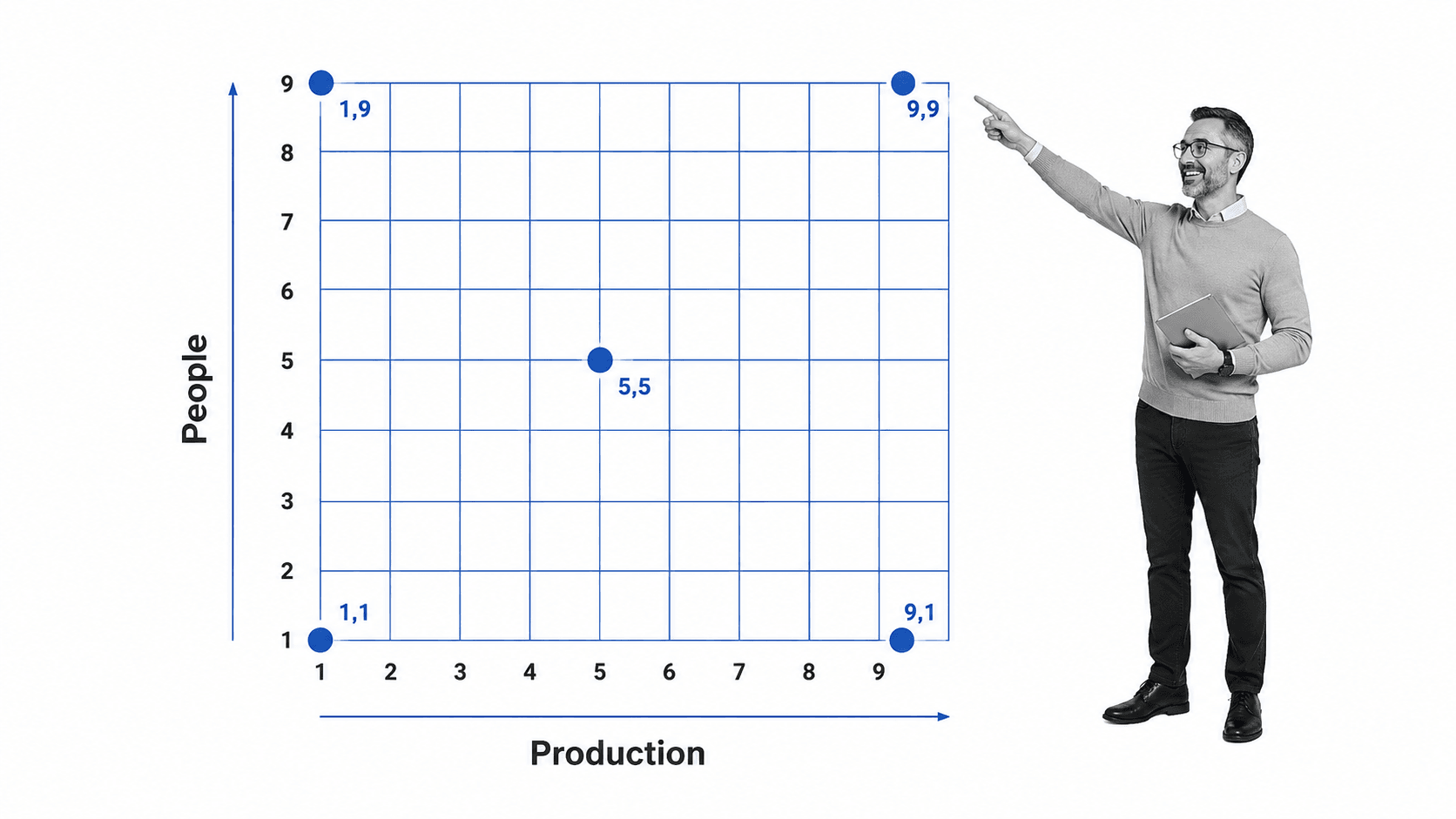
The grid measures leadership styles against their concern for people (on the y-axis) and their concern for production (on the x-axis). In other words, they studied what behaviors and motivations create leaders and provided a system with which we can contextualize them.
While this presents 81 possibilities (with nine points on each axis), The Managerial Grid Model originally identified five models. Two more being added as the years went on.
The first of these is the indifferent or impoverished leader.
This pattern shows low concern for both people and production.
These leaders avoid involvement, communicate little, and contribute minimal direction or support. This usually shows up as having very little contact with the team, dodging decisions, and leaving people without clear priorities or support.
As such they’re at the lowest point of the Managerial Grid Model – they have little concern for the people under their care or the production of their team. They’re all the way down at the (1,1) point of the grid.
Sustained low involvement can leave employees unsupported and make reliable performance difficult.
Indifferent leaders exhibit the following behaviors:
- Evading
- Procrastinating
- Lack of communication
- Self-preservation
Country club leaders
Country club leaders were also identified in the Managerial Grid Model. Unlike indifferent leaders, these are people who put every effort into making sure that the human elements of their team are happy and satisfied.
As such, they sit at the (1,9) point of the Managerial Grid.
The theory is that a happy team will naturally produce better results, so a leader putting their efforts into making their team happy will naturally see success.
This isn’t a terrible behavioral theory of leadership, as it often leads to happy teams and a healthy company culture. The attention to relationships can support morale and psychological safety.
The trade-off appears when comfort receives more attention than standards, priorities, or results.
There’s a balance that needs to be struck between caring for people and caring for results. Country club leadership does this better than indifferent leadership but still doesn’t quite reach the mark.
Country club leaders exhibit the following behaviors:
- Caring
- Listening to feedback
- Focus on employee health and happiness
- Quick to support employees
- Involved with the team
Status-quo leaders
Status-quo leaders are what you likely (hopefully) think of as a typical manager. They run the middle road of employee happiness and satisfaction and getting results.
Unfortunately, as shown by their position at (5,5) on the Managerial Grid, these leaders don’t fulfill either focus to its true potential.
They get more done than country club leaders. They focus on people more than indifferent leaders.
They can’t do either to full effectiveness.

This middle position can produce acceptable short-term performance, but it may avoid the harder work required to build strong commitment or raise standards.
Status quo leaders exhibit the following behaviors:
- Listening to feedback
- Reasonable task distribution
- Lack of flexibility in task alterations
Dictatorial leaders
Dictatorial leaders are, as the name suggests, entirely focused on producing results without worry for the people under their employ.
A good example of this is the idea of developer “crunch” periods.
These are times where employees are pressured (if not outright forced) to work long stints to meet deadlines which are usually unreasonable at the expense of their own health and work-life balance.
Sustained pressure without employee consideration raises the risk of burnout, poor judgment, and turnover, even when short-term targets are met.
They take the (9,1) spot on the Managerial Grid.
Dictatorial leaders exhibit the following behaviors:
- Focus on productivity
- Non-acceptance of excuses
- Doesn’t listen to feedback
- Deadlines are absolute
- Hits their targets
Sound (team) leaders
Team leaders show high concern for both results and people. The model treats this as a strong pattern, although no one style is universally effective in every situation.
These leaders are as focused on results as they are on the happiness and sustainability of their team.
This is why they are placed at the (9,9) spot on the Managerial Grid.
They can motivate people with both words and actions, they set goals which are high yet achievable, they thrive in their team’s culture and are open to discussing and working problems through to the satisfaction of all parties.
This plays into Douglas McGregor’s Y theory of management. He states that these managers believe people take pride in their work and are willing to rise to the challenge, benefiting more from autonomy and ownership of their own work.
Such a positive relationship with employees motivates them to reach their goals when guided appropriately.
If they are lacking skills, the sound leader will tutor them or give resources to allow them to expand their repertoire. Regular meetings and performance appraisals are regular but the focus is on encouragement rather than picking faults.
The cornerstones of this leadership style are communication and collaboration. Without appropriate connections to their team it will prove hard, if not impossible, to allow them to reliably take their workload into their own hands.
Sound leaders exhibit the following behaviors:
- Constant communication
- Allowing employees autonomy and ownership of tasks
- Encouragement
- Listening to and acting on feedback
- Provision of resources to further employees’ skills
Opportunistic style (OPP)
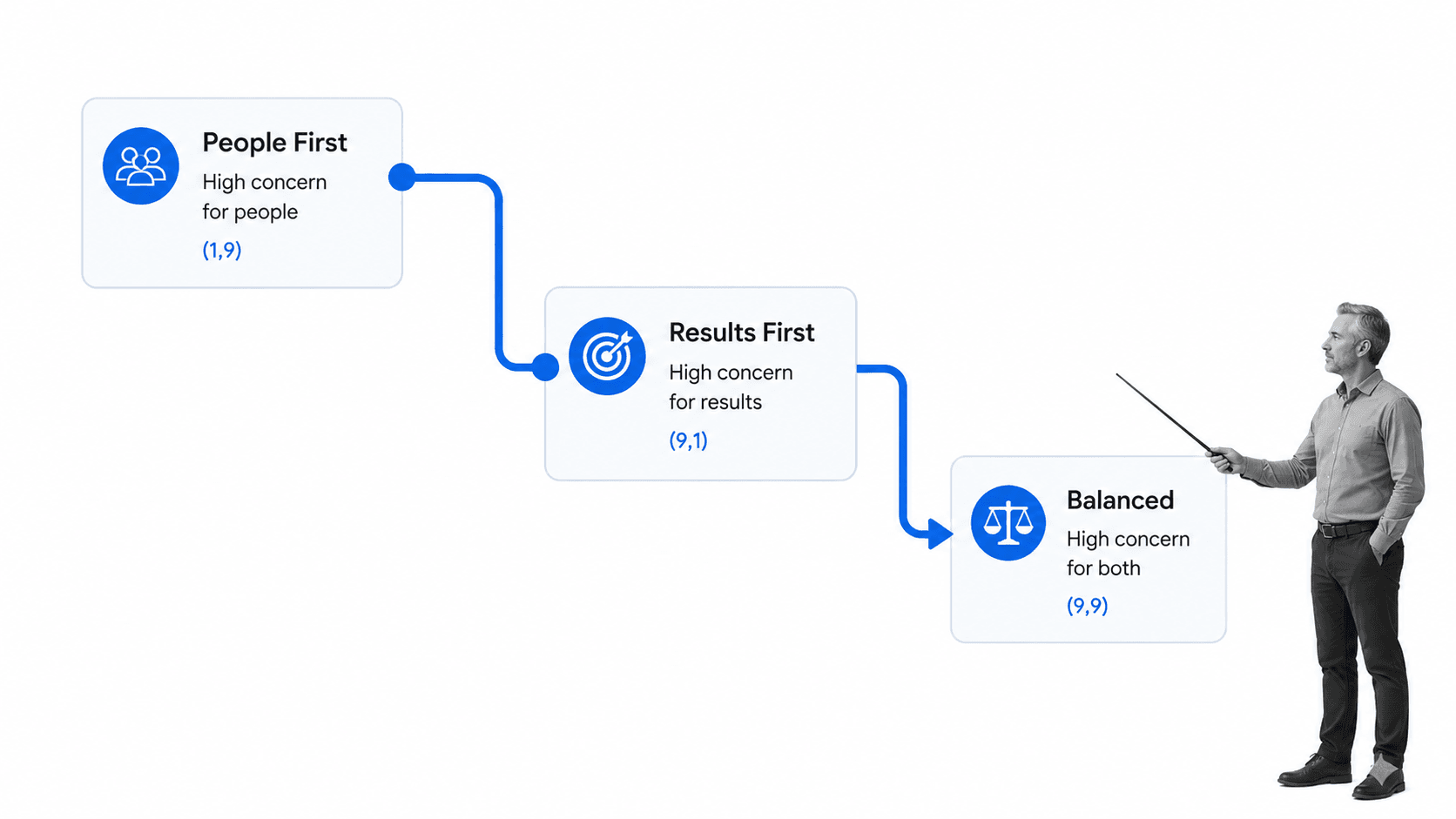
The final two leadership styles shown in the Managerial Grid are more flexible than the previous entries. Due to this, they don’t have a set numerical entry on the grid.
The opportunistic style of leadership can take the form of any of the previous five styles and positions on the grid.
These leaders adjust their approach based on what will most effectively achieve their goals. While this isn’t inherently a bad thing, it does mean that the output and happiness of their team is much more variable than a consistent sound leadership style.
The concern is not flexibility itself. Effective leaders adapt to context. Opportunistic leadership becomes a problem when the leader changes styles mainly to advance personal goals or treats people as obstacles.
If the team is doing fine but deadlines are fast approaching, a dictatorial style will be adopted to hit those marks. Coming out of the crunch they may act as a country club leader to let their team recuperate, and so on.
Opportunistic leaders exhibit the following behaviors:
- Lack of consistent leadership style
- Pushing to meet goals no matter the cost
- Listening when beneficial to them
- Caring for the team solely to prevent roadblocks
Paternalistic style
The paternalistic style of leadership is the other side of the coin to the opportunistic style.
These leaders also focus on the end results of their team but are much more flexible in their approach, rewarding good performance and setting goals for themselves and others.
As such, their leadership style can be anywhere from (9,1) to (1,9) on the managerial grid.
They value their team members and their skills, providing opportunities and resources to better their education and standing.
However, they tend to be critical of thinking that opposes their own.
Paternalistic leaders combine centralized authority with support and protection. They may reward loyalty and development while allowing limited dissent, which can create stability but restrict challenge and autonomy.
Paternalistic leaders exhibit the following behaviors:
- Supporting employees in increasing their skills
- Doesn’t listen to feedback
- Rewards success and punishes failure
The skills and behaviors of effective leaders
So there you have it – the prevailing behavioral theories of leadership. This is where most would sign off without another word but that’s not how we like to do things here at Process Street.
We like to give you actionable tips for you to use.
As such, let’s break down some of the more effective leadership theories highlighted above to demonstrate the kind of skills and actions involved. These both contribute to the behavior of you as a leader, shaping the kind of management you present.
Drawing from the styles above, we can see that effective behaviors include:
- Listening to feedback
- Encouraging communication
- Providing support for employees to improve
- Giving autonomy to employees
- Managing deadlines to be realistic
- Assigning tasks based on individual skills and interests
- Knowing and reiterating clear goals and team mission statement
- Consistent and frequent meetings with employees to assess and give feedback
- Motivating employees to work with and without you
- Meeting goals
- Building and maintaining a healthy team/company culture
To display these behaviors you’ll need to have the following skills:
- Extensive knowledge of your topic
- Being approachable to all levels of employee
- Solid time management
- Effective task prioritization
- Flexible planning
- Ability to empathize with your team
How to build your leadership style into your processes
Leadership improves when expectations become repeatable. If you want managers to listen before deciding, give useful feedback, set realistic deadlines, or delegate clearly, those behaviors need a place in the way work runs.
Start with one recurring management process, such as a one-to-one, project kickoff, performance review, incident review, or hiring decision. Define the behavior you want to see at each point. Add the questions a manager must ask, the evidence they need, the decision criteria they should use, and the follow-up owner. The right manager tools turn leadership expectations into assigned work, repeatable coaching, and visible accountability.
Ray Dalio’s meeting principles offer a useful example. The value is not a label for his leadership style. It is the discipline of turning principles such as candid feedback, clear decisions, and documented follow-up into a process people can run.
Process Street is a single Compliance Operations Platform with Docs for governed SOPs and policies, Ops for executable workflows, and built-in AI that helps teams enforce and improve how work gets done. Leaders can document the expected behavior, assign the work, route approvals, capture evidence, and keep an audit trail in one system.
That closes the gap between saying how managers should lead and making those behaviors part of daily operations. Use workflow templates as a starting point, adapt the steps to your team, and review the results over time.
Start a 14-day Process Street trial to turn leadership principles into governed, executable workflows.