Turn every policy into automated workflows with built-in enforcement and audit-ready proof.


AI Agent Guardrails
Last updated:
AI agent guardrails are enforceable controls that limit what an autonomous system can see, decide, and do. They check inputs, data access, permissions, tool calls, outputs, and real-world actions before a mistake becomes an operational incident.
The strongest guardrails do not depend on the agent choosing to obey. They live around the model in identity systems, policy engines, workflow gates, tool wrappers, sandboxes, monitoring, and recovery procedures. The agent can propose an action, but the surrounding system decides whether that action is allowed.
Good guardrails are proportional. A low-risk research task can run with lightweight controls. An action that changes access, moves money, sends an external message, deletes data, or affects a regulated decision should face tighter permissions, deterministic checks, human approval, and complete evidence capture.
In this guide, you will learn:
- What are AI agent guardrails?
- Why AI agents need more than prompt rules
- The layers of effective AI agent guardrails
- How to match guardrails to risk
- How to design AI agent guardrails
- How to test and monitor AI agent guardrails
- How Process Street enforces AI agent guardrails
- FAQs
What are AI agent guardrails?
AI agent guardrails are the policies and technical mechanisms that keep an agent inside an approved operating boundary. They define which goals are valid, which data is available, which tools can be called, which arguments are permitted, which actions require approval, and what should happen when the system is uncertain.
Guardrails govern behavior and authority
A chatbot guardrail often focuses on what the model says. An agent guardrail must also govern what the system does. An agent may browse the web, read files, call APIs, change records, run code, or communicate with people. Every capability adds a path from model output to real consequences.
That is why OpenAI guidance on building agents describes guardrails as a layered defense that belongs beside authentication, authorization, strict access control, and standard software security. Content filtering is useful, but it is not an execution boundary.
A guardrail can allow, transform, escalate, or stop
A control does not need to block everything. It can allow a safe request, remove sensitive fields, narrow a tool argument, require a second source, route the action to a human, place the agent in read-only mode, or stop the run. These responses make guardrails useful instead of merely restrictive.
The operating boundary should be explicit
Write the boundary in operational terms. Name the permitted systems, records, actions, value limits, recipients, time windows, and evidence requirements. Avoid vague rules such as use good judgment. A reviewer should be able to tell whether a proposed action fits the boundary without asking the model to interpret the rule that controls it.
Guardrails are part of the process
A guarded agent belongs inside an agentic process automation design. The business process supplies owners, approval points, exception routes, stop conditions, and evidence. The agent supplies speed and flexible reasoning inside that governed path.
Why AI agents need more than prompt rules
Prompt rules are useful instructions, but instructions are not a security boundary. The same model interprets the system prompt, user request, retrieved documents, web pages, tool results, and messages from other agents. Malicious or simply confusing content can compete with the original instruction.
Prompt injection changes the apparent goal
OWASP defines prompt injection as malicious instructions that cause a model to override its intended behavior. Indirect prompt injection is especially important for agents because the hostile instruction can arrive inside a document, ticket, email, web page, or tool response that the agent was asked to process.
The agent may treat untrusted content as a new command. A system prompt that says never reveal secrets cannot guarantee safety if the same agent can read a credential, call an external tool, and choose the destination. The control must prevent the dangerous combination outside the model.
Excessive agency turns an error into an incident
OWASP excessive agency guidance identifies excessive functionality, permissions, and autonomy as root causes of damaging actions. A hallucination or ambiguous request becomes much more serious when the agent holds broad write access and can act without review.
The practical failure patterns are visible in accounts of what breaks when AI agents get real access. The lesson is not to avoid agents. It is to separate useful reasoning from unrestricted authority.
The agent cannot be its only referee
Do not ask the same model to decide an action, judge whether the action is safe, and execute it with broad credentials. Independent policy checks, constrained tool schemas, permission enforcement, and human review create separation between proposal and authority.
Fail-safe behavior needs external enforcement
International guidance on the careful adoption of agentic AI services recommends safe defaults, clear constraints, layered guardrails, isolation, monitoring, and escalation. A high-risk agent should stop or degrade to a safer mode when the required control is unavailable, not continue because the model believes the task is urgent.
The layers of effective AI agent guardrails
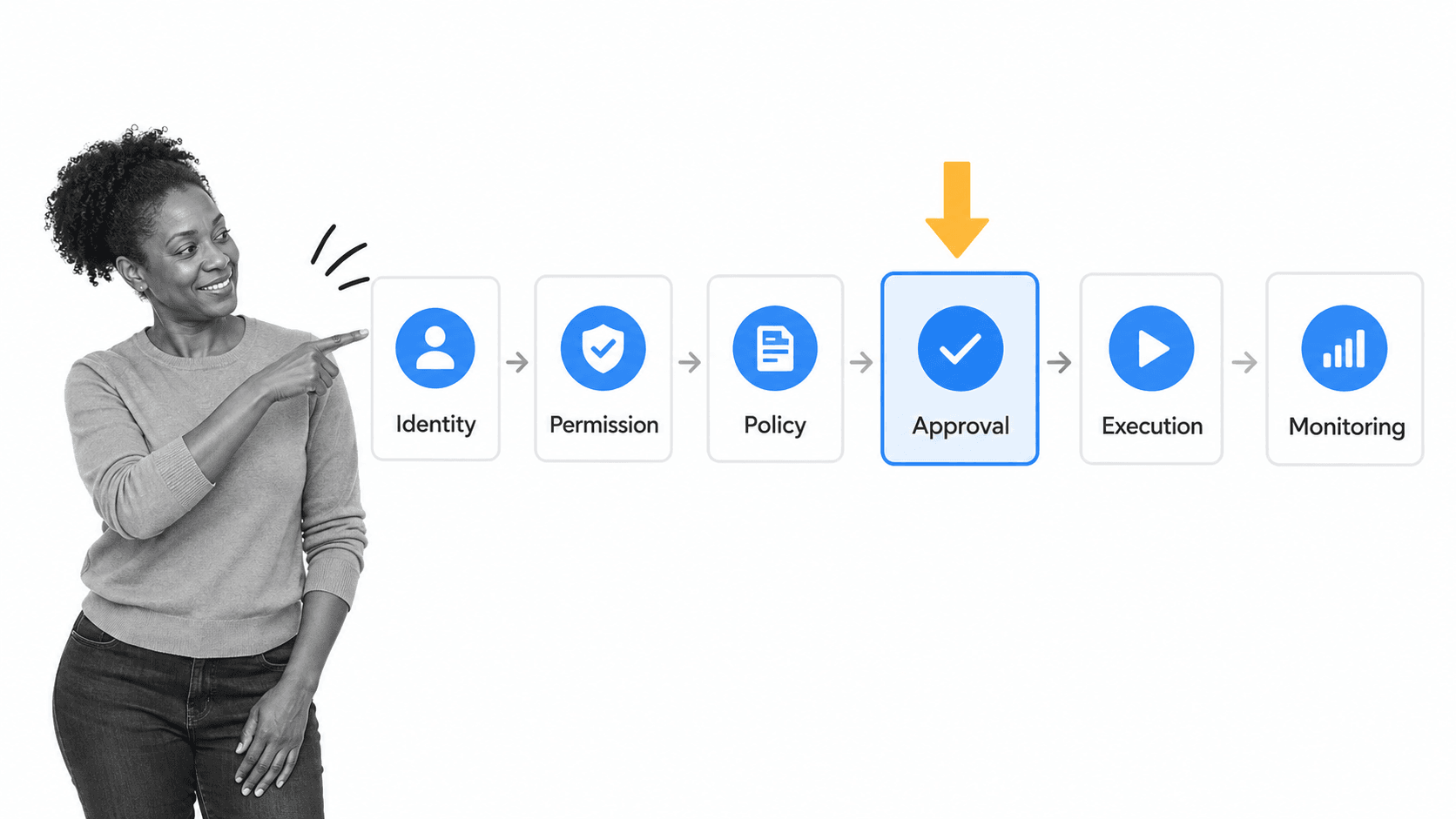
Effective AI agent guardrails form a control stack. Each layer answers a different question, and no single layer is strong enough by itself. The exact implementation varies, but the following layers cover the path from request to outcome.
1. Identity and provenance controls
Identify the initiating user, workflow, agent instance, model configuration, and credential used for every action. Preserve where instructions and data came from. Provenance helps the system distinguish a trusted policy from an untrusted web page and lets investigators reconstruct who delegated authority to the agent.
2. Scope and permission controls
Give the agent the least authority required for the current task. Prefer short-lived credentials, explicit resource scopes, read-only access by default, and separate identities for separate agents. Limit filesystem roots, database tables, API operations, recipients, and network destinations rather than handing the agent a broad administrator token.
3. Input and context controls
Classify inputs by trust level. Scan for prompt injection, secrets, personal data, malicious files, unsupported requests, and missing prerequisites. Keep untrusted content clearly separated from system instructions. Retrieval should return the minimum relevant context, with source metadata attached.
4. Policy and business-rule controls
Translate policies into deterministic checks where possible. Validate amounts, destinations, user roles, data classifications, record states, and required evidence. Use allowlists and typed schemas for tool arguments. A model can propose a value, but ordinary software should verify whether that value is permitted.
5. Human approval controls
Use a human in the loop for actions that are consequential, difficult to reverse, unusual, or weakly supported. The reviewer should see the proposed action, target, evidence, risk, and exact consequence. Approval must occur before execution and apply only to the reviewed scope.
A formal approval task creates a separate decision point and record. A casual message asking looks okay does not provide the same control because it may not block the downstream action or preserve what the reviewer saw.
6. Tool and execution controls
Wrap tools so the agent cannot call arbitrary functions or pass unrestricted arguments. Validate every tool request, bind it to the approved task, enforce rate and value limits, isolate code execution, and block dangerous combinations. Keep write tools separate from read tools so low-risk research does not inherit change authority.
7. Output and downstream controls
Treat model output as untrusted data. Validate formats, citations, destinations, code, SQL, and structured fields before another system consumes them. Escape content for its destination and prevent model-controlled strings from becoming shell commands, queries, templates, or URLs without ordinary application validation.
8. Monitoring, evidence, and recovery controls
Record requests, policy decisions, approvals, tool calls, results, and exceptions in an AI agent audit trail. Monitor for unusual sequences, denied actions, repeated retries, permission changes, and data movement. Define a kill switch, credential revocation, rollback, quarantine, and incident route before production use.
How to match guardrails to risk
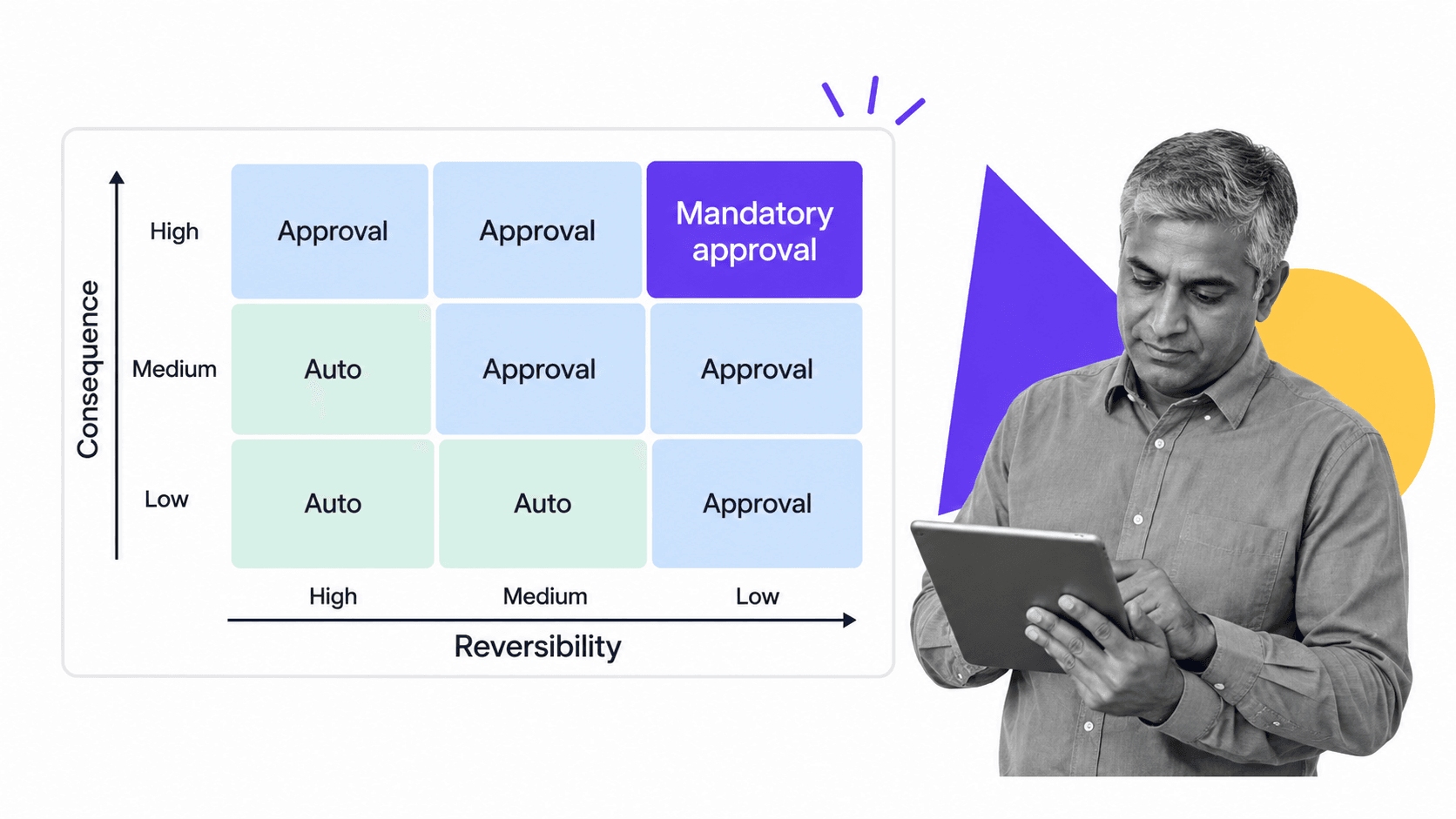
Not every agent action needs the same controls. Guardrails should become stronger as consequence rises, reversibility falls, data becomes more sensitive, and autonomy expands. A clear risk model prevents teams from applying heavy review to trivial work while leaving dangerous actions under-controlled.
Assess consequence
Ask what could change if the action is wrong. Consider financial loss, access, safety, legal duties, customer communication, privacy, data integrity, production availability, and reputational impact. Consequence depends on the target and context, not only the tool name.
Assess reversibility
A draft can be edited. A message sent to a customer, payment released, file deleted, or access grant exposed may be difficult to undo. Hard-to-reverse actions deserve stronger pre-execution checks even when their expected impact appears moderate.
Assess uncertainty and novelty
Raise the control level when the agent has weak evidence, conflicting sources, a new tool, an unfamiliar request, or an unusual action sequence. Novelty is a signal that historical tests may not cover the case. Route the action to review instead of asking the model to guess confidently.
Choose the control tier
- Low risk: read-only access, input validation, output checks, logging, and bounded cost limits.
- Moderate risk: scoped write access, deterministic policy checks, stronger monitoring, and sampled review.
- High risk: mandatory approval, separation of duties, isolated execution, complete evidence, and tested rollback.
- Prohibited: actions outside policy, unlawful uses, unsupported safety-critical decisions, or requests with unacceptable residual risk.
Document the classification with a risk management process so the chosen guardrails have an owner, rationale, review date, and exception path.
How to design AI agent guardrails
Design starts with the action path, not a catalog of filters. Map how a request becomes a real-world change, then place controls at the points where identity, trust, authority, or system state changes.
Step 1: Define the allowed job
Write a narrow purpose statement and explicit non-goals. Name the inputs, outputs, systems, records, tool operations, recipients, and environments in scope. If the job cannot be described clearly, it is too broad to automate safely.
Step 2: Map data and trust boundaries
List every source the agent reads and every destination it can affect. Mark which content is untrusted, sensitive, regulated, or secret-bearing. Record where data crosses tenants, networks, applications, or human teams. These boundaries determine where validation, redaction, and isolation belong.
Step 3: Inventory tools and permissions
For each tool, record operations, argument types, reachable resources, credential scope, side effects, rate limits, and failure modes. Remove unused functions. Split powerful tools into smaller functions so the agent can request one safe operation instead of receiving a general command surface.
Step 4: Write policy as executable checks
Convert rules into allowlists, schemas, thresholds, state checks, and prerequisite tasks. Use the model for fuzzy classification where necessary, but keep decisive boundaries in deterministic code or controlled workflows. Record a reason code whenever a rule allows, transforms, escalates, or denies an action.
Step 5: Place approval before consequence
Approval belongs immediately before the consequential action, after the reviewer has enough evidence to decide. Bind the approval to the exact target, values, recipient, and expiry. If the proposal changes, request a new decision. Never reuse a broad approval for a different action.
Step 6: Design safe failure behavior
Define what happens when the policy service, approval system, model, tool, or evidence store is unavailable. High-risk actions should fail closed. Lower-risk tasks may degrade to read-only work or create a queue for later review. Set timeouts and retry limits to prevent loops and duplicate side effects.
Step 7: Connect evidence and ownership
Every denied, approved, executed, rolled-back, and exceptional action should connect to an owner and evidence record. Link the control design to AI agent compliance requirements so teams can prove that the rule operated, not merely that a policy document existed.
Step 8: Manage changes deliberately
Models, prompts, retrieval sources, tools, permissions, and policies change the effective guardrail. Route these changes through a change management process with testing, approval, versioning, and rollback. A safe agent can become unsafe without any change to its visible user interface.
How to test and monitor AI agent guardrails
Guardrails are hypotheses about failure. Testing proves whether they hold when an agent receives confusing instructions, hostile content, partial data, unavailable services, or pressure to complete a task. Production monitoring then checks for failures the test set did not predict.
Test normal, boundary, and adversarial cases
Create tests for allowed work, denied work, missing prerequisites, values just below and above thresholds, ambiguous targets, prompt injection, poisoned retrieval, malformed tool output, duplicate requests, and attempts to expand permission scope. Verify both the decision and the resulting system state.
Test the full action path
A model-only evaluation can miss failures in tool wrappers, credentials, approvals, queues, and downstream systems. Run end-to-end tests in an isolated environment using realistic permissions and data shapes. Confirm that a denied action cannot reach the target through another tool or retry path.
Measure control performance
Track allowed, transformed, escalated, and denied actions. Measure false blocks, missed violations, approval turnaround, override rates, duplicate side effects, incomplete evidence, recovery time, and cost-limit events. Review trends by agent, workflow, tool, policy, and risk tier.
Monitor for behavior drift
Model and system changes can alter action patterns even when aggregate success remains high. Watch for new tool sequences, more retries, broader data access, changed refusal rates, and rising exception volume. Compare behavior before and after every material version change.
Practice incident response
Use an information security incident response workflow to rehearse containment. Operators should be able to stop the agent, revoke credentials, isolate affected systems, preserve evidence, identify impacted records, roll back changes, and communicate with owners without relying on the agent that failed.
The NIST Generative AI Profile provides a broader risk-management frame for governance, measurement, monitoring, and response. Use it to connect individual controls to an organization-wide AI risk program.
How Process Street enforces AI agent guardrails
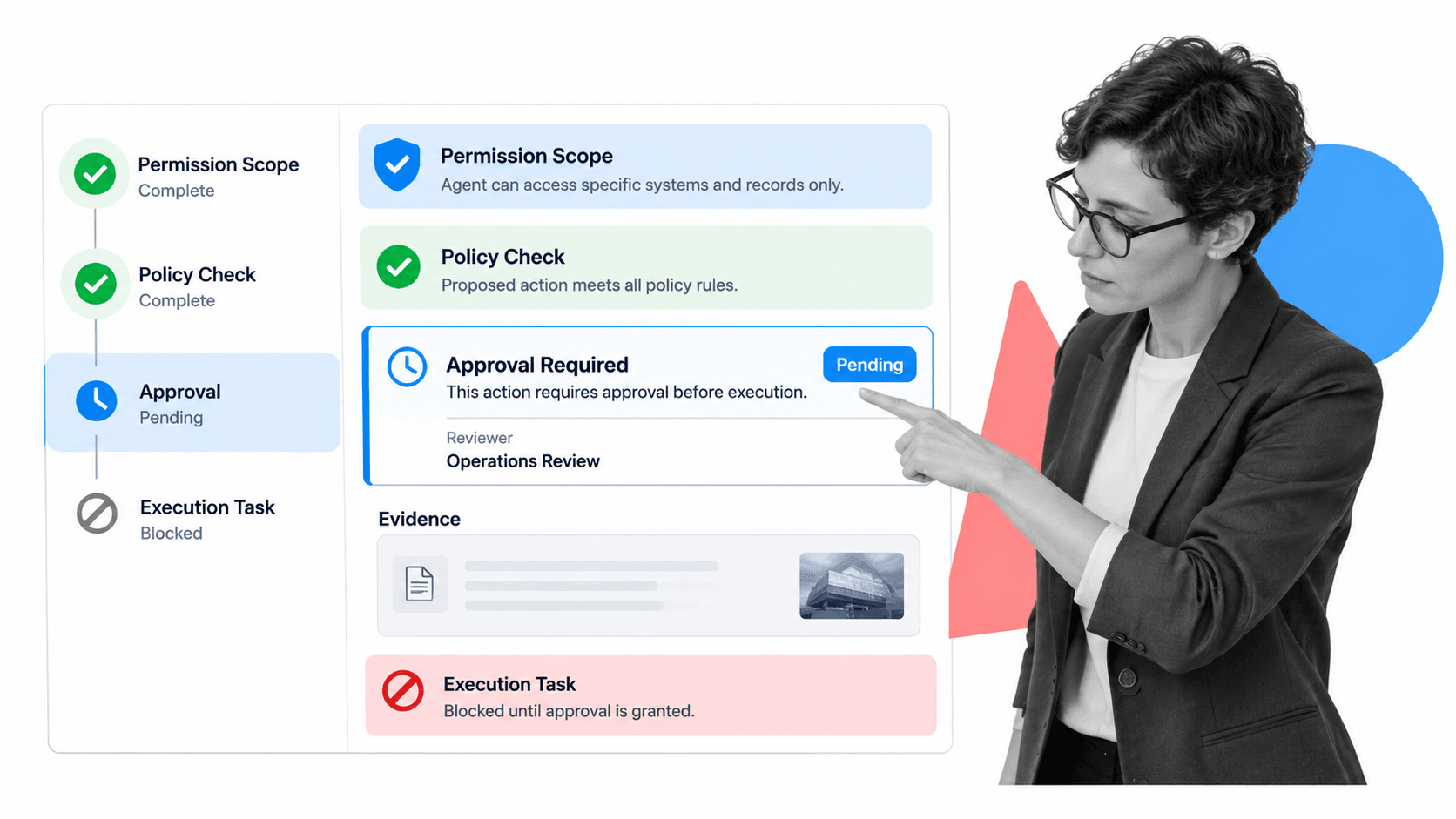
Process Street enforces AI agent guardrails by putting the agent inside an executable business process. Permission scope, policy checks, approvals, stop conditions, evidence, exception routes, and action history become required parts of the workflow rather than suggestions in a prompt.
Controls happen before execution
A workflow can collect the request, classify risk, verify prerequisites, check scope, and pause at an approval task before the agent reaches the write action. Conditional paths send different risk tiers through different controls, while stop conditions prevent downstream tasks from opening too early.
This is a practical answer to the problem that agents do not improvise well: the process supplies the stable structure, and the agent handles the bounded reasoning inside it.
Reviewers see the action in context
The reviewer can see the proposed target, supporting evidence, policy result, and expected consequence in the same run. Approval is attached to the exact action. Rejections and changes route back through the process instead of disappearing into a side conversation.
Execution creates its own proof
Required fields, files, comments, approvals, task completion, exceptions, and results remain attached to the workflow run. This creates a reviewable record of what the control required and what actually happened.
Guardrails can improve without losing the standard
Teams can review exceptions, sample completed runs, update risk rules, and expand coverage while keeping one controlled operating model. AI agent orchestration remains connected to ownership and evidence instead of becoming an invisible chain of background calls.
Start with one high-consequence workflow and one clear owner. Use a vendor risk assessment checklist when the agent depends on external providers, then add the exact controls, evidence, and approval points the action requires.
FAQs
What are AI agent guardrails?
AI agent guardrails are enforceable controls that limit what an autonomous system can access, decide, and do. They include identity, permissions, input checks, policy rules, approval gates, tool restrictions, output validation, monitoring, and recovery procedures.
What types of guardrails do AI agents need?
Most agents need layered guardrails for identity, data access, permissions, inputs, business rules, human approval, tool execution, outputs, logging, and incident response. The strength of each layer should match the consequence, reversibility, sensitivity, and autonomy of the action.
Are prompt instructions enough to guardrail an AI agent?
No. Prompt instructions can guide behavior, but the model also processes untrusted content and can misinterpret or be redirected by it. High-value boundaries should be enforced outside the model through scoped permissions, deterministic checks, constrained tools, workflow gates, and human approval.
When should an AI agent require human approval?
Require human approval when an action has high consequences, is difficult to reverse, affects sensitive data or access, communicates externally, moves money, changes a regulated record, or falls outside familiar patterns. The approval should apply to the exact proposed action and occur before execution.
How do you test AI agent guardrails?
Test allowed, denied, boundary, and adversarial scenarios across the full action path. Include prompt injection, poisoned context, malformed tool output, missing approvals, permission expansion, duplicate requests, unavailable controls, and rollback, then verify the real system state and evidence record.
How does Process Street enforce AI agent guardrails?
Process Street places permission checks, policy tasks, approvals, stop conditions, exception routes, evidence, and execution history inside an executable workflow. The agent can perform bounded work, while the process controls when consequential actions may proceed and preserves proof of each decision.