Turn every policy into automated workflows with built-in enforcement and audit-ready proof.



AI Agent Orchestration
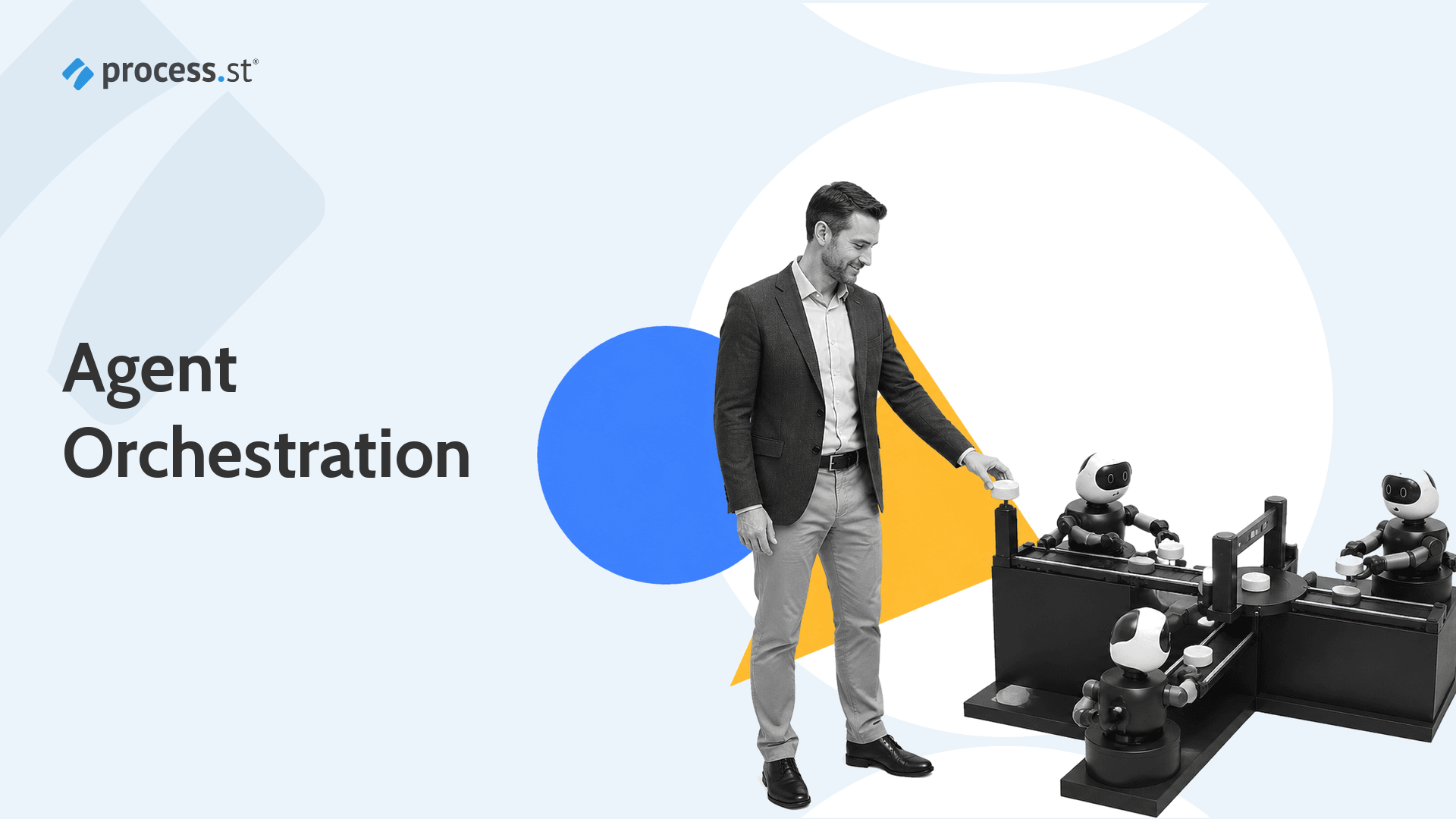
AI agent orchestration is the discipline of coordinating multiple AI agents so they can work toward a shared goal without losing context, skipping controls, duplicating work, or taking unsafe actions. It is the management layer that decides which agent acts, when it acts, what tools it can use, what evidence it must produce, and when a human must approve the next step.
That matters because a single AI agent can be useful, but a group of agents can become chaotic fast. One agent plans, another researches, another executes, another checks, and another reports. Without orchestration, those handoffs are just a pile of prompts. With orchestration, they become a governed workflow.
This guide explains what AI agent orchestration is, why it matters, how it works, which patterns teams use, what controls belong in the orchestration layer, and how to start without giving autonomous systems more authority than the business can govern.
In this article, we are going to cover:
- What is AI agent orchestration?
- Why AI agent orchestration matters
- How AI agent orchestration works
- AI agent orchestration patterns
- Core components of an orchestration layer
- Governance and risk controls for AI agent orchestration
- How to start with AI agent orchestration
- How Process Street governs AI agent orchestration
- FAQs
What is AI agent orchestration?
AI agent orchestration coordinates specialized agents inside one operating system for work. IBM overview of AI agent orchestration defines it as coordinating multiple specialized AI agents in a unified system to achieve shared objectives. GitHub guide to AI agent orchestration describes it as a control layer for execution, context, and collaboration across autonomous agents.
The core idea is simple: one agent should not own every task. A planner agent can break down the request, a specialist agent can gather or transform information, a checker agent can evaluate the output, and a workflow system can route the result to a human when the stakes are high. That is different from a broad AI agents definition because the focus is the coordination layer, not just the agent.
AI orchestration versus AI agent orchestration
AI orchestration can coordinate models, prompts, data sources, tools, and workflow steps. AI agent orchestration is narrower and more operational: it coordinates agents that can reason, choose tools, hand off work, and adapt inside defined limits.
That makes it a practical branch of agentic AI. Agentic systems need more than prompts. They need state, roles, routing, policy, permissions, monitoring, and a record of what happened.
The orchestrator is the control surface
The orchestrator does not have to be a single product, model, or agent. It is the control surface that defines how work moves. In a simple setup, that might be a workflow with one agent and one approval step. In a mature setup, it might include a planner, several specialist agents, a checker, a policy engine, workflow automation, and monitoring.
The important point is ownership. The organization needs one place where agent responsibilities, tool access, handoffs, exceptions, and approvals are visible. Otherwise, every agent becomes its own hidden process.
Why AI agent orchestration matters
AI agent orchestration matters when work becomes too complex for one model call, one script, or one human prompt. Business processes often require research, judgment, system updates, approvals, and proof. Those steps need coordination.
It prevents agent sprawl
Agent sprawl happens when teams create isolated agents for separate tasks without a shared operating model. Each agent has its own prompt, permissions, context, and output format. The result is hard to debug and harder to govern.
It preserves context across handoffs
A handoff fails when the next agent receives an output but not the reason behind it. Orchestration keeps the goal, source data, assumptions, policy checks, and prior actions available as work moves across agents.
It turns autonomy into accountable execution
Autonomy is useful only when somebody can explain what happened. A strong orchestration layer records who requested the work, which agent acted, what tool was used, what changed, and which approval gate fired.
Teams working on AI agents with real access need this layer early because tool access changes the risk model. An answer can be corrected. An action can change a record, trigger a message, or create audit exposure.
It separates reliable work from experimental work
Many teams begin agent work as experiments. That is fine for exploration, but production work needs a stronger boundary. Orchestration creates that boundary by deciding which steps are deterministic, which steps can be handled by agents, which steps require a checker, and which steps must stop for human approval.
This separation prevents a common failure mode: using an agent for everything because the demo worked once. The better path is to let agents handle bounded work, then use the workflow to catch uncertainty, policy failures, missing evidence, and risky actions before the output leaves the system.
How AI agent orchestration works
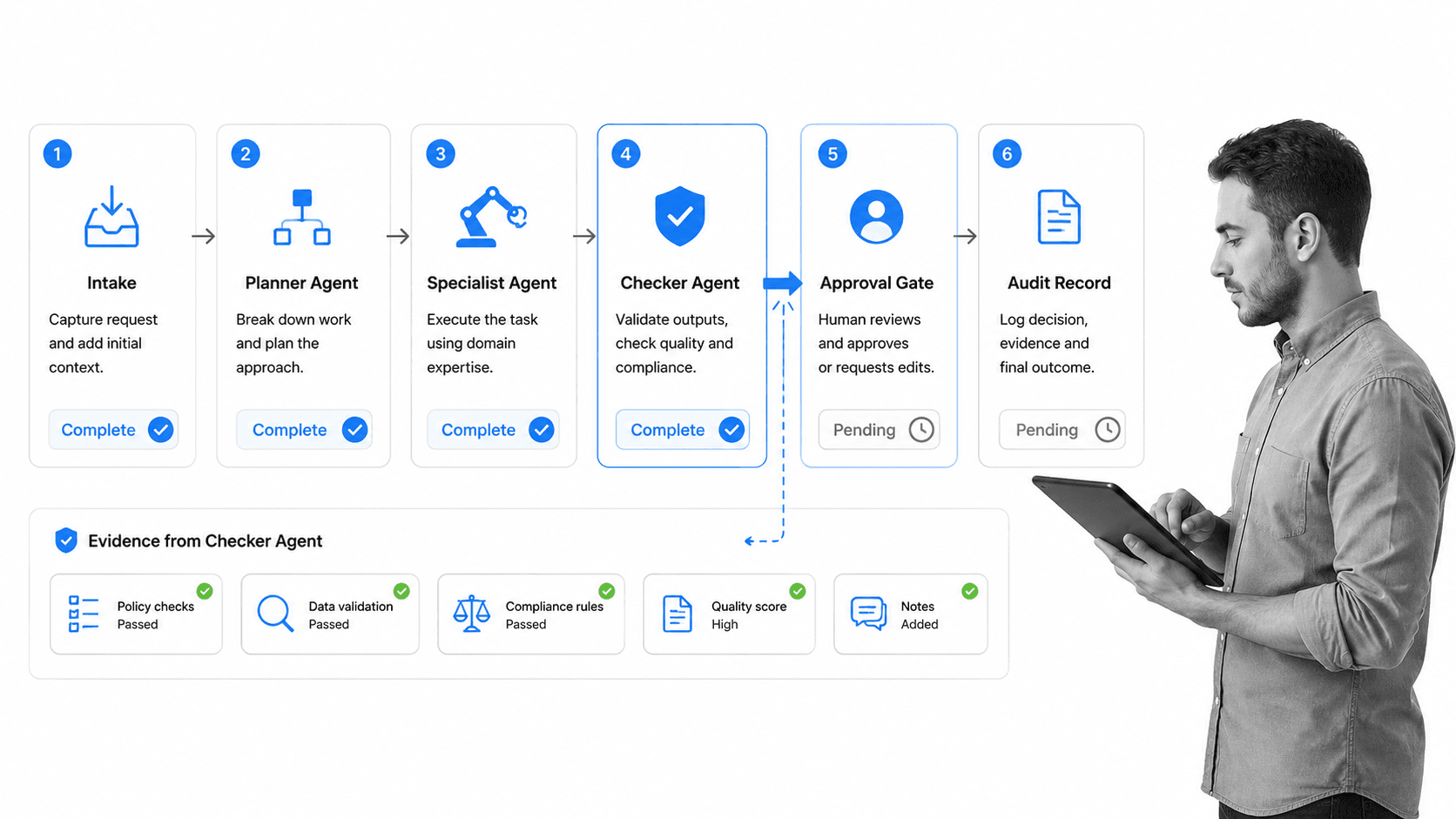
AI agent orchestration works by wrapping agents in a repeatable flow. The orchestrator receives the goal, chooses the right agents or tools, passes context between them, checks outputs, handles exceptions, and records the result.
1. Intake and goal framing
The workflow starts with a goal. Good orchestration translates that goal into a constrained request: what outcome is needed, what systems are allowed, what data is in scope, and what actions require approval.
2. Planning and decomposition
A planner breaks the goal into smaller units of work. It may decide that one agent should retrieve records, another should classify risk, another should draft a recommendation, and another should check the output against a policy.
3. Routing and handoff
Routing sends each step to the right agent, tool, workflow, or human. The handoff must carry more than a result. It should include the goal, context, constraints, evidence, confidence, and next decision point.
4. Tool use and action
Agents become operational when they use tools. Standards such as Model Context Protocol documentation matter because agents need consistent ways to reach external data, tools, and workflows without brittle one-off wiring.
5. Checking and escalation
The checker may be another agent, a deterministic rule, a human approver, or a combination of all three. The point is to stop low-confidence or high-impact work before it becomes a business action.
6. Evidence and audit history
The orchestration layer should preserve inputs, outputs, approvals, tool calls, workflow steps, comments, and final status. That record is what separates governed execution from untraceable automation.
7. Retry and failure handling
Agents will hit bad inputs, unavailable systems, contradictory context, and incomplete outputs. Orchestration should define what happens next. Some failures can retry. Some should route to another agent. Some should create an exception task. Some should stop until a human reviews the case.
This matters because silent retries can hide risk. A governed workflow records the retry path and shows whether the final result came from the first attempt, a corrected attempt, or a human override.
AI agent orchestration patterns
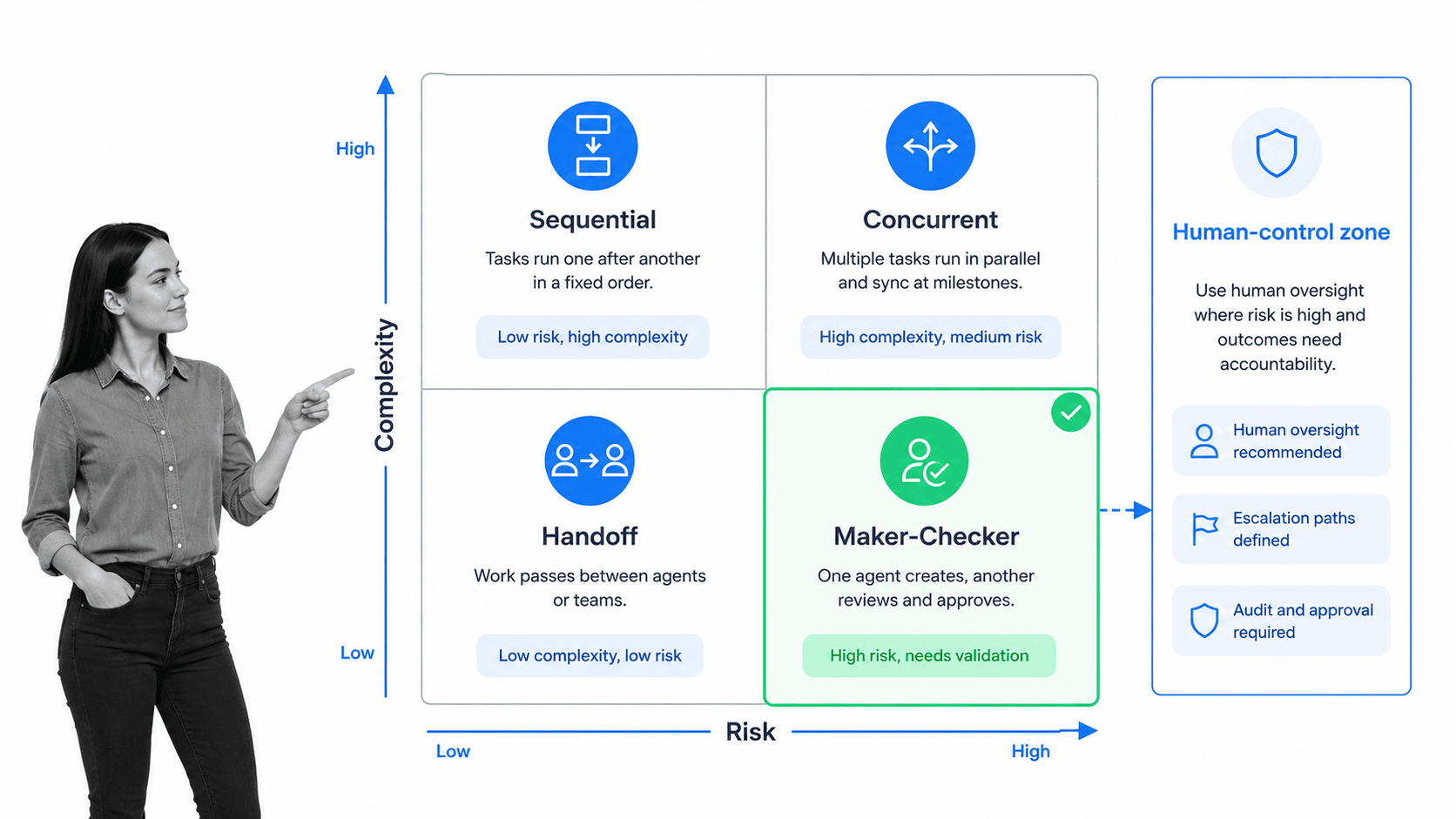
Microsoft AI agent orchestration patterns describes several multi-agent orchestration patterns. The right pattern depends on workflow complexity, risk, latency, cost, and the need for human review.
Sequential orchestration
Sequential orchestration moves work through agents in a fixed order. It fits processes where each output becomes the next input, such as intake, classification, recommendation, approval, and record update.
Concurrent orchestration
Concurrent orchestration sends work to multiple agents in parallel. It fits research, evidence gathering, or analysis tasks where independent outputs can be merged later. It needs careful conflict handling because parallel agents can disagree.
Handoff orchestration
Handoff orchestration routes work to the agent best suited for the next step. It is useful when different specialists own different domains, but it requires a strong context package so progress does not reset at every transfer.
Maker-checker orchestration
Maker-checker orchestration separates creation from review. One agent proposes an output and another evaluates it against criteria. This pattern is useful for compliance, risk, finance, legal, quality, and customer-impacting work.
Human-in-the-loop orchestration
Human-in-the-loop orchestration pauses agent work for judgment, approval, or exception handling. It is not a weakness in the system. It is how teams keep autonomy inside acceptable business boundaries.
Core components of an orchestration layer
An AI agent orchestration layer is not just a prompt chain. It is a set of operational components that make autonomous work reliable enough for business use.
Roles and responsibilities
Each agent needs a role. Planner, researcher, operator, reviewer, approver, monitor, and reporter are different jobs. Clear roles reduce duplicated work and make failures easier to diagnose.
Shared state and memory
Agents need shared state for the current task and durable records for the business process. Short-term state helps agents coordinate the work. Durable state gives the organization an auditable history.
Tool registry and permissions
The orchestration layer should define which tools each agent can use. Read access, write access, send access, deletion rights, and approval authority should be separated. A research agent does not need the same authority as an execution agent.
Policy and guardrails
Guardrails should be operational, not just advisory. They define blocked actions, approval thresholds, evidence requirements, confidence limits, and escalation rules.
Monitoring and observability
Teams need to see agent activity at the workflow level: steps completed, exceptions, retries, approvals, tool failures, unresolved handoffs, and work waiting on a human.
Templates and reusable workflows
Reusable workflows make orchestration easier to govern. Starting from a concrete process, such as a risk management process template or an internal audit checklist for DORA compliance, helps teams define where autonomy belongs and where approval should stay human.
Cost and rate controls
Agent orchestration should also manage cost and rate limits. Multi-agent systems can multiply model calls, tool calls, retries, and external API usage. Without limits, a small request can become expensive or noisy.
Set budgets for each workflow, cap retries, log tool usage, and define when a task should stop instead of continuing. Cost control is a governance feature because it keeps autonomous work predictable.
Governance and risk controls for AI agent orchestration
The risk in AI agent orchestration comes from coordinated action. One agent can make a mistake. Several agents can compound that mistake across systems unless the workflow catches it.
Access control
Give each agent the minimum access required for its role. Separate discovery, drafting, updating, sending, approving, and deleting. Escalate authority only after the workflow proves the agent can complete lower-risk tasks reliably.
Approval gates
Approval gates should sit before external communication, regulated decisions, financial actions, customer-impacting updates, data deletion, access changes, and high-risk exceptions. Approvals is the product pattern that keeps those approvals inside the work itself.
Evidence requirements
Every meaningful action should attach proof. That might be the source record, the policy used, the reviewer note, the tool result, the uploaded file, or the final approval.
Security and misuse
The OWASP Top 10 for Agentic Applications 2026 is useful because it treats agentic systems as applications that can plan, act, and affect real workflows. That shifts governance from model safety alone to operational control.
Compliance operations
Agent orchestration belongs inside compliance operations, not beside it. AI-driven compliance, digital compliance officer, and compliance management software all depend on knowing what happened, who approved it, and where evidence lives.
How to start with AI agent orchestration
The safest way to start is not to build a giant multi-agent system. Start with one workflow where the process is known, the data is accessible, the risk is bounded, and the human approval points are obvious.
Pick one repeatable process
Choose a process with repeated cases, clear inputs, and measurable outputs. Vendor review, onboarding, evidence collection, incident triage, renewal checks, and policy acknowledgments are better starting points than vague strategy work.
Map the agent roles
Name the roles before choosing tools. Planner, data collector, classifier, drafter, checker, and approver should not be one undifferentiated prompt. Role clarity is what makes orchestration testable.
Define the handoff packet
Every handoff should include the goal, context, source links, confidence, output, known gaps, policy checks, and requested next action. Without a handoff packet, the next agent guesses.
Add controls before adding autonomy
Define permissions, blocked actions, approval gates, exception paths, and evidence requirements before expanding tool access. Controls are easier to design before a workflow is live.
Measure the run
Track completion time, retries, exceptions, approvals, false positives, false negatives, unresolved handoffs, and manual rework. Orchestration is not a one-time setup. It improves when the workflow shows where agents need better context or tighter boundaries.
Expand only after the workflow proves itself
After the first workflow is stable, expand in one direction at a time. Add another agent, another tool, another approval path, or another workflow, but do not add all of them at once. Controlled expansion keeps the source of improvement or failure visible.
A useful maturity path is narrow execution first, then broader tool access, then multi-agent handoffs, then cross-system orchestration. Each stage should have evidence that the previous stage works under normal cases and exceptions.
How Process Street governs AI agent orchestration
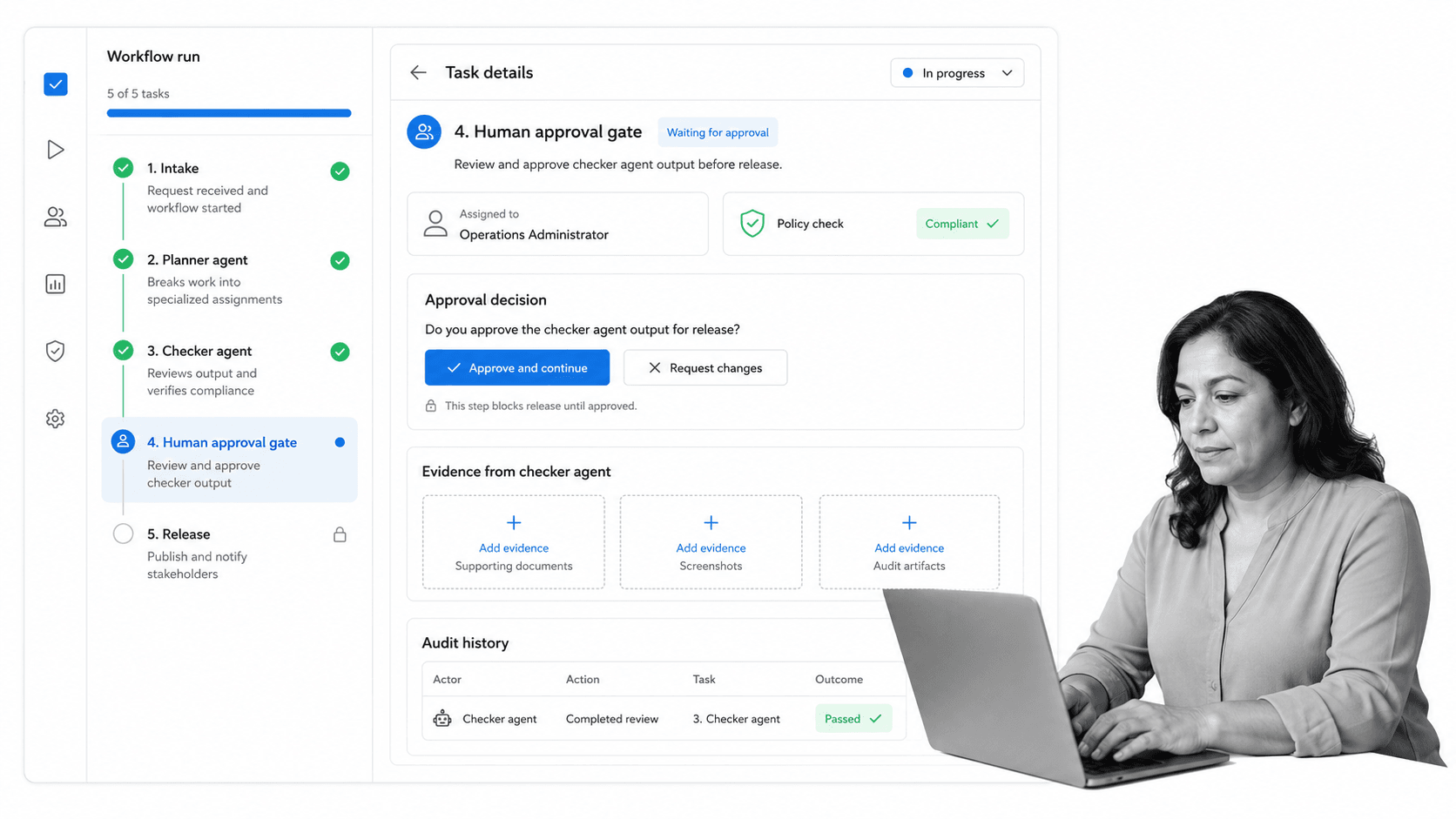
Process Street gives AI agent orchestration a governed workflow environment. Agents can be assigned work, routed through steps, paused for approval, connected to systems, and measured through task history.
That matters because the safest AI agent orchestration is not a free-floating chat layer. It is a workflow where every agent action has an owner, a permission boundary, an evidence trail, and a visible status.
Give agents a workflow spine
A workflow tells agents what good execution looks like. It defines the intake, task order, required evidence, owner, approval path, exception route, and completion criteria.
Use approvals for sensitive handoffs
Maker-checker and human approval patterns are easier to run when the approval is part of the workflow, not a side conversation. Sensitive outputs can pause until a human signs off.
Connect the systems where work happens
Process Street has direct, universal integrations to 5,000+ systems. Need a new one? An AI agent builds it on the fly. That lets orchestrated work connect to records, messages, files, forms, and approvals across the stack.
Create proof by default
AI-agent work should produce proof as it happens. Process Street records tasks, owners, comments, due dates, evidence, approvals, and completion history, so agent work can be inspected after the fact.
Features such as Workflow Run Links help turn a request into a governed run instead of a one-off prompt. For teams standardizing procedures, standard operating procedure software gives agents the process structure they need before they act.
FAQs
What is AI agent orchestration?
AI agent orchestration is the coordination layer that routes work across multiple AI agents. It manages roles, context, tool access, handoffs, approvals, evidence, and audit history so agents can work together safely.
How does AI agent orchestration work?
It starts with a goal, breaks the work into agent roles, routes tasks between agents, passes shared context, checks outputs, escalates exceptions, and records what happened. Strong orchestration adds permission limits and human approval gates.
What are common AI agent orchestration patterns?
Common patterns include sequential orchestration, concurrent orchestration, handoff orchestration, maker-checker review, and human-in-the-loop approval. The right pattern depends on complexity, risk, latency, and how much judgment the work requires.
What is the difference between AI orchestration and AI agent orchestration?
AI orchestration can coordinate models, prompts, tools, and workflow steps. AI agent orchestration focuses specifically on coordinating autonomous or semi-autonomous agents that can reason, use tools, collaborate, and adapt inside boundaries.
When should humans approve AI agent work?
Humans should approve agent work before external messages, regulated decisions, financial actions, access changes, customer-impacting updates, data deletion, and any low-confidence or high-risk exception. Approval gates keep autonomy inside acceptable business limits.
How does Process Street govern AI agent orchestration?
Process Street governs AI agent orchestration by placing agent work inside structured workflows. Teams can assign tasks, route handoffs, require approvals, collect evidence, connect systems, and preserve audit history while agents help move work forward.