Turn every policy into automated workflows with built-in enforcement and audit-ready proof.



Agentic Process Automation
Agentic process automation uses AI agents inside a defined business process. The agent can interpret context, choose an action, and adapt when work changes. The process supplies the rules, permissions, approvals, exception paths, and evidence that keep execution controlled.
That combination matters because AI agents and traditional automation solve different parts of the problem. Agents handle judgment and variation. Workflows keep the required path, accountable owners, and control points stable. Together, they can move complex work forward without turning every exception into a manual rescue.
This guide explains the operating model, how it differs from RPA and workflow automation, where human oversight belongs, which use cases fit, and how to evaluate a platform for high-stakes work.
In this article, we are going to cover:
- What is agentic process automation?
- Why this automation model matters
- How agentic process automation works
- APA vs RPA and workflow automation
- Governed autonomy for high-stakes work
- High-value APA use cases
- How to implement APA
- How to evaluate an APA platform
- How Process Street applies APA
- FAQs
What is agentic process automation?
APA is an approach to business automation in which AI agents reason and act within a governed process. Instead of receiving one isolated prompt, the agent receives a goal, structured context, available tools, boundaries, and a defined place in the workflow. The process decides when the agent can proceed, when a person must review the work, and what evidence must be retained.
The term describes an emerging category, not a formal standard. The original ProAgent research framed it as a move beyond repetitive robotic automation toward agents that help construct and execute workflows. Current category guides from Salesforce and Box also emphasize reasoning, orchestration, context, and action across multistep work.
Agents provide contextual judgment
Traditional rules work when every meaningful condition can be predicted in advance. An agent can examine unstructured inputs, compare them with policy and process context, select a next action, and prepare or execute work. That makes agentic automation useful when requests vary, documents need interpretation, or exceptions cannot be reduced to a simple decision tree.
Processes provide structure and accountability
An agent still needs an operating model. A workflow defines the sequence, owners, inputs, decisions, dependencies, deadlines, and completion conditions. In APA, the workflow is the control layer around the agent. It prevents the system from treating every task as an open-ended problem.
Governance happens during execution
Governance is not a report added after the agent acts. It is the permissions, approval gates, stop conditions, exception routes, evidence requirements, and review history built into the process. The goal is bounded autonomy: let the agent act where policy allows it, pause where judgment carries material consequences, and preserve a record either way.
Why this automation model matters
This model matters because many business processes are too variable for rigid scripts and too important for uncontrolled agents. Customer requests arrive in different forms. Vendor evidence is incomplete. Policy exceptions need judgment. Systems fail. People change priorities. A useful automation system has to handle that variation without losing the controls that make the outcome trustworthy.
Rigid automation breaks at the exception
A deterministic automated workflow can move predictable work quickly. The problem appears when the input does not match the expected format or the next step depends on context. The automation stops, takes the wrong branch, or sends the case to a person with too little information. Agent reasoning can interpret the exception and prepare a better next step.
Unstructured autonomy creates control gaps
A standalone agent may produce a good answer while still following the wrong process. It can use the wrong data, act outside its authority, skip a reviewer, or fail to preserve evidence. Those are process failures, even when the model response looks impressive. APA makes the required operating path explicit.
High-stakes teams need both speed and proof
When an error can create compliance exposure, customer harm, financial loss, or security risk, the team needs more than faster task completion. It needs AI governance connected to the actual work. The system should show what the agent received, what it did, which control applied, who approved the result, and how an exception was resolved.
How agentic process automation works
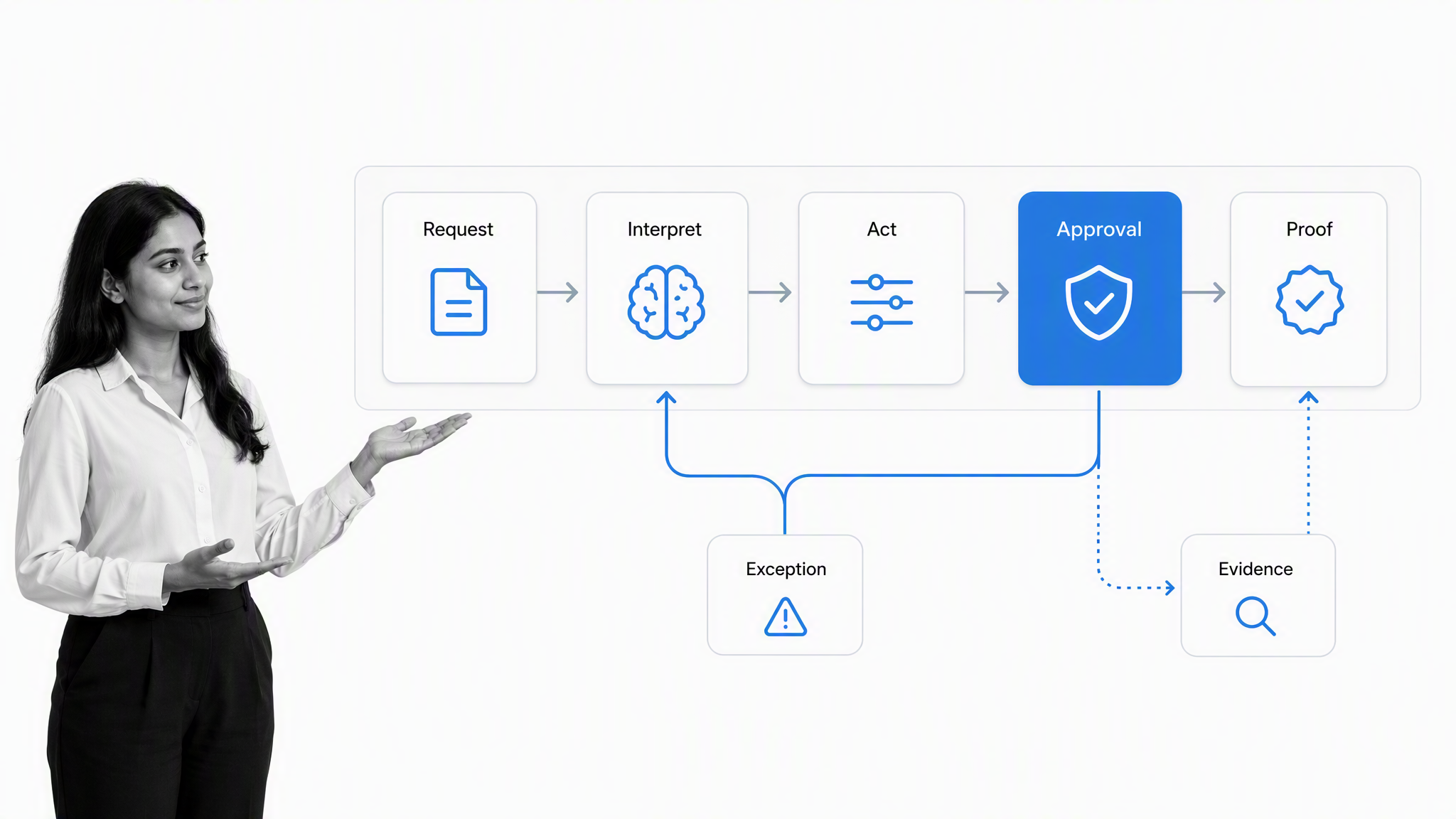
The operating model combines a stable process with flexible agent actions. The exact design varies by use case, but the same loop appears repeatedly: receive the request, interpret the context, choose and perform an allowed action, route consequential decisions to a person, handle exceptions, and preserve proof.
1. A trigger starts a governed process
The process starts from a form submission, system event, schedule, incoming document, message, or human request. Structured intake captures the goal, requestor, business context, risk factors, and required outcome. The trigger should start the correct process, not simply wake an agent with no boundaries.
2. The agent receives context and a bounded task
The agent receives the information required for one stage of the process: the request, relevant policy, prior decisions, permitted tools, required output, and constraints. Narrow tasks are easier to test and govern than broad instructions such as handling the entire case. Context should be relevant, current, and traceable to an approved source.
3. Reasoning selects the next allowed action
The agent interprets the situation and selects from actions the process permits. It might classify a request, extract evidence, compare a submission with policy, prepare a response, update a record, or recommend a route. The process limits the action space so reasoning happens inside an operational boundary.
4. Controls decide whether work can advance
Rules can route low-risk work automatically and hold consequential actions behind approval tasks. A stop condition can pause incomplete work. Permissions restrict who can see or change sensitive information. Conditional logic can send exceptions down a different path without rebuilding the entire workflow.
5. Actions move across people and systems
Once the required control passes, the workflow assigns a human task, updates a connected application, creates a record, sends a message, starts another workflow, or advances the case. The important design choice is that the action remains part of the process record rather than disappearing into a separate automation layer.
6. Evidence closes the loop
The completed run should retain the input, output, decision, approver, exception, and result needed for operational review. That record supports audits, incident analysis, coaching, and process improvement. It also gives teams the data needed to decide which agent actions can safely receive more autonomy over time.
APA vs RPA and workflow automation
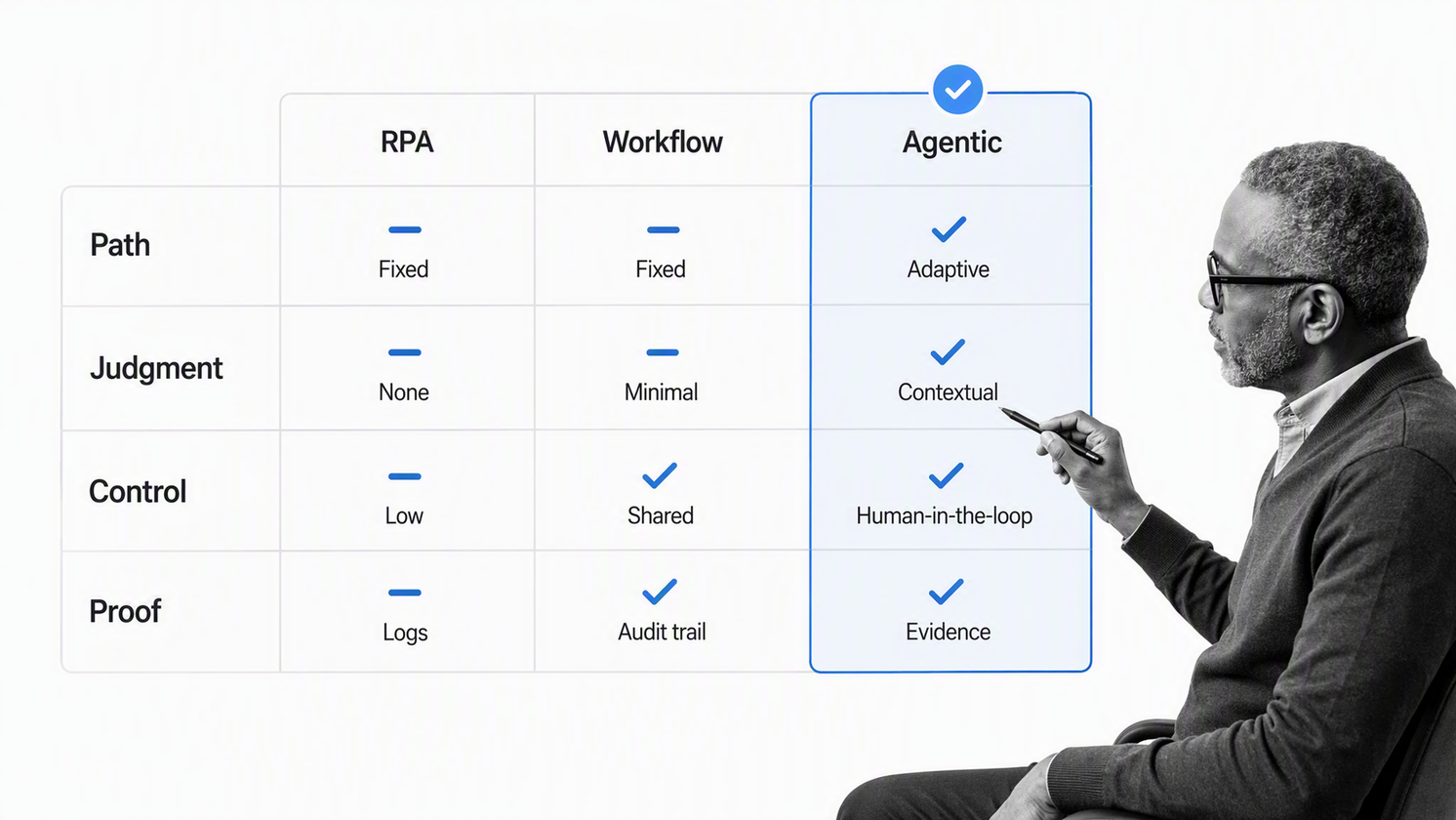
APA does not make RPA or workflow automation obsolete. Each approach fits a different problem shape. Strong operating systems combine them instead of forcing every task through one mechanism.
RPA follows a stable interface
Robotic process automation is strongest when a repetitive task and its interface are stable. A bot can copy data, click through a known sequence, or reconcile structured records. It is efficient when the rules are explicit, but it becomes brittle when layouts, inputs, or decisions change.
Workflow automation follows a designed path
Workflow automation software coordinates tasks, rules, people, deadlines, and system actions across a process designed in advance. It is ideal for required steps, predictable routing, and accountable handoffs. Its limitation appears when the correct route depends on unstructured context that the designer could not enumerate.
Agentic automation interprets changing context
Agentic automation adds reasoning and tool use. The agent can interpret a document, plan a bounded sequence, choose among allowed actions, and revise its approach when the context changes. It still needs a process to define authority, checkpoints, evidence, and the meaning of completion.
The combined model is more useful than a winner
Use deterministic rules for requirements that must not drift. Use workflow orchestration for ownership and sequence. Use agents where judgment or unstructured information makes fixed logic impractical. Use RPA where a stable interface still requires repetitive interaction. The design question is not which technology wins. It is which mechanism should control each step.
Governed autonomy for high-stakes work
Governed autonomy means an agent receives enough freedom to complete useful work and enough constraint to keep risk within an acceptable boundary. That boundary should change with the consequence of the action, the quality of the evidence, and the team’s experience with the use case.
Assist
In assist mode, the agent researches, extracts, summarizes, classifies, or drafts. A person remains responsible for the decision and execution. This is the safest place to start when the process is new, the output is subjective, or the cost of a mistake is high.
Act with approval
The agent prepares a specific action, but the workflow pauses before execution. The reviewer sees the request, evidence, proposed action, and policy context together. They can approve, reject, revise, or route the case. This mode removes busywork without removing accountability.
Act within policy
The agent can execute actions that meet explicit conditions, such as low-risk requests with complete evidence and values inside an approved range. Cases outside the boundary route to a person. The policy should be testable, versioned, and visible to the process owner.
Escalate and stop
A mature design defines what the agent must never guess. Missing evidence, conflicting instructions, unavailable systems, unusual values, and policy ambiguity should trigger an exception or stop condition. A safe system fails into a controlled review path, not into silent improvisation.
The NIST AI Risk Management Framework is useful context for organizing governance around validity, reliability, transparency, accountability, and risk management. The practical implementation still has to happen inside the workflow where decisions and actions occur.
High-value APA use cases
The best use cases combine repeatable process structure with enough variation to benefit from agent judgment. They also have a clear outcome, available evidence, and identifiable control points. Start where the workflow already exists but people spend too much time interpreting inputs, preparing actions, or rescuing exceptions.
Compliance and audit operations
An agent can classify evidence requests, compare submissions with requirements, prepare follow-ups, and assemble review packages. The workflow assigns owners, requires proof, routes exceptions, and holds consequential decisions for approval. A compliance audit checklist gives the operating path a concrete starting point.
Vendor and third-party review
Vendor requests arrive with contracts, security documents, financial information, and business context. An agent can extract facts and prepare a risk summary while the process controls required evidence, legal review, security review, approvals, and remediation. A vendor due diligence checklist makes the exception and approval stages explicit.
Employee onboarding
An onboarding agent can interpret the role, location, start date, and equipment needs, then prepare downstream tasks and system updates. The workflow keeps HR, IT, security, finance, and the hiring manager aligned. A structured employee onboarding checklist prevents personalization from turning into inconsistency.
Incident and exception response
An agent can gather signals, classify severity, draft a timeline, and recommend the next runbook step. The process assigns accountable responders, pauses risky actions, escalates missing evidence, and records decisions. An incident management process is especially valuable because the failure path matters more than a polished happy path.
Controlled change management
An agent can summarize a proposed change, identify affected systems, prepare a risk assessment, and coordinate validation evidence. The process preserves separation of duties, approval, rollback planning, and completion proof. A change management process shows how agent work fits inside accountable change control.
How to implement APA
Implementation should begin with one real process, not a general-purpose agent. A bounded workflow creates the test surface needed to measure reliability, expose exceptions, and decide where autonomy can expand safely.
1. Choose a process with a clear outcome
Pick work that repeats, has an accountable owner, and ends in a verifiable result. Avoid starting with a vague mandate such as improving operations. A useful pilot could approve a vendor, prepare an access review, triage an incident, or assemble an audit evidence package.
2. Map the happy path and the failure path
Document triggers, inputs, owners, decisions, systems, evidence, deadlines, and completion conditions. Then map missing information, rejected approvals, unavailable owners, system failures, and policy conflicts. The exception map is where most of the implementation value lives.
3. Separate fixed controls from agent judgment
Mark the requirements that must remain deterministic: permissions, required evidence, separation of duties, approval thresholds, stop conditions, and retention. Then identify the work that benefits from interpretation: classification, extraction, comparison, summarization, planning, or drafting.
4. Define the agent contract
Specify the goal, approved context sources, available tools, allowed actions, prohibited actions, output format, confidence or validation rules, and escalation triggers. The contract should be understandable to the process owner, not only to the technical team.
5. Test with real variation
Use normal cases, incomplete cases, conflicting inputs, adverse cases, and system failures. Confirm that the agent stays inside its action boundary and that the workflow routes uncertainty correctly. A demo that only succeeds on the ideal case does not prove operational readiness.
6. Measure and expand deliberately
Track cycle time, manual touches, exception rate, approval changes, rework, false escalations, and evidence completeness. Expand autonomy only when the record shows that the agent performs reliably inside the current boundary. When the boundary changes, test it again.
How to evaluate an APA platform
Evaluate an APA platform against one of your actual high-stakes processes. Product tours can hide the gaps that appear when work crosses people, systems, policies, and exceptions.
Can the platform model the whole operating path?
Look for structured intake, roles, tasks, dependencies, deadlines, decisions, approvals, exceptions, integrations, and completion evidence in one model. A workflow management system should make the process understandable before agents are added.
Can autonomy vary by risk?
The platform should support assist, act with approval, and act within policy patterns. One global setting for autonomous or manual work is too blunt. Different actions inside the same process can carry different consequences.
Can you inspect and control agent actions?
Check what context the agent receives, which tools it can use, which actions require approval, how changes are versioned, and what history is retained. The process owner should be able to explain why the action was permitted and who remains accountable.
Does the exception path work end to end?
Ask the vendor to run a rejected approval, missing document, failed integration, ambiguous request, and policy conflict. Confirm that each case pauses or routes correctly, alerts the right owner, and preserves the evidence needed to resolve it.
Can the team improve the process without rebuilding it?
Operators should be able to update instructions, routes, controls, and thresholds as the work changes. APA is an operating system, not a one-time model deployment. The process must remain governable after launch.
How Process Street applies APA
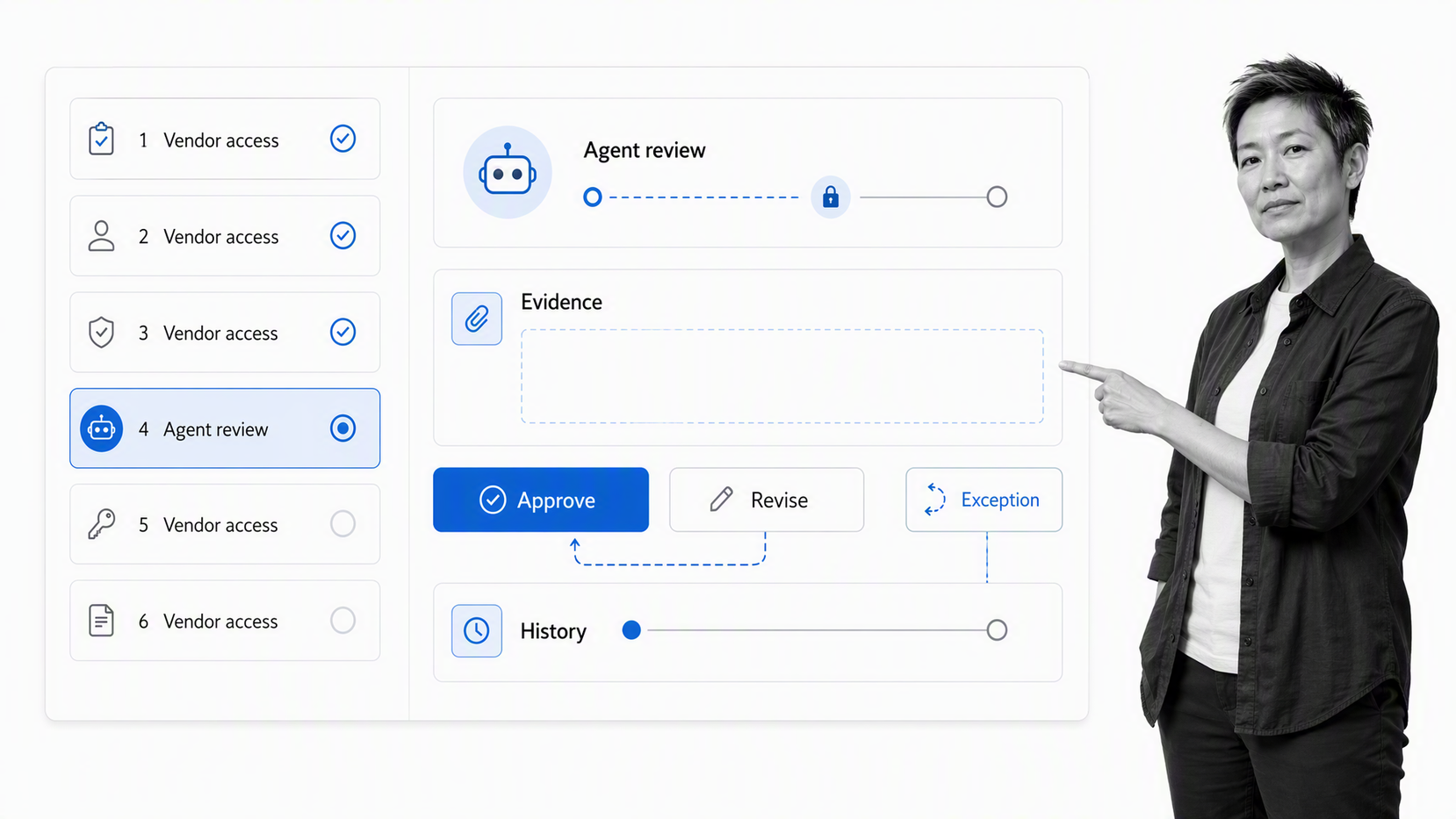
Process Street is the Agentic Process Automation platform for high-stakes operations. It gives people, AI agents, automations, and systems one governed process to follow, with control and proof built into the work.
Start with an executable process
Process Street workflows act as the operating blueprint. Builders can add tasks, AI tasks, headings, approvals, automations, conditional logic, and stop tasks inside one workflow. Each run carries the real request, assigned work, decisions, and evidence through that structure.
Place human control at consequential steps
Approval tasks can support single, multi-stage, or sequential authorization. That lets a process owner hold a consequential agent action for review while lower-risk preparation work continues automatically. Reviewers see the work in the process context instead of approving an isolated message.
Route variation without losing the standard
Conditional logic can reveal different tasks or content based on form data and task completion. The main process remains consistent while risk, location, request type, or decision outcome selects the right path. Exceptions become designed routes rather than side-channel coordination.
Connect execution to the systems around it
Workflow automations can start runs from events and send data into other applications or Process Street workflows. The integration remains connected to the process step, control, and history around it. That keeps system actions from becoming invisible background jobs.
Let execution create proof
Required fields, files, decisions, comments, approvals, and completion history stay attached to the workflow run. This is the bridge between AI-driven compliance and daily operations: the team does not reconstruct the story after the fact because the process captured it while the work happened.
FAQs
What is agentic process automation?
Agentic process automation uses AI agents inside a defined business process. Agents interpret context and take bounded actions, while the process supplies rules, permissions, approvals, exception paths, accountable owners, and evidence.
How is APA different from RPA?
RPA is strongest when a repetitive task and interface are stable. APA is designed for work where inputs, exceptions, or next steps change, so an AI agent must interpret context while a governed workflow controls its actions.
How is APA different from workflow automation?
Workflow automation follows routes and rules designed in advance. APA adds AI judgment for steps that cannot be predicted line by line, while keeping deterministic controls for requirements that must not drift.
What are the main components of APA?
The main components are a defined process, structured context, one or more AI agents, permitted tools, workflow orchestration, permissions, approval gates, exception routes, stop conditions, and an execution record. The exact mix depends on the risk and variability of the use case.
Why does APA need human oversight?
Some actions carry consequences that should remain accountable to a person. Human oversight is most useful at policy exceptions, material financial decisions, access changes, external commitments, and any step where the evidence is incomplete or ambiguous.
How do you implement APA?
Start with one repeatable process and map its happy path, exceptions, controls, owners, evidence, and systems. Give the agent a bounded task, test real variation, measure results, and expand autonomy only when the process record shows reliable performance.