Turn every policy into automated workflows with built-in enforcement and audit-ready proof.


Healthcare Assistant
A healthcare assistant supports patients with personal care, comfort, mobility, observations, and everyday activities while working under the direction of qualified clinical staff. The exact title and permitted duties vary by country, employer, setting, training, and local law, but the role is consistently close to the patient and central to reliable care.
Healthcare assistants are often the people who notice the first small change: a patient is eating less, moving differently, becoming confused, reporting new pain, or struggling with a routine activity. Their work is not simply a list of errands. It combines compassionate support with careful observation, timely reporting, infection prevention, safe handling, documentation, and accountable handoffs.
This guide explains what healthcare assistants do, where they work, how scope and supervision operate, which skills matter, what a typical shift looks like, and how healthcare organizations can support the role with clear workflows without replacing human judgment.
In this article, we are going to cover:
- What is a healthcare assistant?
- Healthcare assistant responsibilities
- Where healthcare assistants work
- Healthcare assistant scope and supervision
- Skills every healthcare assistant needs
- A healthcare assistant shift, step by step
- Healthcare assistant safety and documentation
- How to become a healthcare assistant
- Support healthcare assistants with Process Street
- FAQs
What is a healthcare assistant?
A healthcare assistant is a frontline support worker who helps people receive safe, dignified, and coordinated care. The NHS healthcare assistant role profile describes the role across settings such as hospitals, community care, general practice, mental-health services, and maternity services. Titles can include healthcare support worker, care assistant, patient care assistant, nursing assistant, or nursing aide, and those titles are not perfectly interchangeable across jurisdictions.
The role supports, rather than replaces, regulated clinicians
A healthcare assistant usually works within a defined plan and reports to a nurse or another qualified professional. The assistant may complete delegated activities, but the delegating clinician and organization remain responsible for deciding what can be assigned, what supervision is required, and what changes must be escalated. A clear boundary protects patients and gives the assistant confidence about when to stop and ask.
Direct care and operational reliability meet in one role
The human side of the role includes comfort, privacy, respect, reassurance, and practical help. The operational side includes following the correct healthcare process, using equipment safely, recording observations, replenishing supplies, and completing handoffs. Patients experience both sides as one healthcare service. Kindness without reliability creates risk, while reliability without dignity creates poor care.
Job titles do not define the complete scope
Two people with the same title may have different duties because their training, competency assessment, patient population, and workplace differ. A hospital ward, clinic, home-care service, and residential facility each create a different mix of tasks and risks. The job description, local policy, supervision plan, and demonstrated competence must agree.
Healthcare assistant responsibilities
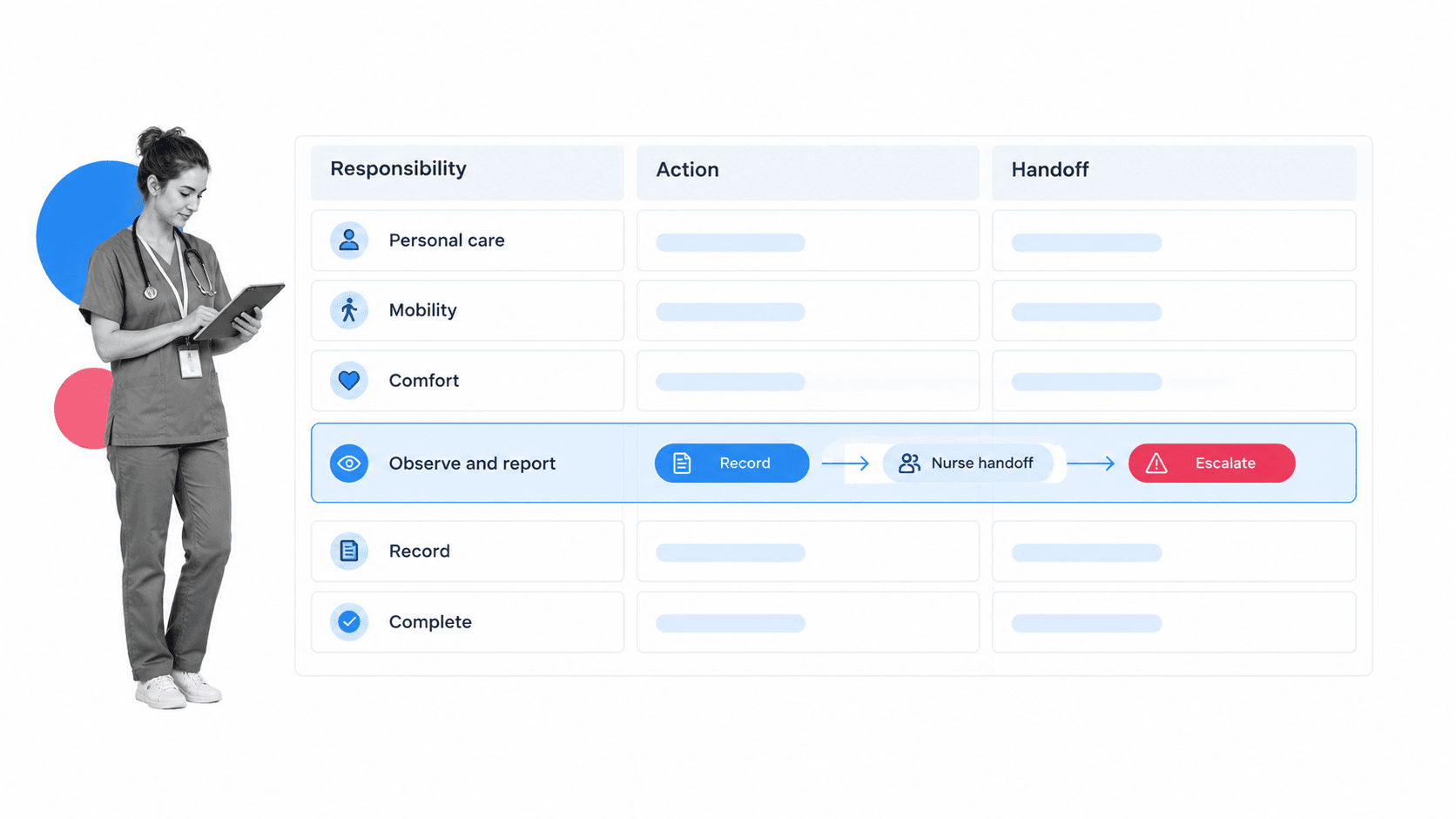
Healthcare assistant responsibilities usually combine direct support, observation, communication, and practical upkeep. The National Careers Service healthcare assistant profile notes that nursing assistants commonly help with activities of daily living, record concerns, measure vital signs as directed, assist with meals, and support transfers. The exact mix depends on the setting and authorized scope.
Personal care and dignity
Assistants may help with washing, dressing, toileting, grooming, oral care, eating, drinking, positioning, and continence support. These are intimate activities. Explain what will happen, protect privacy, seek consent within the care plan, encourage the person to do what they can safely do, and avoid turning efficiency into rushing.
Mobility and comfort
Mobility support can include repositioning, transferring, walking, using wheelchairs or mobility aids, and reducing discomfort. The correct technique depends on the person’s condition, the care plan, available equipment, and local moving-and-handling policy. If the situation differs from the plan, pause and get help rather than improvising.
Observation and reporting
Healthcare assistants spend sustained time close to patients, which makes observation a core responsibility. The O*NET nursing assistant task profile includes monitoring health status, recording vital signs when directed, documenting symptoms, and reporting changes to nursing staff. A useful report is specific: what changed, when it changed, what the patient said, what was observed, what action was taken, and who received the handoff.
Nutrition, hydration, and elimination
Supporting meals and fluids involves more than delivering a tray. Check the care plan, dietary restrictions, swallowing guidance, required assistance, intake recording, and escalation criteria. Changes in appetite, fluid intake, output, nausea, coughing, fatigue, or alertness can matter and should be reported through the agreed path.
Environment, equipment, and supplies
Assistants may prepare spaces, clean or replace permitted equipment, change linens, stock supplies, and help keep care areas safe. These tasks support clinical care directly. Missing equipment, an unsafe room, an empty supply location, or an unclean surface can delay care or expose patients and workers to avoidable risk.
Where healthcare assistants work
Healthcare assistants work across the healthcare system, and the setting changes the rhythm of the role. The National Careers Service healthcare assistant profile describes work in hospitals, patients’ homes, care homes, and hospices. Each environment needs a local role description and a suitable supervision model.
Hospitals and inpatient wards
On a ward, assistants may support several patients across a shift, respond to call systems, help with personal care, take delegated observations, prepare for transfers, accompany patients, restock care areas, and report changes. A structured patient hospital admission form can keep identity, communication, mobility, and immediate care needs visible when admissions change the workload.
Clinics and outpatient services
In outpatient care, assistants may prepare rooms, welcome patients, support intake, collect permitted measurements or specimens, chaperone procedures, turn over equipment, and coordinate the next step. A clear patient intake checklist can prevent missing consent, allergy, communication, or readiness information before the clinician begins.
Home and community care
Home-care assistants work in a person’s own environment, often with less immediate access to colleagues. They need clear visit instructions, lone-worker controls, communication channels, escalation rules, and boundaries around family requests. The plan must account for the real home environment rather than assuming the controlled conditions of a facility.
Residential and long-term care
In long-term care, assistants may support the same people over an extended period and notice gradual changes in mobility, cognition, mood, appetite, skin, sleep, or behavior. Familiarity is valuable, but it must not replace objective recording and escalation when a change matters.
Specialist services
Mental-health, learning-disability, maternity, rehabilitation, hospice, and pediatric services require additional role-specific preparation. Communication, safeguarding, behavioral support, family involvement, observation, equipment, and escalation expectations should reflect the population and service.
Healthcare assistant scope and supervision
Scope defines the activities a healthcare assistant is authorized and competent to perform. Supervision defines how a qualified person directs, supports, observes, reviews, and remains available for that work. Both need to be explicit because a task that is routine in one service may be restricted in another.
Start with authorization and competence
Before assigning an activity, confirm that it is allowed by law, employer policy, the role description, and the patient’s care plan. Then confirm that the individual has received suitable training and has demonstrated competence. Attendance at training is not the same as being able to perform safely in the real setting.
Match supervision to risk
Some tasks may be completed after direction with a supervisor available nearby. Others require direct observation, a second person, or completion by a licensed clinician. Risk changes with the patient’s condition, the assistant’s experience, the environment, the equipment, and whether the situation is familiar or changing.
Use clear escalation triggers
The safest instruction is not simply ‘tell someone if worried.’ Define what must be reported immediately, what can wait for the next routine handoff, which person or role receives the report, what to do if that person is unavailable, and how the report is documented. The assistant should never be left to decide alone whether a concerning change is important enough.
Protect the right to pause
Assistants need permission to stop when a task feels unsafe, exceeds scope, conflicts with the plan, lacks equipment, or requires help. A culture that rewards silent improvisation will eventually turn a preventable gap into harm. A pause followed by the correct escalation is successful process execution.
Keep medication work inside the authorized boundary
An assistant may be asked to collect or confirm information that supports a medication reconciliation process, but collecting information is not the same as making a clinical medication decision. The workflow should identify which steps the assistant may complete and where a pharmacist, nurse, or prescriber must review and decide.
Skills every healthcare assistant needs
Technical routines matter, but strong healthcare assistants also rely on communication, attention, empathy, judgment, and physical awareness. These skills allow a person to follow the plan while recognizing when the real situation no longer matches it.
Observation
Notice changes in appearance, breathing, mobility, skin, alertness, speech, appetite, mood, pain behavior, and ability to complete ordinary activities. Observation is not diagnosis. Its value comes from noticing, recording, and promptly passing useful information to the person qualified to interpret it.
Communication
Listen without interrupting, use plain language, check understanding, and adapt to hearing, language, cognitive, emotional, or communication needs. When reporting to colleagues, separate what the patient said from what you observed and what you did.
Compassion and boundaries
Compassion means responding to discomfort and distress with respect. Professional boundaries keep that relationship safe. Do not promise outcomes outside your control, share private information casually, accept inappropriate responsibility, or hide a concern because a patient asks you not to tell the care team.
Team coordination
Care crosses roles. Assistants need to know the current plan, which tasks are assigned, what has changed, and who owns the next decision. A reliable healthcare workflow reduces duplicate work and prevents observations from disappearing between busy people.
Self-management
The role can be physically and emotionally demanding. Safe practice includes using equipment correctly, asking for assistance, taking required breaks, reporting injury or exposure, debriefing difficult events, and recognizing when fatigue or distress could affect performance.
A healthcare assistant shift, step by step
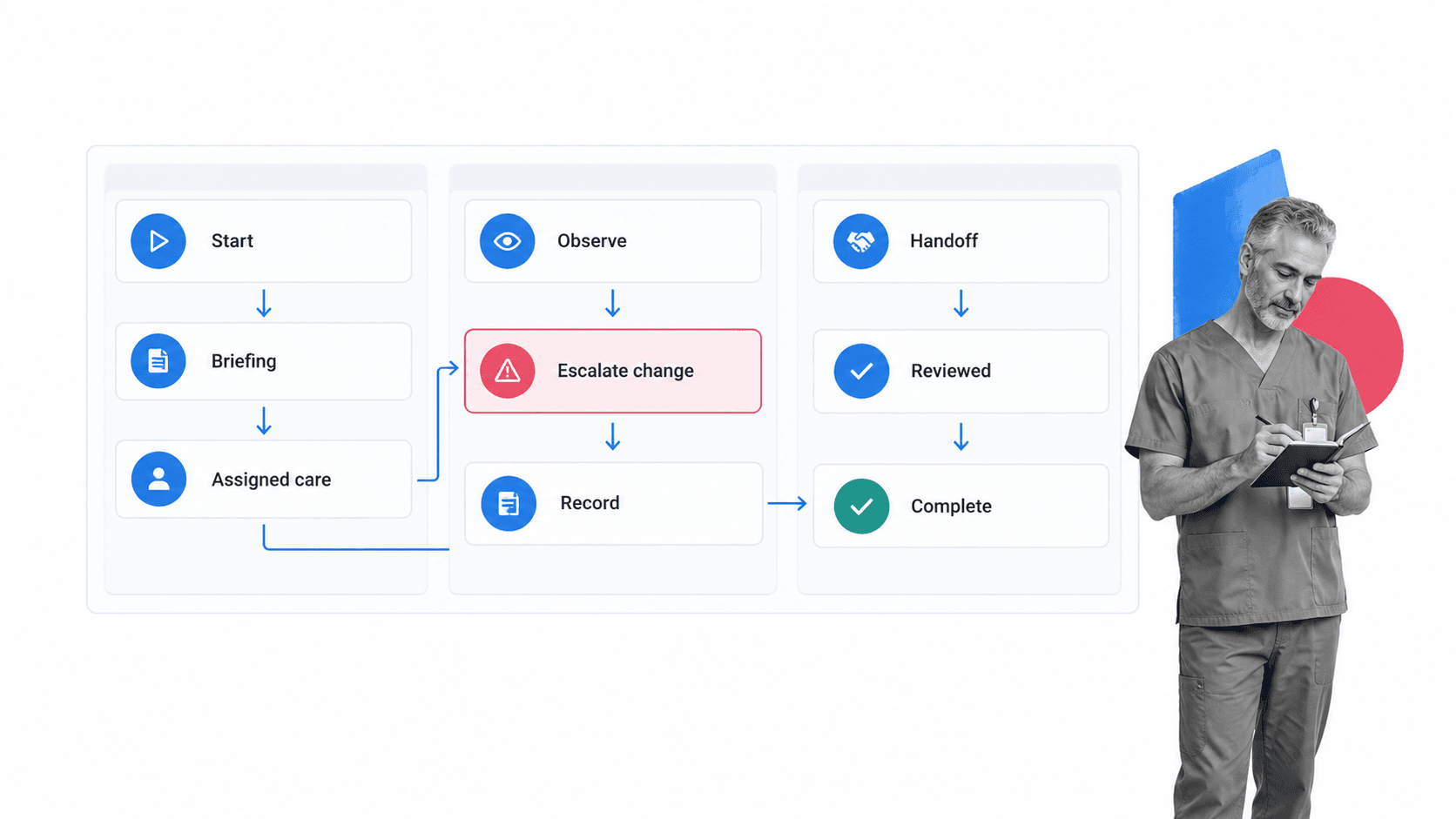
No two shifts are identical, but a dependable shift follows a recognizable loop: receive a clear briefing, confirm assigned care, prepare safely, support patients, observe changes, escalate concerns, document work, and hand over unresolved needs.
1. Receive the briefing
Review assigned patients, care priorities, mobility needs, communication needs, infection precautions, nutrition plans, observation schedules, current risks, and unresolved actions. A structured nurse shift change report should highlight changes and exceptions, not bury them in a narrative that nobody can scan under pressure.
2. Confirm the plan and resources
Check that you understand each delegated activity and know where to get help. Gather permitted equipment and supplies, confirm that they are ready to use, and resolve missing items before beginning a task that cannot be safely interrupted.
3. Deliver assigned care
Introduce yourself, confirm the person and the planned activity, explain what you are doing, protect privacy, and support independence. Follow the care plan and local procedure. If the patient declines, the situation changes, or the task cannot be completed safely, record and escalate rather than forcing completion.
4. Observe and respond
Pay attention throughout the activity. A change may appear during conversation, movement, eating, personal care, or routine measurement. Address immediate safety, remain with the person when necessary, and follow the escalation route. Do not wait until the end of the shift to report a time-sensitive concern.
5. Record and close the task
Document the care given, relevant observations, exceptions, patient response, and any report made. Use objective language and approved terms. Completion should mean the care was delivered or the exception was managed, not merely that a checkbox was selected.
6. Hand over outstanding work
Before leaving, confirm which issues remain open, who accepted responsibility, what follow-up is expected, and where the record can be found. A handoff is complete when the receiving person understands and owns the next action.
Healthcare assistant safety and documentation
Safety and documentation are part of care, not administrative extras. They protect the patient, the assistant, and the wider team by making correct practice repeatable and making important changes visible.
Use Standard Precautions
The WHO Standard Precautions guidance explains that Standard Precautions are the minimum infection-prevention practices for all healthcare workers, patients, settings, and times. They include risk assessment, hand hygiene, risk-based personal protective equipment, respiratory hygiene, safe equipment handling, environmental cleaning, and sharps safety. Local training should translate those principles into the exact tasks and supplies used in the workplace.
Recognize worker hazards
Moving people is a common source of risk for both staff and patients. The HSE moving and handling guidance recommends avoiding hazardous handling where practicable, assessing unavoidable tasks, providing suitable equipment and training, and recording person-specific needs in the care plan. Report injuries, equipment faults, near misses, and unsafe conditions through the required path.
Handle information carefully
Access only the information needed for assigned work and share it through approved channels. The ICO data minimisation guidance explains that personal data should be adequate, relevant, and limited to what is necessary for its purpose. Local privacy rules, confidentiality training, and access controls should govern the exact situation.
Document facts, actions, and handoffs
Good documentation is timely, accurate, objective, attributable, and complete enough for the next person to act. Record what you observed, what the patient reported, what care was provided, what changed, who was informed, and what happened next. Do not diagnose, speculate, copy forward unverified information, or use vague language such as ‘seems fine.’
Use checklists as memory support, not judgment replacement
A medical checklist app can prompt preparation, identity checks, equipment, observations, escalation, and closure evidence. It should make the safe path easier without encouraging staff to continue when the patient, environment, or task falls outside the expected conditions.
How to become a healthcare assistant
There is no single global route into the role. Requirements vary by country, state, employer, care setting, and title. Some roles provide structured workplace training, while regulated nursing assistant roles may require an approved program, competency examination, registry entry, background checks, continuing education, or other credentials.
Read the local role requirements first
The National Careers Service healthcare assistant profile describes several routes in England, including college study, an apprenticeship, and working toward the role, while employers may also require background checks. A healthcare assistant role elsewhere may follow a different route. Start with the relevant regulator, employer, or public career authority rather than assuming one country’s title transfers directly to another.
Build core knowledge
Training often covers person-centered care, communication, safeguarding, infection prevention, moving and handling, privacy, basic observations, nutrition and hydration, emergency response, documentation, and escalation. Governed onboarding management software can connect role onboarding to the exact policies, equipment, and patient population used on the job.
Demonstrate competence in practice
Competence assessment should include observation in the real setting, not only a quiz. The assessor should verify that the assistant prepares correctly, explains the activity, uses equipment safely, recognizes exceptions, documents accurately, and knows when and how to escalate.
Keep learning after onboarding
Refresh training when guidance changes, incidents reveal a gap, new equipment arrives, a service changes, or an individual needs support. Supervisors should review performance evidence and coaching needs. The goal is reliable care, not a folder of completed certificates.
Support healthcare assistants with Process Street
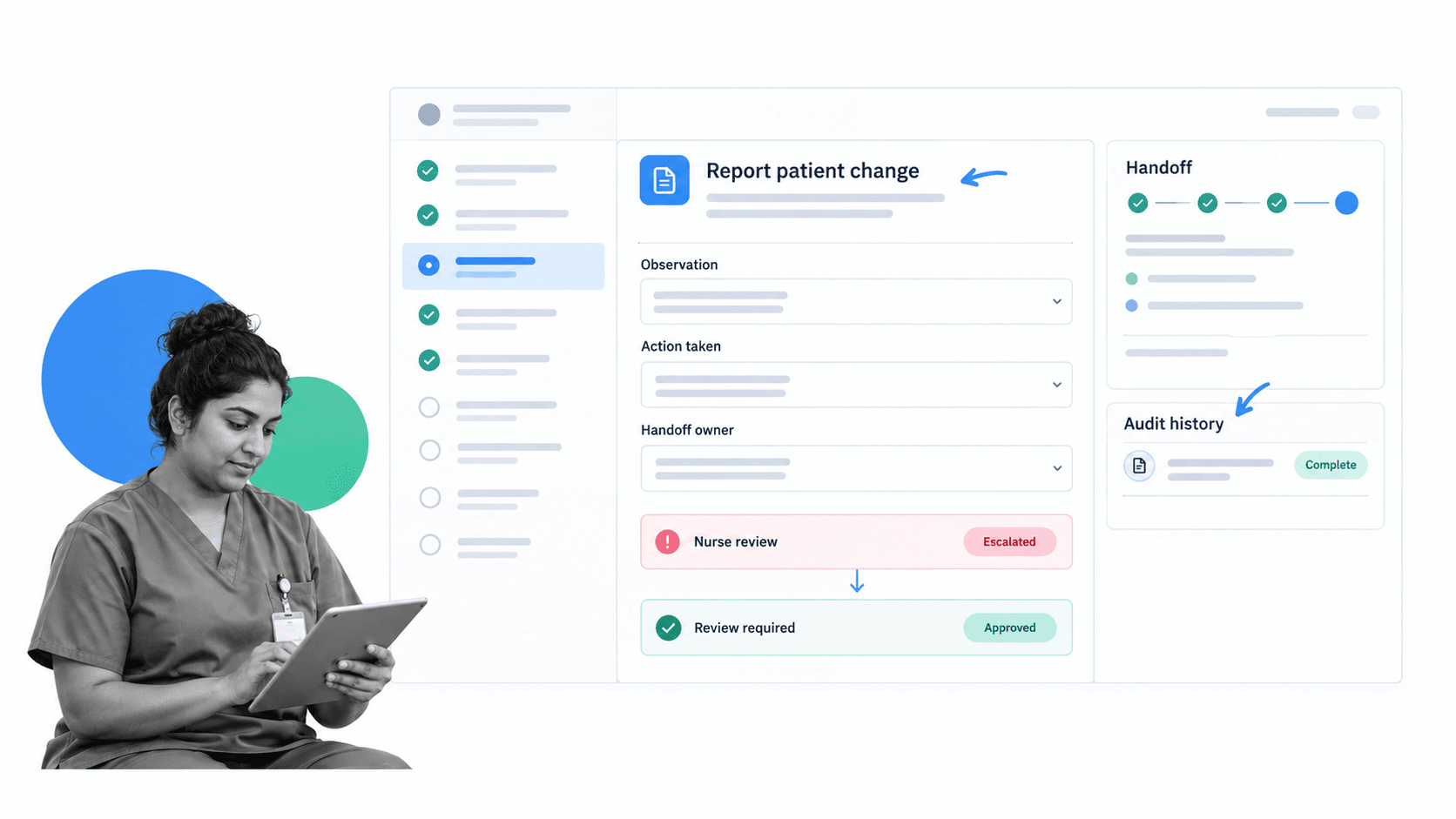
Healthcare teams can use Process Street to turn role standards into assigned workflows. That includes onboarding, competency assessment, shift handoffs, patient-support routines, observation escalation, equipment checks, exposure response, incident follow-up, and periodic policy review.
Make the expected path clear
A workflow can present the correct tasks in order, assign the responsible role, require key observations, and reveal additional steps when risk or context changes. Clear instructions reduce reliance on memory while keeping the assistant focused on the person receiving care.
Route exceptions to qualified judgment
With conditional logic, a concerning observation can add a nurse review, a missing item can trigger escalation, and an irrelevant task can stay hidden. The workflow does not diagnose or decide clinical care. It moves the exception to the person authorized to decide.
Keep approval beside the evidence
Competency signoff, exception closure, incident review, and material process changes may require workflow approvals. The reviewer sees the supporting record and the decision remains attached to the workflow rather than disappearing into a separate message.
Create a usable record
Each workflow run can record assigned tasks, form responses, observations, files, comments, escalations, approvals, and completion status. Leaders can review one event or look across runs to find recurring gaps in training, handoffs, equipment, or workload.
Automate coordination, not compassion
Appropriate healthcare automation can launch recurring checks, notify owners, update connected systems, and route follow-up. The patient-facing conversation, professional judgment, consent, dignity, and human response remain with the care team. Automation should remove preventable coordination friction so assistants have more attention for safe care.
FAQs
What does a healthcare assistant do?
A healthcare assistant supports patients with personal care, comfort, mobility, nutrition, observations, and everyday activities while working within an authorized scope under appropriate clinical direction. Duties vary by setting, training, employer, and local law.
Is a healthcare assistant the same as a nurse?
No. A healthcare assistant supports care and may complete delegated activities, but does not replace the assessment, planning, and regulated responsibilities of a licensed nurse. Titles and boundaries vary by jurisdiction, so the local role description and supervision plan matter.
Where do healthcare assistants work?
Healthcare assistants work in hospitals, clinics, outpatient services, residential care, long-term care, community services, home care, mental-health services, rehabilitation, maternity services, and other care settings. The setting determines the mix of tasks and supervision required.
What skills does a healthcare assistant need?
Important skills include observation, active listening, clear communication, compassion, respect for boundaries, teamwork, safe physical practice, objective documentation, infection prevention, and prompt escalation when a situation changes or exceeds scope.
How do you become a healthcare assistant?
Requirements depend on the country, state, employer, setting, and job title. Check the relevant public career authority, regulator, or employer for education, competency, certification, registry, background-check, and continuing-training requirements.
How can Process Street support healthcare assistant workflows?
Process Street can turn role standards into assigned workflows with required fields, conditional routing, approvals, evidence, escalation, and audit history. It supports coordination and proof while leaving clinical decisions, consent, dignity, and patient-facing care with qualified people.