Turn every policy into automated workflows with built-in enforcement and audit-ready proof.



Process Workflow Tools
Process workflow tools are platforms that take a recurring business process and run it as a controlled sequence of tasks, forms, decisions, approvals, automations, and records. Instead of a process living in someone’s head or a static document, the tool turns it into work that gets assigned, tracked, enforced, and proven.
The distinction that matters is the word process. A process is a repeatable path from a trigger to an outcome: employee onboarding, vendor review, month-end close, incident response, access approval. Process workflow tools exist to make that path start reliably, run the same way each time, and leave evidence behind.
This guide explains what process workflow tools are, why they matter, how they differ from project management and automation apps, which capabilities to weigh, how they work under the hood, and how to choose and implement one without adding another place to update status.
In this article, we are going to cover:
- What process workflow tools are
- Why process workflow tools matter
- Process workflow tools vs. project management, BPM, and automation software
- Core capabilities in process workflow tools
- How process workflow tools work
- Process Street as a process workflow tool
- How to choose and implement process workflow tools
- FAQs
What process workflow tools are
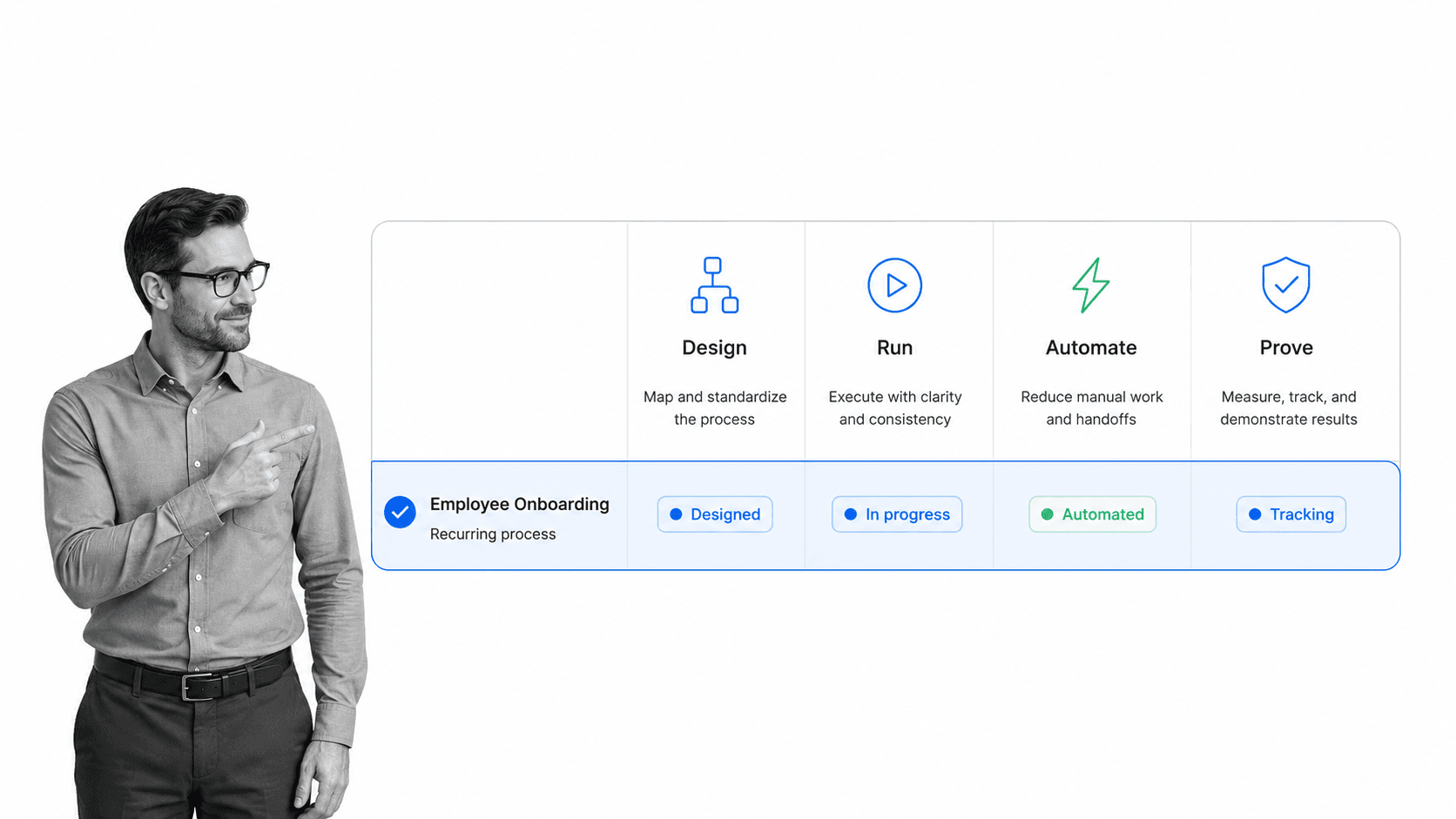
A process workflow tool is any system that helps a team turn a repeatable process into a governed run of work. It sits on top of the raw activity and answers four questions every time the process fires: who does what, in which order, under which conditions, and with what proof. If you already understand what a workflow is, a process workflow tool is the system that makes that workflow operational rather than theoretical.
The category overlaps with several others, so it helps to anchor on function instead of label. Some vendors call themselves workflow software, some call themselves process management platforms, and some call themselves automation tools. What unites the useful ones is that they run a process end to end, not just a slice of it.
The four jobs a process workflow tool must do
A capable tool covers four jobs: design the process, run it, automate parts of it, and prove it happened. Lightweight tools stop after the first two. Stronger tools connect all four so the design, the execution, and the evidence stay in one place.
- Design: capture the process as a reusable template with tasks, owners, instructions, forms, required fields, and decision rules.
- Run: launch instances of the process, assign work, track due dates, route steps, and manage exceptions.
- Automate: trigger actions across connected systems, send notifications, update records, and remove repetitive data entry.
- Prove: capture approvals, evidence, comments, and a full completion history for every run.
That proof layer is what separates a process workflow tool from a shared task board. When a process touches customers, finance, HR, IT, legal, quality, or compliance, finishing the task is not enough. You need a record of how it was finished. This is why compliance as proof of control is a useful lens even for teams that do not think of themselves as compliance-heavy.
A practical definition
A process workflow tool is a system that makes a repeatable process easy to start, hard to skip, simple to improve, and clear enough for a new teammate to run without relying on tribal knowledge. If a tool cannot do all four, it is a task list with extra steps.
Why process workflow tools matter
Process workflow tools matter because growing teams accumulate process debt faster than they expect. Every new hire, market, product line, regulation, and system adds another handoff. Without a workflow layer, teams manage that complexity with memory, and memory does not scale.
When the process lives only in people’s heads, steps get forgotten, managers chase status, documents drift from reality, approvals happen in email, and exceptions become private knowledge. By the time leadership asks what happened, the answer is scattered across chat threads, spreadsheets, and inboxes.
They reduce missed and skipped steps
A process workflow tool gives the team a single path to follow. The process can require fields, enforce order, branch on risk, and name the owner of each step. Recurring work stops depending on whoever remembers the procedure best, which is the person most likely to be on vacation when it matters.
They cut the coordination tax
Workflow tools remove the constant back-and-forth of coordination. Instead of asking whether a step is done, the workflow assigns it. Instead of reminding the next person, it routes to them. Instead of copying a status into another system, it can update the record directly. This is the point at which many teams graduate from process documentation to an execution platform: documentation explains the work, while a process workflow tool actually runs it.
They create operating data
Once processes run in software, leaders can finally see bottlenecks, overdue work, exception rates, approval patterns, and evidence gaps. That operating data is nearly impossible to collect when every process lives in a different spreadsheet or project board. Good tooling turns each run into a data point you can improve against.
Process workflow tools vs. project management, BPM, and automation software
Process workflow tools sit near project management tools, business process management systems, and automation apps. The categories borrow each other’s language, but they solve different operating problems, and buying the wrong one is a common and expensive mistake.
Process workflow tools vs. project management tools
Project management tools shine when work is one-off, milestone-based, and collaborative: a launch, a campaign, a build, an initiative. A workflow management system is stronger when work repeats and the process itself must be followed the same way each time. A product launch may belong in a project tool, while the launch approval checklist, access provisioning, legal review, and customer handoff belong in a process workflow tool.
Process workflow tools vs. BPM software
IBM describes business process management as a discipline for discovering, modeling, analyzing, measuring, and optimizing business processes. BPM suites often center on enterprise process architecture and governance. Process workflow tools live closer to daily execution, where operators complete tasks, attach proof, and route approvals. Many organizations use both ideas together, pairing broad business process management software with frontline workflow execution.
Process workflow tools vs. automation apps
Automation apps connect systems and move data. The Microsoft workflow automation tools guide frames workflow automation as replacing manual, repetitive tasks with rule-based logic. That is valuable, but automation alone does not define an operating standard. A process workflow tool gives automation its context: it shows why the automation fired, which human decision preceded it, what evidence was required, and what state the process entered next. Reach for business process automation tools when the problem is repetitive system-to-system work, and for a process workflow tool when people, decisions, controls, and evidence must stay connected.
Core capabilities in process workflow tools
The right process workflow tool depends on the risk and repeatability of the work. A simple team routine may only need a shared checklist. A regulated process needs stronger controls. These are the capabilities to weigh before you compare vendors.
A no-code process and template builder
A non-technical owner should be able to build a repeatable process with tasks, owners, due dates, forms, instructions, required fields, and decision logic. If every change needs engineering, the process will always lag behind reality. Teams that already do process mapping can usually translate an existing map straight into a builder.
Structured intake with forms
Many processes fail at the first step because intake is incomplete. Strong tools capture structured information up front, validate required fields, and use the submitted details to route the run correctly from the start.
Routing and conditional logic
Conditional routing keeps a process from collapsing into a one-size-fits-all checklist. A low-risk vendor review can follow a standard path while a high-risk one branches to a deeper compliance review. Process Street documents this capability through conditional logic.
Approvals and escalation
Approvals belong inside the process, not in side conversations. Built-in approvals make review states visible and stop work from advancing before the right person has signed off.
Integrations and AI execution
Process work rarely stays inside one app. It touches forms, documents, CRMs, HR systems, finance systems, ticketing tools, databases, and email. A strong process workflow tool connects those systems so your people do not become the integration layer.
Process Street has direct, universal integrations to 5,000+ systems. Need a new one? An AI agent builds it on the fly.
Evidence, history, and reporting
If the process matters, the history matters. Look for completion logs, field history, comments, attachments, approval records, timestamps, and dashboards that surface bottlenecks. The tool should tell you not just whether work is done, but whether it was done correctly.
How process workflow tools work
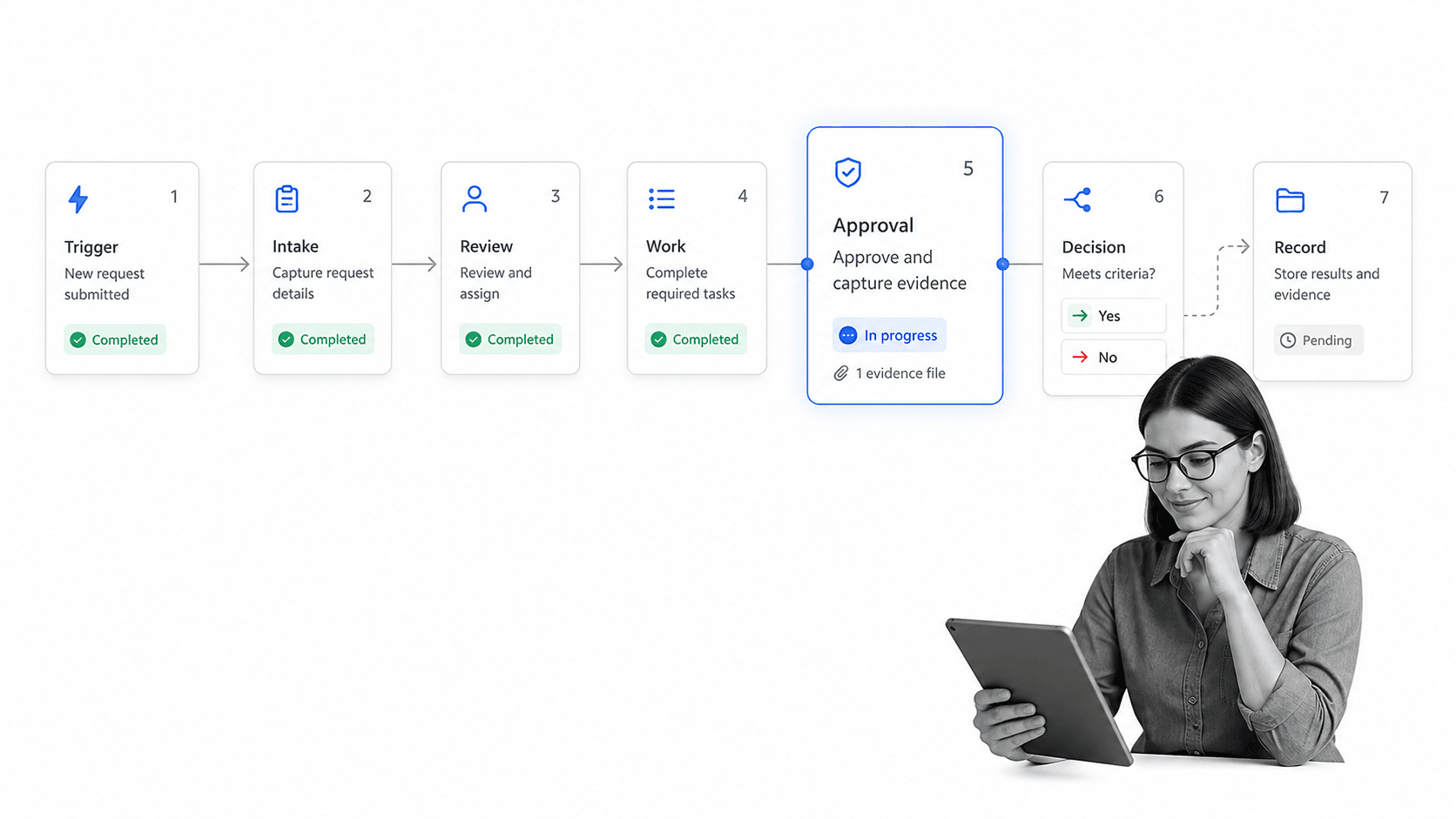
Process workflow tools work by turning a process template into a live run. The template defines the standard. The run captures what actually happened. That split matters because teams need both the designed process and the evidence of each execution.
1. A trigger starts the process
The trigger might be a form submission, a recurring schedule, a manual launch, a customer request, or an event from another system. A good trigger captures enough context to route the run correctly from the very beginning.
2. Tasks are assigned and sequenced
The workflow assigns tasks to the right people or roles and shows dependencies, due dates, instructions, required fields, and files. When a process crosses multiple teams, this sequencing keeps work from stalling in the gap between departments.
3. Logic routes the exceptions
Not every run should follow the same path. Conditional logic adapts the process based on risk level, location, request type, department, customer segment, or any other structured input captured at intake.
4. Automations update connected systems
Automation removes repetitive admin. A run can create a record, send a notification, update a CRM, request a signature, open a ticket, or store a file. Process automation is what makes those actions happen every time without manual copying.
5. Evidence and approvals prove completion
The final job is proof. Required fields, approvals, attachments, comments, and audit history show exactly what happened. That record lets a team answer internal, customer, audit, and leadership questions without reconstructing the process after the fact.
Process Street as a process workflow tool
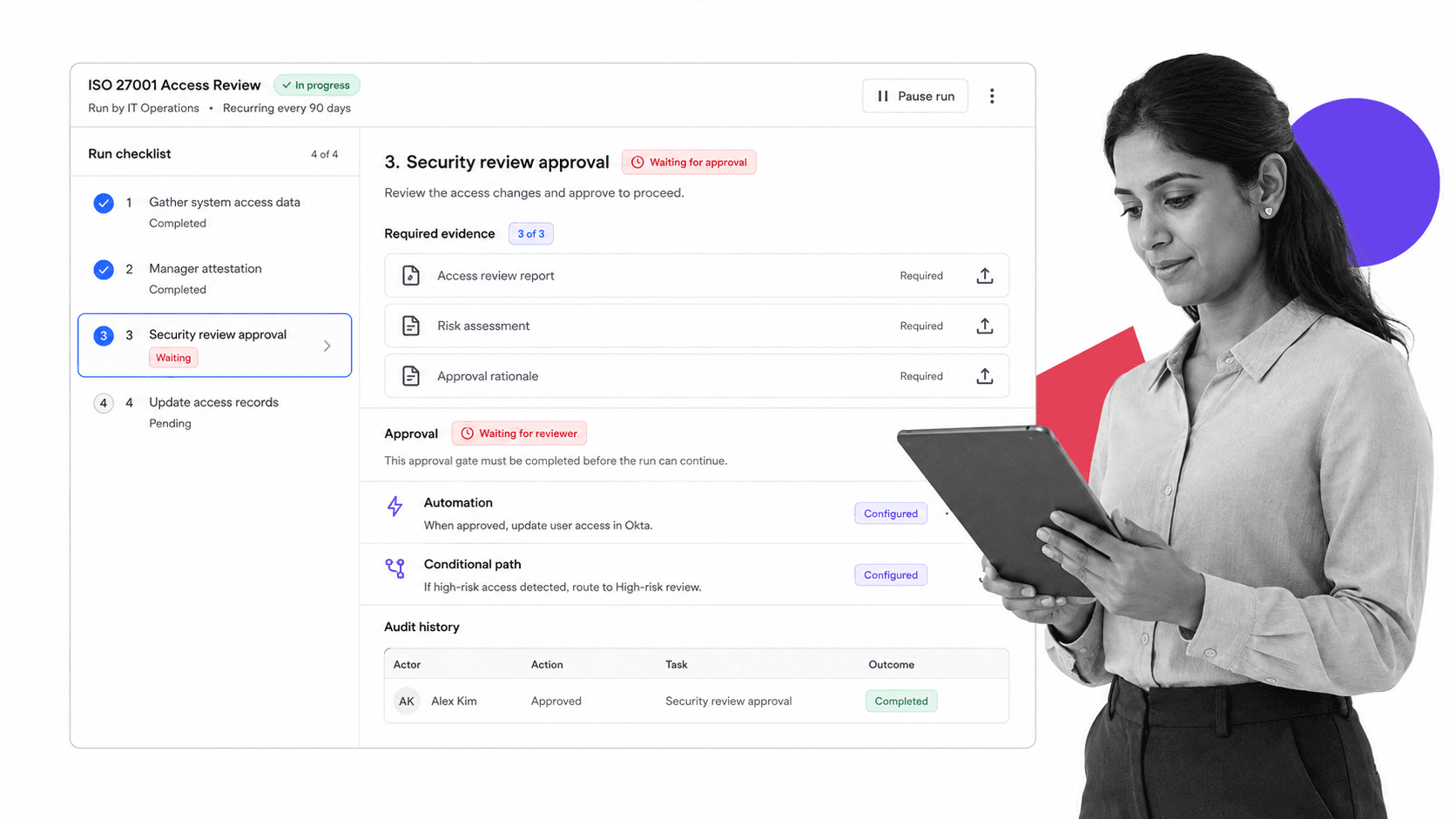
Process Street is a Compliance Operations Platform for teams that need recurring work to run correctly and leave proof behind. It turns SOPs, policies, and operating procedures into workflows with tasks, forms, rules, approvals, automations, and audit-ready history, which makes it a natural fit as a process workflow tool for high-stakes work.
That matters when a process is too important to leave inside a document or a task board. Employee onboarding, vendor reviews, access approvals, customer handoffs, incident response, inspections, audit prep, and policy reviews all benefit from a system that runs the process and captures the record at the same time.
What Process Street handles
- Process templates: reusable designs for recurring work, versioned and easy to update.
- Workflow runs: live execution with owners, due dates, instructions, and required fields.
- Approvals: review steps that keep decisions inside the process instead of in email.
- Conditional logic: branches that adapt each run to its context.
- Automations and integrations: actions across connected systems without manual copying.
- Audit history: a record of who did what, when, and with which supporting evidence.
Teams can start from a workflow management template and adapt it into a governed process that fits their own operating standard, then tighten it over time. Reporting rolls up across runs, so leaders can see where work slows down and where evidence is missing.
Where it fits best
Process Street is strongest when recurring work needs enforcement, not just visibility. If a missed step creates compliance, customer, or operational risk, the workflow should carry the rule, the owner, the due date, and the proof. This is also where AI-driven compliance becomes practical: AI can help monitor, improve, and even execute steps, but it needs structured process context. A controlled workflow gives AI the rails to act safely inside real operations.
How to choose and implement process workflow tools
Choose a process workflow tool by mapping the work before mapping vendors. The fastest way to buy the wrong tool is to start with feature lists before you understand the operating problem you are solving.
Start with process risk
Ask what happens if the process runs late, runs differently, or runs without proof. Low-risk routines may only need a shared checklist. High-risk processes need required fields, approvals, evidence, permissions, and audit history. Risk, not feature count, should drive the shortlist.
Separate planning work from recurring work
Planning work changes shape every time and often belongs in a project tool. Recurring work should become a template. If your team keeps recreating the same intake form, handoff checklist, or approval path, that work belongs in a process workflow tool. Comparing capabilities against workflow management software options is a useful way to pressure-test the shortlist.
Check whether the tool matches your process language
Some teams think in tasks, some in diagrams, and some in controls. If your organization already models processes formally, the OMG BPMN specification is helpful context for how steps, events, and branches are represented. If your team is focused on practical execution, an Atlassian workflow automation guide shows the rule-based language buyers commonly encounter.
Weigh AI oversight
AI changes the selection criteria. A tool that lets AI agents act inside a process needs guardrails, monitoring, and proof. The NIST AI Risk Management Framework is a useful reference when deciding how much oversight an AI-assisted process should require before you trust it with real work.
Pilot one process end to end
Do not pilot on a toy process. Pick one real process with intake, handoffs, at least one exception path, at least one approval, and at least one connected system. A good pilot proves whether the tool can handle the messy parts of the work, not just the happy path. It should also show how quickly a non-technical owner can change the process without help.
Measure proof, not activity
Activity metrics can mislead. A process workflow tool should improve cycle time, reduce missed steps, reduce rework, and make status easier to trust. Track those outcomes alongside your other operations management tools so the workflow layer earns its place. A clean implementation plan names the owner of each process, the source of truth for each field, the decision points that change the route, the proof required before completion, and the systems updated after approval. Write that map first, then configure the workflow, so adoption stays grounded in real work instead of tool enthusiasm.
FAQs
What are process workflow tools?
Process workflow tools are platforms that turn a recurring business process into a controlled run of work. They typically include process templates, task assignments, forms, routing rules, approvals, automations, integrations, and a completion history that shows what happened on every run.
What is the difference between process workflow tools and project management tools?
Project management tools are usually best for one-time initiatives with milestones, timelines, and collaboration. Process workflow tools are built for repeatable processes that must run the same way each time, with consistent execution, rules, approvals, and proof.
Which process workflow tool capabilities matter most?
The most important capabilities are a no-code process builder, structured intake forms, conditional routing, approvals, automations, integrations, evidence capture, audit history, and reporting. When the process carries risk, proof and enforcement matter more than cosmetic task views.
Who needs process workflow tools?
Operations, compliance, HR, finance, IT, customer success, legal, and quality teams tend to need them most. The strongest signal is recurring work that crosses people or systems and becomes painful whenever a step is missed.
How do process workflow tools support compliance?
They support compliance by embedding the rules into the process itself. Required steps, approvals, evidence fields, permissions, and audit history make it far easier to show that the correct process was followed, without reconstructing it later.
How should you choose process workflow tools?
Start by mapping one real process with intake, owners, decisions, exceptions, approvals, connected systems, and proof requirements. Then pick the tool that can run that process end to end with the least manual coordination, and pilot it before you roll it out.