Best SOC 2 Compliance Automation Tools for SMBs
The best SOC 2 compliance automation tools for SMBs reduce manual evidence collection, keep control work on schedule, and give auditors a clean record of what happened. The right choice depends on whether your biggest problem is technical monitoring, day-to-day control execution, expert guidance, or the audit itself.
Small and midsize businesses rarely have a large governance, risk, and compliance team. A useful platform has to make ownership obvious, connect to the systems already in scope, surface gaps early, and keep recurring work moving without creating another administrative job.
This comparison looks at eight SOC 2 compliance tools through that practical SMB lens. It separates evidence automation from operational workflow and auditor support, so you can choose a system that fits the work your team actually needs to run.
In this guide, you will find:
- Best SOC 2 compliance automation tools for SMBs at a glance
- How we evaluated SOC 2 automation software for SMBs
- 1. Process Street
- 2. Vanta
- 3. Drata
- 4. Secureframe
- 5. Sprinto
- 6. Thoropass
- 7. Scytale
- 8. Scrut
- How to choose the right SOC 2 compliance tool
- A practical SOC 2 automation implementation plan
- FAQs
Best SOC 2 compliance automation tools for SMBs at a glance
The short version: Process Street is the strongest choice when your main risk is whether recurring controls, approvals, reviews, and remediation work are actually completed. Vanta, Drata, Secureframe, and Sprinto emphasize automated evidence collection and continuous monitoring. Thoropass connects readiness software with the audit lifecycle, while Scytale and Scrut combine automation with hands-on compliance guidance.
No platform replaces management judgment or an independent CPA firm. The goal is to remove avoidable collection and coordination work while preserving clear control ownership. The AICPA Trust Services Criteria cover security, availability, processing integrity, confidentiality, and privacy, but every company still has to define its own scope and controls.
| Tool | Best for | Standout feature | Pricing |
|---|---|---|---|
| Process Street | Running recurring control work | Assigned workflows, approvals, and execution proof | Custom quote |
| Vanta | Cloud-first automated monitoring | Automated tests and mapped evidence | Personalized pricing |
| Drata | Structured continuous compliance | Control monitoring and evidence reuse | Personalized pricing |
| Secureframe | Guided technical remediation | Infrastructure monitoring and evidence collection | Custom quote |
| Sprinto | First-time startup compliance | Guided program setup and automated checks | Contact sales |
| Thoropass | Readiness plus audit delivery | Integrated auditor collaboration | Contact sales |
| Scytale | Lean teams needing expert help | Automation with dedicated guidance | Book a demo |
| Scrut | Growing risk and compliance programs | Continuous controls and audit projects | Book a demo |
How we evaluated SOC 2 automation software for SMBs
A strong SOC 2 tool does more than display a completion percentage. It should reduce the work required to prove controls, make gaps actionable, and fit the people and systems you already have. The evaluation focused on six questions.
Can it collect evidence from your real stack?
Start with the systems inside your audit boundary: cloud infrastructure, identity, source control, endpoint management, HR, ticketing, and collaboration. A long integration catalog matters less than reliable coverage for the tools you actually use. When a control still needs human evidence, the platform should assign the request and preserve its history.
Does it turn failures into owned work?
A red test is only useful if someone fixes it. Look for named owners, due dates, approvals, escalation, and a durable record of remediation. This is where broader compliance workflow tools for SMBs can complement or outperform a monitoring-only platform.
Can auditors work without email ping-pong?
Auditor access, mapped requests, comments, version history, and controlled sharing reduce duplicate uploads. A clean workspace also helps your team explain exceptions instead of forwarding disconnected screenshots.
- Scope fit: support for your selected criteria, systems, locations, and service boundaries.
- Operational fit: owners, approvals, recurring schedules, and remediation workflows.
- Expertise: useful guidance when a lean team has no full-time compliance specialist.
- Expansion: reuse of controls and evidence when ISO 27001, HIPAA, privacy, or customer requirements arrive later.
- Total cost: software, implementation, audit fees, penetration testing, and the internal time required to operate the program.
1. Process Street
Best for: SMBs that need control work executed consistently, not just monitored.
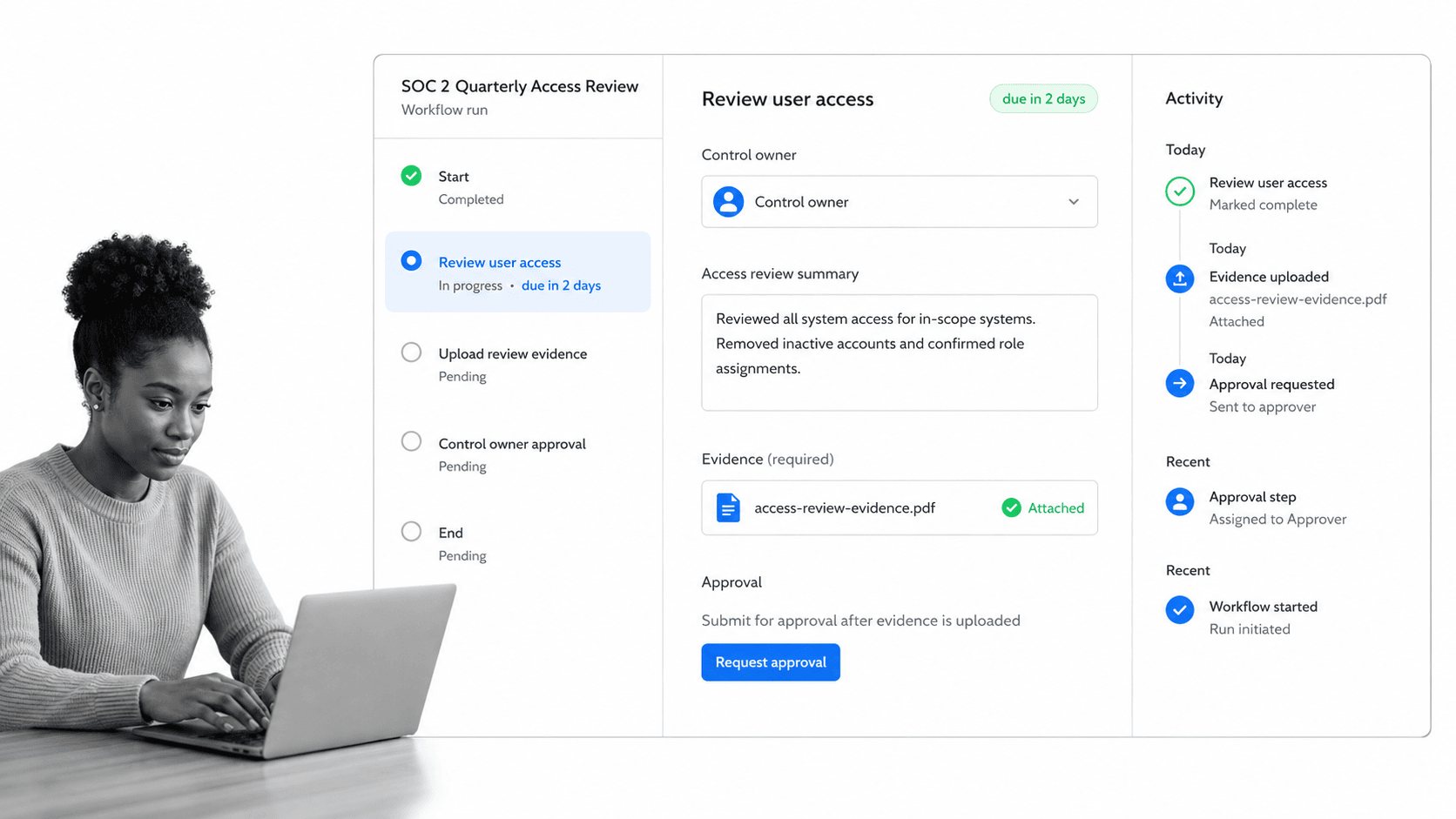
Process Street turns policies and controls into recurring, assigned workflows. A quarterly access review can include the exact systems to inspect, the control owner, required evidence, an approval step, a due date, and a complete activity history. That makes it especially useful when audit risk lives in skipped reviews, inconsistent offboarding, late vendor assessments, or weak remediation follow-through.
The platform is strongest as the execution layer around your SOC 2 program. Teams can run an information security practices workflow, a SOC 2 vendor risk assessment, and an incident response process with ownership and approvals built into each run. The resulting execution record supports audit preparation without relying on memory.
Process Street is also useful beside a dedicated evidence-monitoring product. Automated cloud tests can identify a gap, while Process Street controls the cross-functional remediation work, approvals, and proof. For a wider view of that operating model, see security compliance automation and continuous compliance.
- Choose it when recurring human controls and approvals are your biggest source of risk.
- Use forms, conditional logic, enforced order, assignments, and activity history to standardize evidence-producing work.
- Pricing is custom quoted across Startup, Pro, and Enterprise plans through the Process Street pricing page.
2. Vanta
Best for: cloud-first SMBs that want broad automated evidence collection and continuous tests.
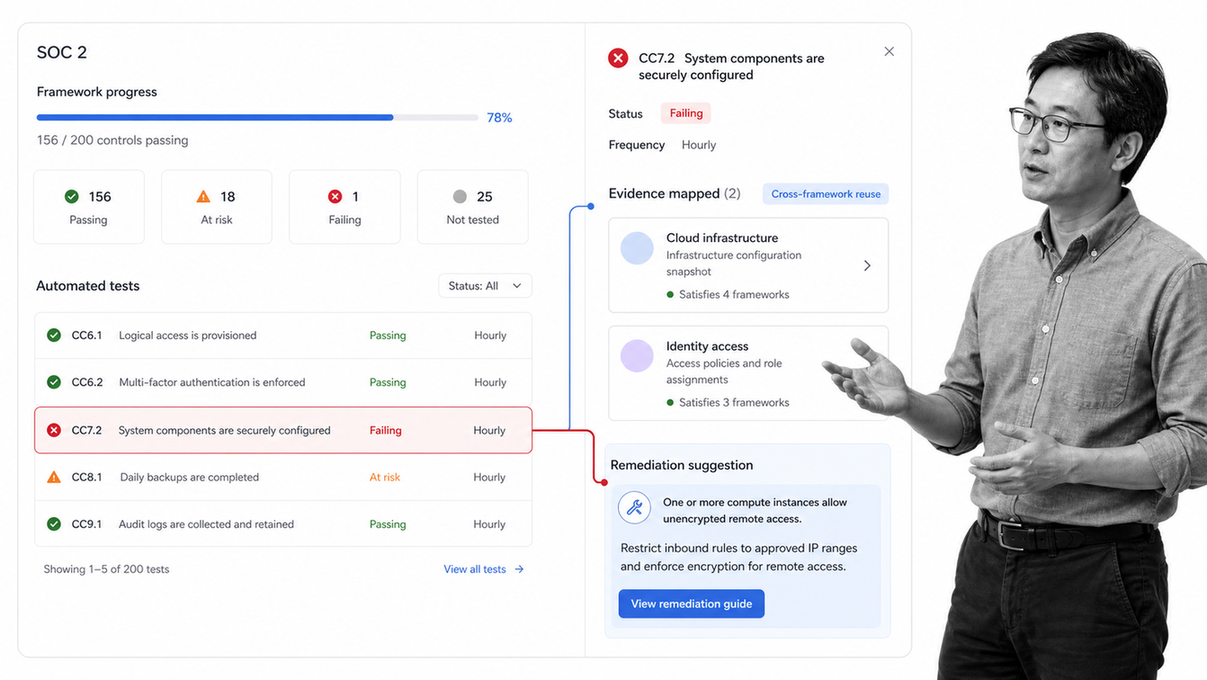
Vanta’s SOC 2 platform connects read-only to cloud, identity, code, and device systems, maps collected evidence to controls, and monitors tests on an ongoing basis. It also supports policy work, access reviews, auditor collaboration, and reuse of evidence across other frameworks.
The product fits teams that already operate a modern SaaS stack and want technical signals pulled into one compliance view. The auditor portal can reduce back-and-forth because evidence, control status, and questions stay connected. Vanta is less of a substitute for detailed cross-functional operating procedures, so teams with complex manual controls should still define how reviews, exceptions, and remediation are executed.
Vanta publishes plan names and feature differences, but uses personalized pricing. Essentials is positioned as a straightforward path to an initial framework, while higher plans add more risk, access, questionnaire, reporting, and control-management capability. Compare the deeper tradeoffs in the Vanta alternatives guide.
3. Drata
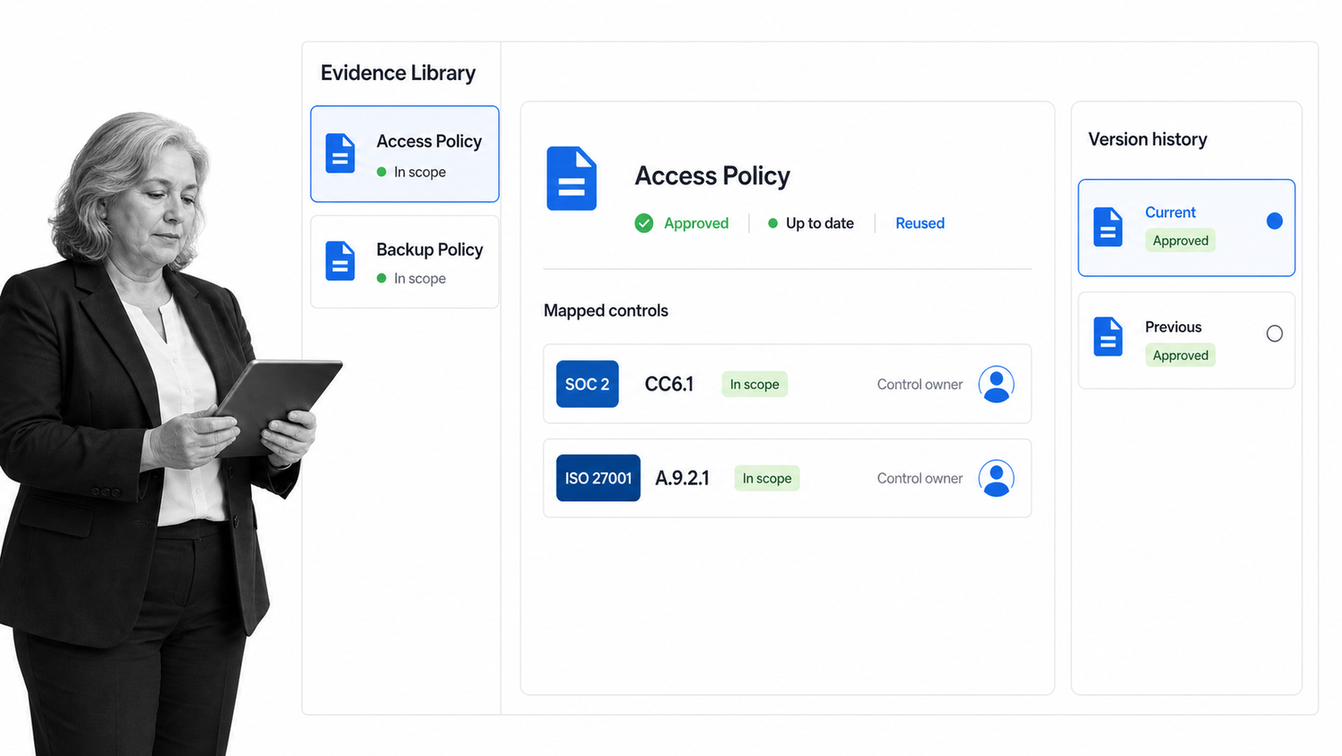
Best for: SMBs building a structured continuous compliance program that may expand over time.
Drata’s SOC 2 software automatically collects evidence from cloud infrastructure, identity providers, HR systems, code repositories, and ticketing tools. It continuously tests controls, alerts teams to gaps, and gives auditors a dedicated workspace with mapped evidence and change history.
Drata is a good fit when you want a formal control and evidence structure that can support more than a single point-in-time project. Evidence can be maintained, versioned, and reused, while policies, risk, third-party work, and training sit near the same program. That depth is useful for a growing security function, but a very small team should confirm which modules it will actively operate rather than buying for a hypothetical future state.
Drata’s Foundation plan is designed for organizations up to 50 full-time employees and supports one pre-mapped framework from a defined set. Pricing is personalized. The Drata alternatives comparison helps if your team wants a narrower or more operations-focused system.
4. Secureframe
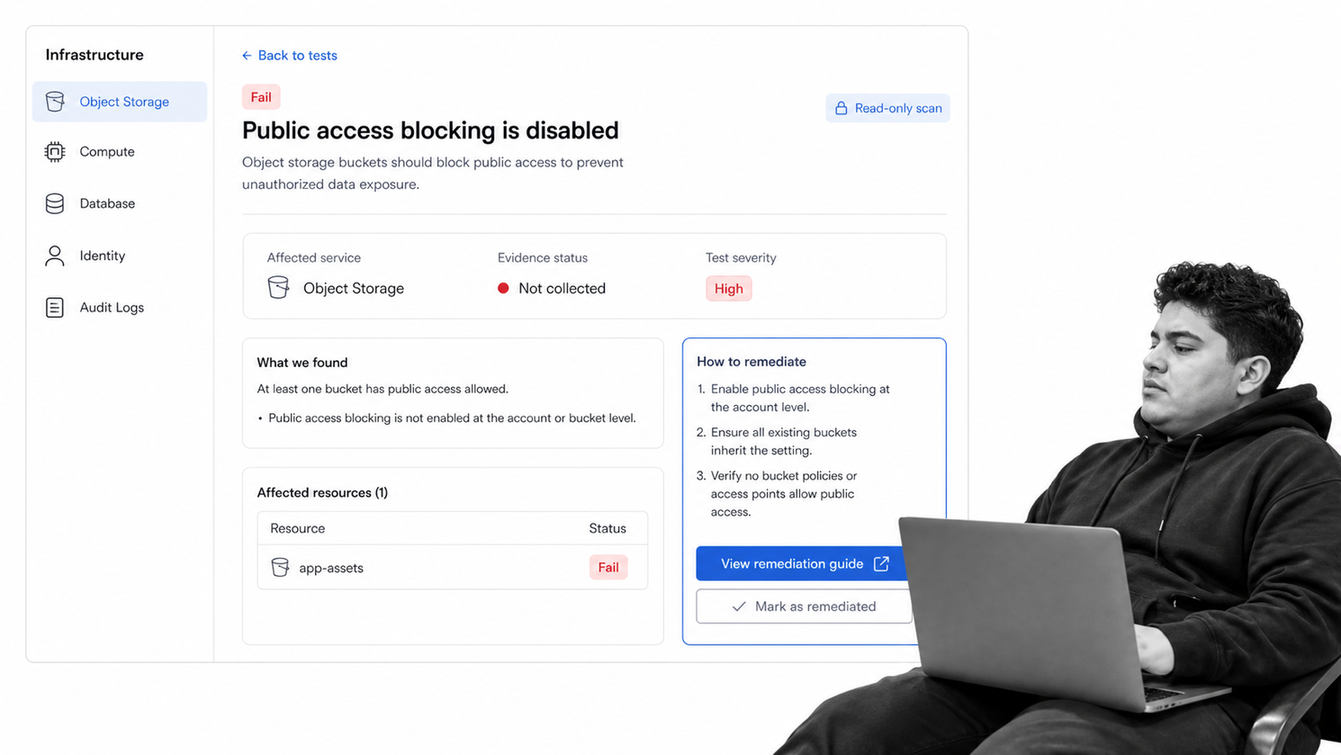
Best for: technical SMBs that want cloud monitoring, remediation guidance, and compliance program basics in one package.
Secureframe connects to cloud, vendor, and HR systems, scans for nonconformities, and collects evidence throughout the year. Its SOC 2 workflow also includes policy support, employee onboarding and offboarding, vendor risk, and an auditor submission path.
The Fundamentals package includes infrastructure monitoring, evidence collection, personnel management, risk management, policy management, and a Trust Center. Complete adds deeper third-party risk, access review, questionnaire, and trust capabilities. Both packages are quote-based.
Secureframe is appealing when your technical team needs to see a failing configuration and understand what to fix. The platform should still be evaluated against your exact systems and audit scope. A generic integration claim does not guarantee that the evidence your auditor expects will be collected in the right form.
5. Sprinto
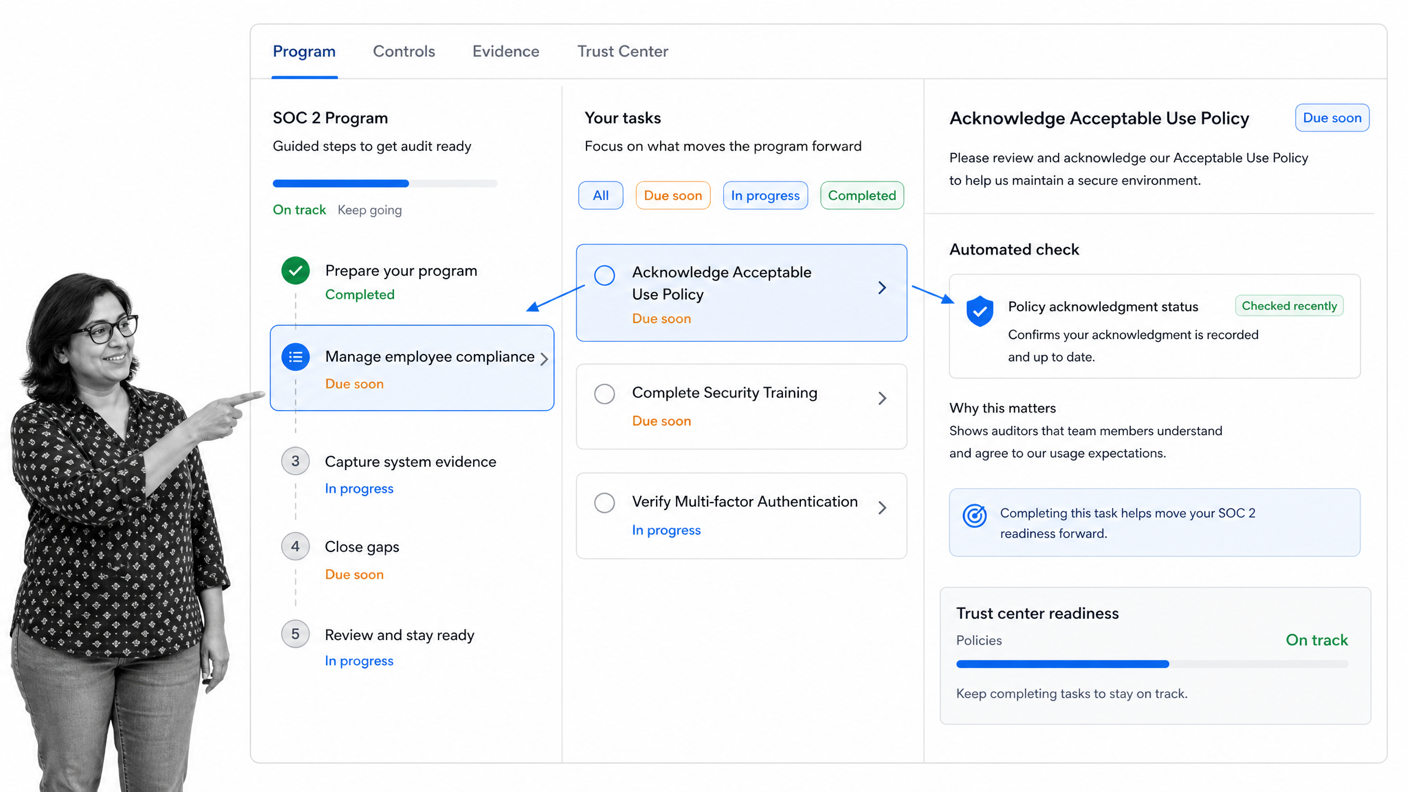
Best for: startups and SMBs approaching SOC 2 for the first time without a dedicated compliance owner.
Sprinto’s SOC 2 platform builds a guided program with policies, controls, checks, tasks, and audit requirements shaped around the customer’s stack. It automates evidence collection, monitors controls, tracks employee and device compliance, supports vendor oversight, and can publish a Trust Center.
The guided setup is useful for a founder, operations leader, or security generalist who does not want to translate every requirement from scratch. It gives the team a concrete sequence of work and keeps technical evidence current in the background. That can shorten the distance between deciding to pursue SOC 2 and having a coherent readiness program.
Sprinto does not publish a simple price card for the main platform on its SOC 2 page, so teams should request a quote based on headcount, scope, integrations, and future frameworks. Ask which services, auditor fees, and implementation support are included before comparing totals.
6. Thoropass
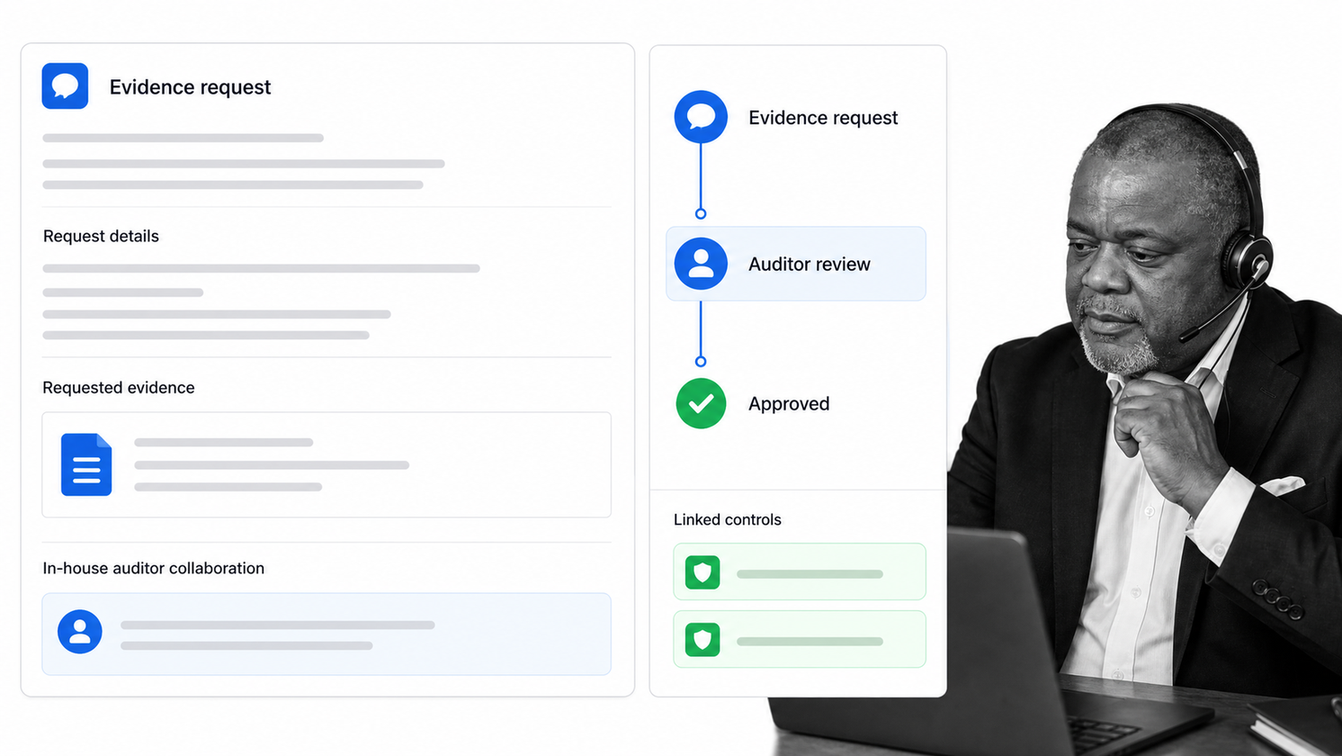
Best for: SMBs that want readiness, evidence management, and the independent audit experience coordinated in one system.
Thoropass connects scope, evidence, requests, reviews, issues, milestones, and attestation in a single audit lifecycle. Its model combines automation with access to audit and compliance professionals, which can reduce handoffs between the readiness platform and the firm completing the examination.
This is useful when a lean team wants one accountable path from initial scoping through the final report. Evidence can also be reused when the program expands into another supported framework. The important procurement question is independence: confirm which entity performs advisory work, which entity issues the report, and how roles are separated for your engagement.
Thoropass requires a sales conversation for pricing. Compare the full engagement, including readiness support and audit services, against a software-only platform plus a separate CPA firm.
7. Scytale
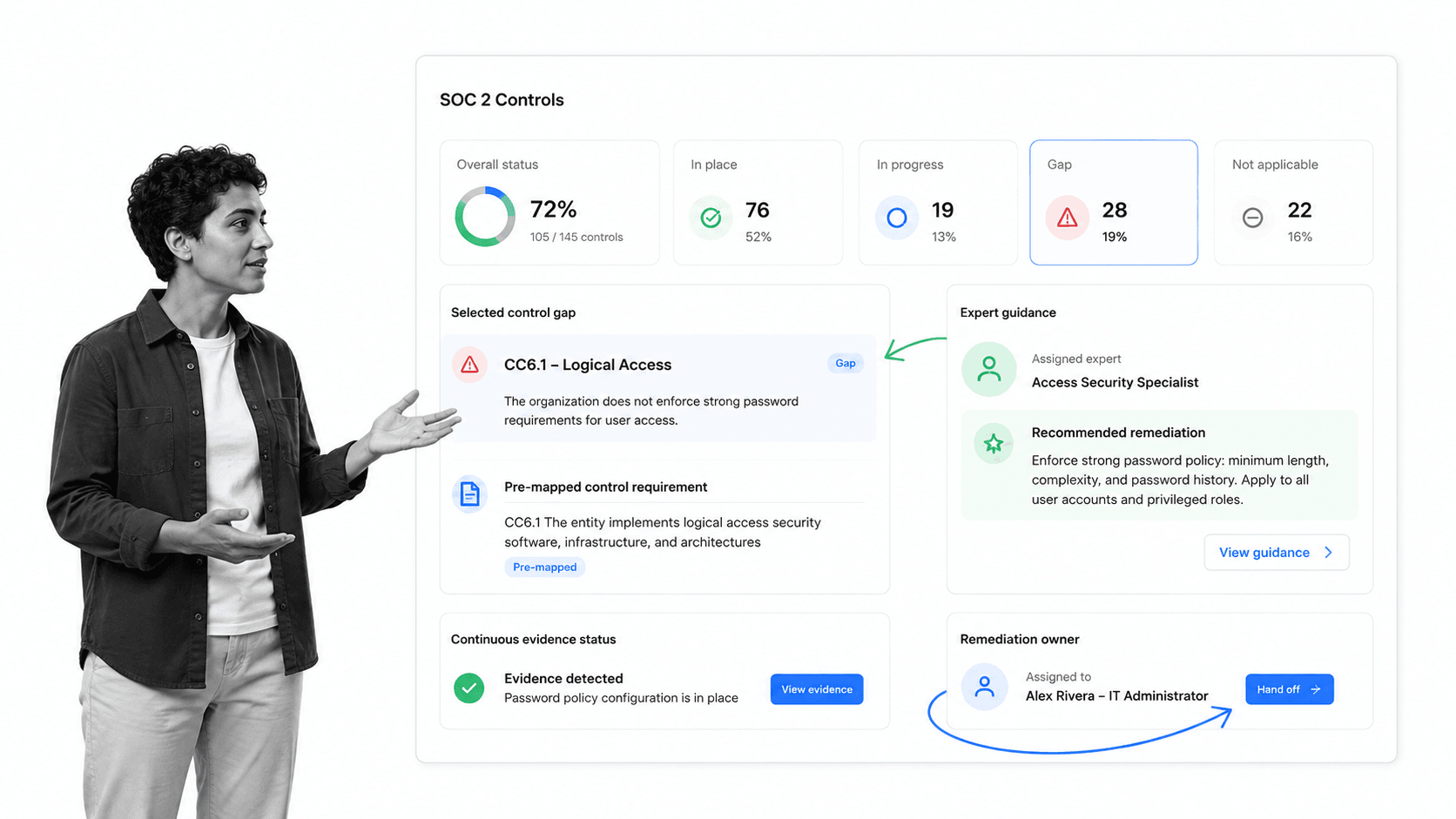
Best for: lean SMB teams that want automated evidence and continuous monitoring with dedicated compliance guidance.
Scytale’s SOC 2 platform combines automated evidence collection, continuous control monitoring, pre-mapped controls, policy templates, gap tracking, and auditor collaboration. The service also emphasizes dedicated expert support from the start of the program.
That combination can work well when nobody on the team has run a SOC 2 program before. Software can show a control gap, but an experienced guide helps interpret whether the control fits your scope and what evidence will satisfy the auditor. This reduces the chance that a small team spends weeks perfecting artifacts that do not address the actual requirement.
Scytale uses a demo-led sales process rather than publishing a simple price. Ask how much expert time is included, how auditor coordination works, and which work remains with your internal team.
8. Scrut
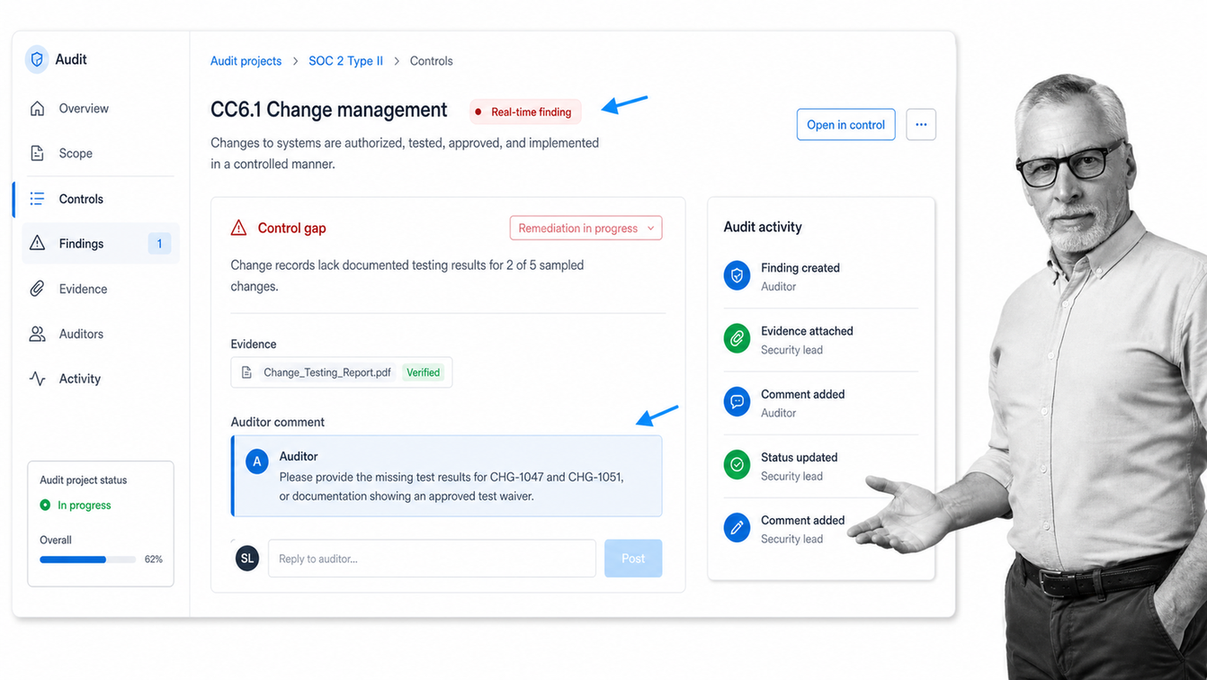
Best for: growing SMBs that want SOC 2 automation inside a broader risk and compliance program.
Scrut provides prebuilt SOC 2 controls, policy content, automated evidence gathering, continuous testing, gap alerts, audit projects, comments, audit logs, and role-based auditor collaboration. Controls and evidence can be reused across frameworks, which matters as customer requirements expand.
Scrut is a sensible option when SOC 2 is the first program, not the final destination. Its risk, vendor, access, asset, and trust capabilities can reduce the need to rebuild the operating model later. The tradeoff is scope: a small company should identify the capabilities it will use now and avoid turning initial readiness into an oversized GRC implementation.
Pricing is provided through a demo process. Ask for a line-item view of platform modules, implementation help, support, and any external audit cost.
How to choose the best SOC 2 compliance automation tools for SMBs
Map the audit boundary before comparing demos
List the product, infrastructure, people, vendors, locations, and processes that may be in scope. Then mark where evidence originates and which controls require human action. This prevents a polished demo from pulling the selection toward features that do not address your real audit boundary.
Separate machine evidence from operational evidence
Cloud settings, user directories, endpoint status, and code changes are good candidates for automated collection. Access reviews, vendor decisions, incident follow-up, management approvals, and policy exceptions often require human judgment. A complete program needs a reliable path for both. The internal controls guide helps clarify how ownership and evidence fit together.
Test one control end to end
During the trial or proof of concept, choose one recurring control such as user access review. Connect the source systems, run the review, attach or collect the evidence, route approval, handle an exception, and export the record. A platform that looks complete at the dashboard level may still create friction at the exact handoffs your team performs every quarter.
Calculate the full first-year cost
- Platform subscription and required modules
- Implementation and advisory support
- Independent CPA firm fees
- Penetration testing, training, and security tooling needed to close gaps
- Internal hours for control owners, engineering, HR, and leadership
- Renewal cost and the effort required to maintain evidence after the first report
The best SOC 2 compliance automation tools for SMBs reduce total program work, not just the time spent uploading screenshots. Broader compliance operations platforms may be a better fit when the central problem is coordinating controls across departments.
A practical SOC 2 automation implementation plan
Confirm scope and report type
Decide which product or service is being examined, which Trust Services Categories apply, and whether the immediate goal is Type I or Type II. Type I evaluates control design at a point in time. Type II also evaluates operating effectiveness across a period. Your auditor should confirm the final scope.
Assign every control to a real owner
Give each control an accountable owner and a backup. Translate recurring obligations into schedules with explicit evidence requirements. A vendor audit workflow or vendor risk assessment process makes third-party control work repeatable instead of leaving it in a spreadsheet.
Connect the highest-value evidence sources first
Start with identity, cloud infrastructure, source control, endpoint management, and HR because these systems support many common controls. Validate the collected artifact against an auditor request before connecting every possible application.
Build an exception and remediation path
Define what happens when a test fails, evidence is late, or a control cannot operate as designed. Record the issue, assess its impact, assign remediation, approve any exception, and preserve the closure evidence. This is the bridge between a monitoring alert and an auditable response.
Run a readiness review before the observation period
Walk through the full program with your auditor or readiness advisor. Resolve unclear ownership, missing evidence, stale policies, and controls that do not match actual practice. The SOC 2 audit preparation guide provides a more detailed readiness sequence.
Operate continuously after the report
Keep integrations healthy, review failing tests, complete recurring controls, update policies, reassess vendors, and track changes to scope. The report is an output of the control environment. If the system only comes alive before the annual audit, the automation has not solved the real problem.
FAQs
What is SOC 2 compliance automation software?
SOC 2 compliance automation software connects to business systems, collects audit evidence, monitors controls, tracks gaps, and organizes work for audit readiness. The strongest tools also assign human control work and preserve approvals, exceptions, and remediation history.
Which SOC 2 automation tool is best for a small business?
The best tool depends on the bottleneck. Process Street is strongest for recurring control execution and approvals. Vanta, Drata, Secureframe, and Sprinto emphasize technical evidence and monitoring, while Thoropass, Scytale, and Scrut add different levels of audit or expert support.
Can SOC 2 compliance software replace an auditor?
No. Software can prepare evidence, monitor controls, and coordinate requests, but an independent licensed CPA firm performs the SOC 2 examination and issues the report. Confirm auditor independence and responsibilities before buying a bundled service.
What should an SMB look for in a SOC 2 tool?
Prioritize coverage for your in-scope systems, clear control ownership, automated and manual evidence handling, remediation workflows, auditor collaboration, and practical support. Test one recurring control end to end before committing.
How much do SOC 2 automation tools cost?
Most leading vendors use custom or personalized pricing based on company size, frameworks, modules, support, and scope. Compare the total first-year cost, including implementation, independent audit fees, security testing, training, and internal labor.
Do SOC 2 automation tools support Type I and Type II reports?
Yes, the major platforms in this comparison support readiness for both report types. Type I focuses on control design at a point in time, while Type II also tests operating effectiveness over an observation period, so ongoing evidence and recurring control execution matter more.