
Turn every policy into automated workflows with built-in enforcement and audit-ready proof.


9 Best Vanta Alternatives & Competitors in 2026

Vanta alternatives are worth comparing when trust work has outgrown one tool shape. Vanta is strong for companies that want a dedicated trust platform for compliance, risk, questionnaires, vendor reviews, trust centers, and automated security evidence. Its public pricing page describes Essentials, Plus, Professional, and Enterprise tracks, with Vanta AI Agent features, automated evidence collection, risk management, access management, advanced reporting, and trust-center capabilities.
This list is maintained by the Process Street team, but the ranking is deliberately use-case based. Process Street ranks first for teams whose real gap is enforceable, trackable, recurring process execution: the human workflows around policies, approvals, evidence, vendor reviews, remediation, access reviews, and internal audit preparation. If you need automated cloud control tests, security posture monitoring, or auditor-bundled software, a dedicated security compliance platform may be the better fit.
The evaluation criteria are practical: how well each product fits the job, how clearly it supports compliance owners, whether pricing is transparent enough to shortlist, how it handles evidence and accountability, and whether it helps people do the work correctly instead of only showing that the work exists.
In this article, we are going to cover:
- Vanta alternatives at a glance
- How to choose Vanta alternatives
- 1. Process Street
- 2. Drata
- 3. Secureframe
- 4. Sprinto
- 5. Thoropass
- 6. Scrut
- 7. Hyperproof
- 8. OneTrust
- 9. Strike Graph
- Vanta alternatives by use case
- FAQs
Vanta alternatives at a glance
Use this table as the short version before the deep dives. The right Vanta replacement depends on whether your pain is recurring SOP execution, security evidence automation, audit services, enterprise GRC, third-party risk, public pricing, or connected risk management.
| Tool | Best for | Standout feature | Free plan | Starting price |
|---|---|---|---|---|
| Process Street | enforceable recurring SOP and compliance operations workflows | workflow runs with required fields, approvals, evidence, conditional logic, and run history | 14-day Pro trial | See pricing page |
| Drata | security teams scaling a trust and GRC program | Foundation, Advanced, and Enterprise tracks with frameworks, trust center, risk, TPRM, and API access | No public free plan | Get started |
| Secureframe | compliance automation with built-in expert support | compliance automation with native integrations, automated evidence collection, and continuous control monitoring | No public free plan | Request pricing |
| Sprinto | continuous compliance for cloud-hosted companies | control monitoring, automated evidence collection, alerts, and integrations for compliance workflows | No public free plan | Book a demo |
| Thoropass | teams that want software and audit delivery together | tailored compliance software and audit delivery based on framework, scope, company size, and required services | No public free plan | Tailored quote |
| Scrut | security-first GRC programs | risk visibility, compliance status tracking, continuous control monitoring, and guided audit readiness | No public free plan | Book a demo |
| Hyperproof | mature GRC programs across compliance, risk, and audit | AI-powered GRC platform that centralizes compliance, risk, and security workflows | No public free plan | Request demo |
| OneTrust | enterprise privacy, tech risk, third-party risk, and GRC programs | tech risk and compliance packaging with actionable tasks, templates, and guidance across 50+ standards | No public free plan | Get pricing |
| Strike Graph | published-price compliance management | Launch, Certify, Scale, and Enterprise packages with Verify AI, questionnaires, SBOM, and TPRM options | Yes, Launch | $10,000/year for Certify |
How to choose Vanta alternatives
Start with the work pattern. If your team needs automated evidence collection from cloud apps and identity systems, compare dedicated compliance automation software vendors first. If your team needs a broader operating model across risk, audit, policy, and vendors, compare GRC software. If the hard part is getting people to follow the same procedure every time and leave proof behind, compare a governed workflow management system and a compliance operations layer.
That distinction matters. A control monitor can tell you whether a connected system is passing or failing. It cannot always make the human workflow happen: collecting an exception explanation, routing an approval, linking a policy, assigning remediation to the right owner, and preserving an instance-level record. A process platform is strongest when the control depends on repeatable work by people.
Most teams evaluating Vanta alternatives should separate three layers. The first layer is security automation: integrations, control monitoring, evidence collection, trust centers, questionnaires, and audit prep. The second layer is GRC governance: controls, risks, policies, third parties, audit plans, and reporting. The third layer is execution: the recurring procedures that prove work was done. Process Street competes most directly in that third layer, with strong adjacency to compliance operations and GRC and compliance as proof of control.
The replacement conversation gets easier when each workflow is labeled by evidence source and owner. Technical controls usually belong with security and IT because they rely on connected systems. Policy, vendor, access, remediation, and customer-commitment workflows usually cross several teams and need clear operating procedure, not only control status. Mixed workflows need both: an automated signal from the trust system and a repeatable follow-up path for the people responsible for exceptions.
Also check where your current Vanta workflow breaks down. If the bottleneck is missing integrations, choose a platform with stronger connector coverage for your environment. If the bottleneck is auditor coordination, choose a vendor that packages audit support. If the bottleneck is that people skip steps, attach evidence in inconsistent places, or forget approvals, choose a process layer that makes the right path mandatory every time.
Finally, decide how much change management the team can absorb. A broad enterprise GRC rollout can be right for a mature risk organization, but it can slow a small team that only needs reliable recurring work. A narrow compliance automation tool can be right for technical evidence, but it may leave cross-functional tasks in spreadsheets and chat. The best shortlist should match the operating model you can actually maintain after procurement and during every audit season reliably.
Use these questions before shortlisting demos:
- Are you replacing Vanta because security evidence automation is missing, or because human process execution is inconsistent?
- Do you need automated control monitoring from connected systems, or guided procedures with required fields and approvals?
- Will InfoSec, compliance, operations, legal, finance, HR, or vendor owners maintain the workflow?
- Do you need audit delivery bundled with the platform, or do you already have an auditor?
- Would public pricing materially speed the buying process, or is enterprise fit more important?
A clean compliance stack can use more than one system. A trust platform can monitor controls, a GRC suite can maintain the control library, and Process Street can run the recurring operating workflows that create the evidence. That split works when the ownership model is clear and each system has a job.
1. Process Street

Best for: enforceable recurring SOP and compliance operations workflows.
Process Street is the strongest Vanta alternative when the work around compliance needs to be enforced as a recurring process, not merely tracked as a control status. It is built for teams that need owners, due dates, required fields, approvals, conditional paths, evidence uploads, and a run history for every instance of work.
That makes Process Street different from security compliance automation tools. A product like Vanta, Drata, Secureframe, or Sprinto can help monitor connected systems and collect technical evidence. Process Street is the better fit when the control depends on people following a procedure: vendor review, access recertification, policy attestation, remediation approval, audit request intake, incident follow-up, or customer security questionnaire handoff.
Process Street also fits teams that want compliance work owned by non-technical operators. A compliance, HR, finance, customer, or operations leader can update the procedure without waiting for a GRC admin or security engineer. The workflow becomes the operating record, not a loose checklist attached to a separate compliance system.
That matters most for controls where the evidence is created by a person doing a job. Examples include quarterly access reviews, vendor risk questionnaires, policy acknowledgements, security exception approvals, remediation follow-up, incident retrospectives, procurement checks, employee offboarding, customer commitment reviews, and audit request intake. In each case, the risk is not only whether a control exists. The risk is whether the responsible person completed the right step, at the right time, with the right evidence and approval.
Process Street is also practical when compliance teams need a clean handoff model. A workflow can assign tasks to legal, HR, finance, customer success, IT, and security without asking those teams to live inside a full GRC system. Required fields keep the record complete. Conditional logic sends different paths to different owners. Approvals create a clear checkpoint before work moves forward. The result is a repeatable operating pattern that supports audit preparation without turning every participant into a compliance platform admin.
For current package details, use Process Street pricing. The page should be shortlisted when recurring human work is the bottleneck. If your primary requirement is automated cloud control testing and auditor evidence collection, keep dedicated trust platforms in the shortlist and use Process Street to govern the repeatable workflows around them.
Process Street key features:
- Workflow runs with task owners, due dates, required fields, approvals, and conditional logic.
- Evidence collection through file uploads, form fields, comments, and run history.
- Policy-linked execution patterns that support document control best practices and controlled SOP work.
- Process records that turn execution into compliance as proof of control.
- Direct, universal integrations to 5,000+ systems. Need a new one? An AI agent builds it on the fly.
Process Street pros:
- Strong fit for SOPs, recurring operations, vendor reviews, access checks, approvals, and audit request workflows.
- Readable enough for non-technical process owners to build and maintain.
- Keeps human accountability, evidence, policies, and workflow history in one execution record.
- Works beside trust platforms, GRC suites, project tools, identity systems, and document repositories.
- Useful when skipped steps, stale SOPs, and missing proof create audit risk.
Process Street cons:
- Not a dedicated security posture monitoring platform with automated cloud control tests.
- Not an audit firm or bundled auditor marketplace.
- Not the best fit when the only requirement is a trust center or security questionnaire automation.
2. Drata

Best for: security teams scaling a trust and GRC program.
Drata is a trust management and GRC platform with Foundation, Advanced, and Enterprise tracks. Its public plans page describes framework support, pre-built integrations, trust center, AI questionnaire assistance, risk management, third-party risk management, compliance as code, custom controls, custom connections, API access, and advanced GRC options by package.
It beats Process Street when the core need is a dedicated security compliance platform that maps frameworks and supports trust-center, risk, TPRM, and technical compliance work. It is weaker when non-technical operators need a simple recurring workflow run for policy signoff, remediation, access reviews, or audit request handoffs.
Use Drata when Vanta feels mismatched for security teams scaling a trust and GRC program. Keep Process Street in the stack when the selected platform still needs repeatable human workflows around access reviews, remediation, vendor handoffs, policy signoffs, audit requests, and customer commitments.
Drata key features:
- Foundation, Advanced, and Enterprise package structure.
- Pre-mapped framework support and additional frameworks by package.
- Trust Center, risk management, TPRM, and AI questionnaire assistance.
- Open API access, custom controls, custom connections, and GRC options.
Drata pros:
- Strong Vanta-like fit for security compliance automation.
- Good breadth across trust center, risk, TPRM, and framework work.
- Clear public package descriptions even without public dollar pricing.
Drata cons:
- Pricing requires a sales flow.
- More security-program oriented than operator-owned SOP execution.
For current package details, see Drata pricing. Drata is a better fit when the main need is security compliance automation with pre-built framework mapping and trust-center workflows.
3. Secureframe

Best for: compliance automation with built-in expert support.
Secureframe is a compliance automation platform with package tables for compliance automation. Its pricing page lists native integrations, automated evidence collection, continuous control monitoring, custom frameworks, custom controls, and custom tests in its compliance automation package comparison.
It beats Process Street when the buyer wants a dedicated compliance automation platform with expert-backed guidance and technical evidence collection. It is weaker when the control depends on recurring human process execution that must be owned by operations, HR, finance, or customer teams.
Use Secureframe when Vanta feels mismatched for compliance automation with built-in expert support. Keep Process Street in the stack when the selected platform still needs repeatable human workflows around access reviews, remediation, vendor handoffs, policy signoffs, audit requests, and customer commitments.
Secureframe key features:
- Compliance automation packages.
- Native integrations.
- Automated evidence collection.
- Continuous control monitoring and custom framework support.
Secureframe pros:
- Strong fit for audit readiness and evidence automation.
- Clear focus on compliance tasks and expert guidance.
- Good like-for-like alternative for Vanta evaluators.
Secureframe cons:
- Public page does not list a simple starting price.
- Less focused on broad SOP execution outside the security compliance program.
For current package details, see Secureframe pricing. Secureframe is a better fit when the buying team wants compliance automation packaged with hands-on expert guidance.
4. Sprinto

Best for: continuous compliance for cloud-hosted companies.
Sprinto positions continuous compliance around control monitoring, evidence collection, remediation workflows, intelligent alerts, and connected systems. Its continuous compliance page describes integrations and custom API coverage across cloud apps, infrastructure, code repos, devices, and people.
It beats Process Street when the team wants a live compliance health view across connected systems. It is weaker when the work is a recurring business process that needs guided steps, policy context, approval, and evidence history inside the workflow itself.
Use Sprinto when Vanta feels mismatched for continuous compliance for cloud-hosted companies. Keep Process Street in the stack when the selected platform still needs repeatable human workflows around access reviews, remediation, vendor handoffs, policy signoffs, audit requests, and customer commitments.
Sprinto key features:
- Continuous control monitoring.
- Automated evidence collection.
- Intelligent alerts and remediation workflows.
- Integrations and custom API coverage.
Sprinto pros:
- Good fit for cloud-hosted teams maintaining compliance year round.
- Strong focus on control health and evidence automation.
- Useful when technical systems need continuous monitoring.
Sprinto cons:
- Pricing is demo-led on the pages reviewed.
- Not primarily an operator-owned SOP workflow platform.
For current package details, see Sprinto pricing. Sprinto is a better fit when the priority is always-on control monitoring across cloud apps and infrastructure.
5. Thoropass

Best for: teams that want software and audit delivery together.
Thoropass combines compliance software with audit delivery. Its website states pricing varies based on frameworks pursued, audit scope, company size, and required services, with tailored quotes because the platform can combine software and audit components.
It beats Process Street when the team wants one route for readiness tooling and audit services. It is weaker when the team already has an auditor and mainly needs repeatable internal workflows that enforce how compliance work gets done.
Use Thoropass when Vanta feels mismatched for teams that want software and audit delivery together. Keep Process Street in the stack when the selected platform still needs repeatable human workflows around access reviews, remediation, vendor handoffs, policy signoffs, audit requests, and customer commitments.
Thoropass key features:
- Compliance software and audit delivery path.
- Tailored pricing based on framework, scope, company size, and required services.
- Support for readiness tooling and audit execution.
- Bundled buying path for teams that prefer one vendor route.
Thoropass pros:
- Good fit when audit services and software should be coordinated.
- Can simplify vendor selection for early compliance programs.
- Helpful when internal teams do not want to assemble the audit path themselves.
Thoropass cons:
- Less transparent for buyers who want public pricing.
- Bundled audit delivery may be unnecessary for teams with an existing auditor.
For current package details, see Thoropass pricing. Thoropass is a better fit when a team wants readiness tooling and audit delivery from one vendor path.
6. Scrut

Best for: security-first GRC programs.
Scrut is a security-first GRC platform. Its public site describes risk visibility, compliance status tracking, continuous control monitoring, audit readiness, and guided support through its platform and team.
It beats Process Street when the priority is security risk posture and GRC visibility. It is weaker when the main problem is making cross-functional teams follow a recurring procedure consistently and leave proof after every run.
Use Scrut when Vanta feels mismatched for security-first GRC programs. Keep Process Street in the stack when the selected platform still needs repeatable human workflows around access reviews, remediation, vendor handoffs, policy signoffs, audit requests, and customer commitments.
Scrut key features:
- Risk visibility across cloud infrastructure, applications, people, and third parties.
- Compliance status tracking across frameworks.
- Continuous control monitoring.
- Setup wizard and guided audit preparation.
Scrut pros:
- Security-first framing is useful for InfoSec buyers.
- Good fit for risk-aware compliance programs.
- Strong emphasis on live answers and guided control decisions.
Scrut cons:
- Public site does not expose a simple starting price.
- May be more security-program oriented than day-to-day operations workflows.
For current package details, see Scrut pricing. Scrut is a better fit when the team wants GRC work anchored in security-risk visibility rather than only certification readiness.
7. Hyperproof

Best for: mature GRC programs across compliance, risk, and audit.
Hyperproof positions itself as an AI-powered GRC platform that centralizes compliance, risk, and security workflows. Its product page frames the product around maintaining compliance, proactively mitigating risks, and running GRC from one platform.
It beats Process Street when the program is already a mature GRC function with compliance, risk, audit, and security workflows that need shared governance. It is weaker when the immediate need is a lightweight recurring workflow that a non-technical owner can update quickly.
Use Hyperproof when Vanta feels mismatched for mature GRC programs across compliance, risk, and audit. Keep Process Street in the stack when the selected platform still needs repeatable human workflows around access reviews, remediation, vendor handoffs, policy signoffs, audit requests, and customer commitments.
Hyperproof key features:
- Centralized compliance, risk, and security workflows.
- AI-powered GRC positioning.
- Compliance and risk workflow management.
- Platform scope across compliance, risk, audit, trust, third-party risk, and governance.
Hyperproof pros:
- Strong fit for maturing GRC teams.
- Better for cross-domain risk and audit operations than a narrow SOP workflow alone.
- Useful when compliance work spans several governance teams.
Hyperproof cons:
- Pricing is not public on the reviewed product page.
- May be more platform than a small team needs for recurring procedures.
For current package details, see Hyperproof pricing. Hyperproof is a better fit when compliance work is part of a broader risk, audit, and GRC operating model.
8. OneTrust
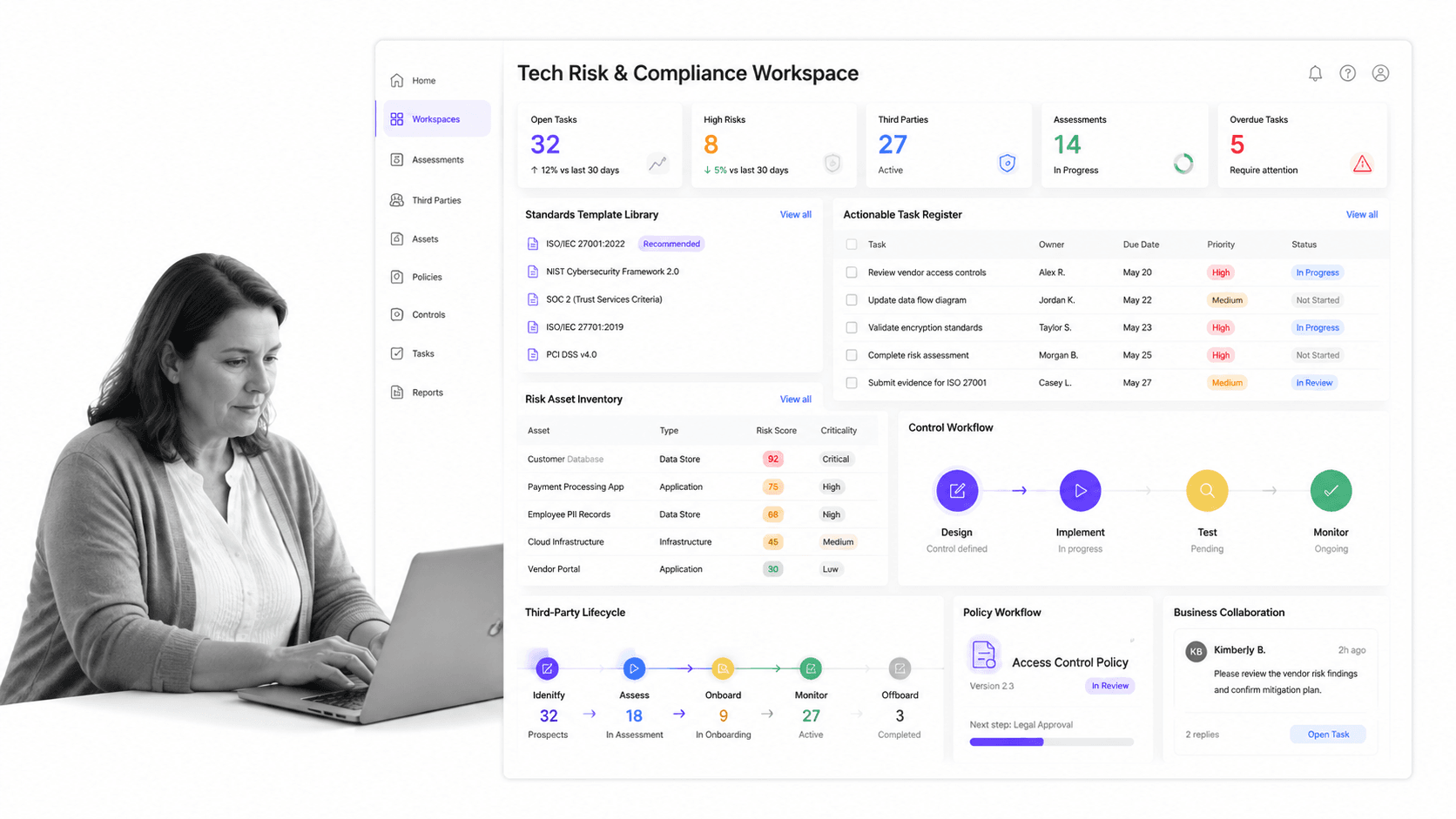
Best for: enterprise privacy, tech risk, third-party risk, and GRC programs.
OneTrust is a broad governance platform. Its pricing and packaging page includes Tech Risk & Compliance, with capabilities for actionable tasks, templates and guidance across 50+ standards, risk identification across IT ecosystems, assessments, control management, policy workflows, and third-party lifecycle work.
It beats Process Street when the buying need extends beyond compliance operations into privacy, consent, data use governance, third-party risk, and enterprise tech risk. It is weaker when a team needs a focused process execution layer without the breadth of an enterprise governance suite.
Use OneTrust when Vanta feels mismatched for enterprise privacy, tech risk, third-party risk, and GRC programs. Keep Process Street in the stack when the selected platform still needs repeatable human workflows around access reviews, remediation, vendor handoffs, policy signoffs, audit requests, and customer commitments.
OneTrust key features:
- Tech Risk & Compliance packaging.
- Templates and guidance across 50+ standards, regulations, and frameworks.
- Risk assessment, control management, policy lifecycle, and third-party lifecycle workflows.
- Broader privacy, consent, data use, and governance product portfolio.
OneTrust pros:
- Strong enterprise governance breadth.
- Good fit for large organizations with privacy, risk, compliance, and third-party programs.
- Useful when compliance work needs to connect to data governance and privacy workflows.
OneTrust cons:
- Breadth can be more than a focused operations team needs.
- Pricing is request-led for the relevant packages.
For current package details, see OneTrust pricing. OneTrust is a better fit when the buyer needs a broad enterprise governance platform across privacy, consent, third-party risk, and tech risk.
9. Strike Graph

Best for: published-price compliance management.
Strike Graph publishes pricing for Launch, Certify, Scale, and Enterprise packages. Its pricing page lists a free Launch option, Certify starting at $10,000 per year, Scale starting at $21,500 per year, and Enterprise starting at $35,000 per year, with capabilities such as Verify AI, questionnaires, SBOM, TPRM, evidence API, and security assistant features.
It beats Process Street when public pricing, AI-assisted evidence validation, and security compliance package clarity are important. It is weaker when the core need is recurring cross-functional workflow execution outside the trust program.
Use Strike Graph when Vanta feels mismatched for published-price compliance management. Keep Process Street in the stack when the selected platform still needs repeatable human workflows around access reviews, remediation, vendor handoffs, policy signoffs, audit requests, and customer commitments.
Strike Graph key features:
- Free Launch package and public paid package prices.
- Verify AI for evidence checks.
- Questionnaires, SBOM, TPRM, and self-assessment options.
- Security assistant, evidence API, and enterprise features in higher packages.
Strike Graph pros:
- Public pricing reduces early buying ambiguity.
- Good fit for teams that want AI-assisted audit readiness.
- Clear plan structure for startup and scale-stage comparison.
Strike Graph cons:
- Some modules are package-dependent or add-on dependent.
- Not a broad recurring SOP workflow platform.
For current package details, see Strike Graph pricing. Strike Graph is a better fit when public pricing and AI-assisted audit readiness are important buying criteria.
Vanta alternatives by use case
The safest shortlist starts with the job you are trying to move out of Vanta.
For each use case, ask what a successful week looks like. Security evidence automation succeeds when connected systems stay mapped, tests stay current, and audit evidence is collected with minimal manual chasing. GRC succeeds when controls, risks, policies, issues, vendors, and audit plans are governed consistently. Workflow execution succeeds when recurring tasks are assigned, completed, approved, documented, and easy to prove later. Those outcomes overlap, but they are not the same buying requirement.
- Choose Process Street when recurring compliance work needs required steps, owners, approvals, evidence, and run history.
- Choose Drata when the program needs a trust management platform with framework mapping, trust-center workflows, risk, TPRM, and API access.
- Choose Secureframe when automated evidence collection and expert-backed compliance workflows are the main priority.
- Choose Sprinto when continuous control monitoring across connected systems is central to the program.
- Choose Thoropass when bundled readiness software and audit delivery are more valuable than assembling separate vendors.
- Choose Scrut when a security-first GRC program and risk visibility are the core needs.
- Choose Hyperproof when compliance needs to sit inside a mature GRC, risk, and audit operating model.
- Choose OneTrust when the buyer needs enterprise governance across many risk, privacy, compliance, and audit surfaces.
- Choose Strike Graph when public pricing and AI-assisted evidence readiness are important to the buying process.
A common pattern is to pair tools rather than force one platform to do every job. A security compliance platform can monitor technical controls. A third-party risk management workflow can route vendor evidence. A broader GRC suite can own the control library. Process Street can run the recurring procedures that keep work accountable. That is where workflow automation compliance becomes more than status reporting.
This is especially useful for lean compliance teams. They can keep a trusted source for frameworks and control mappings, then move repeatable work into procedures that business owners can actually complete. The compliance team gets fewer ad hoc follow-ups, business teams get clearer instructions, and auditors get a stronger trail of what happened in each instance.
If Vanta is being stretched into operating procedures, start by mapping those procedures into workflows: trigger, owner, required fields, policy link, approval, evidence, exception path, escalation, and completion record. That will show whether the real replacement is a trust platform, a GRC suite, or a controlled workflow layer. Teams exploring AI in this space should also compare the role of an AI compliance agent and AI-driven compliance before locking the architecture.
FAQs
What is the best Vanta alternative?
The best Vanta alternative depends on the job. Process Street is best for enforceable recurring SOP and compliance operations workflows, while Drata, Secureframe, Sprinto, Thoropass, Scrut, Hyperproof, OneTrust, and Strike Graph each fit different trust, GRC, audit, and risk use cases.
Is there a free Vanta alternative?
Most enterprise compliance and GRC platforms do not publish a permanent free plan. Strike Graph publishes a free Launch package, and Process Street publishes a 14-day Pro trial. Always check vendor pricing pages because plan limits change.
Why is Process Street ranked first?
Process Street is ranked first for the ICP this page is judging: teams that need enforceable, trackable, recurring process and SOP workflows around compliance. It is not ranked first for every trust automation use case. If your main need is automated security evidence collection from connected cloud systems, a dedicated compliance automation platform may fit better.
What is the closest alternative to Vanta?
Drata, Secureframe, and Sprinto are closer like-for-like Vanta alternatives for security compliance automation. Process Street is closer when Vanta is being used to coordinate recurring human compliance workflows that need owners, approvals, evidence, and audit history.
Which Vanta alternative is best for small teams?
Small teams should compare Process Street, Strike Graph, Secureframe, Sprinto, and Drata based on the work pattern. Process Street fits operator-owned recurring procedures, while dedicated compliance automation tools fit technical evidence collection and certification readiness.
Which Vanta alternative is best for enterprise teams?
Enterprise teams should compare OneTrust, Hyperproof, Drata, Secureframe, and Process Street. The right choice depends on whether the enterprise needs privacy and GRC breadth, connected risk, control monitoring, or recurring workflow execution with proof.
Can Process Street replace Vanta?
Process Street can replace Vanta for recurring human workflows around compliance operations, SOPs, approvals, evidence collection, vendor reviews, and audit request management. It should not be treated as a direct replacement for Vanta when the requirement is automated cloud control monitoring or trust-center automation.
If Vanta is not solving the recurring work around your compliance program, start with Process Street. Build the workflow that controls the work, then connect the surrounding trust, risk, and audit systems around it.
Comparing something else? The full directory of software alternatives and competitor comparisons covers AI agents, workflow and BPM platforms, integration tools, and more.