Turn every policy into automated workflows with built-in enforcement and audit-ready proof.



Wealth Management System
A wealth management system is the connected operating model a firm uses to manage client data, planning, portfolios, documents, service requests, controls, and recurring work. It is not one dashboard or database. It is the combination of systems of record, client-facing tools, and governed workflows that turn advice into completed action.
For a client, the system should feel simple: one relationship, clear requests, secure information exchange, and visible follow-through. Behind that experience, advisors, operations teams, compliance reviewers, and specialists need shared context, explicit ownership, reliable handoffs, and proof that required work happened.
This guide explains the architecture of an integrated wealth management system, the workflows it needs, the controls that keep it trustworthy, and a practical implementation path. It does not rank software vendors. The focus is how the parts work together.
In this article, we are going to cover:
- What a wealth management system is
- Wealth management system architecture
- Core wealth management system workflows
- Wealth management system governance, security, and compliance
- How to implement a wealth management system
- How to evaluate a wealth management system
- Run wealth management operations in Process Street
- FAQs
What a wealth management system is
A wealth management system connects the client relationship to the work required to serve it. The system holds or references household data, goals, accounts, plans, portfolio decisions, documents, communications, approvals, tasks, and review history.
A system is wider than wealth management software
A single wealth management software product may handle planning, CRM, portfolio management, reporting, or another specific job. The system is the way those tools, records, people, and control steps operate as one service model.
The system has three jobs
- Preserve reliable client and account context.
- Coordinate decisions and actions across roles and tools.
- Create evidence that the firm’s service and control standards were followed.
If one of those jobs is missing, the firm pays for it. Weak context causes repeated questions and inconsistent recommendations. Weak coordination causes delays and dropped handoffs. Weak evidence turns routine reviews and audits into reconstruction projects.
The client experience depends on the back office
A polished wealth management portal can collect documents and requests, but the experience breaks when submissions land in an unowned queue. Every client action needs a corresponding internal workflow with an owner, required information, review rule, and completion state.
The operating model matters more than the logo stack
Firms often buy several strong applications and still run work through email, spreadsheets, and personal reminders. The problem is not always missing technology. It is the absence of a system of action that connects the technology to a repeatable service standard.
Wealth management system architecture
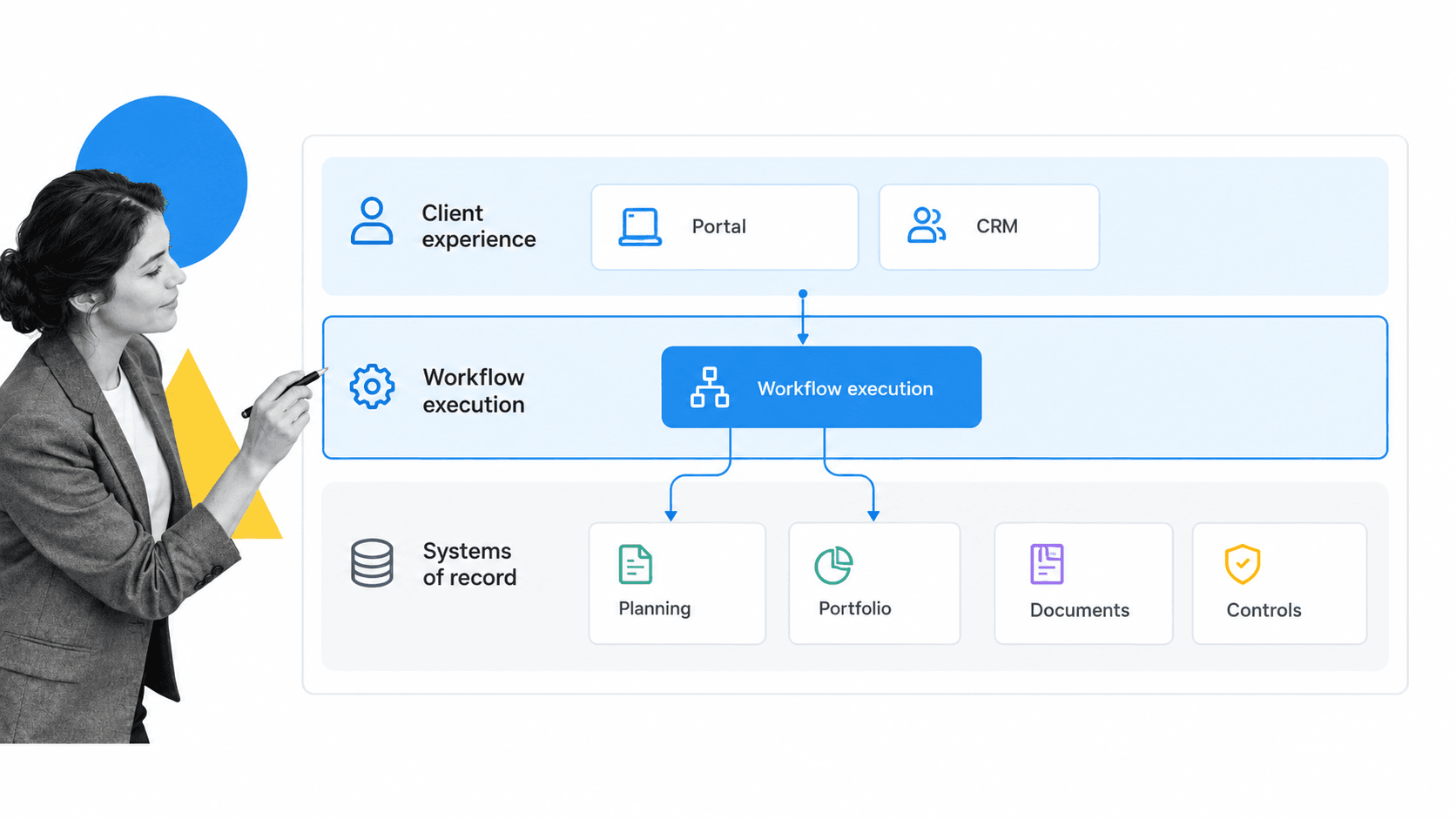
A practical wealth management system architecture separates the client experience, systems of record, and workflow execution. Each layer has a different purpose, and forcing one tool to perform every purpose usually creates brittle workarounds.
Client experience layer
The client experience layer includes the portal, secure messaging, forms, digital signatures, meeting preparation, document exchange, and status updates. It should ask for information once, explain the next step, and avoid exposing internal complexity.
Client relationship record
The CRM or equivalent relationship record stores people, households, entities, contact history, service segmentation, opportunities, and relationship ownership. It should answer who the client is, who serves them, and which relationships or entities affect the work.
Planning and advice systems
A wealth management planner organizes goals, assumptions, scenarios, and recommendations. Planning data should flow into service workflows without turning every changed assumption into manual re-entry.
Portfolio and account systems
Portfolio systems support holdings, models, trading, rebalancing, performance, risk, and account operations. A wealth management system should connect relevant events from those systems to client communication, approvals, exceptions, and follow-up.
Document and evidence systems
Documents need clear ownership, version context, access rules, retention logic, and links to the request or decision they support. A file repository without workflow context makes it difficult to know why a document exists or what happened after it arrived.
Workflow execution layer
The workflow layer turns triggers into assigned actions. It collects required fields, routes cases, waits for approvals, updates connected systems, records exceptions, and closes the loop with the client.
Integration and data movement
Good wealth management integration starts with ownership. Define which system is authoritative for each field, which events trigger work, which updates can be automated, and which changes require review. More connections do not help if every tool can overwrite the same fact.
Core wealth management system workflows
The system becomes real through recurring workflows. Start with work that crosses roles, carries risk, or creates repeated client friction.
Prospect qualification and conversion
Capture fit, service needs, conflicts, required disclosures, decision ownership, and the handoff from prospect to client. A defined conversion process prevents sales promises from disappearing before onboarding begins.
Client onboarding
A financial services client onboarding template can structure discovery, documents, account setup, approvals, system updates, and welcome communication. The workflow should show what is waiting on the client and what is waiting on the firm.
Planning and recommendation delivery
Planning workflows collect assumptions, validate inputs, prepare analysis, review recommendations, document decisions, and assign implementation. Facts, analysis, advice, and approval should remain distinguishable so a changed input does not silently alter a conclusion.
Account opening and maintenance
New accounts, transfers, beneficiary changes, address updates, distributions, permissions, and closures need complete information and controlled handoffs. The workflow should prevent downstream action when required evidence is missing.
Annual and event-driven reviews
Scheduled wealth management checklists protect coverage. Event-driven workflows protect relevance when a household, goal, account, risk, or regulation changes between scheduled meetings.
Service requests and exceptions
Routine requests should move quickly. Exceptions should become more visible, not less. The system should identify unusual amounts, incomplete evidence, conflicting instructions, vulnerable-client concerns, complaints, or out-of-policy requests and route them to the right reviewer.
Offboarding and record closure
A controlled exit confirms outstanding work, access removal, document delivery, account status, communication, and record retention. Offboarding is part of the service lifecycle, not an administrative afterthought.
Wealth management system governance, security, and compliance
A wealth management system handles sensitive personal, financial, and advisory information. Governance should be built into the architecture and workflows, not added as a policy memo after implementation.
Data ownership and quality
Assign an owner to every important data domain. Define validation rules, refresh cadence, source systems, allowed editors, and the process for resolving conflicts. A system cannot automate reliably when nobody knows which record is authoritative.
Access and cybersecurity
The NIST Cybersecurity Framework provides a useful structure for governing cybersecurity risk. Wealth firms should connect identity, access reviews, vendor oversight, incident handling, and recovery procedures to actual recurring workflows.
The SEC cybersecurity resources also collects current materials relevant to market participants and advisers. The system should make it possible to show how policy requirements become executed controls.
Customer information and trusted contacts
FINRA Rule 4512 addresses customer account information, including reasonable efforts around trusted contacts for applicable accounts. A controlled workflow can request, review, update, and evidence that information without relying on advisor memory.
Advice standards and disclosures
The SEC Regulation Best Interest and Form CRS hub centralizes official materials on conduct standards and relationship summaries. The CFP Board Code and Standards provides professional conduct standards for CFP professionals. Firms should map applicable duties and disclosures to defined tasks, review points, and records.
AI governance
AI can classify documents, summarize requests, draft follow-up, and suggest routing. The system should record where AI is used, which data it can access, what a human must approve, how exceptions are handled, and how outputs are monitored. Speed without accountable review creates a second operating model outside the first.
How to implement a wealth management system
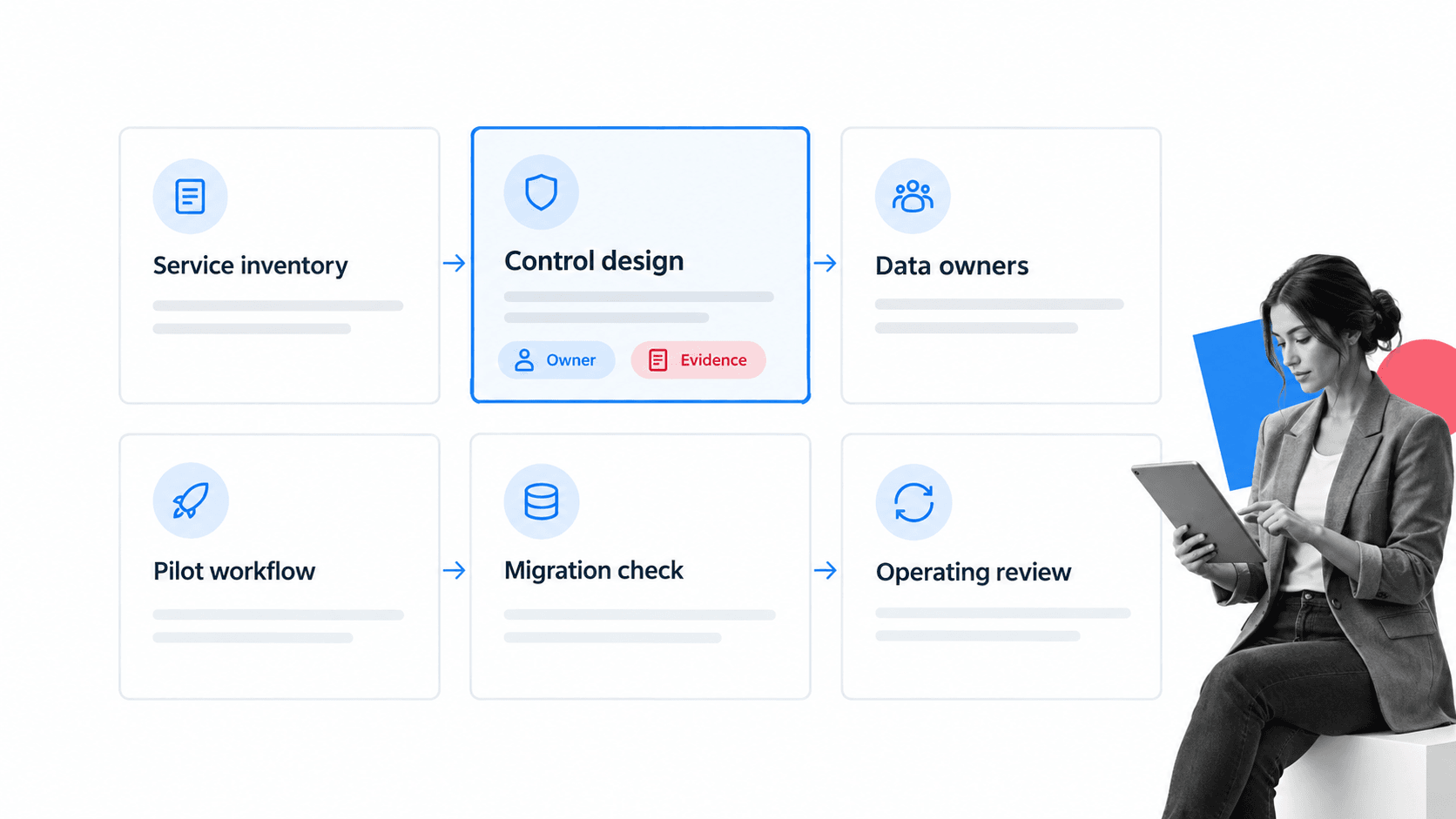
Implementing a wealth management system is an operating-model project supported by technology. The safest path is to define the service, data, ownership, and controls before moving every process at once.
Step 1: Inventory services and workflows
List every recurring client and internal process. Group the inventory into acquisition, onboarding, planning, investment operations, client service, compliance, reviews, and offboarding. Existing wealth management workflows can expose the handoffs that matter most.
Step 2: Name systems of record
For each important data element, name the authoritative system, owner, update path, and downstream consumers. Resolve duplicate and conflicting records before adding automation, or the automation will move uncertainty faster.
Step 3: Define the system of action
Choose where work is assigned, routed, approved, monitored, and evidenced. The system of action should reference source records without pretending to replace every specialist system.
Step 4: Design controls and exceptions
Use compliance management software principles to place required fields, segregation of duties, approvals, evidence, and exception routes inside the work. Controls should concentrate on material risks instead of adding friction to every routine action.
Step 5: Pilot one end-to-end journey
Choose a journey with visible pain and measurable outcomes, such as onboarding, annual review, document collection, or an account change. Test the full path from client trigger through record update and confirmation.
Step 6: Migrate in controlled waves
Move related workflows together, validate integrations, reconcile records, train every participating role, and keep clear rollback criteria. Avoid a broad launch that hides whether failures come from data, process, integration, or training.
Step 7: Establish operating review
Review completion time, rework, missing information, approval delays, exception frequency, integration failures, client follow-up, and policy drift. The system should improve from execution evidence, not from anecdotes alone.
How to evaluate a wealth management system
Evaluate a wealth management system by how well it connects the service promise to reliable execution. Feature breadth matters, but operating fit matters more.
Architecture questions
- Which system owns each critical record?
- How does the client experience connect to internal work?
- Can workflows span CRM, planning, portfolio, document, and communication tools?
- How are failed integrations and conflicting records handled?
Control questions
- Can required information block incomplete work?
- Can higher-risk cases route to accountable approval?
- Does the system preserve evidence and exception reasons?
- Can access, controls, and workflows be reviewed on a schedule?
Usability and change questions
Advisors and operators should be able to see the next action without learning every system in the stack. Process owners should be able to update a workflow without breaking governance. Clients should receive clear requests and confirmations without seeing internal complexity.
Outcome questions
Measure the system against onboarding time, request turnaround, incomplete submissions, repeated data entry, approval delay, exception rates, advisor capacity, client follow-up, and audit preparation. Avoid declaring success because applications are connected or a dashboard is live.
Ownership questions
Ask who owns the operating model after implementation. Technology may be administered by IT, but service workflows also need accountable business owners in advisory operations and compliance. Each workflow should have one person responsible for the standard, one person responsible for technical reliability, and a defined group that approves material changes.
Ownership should cover the boring failure modes as well as the launch plan. Someone needs to review failed automations, stale queues, duplicate records, overdue approvals, unused fields, and workarounds that have moved back into email. If nobody owns those signals, the system will slowly separate from the way the firm actually works.
Change-management questions
A wealth management system changes daily behavior across several roles. Evaluate whether the implementation gives advisors a clear reason to use the new process, gives operations teams a faster path through routine work, and gives compliance reviewers better evidence without forcing them to inspect every case manually.
Training should follow real client journeys, not isolated feature tours. An advisor should be able to start a review, an operator should be able to identify missing evidence, a reviewer should be able to approve or return a case, and a manager should be able to locate an exception. Those scenarios reveal gaps faster than a generic product demonstration.
Resilience questions
Ask what happens when a specialist application is unavailable, an integration fails, a staff member leaves, or a client sends information through the wrong channel. The system should preserve ownership and provide a visible recovery path rather than allowing work to vanish into a private inbox.
Resilience also means the firm can change a workflow safely. Updates should be reviewed, tested, communicated, and traceable. A system that is easy to change but impossible to govern creates inconsistency. A system that is tightly governed but too difficult to change pushes teams back to workarounds. The right design supports both controlled change and practical ownership.
Run wealth management operations in Process Street
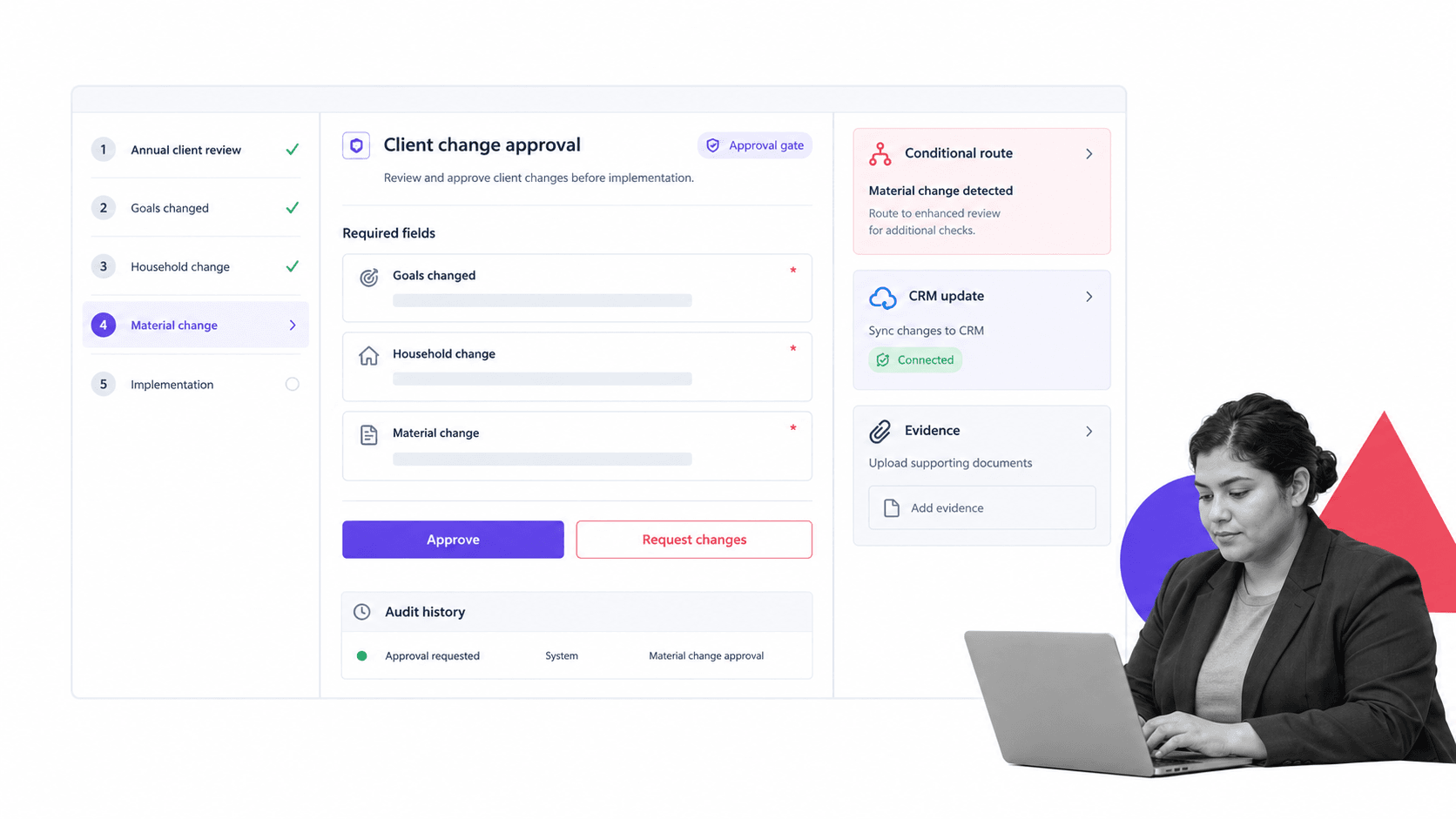
Process Street is an Agentic Process Automation platform for high-stakes operations. It can serve as the system of action that coordinates recurring wealth management work across advisors, operations, compliance, clients, and specialist systems.
Turn service standards into executable workflows
Teams can build assigned workflows for onboarding, annual reviews, account changes, document requests, money movement, complaints, and offboarding. That turns a wealth management service promise into visible tasks, owners, timing, and completion states.
Collect complete information
Required fields and files keep work from advancing without the client context, evidence, decision, or owner needed by the next role. Conditional logic can adapt the path when client type, request type, risk, or material change requires different handling.
Place approval at the point of risk
Approval tasks can hold consequential work until the right reviewer signs off. Routine cases keep moving, while exceptions, material changes, incomplete evidence, or policy-sensitive requests become visible.
Connect the specialist stack
Process Street has direct, universal integrations to 5,000+ systems. Need a new one? An AI agent builds it on the fly. That lets workflows coordinate CRM, planning, portfolio, document, communication, and reporting systems while each system retains its proper record ownership.
Create proof while work happens
Assignments, field values, files, comments, approvals, automation events, and task history create an operating record during execution. Managers can inspect current state and exceptions without rebuilding the story from email.
A wealth advisory operations case study shows how structured workflows can expand advisory capacity. The broader financial workflows and financial process management patterns explain why consistent execution is the connective tissue of the system.
FAQs
What is a wealth management system?
A wealth management system is the connected operating model that links client experience, relationship data, planning, portfolio work, documents, controls, and recurring workflows. It can include several specialist applications plus a system of action that coordinates work across them.
What should a wealth management system include?
It should include reliable client and household records, planning and portfolio context, secure document handling, client communication, workflow execution, approvals, integrations, exception management, reporting, and audit history. The exact mix depends on the firm’s service model.
How is a wealth management system different from a CRM?
A CRM primarily manages relationship and interaction data. A wealth management system is broader: it connects CRM data to planning, portfolio, documents, client experience, service workflows, controls, and evidence.
What is a front-to-back wealth management system?
A front-to-back wealth management system connects client-facing activity with middle-office controls and back-office execution. A client request should move through ownership, review, system updates, evidence, and confirmation without disappearing between tools.
How do you implement a wealth management system?
Inventory services and workflows, name authoritative systems and data owners, define the system of action, design controls and exceptions, pilot one complete client journey, migrate in waves, and establish an ongoing operating review.
How can Process Street support wealth management operations?
Process Street can coordinate recurring wealth management work as assigned workflows with required fields, conditional routing, approvals, integrations, evidence, and audit history. It acts as a controlled system of action across the firm’s specialist tools.