

Turn every policy into automated workflows with built-in enforcement and audit-ready proof.

Supplier Relationship Management Software

Supplier relationship management software is a system for managing supplier information, segmentation, performance, risk, collaboration, and improvement across the supplier lifecycle. It gives procurement, supply chain, quality, compliance, and operations teams one operating view of each relationship, then helps them turn reviews and exceptions into accountable work.
SRM software is not only a supplier database. A database can store contacts, contracts, certificates, and spend. A relationship management system also shows which suppliers matter most, what each side has committed to, where performance is drifting, who owns the response, and whether improvement work actually closed.
This guide explains what supplier relationship management software does, why it matters, the capabilities to expect, how to segment and govern suppliers, how the lifecycle works, which performance and risk signals to track, and how to choose a platform. It also shows how to connect supplier insight to controlled execution.
In this article, we are going to cover:
- What is supplier relationship management software?
- Why supplier relationship management software matters
- Core capabilities of SRM software
- Supplier segmentation and governance
- The supplier lifecycle workflow
- Supplier performance and risk management
- Supplier management in Process Street
- How to choose supplier relationship management software
- FAQs
What is supplier relationship management software?
The ASCM supply chain dictionary defines supplier relationship management as a comprehensive approach to managing an enterprise’s interactions with the organizations that supply its goods and services. Supplier relationship management software supports that approach with structured data, workflows, scorecards, communication records, risk signals, review cadences, and improvement tracking.
SRM is a strategy and a system
The strategy decides which supplier relationships deserve deeper investment and what value the business expects from each one. The system makes that strategy repeatable. It keeps supplier records current, schedules the right reviews, captures evidence, compares performance, routes exceptions, and gives both operational teams and leadership a shared record.
That scope overlaps with vendor management, but SRM puts more weight on the long-term quality of the relationship. It asks how the organization should collaborate with a strategic supplier, not only whether a vendor completed onboarding or submitted a certificate.
SRM versus procurement and vendor management
Procurement focuses on sourcing, buying, contracting, and spend. procurement management governs how those purchasing activities are planned and controlled. Vendor management often covers onboarding, records, compliance, contracts, and service delivery. SRM connects those foundations to segmentation, joint planning, performance development, innovation, and executive governance.
The boundaries vary by organization. Some teams use supplier and vendor as synonyms. Others reserve supplier for organizations that directly affect production or service delivery. The label matters less than the operating model: every critical external relationship needs an owner, expectations, evidence, review, escalation, and a path to improvement.
Why supplier relationship management software matters
Suppliers influence cost, quality, resilience, compliance, service, and the speed of change. When supplier information is scattered across email, spreadsheets, ERP records, contract folders, quality systems, and individual memory, leaders cannot see the full relationship or coordinate the response when something changes.
It creates one relationship record
A useful supplier record combines the facts teams need to make decisions: ownership, category, segmentation, contracts, qualifications, locations, products or services, performance, risk, open actions, and review history. The goal is not to duplicate every source system. It is to connect the information that explains the relationship and the work that keeps it healthy.
It makes expectations measurable
Relationships weaken when expectations live only in a contract or quarterly slide. SRM software turns expectations into scorecard measures, review questions, evidence requirements, action owners, and escalation rules. A supplier and buyer can then discuss the same facts and see which commitments are open.
It reduces reactive supplier management
Without a system, a team often reviews a supplier only after a late delivery, quality failure, security issue, or renewal surprise. SRM software creates planned operating rhythms and links exceptions to a third-party risk management workflow. That lets teams detect drift earlier and respond consistently rather than rebuilding the history during a crisis.
It supports collaboration, not only control
The collaborative side matters most for strategic suppliers. ISO 44001 collaborative business relationship management standard provides a structured standard for collaborative business relationship management. The practical lesson is that collaboration needs governance: shared objectives, clear roles, agreed review points, issue resolution, and a way to learn from outcomes. Software gives those commitments a working home.
Core capabilities of SRM software
Strong SRM software connects supplier data to supplier work. A long feature list is less useful than a clear path from qualification to review, exception, action, and proof. Evaluate the category across data, lifecycle, performance, risk, collaboration, and execution.
Supplier master data and profiles
The platform should maintain ownership, contacts, categories, locations, products or services, criticality, certifications, documents, contract references, and relationship history. It should also define who can change important fields and how those changes are reviewed.
Qualification and onboarding
A supplier should not enter the operating environment through an email handoff. A structured vendor onboarding process collects the right information, runs due diligence, assigns risk, gathers documents, routes approval, and establishes the initial management plan. Teams can start from a new vendor onboarding checklist and adapt it by supplier type.
Performance scorecards and reviews
Scorecards should support measures that fit the relationship, not force every supplier into one generic template. The software should collect data, show trends, preserve commentary, record review decisions, and create actions when performance misses an agreed threshold.
Risk, compliance, and evidence
Supplier risk changes over time. SRM software should support risk reviews, evidence collection, policy checks, control ownership, exceptions, remediation, and escalation. NIST Cybersecurity Supply Chain Risk Management guidance shows why cyber supply chain risk requires a managed program rather than a one-time questionnaire.
Collaboration and improvement
Strategic relationships need shared plans, meeting records, ideas, commitments, and improvement work. The platform should help both sides turn a discussion into an owner, due state, evidence requirement, decision, and closed result. Collaboration without follow-through is only conversation.
Integration and workflow automation
Supplier relationship management software should connect with ERP, procurement, contract, quality, risk, identity, finance, and communication systems. It should also support automated procurement software so routine routing, reminders, record updates, and evidence requests do not depend on manual coordination.
Supplier segmentation and governance
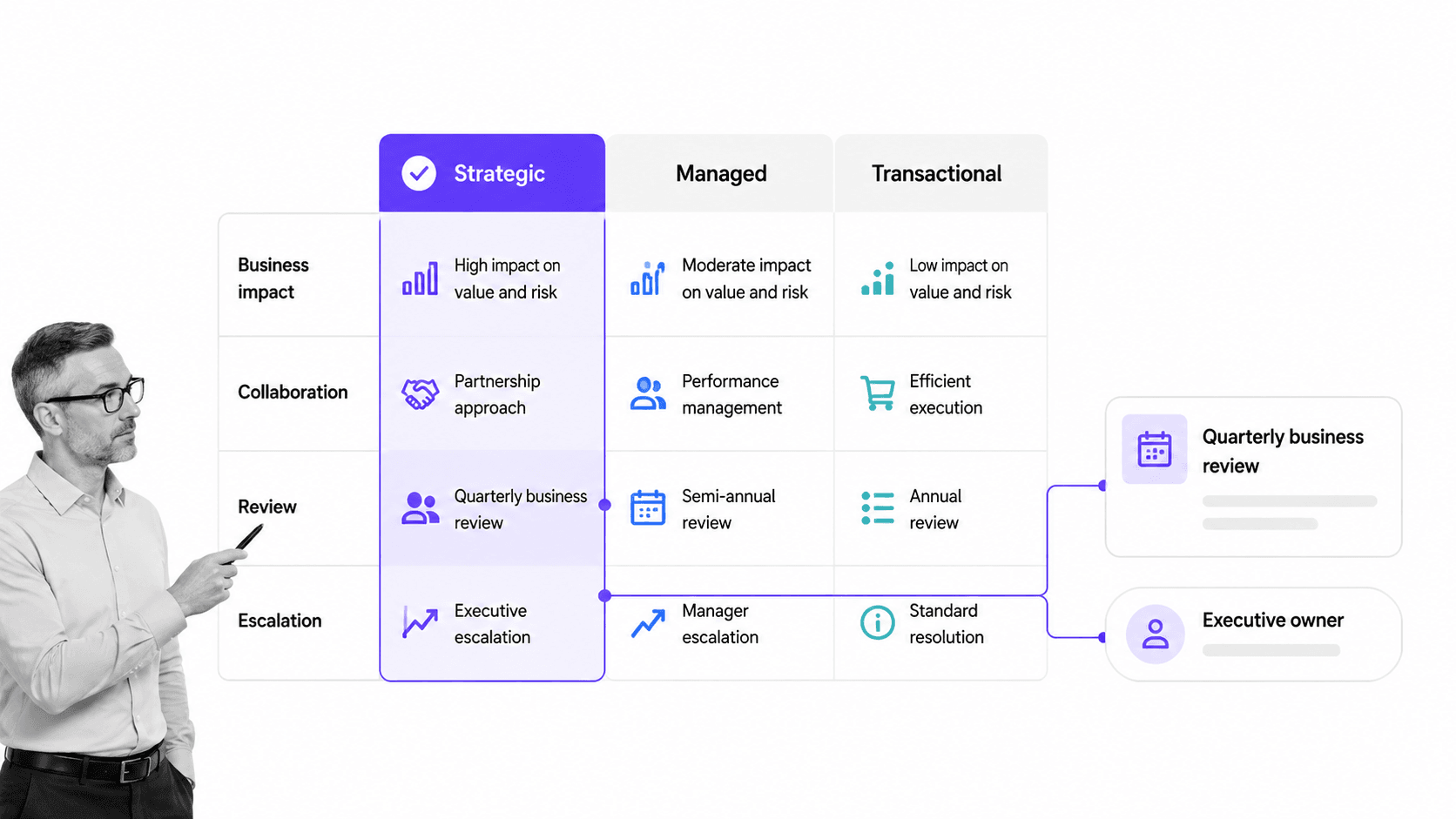
Supplier segmentation decides how much management attention each relationship receives. It prevents a team from applying an expensive governance model to every supplier while leaving critical relationships under-managed. The output should be a practical operating tier, not a label that sits unused in a profile.
Choose segmentation factors
Common factors include business impact, supply criticality, switching difficulty, risk, spend, innovation potential, customer impact, regulatory exposure, data access, and concentration. Use a small set that explains how the relationship should be managed. Spend alone is rarely enough because a low-spend supplier can still create high operational or compliance risk.
Translate each tier into governance
- Strategic: executive owner, joint objectives, regular business reviews, shared improvement plan, and fast escalation.
- Managed: named operational owner, periodic scorecard review, targeted risk checks, and corrective action when thresholds are missed.
- Transactional: standardized qualification, service monitoring, exception-based review, and efficient renewal or exit controls.
The tier should control review frequency, participants, measures, evidence, escalation, and collaboration. A change in supplier criticality or risk should trigger a segmentation review so the governance model stays aligned with reality.
Keep governance reciprocal
Supplier relationships are two-way. The buyer should also track its own commitments, decision speed, forecast quality, issue resolution, and communication. CIPS supplier relationship management resources frames SRM as a professional discipline, and the operating model becomes stronger when the review asks what both sides can improve.
The supplier lifecycle workflow
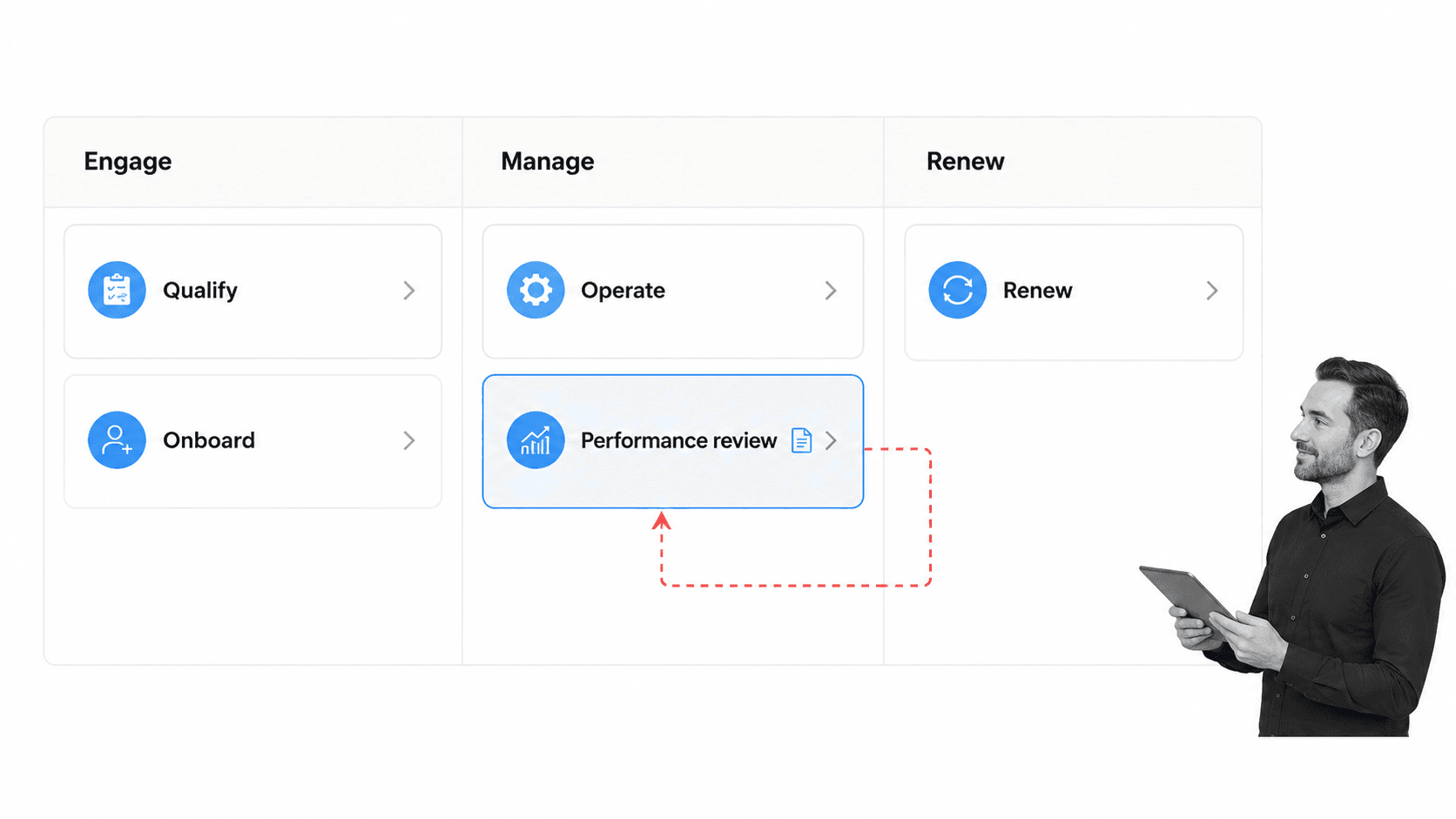
A supplier lifecycle connects qualification, onboarding, operation, review, renewal, and exit. Supplier relationship management software should preserve that continuity so each stage starts with the decisions and evidence from the stage before it.
1. Qualify and segment
Collect the supplier’s profile, capability, ownership, risk, compliance evidence, quality information, and commercial context. A structured supplier evaluation workflow helps teams compare candidates consistently. Assign the first relationship tier and define the checks required before approval.
2. Onboard and establish controls
Complete the relevant vendor onboarding checklist, confirm internal and supplier owners, connect systems, approve documents, define scorecard measures, and schedule the first review. The onboarding outcome should be a live management plan, not only an activated vendor record.
3. Operate and monitor
Capture delivery, quality, service, compliance, responsiveness, financial, and risk signals at the cadence the relationship needs. Routine performance should stay lightweight. Exceptions should route immediately to the right owner with the context and evidence needed to act.
4. Review and improve
Run operational reviews for day-to-day performance and broader business reviews for strategic relationships. Record decisions, corrective actions, improvement ideas, supplier commitments, buyer commitments, evidence, and follow-up. The system should make open actions visible between meetings.
5. Renew, expand, remediate, or exit
A renewal decision should combine commercial terms with performance, risk, relationship quality, and open obligations. If the relationship expands, update segmentation and controls. If it exits, protect continuity, data, access, assets, records, and knowledge through a controlled procurement process.
Supplier performance and risk management
Supplier performance and supplier risk belong in the same operating conversation. Performance shows whether commitments are being met. Risk shows how future disruption or failure could affect the organization. Both need context, ownership, thresholds, and action.
Build a balanced supplier scorecard
Choose measures that reflect the supplier’s role. Common categories include quality, delivery, cost, service, responsiveness, compliance, innovation, sustainability, and resilience. Define the calculation, source, owner, cadence, threshold, and action for each measure. Avoid measures that no one trusts or can influence.
Use evidence with the score
A number without evidence invites argument. Link the score to the underlying incidents, inspections, deliveries, cases, documents, or reviews. Commentary should explain material changes and separate a one-time event from a repeated pattern.
Connect thresholds to action
A threshold should do more than change a dashboard color. It should trigger investigation, ownership, review, remediation, approval, or escalation. approvals can hold a supplier decision until the required reviewer signs off, while conditional logic can route different paths by severity, category, or risk tier.
Treat corrective action as a closed loop
A corrective action needs a cause, owner, plan, evidence, effectiveness check, and closure decision. Quality-sensitive relationships may also connect supplier work to quality management system software so supplier issues and internal quality controls share the same proof chain.
Sustainable procurement adds another decision layer. ISO 20400 sustainable procurement guidance provides guidance for integrating sustainability into procurement. SRM software can make those requirements operational through qualification evidence, scorecard measures, improvement actions, and renewal review.
Supplier management in Process Street
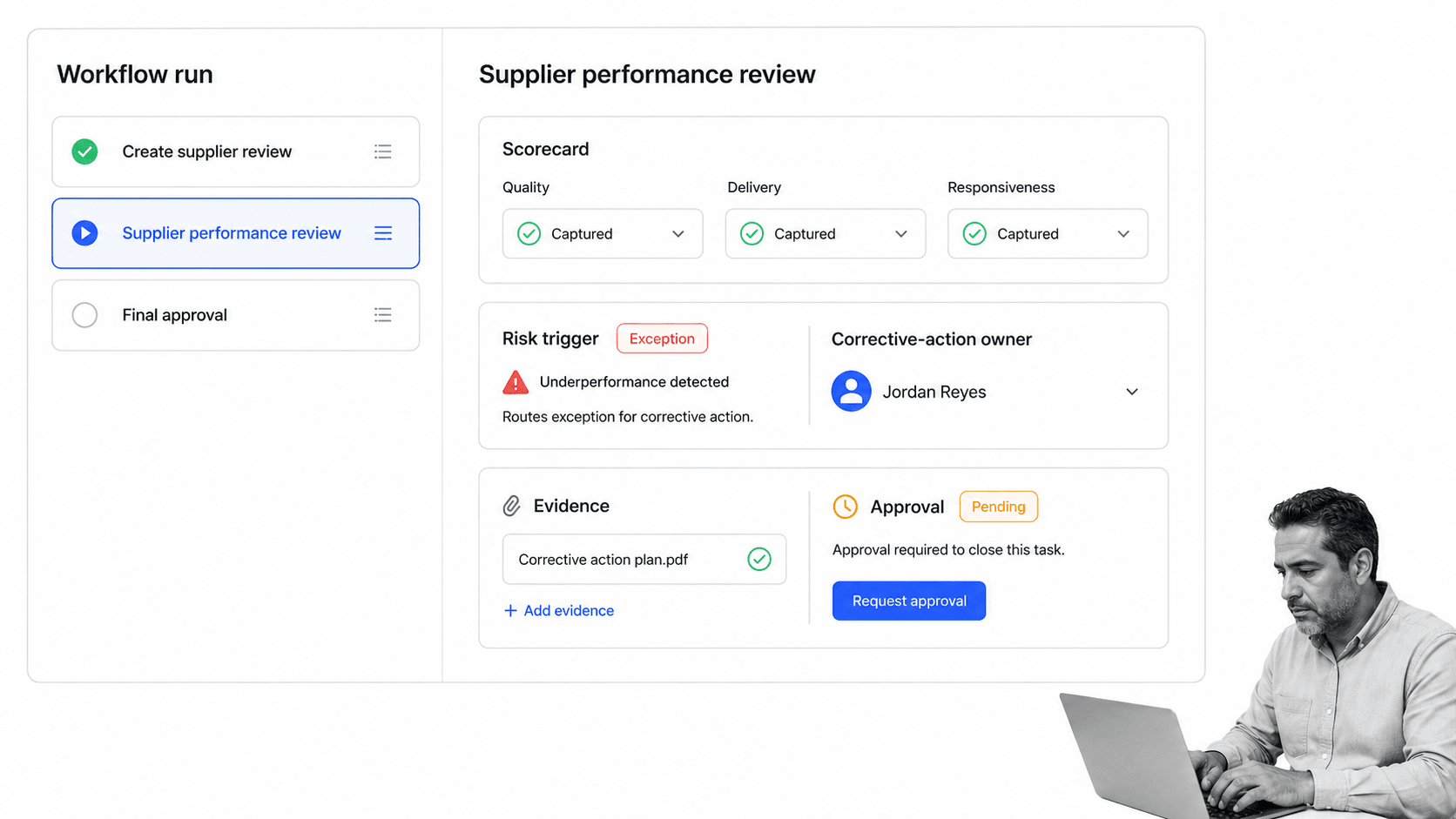
Supplier management in Process Street starts where the supplier record becomes work. A qualification, risk signal, performance miss, review commitment, corrective action, renewal, or exit can launch a controlled workflow with assignments, required fields, conditional routing, approvals, evidence, and audit history.
Process Street is becoming an Agentic Process Automation platform for high-stakes operations. It is strongest in an SRM stack when teams need supplier policies and decisions to become repeatable execution that can be monitored and proven.
Run supplier processes consistently
Teams can build workflows for qualification, onboarding, scorecard review, risk assessment, certificate renewal, business reviews, corrective action, supplier change, and offboarding. Each workflow defines the owner, required information, decision points, evidence, escalation, and closure rule.
Route exceptions by context
A strategic supplier, high-risk data processor, quality-critical manufacturer, and routine service provider should not follow the same path. Conditional logic can route the workflow by tier, category, geography, risk, performance, or requested access. Approvals keep high-impact decisions from closing without review.
Connect the supplier stack
Process Street has direct, universal integrations to 5,000+ systems. Need a new one? An AI agent builds it on the fly. That lets teams connect supplier workflows with procurement, ERP, contract, quality, risk, finance, communication, and analytics systems while keeping the human decisions controlled.
Create proof as work happens
Every run preserves who did what, which evidence was supplied, which path the workflow followed, who approved the decision, and whether the action closed. That record supports supplier reviews, audits, renewals, and improvement without reconstructing the history from inboxes.
How to choose supplier relationship management software
Choose supplier relationship management software by testing the operating model, not only the interface. The right platform should fit supplier criticality, connect with systems of record, support the review cadence, and make exceptions easier to resolve.
Start with the relationship model
Define supplier types, segmentation logic, governance tiers, owners, scorecards, risks, evidence, review cadences, and escalation paths before comparing products. If those decisions are unclear, the software will automate inconsistency.
Map systems and data ownership
List where supplier, contract, spend, purchase, quality, risk, access, and performance data lives. Decide which system remains authoritative for each field. The SRM layer should connect these records without becoming an uncontrolled duplicate of every supply chain management tools application in the stack.
Evaluate workflow depth
Ask how the product handles qualification, review, evidence, exception routing, approvals, corrective actions, recurring obligations, and renewal. A portal and dashboard can improve access, but the real test is whether the system gets the right work completed and shows proof.
Test supplier and internal usability
A process that suppliers cannot understand will create email workarounds. A process that category, quality, security, legal, finance, and operations teams cannot share will recreate silos. Run one real relationship end to end with the people who will use it.
Check governance and adaptability
Confirm role-based access, change control, audit history, evidence retention, integration monitoring, and ownership. Then test whether the team can change a question, threshold, route, scorecard, or review cadence without a long development cycle.
Use a practical pilot
Choose one important supplier process, such as qualification, performance review, or corrective action. Run it with live owners and evidence. Compare the result with the current process and review current Process Street pricing information before making the commercial decision. The pilot should prove data fit, workflow fit, adoption, and auditability.
FAQs
What is supplier relationship management software?
Supplier relationship management software is a system for managing supplier information, segmentation, performance, risk, collaboration, reviews, and improvement across the supplier lifecycle. It helps procurement, supply chain, quality, compliance, and operations teams coordinate each relationship and turn decisions into accountable work.
What does SRM software do?
SRM software maintains supplier profiles, supports qualification and onboarding, segments suppliers, tracks performance and risk, schedules reviews, records collaboration, routes exceptions, assigns corrective actions, and preserves evidence. The strongest systems connect supplier data with the workflows required to act on it.
How is SRM software different from procurement software?
Procurement software focuses on sourcing, purchasing, contracting, and spend. SRM software focuses on the ongoing relationship, including segmentation, governance, performance, risk, collaboration, and improvement. Many organizations connect both so commercial transactions and relationship management share context.
What supplier performance metrics should SRM software track?
Track measures that match the supplier’s role. Common categories include quality, delivery, cost, service, responsiveness, compliance, innovation, sustainability, and resilience. Every measure should have a clear definition, source, owner, cadence, threshold, and action.
How do you implement supplier relationship management software?
Start by defining supplier types, segmentation, governance tiers, owners, scorecards, risks, evidence, review cadences, and escalation paths. Map systems of record, pilot one important supplier process end to end, connect the data, train both internal users and suppliers, and improve the model from real execution evidence.
Can Process Street support supplier relationship management?
Yes. Process Street can run supplier qualification, onboarding, risk review, performance review, corrective action, renewal, and offboarding workflows with assignments, required fields, conditional routing, approvals, evidence, integrations, and audit history. It complements procurement and ERP records with a controlled execution layer.