Turn every policy into automated workflows with built-in enforcement and audit-ready proof.


Healthcare Planner

A healthcare planner is a professional who turns population needs, service demand, clinical priorities, workforce capacity, facilities, technology, finance, and quality requirements into a plan that a healthcare organization can actually deliver. The role sits between strategy and daily operations.
The title can mean different things across health systems. Some healthcare planners focus on services and capacity. Others specialize in facilities, workforce, public health programs, clinical operations, or long-range strategy. The common responsibility is to connect evidence, constraints, stakeholders, and delivery decisions.
This guide explains what a healthcare planner does, the areas they plan, the responsibilities and skills the role needs, the healthcare planning cycle, the evidence and governance required, and how to turn an approved plan into controlled execution.
In this article, we are going to cover:
- What is a healthcare planner?
- What healthcare planners plan
- Healthcare planner responsibilities
- The healthcare planning cycle
- Data and evidence for healthcare planning
- Healthcare planning governance and compliance
- Run healthcare planning in Process Street
- How to make a healthcare planner successful
- FAQs
What is a healthcare planner?
A healthcare planner analyzes current and future health needs, evaluates the capacity of services to meet them, develops practical options, coordinates stakeholder decisions, and tracks whether the resulting plan improves access, quality, efficiency, and resilience. The planner may work for a hospital, health system, public agency, insurer, consulting firm, design practice, or community program.
The planner connects strategy to delivery
A strategy may promise better access, safer care, shorter waits, stronger prevention, or more equitable outcomes. The healthcare planner translates that ambition into service models, workforce needs, capacity assumptions, facility and technology requirements, milestones, owners, risks, and measures. In a complex healthcare system, that translation is what separates a credible plan from a wish list.
The role is different from care planning
Individual care planning focuses on a patient’s goals, treatment, support, and coordination. Healthcare planning at the organizational or system level focuses on the services, resources, and operating model needed for many patients or populations. Both require collaboration and evidence, but their scope and decision rights are different.
The role is different from scheduling
Scheduling assigns specific people, rooms, or resources to specific times. Planning determines how much capacity should exist, where it should sit, which service model should use it, what demand it must meet, and how leaders will respond when assumptions change. Scheduling is one execution layer within a wider plan.
What healthcare planners plan
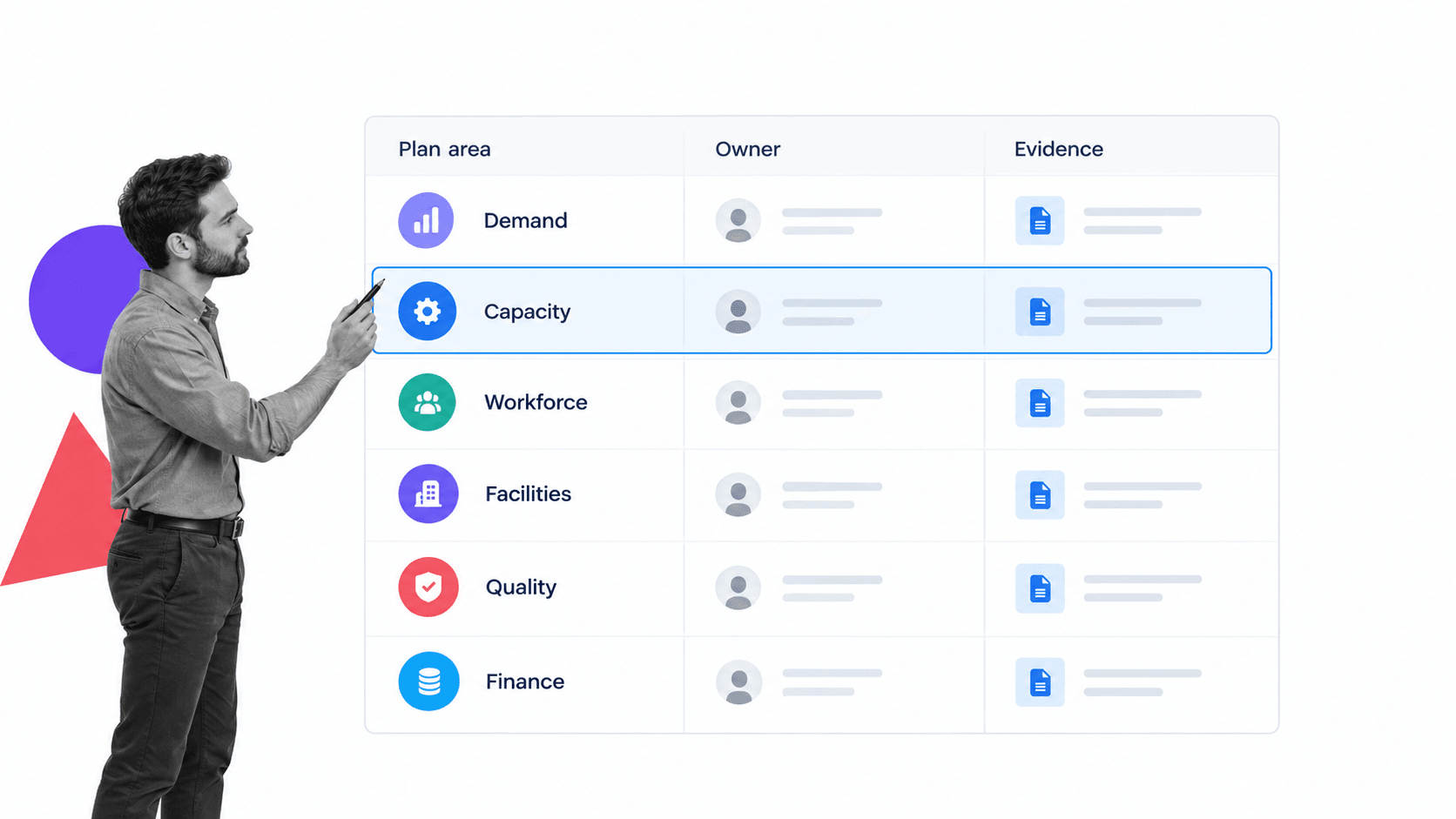
Healthcare planners rarely own only one variable. A service plan becomes credible when demand, capacity, workforce, infrastructure, quality, technology, and finance agree with one another.
Population and service demand
Planners study who needs care, which needs are changing, where demand appears, what barriers affect access, and how activity may shift over time. They distinguish total demand from the demand a service can appropriately address, then document the assumptions behind each forecast.
Capacity and patient flow
Capacity includes staff time, beds, rooms, clinics, equipment, referral pathways, diagnostic access, and administrative support. Planners look for bottlenecks across the whole pathway, not only inside one department. A constrained handoff can limit the value of capacity added elsewhere.
Workforce and skills
A workforce plan links required activity to roles, skills, availability, training, and sustainable working patterns. The NHS medical job planning guide emphasizes aligning service demand with clinical capacity and reviewing job planning data alongside activity and financial information. The same principle applies beyond medical staff: capacity is useful only when the right skills are available at the right point in the pathway.
Facilities, technology, and resilience
A planner connects the service model to healthcare infrastructure, digital systems, equipment, privacy, infection prevention, maintenance, and business continuity. New space or software should solve a documented operating need and fit the wider pathway, rather than becoming an isolated project.
Quality, equity, and financial sustainability
A plan must show how it will protect quality, improve outcomes, support equitable access, and remain financially deliverable. These are not separate appendices. They are tests applied to every major planning option.
Healthcare planner responsibilities
Healthcare planner responsibilities change with the organization, but strong roles share a consistent core: build the evidence base, structure decisions, make tradeoffs visible, and keep delivery connected to the approved plan.
Assess the current state
The planner maps services, demand, waiting lists, workforce, facilities, technology, finances, quality signals, and known risks. Current-state work should identify variation and constraints without assuming that today’s operating model is the right starting point for the future.
Develop options and recommendations
A good option describes the service model, expected benefits, required resources, dependencies, risks, implementation sequence, and measures. The planner should make assumptions explicit so leaders can challenge them before approval.
Coordinate stakeholders
Plans touch clinical teams, operations, finance, workforce, estates, technology, quality, compliance, patients, and community partners. The planner creates a decision process that gives each group a clear role without allowing consultation to become endless delay.
Maintain the planning record
Decision logs, evidence sources, option appraisals, approvals, dependencies, risks, and change history need one controlled record. When assumptions change, the organization should know which decisions and delivery commitments are affected.
Explain tradeoffs clearly
Healthcare plans rarely have one option that improves every outcome without cost or disruption. A planner should show what each option improves, what it delays, which groups are affected, which resources it consumes, and which risks remain. Clear option appraisal helps decision makers compare choices on the same basis instead of rewarding the proposal with the strongest presentation.
The planner also needs to translate specialist evidence into language that different stakeholders can use. Clinical leaders may focus on safety and outcomes, finance leaders on affordability, workforce leaders on recruitment and skills, and operations leaders on flow. The planning record should preserve those perspectives while bringing them back to one decision and one set of accountable actions.
Track delivery and benefits
Planning does not end when a document is approved. The planner connects milestones and measures to healthcare monitoring so leaders can see whether implementation is on time, whether capacity is changing as expected, and whether the plan is improving the intended outcomes.
The healthcare planning cycle
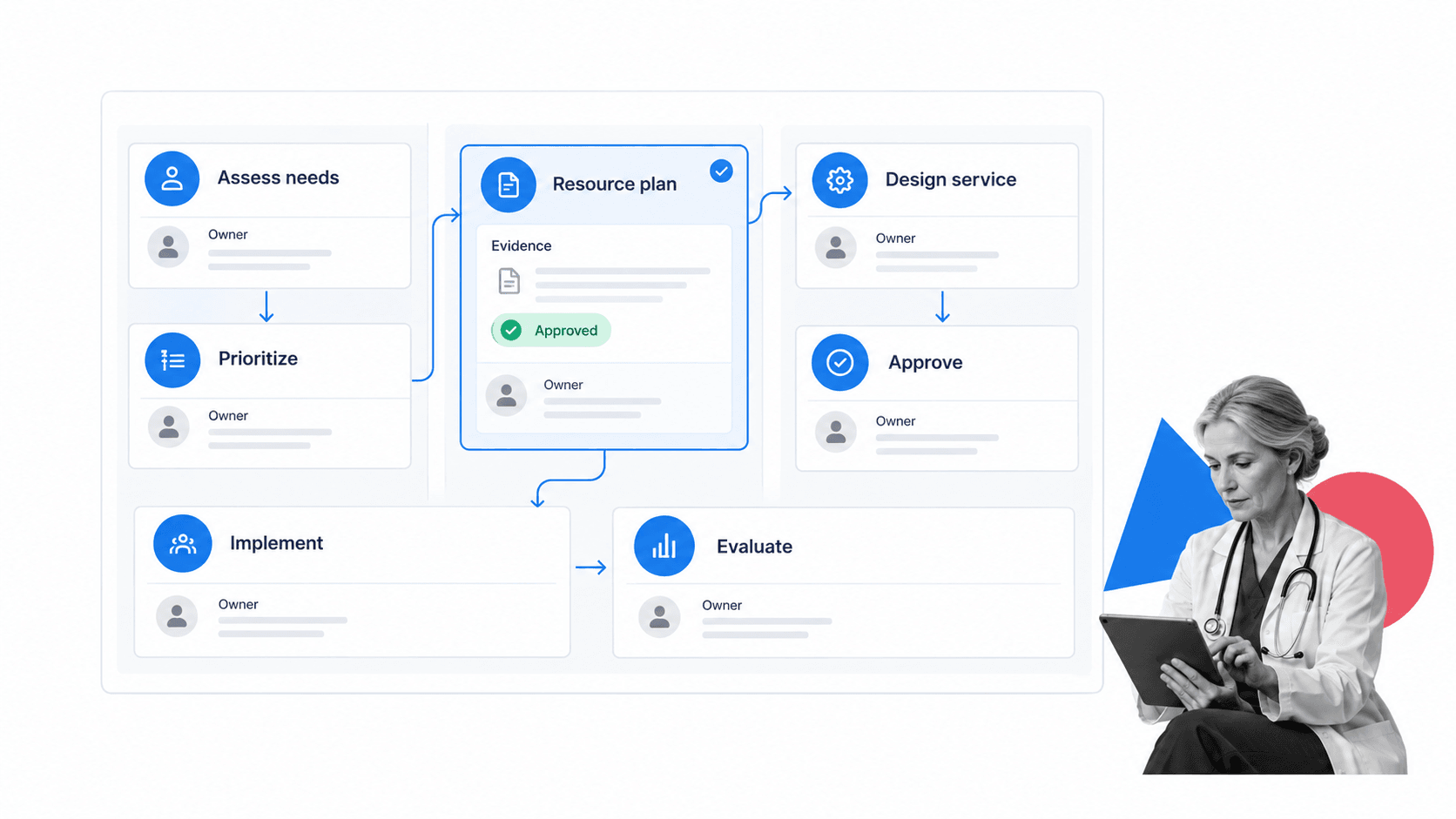
The NHS England planning framework describes planning as a continuous, iterative process that joins strategy, resources, delivery, and performance management. A healthcare planner can use that principle as a practical cycle rather than treating planning as an annual document exercise.
1. Assess needs and the current state
Define the population, service, outcome, and planning horizon. Gather demand, activity, capacity, workforce, quality, financial, and experience data. Record data gaps and confidence levels rather than hiding uncertainty.
2. Set priorities and outcomes
Translate broad ambitions into a small set of measurable outcomes. Priorities should reflect clinical need, population impact, equity, safety, statutory obligations, feasibility, and opportunity cost.
3. Design the service model
Map how people, information, and decisions should move. The WHO health communication planning guide uses an iterative cycle that moves from understanding and planning through development, testing, implementation, evaluation, and learning. A proposed service model should apply the same discipline to entry points, handoffs, escalation, supporting systems, and the experience for patients and staff.
4. Build the resource plan
Connect expected activity to workforce, facilities, equipment, technology, suppliers, and budget. A detailed healthcare resource management makes dependencies and constraints visible before leaders commit to delivery dates.
5. Assure and approve the plan
Review clinical quality, finance, workforce, technology, data protection, compliance, implementation, and risk. Approval should name accountable owners, conditions, unresolved assumptions, and thresholds that require the plan to return for review.
6. Implement, measure, and adapt
Turn the plan into owned work, review progress on a fixed cadence, compare actual performance with assumptions, and change the plan when evidence requires it. Continuous planning is disciplined adaptation, not constant priority churn.
Data and evidence for healthcare planning
Healthcare planning is evidence-led, but evidence is more than a forecast. A planner needs enough context to understand why a number moved, how reliable it is, and which decision it can support.
Use a balanced evidence base
Combine population need, service activity, waiting time, referral patterns, workforce, capacity, quality, patient experience, finance, facilities, and technology data. Qualitative evidence from staff, patients, and partners explains constraints that dashboards alone miss.
Define measures before implementation
Measures should connect to the intended outcome and the process expected to create it. CMS quality measures provides formal quality measures for Medicare programs, while local plans may also need access, flow, equity, workforce, experience, cost, and reliability measures. Every measure needs an owner, source, frequency, threshold, and action.
Separate assumptions from facts
Forecast growth, productivity improvement, recruitment success, adoption, or capital timing may be assumptions rather than observed facts. Label them clearly, assign an owner, set a review date, and define what happens if the assumption fails.
Use scenarios for uncertainty
A single forecast can hide how exposed a plan is. Build a small set of plausible scenarios for demand, workforce availability, funding, technology readiness, or facility timing. For each scenario, identify the trigger that shows it is emerging and the response the organization will take. This turns uncertainty into a managed planning condition instead of a surprise discovered during implementation.
Create one source of planning truth
A planner may draw evidence from many systems, but the planning record should preserve the approved baseline, current forecast, decisions, changes, and supporting evidence. healthcare analytics can help connect analysis to decisions without turning the plan into a collection of disconnected reports.
Healthcare planning governance and compliance
Healthcare planning governance defines who can propose, review, approve, change, and monitor a plan. It protects the quality of decisions and prevents approved priorities from drifting as delivery becomes difficult.
Define decision rights
Name the plan sponsor, planner, workstream owners, clinical reviewers, finance reviewers, workforce reviewers, quality and compliance reviewers, and final approval body. Consultation should be broad, but accountability should be specific.
Control sensitive information
Planning may involve patient, workforce, financial, facility, and operational data. The HIPAA Security Rule safeguards standard requires administrative, physical, and technical safeguards for electronic protected health information. Applicability decisions belong with qualified privacy, security, and legal owners, while the workflow should enforce access and evidence requirements.
Use formal assurance gates
Clinical, quality, finance, workforce, technology, privacy, and implementation reviews should be explicit gates, not informal comments scattered across email. workflow approvals can require the right reviewer before a plan or material change advances.
Keep an auditable change history
When priorities, assumptions, budgets, or service models change, record what changed, why, who approved it, which risks moved, and what delivery work needs to be updated. A structured compliance management software or quality management system software can keep governance connected to daily execution.
Focused tools such as a clinical audit workflow and HIPAA compliance audit checklist can then turn assurance requirements into assigned evidence and remediation work rather than leaving them as static planning statements.
Run healthcare planning in Process Street
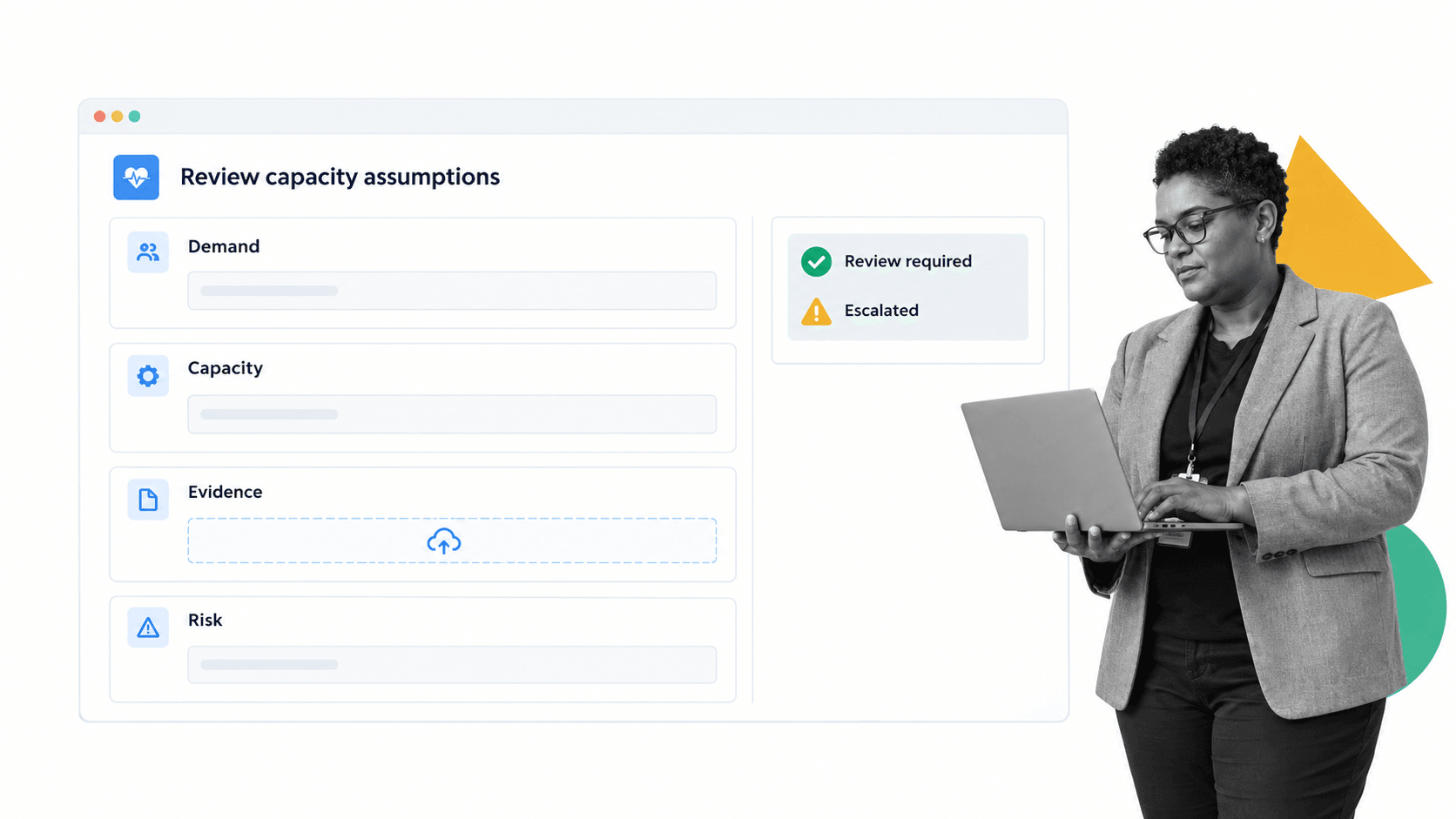
Running healthcare planning in Process Street means converting the planning cycle into workflows that assign owners, capture assumptions, require evidence, route risks, collect approvals, and preserve a decision history. The plan becomes executable work rather than a document people revisit only at reporting time.
Process Street is an agentic process automation platform and is HIPAA compliant. It is useful when strategy, operations, clinical, quality, finance, workforce, technology, and compliance teams need one controlled path from planning evidence to delivery decisions.
Create one workflow for each planning gate
Needs assessment, option appraisal, resource review, clinical assurance, finance review, executive approval, implementation readiness, benefits review, and plan change control can each run as reusable workflows. Required fields keep evidence attached to the decision.
Route plans by scope and risk
Use conditional logic to vary reviewers and evidence by service, investment level, patient impact, data sensitivity, or delivery risk. Routine adjustments can stay efficient while consequential changes receive deeper assurance.
Connect planning and implementation
A plan can trigger an owned healthcare workflow for each workstream, with milestones, dependencies, escalation, and outcome review. Process Street has 5,000+ integrations, so planning workflows can connect with the systems teams already use while keeping decisions and evidence visible.
Preserve proof
Each workflow run records owners, inputs, comments, attachments, approvals, exceptions, and completion. That record lets leaders trace how the plan changed and whether delivery followed the approved path.
How to make a healthcare planner successful
A healthcare planner succeeds when the organization gives the role clear authority, reliable evidence, engaged decision makers, and an execution system. Technical planning skill cannot compensate for vague ownership or a plan disconnected from operations.
Set a clear mandate
Define the planner’s scope, planning horizon, decision rights, required outputs, review cadence, and escalation path. Clarify where the planner recommends, where they coordinate, and where an executive or clinical owner decides.
Build multidisciplinary planning routines
Use regular working sessions with clinical, operations, finance, workforce, quality, technology, estates, and community partners. Each session should resolve named decisions or evidence gaps, not simply share updates.
Standardize planning artifacts
Use consistent templates for needs assessments, assumptions, options, resource plans, risk registers, assurance reviews, approvals, benefits, and change control. Standardization makes plans easier to compare and govern without forcing every service into the same model.
Pilot the full cycle
Choose one meaningful service problem, such as patient intake delays, referral capacity, clinic expansion, workforce redesign, or a quality improvement priority. Pair the plan with an operational healthcare process and a practical patient intake checklist so evidence, decisions, and frontline execution can be tested together.
Review planning quality
After each cycle, ask whether assumptions were accurate, decisions were timely, stakeholders understood tradeoffs, delivery owners had what they needed, and measures triggered action. Improve the planning process with the same discipline used to improve care processes.
FAQs
What is a healthcare planner?
A healthcare planner is a professional who turns health needs, service demand, workforce capacity, facilities, technology, finance, quality, and compliance requirements into a deliverable plan. The role connects strategy, stakeholder decisions, implementation, and performance review.
What does a healthcare planner do?
A healthcare planner assesses needs, forecasts demand, reviews capacity, develops service options, coordinates stakeholders, builds resource plans, supports assurance and approval, and tracks delivery. The exact emphasis depends on whether the role focuses on services, facilities, workforce, public health, or operations.
What skills does a healthcare planner need?
Healthcare planners need analytical thinking, facilitation, service design, forecasting, option appraisal, project and risk management, clear writing, and stakeholder communication. They also need enough clinical, operational, financial, workforce, technology, and compliance understanding to connect specialist input into one plan.
What is the healthcare planning cycle?
The healthcare planning cycle includes assessing needs, setting priorities, designing the service model, building the resource plan, assuring and approving the plan, implementing it, measuring results, and adapting when assumptions or needs change. It is continuous rather than a one-time annual document.
How is healthcare planning different from care planning?
Healthcare planning at the organizational or system level designs services, capacity, resources, and delivery models for populations or groups. Care planning focuses on the goals, treatment, and support needs of an individual patient. The two inform each other but use different scopes and decision rights.
Can Process Street support a healthcare planner?
Yes. Process Street can run needs assessments, option appraisals, resource reviews, assurance gates, approvals, implementation readiness checks, benefits reviews, and change control as assigned workflows. Conditional logic, evidence fields, integrations, approvals, and audit history keep the planning record controlled and actionable.