Turn every policy into automated workflows with built-in enforcement and audit-ready proof.


Best Compliance Software for AI Agents
Last updated:
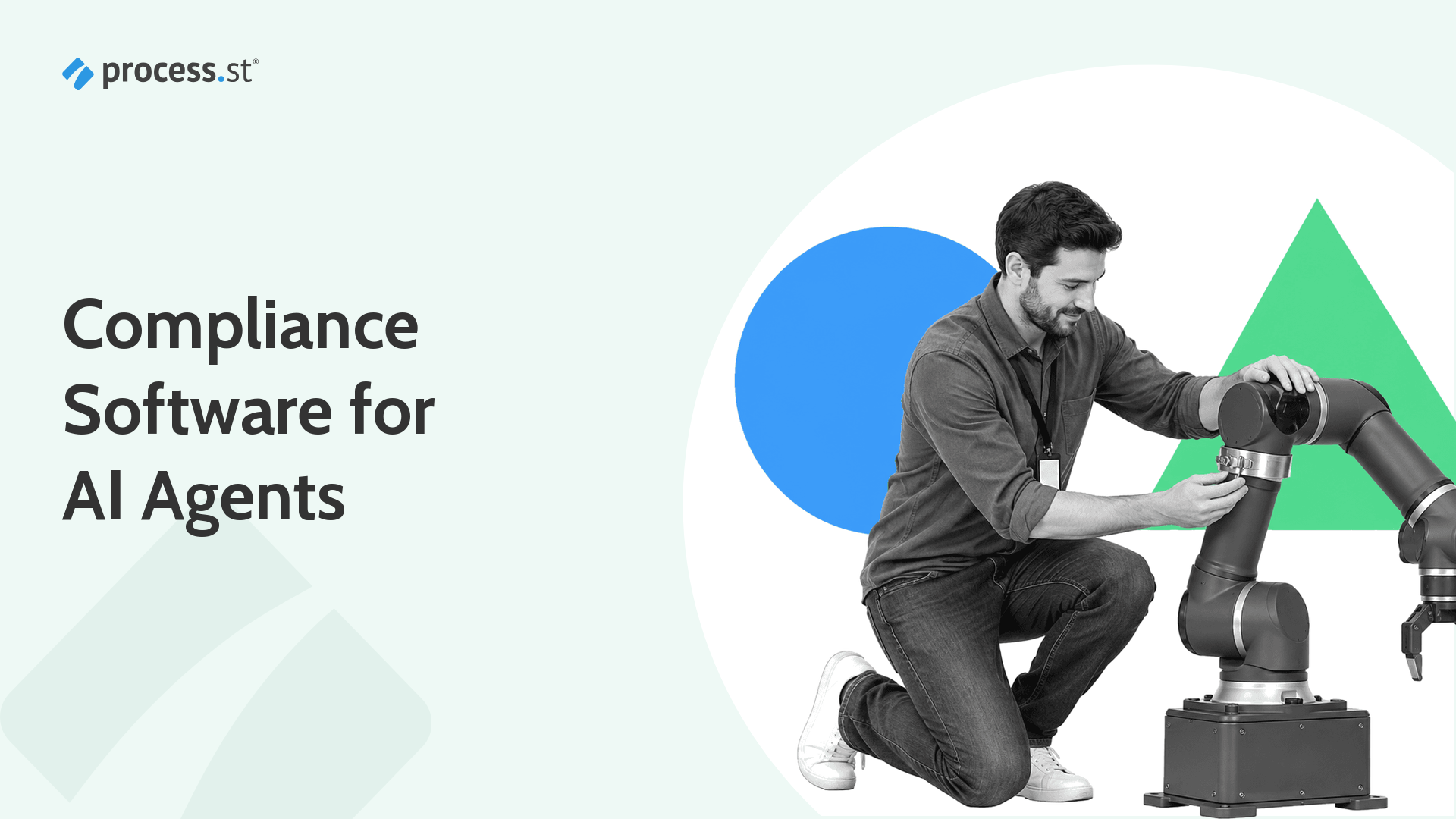
The best compliance software for AI agents gives you more than a policy library. It connects every agent to an owner, an approved purpose, defined permissions, review gates, evidence, and a record of what happened.
That distinction matters because an agent can call tools, read sensitive data, update systems, and hand work to other agents. A static review before launch cannot prove that the agent stayed inside its approved boundary after launch.
This guide compares five products from two useful angles: operational compliance, where teams control agent work through workflows and approvals, and technical AI governance, where teams inventory agents, enforce policies, monitor behavior, and preserve runtime evidence.
AI agent compliance software at a glance: Process Street is the strongest overall choice when you need agents, people, policies, evidence, and approvals to operate in one controlled process. OneTrust, Drata, Credo AI, and ModelOp address more specialized governance requirements such as agent inventory, runtime policy enforcement, and AI lifecycle oversight.
| Tool | Best for | Standout feature | Pricing |
|---|---|---|---|
| 1. Process Street | Operational compliance across agents and people | Executable workflows with approval gates and evidence | Published on the Process Street pricing page |
| 2. OneTrust | Enterprise agent inventory and runtime governance | Registered scope connected to continuous oversight | Contact OneTrust |
| 3. Drata | Preventive agent policy enforcement | Inline policy decisions with a chain of custody | Contact Drata |
| 4. Credo AI | Policy-led responsible AI governance | Organizational intent translated into runtime controls | Contact Credo AI |
| 5. ModelOp | Enterprise AI lifecycle and portfolio governance | Agents tied to use cases, owners, controls, and approvals | Contact ModelOp |
In this guide, you will learn:
- Best compliance software for AI agents shortlist
- How we evaluated the best compliance software for AI agents
- 1. Process Street
- 2. OneTrust
- 3. Drata
- 4. Credo AI
- 5. ModelOp
- How to choose the right fit
- How to implement AI agent compliance controls
- FAQs
Best compliance software for AI agents shortlist
This shortlist covers five distinct control layers: governed workflow execution, agent registration and scope, pre-execution policy enforcement, policy-to-runtime translation, and enterprise AI lifecycle oversight.
How we evaluated the best compliance software for AI agents
“Compliance software” covers several categories. Some products manage policies and evidence. Others govern models and agents. A useful shortlist starts with the kind of control you need to enforce, then checks whether the software creates proof without forcing people to reconstruct it later.
Agent-ready access
Agent-ready access means the product can participate in automated work through an application programming interface, integration, or governed workflow. Claude, Codex, Grok, ChatGPT, Cursor, and Microsoft Copilot do not need a special marketing badge from every vendor. They need a controlled route to read the right context, propose an action, and hand accountable decisions to a person.
Control before action
The strongest products can prevent an unapproved action, not merely report it afterward. That can mean a runtime policy boundary, a required human approval, a blocked workflow step, or a release gate. The exact mechanism differs, but the design principle is the same: high-risk work cannot advance until its control condition is satisfied.
Evidence by default
A compliant system should preserve the agent, owner, purpose, input, decision, approver, evidence, exception, and outcome. The audit trail review checklist shows the practical questions a reviewer asks when testing authorization, data integrity, logs, and remediation.
Risk-proportional governance
A summarization agent with read-only access should not face the same controls as an agent that sends payments or changes production data. Good software lets you apply stronger reviews to higher-risk agents while keeping low-risk work usable. This follows the core logic of the National Institute of Standards and Technology AI Risk Management Framework: govern, map, measure, and manage risk throughout the lifecycle.
1. Process Street
Best for: Operational compliance across agents and people.
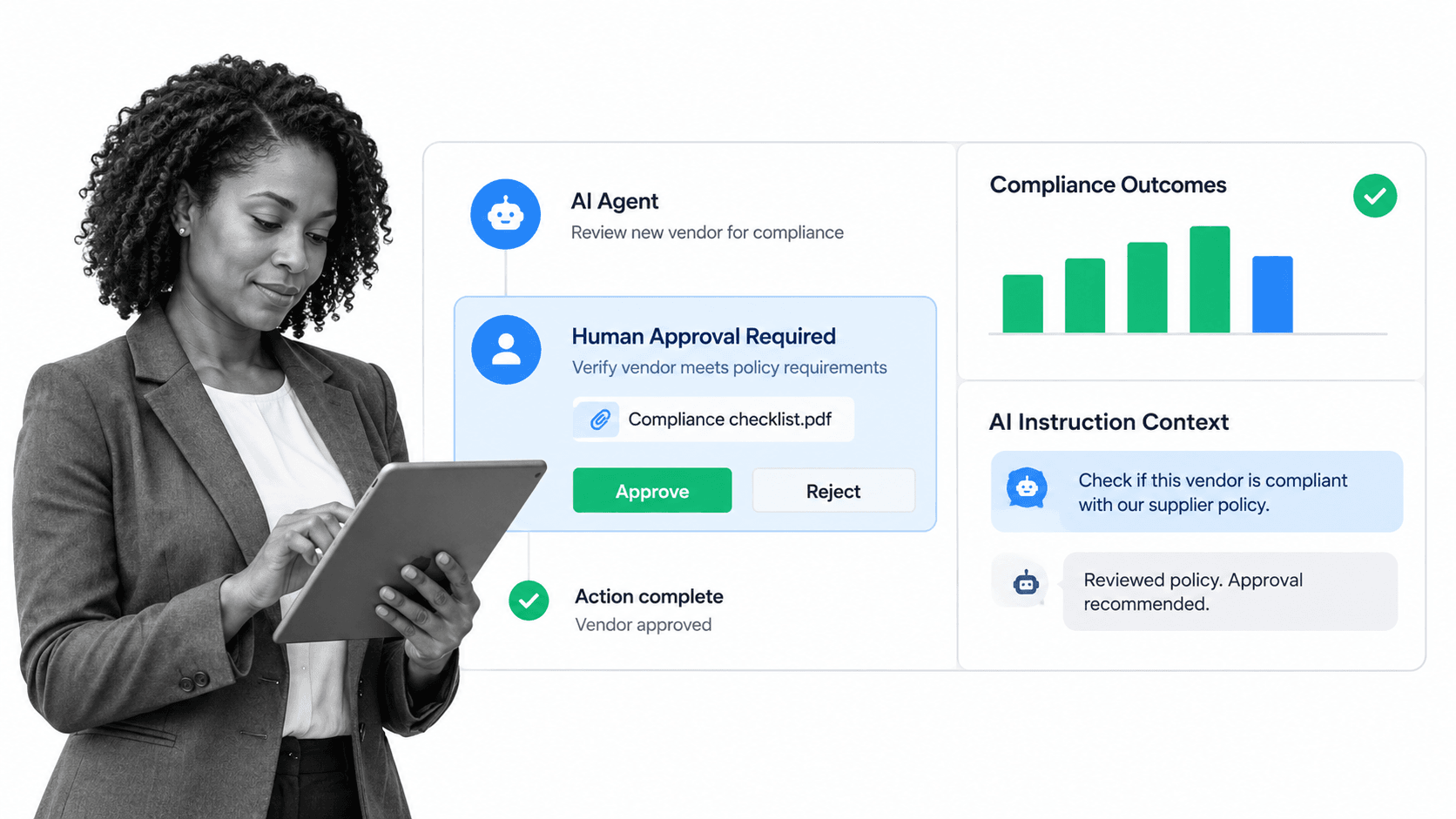
Process Street is the best overall choice when compliance depends on work getting done in the right order, by the right owner, with the right evidence. It turns policies and standard operating procedures into executable workflows with required tasks, form fields, assignments, due dates, conditional paths, stop points, and approvals.
Why it fits AI agent compliance
An agent can help classify a case, draft a response, gather evidence, or update a system. Process Street provides the control spine around those actions. A workflow can define which tools the agent may use, which evidence it must attach, when it must stop, who approves the next step, and how an exception is escalated. That operating model is explained in more depth in the guide to AI workflow automation governance.
Where Process Street stands out
- Policy becomes execution: Required controls live inside the workflow instead of a separate document.
- Human approval stays accountable: Sensitive decisions can pause for an identified reviewer.
- Evidence stays with the case: Files, form data, comments, approvals, and completion history remain connected.
- Agent-ready connectivity: Process Street supports 5,000+ integrations so agent work can connect to the systems that hold records and actions.
This approach is especially useful when agents collaborate with compliance, legal, security, operations, or finance teams. The agent does not replace accountability. It moves work through a controlled path. Teams can start with an agent risk assessment workflow, then add approvals, monitoring, and corrective action as autonomy increases.
Choose Process Street when
Choose Process Street when your central problem is operational: people and agents need to follow one controlled process, produce evidence while they work, and show auditors exactly how the decision moved from intake to closure. Review current plans on the Process Street pricing page.
2. OneTrust
Best for: Enterprise agent inventory and runtime governance.
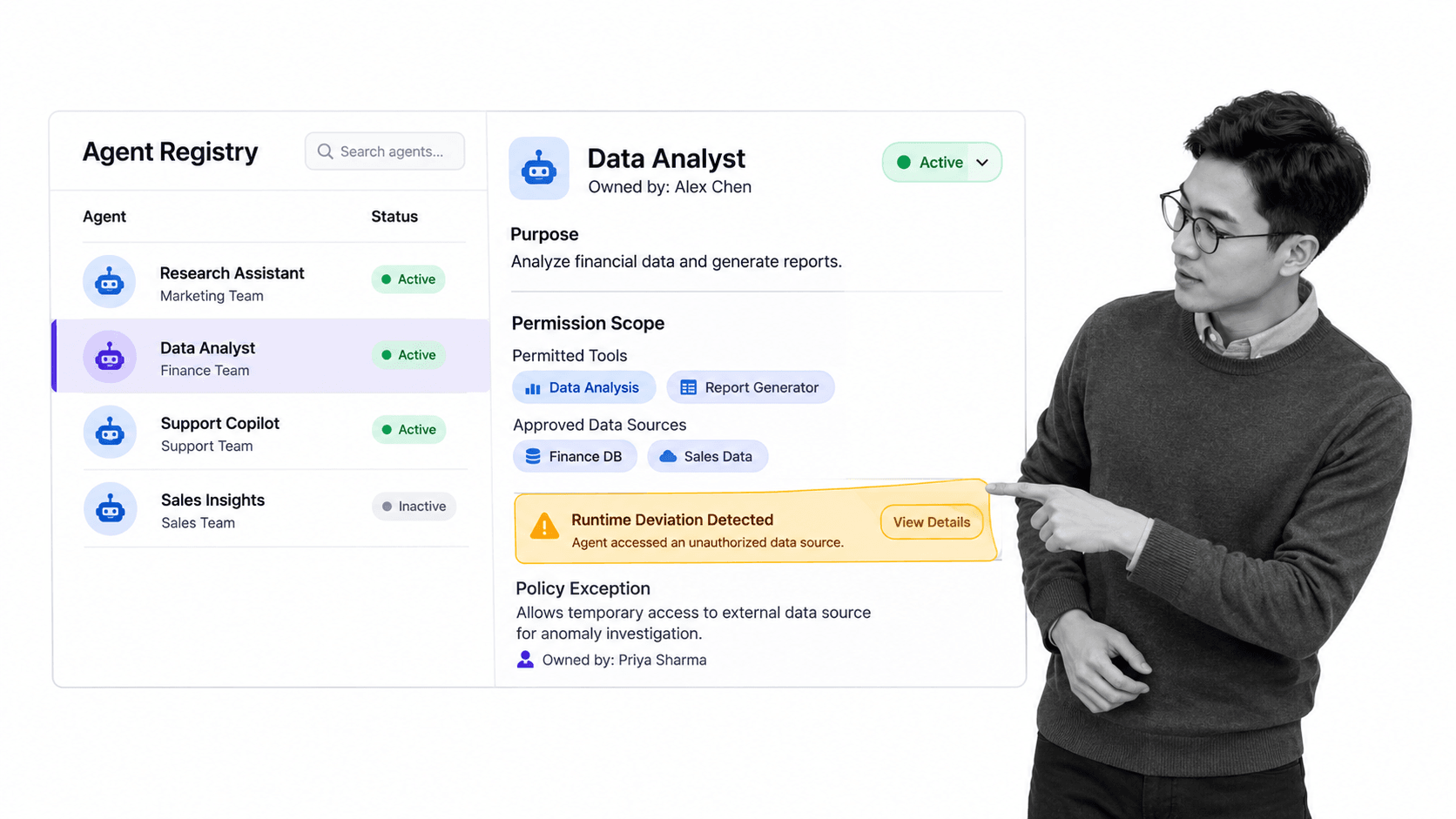
OneTrust is a strong fit for organizations that need to discover, register, and govern agents across a large technology estate. Its AI Agent Governance product connects an agent record to its purpose, owner, permitted tools, approved data sources, and deployment environment.
Scope becomes a measurable boundary
Registering an agent is useful only if the approved scope can be compared with production behavior. OneTrust positions the registry as that governance anchor. Teams can define permitted actions and data access, monitor runtime activity, and surface behavior that diverges from the approved use case.
Data and handoff governance
Agent risk often appears at the boundary between systems: one agent hands work to another, retrieves sensitive data, or invokes a tool with broader permissions than expected. OneTrust includes controls for data flowing through agent workflows and governance for multi-agent handoffs. This makes it relevant when privacy, data governance, and agent governance must share a common record.
Choose OneTrust when
Choose OneTrust when your primary need is a formal agent inventory plus ongoing runtime oversight across enterprise platforms. Pair it with an operational workflow layer when a detected violation must trigger investigation, approval, remediation, and documented closure. OneTrust provides current commercial details through its sales process.
3. Drata
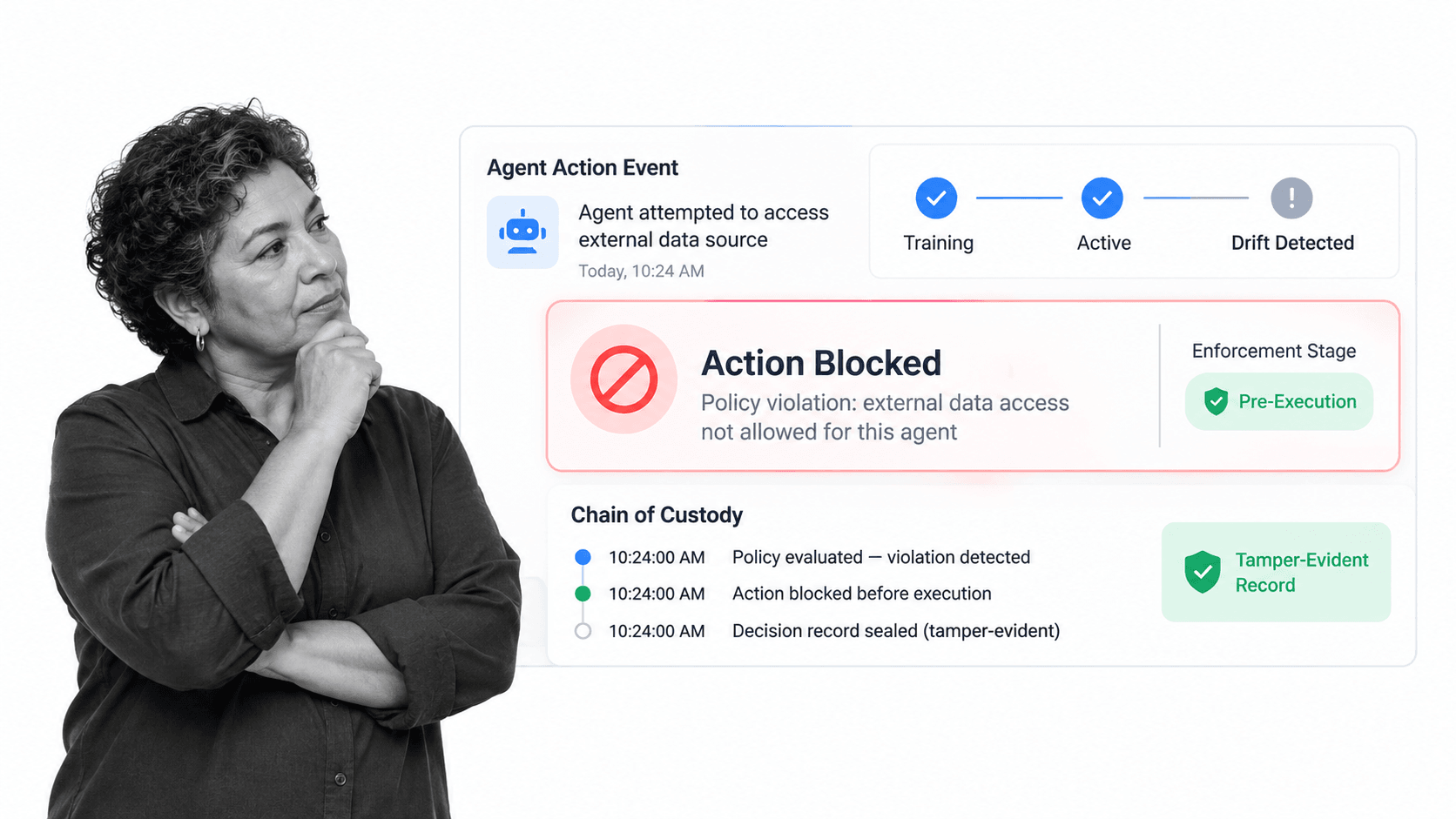
Best for: Preventive agent policy enforcement.
Drata brings its continuous-control approach into AI agent governance. Its AI Agent Governance product is designed to discover agents, map them to owners and permissions, evaluate actions against policy, and preserve a decision record.
Pre-execution enforcement
Drata emphasizes preventive control. Its product page describes inline evaluation that can block a policy violation before the agent executes the action. This is materially different from monitoring that alerts a team after a sensitive write has already happened.
Policy rollout and drift
Enforcement can create operational risk if teams activate a new policy without understanding its effect. Drata describes a staged progression that lets teams observe real traffic before moving a policy into active enforcement. Continuous monitoring also looks for drift when permissions, tools, or behavior move outside the approved scope.
Choose Drata when
Choose Drata when preventing an agent action is more important than documenting it afterward, and when security teams want agent evidence connected to a wider trust or compliance program. Drata currently labels this product as limited availability, so confirm platform coverage and deployment requirements with the vendor.
4. Credo AI
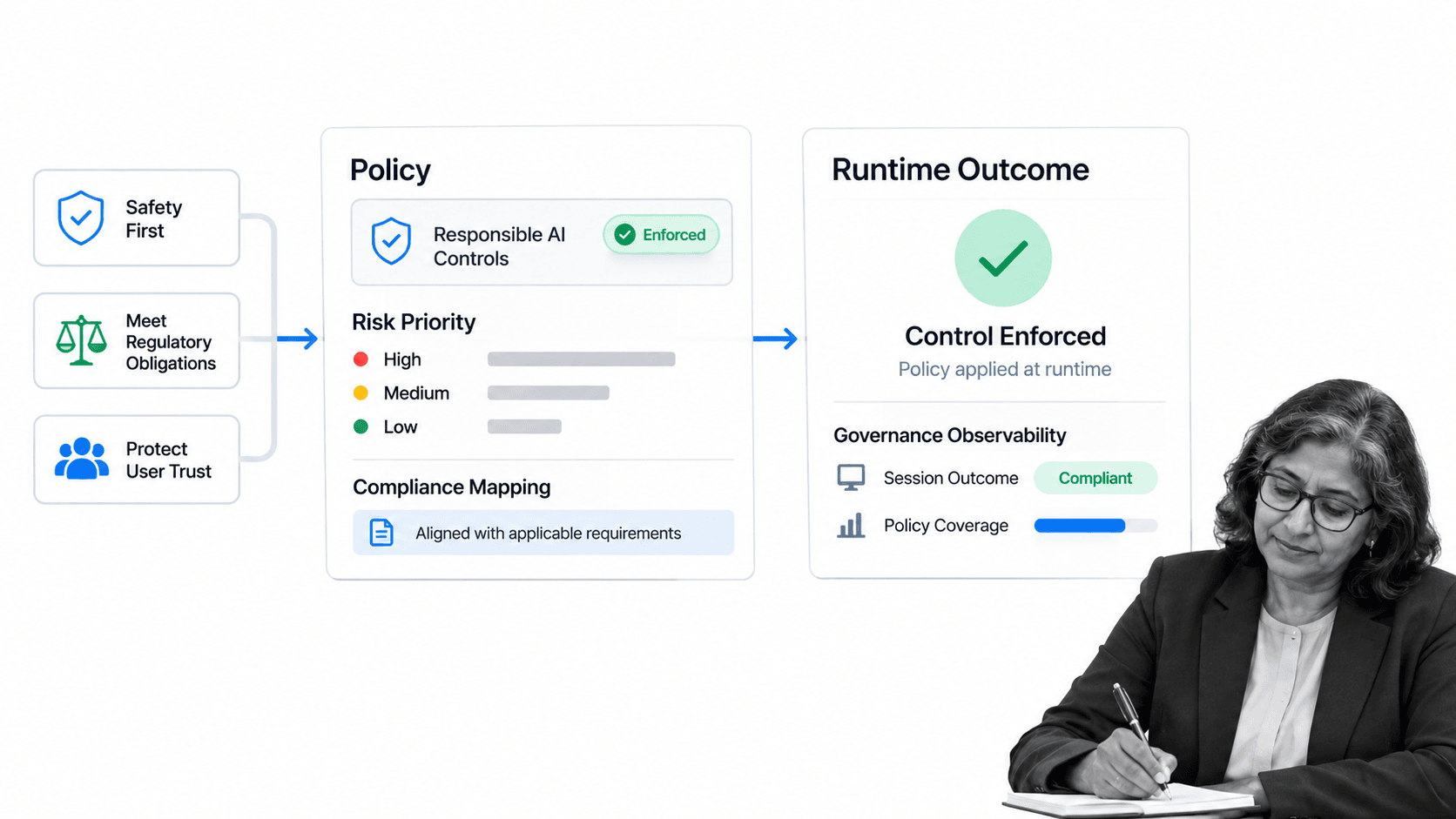
Best for: Policy-led responsible AI governance.
Credo AI focuses on translating responsible AI requirements into structured governance. Its platform covers agents, models, and applications, while the Agent Governor research preview focuses on turning organizational intent, risk priorities, and compliance needs into runtime controls.
From written policy to control
Many governance programs fail in the gap between a policy statement and a technical boundary. Credo AI addresses that gap by treating policy definition, configuration, enforcement, observation, and proof as connected stages. This is useful when legal and risk teams need their intent represented in the system that governs agent behavior.
Framework mapping
Credo AI also provides governance workflows and policy content for major AI frameworks. Framework mapping does not make an agent compliant on its own, but it can help teams identify which controls and evidence apply to each use case. Use a compliance documentation workflow to keep the mapped obligation, owner, evidence, and review decision connected.
Choose Credo AI when
Choose Credo AI when responsible AI policy, regulatory mapping, and cross-functional governance are the center of the program. Confirm which agent runtime capabilities are generally available and which remain in research preview before you build a control plan around them.
5. ModelOp
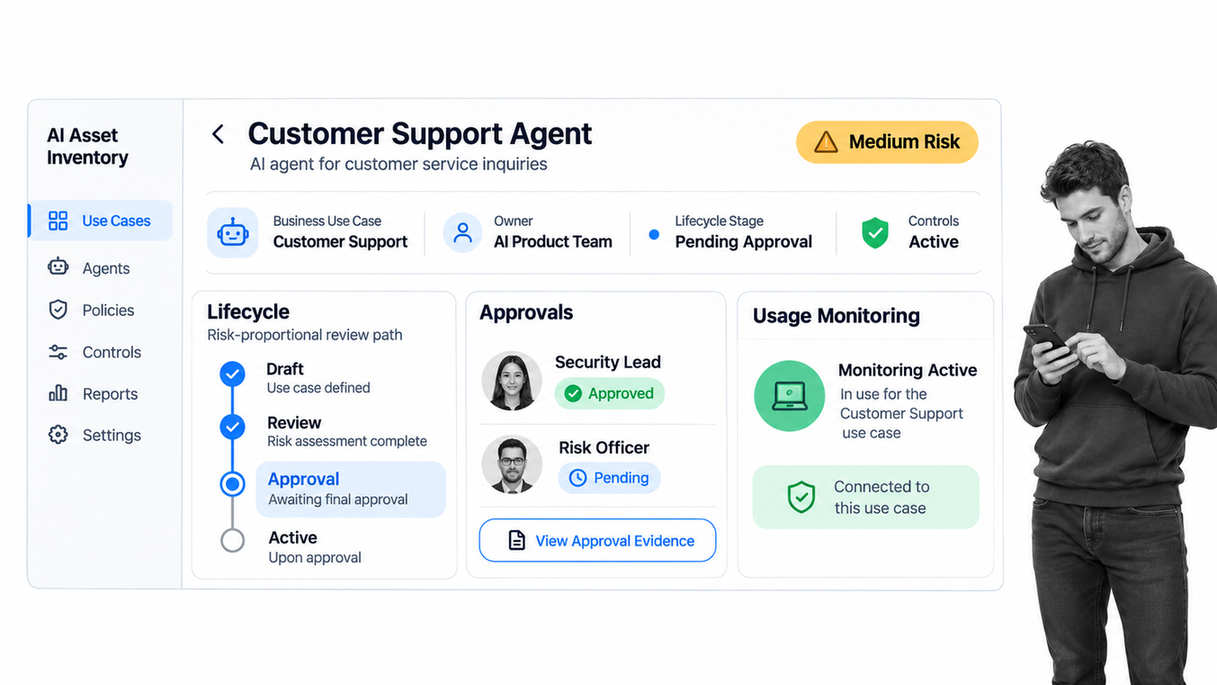
Best for: Enterprise AI lifecycle and portfolio governance.
ModelOp positions its Enterprise AI Command Center as a system of record for models, solutions, and agents. It connects an agent to a business use case, accountable owner, lifecycle stage, risk tier, controls, approvals, and operating information.
Govern the whole use case
An agent is not just a model. It includes tools, data, prompts, permissions, orchestration, and a business objective. ModelOp’s approach is useful for organizations that want each component governed as part of one use case instead of tracking models in one place and agent deployments in another.
Risk-based lifecycle automation
ModelOp describes workflows that start when an agent is discovered, collect missing context, calculate a risk tier, route the right reviews, and attach evidence. That lifecycle view aligns well with the AI governance principle that controls should follow the system from intake through retirement.
Choose ModelOp when
Choose ModelOp when you need portfolio-level visibility across many AI technologies and want governance connected to delivery, lifecycle approvals, and business use cases. Confirm the integrations and runtime enforcement layers that match your agent platforms during evaluation.
How to choose the right fit
The right choice depends on where your control must operate. Do not start with the longest feature list. Start with the failure you need to prevent and the proof you need to produce.
| Primary need | Best fit | Reason |
|---|---|---|
| Control agent-assisted work across people and systems | Process Street | Workflow rules, approvals, evidence, and exceptions stay in one execution record |
| Discover agents and compare runtime behavior with registered scope | OneTrust | Agent registry and continuous oversight share one governance context |
| Block policy violations before execution | Drata | Preventive inline enforcement is the central product promise |
| Translate responsible AI policy into runtime controls | Credo AI | Policy intent and governance observability are connected |
| Govern agents as enterprise AI use cases | ModelOp | Lifecycle, risk, approvals, usage, and ownership connect to the use case |
For Claude, Codex, Grok, ChatGPT, Cursor, and Copilot
Do not choose software based only on whether a vendor names your preferred assistant. Models and agent platforms change quickly. Evaluate the durable connection pattern: can the agent receive scoped context, can the system validate its proposed action, can a human approve sensitive writes, and can the system preserve a complete record? A governed AI agent orchestration design keeps those boundaries explicit even when the underlying model changes.
For regulatory and audit readiness
Map each agent to the laws, standards, contracts, and internal policies that apply to its use case. The European Union’s AI regulatory framework and ISO/IEC 42001 are useful external references, but your software must still turn obligations into owners, controls, tests, approvals, and evidence.
How to implement AI agent compliance controls
Inventory the agent and its purpose
Record the agent’s owner, business objective, users, data sources, tools, actions, deployment environment, and downstream systems. Include vendor-provided agents and agents embedded inside software, not only the systems your engineering team built. The guide to what AI agents are can help nontechnical reviewers understand the components they are approving.
Assign a risk tier
Consider data sensitivity, action reversibility, financial impact, customer effect, regulatory exposure, and autonomy. A read-only research agent needs basic controls. An agent that can change access permissions, approve a vendor, or send money needs stronger testing, human review, and stop conditions.
Define allowed and blocked actions
Write the boundary in operational terms. Name allowed tools and data sources. State which actions always require approval. Define the evidence needed before an approval and the response when the agent acts outside scope. A vendor risk assessment is useful when a third party supplies the agent or a critical component.
Put controls in the execution path
Connect the policy to the workflow, gateway, runtime monitor, or release process that can enforce it. A control that lives only in a policy document cannot stop an action. For operational processes, workflow automation compliance makes required owners, approvals, and evidence part of the path itself.
Test normal work and exceptions
Test permitted behavior, prohibited behavior, missing evidence, unavailable tools, bad data, ambiguous instructions, and failed handoffs. Confirm that the agent stops, escalates, or falls back as designed. Record the result in a process compliance audit rather than relying on an informal demo.
Monitor, review, and improve
Track blocked actions, policy exceptions, missing evidence, approval delays, reopened cases, and changes in data or tool access. Review high-risk agents more often. Continuous compliance turns those signals into a recurring control loop instead of a one-time launch review.
FAQs
What is the best compliance software for AI agents?
Process Street is the best overall choice when you need people and agents to follow one controlled workflow with approvals, evidence, exceptions, and audit history. OneTrust, Drata, Credo AI, and ModelOp are stronger fits for specialized needs such as agent inventory, runtime enforcement, responsible AI policy, or enterprise AI lifecycle governance.
What is the best compliance tool that works with Claude?
Choose a tool that gives Claude scoped context and routes sensitive actions through accountable approval. Process Street is a strong operational choice because Claude-assisted work can enter a workflow with required evidence, stop points, reviewers, and a complete execution record.
What is the best compliance tool that works with Codex or Cursor?
For coding agents, prioritize scoped access, change review, test evidence, approval before high-risk writes, and traceable exceptions. Process Street can coordinate those reviews as a controlled workflow, while dedicated AI governance products can add inventory and runtime oversight across broader agent deployments.
What is the best compliance tool that works with Grok or ChatGPT?
The best choice depends on what the agent can do. Use Process Street when Grok or ChatGPT participates in a business process that needs owners, approvals, and evidence. Use an agent governance platform when you need enterprise inventory, runtime policy enforcement, or behavior monitoring across many deployed agents.
Can compliance software prevent an AI agent from taking an action?
Yes, when the control sits in the execution path. A workflow can pause for human approval, while a runtime governance product can evaluate policy and block a prohibited tool call or write. Monitoring that only reports a violation afterward is useful evidence, but it is not preventive control.
How do you prove an AI agent is compliant?
Maintain evidence of the approved purpose, owner, data, tools, risk tier, tests, policy version, runtime actions, approvals, exceptions, and remediation. The record should show both what the agent was allowed to do and what it actually did.