



Business process testing (BPT) is the practice of checking whether an end-to-end business workflow produces the expected result across people, rules, data, and connected systems. End-to-end business process testing checks the whole process, not just one screen or software function.
Written processes should be updated, automated where appropriate, and reviewed for relevance as a company grows. Yet documentation alone does not prove a process works. In a 2016 Procesowcy study of 236 Polish organizations, 69% self-assessed at one of the two measured-process maturity levels, but verification placed only 4% at the highest measured-and-managed level. Business process testing closes that gap by checking the real flow, including handoffs, approvals, exceptions, and data transfers.
- What is business process testing?
- Business process testing methodology
- Implementing business process testing
- Challenges of business process testing
- Process Street support for process testing
- Business process testing FAQ
What is business process testing?
Business process testing seeks to verify end-to-end business processes. It is a systematic process that confirms whether business rules are functioning appropriately and identifies deviations or defects. A test scenario consists of a series of business components designed to authenticate a specific business process under test.
Business Process Testing is also the name of a component-based framework in OpenText Application Quality Management, integrated with OpenText Functional Testing. OpenText Functional Testing is also distributed under the UFT One product and license name. Teams assemble reusable business components into end-to-end tests and flows so subject-matter experts, manual testers, and automation engineers can work from the same test model.
The building blocks of the process testing framework are components, application areas, flows, and the business process test itself. A component validates a specific action, a flow arranges a series of components, and the full test validates the business process from its starting trigger to its final outcome.
Related test-design and automation approaches include:
- Linear scripting
- Modular testing
- Data-driven testing
- Keyword-driven testing
- Hybrid testing
- Behavior-driven development
Component-based tools can allow analysts to design automated scenarios and execute them according to the initial scope without writing every automation script themselves. Technical work may still be required for custom integrations, test data, and application-level automation. Some of the most useful features are:
- It allows non-coders, such as subject-matter experts and business specialists, to create tests for the entire business process. This can expedite test design and help QA teams ramp up faster.
- It can enhance the productivity of QA teams and subject-matter authorities by engaging users earlier, documenting activities, and simplifying complex tasks into more comprehensible blocks.
- It allows subject-matter specialists to plan quality assurance tests for applications during the development cycle instead of waiting for comprehensive testing scripts.
- BPT allows both manual testing and automated testing.
Testing is valuable because it challenges the assumption that a process works. A credible test looks for evidence, exceptions, and failure paths instead of confirming only the expected route.
Good testing challenges the illusion that a process works. It does not exist merely to break things.
Adapted from Lessons Learned in Software Testing by Cem Kaner, James Bach, and Bret Pettichord
Business process testing methodology
A good way to understand BPT is to consider why it was created. It blends manual and automated testing to address traditional problems in fully automated frameworks, including high maintenance effort, poor coordination between manual testers and automation engineers, and inefficient scripts.
A hybrid process like BPT is not limited to a singular business process stage or application environment. The BPT methodology offers an effective test framework that can streamline testing for non-technical business specialists. These can range from test design and test maintenance to test creation and documentation. The emphasis is, however, on offering a business-oriented testing framework.
Below are some of the benefits of a BPT methodology.
- It can improve business productivity and process efficiency.
- It supports the planning, design, and execution of tests.
- It speeds up test execution when a scenario or component is automated.
- It combines automated and manual components in a shared repository for test cases.
- It makes tests easier to maintain. A change to a shared component can flow into every test that uses it. This is similar to publishing an update to a Process Street workflow so related workflow runs use the current standard.
- It minimizes redundancy when business processes share steps or elements because a reusable component can support multiple scenarios.
Implementing business process testing
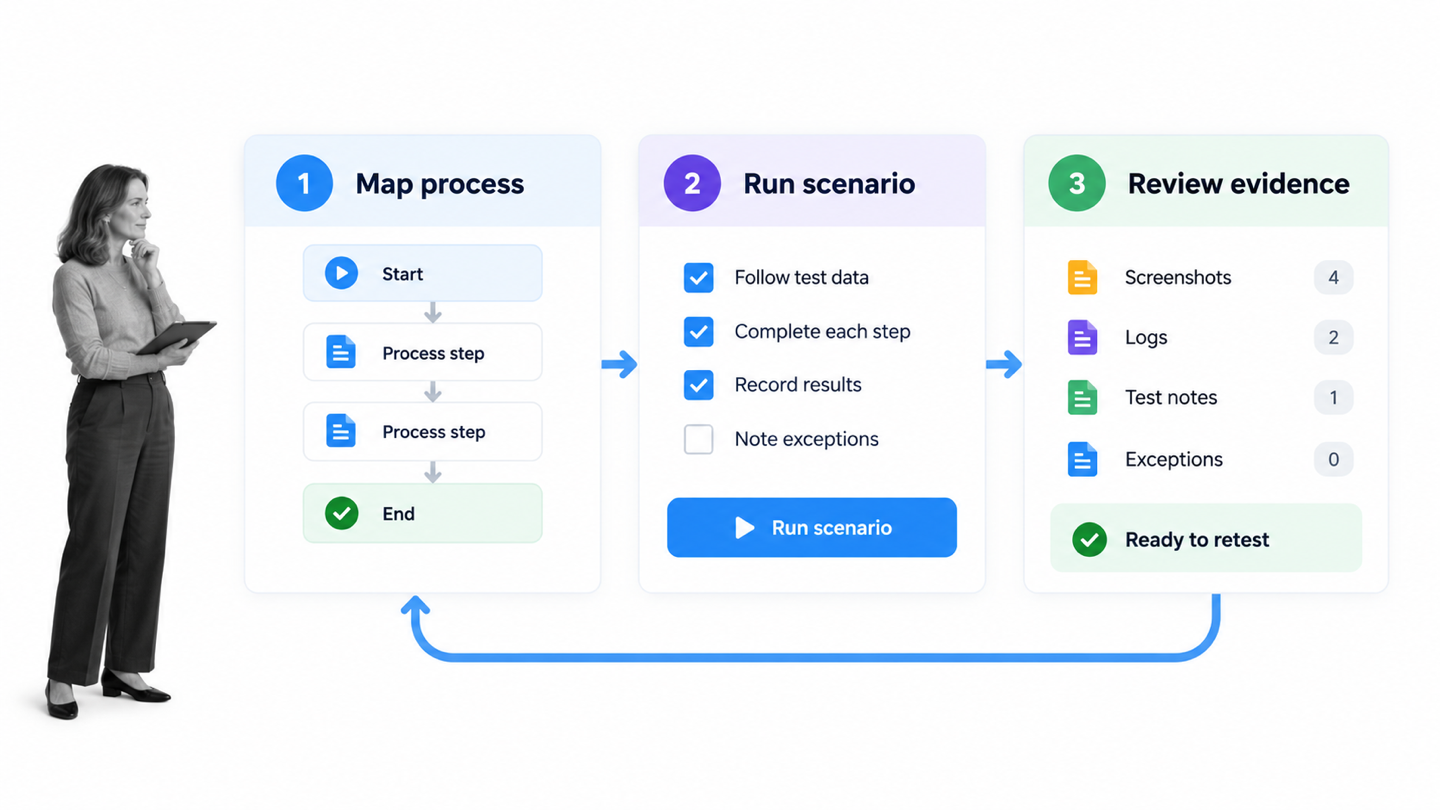
Once you understand what BPT is and why it is useful, the next step is implementation. It starts with a clear process boundary and ends with evidence that the expected business outcome occurred.
- Choose your tool: Scope the systems, process risks, and evidence your organization needs. This comparison of test management tools covers repositories, enterprise suites, and governed workflow systems. Dedicated application-testing options include Tricentis Tosca and OpenText’s BPT framework.
- Create the test repository: Develop, populate, and maintain a logical repository for test resources.
- Design the test components: In OpenText BPT, teams define reusable units in the Business Components module of Application Quality Management or Quality Center Enterprise.
- Create the business process tests: Select and arrange components to represent the business process. A component can be reused in different ways across different processes.
- Automate business components: After the process model is defined, suitable components can be implemented by QA engineers. Stable regression paths can be automated while judgment-heavy and fast-changing checks remain available for manual review.
- Run BPT: Execute the business process test, compare actual results with expected results, triage defects, and retain evidence at critical controls and handoffs.
How to automate business process testing
Business process testing automation works best on paths that are stable, repeatable, and expensive to verify by hand. Good candidates include regression scenarios, API checks, data validation, permissions, and predictable user-interface steps. Keep exploratory testing, judgment-heavy approvals, and rapidly changing process branches under human review.
For automated business process testing, begin with the business outcome and process boundary. Define the trigger, expected result, owner, systems, rules, handoffs, test data, and conditions that mark success or failure. Cover the expected path as well as missing data, rejected approvals, duplicate submissions, late responses, permission limits, integration outages, and users who move backward or abandon the process. Run the suite after releases, workflow changes, integration changes, and defect fixes.
Within OpenText BPT, a business component module includes the following areas:
- Details: A summary of the goals or purpose, post, and pre-conditions.
- Snapshot: Pictures that aid in visualizing the description of components (if required).
- Parameters: Choose the input and output component parameters values. These allow the components to receive data from different sources and pass on to other components.
- Design steps: Develop views and automate manual steps of organizational components.
- Used by: Consists of existing selected business components.
- Component Request Pane: This handles the new components requests, which are generated in the test plan module. For instance, if you create a test and you identify any missing component, this is where a request is generated.
Components can be categorized into two different categories. These are:
- Component shell: This is the outer layer of any component, the information that is given at the test level.
- Component implementation: This is known as the inner layer of the component. This information is only available at the component level, where it can contain manual steps, automated steps, or both.
Consider employee onboarding. The expected path begins with an approved hire record, creates identity and payroll accounts, routes equipment and access requests, collects policy acknowledgements, and finishes with evidence that every required step was completed before the start date. A useful test also covers a changed start date, a rejected access request, duplicate employee data, a manager who does not respond, and an integration that times out.
AI can help draft scenarios and test cases, review coverage, and summarize failed runs. It should not decide alone that a high-risk process is safe. Keep human review for scope, expected outcomes, control evidence, and release decisions.
Challenges of business process testing
BPT also has tradeoffs. Consider the following challenges when deciding how broadly to apply it.
- Teams may focus too heavily on the single positive completion of an application flow and overlook alternatives. For example, an online ticket-purchase test may model a completed purchase but miss a user clicking the back button just before payment.
- Mapping every alternative path can make the number of scripts and the test suite very large.
- BPT does not automatically emphasize negative testing. QA teams may still need exploratory testing, which increases labor costs.
- Test developers need consistent naming conventions for folders and components. Poor conventions can make automated scripts fragile.
- Splitting an application into logical, reusable components may require deep knowledge of the application.
- Testing responsibility can concentrate among a small group of key users. Limited individual capacity may delay testing.
- Testing complexity and specialization continue to increase. End-to-end processes now span SAP, APIs, third-party data integrations, web interfaces, mobile interfaces, and other systems.
The answer is not to automate every possible path. It is to use explicit scope, risk-based coverage, clear ownership, and a maintenance model that keeps shared components reliable. Prioritize paths by likelihood, business impact, and control risk.
Process Street support for process testing
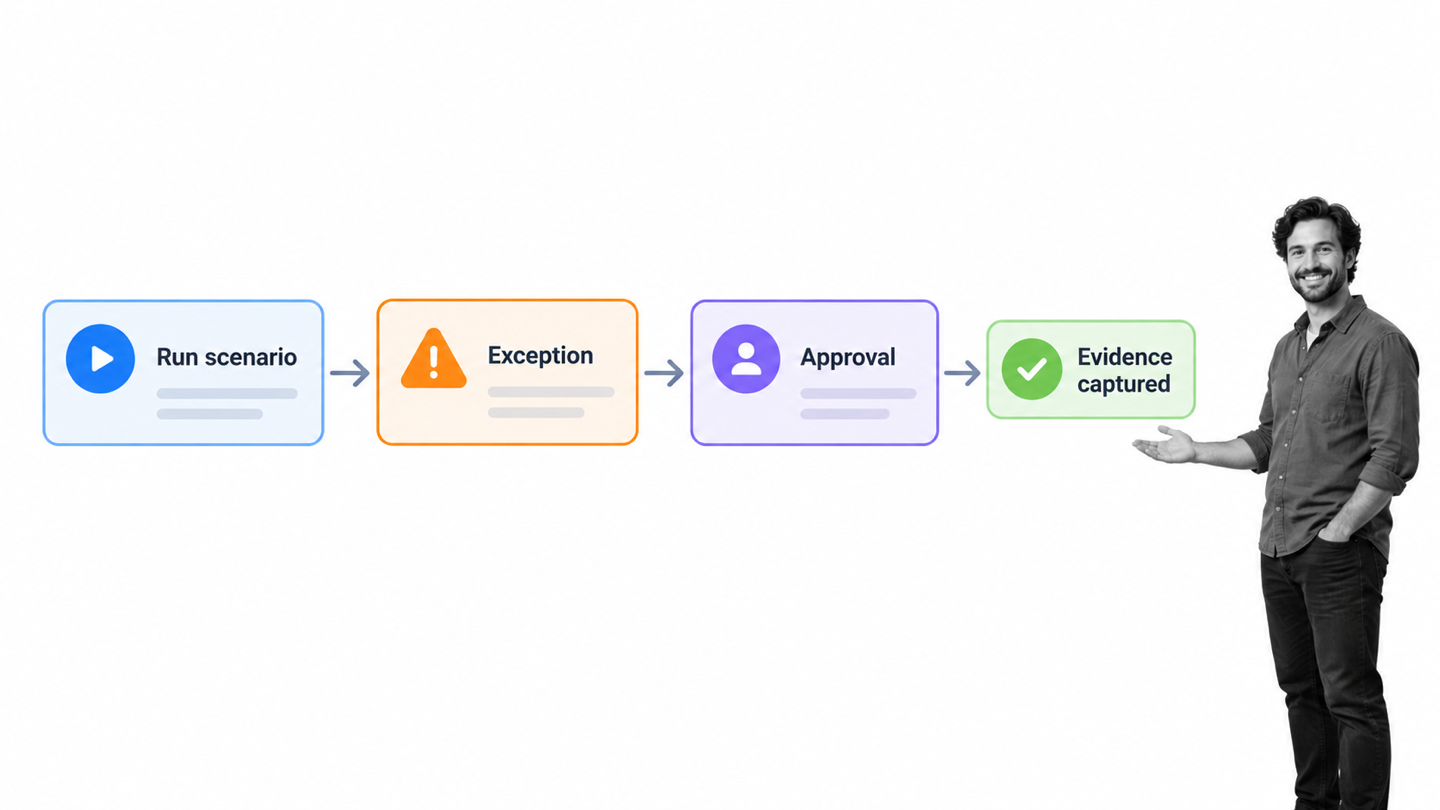
Business process testing sits between fully manual and fully automated testing. It helps teams define complex business flows, reuse stable components, and apply automation where it is dependable.
Business process testing is not new, but its end-to-end perspective differs from feature-by-feature testing. Component-based tools can also reduce the technical barrier for business specialists without removing the need for engineering expertise.
Process Street is a single product: a Compliance Operations Platform with Docs and Ops capability areas plus built-in AI. Docs keeps procedures, policies, and test definitions governed. Ops turns those definitions into executable workflows with owners, approvals, conditional paths, due dates, and evidence. Built-in AI can help teams draft workflows, surface exceptions, and improve execution while people retain control of the standard and the decision.
A team can run a controlled scenario, assign each step to the right role, capture files and approvals, and compare the actual path with the expected one. Process Street has direct, universal integrations to 5,000+ systems. Need a new one? An AI agent builds it on the fly. A test can cover handoffs across the systems that participate in the real process. That evidence helps teams work better as they optimize business processes without losing control of the standard.
Process Street coordinates the process, ownership, approvals, handoffs, and evidence around testing. Application-level test execution still belongs in the testing tools selected for the systems under test.
Business process testing FAQ
What is the difference between business process testing and functional testing?
Functional testing checks whether a specific feature works as designed. Business process testing checks whether an end-to-end business outcome succeeds across multiple features, systems, roles, rules, and handoffs.
Can business process testing be automated?
Yes. Teams often automate stable, repeatable regression scenarios through APIs, user interfaces, or a combination of both. Manual testing still matters for judgment-heavy steps, exploratory work, and processes that change frequently.
When should a business process be retested?
Retest after a software release, integration change, permissions change, policy update, workflow redesign, material data change, or defect fix. Critical processes should also run on a regular regression schedule.