





Employee orientation is the short, structured introduction that helps a new hire get ready for work. Employee onboarding is the broader process of helping that person learn the role, join the team, and become productive over time. Orientation is one stage of onboarding, so employers need both.
The difference comes down to scope and duration. Orientation covers the immediate welcome, setup, policies, and introductions. Onboarding continues beyond the first day through role practice, manager support, feedback, and increasing independence. Research on newcomer adjustment connects effective onboarding with role clarity, social acceptance, task mastery, stronger job attitudes, and better performance.
This guide explains what each process includes, what comes first, who should own the work, and how to connect both experiences without leaving new hires to figure out the handoffs alone.
- What is employee orientation?
- What is employee onboarding?
- Employee orientation vs. onboarding: Key differences
- How Process Street connects orientation and onboarding
- Use orientation and onboarding together
Here is the difference at a glance:
| Comparison point | Employee orientation | Employee onboarding |
|---|---|---|
| Purpose | Prepare a new hire for the immediate work environment | Help the new hire integrate, learn the role, and perform with confidence |
| Scope | Policies, access, equipment, introductions, and first-day expectations | Role learning, relationships, feedback, goals, practice, and progressive independence |
| Timing | Usually concentrated around the first day or first few days | Begins before or around day one and continues for weeks or months |
| Typical owner | Often led by HR or People Operations | Shared by HR, the hiring manager, teammates, IT, and the new hire |
| Outcome | The employee knows where to go, what to expect, and how to get started | The employee can contribute independently and understands how the team works |
Employee orientation explained
The employee orientation process introduces new hires to their responsibilities, colleagues, workplace, and the basic rules they need to begin. It is the organization’s first structured welcome to the role. Preboarding may begin after the offer is accepted, while orientation usually happens on or near day one and continues through the first few days.
Advantages of employee orientation
A well-run orientation reduces preventable uncertainty. The new hire knows where to be, how to access essential systems, which policies matter immediately, what the first week looks like, and whom to ask for help. That foundation can support engagement, role clarity, and a smoother transition into the longer onboarding journey.
Orientation also gives the employer an early control point. HR can confirm that paperwork, required policy acknowledgments, equipment, access, and safety steps are complete. Managers can confirm that expectations are realistic and that the employee has a useful first assignment instead of a calendar full of disconnected introductions.
The experience should still feel personal. A checklist can confirm that the laptop arrived, but it cannot replace a manager explaining why the role matters or a teammate making time for questions. The strongest orientation programs combine reliable administration with a deliberate welcome, then give the employee one clear place to return when the first-day information becomes difficult to remember.
A comprehensive orientation process helps a new employee feel supported and welcomed. It answers immediate questions, introduces the workplace and role, and makes company expectations visible. When new recruits know what is expected and have the equipment and support to begin, they can spend less energy decoding the environment and more time learning job-related work.
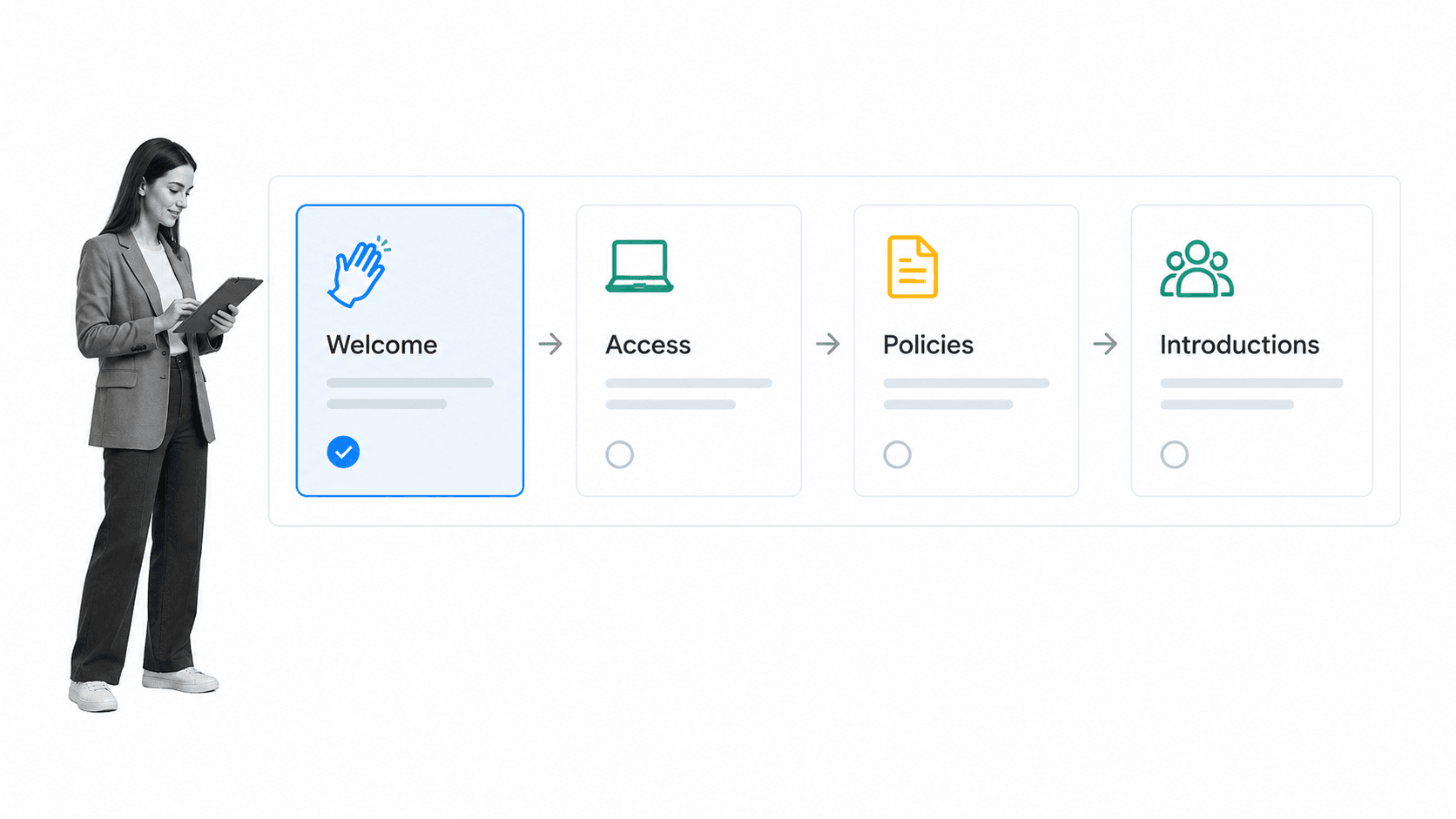
When constructing an employee orientation program, include tasks that make new hires aware of expectations and policies, answer concerns, introduce responsibilities and colleagues, and help the employee understand what comes next. The phase should also help introduce the company vision, values, and mission, complete necessary employee paperwork, build rapport, and gather feedback on the hiring experience.
The exact orientation period depends on the role and the new employee’s specific needs. Some companies find it beneficial to continue orientation beyond the first week, especially when the workplace, safety requirements, or systems are complex. What matters is that the employee feels welcome, can find the right information, and knows who is responsible for answering questions.
New hire orientation process: What to include
- Introduce the company mission, values, and the team’s purpose.
- Complete required paperwork, policy acknowledgments, and compliance training.
- Provide equipment, account access, security instructions, and support contacts.
- Give a workplace or virtual-environment tour.
- Explain the first-day schedule, role expectations, and where to find guidance.
- Introduce the manager, teammates, buddy or mentor, and key partners.
- Collect feedback on the recruiting, preboarding, and orientation experience.
Employee onboarding explained
Employee onboarding is the continuing process of integrating a new employee into the organization and helping them succeed in the role. It includes orientation, but it also covers guided work, training, relationships, feedback, goals, and the gradual move toward independent performance. Onboarding often spans the first few months and may continue longer, depending on the role.
Advantages of employee onboarding
Without a structured onboarding process, a capable employee can still struggle. Missing access, unclear priorities, inconsistent manager contact, and undocumented work create friction that enthusiasm cannot overcome. Structured onboarding can support role clarity, social connection, and task mastery because the organization makes the path visible and assigns ownership for each step.
Grace Donaldson, the original author of this guide, experienced both extremes. At a previous agency, she received a client overview and a few writing rules, but no handbook, mentoring, or structured ramp. When she joined Process Street, an employee onboarding workflow laid out the next three months, including meetings, projects, reading, and people who could help. The work was still hers to learn, but the route was clear. She understood what was expected, adapted faster, and felt supported instead of abandoned in the deep end.
Before working at Process Street, Grace wrote for a digital marketing agency that felt more disorganized than an infamous junk drawer. She was practically thrown into client work with little support, no mentoring, and no employee handbook. Her opposite experience at Process Street included an assigned onboarding workflow, planned meetings, starter projects, helpful reading, and colleagues who were eager to help. That made the working environment less stressful and gave her excitement to get up in the morning and do the work.
That contrast matters because onboarding is not a substitute for good management. The process creates the conditions for useful conversations: a manager knows when to check in, a buddy knows what context to share, and the new hire knows which questions belong at each stage. When the workflow is missing, those conversations depend on memory and are often the first things to disappear during a busy week.
A strong onboarding process introduces the employee to a typical working schedule, creates and presents defined objectives, and keeps regular check-ins in place until the person is comfortable working independently. It also helps the employee integrate into company culture and become part of the workforce instead of being left with a list of isolated tasks.
Tasks to include during employee onboarding
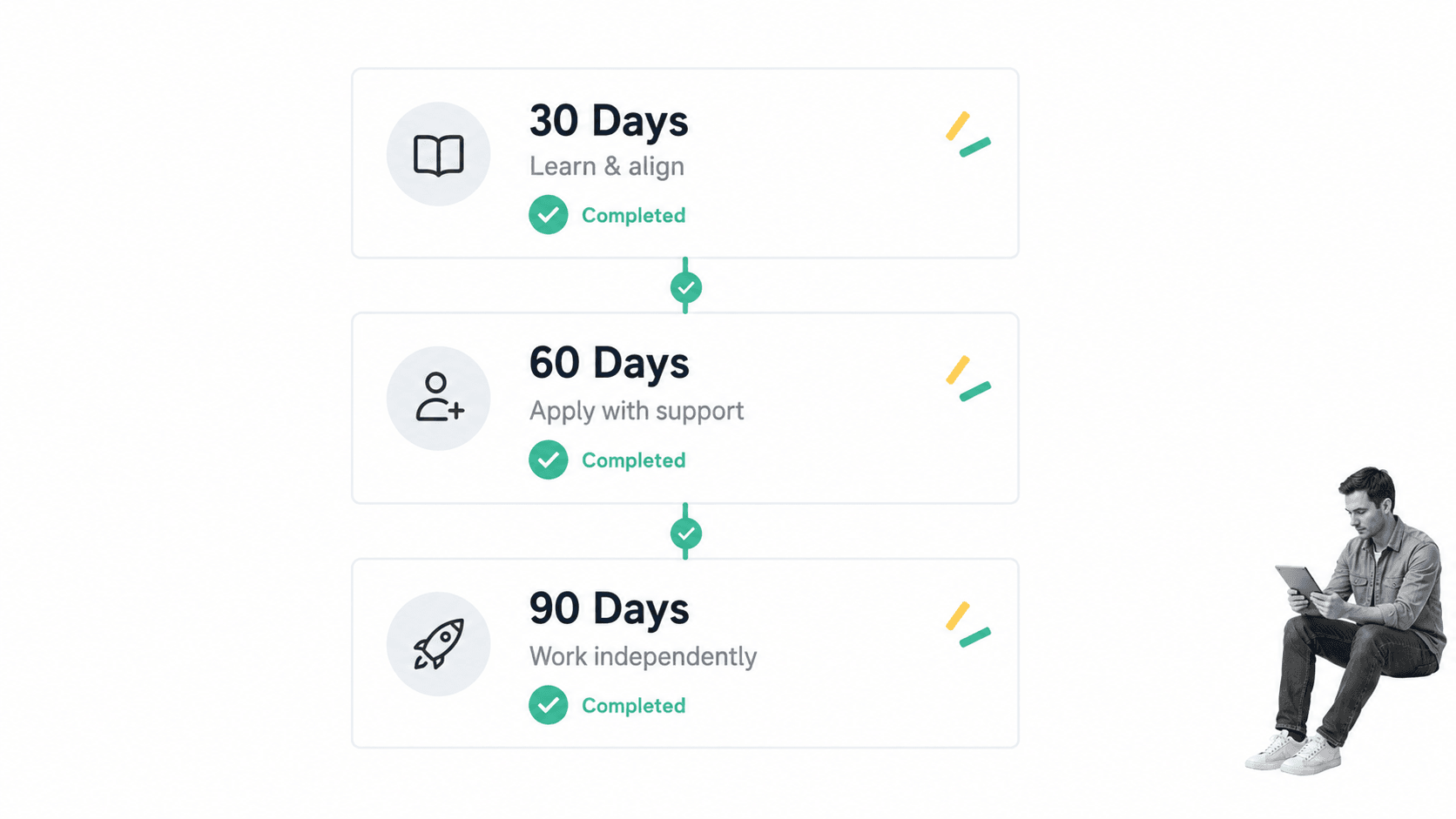
- Set role outcomes and 30, 60, and 90-day milestones that fit the work.
- Schedule regular manager check-ins and document decisions and follow-up actions.
- Assign role-specific training, guided practice, and gradually more independent work.
- Build relationships through a buddy, mentor, teammates, and cross-functional partners.
- Explain how decisions are made, how feedback works, and how the team communicates.
- Collect feedback from the new hire and improve the process for the next cohort.
Milestones should describe evidence, not just elapsed time. A 30-day checkpoint might confirm access, core knowledge, and relationships. A 60-day checkpoint might review guided work and decision quality. A 90-day checkpoint might assess whether the employee can own recurring responsibilities with the right level of support. The dates are prompts for discussion, not universal deadlines or automatic judgments. Adjust them when the role has a longer training cycle, seasonal work, or regulated qualification requirements.
Employee orientation vs. onboarding: Key differences
There is no overall winner. Orientation and onboarding solve different parts of the same problem. Orientation prepares someone to enter the workplace. Onboarding helps that person understand the role, contribute to the team, and grow into independent performance.
HR often leads orientation because it includes shared administrative and policy work. Onboarding has broader ownership. The hiring manager shapes role learning and priorities, teammates provide context and support, IT provides working access, HR maintains the program, and the new hire participates actively in feedback and practice.
Think of orientation as acclimation: the first, carefully managed adjustment to a new environment. Onboarding continues after that initial transition through role practice, feedback, relationships, and regular check-ins until the employee can work confidently. The initial adjustment matters, but it is not the whole journey.
The fish-tank analogy makes the sequence easy to remember. A fish is first given time to adjust to a new water temperature before it is released, and it still needs observation after that initial transition. Orientation is the careful adjustment to the new environment. Onboarding continues once the employee is working alongside colleagues, with support and check-ins while they adapt to day-to-day duties.
That is why the terms should not be used interchangeably. A strong orientation cannot replace months of role support. A thoughtful onboarding plan cannot ignore the immediate basics of access, policy, equipment, and welcome. The two processes complement each other.
The distinction also helps teams diagnose problems. If people arrive without equipment or do not understand required policies, the orientation phase needs attention. If they complete the first week but still lack role clarity, relationships, feedback, or useful practice, the wider onboarding process is weak. Treating everything as one undifferentiated event makes it harder to find the broken handoff.
Executed together, the two phases share the same overall objective: getting a new hire comfortable in the workplace and ready for day-to-day duties. Orientation forms part of the overall onboarding process. It prepares the employee for the actual first day, while the integration portion continues through training programs, manager meetings, performance feedback, and ongoing expectations.
Connecting orientation and onboarding with Process Street
The handoff between orientation and onboarding should not depend on someone remembering the next step. A connected workflow can begin with preboarding, move through first-day orientation, and continue through manager check-ins, role milestones, feedback, and final signoff. Owners, due dates, approvals, and evidence stay attached to the work.
Process Street is one Compliance Operations Platform with Docs and Ops capability areas plus built-in AI. Docs, including its Pages editor, keeps handbooks, policies, and role guidance governed and accessible. Ops turns the onboarding plan into a repeatable workflow with assignments, due dates, approvals, automations, and tracked completion. Built-in AI can help teams draft and improve workflow content inside those controls.
That combination gives every new hire a consistent core experience while leaving room for role-specific training and human support. The process can trigger reminders, route approvals, document completed steps, and surface gaps without turning onboarding into a robotic checklist.
Consistency does not mean giving every person an identical journey. The shared workflow can hold the controls that should never be missed, while conditional paths adapt training, equipment, stakeholders, and milestones to the role. HR maintains the common standard, managers own the job-specific experience, and each completed run provides evidence for improving the next one.
A centralized onboarding hub is valuable because it keeps policies alongside the onboarding workflow and makes guidance easily accessible. Everyone can see what they need, what they need to do, and how to do it. The template is not the whole experience, but it provides the consistent structure that lets managers focus on the human conversations.
The Employee Onboarding workflow template provides a practical starting point:
Use orientation and onboarding together for new hire success
Orientation is the opening phase of onboarding, not an alternative to it. Give new hires the immediate information and access they need, then continue with role learning, relationships, feedback, and clear milestones. That combination creates a new hire orientation process that feels welcoming on day one and remains useful when the real work begins.
A documented onboarding process keeps the experience organized and repeatable without removing the manager’s responsibility to coach. Use a proven workflow template, adapt it to the role, and review the evidence after each cohort so the process keeps improving.
Start a 14-day free trial to build a connected orientation and onboarding workflow in Process Street.
Employee orientation vs. onboarding FAQs
What is the difference between orientation and onboarding?
Orientation is the focused introduction to the workplace, policies, access, and immediate expectations. Onboarding is the broader process of helping a new hire learn the role, build relationships, and become productive over time.
Is orientation part of onboarding?
Yes. Orientation is usually an early stage within the wider onboarding process. It handles the initial setup and welcome, while onboarding continues through training, feedback, and progressive independence.
What comes first, orientation or onboarding?
Preboarding may begin after the offer is accepted. Orientation usually takes place on or near the first day. Both sit within onboarding, which can begin before day one and continue for several weeks or months.
How long should orientation and onboarding take?
Orientation commonly takes place on the first day or over the first few days. Onboarding can continue for several weeks or months, depending on the role, the employee’s prior experience, and the organization.
Do new hires need both orientation and onboarding?
Yes. Orientation covers the immediate basics. Onboarding supplies the continuing support and role development needed after the first-day tasks are complete.