

Turn every policy into automated workflows with built-in enforcement and audit-ready proof.



Best AI Agent for Property Management: 8 Compared
The best AI agent for property management is the one that reaches the systems you already run, stops before it acts, and lives where your team already talks. Everything else is a detail. This page ranks eight agents and tools against those tests, says plainly where each one is the better choice, and shows what to check before you buy.
- What is an AI agent for property management
- Best AI agents for property management at a glance
- How we evaluated these tools
- The best AI agent for property management: eight compared
- Where Process Street fits
- How to choose
- Frequently asked questions
What is an AI agent for property management
An AI agent for property management reads the systems a property management company already runs on, then does the fetching, compiling and drafting a person would otherwise do by hand. The distinction that matters is between a tool you operate and an agent that does the work. This page covers both shapes, because the field genuinely contains both: function specialists that go deep on leasing, or collections, or maintenance, and cross system agents that go wide across everything the office touches and prepare work for a person to approve.
Property management does not have one AI problem. It has a leasing problem, a maintenance problem, a collections problem and an owner reporting problem, and they live in four systems that disagree about the same unit. A work order, a rent roll, an owner email and a ledger entry all describe the same apartment, and somebody spends their week carrying information between them. That is why this list mixes specialists with generalists rather than pretending they all compete for the same budget.
Best AI agents for property management at a glance
| Tool | Best for | Where it runs | Scope of work | Asks before it acts |
|---|---|---|---|---|
| Dash | Recurring work across every system the office uses | Slack, Microsoft Teams, browser | Whole back office | Yes, on anything that goes out or spends |
| EliseAI | Housing providers automating resident and prospect communication | Its own platform and messaging channels | Communications and workflow automation | Configured per workflow |
| Zuma | Multifamily leasing, collections and calls | Your CRM, phone, messaging | Leasing, rent collection, move outs | Human expert team behind it |
| Funnel | Replacing the multifamily front office | Its own platform | Prospect and resident lifecycle | Configured per workflow |
| LeadSimple | The operations backbone in a property management company | Its own workspace | Leads, calls, processes, work orders | Process driven |
| Property Meld | Maintenance depth | Its own platform | Maintenance operations | Process driven |
| OpenAI Codex | Shipping custom software | Terminal and cloud | Software engineering | Built for reversible change |
| Claude Code | Shipping custom software | Terminal, IDE, desktop, browser | Software engineering | Built for reversible change |
This table carries no pricing column on purpose. Most vendors in this category do not publish a price, and an invented figure is worse than an absent one. Dash publishes its current plans on its own pricing page.
How we evaluated these tools
Five criteria, in the order they actually decide a purchase.
- Reach into property software. Does it read the property management system, or only a spreadsheet someone exported out of it last week. Ask for the connector list and read the status column rather than the logo wall.
- Restraint. Does anything that goes out, files or spends money stop for a person first, by default rather than by setting. Ask what happens when the agent is missing information: the right behaviour is to stop and ask, not to guess convincingly.
- Traceability. When it gives you a number, can you ask where that number came from and get a straight answer. An agent you cannot audit is an agent you cannot put in front of an owner.
- Surface. Does it live where the office already works. Adoption dies in a new tab, and by week three an extra login is an unused login.
- Breadth. Does it cover one function or the whole week. This is the question that decides specialist against generalist, and it has no universally right answer.
This list is editorially maintained by the Process Street team. Every product claim was checked against the vendor’s own website, and last verified in September 2026. Dash is a Process Street product, which you should weigh when reading its placement.
The best AI agent for property management: eight compared
1. Dash
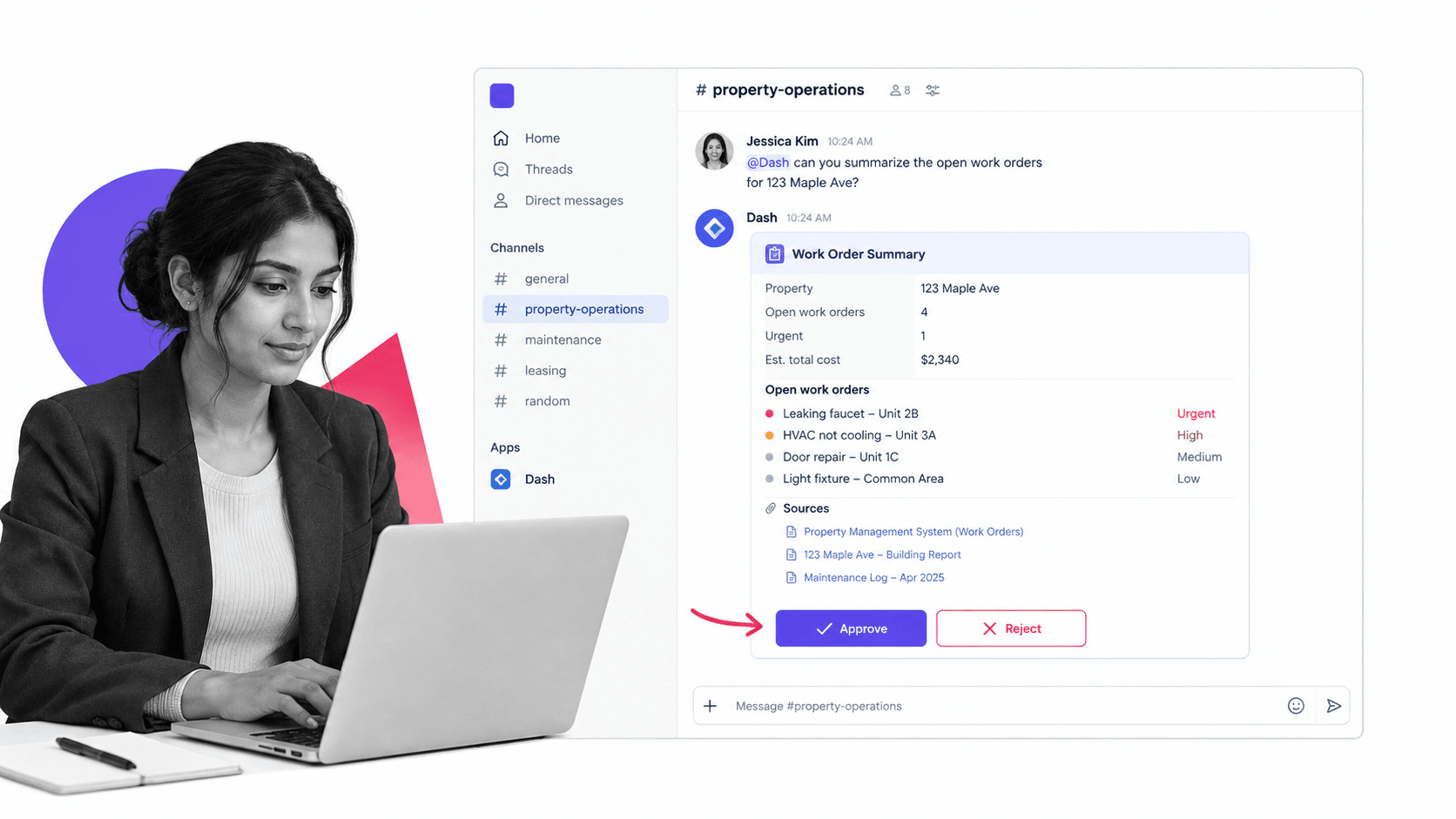
Dash is an AI teammate that joins Slack or Microsoft Teams the way a person would. You mention it in the channel and it reads across the systems the office already runs on: the work order report, the shared inbox, the rent roll, the accounting tool, the CRM. It connects to more than 3,000 tools, and where no connector exists it can work through the browser instead. Property management connectors are available for some systems today and on request for others, so check availability for your own software before you connect it.
What makes it usable on a live portfolio is what it refuses to do. Reading and compiling happen directly. Anything that goes out, files or spends money comes back into the conversation with an approval on it, and that is the default rather than a setting somebody has to find. When it reports that eleven work orders are open across six communities it names the report, the inbox and the repair history it read to get there, so the number can be checked rather than trusted. Dash is covered under Process Street’s SOC 2 Type II attestation and ISO/IEC 27001 certification, as a product of Process Street running on the same systems and controls.
Bottom line: Best for a property management team that wants one assistant across the whole week rather than one function, and wants it to ask before it acts.
- Choose Dash if your week is spread across leasing, maintenance, collections and owner reporting, and your team already lives in Slack or Microsoft Teams.
- Skip Dash if your only problem is filling units and you would rather have a leasing specialist that plugs straight into a multifamily CRM.
2. EliseAI
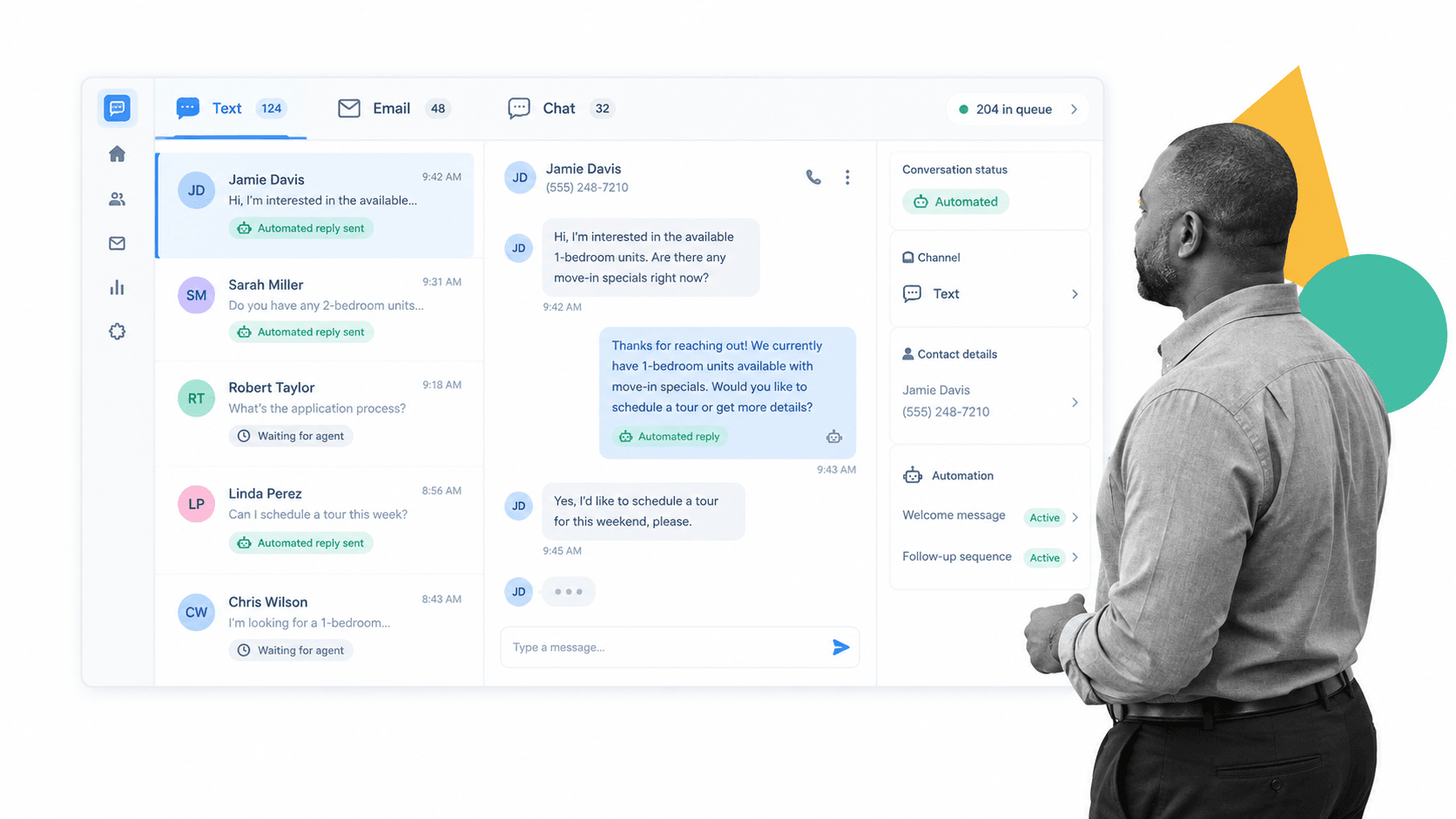
EliseAI describes itself as AI for housing and healthcare, and in housing it covers multifamily and single family operators. Its focus is communication at scale: streamlining how an organisation talks to prospects and residents across channels, with workflow automation underneath.
It is a platform decision rather than an assistant you add to a channel, and it is aimed at larger housing providers with the volume to justify that. If the sheer quantity of inbound conversation is what is breaking your team, this is the category it was built for.
Bottom line: Best for housing providers whose bottleneck is the volume of resident and prospect communication.
- Choose EliseAI if you run a large portfolio and want communications handled as a platform rather than a task.
- Skip it if you want one assistant that also prepares owner reports, chases arrears and triages maintenance in the same conversation.
More detail on the EliseAI website.
3. Zuma
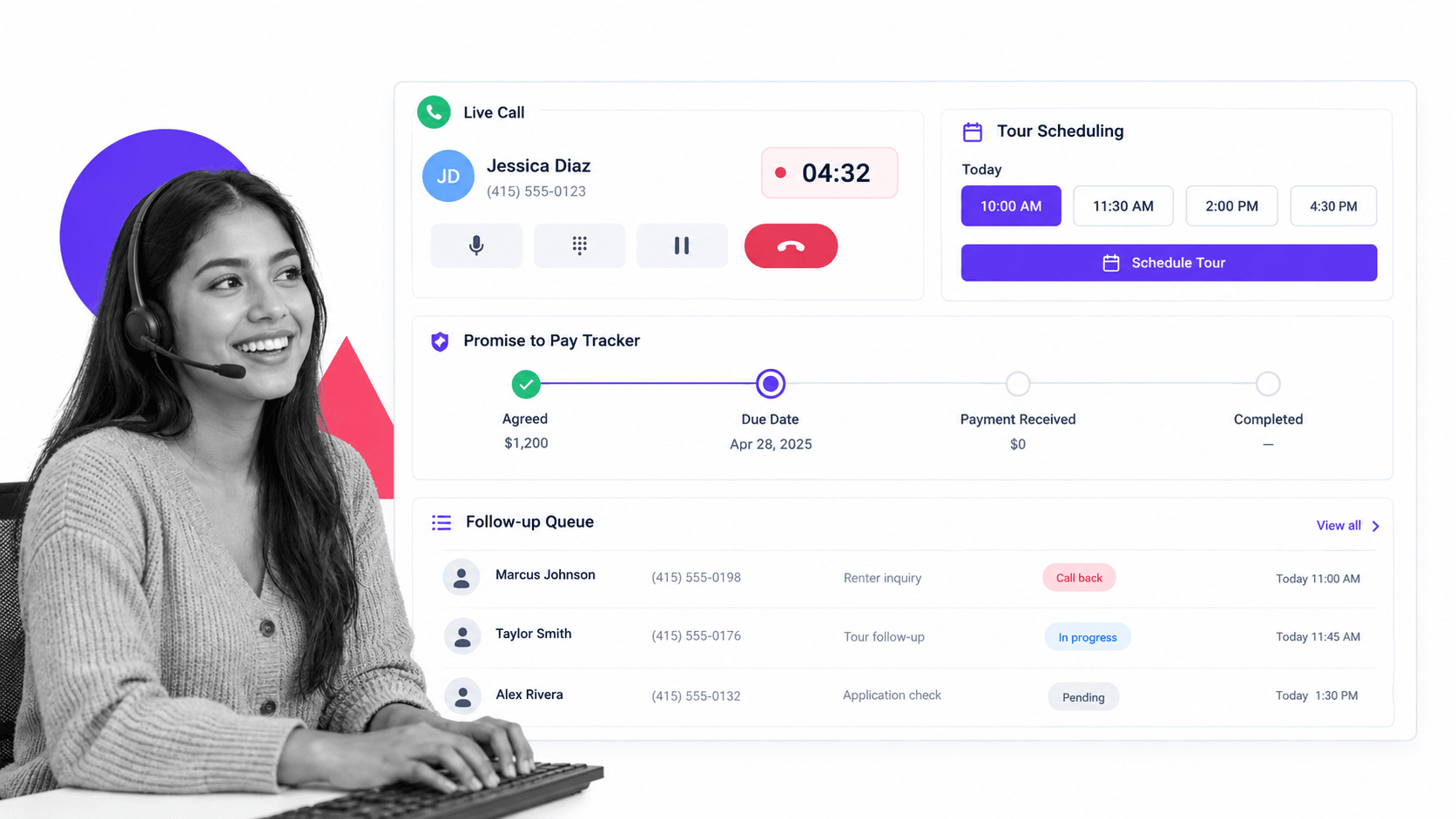
Zuma’s assistant is called Kelsey and it is built for multifamily. It integrates with your CRM to handle enquiries and automate scheduling, sends payment reminders and tracks promise to pay dates for rent collections, runs move outs from the initial notice through inspections and deposit returns, and acts as a customisable AI receptionist for property calls.
A team of human experts sits behind it, and that backstop is the interesting part of the design. It is a different answer to the same trust problem an approval gate solves: rather than holding the work for your team to check, Zuma holds it for theirs.
Bottom line: Best for multifamily operators who want leasing, collections and calls covered with a human safety net behind the automation.
- Choose Zuma if you are multifamily and want leasing and collections coverage around the clock.
- Skip it if you manage single family or commercial and want the assistant working inside your own chat tools.
More detail on the Zuma website.
4. Funnel
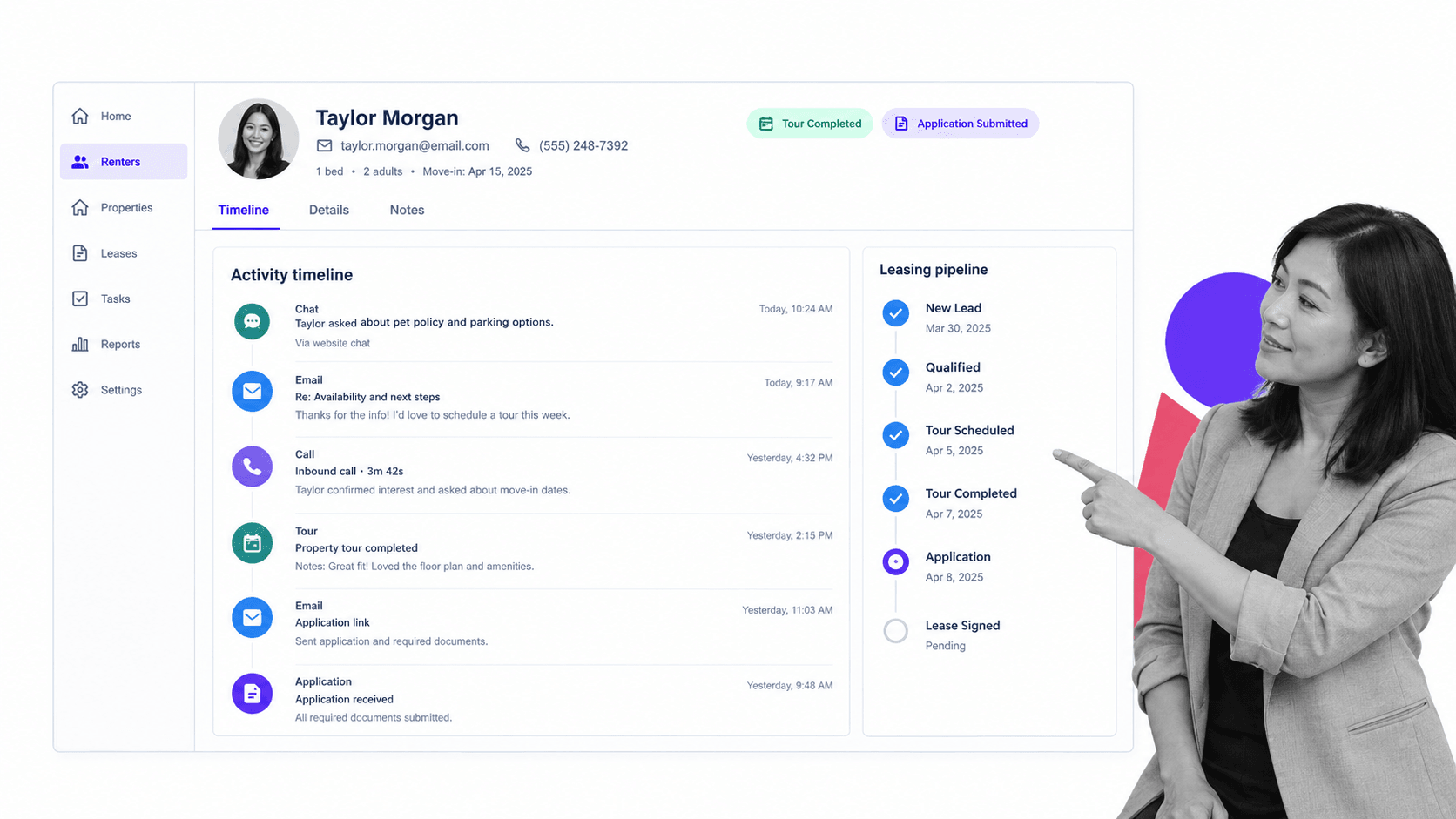
Funnel calls itself multifamily’s first AI front office only platform. It pairs agentic AI for prospect and resident follow up across email, chat, SMS and voice with a renter centric CRM, contact centre software, resident onboarding and portal apps, and an assistant called Fenix that handles SOPs, tours and reminders and surfaces portfolio data across connected tools.
This is the most complete front office replacement on the list. That is its strength and also the size of the decision, because you are adopting a platform rather than adding an agent on top of the stack you already have.
Bottom line: Best for multifamily operators willing to rebuild the front office around one AI native platform.
- Choose Funnel if you want the whole renter experience on one system rather than an agent spanning several.
- Skip it if you want to keep the systems you have and add an assistant across them.
More detail on the Funnel website.
5. LeadSimple
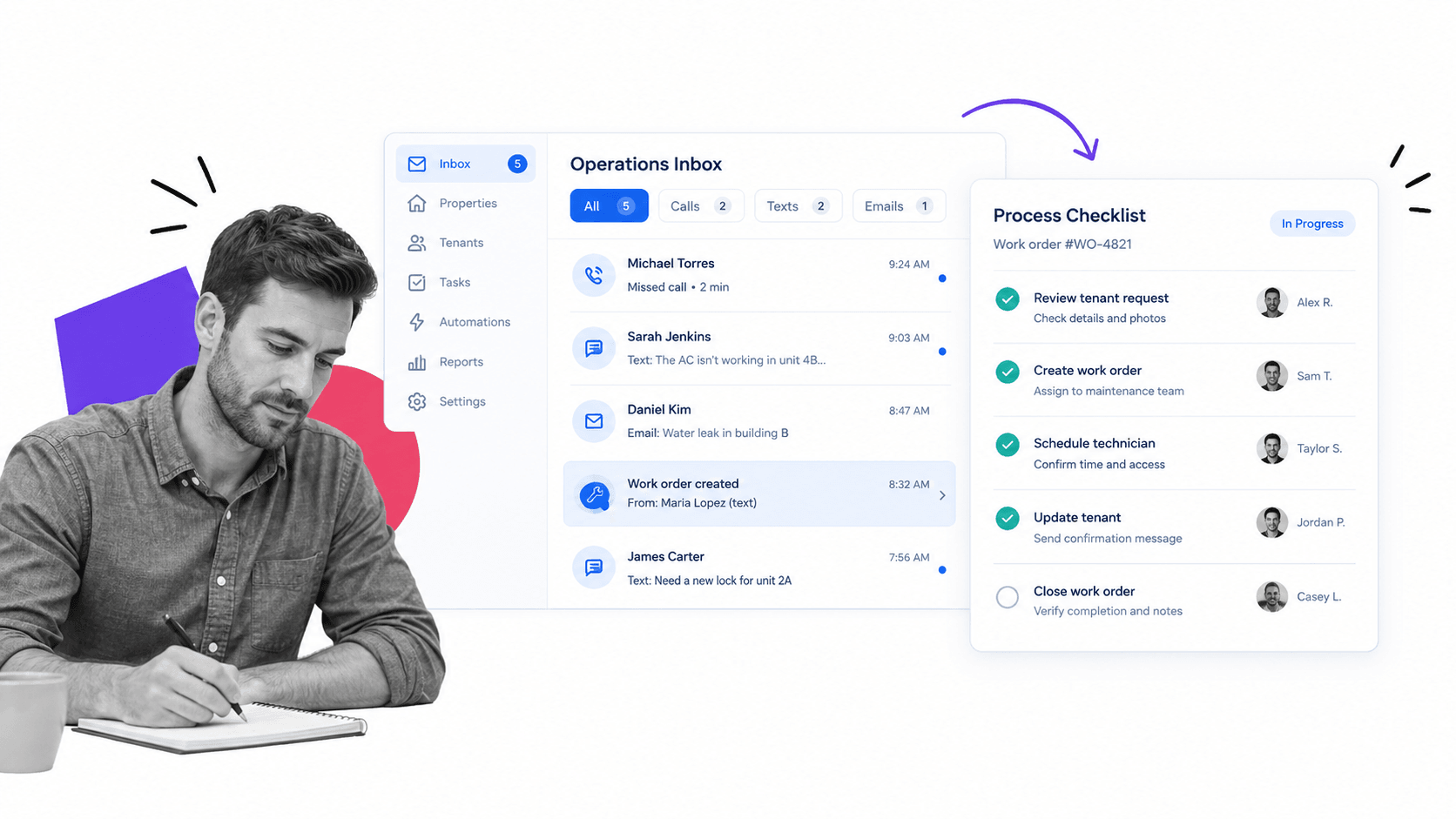
LeadSimple puts leads, calls, processes and work orders on one system and one timeline, with a shared inbox, VOIP and maintenance included on the platform. It is aimed squarely at property management companies growing their door count without adding chaos.
Worth being straight about something here. LeadSimple is also one of the property systems Dash connects to, so for many teams this is a complement rather than a choice between the two. LeadSimple holds the process, and a cross system assistant works across it and everything else.
Bottom line: Best as the operational backbone for small and mid sized property management companies.
- Choose LeadSimple if your processes and work orders need one home with clear ownership per step.
- Skip it if you already have a system of record and the real gap is the work between systems.
More detail on the LeadSimple website.
6. Property Meld
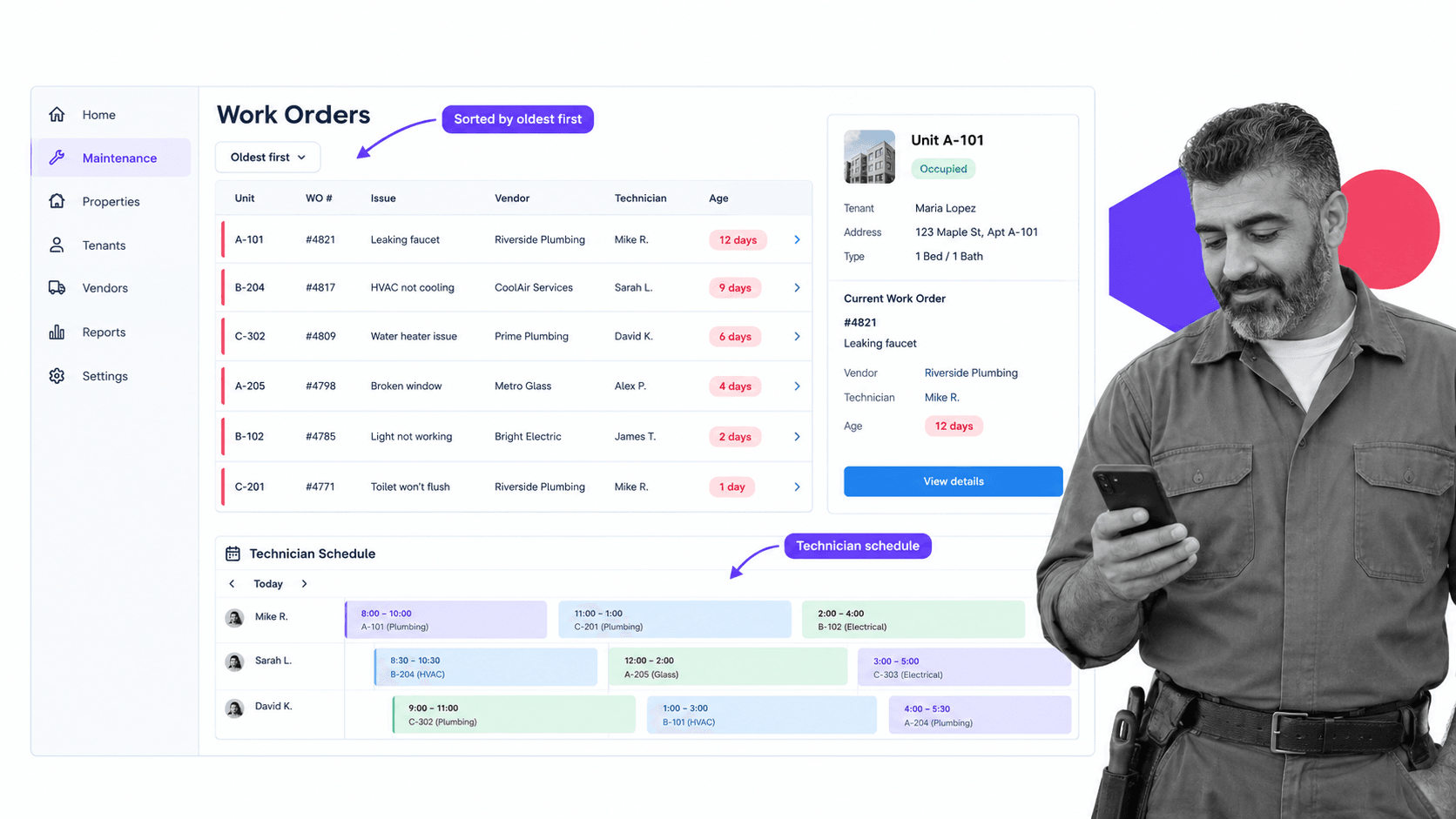
Property Meld is maintenance software for maintenance operations, built for property management companies and their teams to run repairs, coordinate technicians and vendors, and keep residents and owners informed.
If maintenance is the part of the week that hurts most, depth in one function beats breadth across many. Property Meld is the specialist answer to the complaint that sends most operators looking for an AI agent in the first place.
Bottom line: Best when maintenance coordination is the single biggest drag on the team.
- Choose Property Meld if repairs, vendors and technician scheduling are your core operational problem.
- Skip it if your bottleneck sits in leasing, arrears or owner reporting instead.
More detail on the Property Meld website.
7. OpenAI Codex
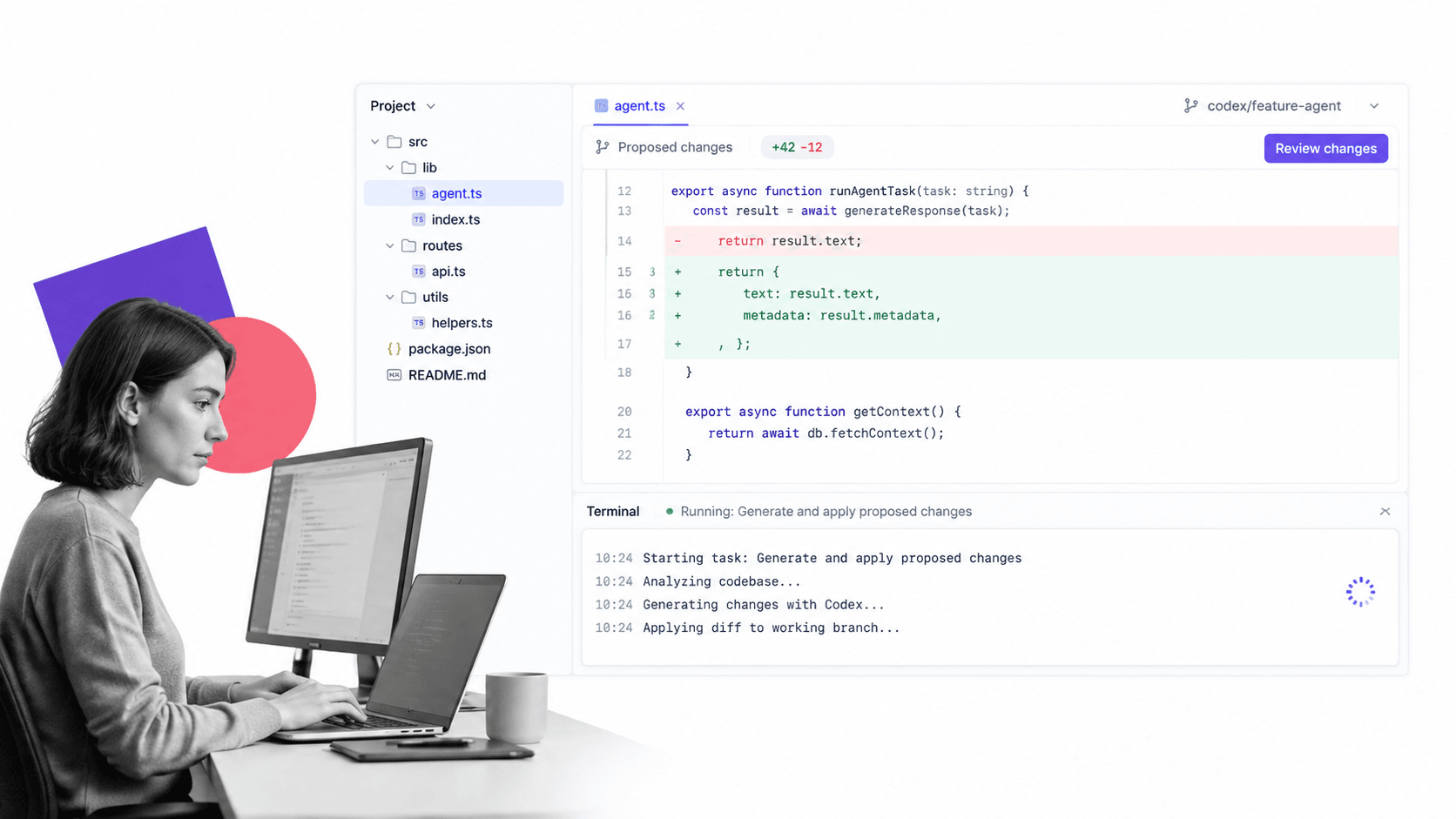
Codex is OpenAI’s coding agent. It reads a repository, makes changes and runs tasks in the terminal and in the cloud, and it is genuinely excellent at software engineering. It appears on this list because property managers keep being pointed at it, not because it competes for the same job.
It is a developer tool for developers. If your company ships custom software, an engineer will get a great deal out of it. If your team runs leasing, maintenance, accounting and owner relations, a coding agent is the wrong shape for the day to day work.
Bottom line: Best in class for engineering, and not built for the back office of a property management company.
- Choose Codex if you have engineers and a codebase.
- Skip it if the work you want automated lives in email, reports and your property management system.
More detail on the OpenAI Codex website.
8. Claude Code
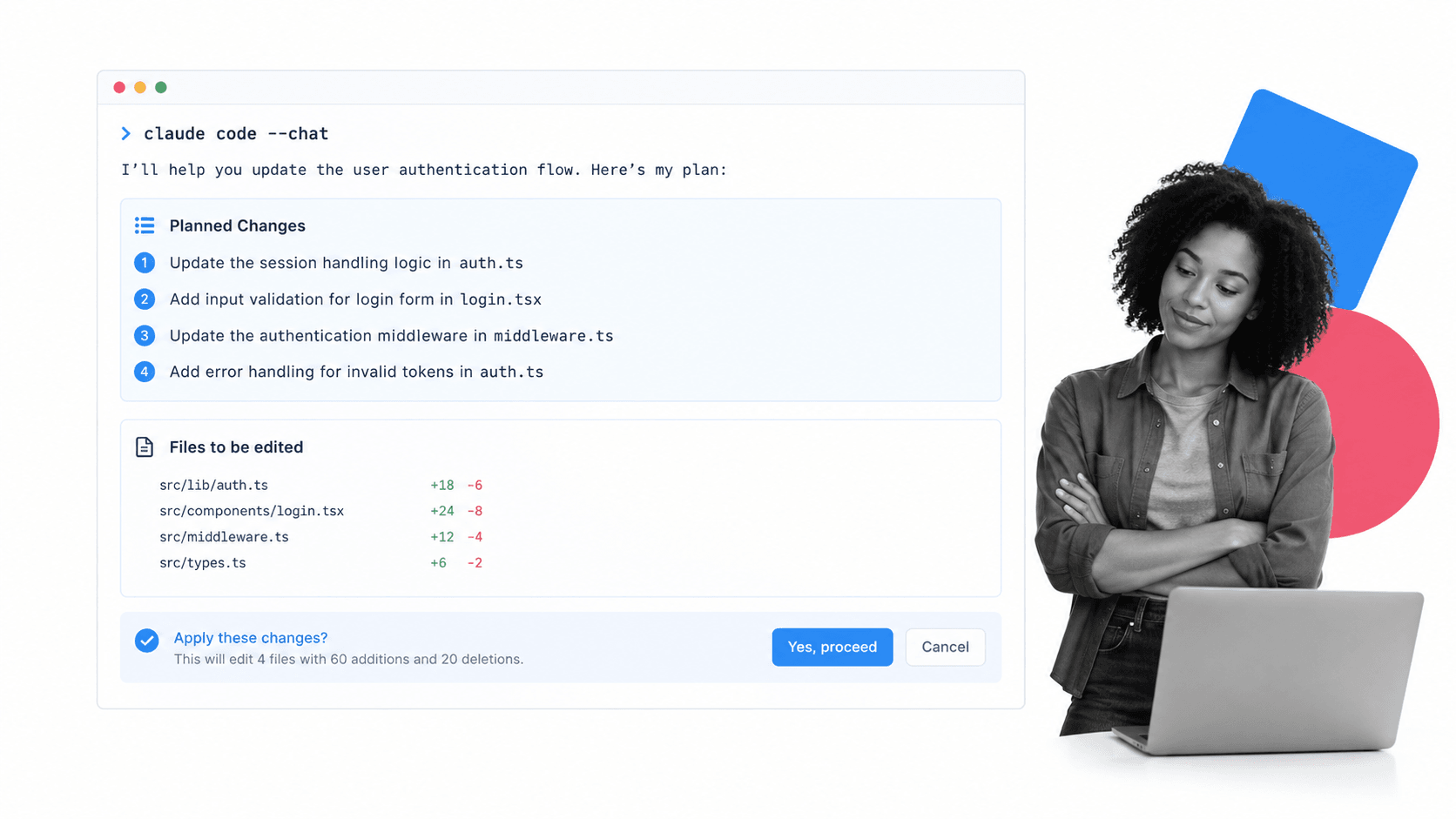
Claude Code is an agentic coding tool. It reads a codebase, edits files and runs commands, and it works across the terminal, IDE extensions, a desktop app and the browser.
Like Codex it is strong at the thing it was built for and lives in the codebase rather than the workspace business teams use every day. The design assumption underneath both is that a wrong move is reversible, because inside a repository it is. A notice that reaches the wrong resident is not a revert, which is why an operations agent needs an approval step and a coding agent does not.
Bottom line: Best for building software, not for running the property business.
- Choose Claude Code if you are building software.
- Skip it if you want an operator facing teammate in chat.
More detail on the Claude Code website.
Where Process Street fits with AI agents for property management
Process Street is not one of these alternatives and does not belong in the ranking above. It is the layer underneath them. An AI agent sits in chat and does the fetching, compiling and drafting. Process Street holds the part that has to be repeatable: the checklist, the approvals, the owner assignment, the conditional logic and the evidence trail for a move out, a renewal, a turnover or a month end close.
That distinction is the whole reason agents disappoint in month three. A team buys an agent, points it at a job, gets a good answer once and a bad answer the third time, and concludes the agent got worse. The agent did not get worse. The job was never actually defined. An agent given a vague instruction produces a plausible answer. An agent given an executable process produces a repeatable one.
So the honest sequence is to write the process down in a form something can execute, then put an agent on top of it. Document control keeps the policy version straight, automations move the work between steps, and the AI platform is where agents execute against it. If you are starting from nothing, the template library is the shortest path to a first written procedure.
For the wider picture on this category, see what AI agents are, AI agents for Slack, AI coworkers for Slack, AI employees for Slack and multiplayer AI agents. For the property specific software picture, see property management, commercial property management software and property management software for small landlords. Pricing for Process Street is on the pricing page, and a broader agent comparison sits on AI employee alternatives.
How to choose
If one function is clearly the problem, buy the specialist for that function. If the problem is the work between functions, and the week is lost carrying information from one system to another, buy the assistant that reaches all of them and asks before it acts. Those are genuinely different purchases and confusing them is the most common mistake in this category.
Then test it on one job. Pick the task your office repeats every single week that nobody enjoys. Run it beside the person who does it today and compare the draft against what they would have written. Check you can inspect the sources behind every number. Check what it does when information is missing. If the person is editing rather than rewriting, you have your answer, and then you add the second job.
Frequently asked questions
What is the best AI for property management?
For a team whose work spans leasing, maintenance, collections and owner reporting, Dash, because it reaches those systems from inside Slack or Microsoft Teams and holds every outbound action for approval. For a single function, the specialist for that function will go deeper: EliseAI for communications at scale, Zuma for multifamily leasing and collections, Property Meld for maintenance.
How is AI used in property management?
Mostly for reading and drafting rather than deciding. The four jobs that come up first are compiling owner reports, triaging maintenance requests, drafting arrears follow ups, and tracking renewals before dates slip. In each case the agent gathers from several systems and prepares the work, and a person approves it.
What are the top 5 AI agents for property management?
Ranked for a team that wants breadth: Dash, EliseAI, Zuma, Funnel and LeadSimple. Property Meld is the sixth and the strongest pick if maintenance is your main problem. The right answer depends on whether one function is the bottleneck or the work between functions is.
Is there a free AI agent for property management?
Several vendors publish trials and free entry points, and Dash publishes its current plans on its own pricing page. Where a vendor does not publish pricing at all, you will need a demo to find out, which is itself a useful signal about who the product is sold to.
Will an AI agent connect to the property system I already use?
Check the connector status rather than the logo wall. A logo on a marketing page can mean live, planned, or available on request, and the difference decides whether the agent reads your actual system or a spreadsheet exported out of it last week.
How is Dash different from a coding agent like Claude Code or Codex?
Those are developer tools that work inside a codebase, where a wrong move is reversible. Dash works inside your business systems, where a wrong move reaches a resident or an owner, so it is built around approvals rather than autonomy. Both are excellent at their own job and they are not the same job.
Do realtors and property managers use ChatGPT?
Widely, for drafting and summarising. The limit is that a general chat assistant does not connect to your property management system, your ledger or your shared inbox, so a person still has to fetch the information and paste it in. That fetching is the part that eats the week.
Can an AI agent message residents and owners on its own?
It should not, unless you have explicitly allowed it for a specific job. The safe default is that the agent prepares the message and a person approves it before anything is sent.
Ready to put a written process under your agents? See how Process Street works.