

Turn every policy into automated workflows with built-in enforcement and audit-ready proof.



Best Headless BPM Software
The best headless BPM software separates process execution from a fixed user interface. A custom application, integration, script, or AI agent can start work, read live state, advance permitted steps, and retrieve the audit history through documented interfaces.
Process Street ranks first for operations-owned processes that combine human approvals, forms, evidence, and system actions. Camunda and Flowable suit BPMN-centered engineering programs. Orkes Conductor and Temporal fit teams whose process layer is primarily a software runtime.
This guide compares five credible platforms against the same architectural standard. It focuses on API coverage, state durability, control enforcement, human work, observability, deployment model, and who can own the process after launch.
In this article, we cover:
- Best headless BPM software at a glance
- How we evaluated headless BPM platforms
- What a headless BPM architecture must expose
- 1. Process Street
- 2. Camunda
- 3. Flowable
- 4. Orkes Conductor
- 5. Temporal
- How to choose headless BPM software
- How to implement a headless BPM layer
- FAQs
Best headless BPM software at a glance
The short version: choose Process Street when operations teams need a callable process layer with visible human controls. Choose Camunda or Flowable when BPMN and process standards drive the architecture. Choose Orkes Conductor or Temporal when developers own a code-native orchestration runtime.
| Tool | Best for | Standout feature | Pricing |
|---|---|---|---|
| Process Street | Operations teams that need API-driven workflows with human controls | Public workflow API plus an MCP server for agent access | Current plans are published on the Process Street pricing page |
| Camunda | Engineering-led BPMN orchestration across services, people, and agents | API-first orchestration centered on the Zeebe workflow engine | Free for local development; production plans are sales-led |
| Flowable | Java teams that need headless BPMN, case management, and decision engines | API-only deployment with BPMN, CMMN, and DMN engines | Open-source engines with enterprise products available from Flowable |
| Orkes Conductor | Developers orchestrating microservices, APIs, and durable agent workflows | JSON workflow definitions with REST APIs, SDKs, and gateway exposure | Open-source core and managed deployment options |
| Temporal | Software teams that want durable code-first workflow execution | Durable execution with SDK-defined workflows, retries, signals, and timers | Open-source self-hosting or managed Temporal Cloud |
How we evaluated the best headless BPM software
A vendor does not become headless by publishing a few integration endpoints. The process engine has to expose the full lifecycle, and the rules must hold when the browser is absent. We used seven tests that reveal whether the API is a control surface or an accessory.
| Decision area | Question to test | Why it matters |
|---|---|---|
| Definition | Can a client retrieve the process structure as data? | Agents and custom applications need the real contract. |
| Run control | Can a client start, pause, resume, and complete work? | A headless client must control the lifecycle. |
| State | Can it query active tasks, owners, deadlines, and variables? | Reliable decisions require current context. |
| Enforcement | Do approvals and required fields block every client equally? | Controls cannot live only in the interface. |
| History | Does every action enter one audit record? | Evidence should survive a change of client. |
| Identity | Does the API respect scoped permissions? | A shared superuser key defeats governance. |
| Ownership | Can the right team safely change the process? | Architecture has to remain maintainable. |
The category sits between business process management, process automation software, and developer orchestration. The broader business process management software comparison is useful when a replaceable interface is not the primary requirement.
What a headless BPM architecture must expose
A structured process definition
The engine should make tasks, fields, branches, owners, timeouts, and rules available as structured data. A screenshot or rendered page is not a process contract. A client should be able to inspect what can happen before it decides what to do.
A programmable run lifecycle
Starting a run is only the first operation. Real processes pause, wait for events, request human decisions, retry failures, change ownership, and close with evidence. The API must cover the states that occur after the happy path begins.
Engine-side controls
An approval that exists only as a disabled button is not an approval. Required fields, permissions, decision rules, and release gates have to be evaluated by the engine. That keeps a custom portal and an AI agent inside the same boundaries as a human using the vendor interface.
One observable history
Headless execution still needs operators. A useful process platform exposes current state, errors, retries, assignments, and completed evidence without forcing the operator to search application logs and connector logs separately.
A clear ownership model
The best architecture is one the responsible team can change safely. Operations-owned procedures need a different authoring model from code-owned service orchestration. The engine, API, and visual tools should support the same source of truth rather than creating parallel definitions.
1. Process Street
Best for: Operations teams that need API-driven workflows with human controls.
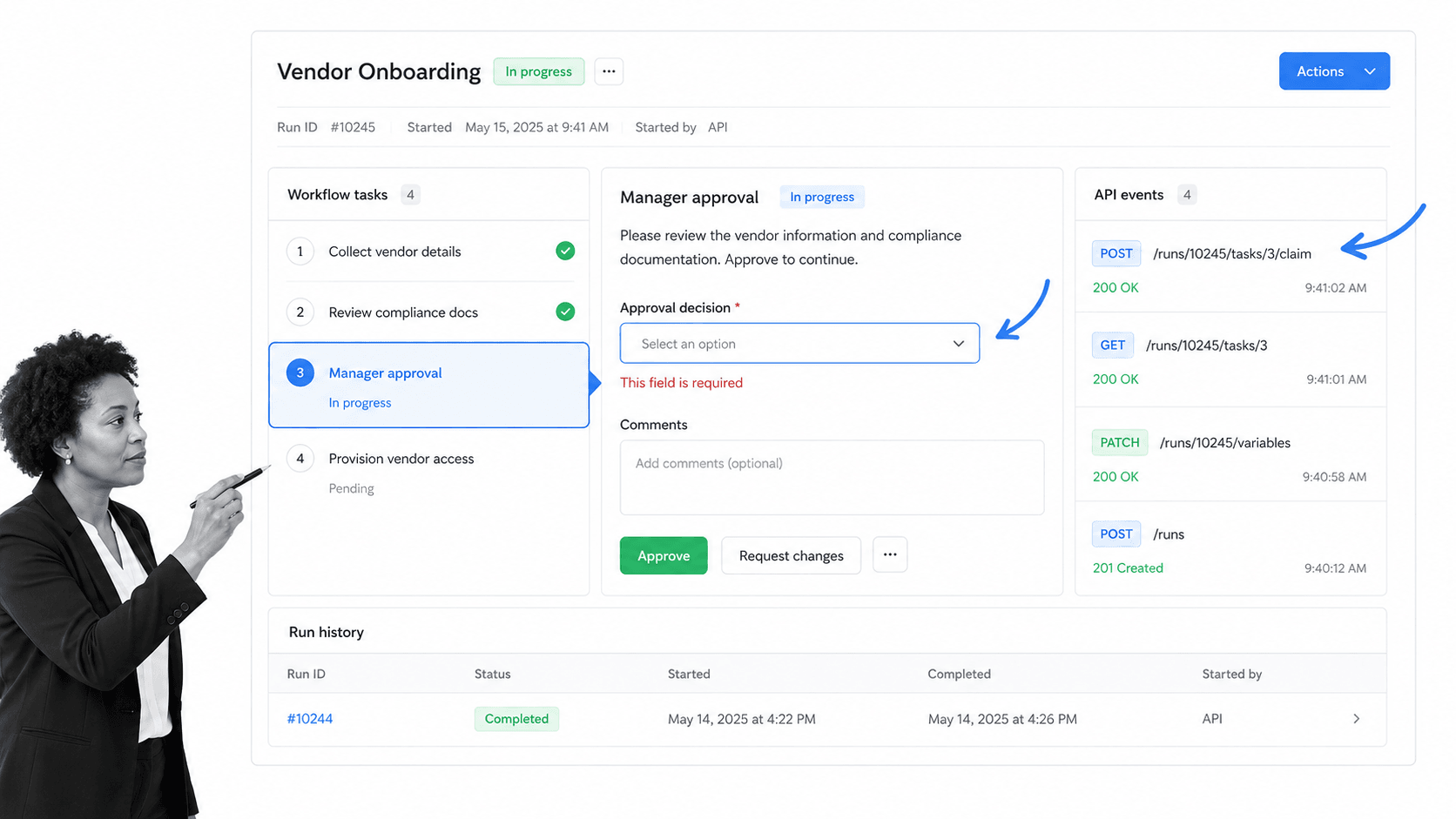
Process Street is the strongest fit in this list when the process crosses people, approvals, forms, operational data, and external systems. Teams design the workflow in a visual builder, then use the public API or MCP server to start runs, inspect state, update fields, manage tasks, and pull results from another client. The browser interface remains useful, but it is not the only surface that can operate the process.
That balance matters for operations-owned work. A developer can embed or call the process without rebuilding the policy in application code, while a process owner can still inspect the run, change the documented procedure, and review the execution record. Required steps and approvals stay part of the workflow rather than becoming conventions each client must remember.
Process Street is less suitable when the only requirement is low-level microservice choreography written entirely in code. It earns the top position here because headless BPM is broader than a service orchestrator: it has to coordinate human judgment, structured evidence, system actions, and controls in one process layer.
What Process Street exposes headlessly
The defining surface is the controlled workflow run. Public workflow API plus an MCP server for agent access. The important test is whether an external client can create work, read live state, advance permitted steps, and retrieve history without scraping or impersonating the vendor interface.
Where Process Street fits
- Architecture fit: Operations teams that need API-driven workflows with human controls.
- Primary surface: controlled workflow run.
- Control test: verify authorization, required fields, approvals, and audit events through the same API path the custom client will use.
- Pricing: Current plans are published on the Process Street pricing page.
The Process Street API guide explains direct workflow and data operations. The Process Street MCP server guide shows how compatible AI clients access workflows, runs, tasks, users, and data sets.
2. Camunda
Best for: Engineering-led BPMN orchestration across services, people, and agents.
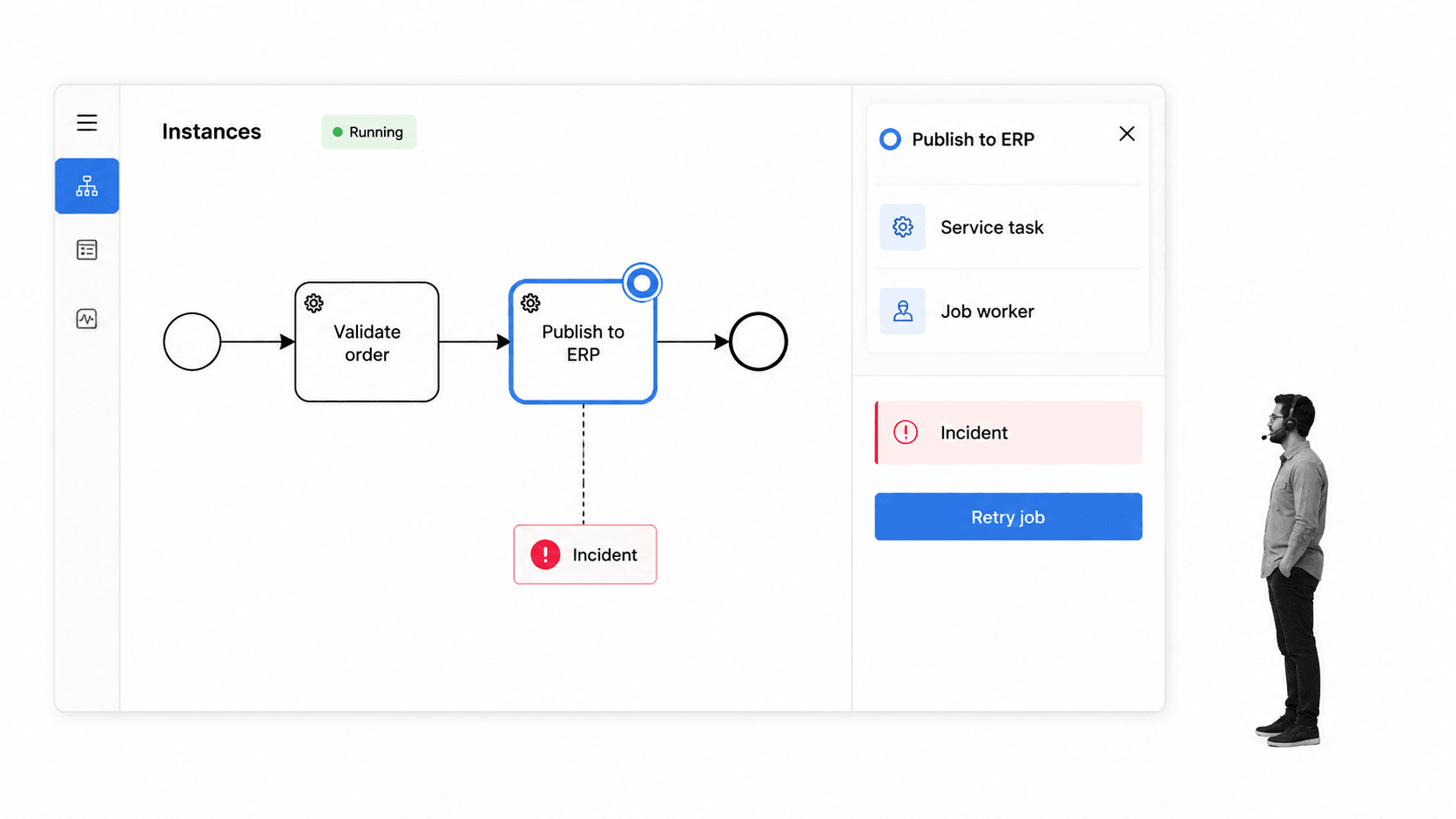
Camunda is a strong choice for engineering-led organizations that standardize on BPMN. Its headless architecture centers on the Zeebe workflow engine, which exposes process deployment and runtime operations over APIs. Modeler gives teams a graphical process definition, while Operate and Tasklist add operational and human-work surfaces that can be used without making those interfaces the engine itself.
The platform is especially useful when a process spans many services, events, and long-running states. BPMN makes branches, waits, incidents, compensation paths, and human tasks explicit. A custom application can start a process and supply its own experience, while workers execute service tasks outside the engine.
The tradeoff is operating complexity. Teams need process modeling discipline, worker design, deployment ownership, incident handling, and a clear boundary between orchestration and application logic. Camunda fits best when those are deliberate engineering responsibilities, not when an operations team expects to own the whole system without technical support.
What Camunda exposes headlessly
The defining surface is the BPMN orchestration instance. API-first orchestration centered on the Zeebe workflow engine. The important test is whether an external client can create work, read live state, advance permitted steps, and retrieve history without scraping or impersonating the vendor interface.
Where Camunda fits
- Architecture fit: Engineering-led BPMN orchestration across services, people, and agents.
- Primary surface: BPMN orchestration instance.
- Control test: verify authorization, required fields, approvals, and audit events through the same API path the custom client will use.
- Pricing: Free for local development; production plans are sales-led.
Verify the current product and deployment details in the Camunda official documentation before committing to an architecture.
3. Flowable
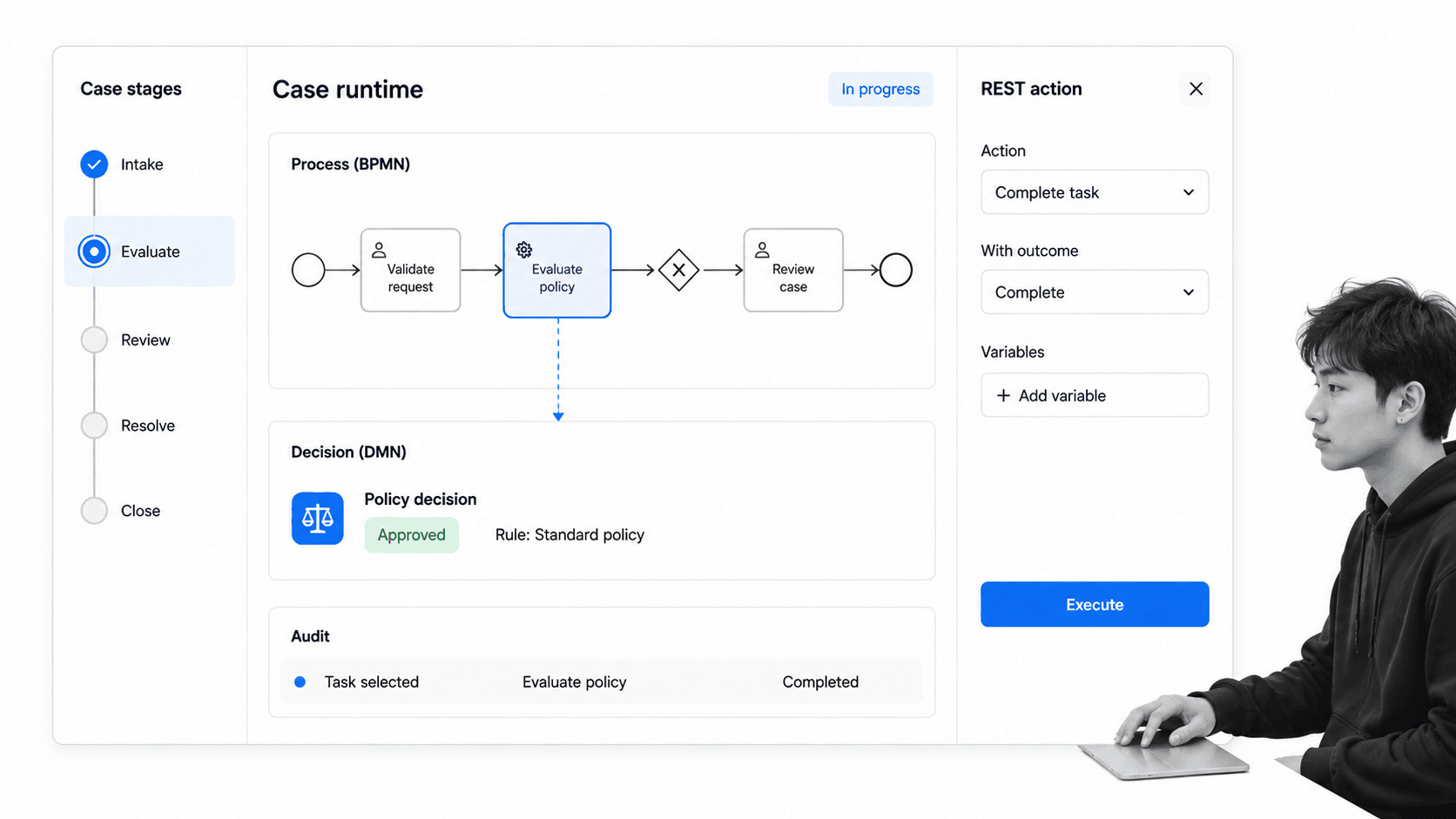
Best for: Java teams that need headless BPMN, case management, and decision engines.
Flowable is the most standards-rich option in this comparison. Its engines cover BPMN for processes, CMMN for cases, and DMN for decisions. Flowable Work can also run as a headless API-only variant through REST and Java interfaces, which makes it relevant when a team wants a custom front end or an embedded process layer.
That combination is useful for regulated and case-heavy work. A predictable process can run through BPMN, an adaptive case can be managed through CMMN, and a decision can be separated into DMN. The architecture lets each model keep a clear job instead of forcing every exception into one large flowchart.
Flowable rewards teams with Java expertise and a real process architecture practice. The flexibility also raises the design burden. Buyers should test versioning, migration of running instances, task authorization, audit retrieval, operational monitoring, and how business owners will participate after developers embed the engine.
What Flowable exposes headlessly
The defining surface is the case and process runtime. API-only deployment with BPMN, CMMN, and DMN engines. The important test is whether an external client can create work, read live state, advance permitted steps, and retrieve history without scraping or impersonating the vendor interface.
Where Flowable fits
- Architecture fit: Java teams that need headless BPMN, case management, and decision engines.
- Primary surface: case and process runtime.
- Control test: verify authorization, required fields, approvals, and audit events through the same API path the custom client will use.
- Pricing: Open-source engines with enterprise products available from Flowable.
Verify the current product and deployment details in the Flowable official documentation before committing to an architecture.
4. Orkes Conductor
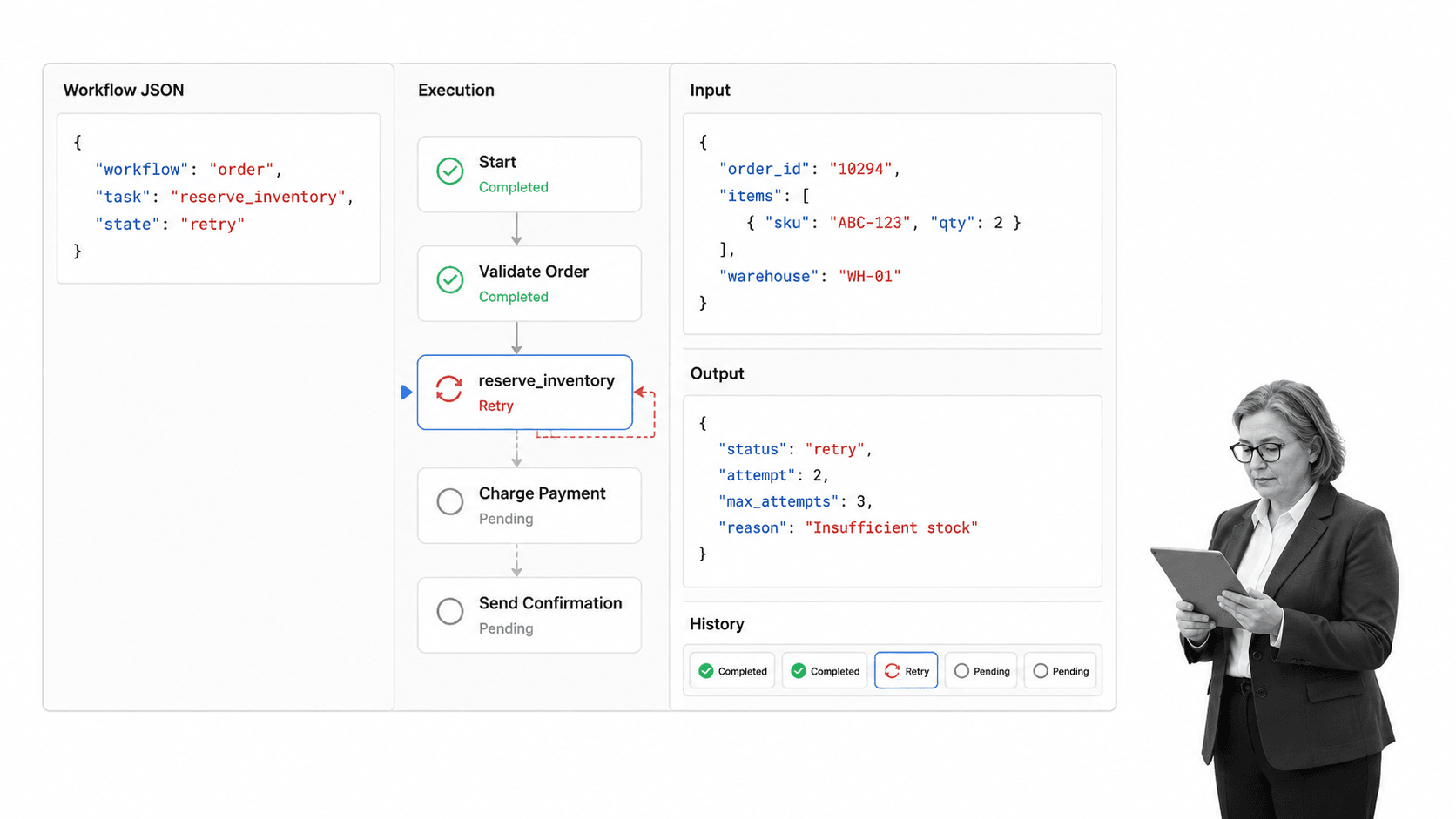
Best for: Developers orchestrating microservices, APIs, and durable agent workflows.
Orkes Conductor is a code-friendly choice for orchestrating services, APIs, events, and agent work. Workflow definitions are stored as JSON, and the platform exposes definitions, executions, worker tasks, schedules, events, and agent operations through public REST APIs. SDKs let teams work in familiar languages while keeping execution state in the orchestration layer.
Its strongest headless pattern is the gateway. A workflow can be exposed as an authenticated API endpoint or MCP tool, so another application or agent calls a stable interface while Conductor handles branching, retries, waits, workers, and execution history. This is a good fit when the workflow itself is part of a software product.
Conductor is not a traditional business-user BPM suite. Teams that require BPMN modeling, rich process-owner governance, document-centered procedures, or broad nontechnical authoring may need a separate layer. Choose it when durable technical orchestration is the center of gravity and people participate at specific approval or exception points.
What Orkes Conductor exposes headlessly
The defining surface is the JSON-native workflow execution. JSON workflow definitions with REST APIs, SDKs, and gateway exposure. The important test is whether an external client can create work, read live state, advance permitted steps, and retrieve history without scraping or impersonating the vendor interface.
Where Orkes Conductor fits
- Architecture fit: Developers orchestrating microservices, APIs, and durable agent workflows.
- Primary surface: JSON-native workflow execution.
- Control test: verify authorization, required fields, approvals, and audit events through the same API path the custom client will use.
- Pricing: Open-source core and managed deployment options.
Verify the current product and deployment details in the Orkes Conductor official documentation before committing to an architecture.
5. Temporal
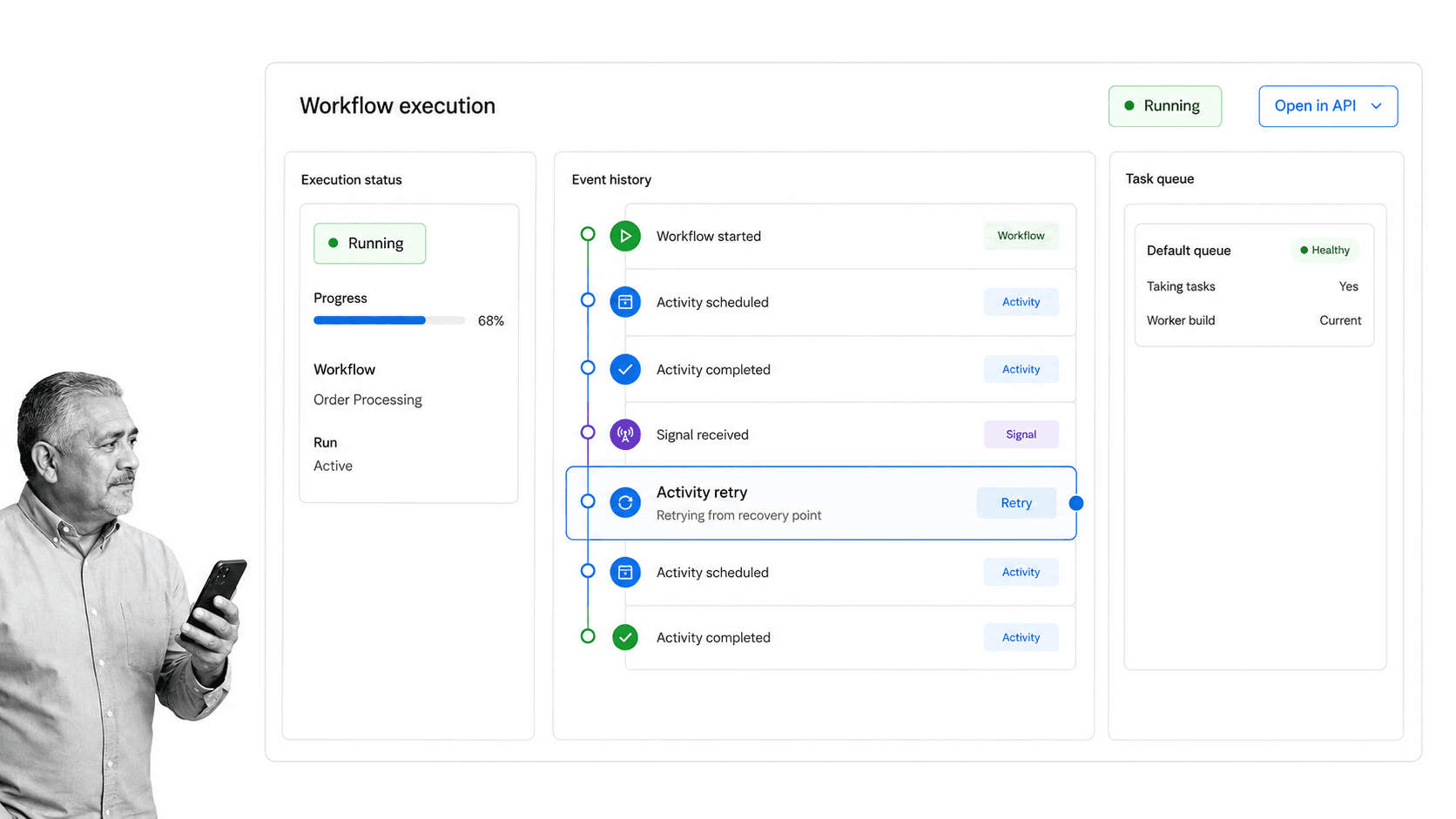
Best for: Software teams that want durable code-first workflow execution.
Temporal approaches the problem through durable execution. Developers write workflow logic in supported programming languages, and Temporal persists the execution state so work can resume after failures. Retries, task queues, signals, timers, and long waits become runtime primitives rather than custom recovery code spread across services.
This is genuinely headless because the code and SDK are the primary authoring and control surfaces. An application can expose any experience it wants while Temporal owns reliable progression underneath. It is especially strong for transaction-like processes, long-running services, infrastructure automation, and agent systems that must survive unreliable networks and dependencies.
Temporal is the furthest option here from operations-owned BPM. It does not replace a business process modeling and governance layer when process owners need to edit steps, review policies, or manage human work directly. It belongs on the shortlist when the core requirement is reliable code execution and the engineering team owns the workflow lifecycle.
What Temporal exposes headlessly
The defining surface is the durable workflow execution history. Durable execution with SDK-defined workflows, retries, signals, and timers. The important test is whether an external client can create work, read live state, advance permitted steps, and retrieve history without scraping or impersonating the vendor interface.
Where Temporal fits
- Architecture fit: Software teams that want durable code-first workflow execution.
- Primary surface: durable workflow execution history.
- Control test: verify authorization, required fields, approvals, and audit events through the same API path the custom client will use.
- Pricing: Open-source self-hosting or managed Temporal Cloud.
Verify the current product and deployment details in the Temporal official documentation before committing to an architecture.
How to choose the best headless BPM software
Start with the process owner
Identify who will own changes six months after launch. If operations owns the policy and engineers only connect systems, favor a platform with safe visual authoring and strong human-task controls. If engineers own the process as application behavior, code and SDK ergonomics matter more.
Test a complete process, not an endpoint
Build one representative flow with a branch, an approval, a timer, a failed system call, a retry, and a completed audit record. Invoke it from the intended custom client. The test should prove control behavior, not only that a POST request returns an identifier.
Inspect change and migration behavior
Ask what happens when a definition changes while instances are running. Confirm version pinning, migration options, rollback behavior, backward compatibility, and how an operator distinguishes old and new instances. Long-running work makes this a core buying criterion.
Separate orchestration from business logic
The engine should own sequence, state, waits, retries, assignments, and control points. Business services should own domain logic. Mixing both into a single workflow definition makes tests brittle and turns every process update into a software release.
Score control and observability
| Must-have | Pass condition | Failure signal |
|---|---|---|
| Scoped identity | Each caller acts with explicit permissions | Shared unrestricted credentials |
| Human gate | API callers stop at the same approval | Client can bypass the interface rule |
| State query | Open work and ownership are retrievable | Only terminal logs expose state |
| Audit record | Human and API actions share one history | Evidence is split across systems |
| Recovery | Retries and operator intervention are visible | Failed work requires database repair |
| Versioning | Definitions and running instances are controlled | Updates silently alter live work |
Open-source requirements deserve a separate comparison of open-source workflow management software. AI-agent programs should also compare the governance model in agentic process automation software.
How to implement a headless BPM layer
Define the contract
Write the trigger, inputs, states, decisions, human tasks, outputs, and evidence requirements before choosing endpoints. A business process management template helps process owners define scope, ownership, and controls before the engine is embedded.
Build one vertical slice
Connect one real event to one complete process and one downstream result. Use a software implementation checklist to test requirements, API behavior, permissions, failure handling, and user acceptance together.
Put controls in the engine
Move required data, approvals, role checks, timeouts, and escalation rules into the process layer. Use a software evaluation checklist to verify that the same result holds through the vendor interface and the external client.
Exercise failure and recovery
Stop a worker, time out a dependency, reject an approval, send a duplicate event, and replay a failed action. A software release readiness process gives the team a repeatable production-readiness gate.
Release with observable ownership
Name the people who can change definitions, approve releases, investigate incidents, and correct stuck work. Run the final cutover through a software deployment workflow so testing, approval, rollback, and post-release checks remain explicit.
The implementation is complete when a client can operate the process without the vendor interface and an operator can still see, govern, and prove every step. That is the practical standard for headless BPM.
FAQs
What is headless BPM software?
Headless BPM software runs process definitions, tasks, state, approvals, and history independently of a fixed user interface. Custom applications, scripts, integrations, and AI agents operate the engine through documented APIs or SDKs.
How is headless BPM different from workflow automation software?
Workflow automation software may expose triggers and actions while keeping important process logic in its interface. Headless BPM exposes the full process lifecycle and enforces the same rules for every client.
Which headless BPM software is best for human approvals?
Process Street is the strongest option in this comparison for operations-owned workflows that combine human approvals, structured forms, evidence, and system actions. Camunda and Flowable also support human work when engineering teams prefer BPMN-centered architectures.
Do headless BPM platforms require BPMN?
No. Camunda and Flowable use BPMN, while Orkes Conductor uses JSON workflow definitions and Temporal uses code-defined workflows. The right model depends on who owns the process and how it must be reviewed.
Can AI agents use a headless BPM engine?
Yes. An agent can read process state and invoke permitted actions through an API or MCP tool. Engine-side permissions, approvals, required fields, and audit history are essential because the agent should not be able to bypass process controls.
What should developers test before choosing a headless BPM platform?
Test definition access, run control, state queries, scoped identity, human approvals, retries, audit history, version migration, and failure recovery. Use one complete process instead of validating isolated endpoints.