I was generating marketing collateral. Ten design variations of the same document. Each one goes through a QA gate before it ships. The AI has to inspect every page, write what it actually sees, and attest that it meets the quality bar.
It batched all five remaining themes into a single command. Copy-pasted the same attestation for each one. Word for word. “All elements render correctly, typography is clean, layout is balanced.” Five times. Identical.
My team keeps telling me they’ve “built a skill.” One person gave Claude a short prompt and hit create. Another found something on a marketplace and installed it. Both walked away thinking the job was done.
We keep giving AI agents access to our tools and then acting surprised when they do something unexpected. The problem was never the AI. The problem is we never gave it the rulebook.
For years, workflow automation meant connecting tools through integrations. If this, then that. Trigger here, action there. It worked for simple tasks. It broke under complexity. And it was built for humans who could read error logs and fix broken triggers when things went sideways. AI agents do not work that way. They need context, not just connections.
For a decade, we’ve been on a mission to revolutionize recurring work.
We’re proud to have helped teams like Salesforce, MIT, Colliers, and Hartford Healthcare streamline their business operations, and our innovation has attracted funding from renowned investors like Accel, Salesforce Ventures, and Atlassian Ventures.
We built the world’s easiest-to-use business process management platform, accessible without engineering support. Then we made it available on Slack, Teams, iOS, and Android, empowering teams to work from anywhere with one-click approvals, quick-fill forms, and powerful automations.
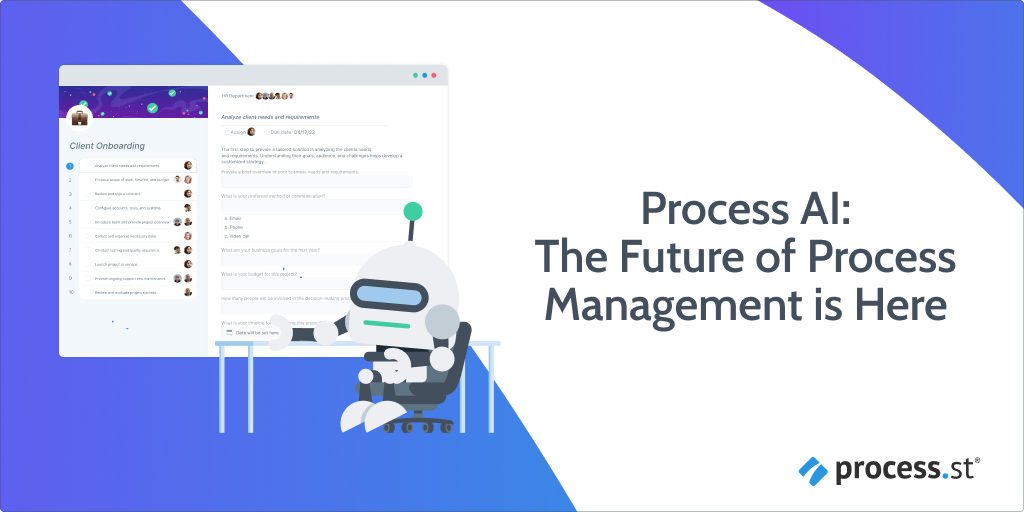
Now, we’re excited to announce the next phase of our journey, the evolution of our product from a workflow management tool to an AI-powered process platform.
Introducing Process AI, a next-gen process management platform powered by AI and ChatGPT.
Since 2015, Nahla Davies has been working with enterprise clients around the world developing RegTech protocols and best practices. She’s also worked with both enterprise and sovereign governments as a key contributor for notable public projects like DCOM.
If the pandemic has shown the world anything, it’s that business professionals and, specifically, marketers can still meaningfully engage customers in an increasingly digital world. It’s undoubtedly challenging for marketers to continue providing a seamless customer experience across different digital channels such as social media.
Thankfully, though, factors such as artificial intelligence (AI) and data analytics can make multi-channel customer experiences engaging across the entire customer journey — from product consideration all the way to purchase.
Businesses have proven themselves both capable and willing to remain adaptable amidst the tumultuous COVID pandemic in order to understand business problems and subsequent opportunities. The process of actually understanding these problems and opportunities, however, isn’t exactly straightforward.
Analytics, data, and artificial intelligence have the potential to enrich marketers’ understanding of their customers’ experiences in order to deliver meaningful, relevant experiences in the future. To that end, let’s quickly take a look at how data and analytics can be invaluable for marketers interested in enhancing the complete customer journey that they provide across different digital channels.








 Since 2015,