
Turn every policy into automated workflows with built-in enforcement and audit-ready proof.

The 20 Best Customer Success Software Tools

Customer success software is a category of tools that helps businesses proactively manage post-sale relationships, reduce churn, and grow the value of every account. Rather than waiting for customers to raise a support ticket, these platforms monitor product usage, track customer health, and trigger playbooks before small problems turn into cancellations. For a neutral primer on the discipline, see TechTarget’s overview of customer success.
The category has shifted fast. AI-native platforms now run autonomous agents that flag at-risk accounts, prepare quarterly business reviews, and personalize outreach at scale. Gartner published its first Magic Quadrant for Customer Success Management Platforms in 2024 and a second edition in 2025, with vendors such as Gainsight named a Leader in both editions. Consolidation has accelerated as well: Totango and Catalyst merged into a single company, and Gainsight folded Staircase AI into its platform to deepen conversation intelligence.
The business case is straightforward. Retaining and expanding existing customers is far cheaper than acquiring new ones: work popularized by Bain and Harvard Business Review found that increasing customer retention rates by five percent can lift profits substantially, and Bain research reached the same conclusion. Customer success software is how modern teams operationalize that math.
Whether you are standing up your first customer success function or replacing a legacy platform, the list below covers twenty strong options for a 2026 stack, grouped loosely from dedicated customer success platforms to service and adoption tools that neighboring teams often rely on.
Here is what we cover:
- The 20 best customer success software tools
- How is AI reshaping customer success software?
- What are the signs you need customer success software?
- Is customer success software right for you?
- What features should you look for in customer success software?
- What are the benefits of customer success software?
- Frequently asked questions
The 20 best customer success software tools
This list focuses on tools that earn a place in a current customer success stack, judged on present-day product strength and AI capability rather than legacy reputation. Process Street leads because it turns the repeatable processes behind onboarding, renewals, and escalations into automated, enforceable workflows that the rest of these tools then feed.
1. Process Street
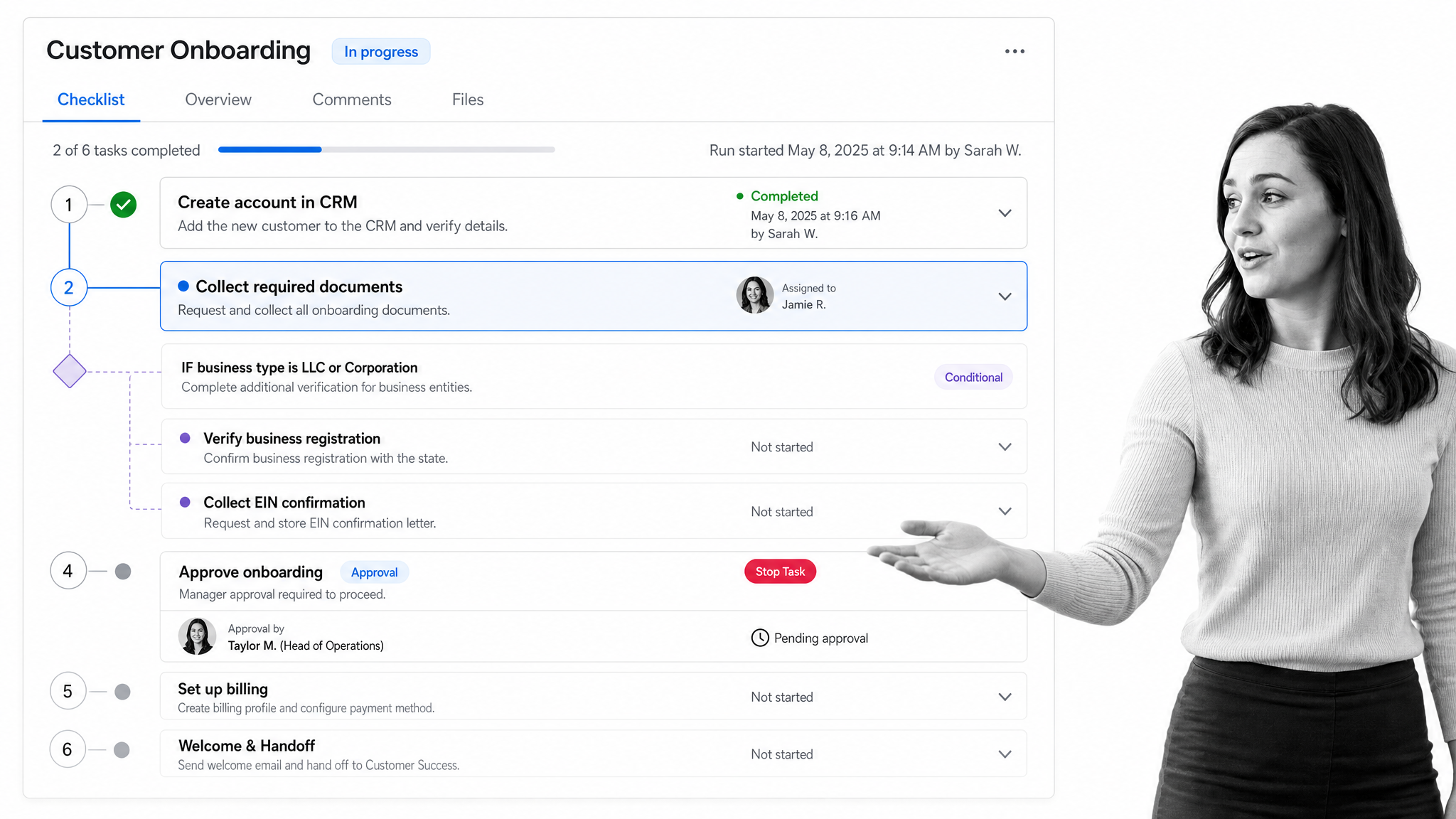
Process Street is a process and workflow management platform that turns critical customer success procedures into automated, AI-enforced workflows. Instead of burying standard operating procedures in static documents, customer success teams build repeatable processes that run every time a customer hits a milestone, stalls on adoption, or enters a renewal cycle. Process Street has direct, universal integrations to 5,000+ systems, including Salesforce, HubSpot, and Slack. Need a new one? An AI agent builds it on the fly.
Best for: Customer success teams that need to standardize and enforce repeatable processes across onboarding, renewals, QBRs, and escalation handling, especially in regulated industries where every step must be documented. It pairs naturally with a dedicated customer onboarding process and broader workflow management.
Key features: No-code workflow automation, AI-powered process enforcement, conditional logic for branching playbooks, approvals and stop tasks, real-time audit trails, and role-based assignments.
2. Gainsight
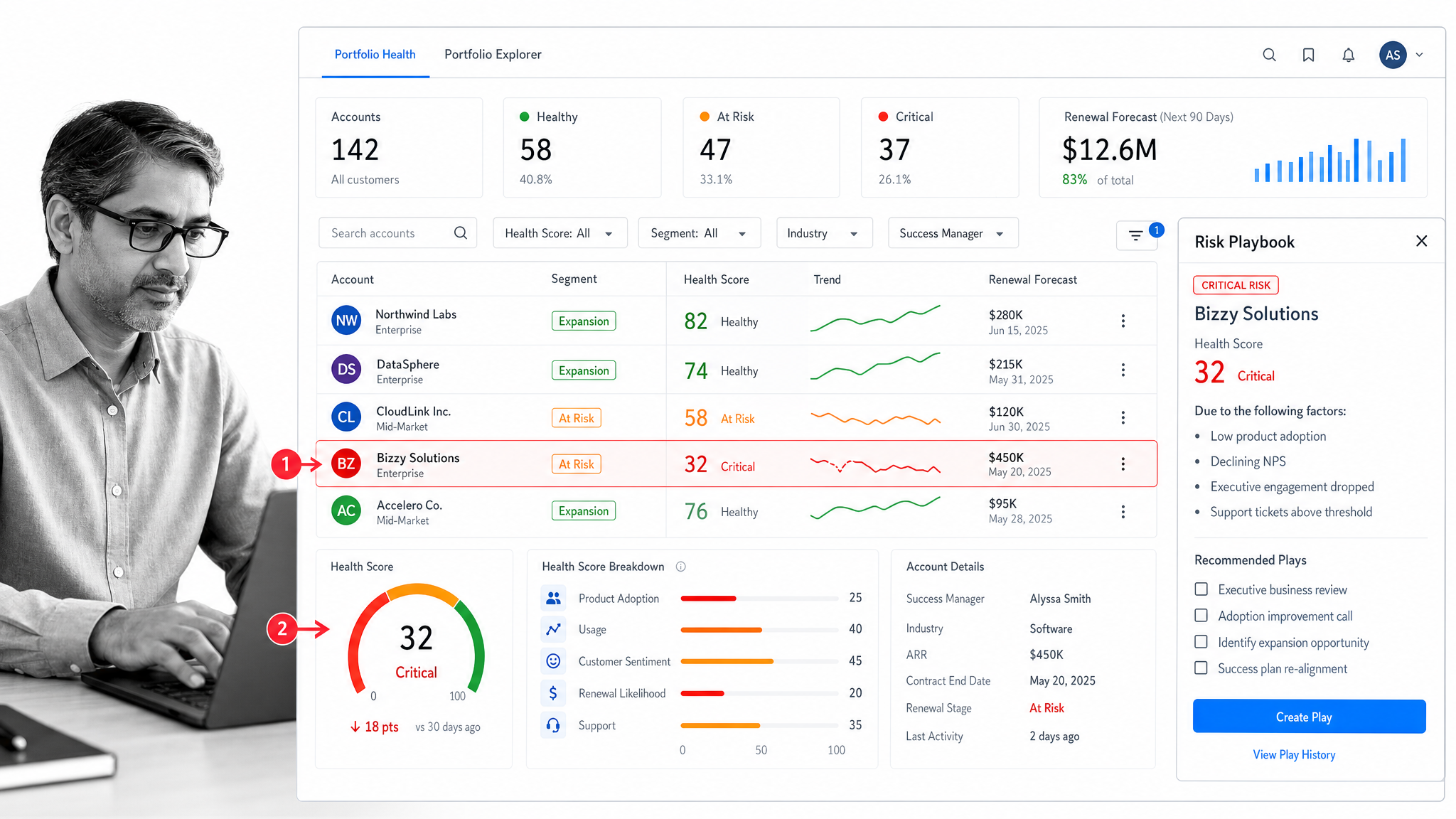
Gainsight is one of the most established dedicated customer success platforms and was named a Leader in both the 2024 and 2025 Gartner Magic Quadrant for Customer Success Management Platforms, as well as a Leader in the 2025 Forrester Wave for the category. It has deepened its AI with Staircase AI for real-time conversation and sentiment insight across customer communications.
Best for: Mid-market and enterprise teams that want a mature, deeply configurable platform and are prepared to invest in implementation.
Key features: Multidimensional customer health scoring, automated playbooks and journey orchestration, prebuilt AI agents for risk and expansion, and revenue and renewal forecasting.
3. ChurnZero
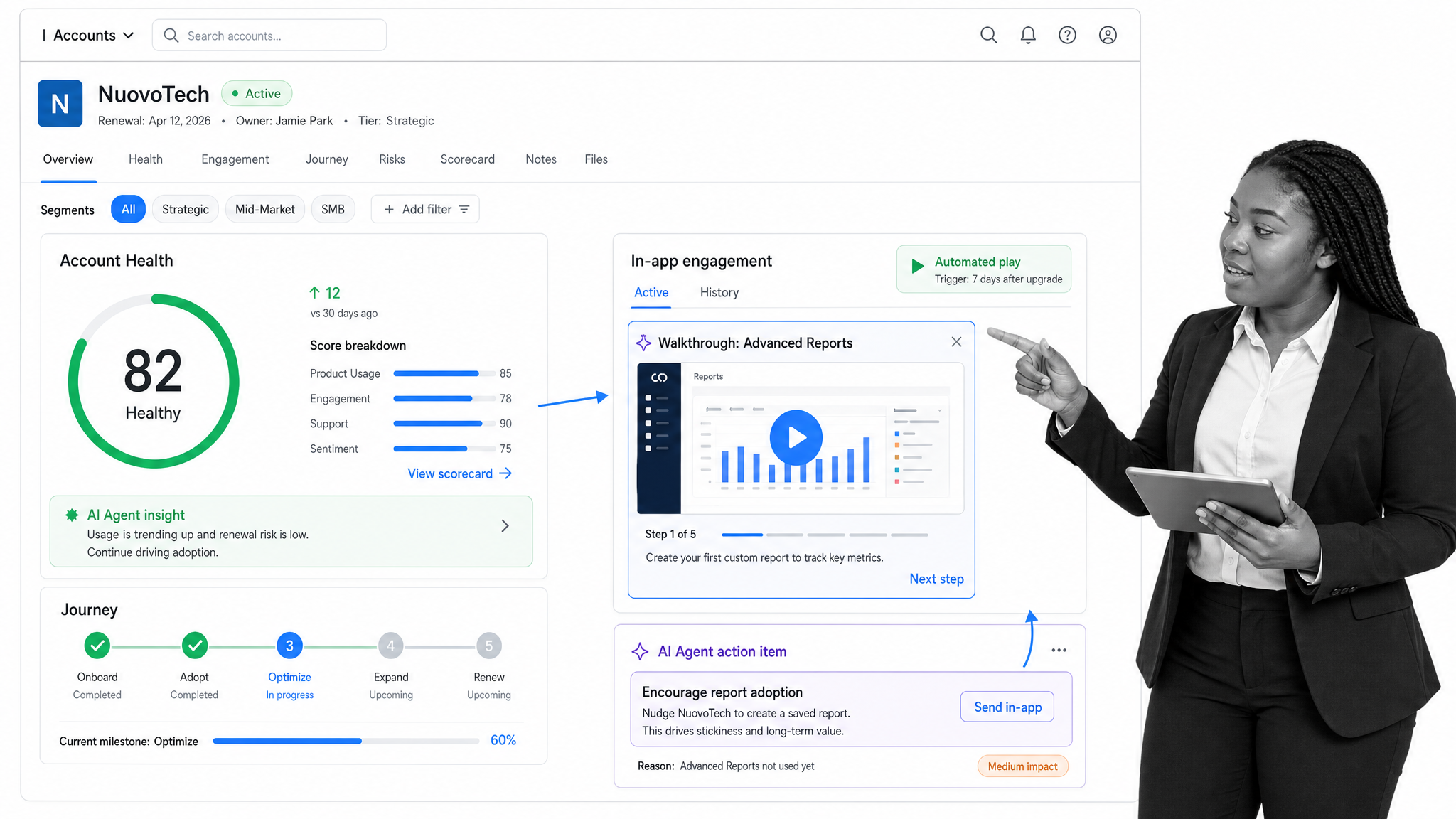
ChurnZero is an AI-powered customer success platform for B2B SaaS teams focused on reducing churn and driving retention. It was also named a Leader in both the 2024 and 2025 Gartner Magic Quadrant for the category, and it now embeds AI agents that take action rather than only surfacing insight.
Best for: Subscription businesses that want strong in-app engagement and automation without the heaviest enterprise footprint.
Key features: Customer health scoring, in-app communications and walkthroughs, automated playbooks, journey tracking, and embedded AI agents.
4. Planhat
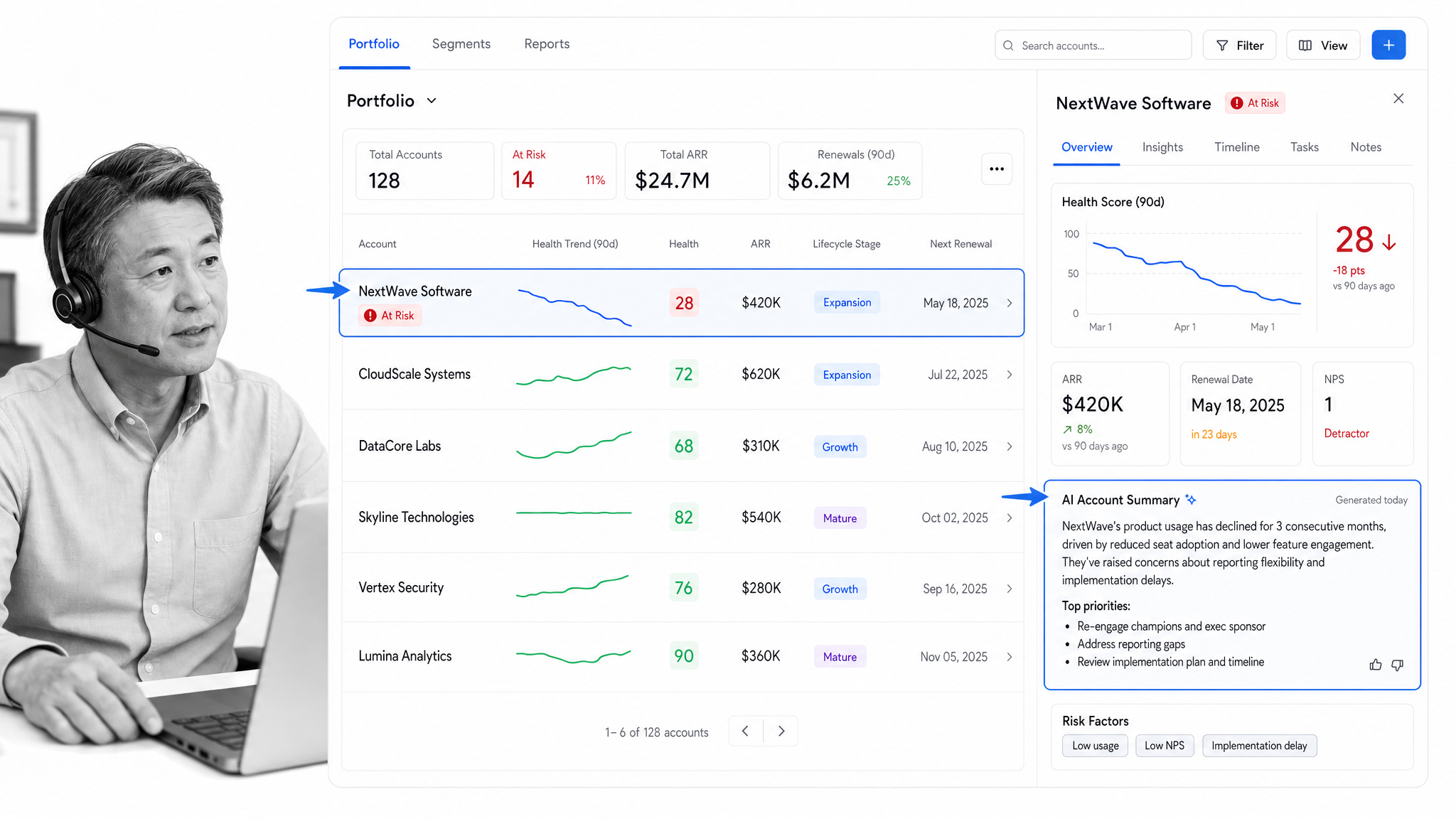
Planhat positions itself as a customer platform for SaaS and subscription businesses, unifying post-sale data and workflows across the lifecycle. It was named a Leader in the 2025 Gartner Magic Quadrant for the category and markets an AI-native approach to summarizing sentiment, preparing QBRs, and flagging at-risk accounts.
Best for: Data-oriented teams that want a flexible, model-driven view of the customer and strong analytics.
Key features: A unified customer data model, health and revenue metrics, automated playbooks, and AI-native summaries and account risk detection.
5. Totango
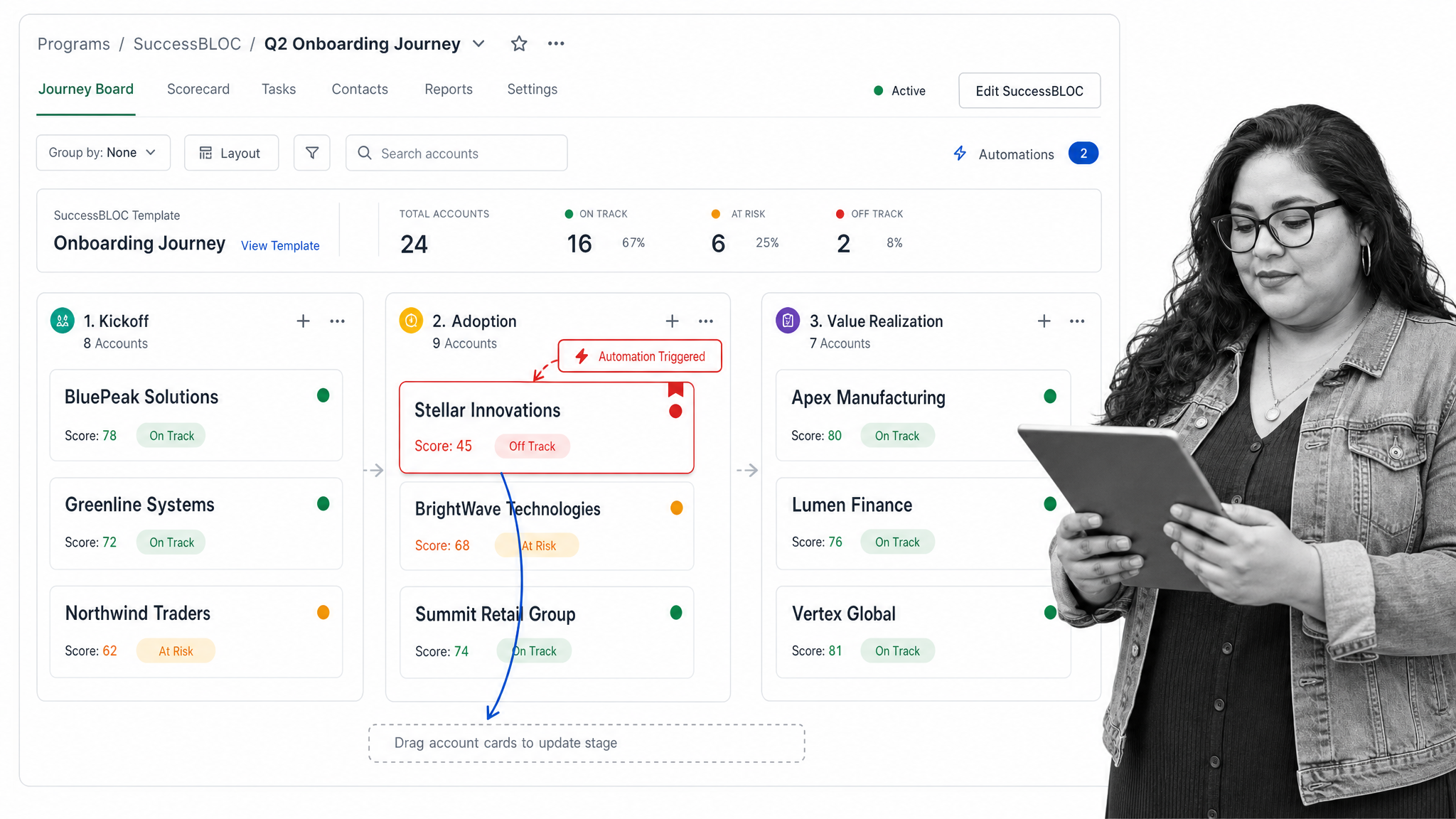
Totango is a customer success platform for post-sale and revenue teams that merged with Catalyst in 2024. The combined company operates under the Totango brand and offers Catalyst and Unison alongside the core Totango product, giving teams a broader suite for retention and revenue growth.
Best for: Teams that want a modular, journey-based platform and value the combined Totango and Catalyst product lineup.
Key features: Prebuilt success programs (SuccessBLOCs), health monitoring, automation and alerts, and AI-assisted insights across the merged suite.
6. Vitally
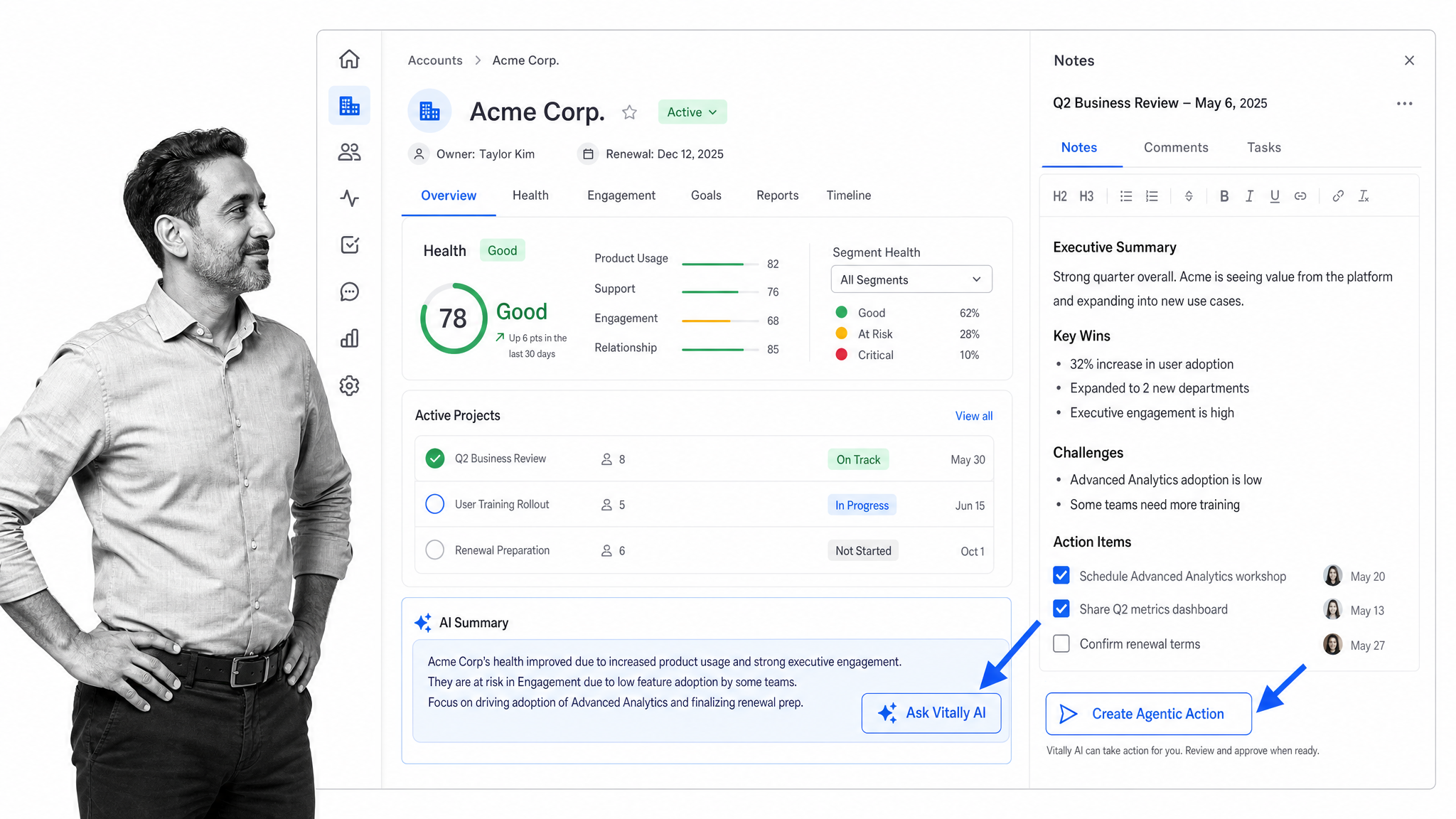
Vitally is a customer success platform that consolidates customer data, team workflows, and collaboration into a single workspace. It markets Vitally AI as a copilot for customer success, with features aimed at speeding up routine analysis and account work.
Best for: Fast-moving B2B SaaS teams that want a modern, highly usable workspace with strong project and notes tooling built in.
Key features: Customer health scoring, docs and project management for CS, automated playbooks, and AI features such as instant summaries and agentic actions.
7. Custify
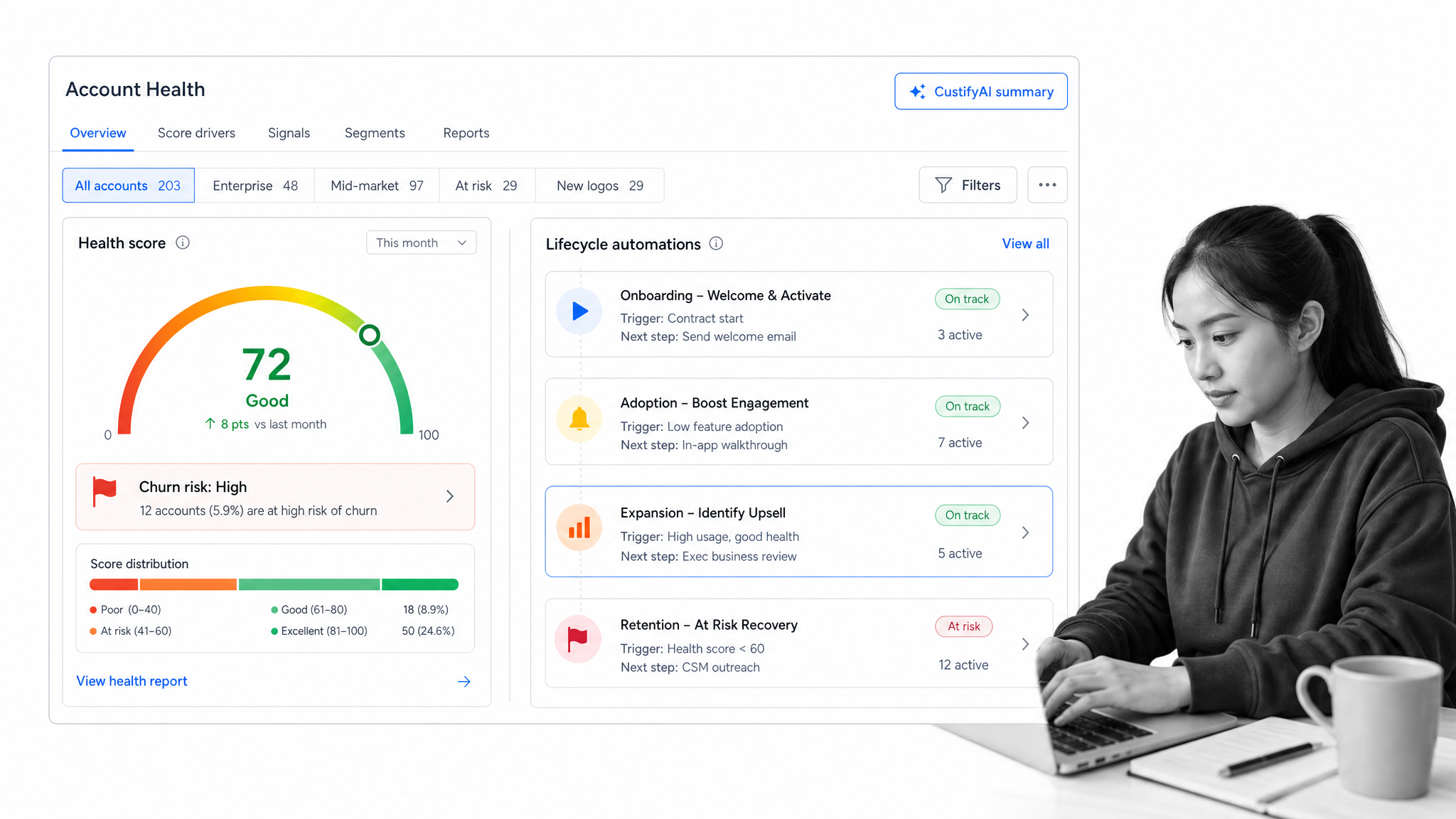
Custify is a customer success platform built to help B2B SaaS teams centralize customer data, automate workflows, and reduce churn through health scoring and analytics. It markets CustifyAI for churn-risk analysis, playbooks, and summaries.
Best for: Small and mid-sized SaaS teams that want a focused, approachable CS platform.
Key features: Customer health scores, lifecycle automation, task and playbook management, and AI-assisted risk and summary insights.
8. ClientSuccess
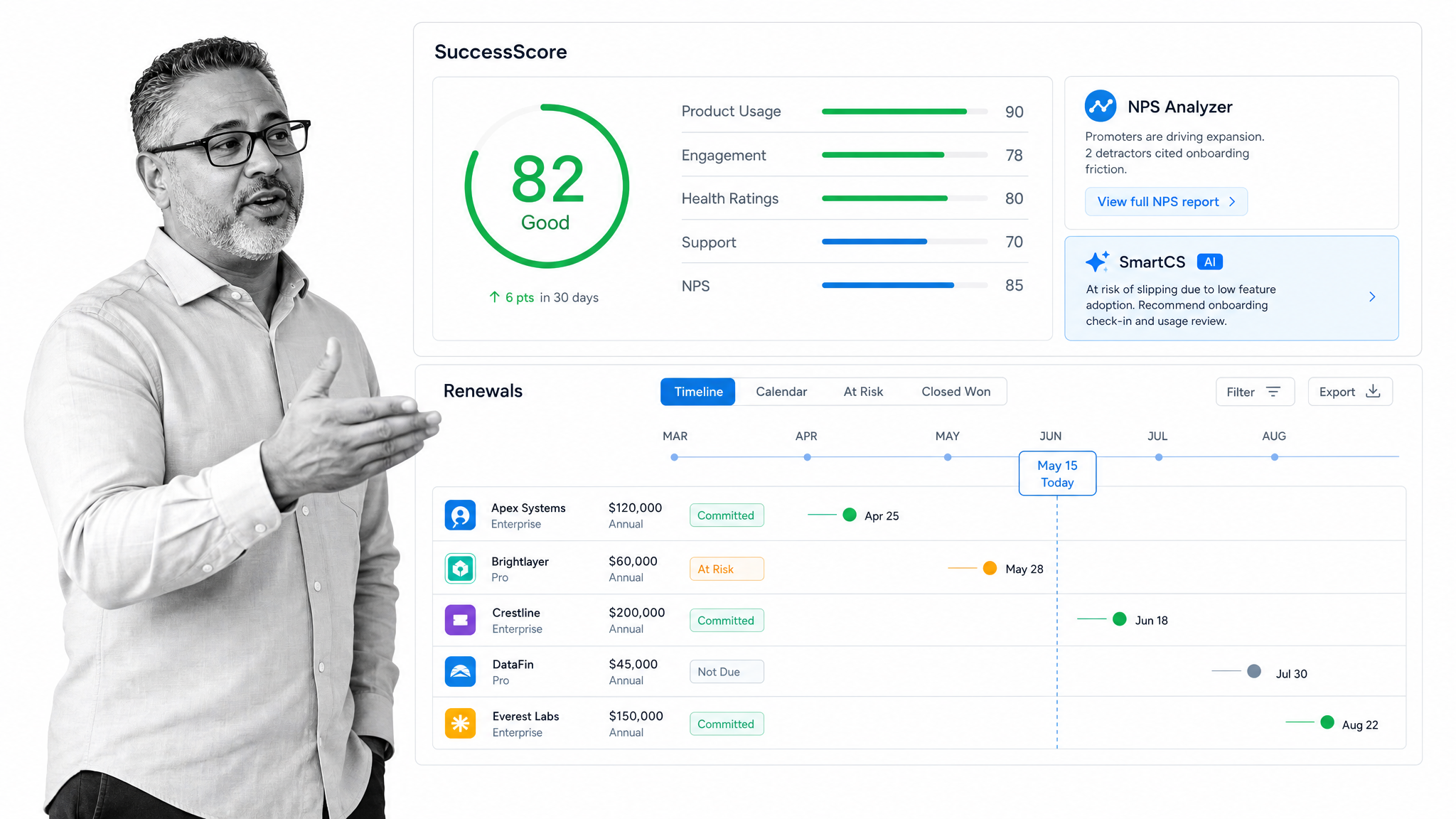
ClientSuccess is a customer success platform for teams that want to monitor customer health, manage the lifecycle, and support renewals to reduce churn and grow revenue. It markets a SmartCS AI co-pilot alongside named modules for scoring and reporting.
Best for: Teams that want a straightforward, renewals-focused platform with clear health and reporting views.
Key features: SuccessScore health scoring, Pulse reporting, an NPS analyzer, lifecycle management, and the SmartCS co-pilot.
9. Velaris
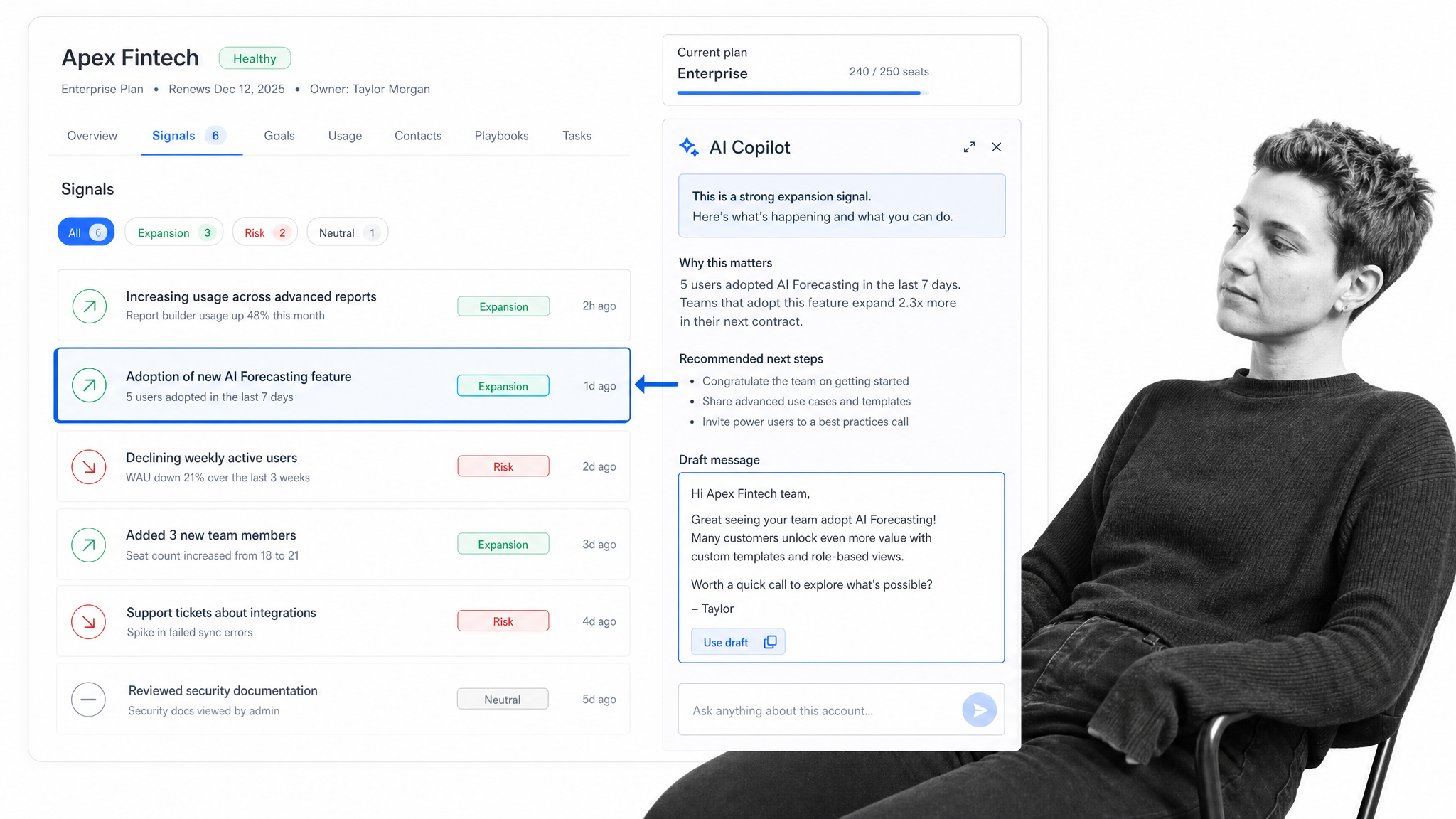
Velaris is an AI-native customer success platform that centralizes account data, tracks health, and flags churn and expansion signals while automating post-sale workflows. It markets an AI Copilot and configurable playbooks aimed at mid-market and enterprise SaaS teams.
Best for: Teams that want an AI-first platform with strong signal detection and account planning built in.
Key features: Customizable and AI health scoring, churn and expansion signal detection, journey orchestration, account planning and QBR creation, and configurable playbooks.
10. EverAfter
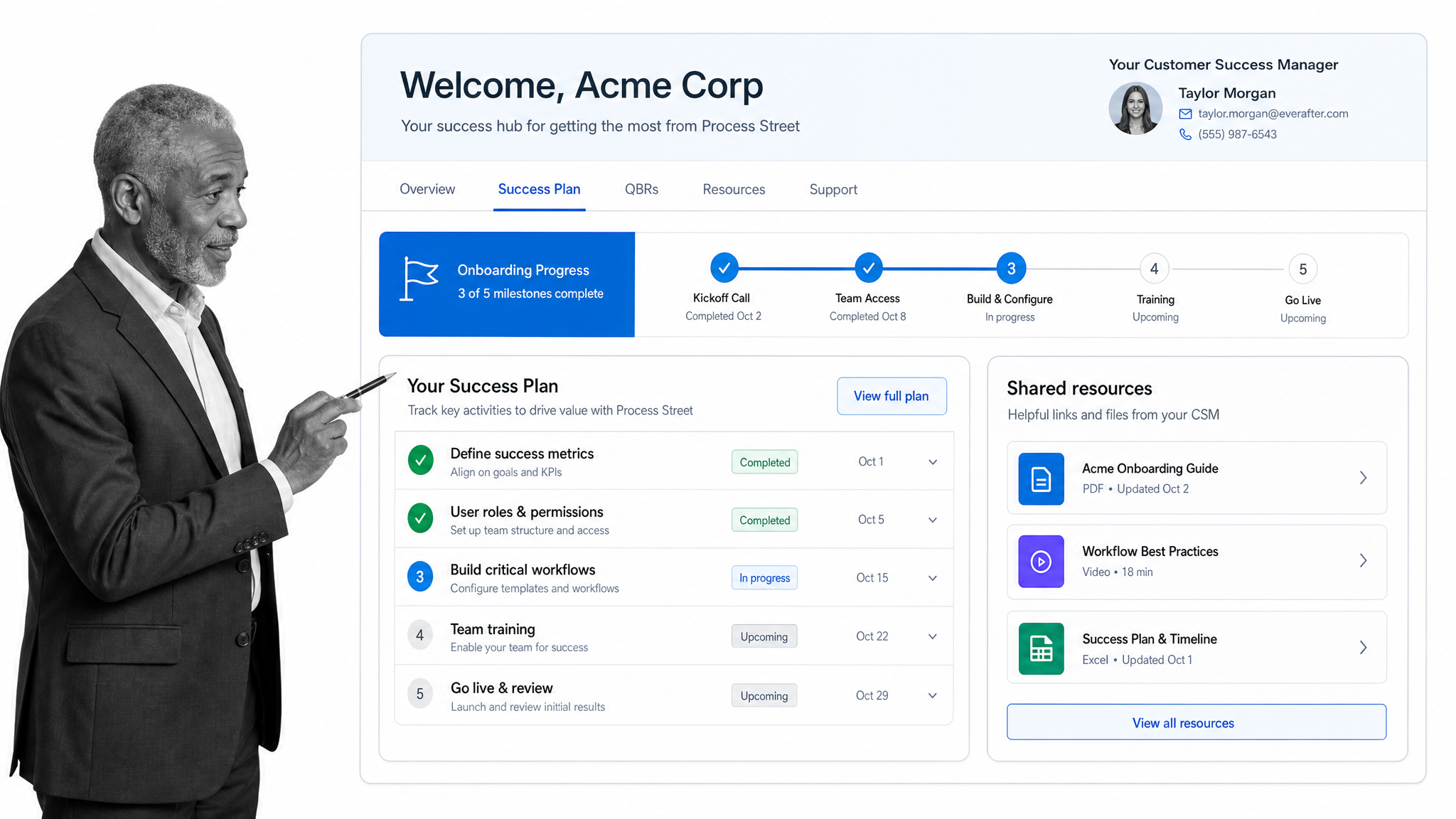
EverAfter is a digital customer success platform that builds branded, customer-facing hubs to manage onboarding, success plans, QBRs, and renewals. It markets an AI-powered interface builder and an agent for post-sale journeys, and it connects to CRMs such as Salesforce and HubSpot.
Best for: Teams that want to scale one-to-many customer success through structured, customer-facing portals.
Key features: Branded customer hubs, success plans and task management, data collection, and an AI interface builder for post-sale experiences.
11. Cast.app
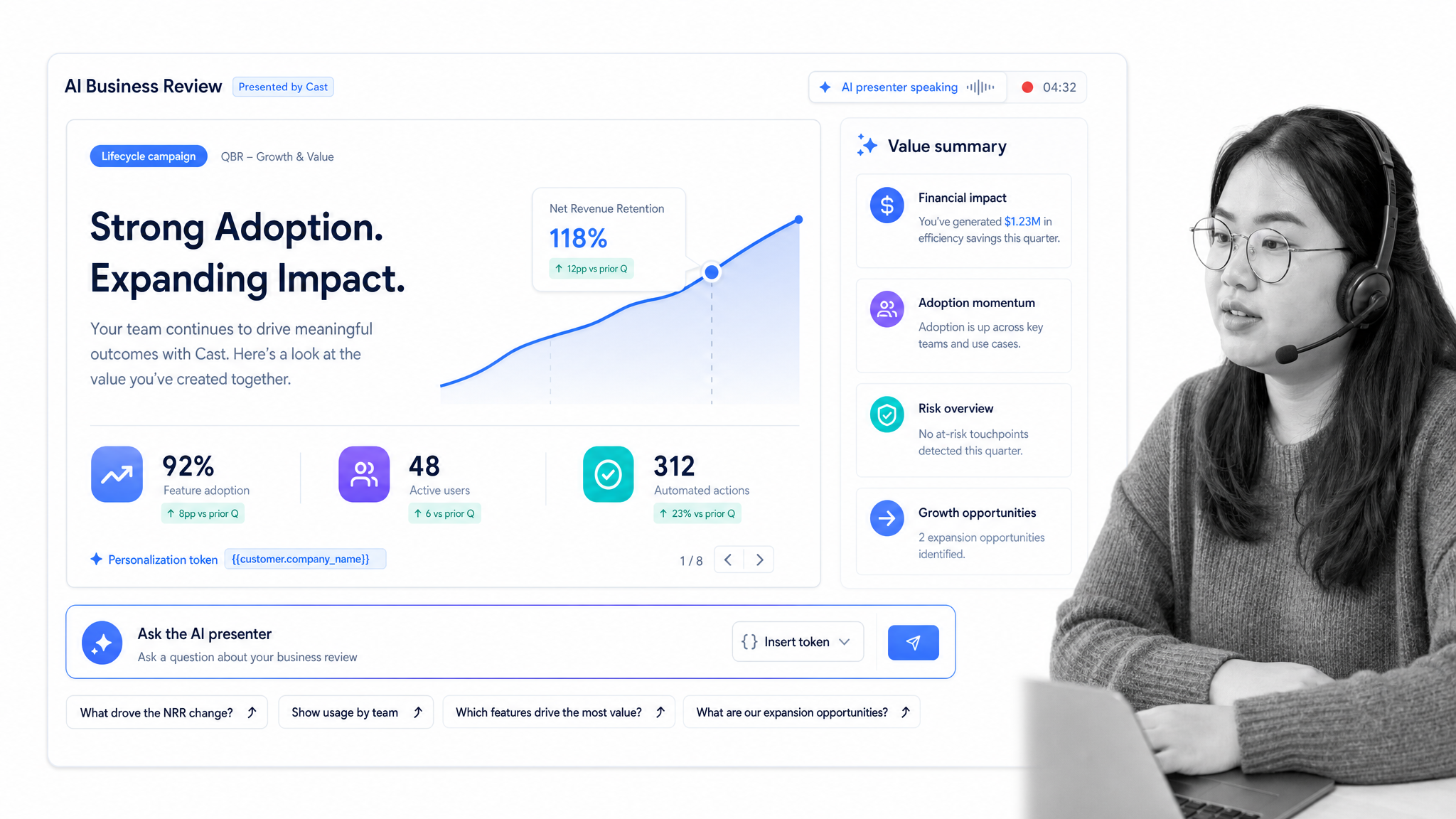
Cast.app describes itself as an autopilot layer that sits on top of your existing stack rather than a CRM or a customer success platform. It automatically generates and delivers personalized, AI-presented business reviews and lifecycle communications so teams can scale digital customer success without adding headcount.
Best for: Teams managing large books of business that need personalized engagement across many accounts per customer success manager.
Key features: AI-presented business reviews, an ask-the-presenter Q and A layer, and lifecycle AI agents for onboarding, adoption, retention, expansion, and feedback.
12. Oliv AI
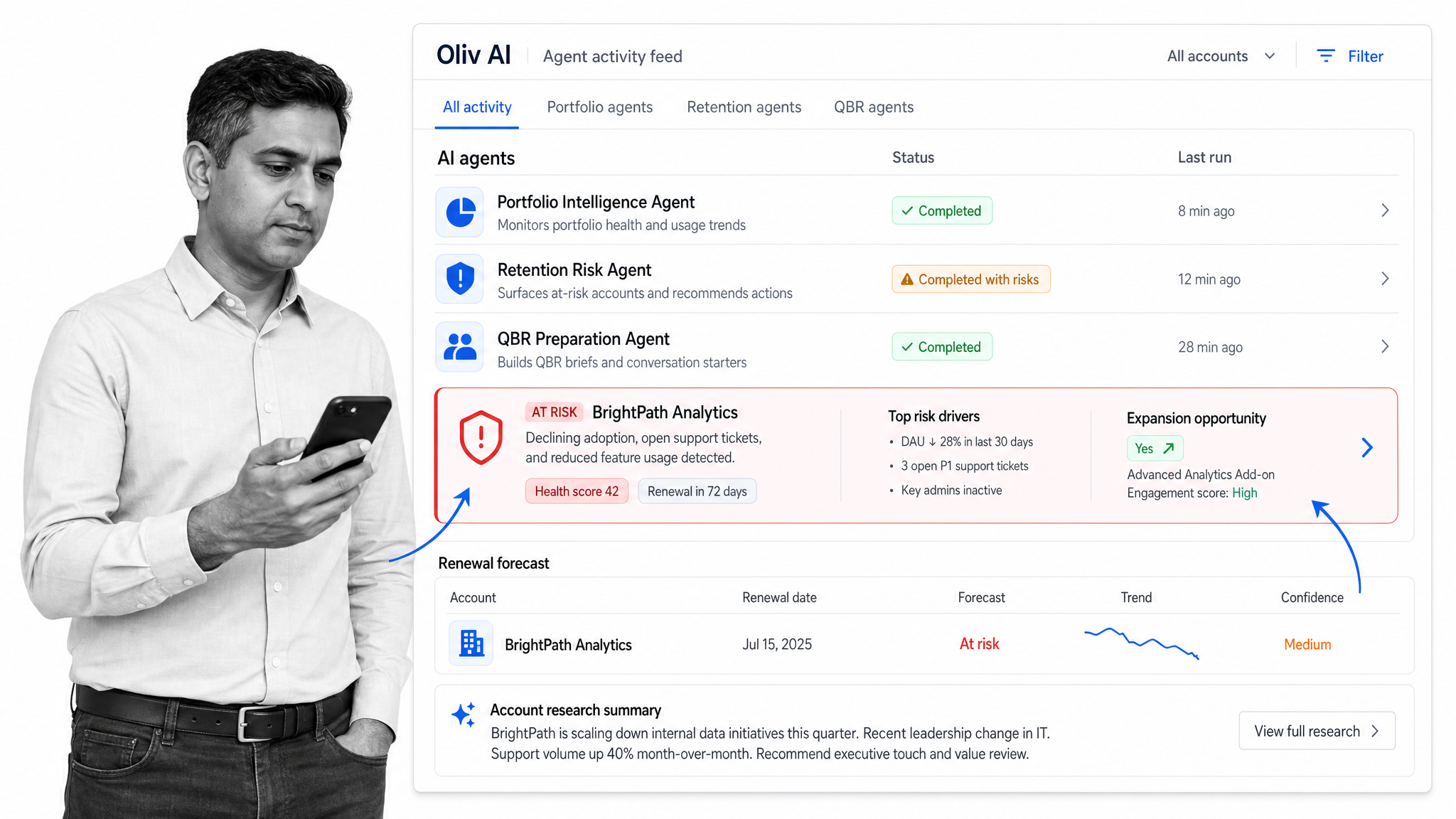
Oliv AI is an AI-native platform that deploys autonomous agents across a customer success manager’s book of business to surface risk, expansion, and renewal signals ahead of the renewal conversation. It markets a lineup of specialized customer success agents that embed into the tools teams already use.
Best for: Forward-looking teams that want agents to handle routine account research, QBR prep, and risk monitoring so managers can focus on relationships.
Key features: Named agents such as Portfolio Manager, Retention Forecaster, and QBR Builder, automated account research, and renewal and expansion signals.
13. ZapScale
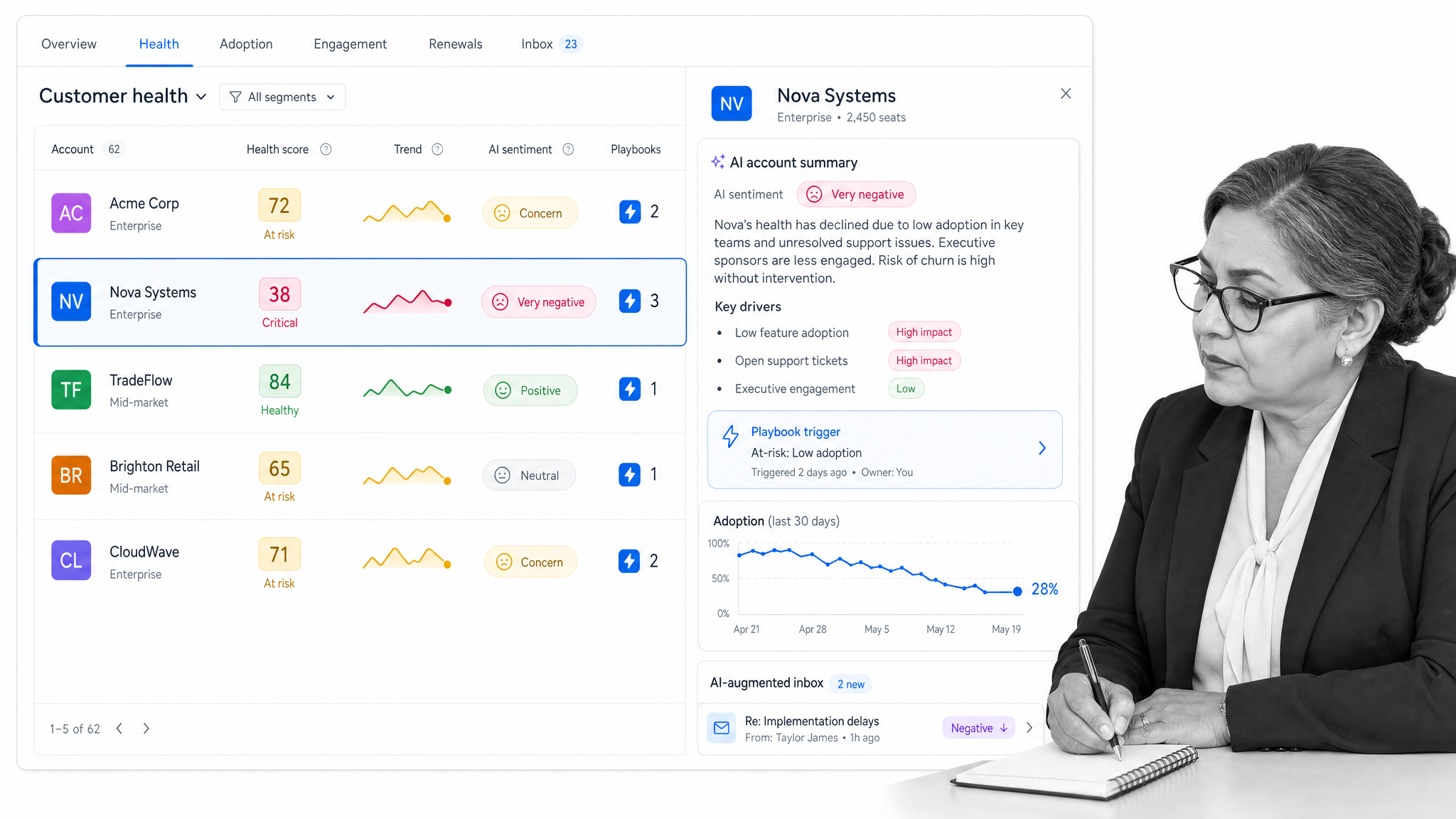
ZapScale is a customer success platform aimed at B2B SaaS teams, giving visibility into customer health, product adoption, and expansion signals through dashboards, analytics, and automated playbooks. It markets AI features for the inbox, account summaries, and sentiment analysis.
Best for: Growing SaaS teams that want an affordable, analytics-driven CS platform.
Key features: Customer health scores, adoption and usage analytics, automated playbooks, and AI-augmented inbox, account summary, and sentiment tooling.
14. HubSpot Service Hub
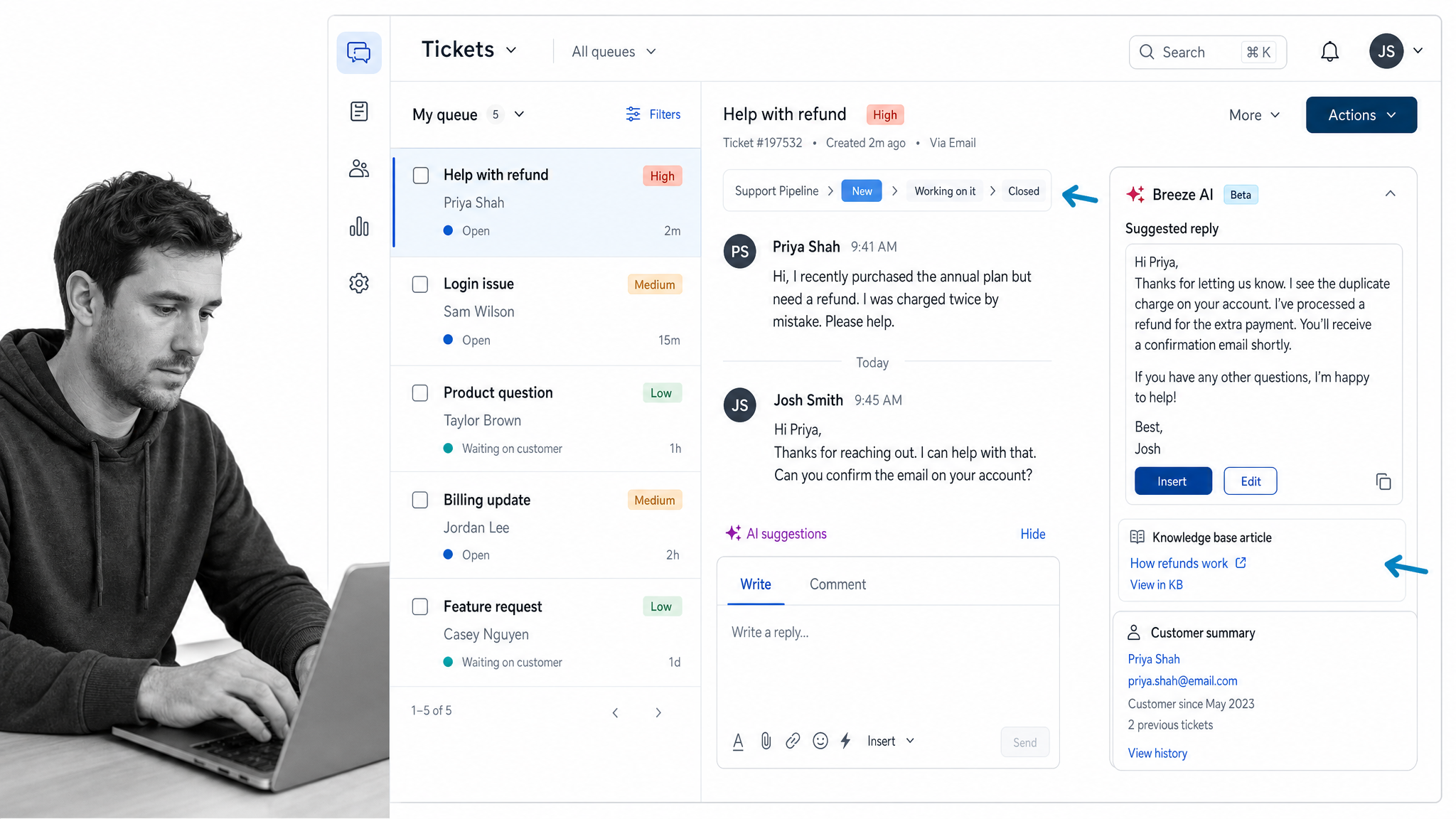
HubSpot Service Hub is an AI-powered customer service platform for growing teams, spanning omnichannel help desk, ticket automation, SLAs, and self-service. It markets AI agents under the Breeze brand and sits inside HubSpot’s broader customer platform, making it a natural fit for teams already on HubSpot.
Best for: Teams that run sales and marketing on HubSpot and want service and lightweight success workflows in the same platform.
Key features: Omnichannel help desk, ticket automation and SLAs, knowledge base and self-service, and Breeze AI agents.
15. Salesforce Service Cloud
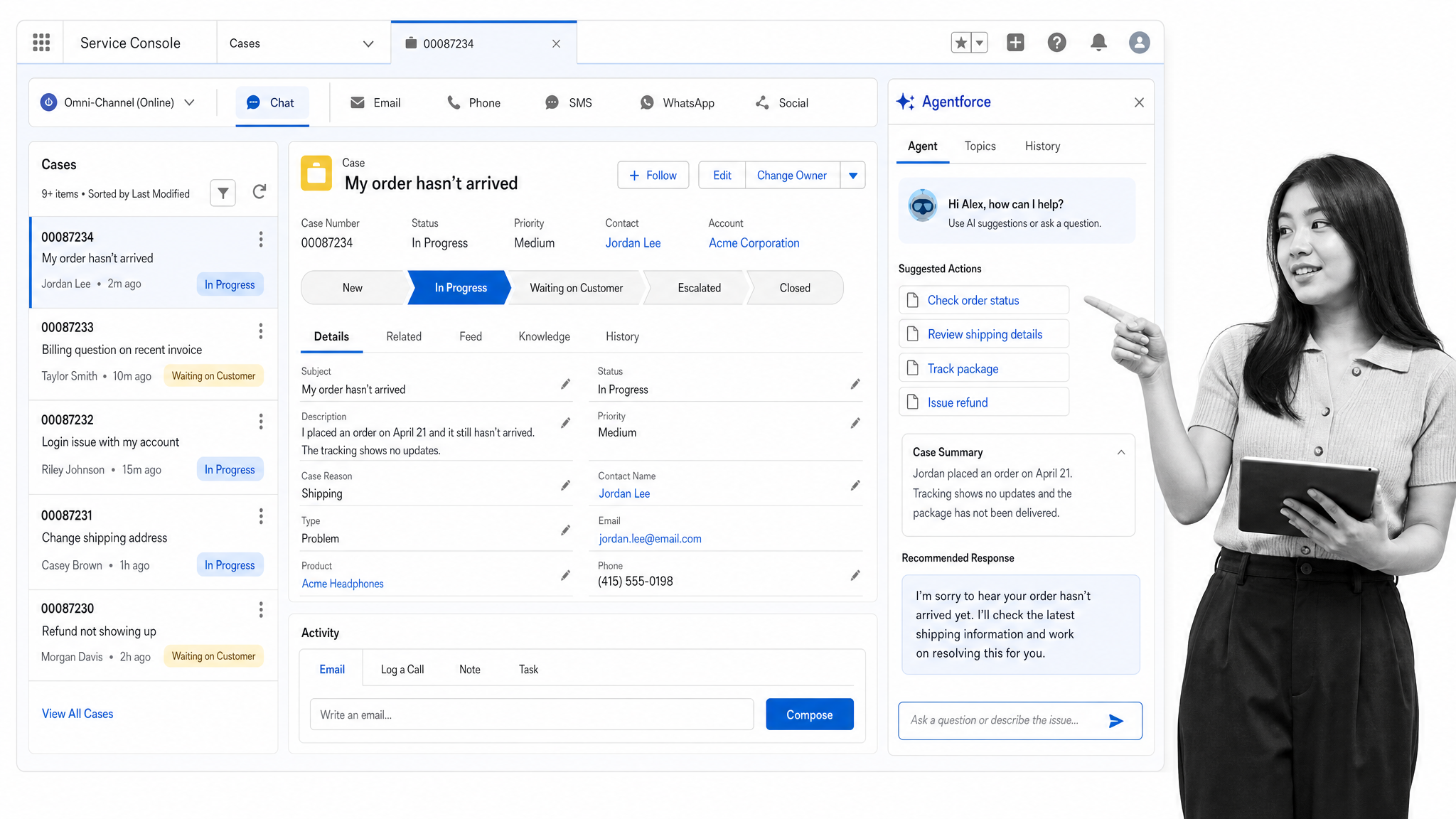
Salesforce Service Cloud is the service application within the Salesforce platform, now paired with Agentforce AI agents for proactive, always-on support. For customer success teams already standardized on Salesforce, it brings case management and omnichannel service alongside the CRM record.
Best for: Enterprises running on Salesforce that want service and success workflows on the same platform as their CRM.
Key features: Case management, omnichannel routing, service analytics, and Agentforce AI service agents.
16. Zendesk
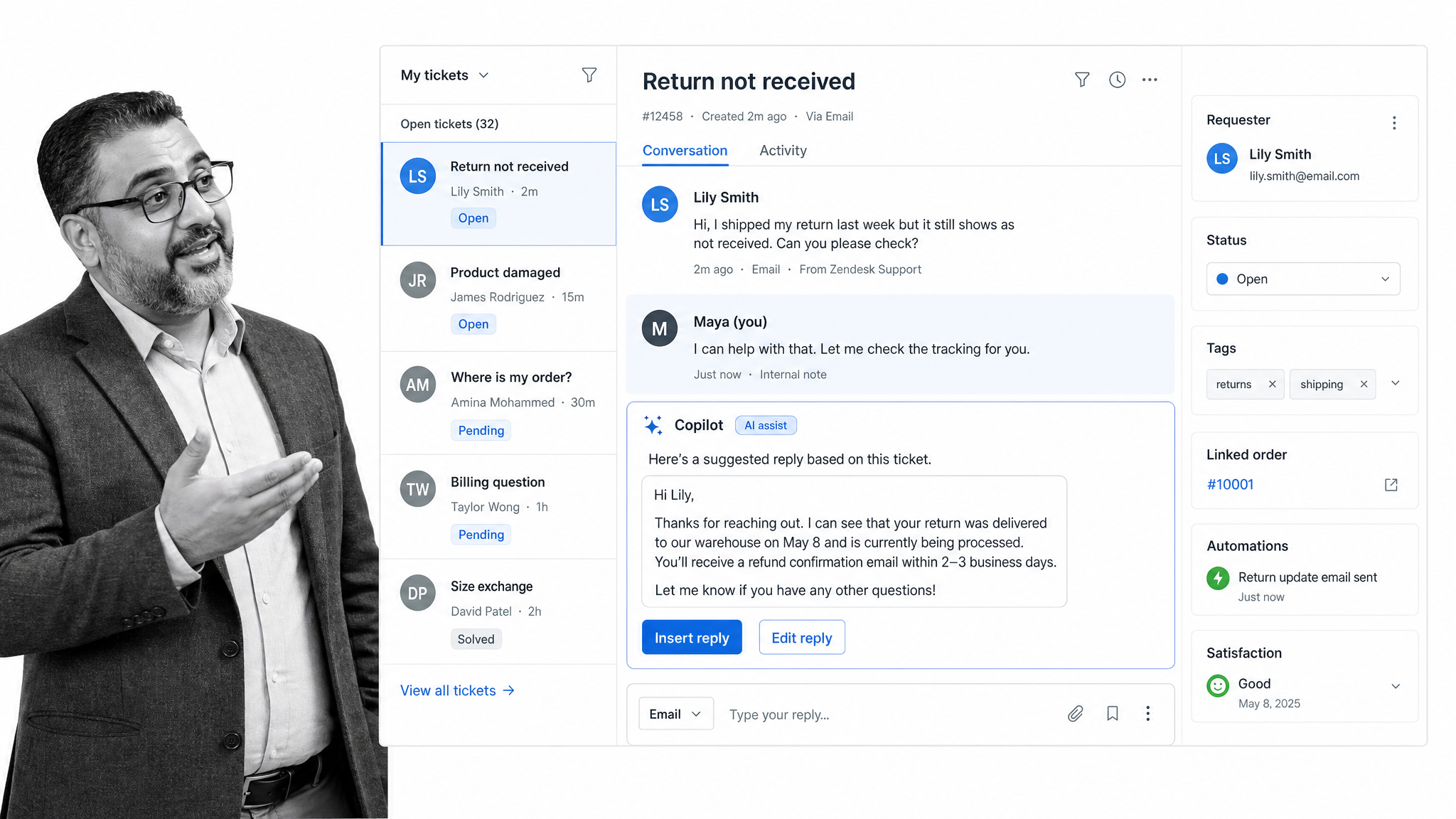
Zendesk is an AI-first customer service platform that manages and resolves customer inquiries across channels in one workspace. It markets Zendesk AI, autonomous AI agents, and a Copilot assistant for human agents, and it is widely used by support-led organizations that also carry success responsibilities.
Best for: Support-heavy teams that want mature, scalable service tooling with strong automation.
Key features: Omnichannel ticketing, knowledge base and self-service, AI agents, and a Copilot assistant for support agents.
17. Intercom
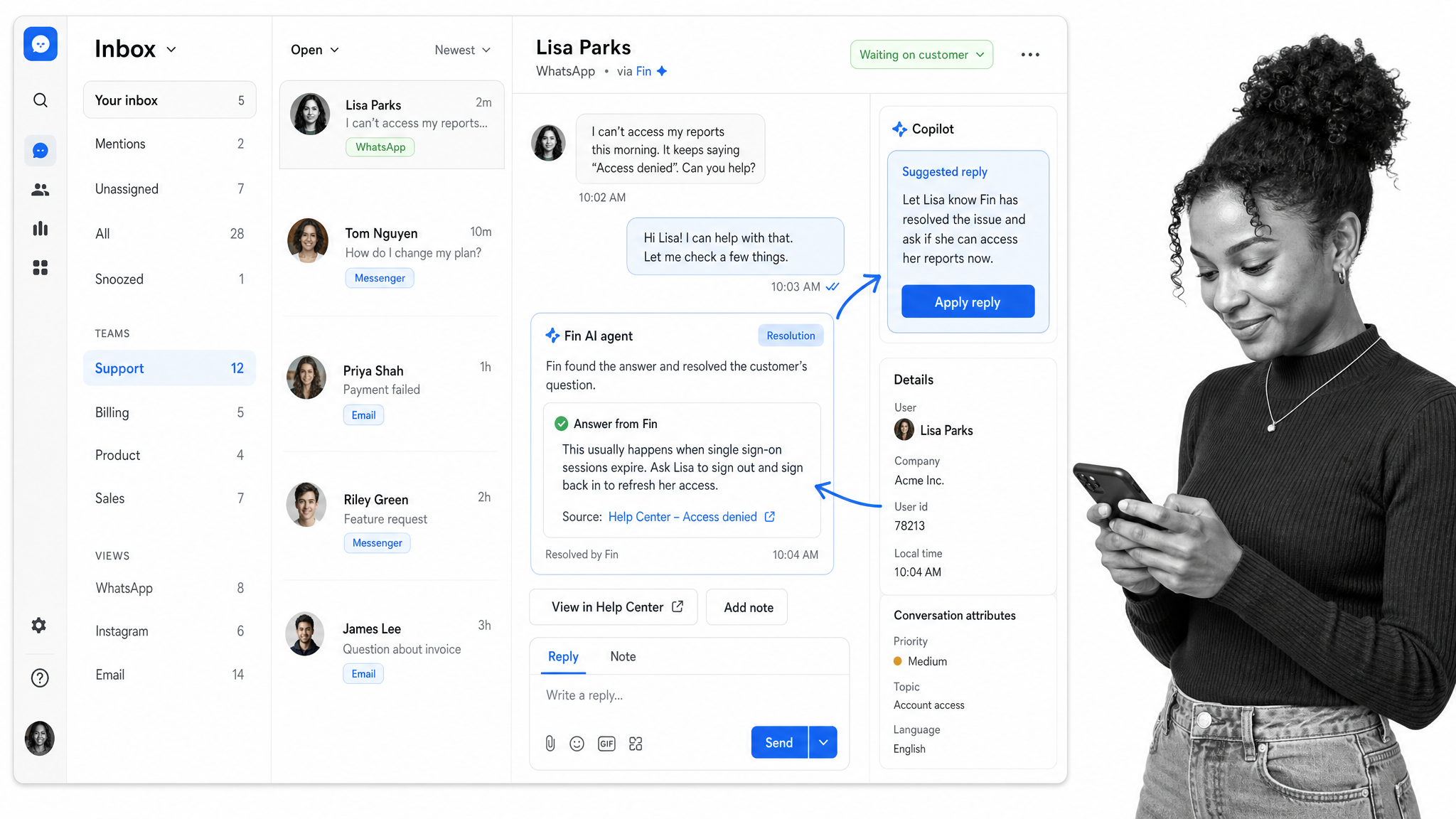
Intercom is an AI-powered customer service and helpdesk platform built around Fin, an AI agent that resolves customer queries across chat, email, phone, and social channels. A Copilot assists human agents, and the platform adds an omnichannel inbox plus quality and insights tooling.
Best for: Product-led and B2B teams that want an AI agent handling front-line resolution and a modern messaging-first experience.
Key features: The Fin AI agent, a Copilot for human agents, an omnichannel inbox, and quality assurance and reporting.
18. Zoho Desk
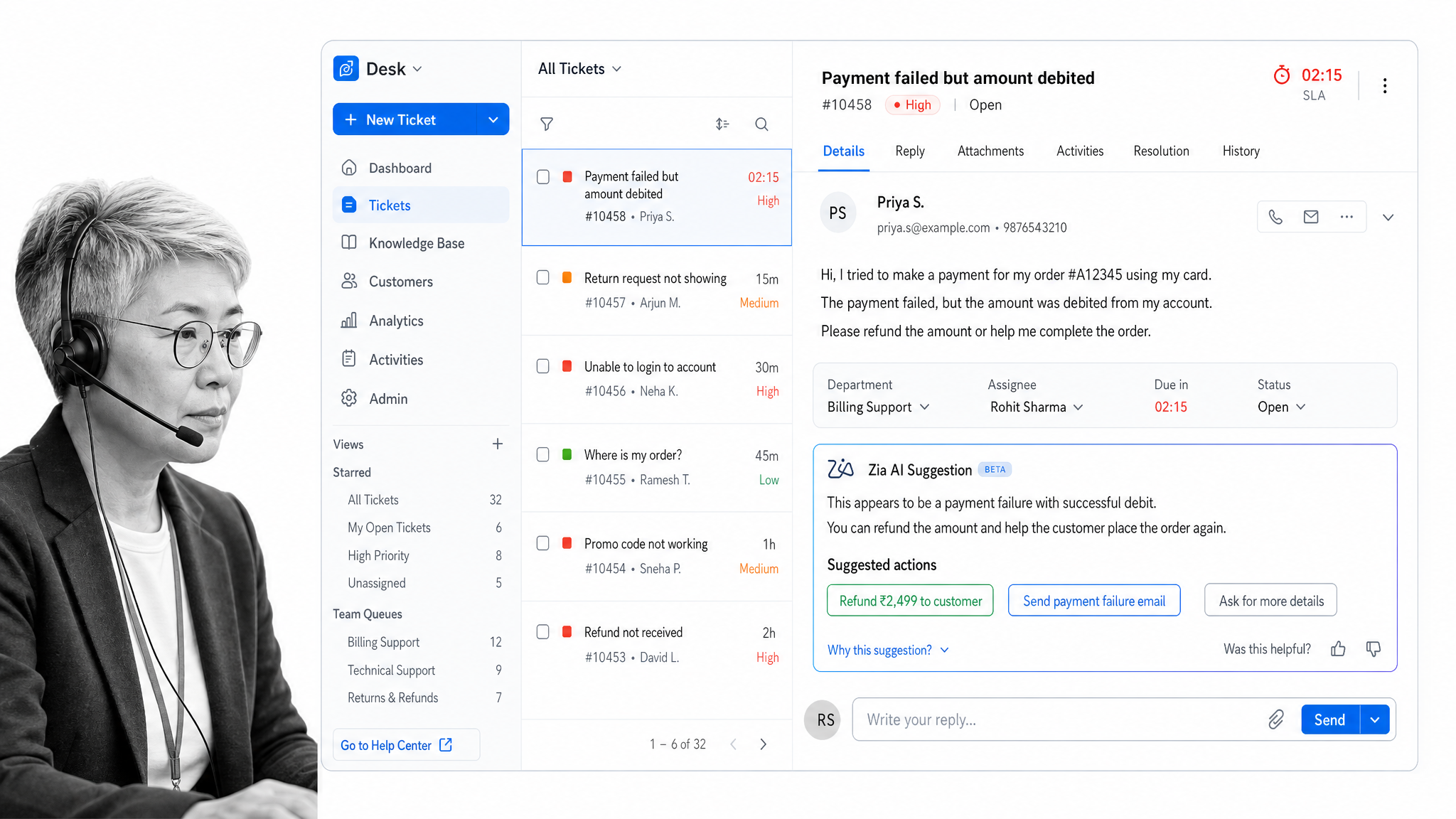
Zoho Desk is a customer service and help desk platform that unifies support conversations across channels with ticketing, a self-service help center, and AI assistance from Zia. It is a cost-effective option for teams already invested in the Zoho ecosystem.
Best for: Small and mid-sized businesses that want capable service tooling at an accessible price point, especially existing Zoho customers.
Key features: Omnichannel ticketing, skill and workload-based routing, SLAs and escalations, a branded help center, and Zia AI for autonomous handling and drafted replies.
19. Pylon
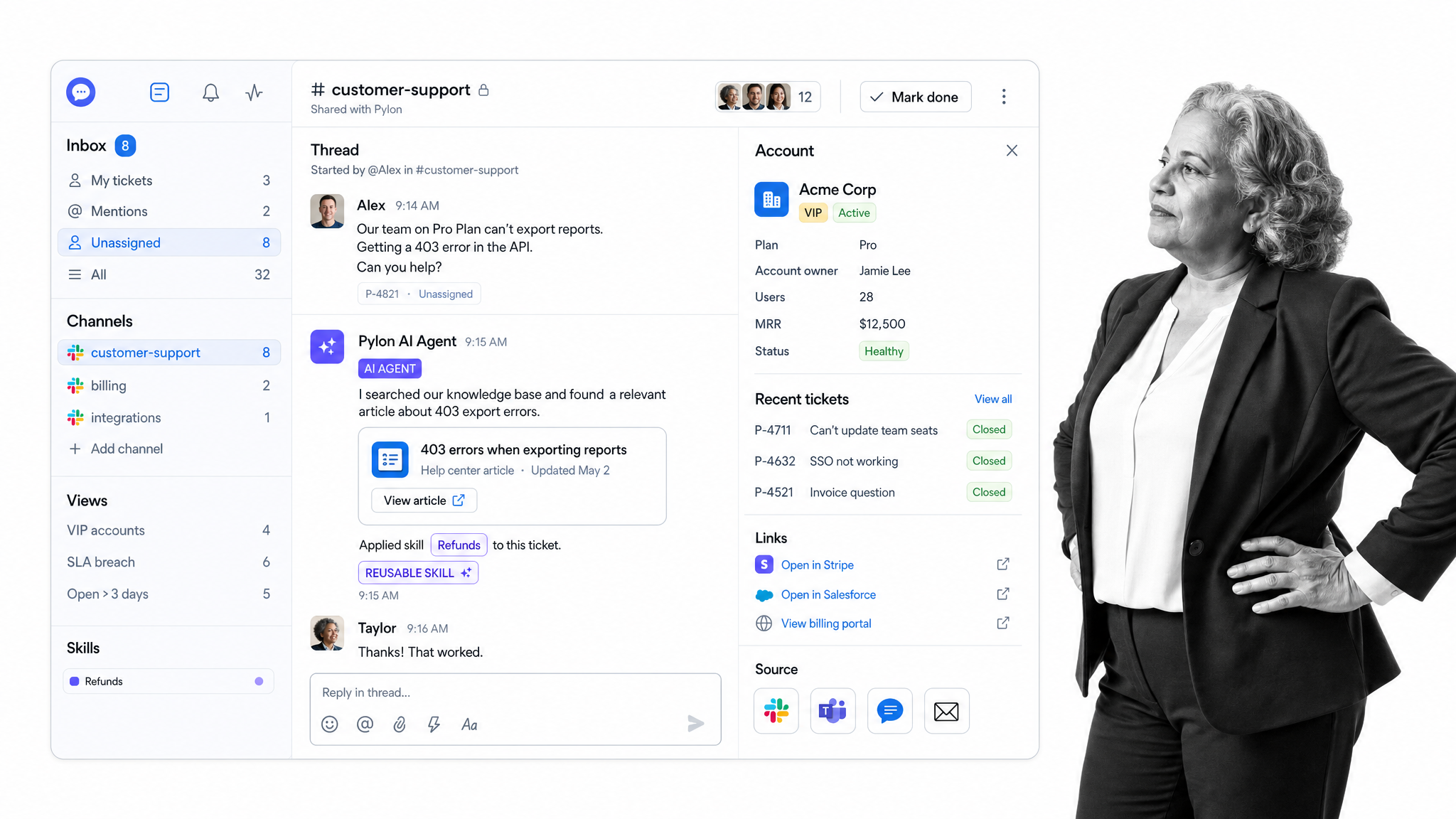
Pylon is an agentic, AI-native support platform built for B2B companies, unifying ticketing and omnichannel messaging across Slack, Microsoft Teams, email, and chat with knowledge management and account intelligence. It sits at the crossover of support and customer success for teams that run heavily in shared channels.
Best for: B2B software teams that support customers in Slack or Teams and want AI agents directing the work.
Key features: Omnichannel ticketing, named AI agents and reusable skills, knowledge base management, account intelligence, and workforce management.
20. UserGuiding
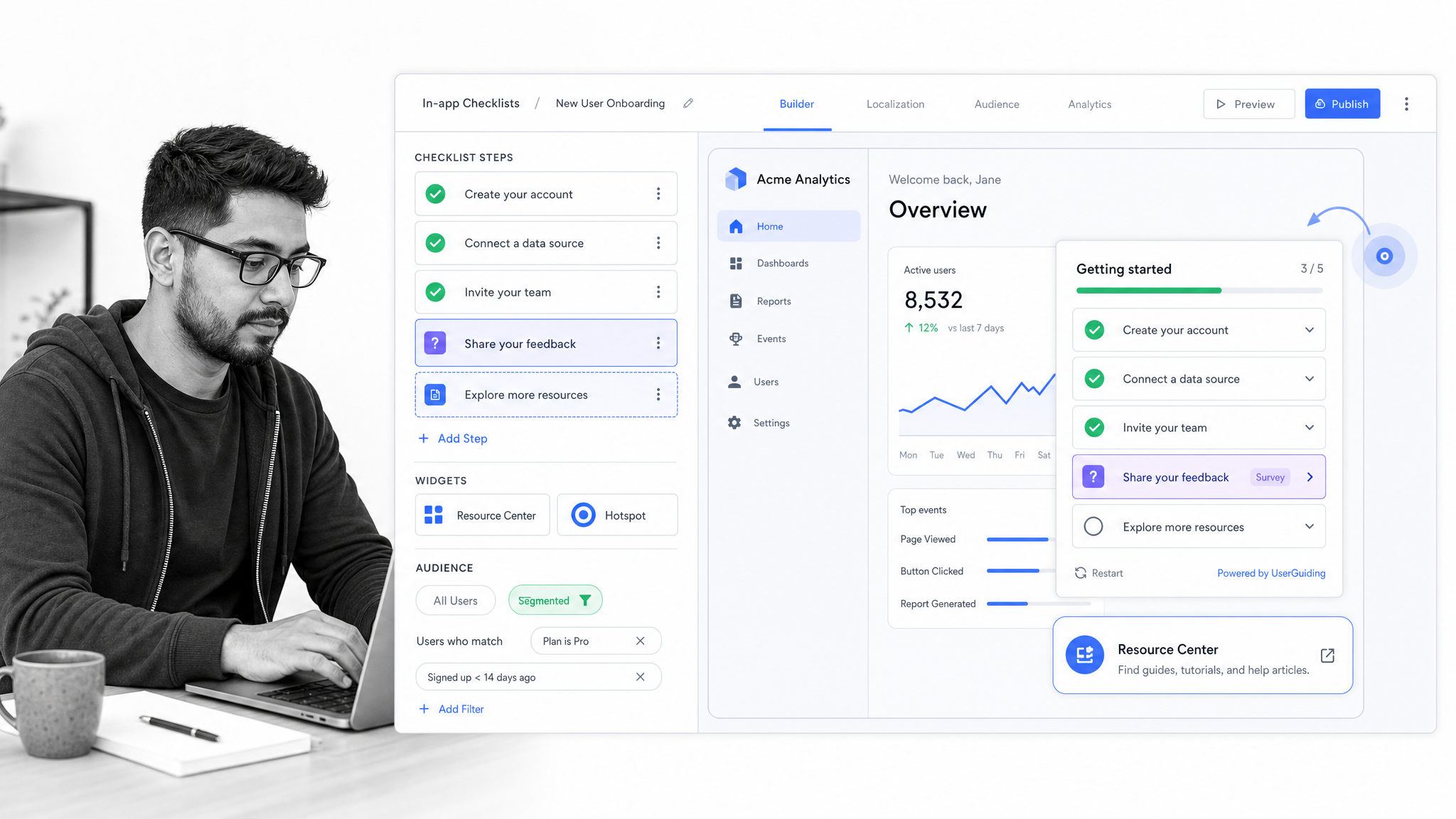
UserGuiding is a no-code user onboarding and product adoption platform that lets teams build in-app guides, checklists, tooltips, surveys, and resource centers. It supports the adoption side of customer success by guiding users to value inside the product itself.
Best for: Product and success teams that want to drive in-app onboarding and adoption without engineering effort.
Key features: Product tours and onboarding checklists, tooltips and hotspots, in-app surveys, resource centers, an AI assistant, and segmentation and analytics.
How is AI reshaping customer success software?
AI has moved from a reporting layer to an action layer. Early tools summarized activity and surfaced health scores for a human to act on. Current platforms deploy autonomous agents that research accounts, draft QBRs, forecast renewals, and trigger playbooks directly, then hand context back to the customer success manager for the strategic call.
Three shifts matter most. First, agents now act rather than advise, taking routine work off a manager’s plate. Second, sentiment and conversation intelligence read signals across email, calls, and chat instead of relying on usage data alone. Third, one-to-many automation lets a single manager keep a much larger book of business healthy through personalized, automated outreach. The practical takeaway is that a strong stack now pairs an AI-native customer success platform with a workflow engine that makes the underlying processes repeatable and auditable.
What are the signs you need customer success software?
You do not need a dedicated platform on day one. These signals suggest the manual approach has run out of room and a purpose-built tool will pay for itself.
You are scaling faster than your team can track accounts
When each manager carries more accounts than they can personally monitor, health slips through the cracks. Customer success software watches usage and engagement continuously so no account goes dark unnoticed.
You are over-reliant on your CRM
A CRM is built to win deals, not to nurture them afterward. If your team bends sales fields and manual notes into a makeshift success process, a dedicated platform will track health, renewals, and adoption far better.
Your processes live in people’s heads
If onboarding, escalations, and renewals depend on who happens to run them, results vary by person. A workflow platform turns those processes into repeatable, enforceable steps so quality does not depend on memory.
Renewals and upsells are slipping
A steady decline in renewals, upsells, or cross-sells often means at-risk accounts are being spotted too late. Health scoring and automated playbooks help you intervene while there is still time to change the outcome.
Is customer success software right for you?
Customer success software delivers the most value for recurring-revenue businesses where retention and expansion drive growth. Before buying, work through a few questions.
How will you measure success?
Decide which outcomes matter first, such as net revenue retention, churn rate, product adoption, or onboarding time to value. The right platform is the one that instruments those metrics cleanly.
Do you have the resources to implement it?
Enterprise platforms reward investment in configuration and data hygiene, while lighter tools get a team productive quickly. Match the platform’s implementation weight to the resources you can commit.
How will it fit your existing stack?
Customer success software is only as good as the data flowing into it. Confirm it connects cleanly to your CRM, product analytics, billing, and support tools so health scores reflect reality.
What features should you look for in customer success software?
Regardless of vendor, a capable platform in 2026 should cover the following.
Customer health scoring
Multidimensional health scores that combine product usage, engagement, sentiment, and support signals so you can rank accounts by risk and opportunity, not gut feel.
Integration with your tech stack
Native, reliable connections to your CRM, product analytics, billing, and communication tools so the platform reflects a complete picture of each account.
Automated playbooks and workflows
Repeatable playbooks that trigger the right action at the right moment, from onboarding sequences to renewal outreach and escalation handling.
AI and predictive insight
AI that predicts churn, prepares reviews, and increasingly acts on routine work through agents, with a human in the loop for strategic decisions.
Security and compliance
Strong access controls, audit trails, and data protection, which matter most in regulated industries where every customer-facing step needs to be documented and defensible.
What are the benefits of customer success software?
Done well, customer success software lowers churn, lifts net revenue retention, and makes a small team feel much larger. It replaces reactive firefighting with proactive, standardized motions: at-risk accounts get attention before they cancel, onboarding runs the same way every time, and renewals stop being a surprise. Because retention compounds, even modest gains in keeping and growing customers translate into outsized profit over time.
The strongest results come from pairing a customer success platform with disciplined processes. The platform surfaces the signal; a repeatable onboarding and success process ensures the team acts on it consistently, every account, every time.
Frequently asked questions
What is customer success software?
Customer success software is a platform that helps businesses proactively manage post-sale customer relationships, reduce churn, and grow the value of each account. These tools centralize customer data, track health, automate outreach, and surface insights so teams can intervene before problems escalate.
How does customer success software reduce churn?
It reduces churn by detecting at-risk accounts early. By combining product usage, engagement, sentiment, and support signals into a health score, the software flags accounts trending downward and triggers playbooks so teams can act while there is still time to change the outcome.
What is the difference between customer success software and a CRM?
A CRM is designed to win new deals and manage the sales pipeline. Customer success software focuses on what happens after the sale: onboarding, adoption, health monitoring, renewals, and expansion. Many teams use both and connect them so post-sale signals flow alongside the sales record.
How much does customer success software cost?
Pricing varies widely by platform and scale. Lighter, adoption-focused tools are the most accessible, while enterprise customer success platforms typically use custom, quote-based pricing tied to your customer base and usage. Many vendors offer a free trial or demo, so plan to evaluate a shortlist before committing.
What role does AI play in customer success software?
AI now does more than report. Modern platforms use it to predict churn, summarize conversations, prepare business reviews, and increasingly run autonomous agents that take routine actions across a book of business, while leaving strategic decisions to the customer success manager.
Can customer success software integrate with my existing tools?
Yes. Reputable platforms connect to CRMs, product analytics, billing, and communication tools so health scores reflect a complete view of each account. Process Street, for example, has direct, universal integrations to 5,000+ systems, and an AI agent can build a new one on the fly.