Turn every policy into automated workflows with built-in enforcement and audit-ready proof.



Healthcare Controller
A healthcare controller is the finance leader responsible for accurate accounting, timely reporting, disciplined controls, and audit-ready financial operations inside a healthcare organization. The role connects accounting accuracy with reimbursement, payroll, payables, budgeting, compliance, and operational decision support.
The healthcare controller sits close to the CFO, but the job is more execution-heavy than strategy-heavy. A CFO may own capital planning, financing, board communication, and long-range financial direction. The controller makes sure the books, close process, controls, reconciliations, reporting routines, and audit evidence are right.
This guide explains what a healthcare controller does, why the role matters, which responsibilities should be standardized, which controls deserve the most attention, and how finance teams can turn controller work into repeatable workflows.
In this article, we are going to cover:
- What a healthcare controller is
- Why healthcare controllers matter
- Healthcare controller responsibilities
- Healthcare controller controls and close process
- Healthcare controller compliance priorities
- Healthcare controller workflows to standardize
- Healthcare controller in Process Street
- Healthcare controller skills and tools
- FAQs
What a healthcare controller is
A healthcare controller manages the accounting engine of a healthcare organization. That can include the general ledger, month-end close, reconciliations, accounts payable, payroll, financial reporting, budget support, audit preparation, cost report support, and internal controls.
The healthcare context changes the work. Finance teams have to account for payer contracts, reimbursements, denials, grants, restricted funds, provider compensation, patient billing, supply cost pressure, departmental budgets, and privacy-sensitive operating data. The controller does not need to run every clinical system, but they need enough operational fluency to know what financial evidence is complete, late, risky, or inconsistent.
Where the role sits
In many healthcare organizations, the controller reports to the CFO or vice president of finance. The controller usually manages accounting operations and supports leadership with accurate financial statements, variance analysis, budgets, and audit readiness.
Public job descriptions for hospital controllers commonly emphasize accounting leadership, financial reporting, budget analysis, reimbursement support, internal controls, and compliance with accounting standards and healthcare regulations. That mix is what makes the role different from a generic corporate controller.
What the role is not
A healthcare controller is not just a senior accountant. The role owns operating discipline across finance. It is also not the same as a revenue cycle director, although the controller often works closely with revenue cycle teams because claims, denials, payments, contractual adjustments, and receivables affect financial accuracy.
Why healthcare controllers matter
Healthcare controllers matter because healthcare finance is exposed to both operational complexity and regulatory pressure. A late reconciliation, unsupported adjustment, inconsistent approval, missing payroll control, or weak evidence trail can affect reporting, reimbursement, audit readiness, and leadership trust.
Healthcare finance has more moving parts
Healthcare organizations deal with reimbursement rules, payer contracts, patient accounting, department-level budgets, grants, supplies, staffing, and capital projects. CMS prospective payment systems shows how payment systems alone can vary by provider and care setting, which is one reason finance teams need disciplined close and reimbursement support workflows.
Controllers bring structure to that complexity. They make sure source activity becomes accurate accounting records, management reports, variance explanations, and evidence that can withstand review.
The close process is a control system
Month-end close is more than a calendar exercise. It is the control system that proves reconciliations were prepared, journal entries were reviewed, variances were explained, and financial statements were assembled from reliable inputs.
This is where a strong financial workflows system helps. Reconciliations, reviews, approvals, supporting documents, and exception routes should run the same way every period, even when staff, vendors, payers, or operating priorities change.
Audit readiness depends on daily execution
Audit prep fails when evidence is collected only after the request arrives. A healthcare controller needs evidence habits built into the work itself: who prepared the reconciliation, who reviewed it, which exceptions were escalated, which approvals were required, and what changed after review.
Healthcare controller responsibilities
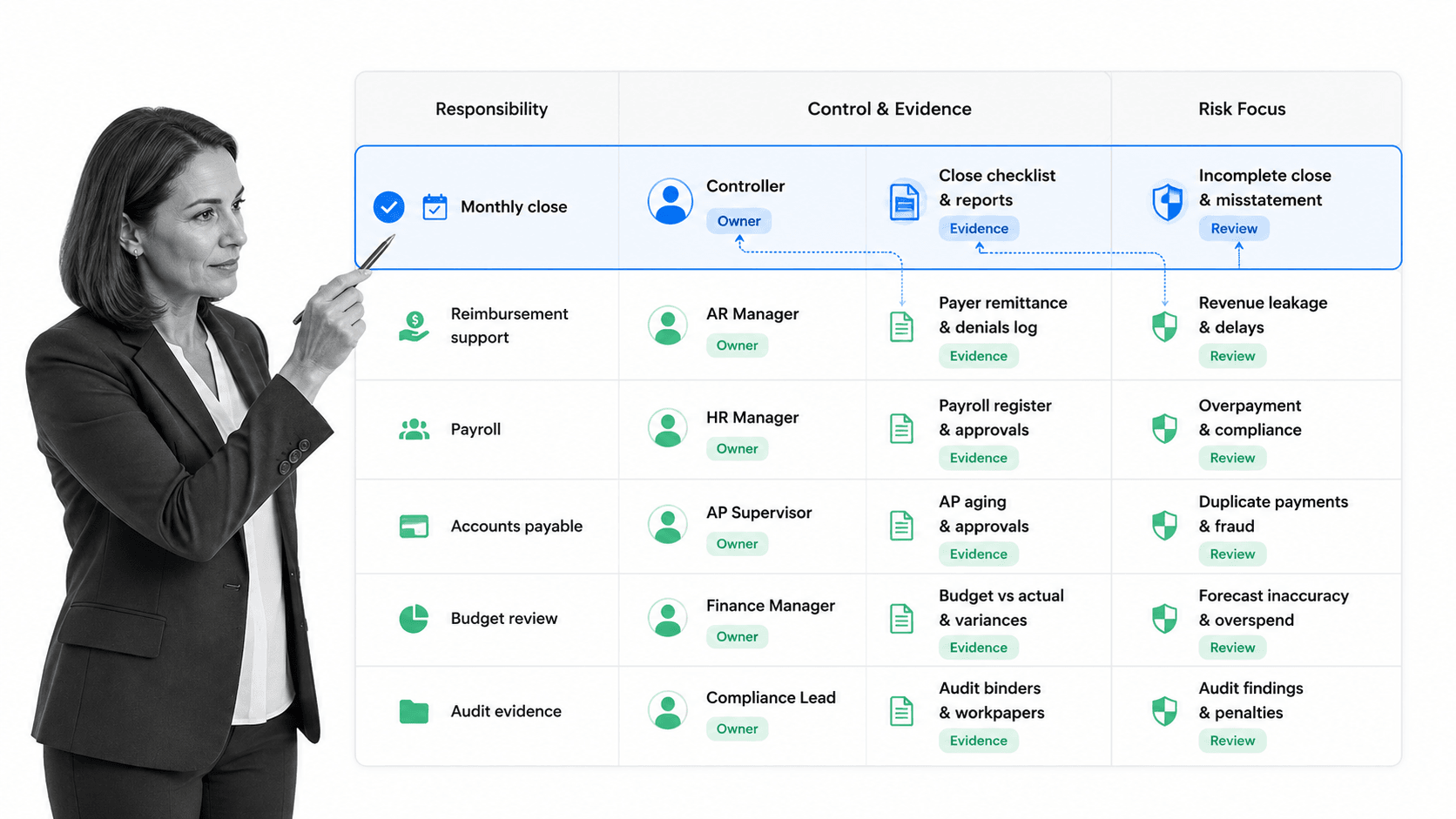
Healthcare controller responsibilities vary by organization size, ownership model, and care setting. A small clinic network might ask the controller to cover hands-on accounting, payroll, reporting, and vendor management. A hospital or health system may split work across accounting managers, reimbursement specialists, revenue cycle teams, and FP&A.
Financial reporting
The controller oversees timely financial statements, monthly reporting packages, budget-to-actual review, variance explanations, and account analysis. The output should be clear enough for executives to make decisions and rigorous enough for auditors to trace back to source records.
General ledger and reconciliations
The controller makes sure the general ledger is maintained, reconciliations are completed, journal entries are reviewed, intercompany activity is handled correctly, and account balances are investigated when they do not make sense.
Accounts payable, payroll, and cash controls
Controller oversight often covers accounts payable, purchasing controls, payroll review, bank reconciliations, cash receipts, deposit controls, and segregation of duties. In healthcare, payroll and staffing can be major cost drivers, so review routines need clear ownership and escalation.
Budget and variance support
A healthcare controller supports budgets and forecasts by making the historical financial record reliable. They may coordinate departmental input, analyze variances, explain cost movement, and help leaders understand whether the issue is volume, reimbursement, staffing, supplies, coding, timing, or process drift.
Audit and cost report support
Healthcare controllers commonly prepare audit schedules, coordinate information requests, support year-end close, and contribute to cost report preparation. That work is easier when supporting documents, approvals, reconciliations, and variance notes are captured during the close instead of reconstructed later.
Department finance partnership
The best healthcare controllers do not keep finance locked inside accounting. They help department leaders understand which financial results are driven by timing, volume, staffing, supplies, payer mix, coding, denials, or unresolved process work. That partnership depends on reliable routines. If variance explanations arrive in different formats every month, the controller cannot separate signal from noise.
A repeatable controller workflow gives department leaders a consistent way to submit explanations, attach support, confirm follow-up actions, and route unresolved questions back to finance. That keeps financial review practical, not performative.
Healthcare controller controls and close process
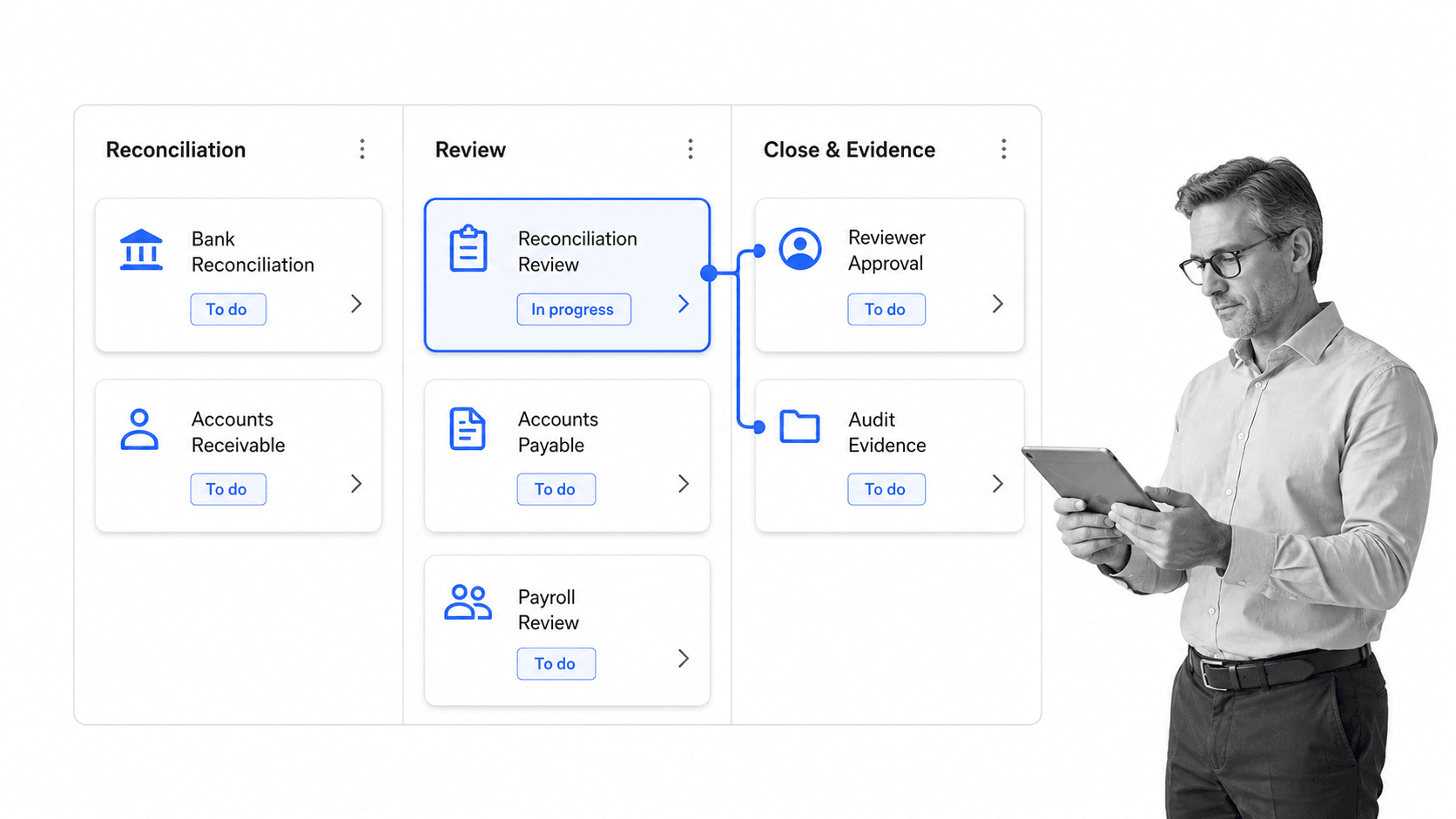
Healthcare controller controls should make close work consistent, reviewable, and resilient. The goal is not to add bureaucracy. The goal is to make the right financial work happen the same way every period with a clear evidence trail.
Start with the close calendar
The close calendar should define each recurring task, owner, reviewer, due date, evidence requirement, approval rule, and escalation path. A monthly financial close process gives finance teams a practical starting point for turning the close into a repeatable workflow.
Standardize reconciliations
Each reconciliation should have a preparer, reviewer, source system, supporting evidence, threshold for investigation, and documented resolution path. High-risk reconciliations need stronger review than routine accounts.
Control journal entries
Journal entry workflows should capture the reason, source, preparer, reviewer, support, and approval state. Recurring entries, estimates, reclasses, accruals, and corrections should not rely on memory or informal messages.
Route exceptions, do not bury them
Close controls are tested when something goes wrong. Variances, missing support, late approvals, unusual adjustments, or payer-related discrepancies should route to the right reviewer automatically. A weak process lets exceptions sit in inboxes. A strong process makes the exception visible and blocks closure until the review is complete.
Keep evidence attached to the work
Audit evidence should live beside the task it supports. If the reconciliation, approval, variance note, and attachment are separated across folders and messages, the controller loses the ability to prove how the work was done.
Review access and segregation of duties
Controller controls also need access discipline. The person preparing a transaction should not always be the person approving it, and system access should match each person’s role. When access reviews are handled informally, finance teams can miss stale permissions, conflicting duties, or approval paths that no longer reflect the organization.
A practical control workflow asks the same questions every review cycle: who has access, what role do they hold, which process needs that access, who approved it, and what evidence proves the review happened. That turns access review from a spreadsheet exercise into a controlled finance process.
Healthcare controller compliance priorities
Healthcare controller compliance priorities sit at the intersection of accounting standards, reimbursement requirements, privacy obligations, grants, payer rules, tax, employment rules, and internal policy. The controller does not own every regulation, but they own finance processes that can create compliance exposure.
Accounting standards and reporting discipline
Healthcare financial statements still need consistent accounting treatment, documented support, and review discipline. FASB Accounting Standards Codification is the core source for U.S. accounting standards, so controller workflows should help teams apply policies consistently and preserve support for material judgments.
Reimbursement and payer support
Healthcare controllers often support reimbursement analysis, cost reporting, and financial evidence that depends on payer or program rules. CMS manuals and guidance is one official CMS source for manuals and guidance, which reinforces why controller work needs documented ownership and review when rules change.
Privacy and access-sensitive finance work
Finance work may touch protected health information, employee data, payer records, and vendor data. HHS HIPAA Security Rule guidance describes HIPAA Security Rule safeguards for electronic protected health information. Controller workflows should limit access, avoid unnecessary patient detail, and preserve audit trails where sensitive information is involved.
Policy and approval control
Healthcare finance teams can use compliance management software to connect policies, approvals, evidence, and remediation work. A controller should be able to see which controls are operating, which reviews are overdue, and which exceptions need escalation.
Healthcare controller workflows to standardize
Healthcare controller workflows are the recurring finance processes that should never depend on one person’s memory. Start with the work that repeats every month, carries audit risk, or blocks leadership decisions when it is late.
Month-end close workflow
The month-end close workflow should include task owners, dependencies, evidence requirements, review states, variance notes, approvals, and escalation rules. It should make the close status visible without asking every preparer for an update.
Reconciliation workflow
A reconciliation workflow should define the source, preparer, reviewer, support, exception threshold, resolution note, and approval path. This keeps account review from becoming a spreadsheet hunt at audit time.
Budget variance workflow
Variance review should route department questions, support requests, explanations, and follow-up actions through a controlled workflow. When a variance has an operational cause, the workflow should assign the next step instead of leaving the explanation trapped in a meeting note.
Audit request workflow
Audit request lists should become assigned tasks with owners, due dates, evidence attachments, reviewer checks, and status. The controller should be able to see which requests are complete, blocked, under review, or at risk.
Compliance and policy review workflow
Finance policies, HIPAA-adjacent access reviews, vendor payment rules, and approval matrices should connect to controlled review cycles. A HIPAA compliance audit checklist can help teams structure healthcare compliance evidence, while healthcare provider onboarding checklist supports provider-related administrative controls.
Healthcare controller in Process Street
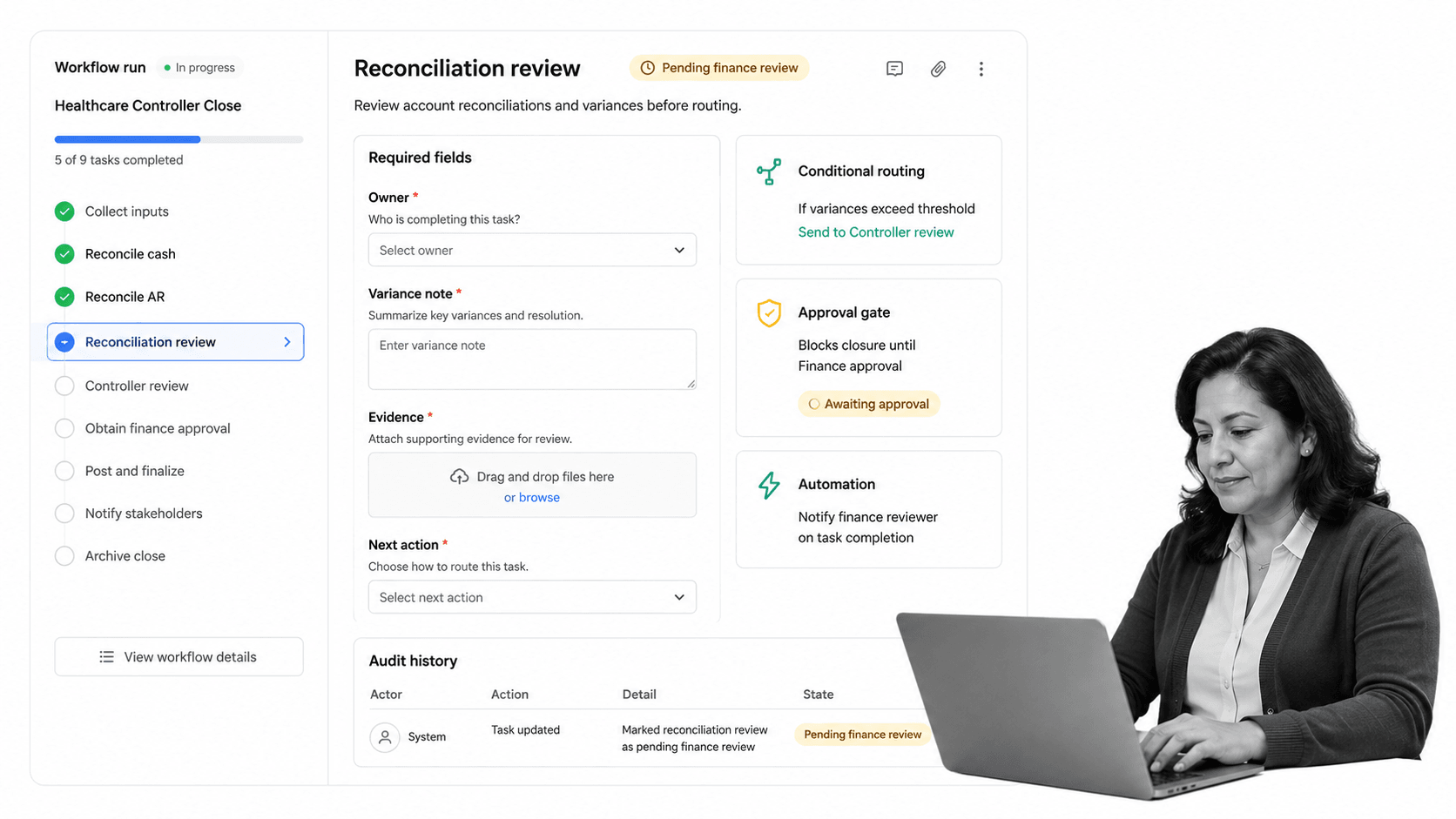
Healthcare controller work in Process Street starts by turning recurring finance processes into governed workflows. Instead of tracking close tasks, reconciliations, audit requests, and approvals across spreadsheets and messages, teams can run the work through one controlled process.
Process Street is a Compliance Operations Platform and is HIPAA compliant. It is built for teams that need repeatable work, clear ownership, approvals, audit trails, and proof that required steps were completed.
Assign finance work with clear ownership
Each workflow run can assign tasks to preparers, reviewers, controllers, finance leaders, compliance owners, or department heads. Required fields can capture support, variance notes, signoffs, and exception reasons before work moves forward.
Use approvals for review gates
approvals let finance teams route reconciliations, journal entries, variance explanations, audit responses, and policy changes through the right review path. The approval sits inside the workflow, so the evidence and decision stay connected.
Use conditional logic for exception routing
conditional logic can route work based on risk, threshold, missing support, department, account type, or review outcome. A routine reconciliation can close quickly, while an exception can route to the controller before the close is marked complete.
Connect controller workflows to the healthcare stack
Process Street has direct, universal integrations to 5,000+ systems. Need a new one? An AI agent builds it on the fly. That helps healthcare finance teams connect workflow tasks to accounting systems, BI tools, document storage, communication tools, and systems of record without making the close depend on manual chasing.
Teams building a broader healthcare process can connect controller workflows to healthcare dashboard, healthcare monitoring, healthcare analytics, and healthcare integration so finance exceptions, operational signals, and compliance evidence do not live in separate operating rhythms.
Healthcare controller skills and tools
Healthcare controller skills and tools should match the risk profile of the organization. The controller needs accounting expertise, healthcare finance fluency, people management, systems discipline, and enough operational judgment to know when a variance is a process issue, a data issue, or a real business issue.
Core skills
Core healthcare controller skills include GAAP knowledge, financial reporting, month-end close management, reconciliation design, budgeting support, variance analysis, internal controls, audit coordination, reimbursement awareness, team leadership, and process improvement.
Technology fluency
Controllers do not need to be engineers, but they do need to understand how accounting systems, payroll systems, revenue cycle data, BI tools, spreadsheets, workflow systems, and document repositories fit together. Weak handoffs between systems are where control gaps appear.
Career outlook
Financial managers, the broader occupational group that includes controller-type roles, remain important because organizations need accurate reporting, risk control, and financial decision support. BLS financial managers outlook provides the official U.S. occupational outlook for financial managers.
What to look for in controller workflow software
Look for software that can assign recurring tasks, enforce evidence requirements, route approvals, branch exceptions, capture audit history, integrate with existing systems, and make status visible to finance leaders. If the software only stores documents or shows a dashboard, the controller still has to chase execution manually.
For teams comparing operational platforms, workflow management system and workflow management software explain how workflow systems help standardize recurring work across teams.
FAQs
What is a healthcare controller?
A healthcare controller is the finance leader responsible for accounting operations, financial reporting, close discipline, controls, reconciliations, audit support, and finance process reliability inside a healthcare organization.
What does a healthcare controller do?
A healthcare controller oversees general ledger work, month-end close, reconciliations, journal entry review, accounts payable, payroll controls, budget support, variance analysis, audit preparation, reimbursement support, and financial reporting routines.
How is a healthcare controller different from a healthcare CFO?
A healthcare CFO usually owns broader financial strategy, capital planning, board communication, financing, and enterprise financial leadership. A healthcare controller usually owns accounting execution, reporting accuracy, close control, reconciliations, audit evidence, and day-to-day finance operations.
What controls should a healthcare controller standardize?
A healthcare controller should standardize close calendars, reconciliations, journal entry review, bank and cash controls, accounts payable approvals, payroll review, budget variance explanations, audit request tracking, and evidence retention.
What software helps a healthcare controller manage close and compliance workflows?
A healthcare controller needs workflow software that assigns recurring finance tasks, requires evidence, routes approvals, escalates exceptions, tracks audit history, and integrates with accounting, BI, storage, and communication systems.
Can Process Street support healthcare controller workflows?
Yes. Process Street can turn healthcare controller work into assigned workflows with required fields, conditional routing, approvals, evidence uploads, automations, and audit history. It helps finance teams move from informal close tracking to controlled execution.