Turn every policy into automated workflows with built-in enforcement and audit-ready proof.



Note Taking Service
A note taking service captures spoken information and turns it into a clear, usable record. Depending on the service model, a trained person, automated system, or hybrid team listens to a meeting, lecture, interview, or event and produces structured notes that preserve the context, decisions, and actions.
The useful output is not a wall of transcript text. It is a concise record that tells readers what happened, why it mattered, what was decided, and who owns the next step. That distinction matters because organizations rarely struggle to collect information. They struggle to turn information into shared understanding and reliable follow-through.
This guide explains the main service models, what professional notes should contain, how the delivery workflow works, where accessibility and privacy fit, and how to choose and implement a service. It also covers the final mile: moving decisions out of the notes and into assigned work.
In this article, you will learn:
- What Is a Note Taking Service?
- Types of Note Taking Services
- What a Note Taking Service Should Capture
- How a Note Taking Service Works
- Benefits of a Note Taking Service
- How to Choose a Note Taking Service
- How to Implement a Note Taking Service
- Turn Notes Into Operational Action
- FAQs
What Is a Note Taking Service?
A note taking service is a managed way to create accurate, organized notes from live or recorded communication. The service may provide a professional notetaker, speech-to-text technology, an AI summarization layer, or a combination of all three. Its job is to deliver a record that the intended audience can understand and use.
A service, not just an app
An app gives you a place to type. A service takes responsibility for an outcome. That outcome may be accurate meeting minutes, accessible notes for a participant, a decision log for a board, a summary of an interview, or a set of action items for a project team. The difference is the delivery standard, quality control, and accountability around the finished record.
A practical meeting minutes guide can define the basic record structure. The service adds reliable capture, consistent production, review, delivery, and accountability around that structure.
Note taking service versus transcription
Transcription converts speech into text, usually in the order it was spoken. Note taking is selective and structured. It groups related points, separates decisions from discussion, adds headings, and identifies actions. A transcript can support the work, but it is only one input. The W3C transcript guidance also shows why speaker identification, logical sections, and useful navigation make text easier to use.
Note taking service versus an AI assistant
An AI note taking assistant focuses on automated capture, transcription, and summary. A broader service can include human judgment, custom formats, confidentiality procedures, accessibility support, same-day review, and delivery into a client workflow. Automation may still do much of the first pass, but the service promise includes the process around it.
Types of Note Taking Services
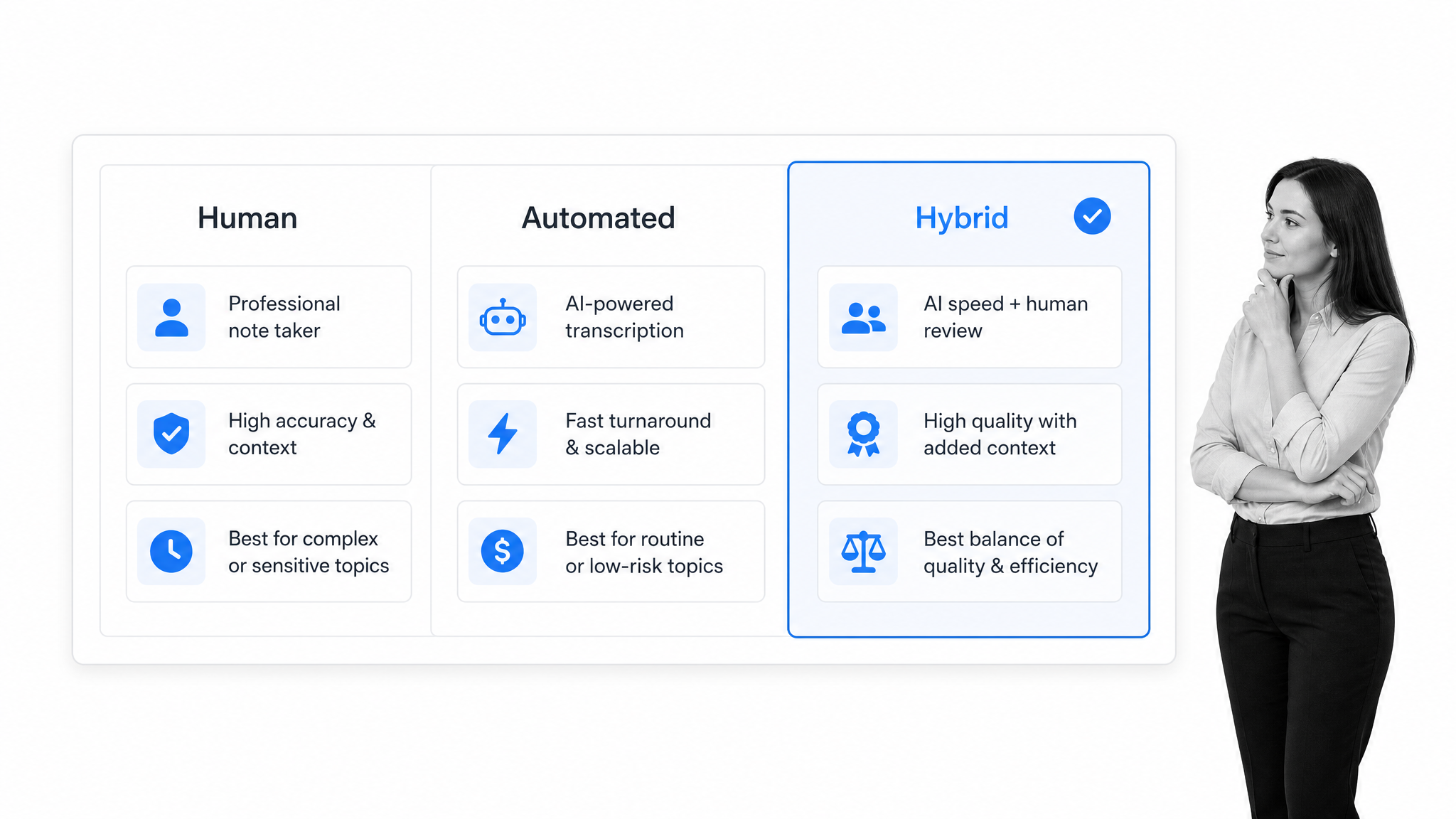
The right model depends on the purpose of the record, the level of risk, the turnaround time, and the needs of the people receiving it. Most services fall into four practical categories.
Human professional note taking
A trained notetaker attends live or watches a recording and creates selective notes. Human services are useful when meaning depends on context, tone, specialist vocabulary, or careful judgment about what belongs in the final record. The notetaker can follow a custom format, ask clarifying questions, and distinguish a formal decision from a tentative idea.
Automated note taking
An automated service records audio, creates a transcript, drafts a summary, and extracts likely actions. It works well for high-volume recurring meetings where speed and consistency matter. The quality depends on the audio, speaker separation, terminology, and how clearly participants state decisions. Automated notes still need a review step when the record carries operational or legal weight.
Hybrid note taking
A hybrid service uses automation for capture and first-pass drafting, then gives a trained reviewer responsibility for accuracy, structure, and delivery. This model often balances speed with judgment. It is especially useful when a team wants fast turnaround but cannot accept speaker errors, vague action items, or unreviewed summaries.
Accessibility-focused note taking
Accessibility services are designed around effective communication rather than general productivity. The ADA effective communication guidance lists qualified notetakers and real-time captioning among possible auxiliary aids for people who are deaf, have hearing loss, or are deaf-blind. The correct service depends on the nature, length, complexity, and context of the communication and the person’s usual method of communication.
Live notes, CART, captions, and post-event summaries are related but not interchangeable. A participant may need real-time text to follow the meeting, a structured set of notes to review afterward, or both. The service should be selected with the participant, not imposed as a generic accommodation.
What a Note Taking Service Should Capture
Good notes reduce the effort required to reconstruct a conversation. They should let someone who missed the meeting understand the outcome without pretending to be a word-for-word record.
Context and purpose
The record starts with the meeting name, date, participants, purpose, and agenda. Context prevents fragments from being misread later. A comment that sounds final in isolation may have been one option in a larger discussion. Clear framing keeps the record honest.
Discussion points and evidence
Notes should capture the reasoning that shaped an outcome, not every sentence. Important evidence, constraints, objections, and alternatives belong in the record when they explain why the team chose a direction. This is where structured notes strengthen a broader knowledge management system.
Decisions and unresolved questions
Each decision should be stated plainly and separated from items that remain open. The official meeting minute guidance for charities emphasizes recording decisions and the actions needed to carry them out. That same discipline helps any business team avoid confusing discussion with commitment.
Action items with owners and dates
An action item needs a clear verb, one accountable owner, and a due date or review point. “Marketing to follow up” is weak. “Maya will send the revised launch brief by Thursday” is executable. A meeting minutes template helps make those fields standard rather than optional.
References and record status
Link the documents, dashboards, recordings, and policies discussed. Mark whether the notes are a draft, reviewed record, approved minutes, or informal summary. Readers should never have to guess whether the document is authoritative.
How a Note Taking Service Works
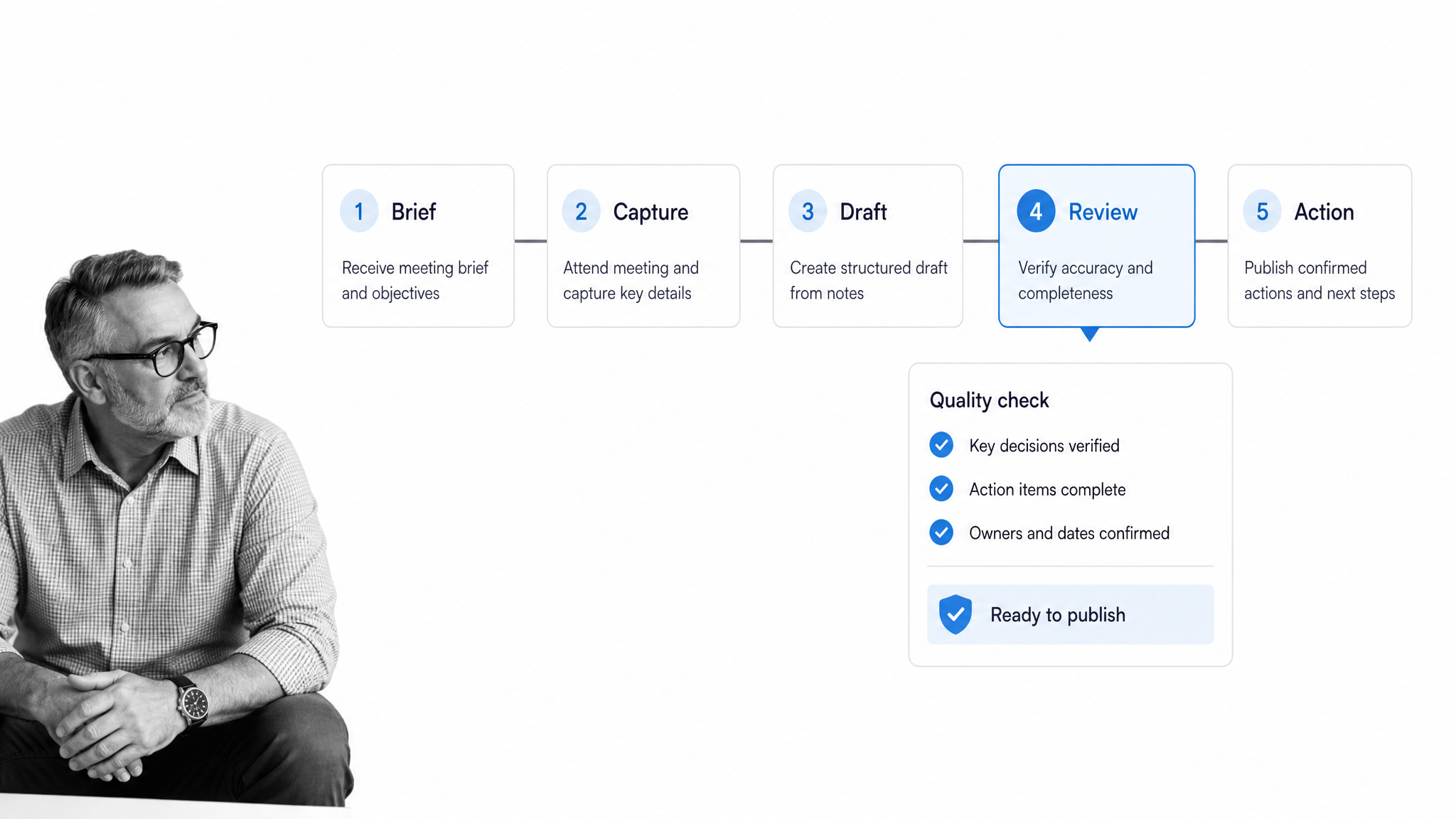
A professional note taking service should run a visible delivery process. The details vary, but the strongest workflows include the same control points.
1. Define the brief
The client states the purpose, audience, preferred format, terminology, confidentiality level, accessibility needs, and turnaround time. The brief should also say what not to capture. A board record, a student support note, and a customer research summary require different levels of detail.
2. Capture the source
The notetaker attends live, joins remotely, or receives an approved recording. Everyone should know how the information will be captured and used. If recording is involved, the ICO recording guidance recommends identifying a valid purpose, telling people why the session is recorded, and explaining use and retention.
3. Produce the first draft
The first draft organizes the material into the agreed structure. Automation may create a transcript and summary, while a human service may write selective notes directly. Either way, the output should distinguish facts, decisions, opinions, and next steps.
4. Review for accuracy and usefulness
Quality review checks names, terminology, numbers, speaker attribution, decisions, and action ownership. It also removes repetition and verifies that the note does not overstate what the group agreed. HMRC’s contemporaneous note guidance emphasizes accuracy and prompt availability, a useful standard even outside investigations.
5. Approve, distribute, and store
The reviewer or meeting owner confirms the record, then the service shares it with the correct audience and stores it under the agreed access and retention rules. Teams can use document approvals when a formal review is required before a note becomes authoritative.
6. Convert actions into work
The final stage moves tasks into the system where owners manage them. If actions remain inside a PDF or email, the service has documented the meeting but not improved execution. A strong delivery workflow connects the record to project, customer, compliance, or operating work.
Benefits of a Note Taking Service
Better attention during live discussion
Participants can listen, ask questions, and notice disagreement instead of splitting attention between the conversation and a personal notebook. The benefit is not just convenience. Better attention improves the quality of the discussion that the service is recording.
Consistent records across teams
A shared template and review standard make records easier to compare and search. Decisions appear in the same place. Actions use the same fields. A consistent record also reduces dependence on one employee’s private notes and supports a centralized knowledge management system.
More accessible information
Structured text can help people who cannot access the original audio, people who process written information more easily, and people who need time to review. Accessibility is not achieved by dumping an automatic transcript into a folder. The record must be accurate, navigable, available in a usable format, and designed around the participant’s needs.
Stronger institutional memory
Good notes preserve the reasons behind a choice, not just the outcome. New employees can understand how a project evolved. Teams can trace when a risk surfaced. Repeated decisions can become process documentation instead of being rediscovered in every meeting.
Clearer accountability
When the record names the owner, due date, and approval path, there is less room for “I thought someone else had it.” The service creates a clean handoff from conversation to execution.
How to Choose a Note Taking Service
Choose against the meetings and records you actually have, not a generic feature list. A short pilot with real source material will reveal more than a polished demo.
Accuracy and subject knowledge
Test names, acronyms, technical vocabulary, multiple speakers, accents, and noisy audio. Ask how corrections work and who is responsible for the final check. If the service supports regulated or specialist work, confirm that reviewers understand the context rather than simply fixing spelling.
Output format and level of detail
Review a sample that matches your intended use. Does it separate decisions, open questions, and actions? Can you choose concise summary notes, detailed minutes, or accessibility notes? Can the service follow your headings and naming conventions? A good format should connect with the knowledge management tools your team already uses.
Turnaround and service reliability
Define what “fast” means for each meeting type. Live accessibility support, same-day project notes, and board minutes have different delivery windows. Ask how the provider handles scheduling changes, late recordings, urgent corrections, and coverage when the assigned notetaker is unavailable.
Privacy, security, and retention
Map the information flow from capture through deletion. Identify who can access recordings, transcripts, drafts, and approved notes. Ask where data is stored, how access is revoked, and whether retention can match your policy. The NIST Privacy Framework offers a practical risk-management structure for evaluating how personal information is processed.
Accessibility fit
Confirm the service with the person who needs the accommodation. A transcript delivered tomorrow does not replace live text needed today. A generic summary may omit the detail a student needs. Ask about qualified notetakers, CART, accessible document formats, speaker identification, and how corrections are handled.
Workflow integration
Decide where the finished record and action items should go. The service should fit your calendar, document store, project system, and operating workflows. When recurring follow-up needs a repeatable structure, a workflow template library can provide the next layer.
How to Implement a Note Taking Service
Start with one meeting class
Pick a recurring meeting with clear decisions and follow-up, such as a project review, customer implementation call, governance committee, or research interview. A narrow pilot makes quality measurable and limits privacy exposure while the process is still being designed.
Create the record standard
Define required headings, action fields, naming conventions, approval status, and storage location. Use a standard operating procedure template to document the service workflow and a project management process when meeting outputs feed delivery work.
Assign roles and review gates
Name the requester, notetaker or system owner, quality reviewer, approver, and action owners. Define which records need formal approval and which can be shared as informal summaries. Workflow approvals can stop a record or follow-up process until the right person signs off.
Handle notice and consent before capture
Tell participants what is being captured, why, who will receive it, and how long it will be kept. Provide a path for sensitive or off-record discussion. Record the applicable legal and policy requirements in the service procedure rather than leaving them to meeting hosts to remember.
Measure the pilot
Review correction rate, delivery time, reader usefulness, missing decisions, unclear action ownership, accessibility feedback, and the percentage of actions transferred into the work system. Avoid measuring success only by hours saved. A fast note that causes the wrong work is not a good outcome.
Standardize and expand
Once the pilot works, turn the setup into a reusable service request and meeting workflow. Connect it to onboarding so new employees know how records are created and used. An employee onboarding template can make that expectation part of how the team learns to operate.
Turn Notes Into Operational Action
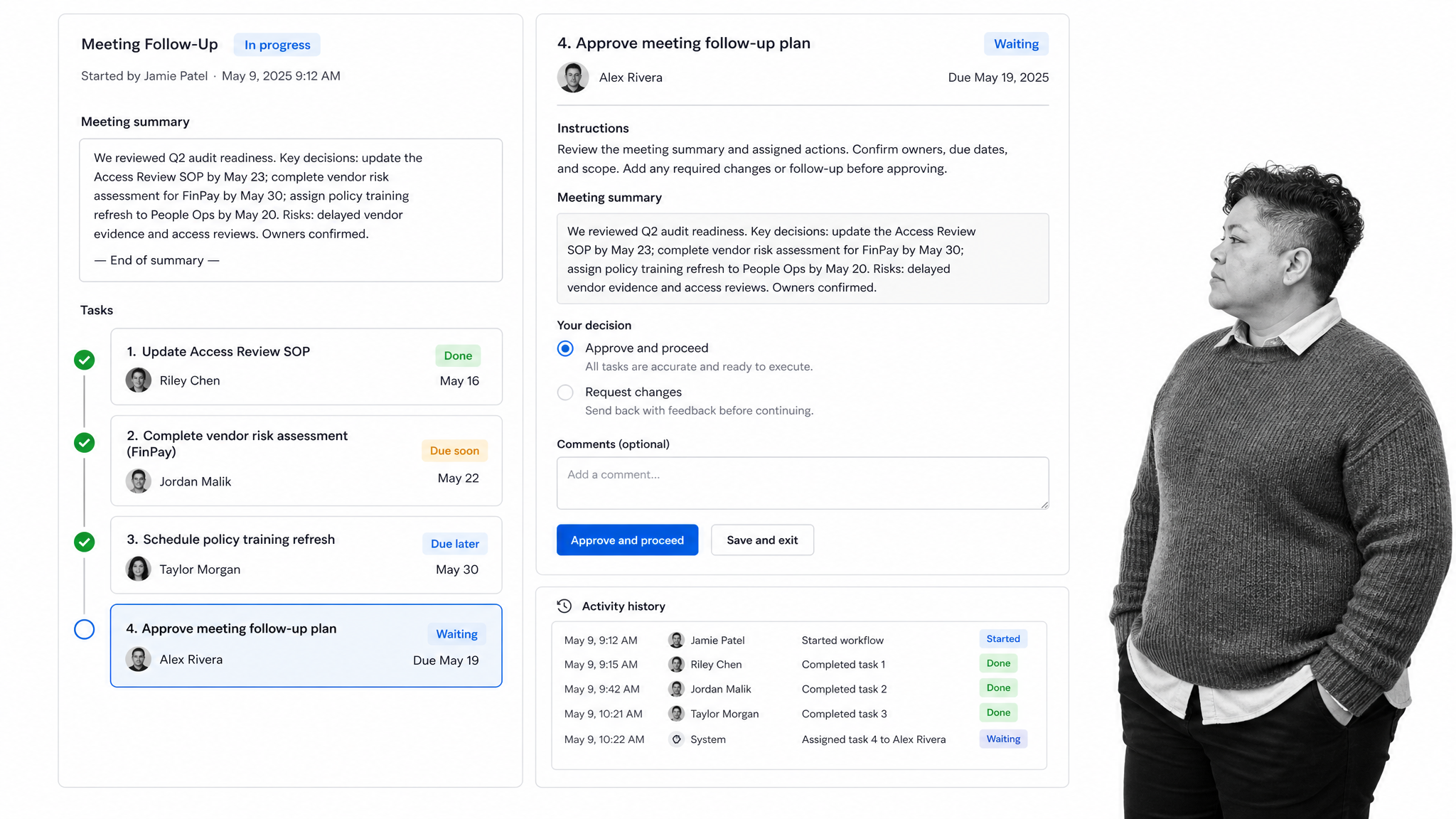
Process Street is a Compliance Operations Platform. It takes the recurring work that emerges from notes and runs it as assigned, controlled workflows. The note taking service preserves the conversation. Process Street makes the follow-up repeatable and provable.
Move actions out of the note
Create tasks with owners, due dates, required fields, and dependencies. If a meeting routinely produces the same follow-up, build that path once and run it after every meeting. The record remains evidence, while the workflow becomes the operating surface.
Require review where risk demands it
Add approval tasks before a decision is finalized, a customer commitment is sent, or a policy change takes effect. This keeps informal discussion from becoming ungoverned execution. The approval history also shows who reviewed the work and when.
Connect the record to controlled documentation
When a meeting changes how work should be done, update the procedure instead of leaving the new rule buried in minutes. Workflow document management software connects governed documentation to the tasks where the policy is followed. Teams can then maintain standard operating procedures as living operational controls.
Close the loop
Review incomplete tasks before the next meeting, bring exceptions back to the agenda, and update the process when the same issue repeats. Notes become more valuable when they are connected to execution data. The team can see not only what it intended to do, but what was completed.
FAQs
What is a note taking service?
A note taking service creates organized notes from meetings, lectures, interviews, calls, or events. It may use a professional notetaker, automated transcription and summarization, or a hybrid model. The finished record normally highlights context, decisions, action items, and references.
What does a professional note taking service include?
A professional service usually includes a delivery brief, live or recorded capture, structured drafting, quality review, secure distribution, and an agreed retention process. Some services also provide accessibility support, custom templates, formal minute approval, or direct transfer of action items into work systems.
Is a note taking service the same as transcription?
No. Transcription converts speech into text in sequence. A note taking service selects, organizes, and summarizes the material so readers can find decisions, reasoning, and actions without reading every spoken word. A transcript can be included as supporting evidence.
How do you choose a secure note taking service?
Map where recordings, transcripts, drafts, and approved notes are captured, processed, stored, shared, and deleted. Check access controls, notice and consent handling, retention settings, reviewer confidentiality, and how corrections are logged. Test the service with realistic sensitive material before expanding it.
Can a note taking service support accessibility?
Yes. Qualified notetakers, CART, real-time captions, transcripts, and structured post-event notes can support different communication needs. The right aid depends on the person and the situation. A delayed summary does not replace live access when someone needs real-time text to participate.
How do meeting notes become action items?
Each commitment should be rewritten as a clear task with one owner, a due date or review point, and any required approval. Move the task into the system where work is managed, then bring incomplete items back to the next agenda. This closes the gap between documenting a decision and executing it.