






Employee onboarding mistakes are expensive because new hires make stay-or-go judgments fast. Gallup reports that only 12% of employees strongly agree their organization does a great job onboarding, and BambooHR found that many new hires decide whether a job is the right fit within the first month.
The good news is that the most fatal onboarding mistakes are operational, not mysterious. If your process gives people time to learn, keeps work out of static paper systems, and makes expectations explicit, your best employees get a clearer path to contribute.
Think of onboarding as the first piece of the puzzle after someone accepts your offer. An awful first day can make a new employee regret the choice instantly, and that formative time can be tainted with bad feelings. The goal of this reference is to outline the mistakes and the solutions before they become retention problems.
Not giving your employees time to learn and grow
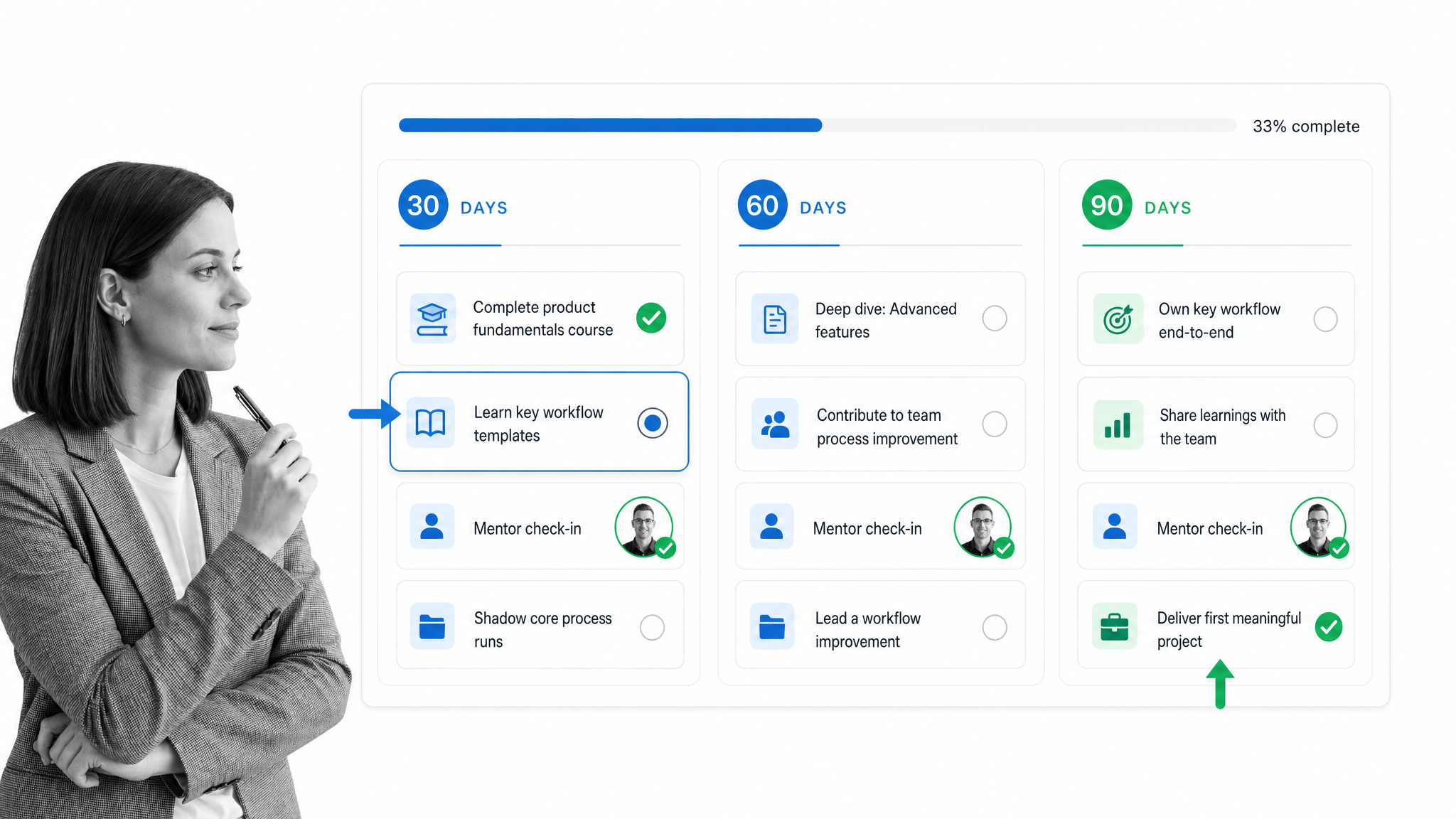
The best employees, especially ambitious employees, take a new job because they want to expand their skills and do meaningful work. If their first week is only admin, disconnected reading, and low-stakes busywork, they get a bad first impression of the role.
Instead of starting new hires with the dullest tasks you can find, build learning and contribution into the onboarding process. Give them time for personal development, assign a mentor, involve them in an important project, and give them a small but visible role in a new initiative.
The old examples still work: physical books that help people grow, 2 hours per week for personal development time, a chance to join an important project, and a pivotal role in a new initiative. Google has used employee-to-employee learning for the same reason ambitious, hard-working people are always keen to soak in information and skills.
That does not mean overwhelming people. It means proving that growth is part of the job from day one. When employees see that learning time and meaningful work are built into the process, they are more likely to feel engaged and less likely to mentally check out.
The solution
Create a 30, 60, and 90 day learning ramp. The first 30 days should help the employee understand the company, role, tools, and core workflows. The next 30 should move them into meaningful ownership. By 90 days, they should have shipped a useful project and know where they are strong, blocked, and ready to grow.
Do not make the first project trivial. Give the employee a project where they can shine safely, with clear support and a defined outcome. If you already keep a backlog of project ideas, use it to match new hires with work that teaches the business while creating value.
Allocate a little time every week for their own projects. That increases motivation in the same way taking a vacation can bring someone back with a fresh attitude. The important point is not the perk itself, it is the signal that growing is part of the role.
Formalizing the process on paper
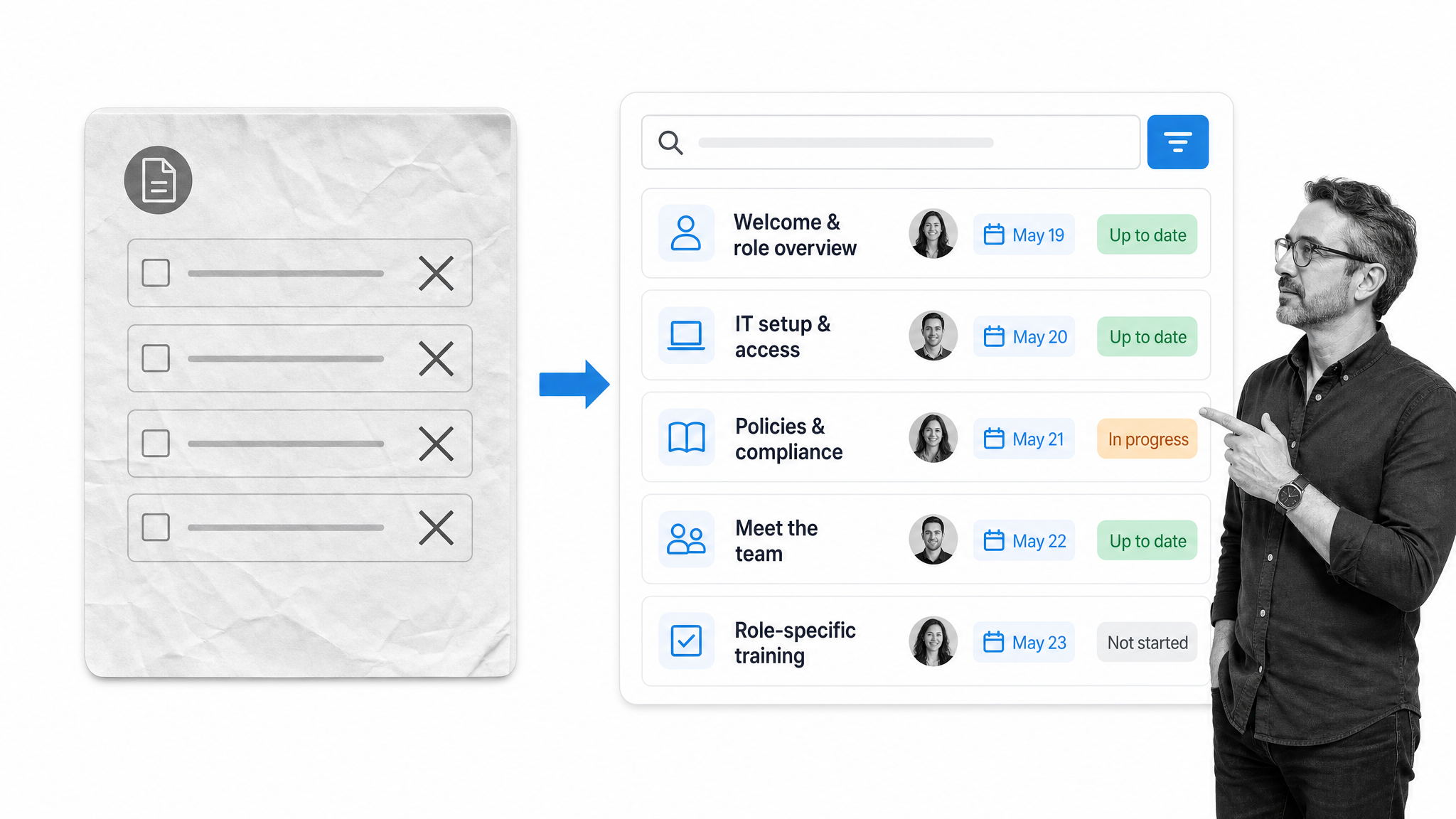
Paper processes were painful because they were hard to search, copy, update, and track. The modern version of the same mistake is a static onboarding doc buried in a folder, a spreadsheet nobody owns, or a checklist passed around without assignments, due dates, approvals, or version control.
When onboarding lives in static documents, the process becomes hard to enforce. A manager may use an old version. IT may miss an access step. HR may complete paperwork while the team forgets role-specific training. The new hire experiences all of that as disorganization.
The downsides of paper are still overwhelming. A notebook is fine for sketching ideas on the fly, but formalizing onboarding SOPs on paper is a recipe for disaster. Moving paper around the office saps time and energy. Printing, photocopying, and handing out copies to several people wastes money and creates version confusion.
Paper is not indexed and searchable. You cannot hit CTRL+F, drag up the correct passage, and move on. You have to walk to the filing cabinet, rifle through folders, and find the exact page. That sort of thing literally wastes days across an employee’s work years and ruins efficiency.
Formalizing SOPs matters, but the format matters too. A good onboarding process should be searchable, assigned, automated, and visible to the people responsible for each step.
The solution
Use an electronic workflow system to manage onboarding. Process Street is a Compliance Operations Platform that lets teams turn employee onboarding into assigned, trackable, auditable workflows instead of disconnected paper or static documents.
With employee onboarding software, you can assign tasks to HR, IT, finance, managers, and mentors, set due dates, collect forms, automate welcome emails, and keep the process consistent across every hire. Docs governs the procedure, Ops runs the workflow, and Cora can help spot gaps or missed steps before they become a bad first week.
Not explaining your expectations
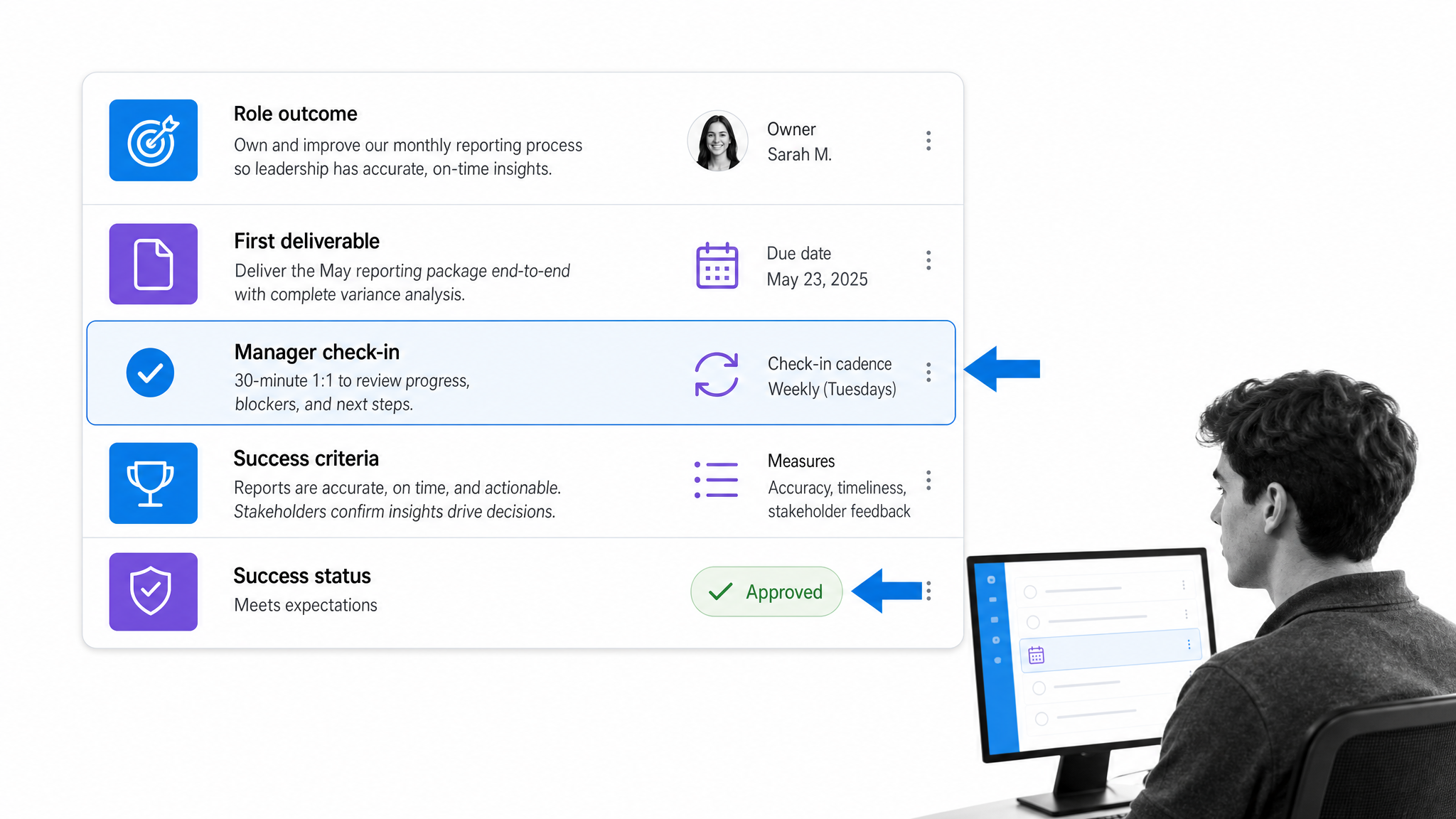
If employees are not sure what they are expected to do, how success will be measured, or when they should ask for help, confusion builds quickly. A new hire can be busy all week and still end Friday unsure whether they did a good job.
Clear expectations help employees block their time, prioritize the right work, and train themselves to improve. This is especially important for ambitious people because they want to know what good looks like and how to earn more responsibility.
The old version of this mistake was failing to say how many articles, issues, calls, or deliverables someone should complete. The current version is broader: failing to define outcomes, review cadence, decision rights, and success criteria for the first 30, 60, and 90 days.
The solution
Write role-specific expectations into the onboarding workflow. A content writer might need a first draft by week two, a publishing rhythm by day 30, and a quality rubric for revisions. A developer might need a first issue, a code review checklist, and a clear escalation path. A salesperson might need talk tracks, call blocks, CRM hygiene standards, and coaching checkpoints.
The exact targets depend on the role. The principle does not. Every new hire should know their main output, who owns each checkpoint, what done means, and when feedback will happen. Setting goals and checking in gently helps prevent the worst onboarding feeling: being overlooked, confused, or superfluous.
Concrete examples make this easier. A content writer might be expected to write two substantial articles per week as their main output. A junior developer might be expected to fix several issues and code one UI enhancement per month. A salesperson might be expected to make a defined number of calls per week. The numbers can change, but the detail should not be vague.
Final thoughts
The trick to employee retention is not a louder welcome message or a longer orientation deck. It is a better onboarding process. New hires need growth, structure, clarity, and follow-through.
If you are losing strong employees early, look at the process before blaming the hire. Are they learning? Can they find the right workflow? Do they know what success looks like? Are managers checking in at the right moments?
For a practical starting point, use this customizable employee onboarding checklist. You can also review Process Street’s employee onboarding workflow examples to see how repeatable onboarding can work across HR, IT, managers, and role-specific teams.
FAQ
What is the biggest onboarding mistake?
The biggest onboarding mistake is treating onboarding as a one-day orientation instead of a structured ramp. New hires need role clarity, learning time, manager support, and useful early work across their first weeks and months.
How do onboarding mistakes affect retention?
Onboarding mistakes create uncertainty at the moment when new hires are deciding whether the job matches what they were promised. Poor first impressions, unclear expectations, and disorganized handoffs can make strong employees disengage before they reach full productivity.
How can you prevent onboarding mistakes?
Prevent onboarding mistakes by turning the process into a repeatable workflow. Assign owners, set due dates, automate reminders, document expectations, schedule check-ins, and review the process after each hire so it improves over time.