Turn every policy into automated workflows with built-in enforcement and audit-ready proof.



Production Workflow Software: A Practical Guide
Production workflow software gives a team a controlled way to move work from request to completion. The right system assigns owners, presents the correct instructions, routes exceptions, captures evidence, and records the outcome. The wrong system adds another dashboard while the real process still runs through messages, spreadsheets, and memory.
The category is broad because production means different things in different environments. A factory needs material and capacity planning. A video team needs media review and version approval. A creative studio needs project and resource tracking. An operations team needs a repeatable workflow that coordinates people and systems. This guide separates those layers so you can choose production workflow software by the job it must do.
The central question is not which product has the longest feature list. It is where control breaks down in your production flow. Start with the handoff, decision, or exception that creates delay or risk. Then choose the system that owns that layer and connect it to the systems that should remain sources of truth.
- What is production workflow software?
- Which production workflow software layer do you need?
- How should you evaluate production workflow software?
- How do you map a production workflow before implementation?
- How can Process Street run controlled production workflows?
- What does a production workflow look like in practice?
- How do you implement production workflow software?
- Production workflow software FAQs
What is production workflow software?
Production workflow software is a system for defining, executing, monitoring, and improving the sequence of work required to produce an output. That output might be a finished product, an approved video, a released document, a completed inspection, or a customer deliverable. The software turns the production method into a repeatable operating path instead of leaving it as an informal checklist.
A useful production workflow has more than tasks. It includes an intake trigger, required inputs, clear ownership, dependencies, decision rules, approval gates, evidence requirements, exception paths, and a completion record. Those controls matter because a process can look complete in a project board even when a critical measurement, sign-off, or handoff is missing.
The term also overlaps with manufacturing execution systems, enterprise resource planning, material requirements planning, project management, digital work instructions, and media review platforms. These tools can work together. A production workflow layer coordinates the human process, while an ERP may own orders and inventory, an MES may own machine and shop-floor events, and a specialist review platform may own rich media feedback.
That layered approach matches the integration problem described in the NIST smart manufacturing standards landscape, which examines information across product, production system, and business dimensions. The practical lesson is simple: do not force one application to become every system. Decide what each layer owns and define the handoffs between them.
Core components of a production workflow
- A request or event that starts the work
- A defined sequence of tasks and accountable owners
- Structured fields for specifications, measurements, files, and decisions
- Rules that adapt the route to product type, risk, or exception
- Approvals or stop points before sensitive work continues
- Connections that read from and update systems of record
- A timestamped completion history for analysis and proof
If your main need is repeatable human execution, compare platforms in the broader workflow management software category. If your main need is work instructions at the point of production, focus on controlled procedures, version governance, evidence capture, and deviation routing.
Which production workflow software layer do you need?
Most buying mistakes begin by comparing products from different layers as if they were substitutes. A video review platform, a manufacturing planner, and a workflow orchestration platform may all appear in search results for this keyword. They solve different constraints. Use the table below to identify the layer that should lead your shortlist.
| Software layer | Primary job | Best signal that you need it | Example |
|---|---|---|---|
| Workflow orchestration | Run repeatable procedures across people and systems | Missed steps, inconsistent handoffs, weak proof | Process Street |
| Video review and approval | Collect precise feedback on media assets | Revision loops happen in email or chat | Frame.io |
| Creative production tracking | Coordinate projects, assets, schedules, and reviews | Studios lack a shared production pipeline | Autodesk Flow Production Tracking |
| Manufacturing planning | Balance demand, materials, capacity, and production orders | Schedules conflict with inventory or capacity | MRPeasy |
| Enterprise resource planning | Connect production with inventory, procurement, and finance | Operational and financial records are fragmented | Oracle NetSuite |
Workflow orchestration: Process Street
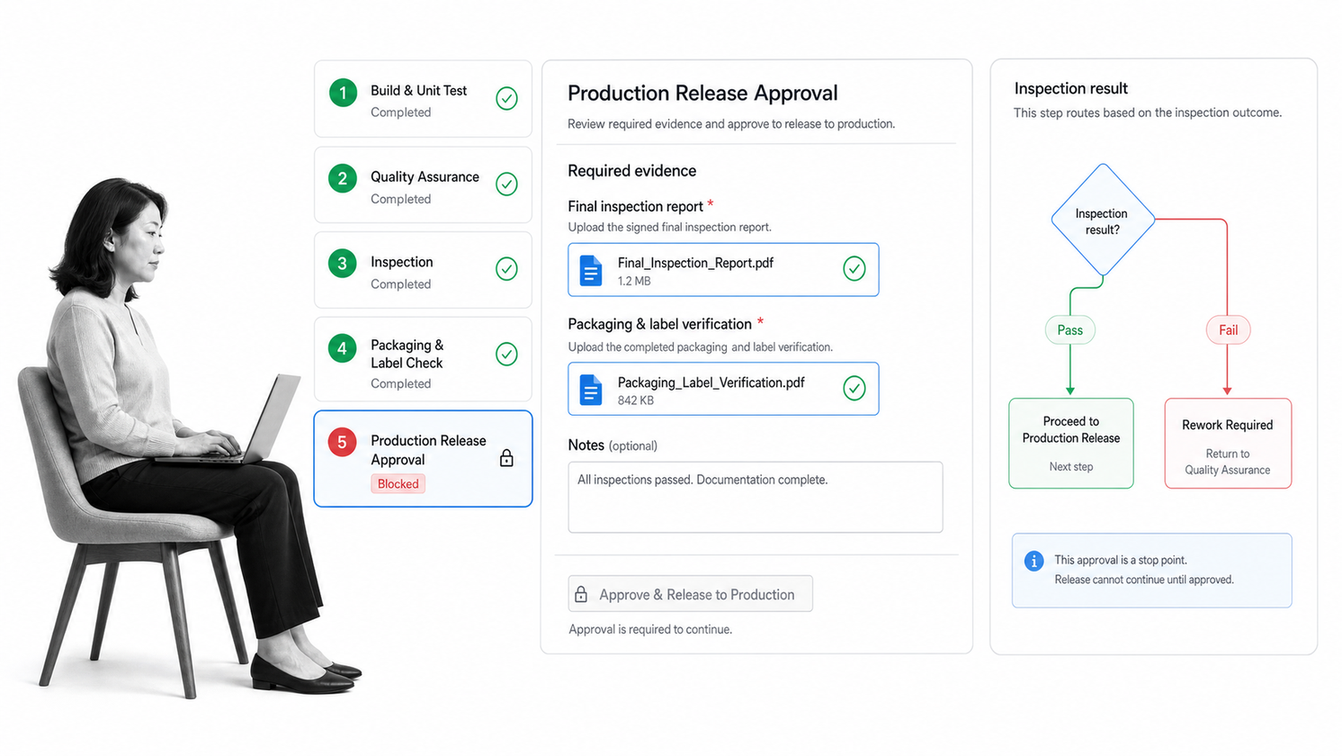
Process Street is the strongest fit when the production constraint is controlled execution. Teams turn a procedure into a workflow run with assigned tasks, structured form fields, conditional paths, approvals, due dates, automations, and completion history. The result is a process people can run, not a document they must remember to interpret.
This layer is particularly useful for quality checks, production readiness reviews, change control, maintenance coordination, release processes, and work that crosses an ERP, CRM, document repository, or specialist production application. The workflow builder documentation shows how tasks, forms, approvals, stops, and logic fit into a repeatable run.
Video review and approval: Frame.io

Frame.io is built for media review. Its official documentation describes comments tied to precise points in an asset, annotations, internal comments, mentions, and feedback status. That makes it useful when the production bottleneck is collecting actionable feedback on video, image, audio, or document assets. See the Frame.io commenting documentation for the review surface.
Frame.io should not be expected to replace a manufacturing planner or an organization-wide process engine. It earns its place when rich-media review is the production-critical activity. A broader workflow can trigger the review, wait for approval, and then continue to release or delivery.
Creative production tracking: Autodesk Flow Production Tracking
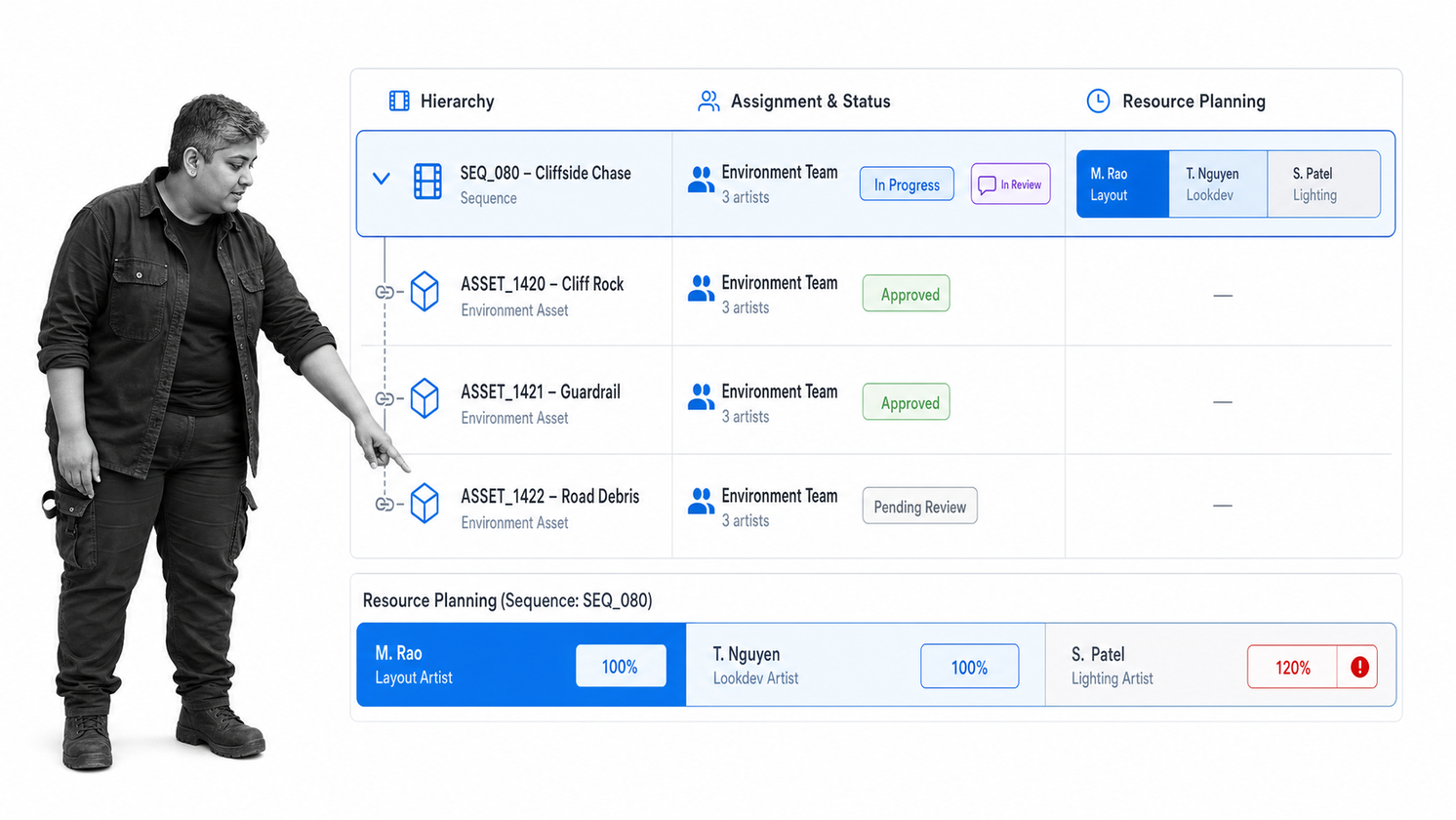
Autodesk Flow Production Tracking is designed for production tracking across film, television, games, and related creative work. Autodesk describes a cloud production tool for tracking, review, approval, communication, and production data management. The official project tracking documentation is the best starting point for validating that scope.
This layer fits studios that need a shared view of projects, artists, assets, and production progress. It is more specialized than a general operations workflow tool. Choose it when the creative pipeline itself is the system that needs structure, then connect procedural controls around onboarding, access, delivery, or compliance as needed.
Manufacturing planning: MRPeasy
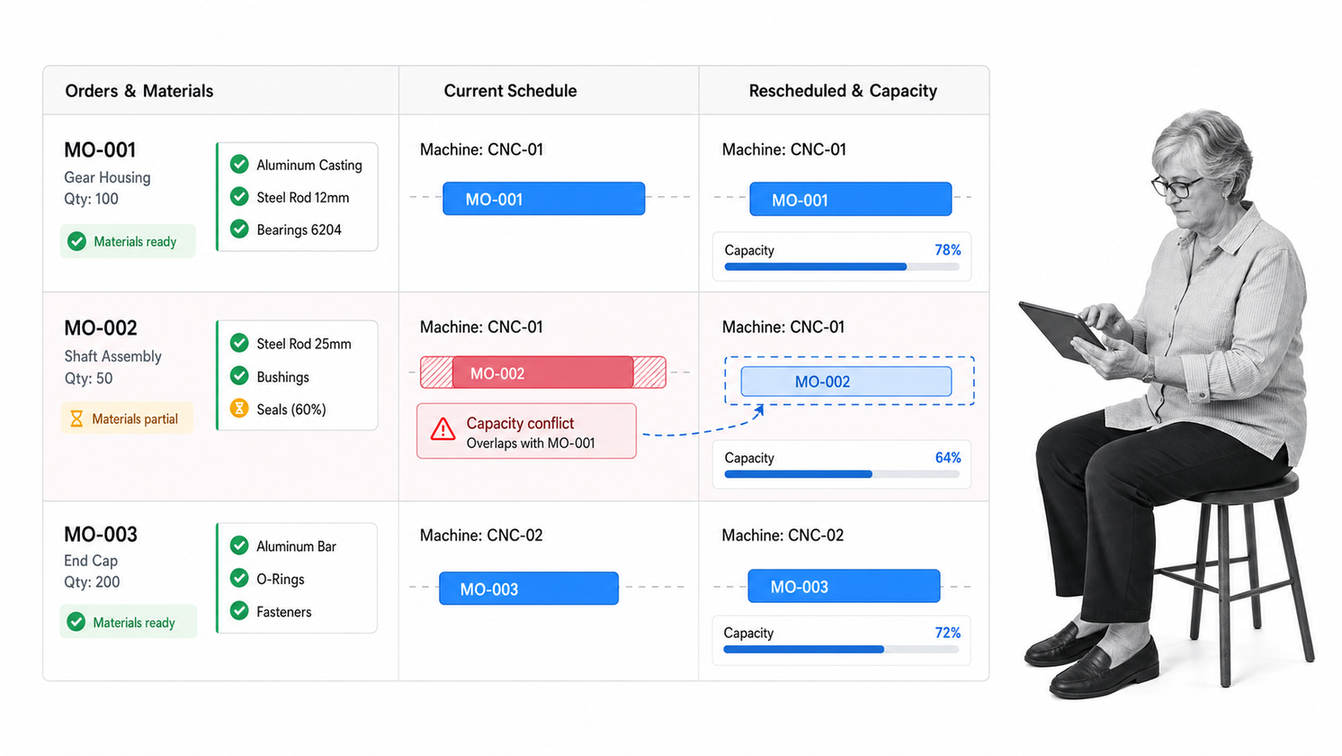
MRPeasy focuses on manufacturing planning. Its production planning product connects inventory levels, bills of materials, routings, capacity, production schedules, and shop-floor reporting. That combination is a fit for smaller manufacturers whose main constraint is turning demand into a realistic schedule with the required materials and resources.
A planning platform answers what should be produced, when, and with which resources. A workflow platform answers who must do what, which evidence must be captured, and what happens when the normal route breaks. Many production environments need both answers.
Enterprise resource planning: Oracle NetSuite
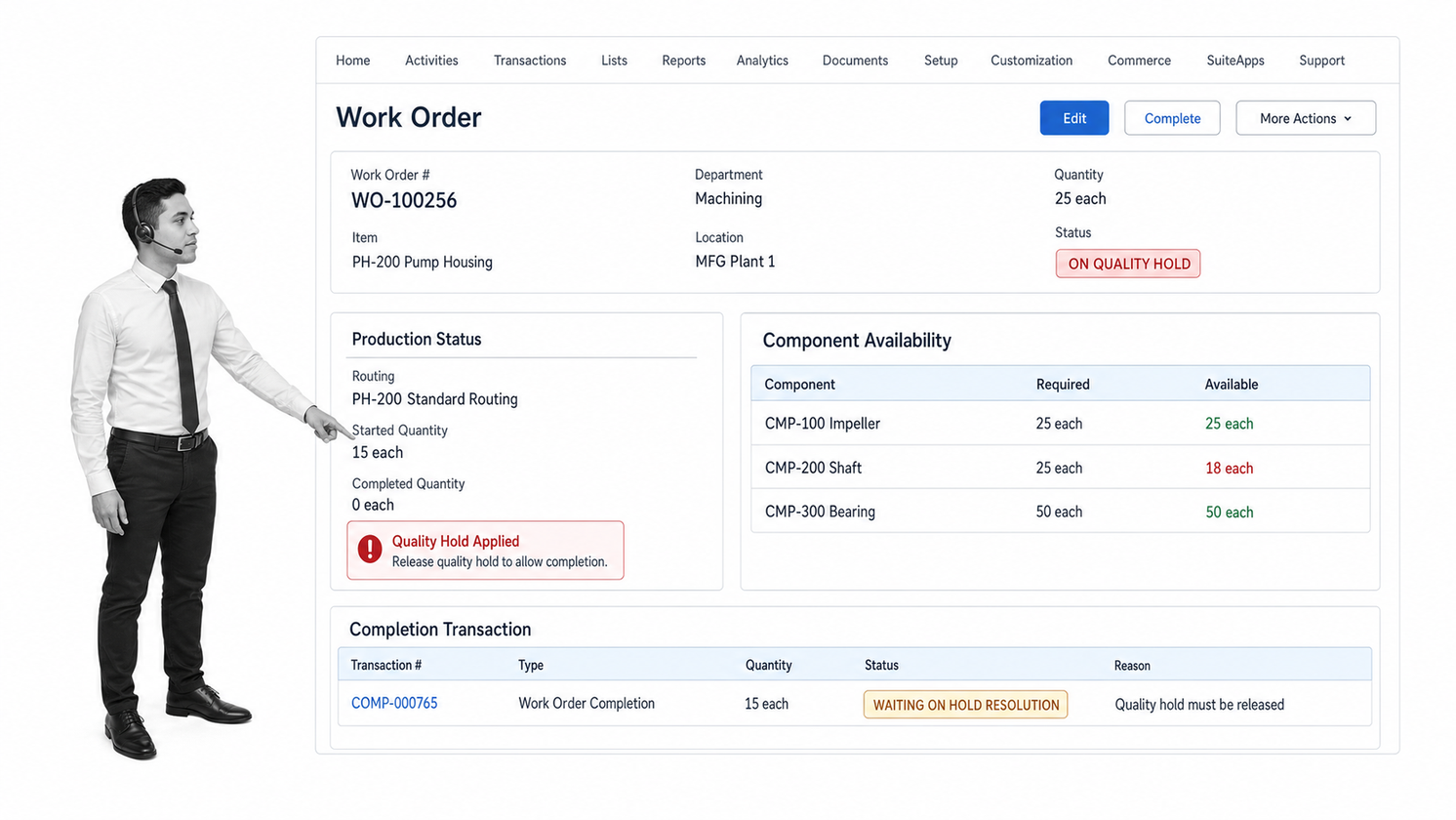
Oracle NetSuite connects production with a broader enterprise record. Its supply chain execution product includes work order management, quality management, production data capture, and connections across inventory, procurement, and financial information. It fits organizations that need production activity reflected in an integrated ERP environment.
ERP implementation is a larger operating-model decision than adding a workflow layer. If NetSuite or another ERP already owns orders, materials, and financial transactions, keep it as the source of truth. Use workflow orchestration around the human approvals, exceptions, evidence, and cross-system handoffs that the ERP does not make easy for operators.
How should you evaluate production workflow software?
Evaluate production workflow software against the control your process requires. A polished board is not enough. The system must help the team execute the right path and make failures visible while there is still time to act.
Start with the production constraint
Name the most expensive or risky failure mode. It may be a late approval, missing material, unclear work instruction, uncontrolled revision, incomplete quality check, or poor resource allocation. That constraint determines the software layer and the pilot process. If you cannot name the failure, the buying process will drift toward feature comparison instead of operational fit.
Test control and exception handling
A production process rarely follows one perfect path. Product variants, failed inspections, unavailable materials, urgent orders, customer revisions, and equipment issues create branches. Test whether the system can route those conditions without asking operators to improvise. In Process Street, for example, conditional logic can show or hide tasks and fields based on data or task state.
Require proof at the point of work
Evidence should be captured while the work happens. Depending on the process, that may mean measurements, photos, files, timestamps, comments, signatures, review status, or an approval decision. Proof collected later is slower and less reliable because the team must reconstruct events from several systems.
Quality systems also need a disciplined improvement loop. The ISO overview of quality management requirements emphasizes establishing, maintaining, evaluating, and continually improving the quality management system. Software should make that loop easier by keeping procedure, execution, evidence, and outcomes connected.
Check safety and access boundaries
Workflow software can coordinate safety-critical work, but it does not replace trained people, validated procedures, or physical controls. The OSHA guidance on controlling hazardous energy is a useful reminder that software steps must support the actual safety program. Evaluate permissions, stop points, escalation, offline constraints, and what happens when the system is unavailable.
Evaluate ownership and change management
The process owner should be able to understand and improve the workflow without waiting for a large implementation project. Ask who can edit the process, how changes are reviewed, how active work is affected, and how users know they are following the approved version. Ease of change matters, but uncontrolled change creates a different risk.
Plan the system boundaries
Write down the source of truth for every critical object: order, customer, part, asset, specification, procedure, approval, and completion record. Then define which system creates it, which systems may read it, and which system may update it. This prevents the workflow tool from becoming an accidental duplicate database.
How do you map a production workflow before implementation?
Map the production workflow before configuring software. The map does not need to be a perfect process diagram. It needs enough detail to expose ownership, decisions, evidence, and system boundaries.
- Define the output and completion condition. State exactly what must be true before the production run is complete.
- Identify the trigger and required inputs. Record what starts the work and which data, materials, files, or approvals must exist.
- List the major stages. Keep the first pass at the level of intake, preparation, execution, quality review, approval, release, and closeout.
- Assign one accountable owner to each action. A team may contribute, but the workflow should make responsibility unambiguous.
- Mark decisions and exception paths. Include rejected work, failed checks, shortages, revision requests, and urgent changes.
- Define evidence requirements. Decide which fields, files, measurements, photos, or signatures must be captured before completion.
- Name system boundaries. Record where each important object lives and what the workflow may read or update.
- Choose pilot measures. Track cycle time, waiting time, rework, missed steps, exceptions, and completion quality.
Walk the map with the people who do the work. Managers often describe the intended process, while operators can show where the real process branches or stalls. Resolve those differences before automation. Automating an inaccurate map makes the problem faster and harder to see.
The map also creates a clean product evaluation script. Give each vendor the same process, same exception, same approval, and same evidence requirement. Ask them to demonstrate the run from intake to completion. A controlled scenario exposes fit more reliably than a feature checklist.
How can Process Street run controlled production workflows?
Process Street can act as the execution layer around production work. A workflow defines the approved sequence. Each production event creates a run with owners, due dates, instructions, form fields, approvals, and connected actions. Operators see the work that applies to the current case, while managers can track progress and exceptions.
Conditional paths can adapt the workflow to product type, inspection result, risk level, or request data. Stop points can prevent downstream tasks from continuing until required work is complete. Approval tasks can route sign-off to the right reviewer and hold the process until a decision is recorded.
The platform is most useful when production depends on repeatable human work and cross-system coordination. It can sit around an ERP, MES, media platform, document repository, or CRM rather than displacing it. The workflow carries the procedure and the execution record, while integrations exchange the data required by each source system.
This creates a practical control surface for production readiness, quality checks, line clearance, change requests, maintenance coordination, supplier onboarding, content approvals, release management, and post-production delivery. The common pattern is the same: assign the work, enforce the route, collect evidence, resolve exceptions, and prove completion.
Explore Process Street or review Process Street pricing when repeatable execution is the layer your production system is missing.
What does a production workflow look like in practice?
Consider a production readiness workflow for a new work order. The ERP creates the order and remains the source of truth for the item, quantity, and material record. That event starts a workflow run for the production coordinator.
- The coordinator verifies that the approved specification and work instruction are attached.
- The system routes the run based on product family, risk level, and required equipment.
- Planning confirms material availability and capacity in the planning or ERP system.
- Quality reviews the inspection plan and records any additional sampling requirement.
- Maintenance confirms equipment readiness when the selected route requires it.
- An approval gate holds release until all required checks and evidence are complete.
- The workflow updates the production status and assigns the first execution task.
- Exceptions follow a defined disposition path instead of returning to an untracked message thread.
This example does not ask the workflow tool to calculate material requirements or control a machine. It coordinates the human decisions and proof around those systems. The same design works in creative production: replace the work order with a content brief, planning with asset preparation, quality with review, and release with final delivery.
The important design choice is the approval boundary. Put it immediately before the action that creates risk, cost, or external commitment. Require the evidence needed for that decision. If the approver must search other systems or ask the operator for context, the workflow is not yet complete.
How do you implement production workflow software?
Implementation should begin with one meaningful process, not an organization-wide rollout. Choose a workflow that repeats often enough to produce evidence, crosses at least two roles, contains a real decision or exception, and has an outcome the team can measure.
Build the smallest complete pilot
Include the full path from trigger to closeout, but limit the pilot to the controls that matter. Configure assignments, required fields, one or two decision branches, a real approval, and the most important system connection. Avoid reproducing every edge case before users have run the normal path.
Run real work and observe it
Have operators execute real production cases while the process owner watches where they hesitate, leave the workflow, duplicate data, or request an exception. Those moments reveal missing instructions, poor field design, unclear ownership, and integration gaps. Fix the workflow, then run it again.
Measure flow and control
Track elapsed time, waiting time between stages, rework, overdue tasks, exception frequency, approval delay, and evidence completeness. The goal is not simply more completed tasks. The goal is faster, more reliable production with a record that the team can trust.
Expand by reusable pattern
Once the pilot is stable, identify the patterns that can be reused: intake, risk routing, quality review, change approval, release, and closeout. Standardize those patterns while allowing the data and instructions to vary by product or team. This creates consistency without forcing every production process into one rigid template.
Review the workflow on a defined cadence and after meaningful exceptions. Update instructions, decisions, and integrations when the operating environment changes. Production workflow software delivers lasting value when it becomes the place where the process is run and improved, not a one-time automation project.
Production workflow software FAQs
What is production workflow software?
Production workflow software defines and runs the sequence of work required to create an output. It coordinates tasks, owners, rules, approvals, evidence, exceptions, and system updates so the process can be repeated and improved.
What is the difference between production workflow software and production planning software?
Production planning software balances demand, materials, capacity, and schedules. Production workflow software coordinates the people, instructions, decisions, approvals, and evidence required to execute the work. Many manufacturers use both layers.
Can production workflow software integrate with an ERP or MES?
Yes. A workflow platform can coordinate human tasks and approvals while an ERP owns orders, materials, inventory, and financial records, and an MES owns machine or shop-floor events. Define the source of truth and permitted updates for each system.
Which features matter most in production workflow software?
Look for clear process design, assignments, structured data capture, conditional routing, approvals, stop points, integrations, permissions, completion history, and reporting. The priority depends on the failure your process needs to prevent.
How do you choose production workflow software?
Map one real workflow, identify its main constraint, and choose the software layer that owns that constraint. Test every shortlisted tool with the same trigger, exception, approval, evidence requirement, and system handoff.
How long should a production workflow software pilot take?
The pilot should be long enough to run several real cases, including at least one exception, but narrow enough that the team can improve it quickly. Define success by flow, control, evidence quality, and operator adoption rather than by configuration volume.