Turn every policy into automated workflows with built-in enforcement and audit-ready proof.



SaaS Operations Management Software
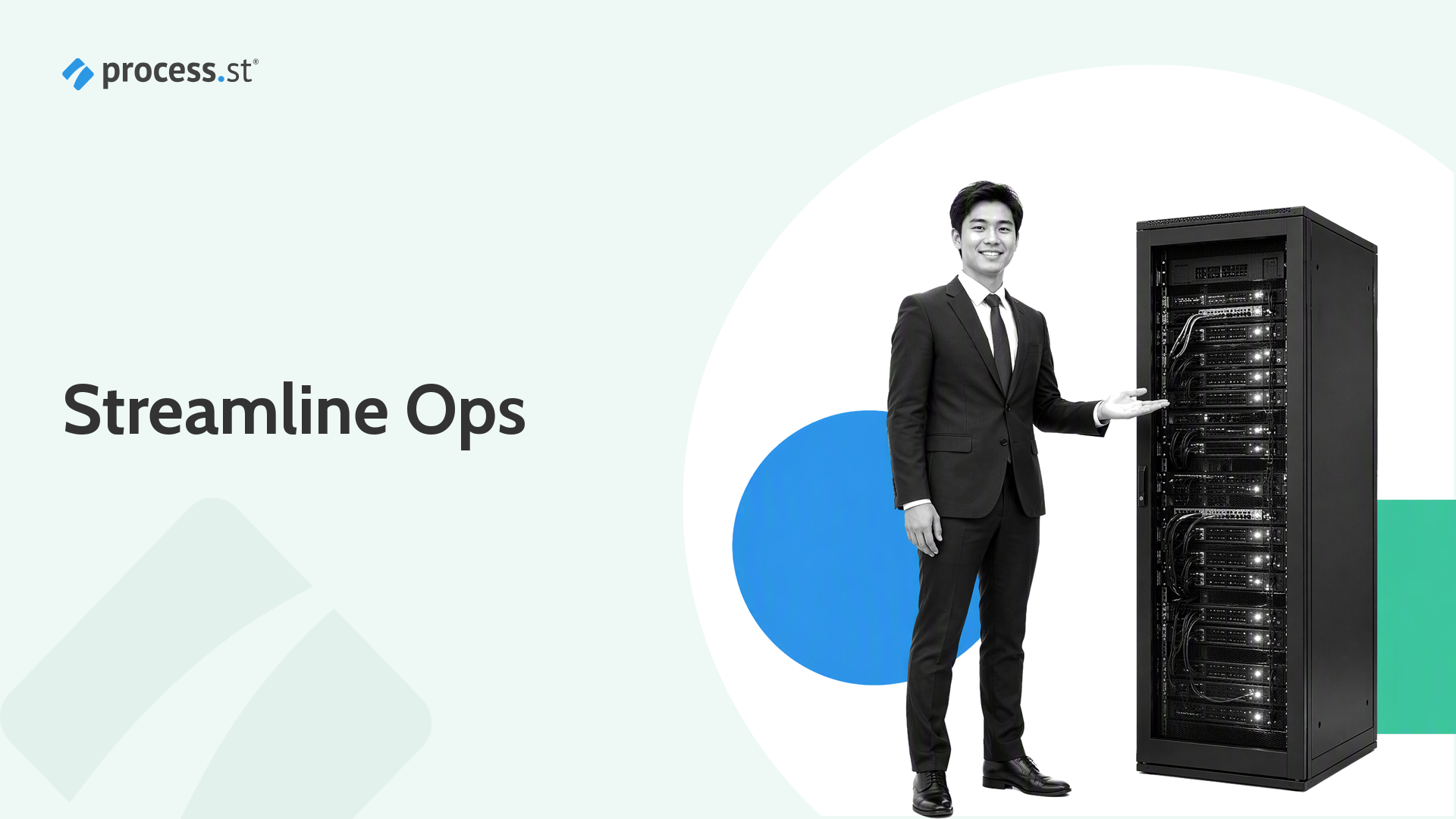
SaaS operations management software is the control layer for the cloud applications a company buys, grants, uses, renews, and retires. It gives IT, procurement, security, finance, and operations one governed way to track applications, ownership, access, contracts, risk, and lifecycle work.
The category matters because SaaS grows through hundreds of small decisions. A team starts a trial, a manager buys seats, a new hire needs access, a vendor changes terms, or a contract reaches renewal. Without a shared operating process, the application may exist in finance records, identity systems, browser activity, and team knowledge without any one owner seeing the full picture.
This guide explains the operating model behind SaaS management, the software capabilities that support it, the application lifecycle, a practical implementation program, and how to evaluate a platform against real work rather than a feature checklist.
In this article, we are going to cover:
- What is SaaS operations management software?
- Why SaaS operations needs dedicated management
- Core capabilities of SaaS operations management software
- The SaaS application lifecycle
- How to build a SaaS operations management program
- How to evaluate SaaS operations software
- Process Street for SaaS operations
- A practical 30-day implementation plan
- FAQs
What is SaaS operations management software?
A SaaS operations platform creates a reliable inventory of cloud applications and connects that inventory to the workflows required to govern them. The inventory answers what exists. The operating layer answers who owns each app, why it is used, who can access it, what it costs, when it renews, what risks it creates, and what must happen next.
SaaS operations is a cross-functional discipline
No single department owns every decision. IT manages identity and technical fit. Security evaluates data and configuration risk. Procurement manages purchasing and terms. Finance tracks commitments and allocation. Legal reviews contracts. Business owners decide whether the application is useful. SaaS operations connects those roles through one lifecycle.
The software is more than a discovery tool
Discovery is important, but a list of applications is not an operating model. A useful platform turns discoveries into review, assignment, approval, renewal, remediation, and retirement work. It also preserves the evidence that the work happened.
How the category differs from adjacent systems
A traditional asset management process can include installed software, hardware, and other assets. Identity platforms focus on authentication and account provisioning. IT service management handles tickets and service delivery. Spend tools analyze purchasing. SaaS operations management connects these signals to the business lifecycle of each cloud application.
That lifecycle also overlaps with vendor management software because every application is a vendor relationship. The difference is that SaaS governance reaches inside the relationship to manage seats, users, permissions, usage, integrations, data exposure, renewals, and retirement tasks.
Why SaaS operations needs dedicated management
SaaS adoption is intentionally easy. That ease creates speed, but it also distributes purchasing and access decisions across the organization. Dedicated management gives the company a way to keep that speed while adding ownership, security, financial control, and operational proof.
Application sprawl fragments ownership
Different teams can buy tools for similar needs, while no one maintains the complete inventory. One application may have an executive sponsor, a billing owner, a technical administrator, and dozens of users, but none of those people owns the whole lifecycle. A governed inventory assigns those roles explicitly.
Access changes faster than contracts
People join, change roles, work with contractors, and leave. The FTC access control guidance recommends limiting access to people who need it for their work and restricting administrative privileges. SaaS operations turns that principle into request, approval, review, and revocation routines across applications.
Spend control depends on usage and timing
The FinOps Foundation Licensing and SaaS guidance treats licensing and SaaS as a cross-functional capability that brings together finance, procurement, legal, engineering, information security, and software asset management. Cost control requires more than invoice review. Teams need ownership, use rights, utilization signals, renewal dates, and a process for changing commitments.
Security depends on configuration and evidence
The CISA Secure Cloud Business Applications guidance emphasizes secure configuration baselines and visibility for cloud business applications. A SaaS program therefore needs to know which configurations matter, who reviews them, what evidence is collected, and how exceptions are remediated.
This is why the category sits naturally beside business operations management software and operations management software. It is not only an IT inventory. It is a recurring operating system for decisions that cut across the company.
Core capabilities of SaaS operations management software
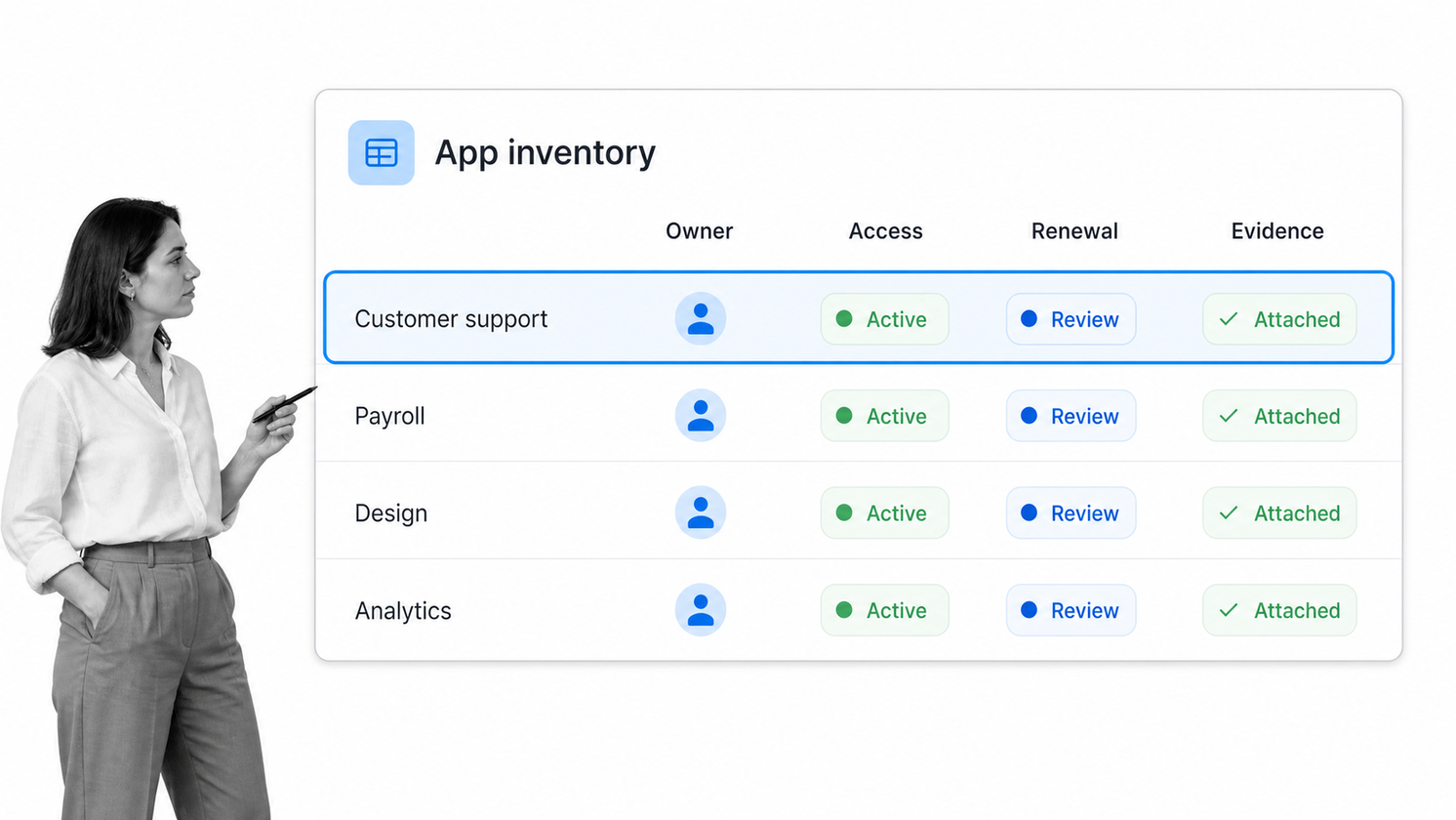
Core capabilities should map directly to the decisions and controls in the SaaS lifecycle. A platform is valuable when it reduces unknown applications, unclear ownership, excessive access, missed renewals, duplicated spending, weak evidence, and manual coordination.
Application discovery and inventory
The inventory should combine approved applications, discovered use, contract records, identity data, and owner confirmation. Each application needs a canonical record with category, purpose, business owner, technical owner, data sensitivity, access method, contract state, and lifecycle status.
Request and approval workflows
New applications and access changes should start through a structured request. A request can capture business need, data involved, expected users, existing alternatives, budget owner, and desired timing. A Approvals can then route authorization to the right reviewers before purchase or access is granted.
Identity and access governance
Access governance includes role-based requests, least-privilege review, privileged account control, periodic certification, and prompt revocation. A reusable user access review checklist gives reviewers a consistent way to confirm whether each account still matches a business need.
Spend, contract, and renewal management
The system should connect committed cost, billing model, seat allocation, usage, renewal terms, notice periods, and owners. Renewal workflows need enough lead time to review usage, alternatives, security posture, service performance, and negotiation strategy before a deadline forces a default decision.
Security, compliance, and evidence
A platform should support application risk classification, security review, exception handling, evidence collection, and periodic control checks. The NIST Cybersecurity Framework 2.0 gives organizations a risk-management structure that can be translated into application-level governance outcomes rather than treated as a one-time checklist.
Reporting and process monitoring
Useful reporting shows missing owners, overdue reviews, inactive access, upcoming renewals, exceptions, stalled approvals, and incomplete retirement work. Pairing the inventory with process monitoring helps leaders see whether controls are executed, not merely documented.
The SaaS application lifecycle
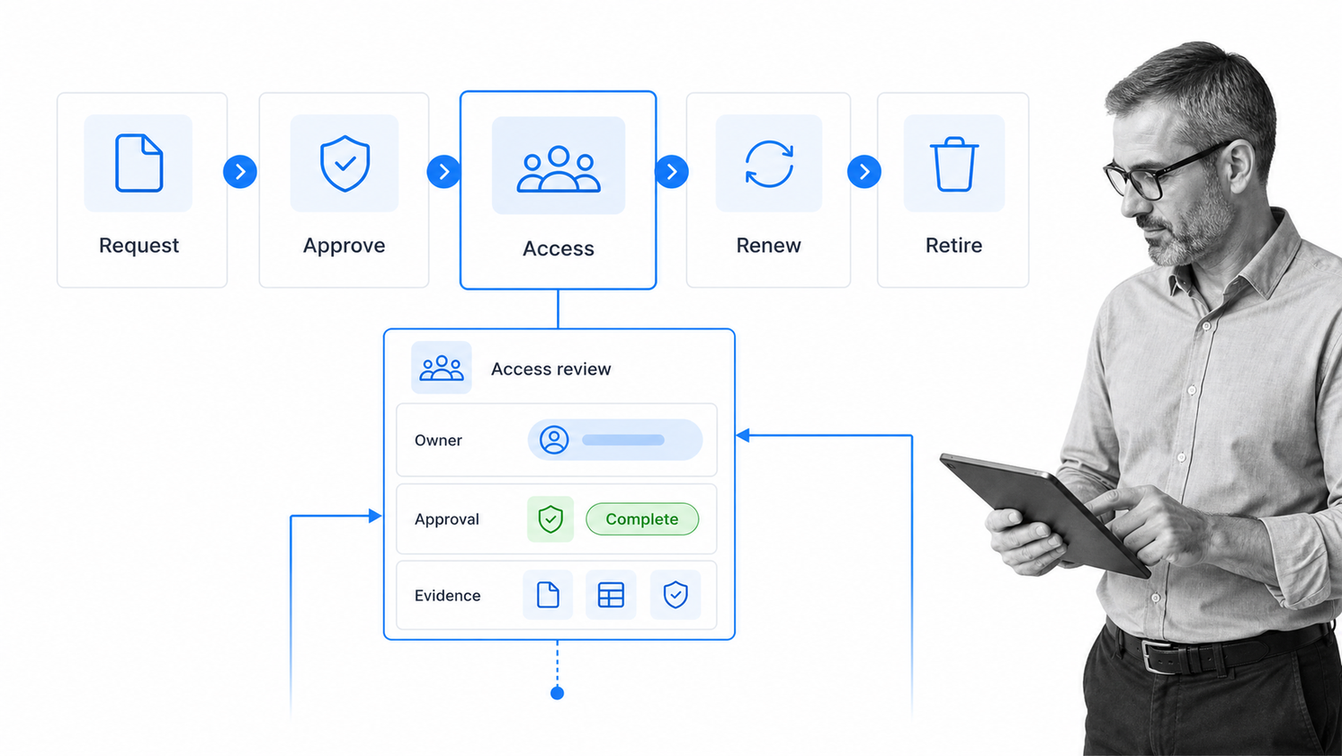
The SaaS application lifecycle is the repeatable path from a business need to a controlled exit. Treating every stage as managed work prevents inventory drift and makes ownership visible when people, budgets, systems, or risks change.
Request and rationalize
The requester explains the need, expected users, data involved, budget, timeline, and success criteria. Reviewers check whether an approved application already solves the problem. This step reduces duplicate categories without blocking legitimate experimentation.
Assess and approve
Security, legal, procurement, finance, IT, and the business owner review the request in proportion to risk. The CISA Software Acquisition Guide provides acquisition guidance for enterprise software consumers, reinforcing the need to evaluate assurance, security, terms, and operational fit before commitment.
Provision and onboard
After approval, the organization assigns administrators, configures identity, records the application, grants least-privilege access, documents support paths, and trains users. The completed onboarding record becomes the baseline for later reviews.
Operate and review
During active use, owners monitor adoption, service issues, privileged access, integrations, data handling, security configuration, contract changes, and business value. Exceptions become assigned work with deadlines and evidence rather than informal notes.
Renew, change, or consolidate
A structured renewal reviews usage, cost, owner feedback, overlapping applications, risk, support quality, and future need. A vendor management plan template can keep contract, risk, performance, and review responsibilities connected throughout the vendor relationship.
Retire and prove closure
Retirement removes access, exports or disposes of data, disconnects integrations, stops billing, closes contracts, updates records, and confirms ownership of retained information. An employee offboarding and access revocation workflow helps coordinate access revocation with the wider employee or contractor exit process.
How to build a SaaS operations management program
A SaaS operations management program is the combination of policy, inventory, roles, workflows, systems, and review rhythms that govern the application lifecycle. Start narrow enough to produce a trustworthy operating loop, then expand coverage.
Define the policy and decision rights
Clarify which applications must be registered, who can approve purchases, what risk triggers extra review, who owns renewals, how access is certified, and what evidence must be retained. Decision rights prevent a central team from becoming an undefined bottleneck.
Create the minimum viable inventory
Combine finance records, identity data, browser or network discovery, contract repositories, expense reports, and team interviews. Mark every record with a confidence state. An incomplete inventory that shows uncertainty is more useful than a polished list that hides gaps.
Assign lifecycle owners
Each application needs a business owner who is accountable for value and a technical or administrative owner who can manage access and configuration. Contracts, renewals, security reviews, and retirement work also need named owners. Avoid generic team mailboxes as the only accountability mechanism.
Build workflows around the riskiest transitions
Start with application request, privileged access, renewal, and retirement. These transitions create clear decisions and evidence. Use workflow management system discipline to define steps, owners, decision points, required fields, exceptions, and completion proof.
Integrate stable sources and actions
Connect authoritative data after the workflow is understood. Finance can supply spend, identity systems can supply accounts, contract systems can supply terms, and application administrators can supply usage or configuration evidence. Integrations should remove transcription without hiding errors or exceptions.
Review outcomes and improve controls
Track missing owners, unreviewed access, overdue renewals, inactive subscriptions, exception age, and retirement completeness. A recurring audit trail review checklist provides a useful pattern for reviewing logs, authorization controls, data integrity, and remediation evidence.
How to evaluate SaaS operations software
Evaluate SaaS operations platforms with real lifecycle work. Product demonstrations can make inventory and dashboards look complete. A better test is whether the platform helps your team make a controlled decision, coordinate the work, and preserve proof across departments.
Start with scope and source coverage
List the data sources that matter: finance, identity, contracts, browser or network discovery, security tools, HR, procurement, and key applications. Confirm which sources are authoritative, how often they refresh, and what happens when records conflict.
Test the operating workflow
Run an application request, an access review, a renewal, and a retirement. Check whether the product supports role-based assignment, conditional review, deadlines, approvals, evidence, exceptions, and escalation. The workflow should be adaptable by the people who own the process.
Evaluate governance and auditability
Ask how roles and permissions work, how changes are recorded, how evidence is retained, how exceptions are approved, and how leaders know a control was completed. A dashboard is not proof if the underlying review happened through email and memory.
Check rationalization and renewal support
The platform should make overlapping categories, duplicate purchases, inactive access, upcoming notice periods, and owner decisions visible. Connect that review to broader business continuity software planning so critical SaaS exits do not create an operational gap.
Measure implementation and ownership cost
Include setup, data cleanup, integration maintenance, workflow administration, training, review effort, and change management. A product with broad discovery but weak workflow may shift the coordination cost back to spreadsheets. A highly configurable platform may also fail if no one can own it.
Use a scored end-to-end pilot
Choose several applications with different owners and risk levels. Score inventory completeness, request time, review quality, owner clarity, access accuracy, renewal readiness, retirement completeness, and evidence. The pilot should expose both the normal path and exceptions.
Process Street for SaaS operations
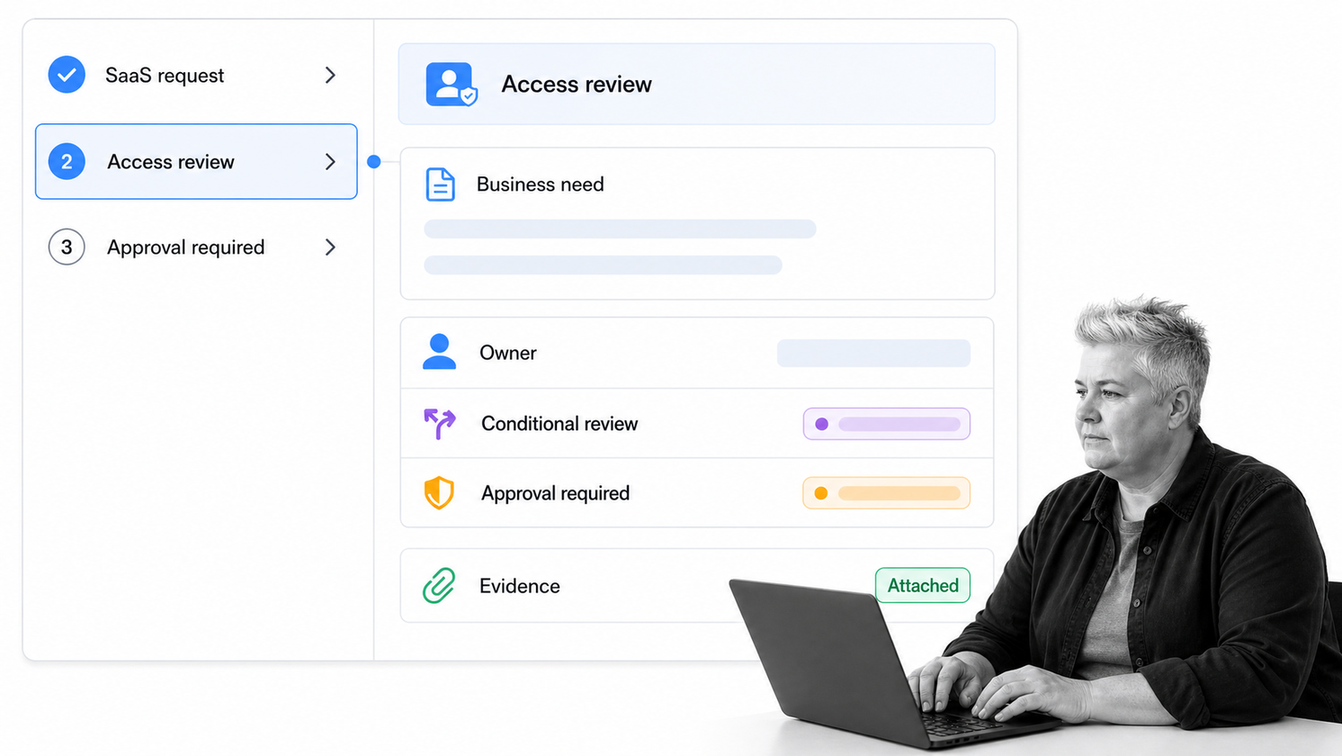
Process Street is becoming an Agentic Process Automation platform. It can serve as the execution layer for SaaS operations by turning application policy into workflows for requests, risk review, access, renewals, exceptions, and retirement.
Run the policy inside the workflow
A request can collect the application, business need, data sensitivity, user group, owner, budget, and timing. The workflow then assigns review tasks, branches based on risk, blocks completion for required approval, and captures evidence at each decision.
Coordinate people and systems
SaaS operations crosses IT, procurement, security, finance, legal, and business teams. Workflows give each function the information and task it needs while keeping one lifecycle record. Automations and agents can move stable data or complete repetitive actions across connected systems.
Handle risk with conditional review
Conditional Logic can change the workflow path based on information in the request or the completion state of another task. Higher-risk applications can receive additional security, legal, or data review without forcing every low-risk request through the same path.
Preserve approval and execution evidence
The workflow run records the request, assignments, inputs, decisions, attachments, and completion state. That gives the application record operational context: not just that an app exists, but why it was approved, who owns it, what was reviewed, and which work remains open.
Process Street also connects SaaS governance to wider automated operations software. Application controls can become part of onboarding, procurement, incident response, compliance, and business continuity instead of living in a separate operations silo.
A practical 30-day implementation plan
A focused 30-day implementation can establish one reliable SaaS governance loop. The goal is not to clean every record or integrate every system. It is to create a trustworthy inventory baseline and prove that one lifecycle workflow can run end to end.
Establish scope and collect sources
Define the application scope, decision rights, and owners. Gather finance, identity, contract, procurement, and team records. Use the vendor management templates library to shape vendor ownership and review responsibilities without starting from a blank page.
Normalize the inventory
Create one record per application, merge duplicates, identify unknowns, assign confidence states, and nominate owners. Separate approved, experimental, duplicate, retiring, and unknown applications so the program can prioritize work without pretending every record is complete.
Build and pilot the lifecycle workflow
Implement one request-to-approval workflow and one renewal or retirement workflow. Test with real applications. Watch where reviewers lack context, where assignments stall, where exceptions appear, and which evidence is difficult to collect.
Connect data and set the review cadence
Add the integrations that remove the most manual work, then schedule inventory ownership checks, access reviews, upcoming renewal reviews, exception review, and retirement verification. Publish a small scorecard that shows control execution and unresolved gaps.
The implementation is successful when application decisions no longer depend on private spreadsheets or one person’s memory, owners can see the work they must complete, and leaders can verify that access, renewal, and retirement controls actually ran.
FAQs
What is SaaS operations management software?
This software creates a governed inventory of cloud applications and connects it to workflows for requests, ownership, access, spend, security, renewals, and retirement. It helps IT, procurement, security, finance, and business teams manage the complete application lifecycle.
What does a SaaS operations team manage?
A SaaS operations team manages application inventory, business and technical ownership, purchase requests, access, security review, contracts, usage, spend, renewals, integrations, exceptions, and retirement. The team coordinates decisions across the departments that share responsibility for SaaS.
How is SaaS operations software different from software asset management?
Software asset management often covers installed software, licenses, hardware relationships, and compliance across a broad technology estate. SaaS operations focuses on cloud application discovery and the recurring business workflows for access, ownership, spend, risk, renewal, and retirement. The two disciplines can share data and controls.
What should a SaaS operations platform track?
It should track the application, category, purpose, owners, administrators, users, access method, data sensitivity, risk, contract, billing model, usage, renewal terms, integrations, lifecycle status, open exceptions, and completion evidence. The record should also show which review or action is due next.
How do you implement SaaS operations governance?
Start with scope and policy, build a minimum viable inventory, assign owners, and implement workflows for application requests, privileged access, renewals, and retirement. Pilot the workflows with real applications, connect stable data sources, and review missing owners, overdue controls, exceptions, and closure evidence.
How does Process Street support SaaS operations?
Process Street can run SaaS request, risk review, access, renewal, exception, and retirement workflows with assigned tasks, required fields, conditional paths, approvals, automations, evidence, and activity records. It connects application policy to the work people and systems must complete.