






If you want a quick explanation for why business writing gets distant, pretentious, and strangely hard to read, start with the famous 5 Monkeys and a Ladder story. It is better understood as a workplace parable than a clean laboratory study, but the point still lands: people repeat inherited rules long after the original reason disappears.
That is how many common writing mistakes survive inside companies. Someone writes in a stiff voice because that is how the last report sounded. Someone adds jargon because plain language feels too exposed. Someone calls weak copy “professional” because nobody wants to be the new monkey reaching for the bananas. Avoid those habits unless you like sounding silly.
The Study
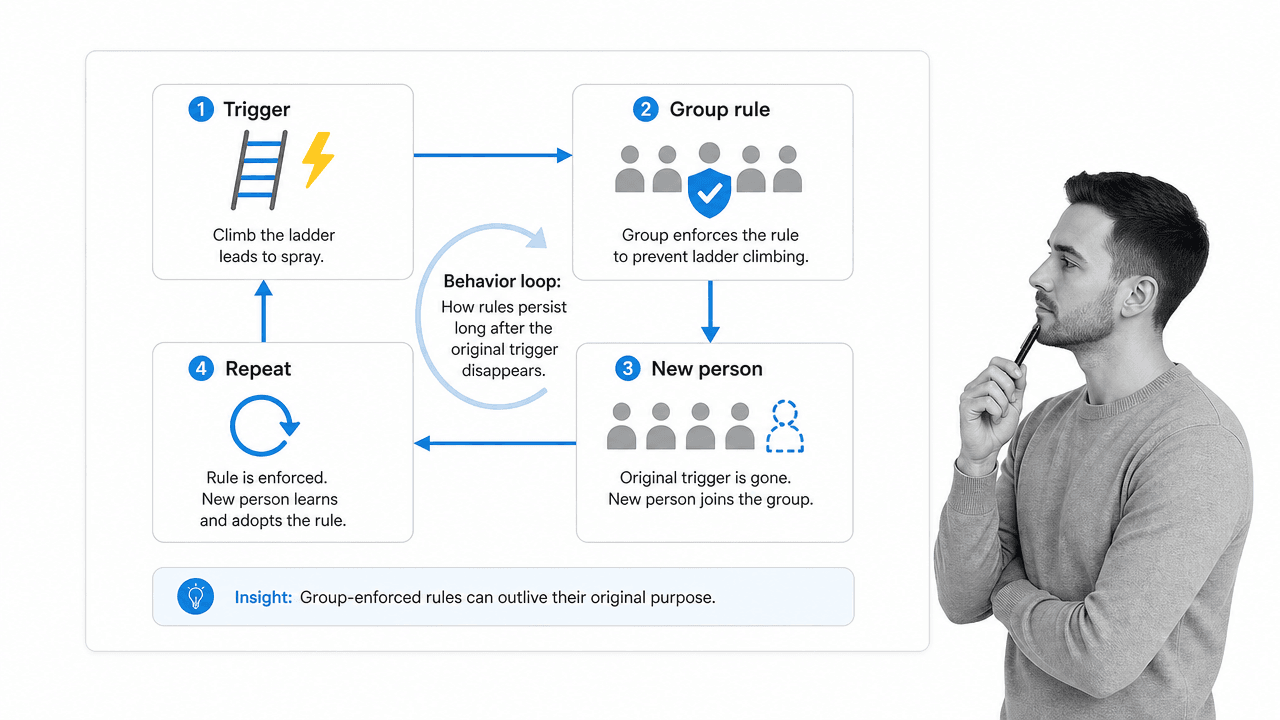
In the story, five monkeys live in a room with a ladder, a bunch of bananas, and a cold-water sprinkler. When one monkey climbs the ladder to reach the bananas, the sprinkler soaks the others. The group learns to stop anyone from climbing.
The monkeys are replaced one by one. Each new monkey tries the ladder, gets pulled down by the group, and learns the rule without ever seeing the sprinkler. Eventually, no original monkey remains, but the rule still holds. Nobody climbs the ladder because “that is how it is done.”
“The most damaging phrase in the language is: ‘It’s always been done that way.’” Grace Hopper
The Way Boring People Write
George Orwell attacked the same habit in Politics and the English Language. Unlike lighter essays such as A Nice Cup of Tea, this one was aimed at politicians, advertisers, and public writers who hid weak thinking under grand language. Orwell said bad writers dress up simple statements and give them an air of scientific impartiality.
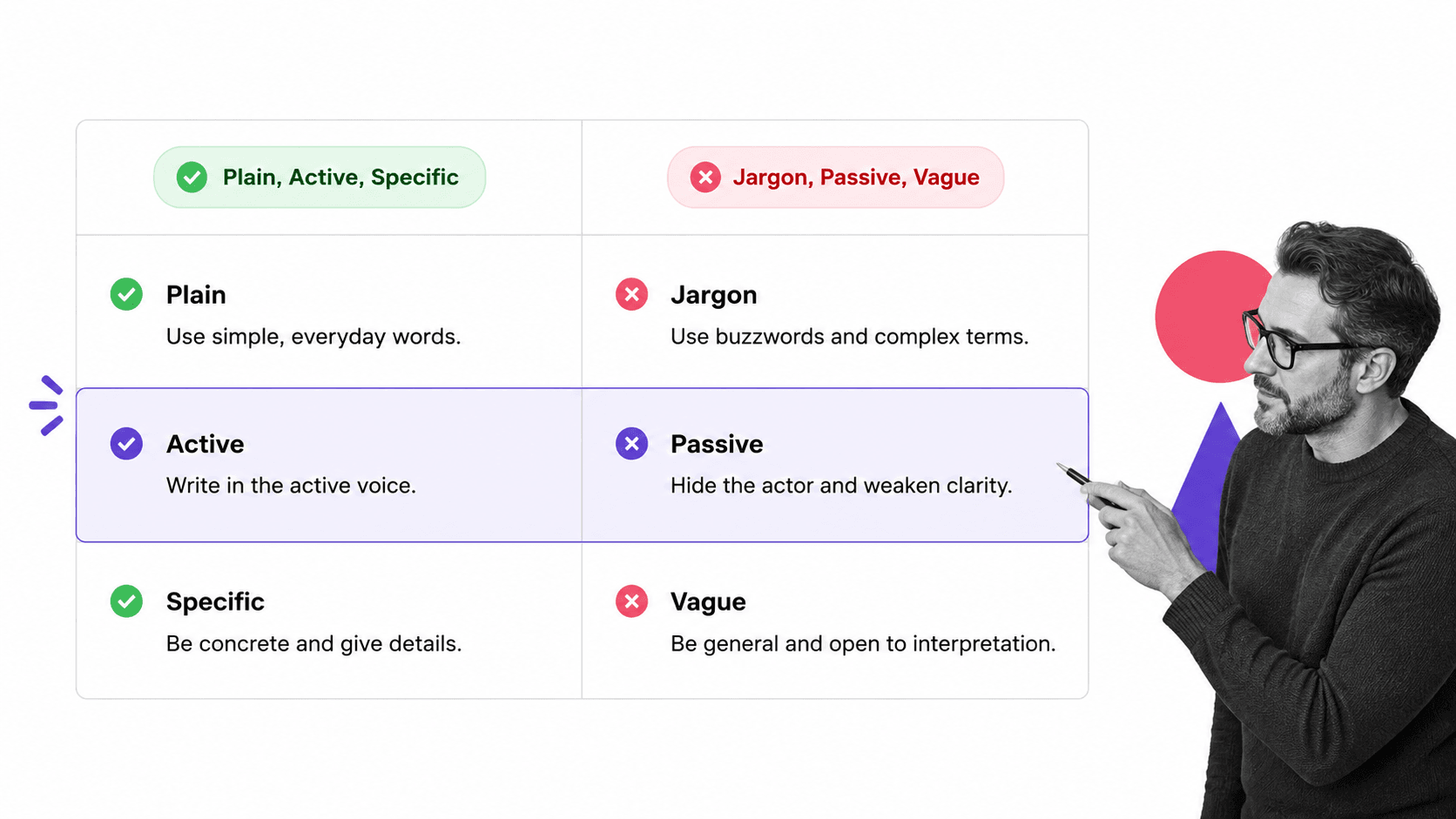
The same problem shows up in business writing and content writing. Teams “leverage robust solutions,” “utilize strategic frameworks,” and “drive alignment across key stakeholders” when they usually mean something much simpler. Everyone would rather you said the thing plainly.
Clear writing is not casual writing. It is writing that makes the claim, names the actor, and gives the reader enough concrete meaning to act.
4 Content Writing Mistakes to Avoid
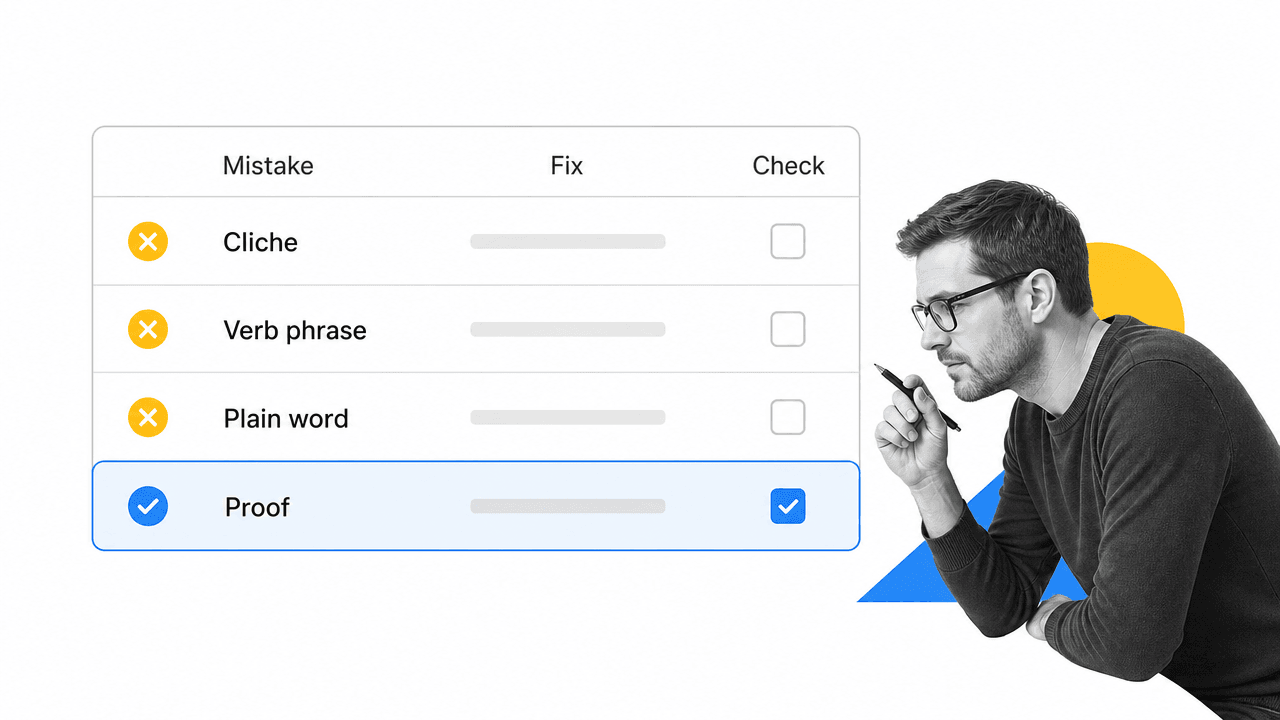
These are the four writing mistakes that make content sound silly, evasive, or empty.
1. Avoid Stale Cliches and Dead Metaphors
If you have heard the phrase a hundred times, your reader has too. Phrases like “best of both worlds,” “move the needle,” and “think outside the box” do not make copy sound sharper. They tell the reader their attention is not required.
Fresh language does not mean clever language. It means specific language. If a metaphor helps the reader see the point faster, keep it. If it only fills space, cut it.
2. Cut Out Verb Phrases
No one is looking for legal loopholes in your content, so do not write like a lawyer. A sentence like this slows the reader down:
“We have initiated the rolling out process of several systems which are designed to be in charge of the formatting of data that is distributed via email.”
You can usually say the same thing in fewer words:
“We are implementing a system to format email data.”
Search your draft for “of,” “that,” and “which,” but do not delete them blindly. Treat them as warning lights. If a sentence needs three clauses to say one simple thing, rewrite it.
3. Avoid Needlessly Complicated Words
Striving to articulate one’s argument with pompous diction is a reliable way to detach oneself from one’s audience.
You did not need that sentence. Your reader usually does not need words like “utilize,” “ascertain,” “plethora,” “myriad,” or “juncture” either. Plain words are not weaker. They are harder to hide behind.
4. Remove Words with Private Meaning
When you make a claim without support, you are using words with private meaning. “Most efficient,” “most talked-about,” “world-class,” and “innovative” can mean almost anything unless you show the proof.
Unsupported claims do not become stronger because they sound impressive. Meaning comes from evidence, examples, and definitions the reader can inspect. Without that support, the claim is debatable at best and meaningless at worst.
How to Catch Content Writing Mistakes
Drafting is where the mess happens. Editing is where the work becomes readable. Your first draft does not need to be clean; it needs to exist. The second pass is where you catch the common business writing mistakes that make the piece sound inflated or vague.
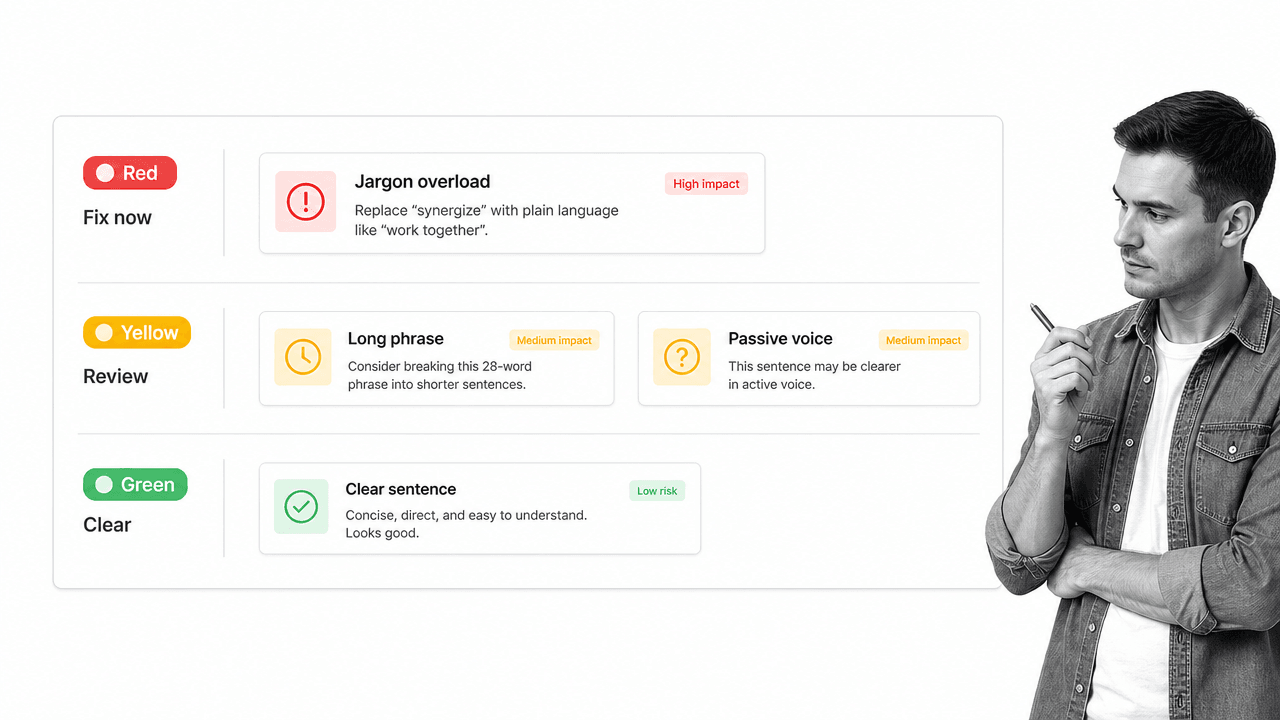
The traffic light method is still a useful way to proofread because it forces judgment instead of vague rereading.
Read through the draft and mark each sentence:
- Red means the sentence needs to be removed or rewritten.
- Yellow means the sentence works, but needs tightening.
- Green means the sentence is clear enough to keep.
AI tools can help spot repeated phrases, passive constructions, or unclear claims, but they cannot decide what your reader needs to understand. Use them as a second set of eyes, then make the editorial call yourself.
From Content to Processes

Good writers are rarely good at only one kind of writing. Specialized copywriters, content writers, technical writers, and even sci-fi novelists all depend on the same core skill: making instructions clear enough that someone else can act on them.
That is why clear writing matters inside a business. A content workflow, an approval checklist, or a compliance procedure fails when the language is vague. A strong process checklist is written so the next person knows exactly what to do, what proof to collect, and when the work is complete.
Process Street is the Compliance Operations Platform for that kind of work. Docs keeps SOPs governed and current. Ops turns those procedures into workflow runs with approvals, assignments, and audit trails. Cora monitors execution, flags risk, and helps teams improve the process instead of repeating the same unclear steps.
Daniel Boorman, one of the people behind modern aviation checklists, captured the same principle in The Checklist Manifesto:
“Good checklists are precise. They are efficient, to the point and easy to use even in the most difficult situations. They do not try to spell out everything. A checklist cannot fly a plane. Instead they provide reminders of only the most critical and important steps, the ones that even the highly skilled professionals could miss. Good checklists are, above all, practical.”
Clear writing and clear processes have the same job: remove ambiguity before it turns into mistakes. The next time you are tempted to call your business “an end-to-end solution for the planning, implementation, and execution of robust, scalable marketing strategies and 100 percent proven SEO tactics,” think again.
If the sentence sounds silly when you read it out loud, your reader already noticed.