


Turn every policy into automated workflows with built-in enforcement and audit-ready proof.



Wealth Management Planner
A wealth management planner is a structured system for turning a household’s financial goals, constraints, risks, and decisions into coordinated advisor work. It connects discovery, analysis, recommendations, implementation, evidence, and recurring review.
For a wealth management firm, the planner is more than a client-facing projection. It is the operating record behind the advice: what changed, what was reviewed, who owns the next action, which approval is required, and when the plan must be revisited.
This guide shows how to design that planning system as a repeatable workflow for advisors, operations teams, and compliance reviewers. It focuses on execution and governance, not a directory of wealth management products.
In this article, we are going to cover:
- What a wealth management planner is
- Why wealth management planning needs a workflow
- What a wealth management planner should contain
- How to build a wealth management planning workflow
- How to govern wealth plan reviews and changes
- How Process Street supports wealth management planning
- How to evaluate a wealth management planner
- FAQs
What a wealth management planner is
A wealth management planner organizes the full client plan and the work required to keep it current. It starts with the client’s objectives and circumstances, then connects those inputs to recommendations, assigned actions, evidence, approvals, and review dates.
A client plan and an operating plan
The client plan explains the destination: retirement income, liquidity, education funding, charitable goals, business succession, tax coordination, estate intentions, risk protection, or another priority. The operating plan explains how the firm will move the client toward that destination.
That second layer is where many firms lose control. A recommendation may be sound, but the account opening, beneficiary update, insurance follow-up, tax document request, or outside-professional handoff can still stall. A planner needs action ownership, not only analysis.
Planning is broader than portfolio management
Portfolio management focuses on investment decisions and ongoing oversight. Wealth planning places those decisions inside the client’s wider financial life. Cash flow, taxes, insurance, estate documents, concentrated positions, business interests, family obligations, and major life events can all change the recommendation path.
The SEC investment adviser fiduciary interpretation explains that an investment adviser’s fiduciary duty includes care and loyalty across the adviser-client relationship. A planning workflow helps the firm connect that broad responsibility to repeatable execution and review.
The planner is not a static document
A plan becomes stale as soon as assumptions change and nobody owns the update. The useful unit is not a finished PDF. It is a living planning record with current inputs, clear decisions, open actions, evidence, and a defined next review trigger.
Why wealth management planning needs a workflow
Wealth management planning crosses roles and systems. Advisors gather context. Planning specialists model scenarios. Operations teams collect documents and open accounts. Compliance reviewers inspect higher-risk decisions. Clients, accountants, attorneys, custodians, and insurance professionals may all contribute.
Handoffs create planning risk
A handoff can fail even when everyone is competent. The advisor assumes operations has the signed document. Operations assumes the advisor confirmed the client objective. The reviewer sees the recommendation but not the evidence behind a changed assumption. Email and spreadsheets make these gaps hard to detect.
Structured wealth management workflows keep the next task, evidence requirement, and owner visible. The workflow becomes the shared record instead of relying on private notes or memory.
The same client needs different paths
Planning cannot be one rigid checklist. A simple annual review may need a light route. A business sale, inheritance, trust change, concentrated holding, retirement transition, or material risk-profile change may require additional specialists and approvals.
A controlled planning system uses conditional logic to branch from the standard path when the facts require more work. The firm keeps one common standard while adapting the route to the client.
A complete record protects service quality
Recordkeeping obligations vary by firm and activity, but FINRA books and records guidance shows why firms need accessible records and accountability around changes. The planner should preserve the evidence and review state behind decisions, not force the team to reconstruct them later.
This is also a client experience issue. A firm that can see the current plan, open actions, responsible owner, and last decision can respond quickly without asking the client to repeat information.
What a wealth management planner should contain
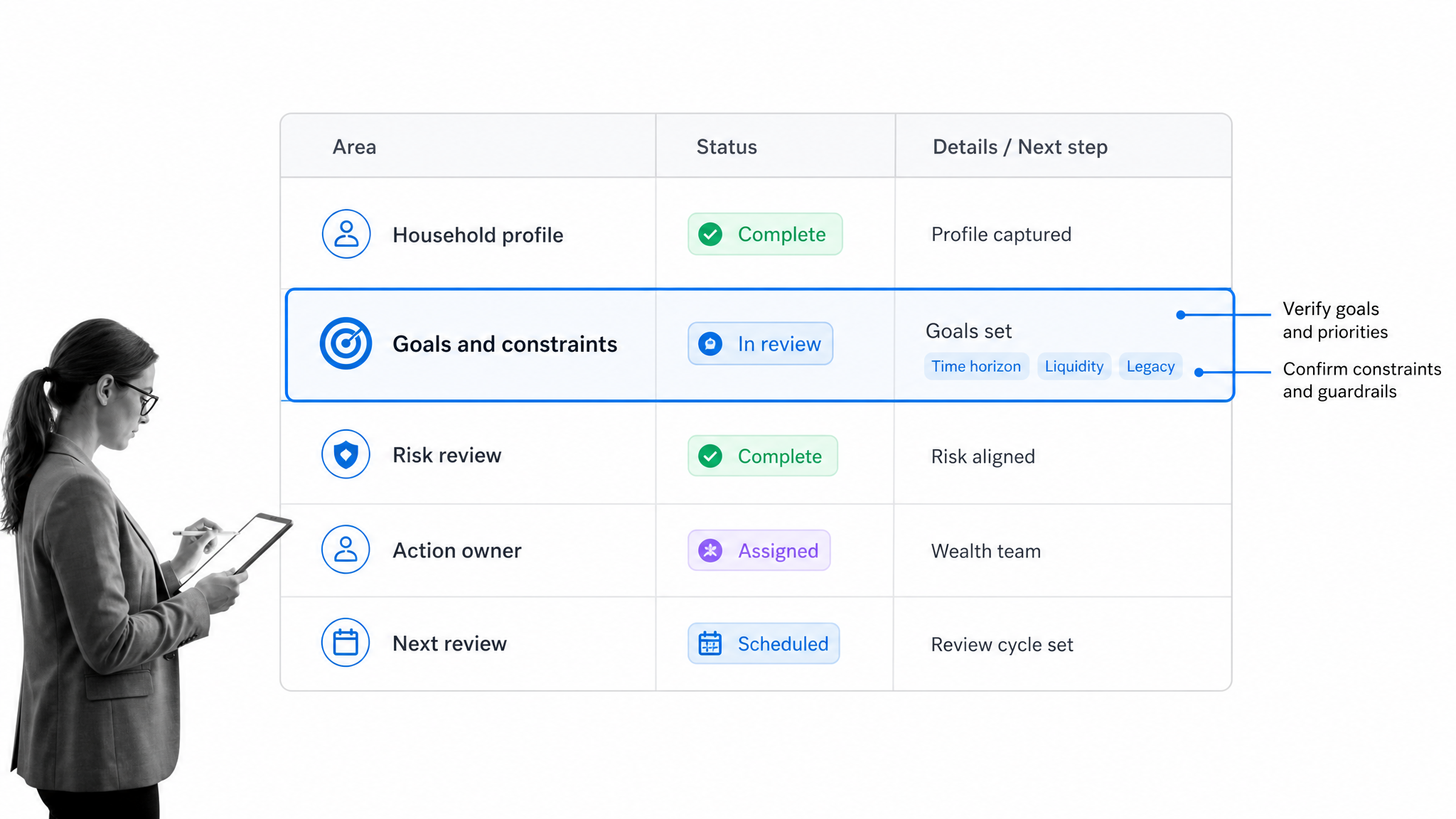
A practical wealth management planner needs enough structure to guide action without turning every client into a data-entry project. The sections below form a durable core.
Household profile and planning scope
Start with the people, entities, accounts, outside professionals, and planning relationships in scope. Record the agreed service boundary so the team knows which issues the firm owns, which it coordinates, and which remain with another professional.
Goals, priorities, and tradeoffs
Goals need an owner, priority, time horizon, and success condition. A goal like retire comfortably is not operational. A useful planning record states what decision is being made, when it matters, which assumption drives it, and what would cause the firm to revisit it.
Clients can also use the calculators and worksheets in Investor.gov financial planning tools to prepare for planning conversations. The firm still needs a controlled process for validating assumptions and turning them into assigned work.
Constraints and risk factors
Constraints include liquidity needs, tax exposure, time horizon, legal restrictions, concentration risk, debt, insurance gaps, family commitments, business dependencies, and the client’s tolerance and capacity for loss. Each material constraint should influence the recommendation or trigger a documented review.
Current position and planning assumptions
The planner should record the source and freshness of important inputs. Account data, income, spending, tax information, insurance coverage, estate documents, ownership structures, and benefit elections change at different speeds. A stale input should be visible before it drives a recommendation.
Recommendations and decision rationale
Recommendations should connect back to the stated objective and relevant constraint. Capture the decision, the reason, alternatives considered when appropriate, open questions, dependencies, and the reviewer state. This creates a usable record without turning the planner into a legal memo.
The SEC care obligations bulletin emphasizes understanding the client’s objectives and using enough information to form a reasonable basis for advice. A planning record should make those inputs and review steps visible.
Action register
Every accepted recommendation should become an action with one owner, a due condition, required evidence, and a completion state. Actions may belong to the advisor, operations team, client, custodian, accountant, attorney, or another specialist. Shared ownership usually means no ownership.
Approvals, evidence, and exceptions
Use approvals for steps that should not move forward without review. Store supporting documents, notes, and field values with the action. If the normal route changes, record the exception, decision-maker, reason, and follow-up requirement.
Review calendar and trigger events
Set a normal review cadence, then add event-driven triggers. Retirement, inheritance, marriage, divorce, birth, death, business sale, job change, relocation, health event, major market movement, tax-law change, or a material shift in goals can justify an earlier review.
Firms can pair the planner with focused wealth management checklists for discovery, implementation, annual review, and evidence checks. The checklist supports the planner; it does not replace the decision record.
How to build a wealth management planning workflow
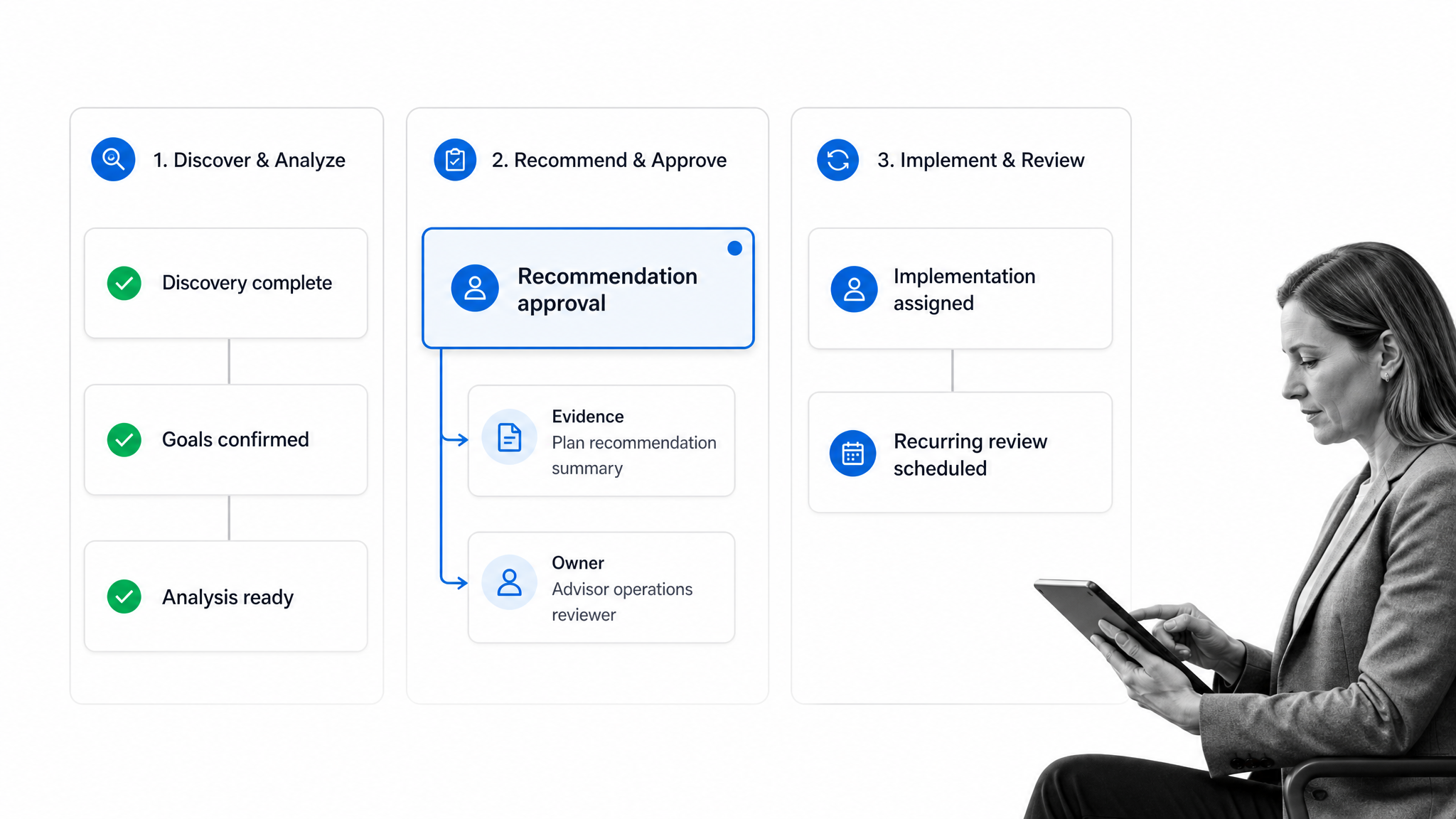
Build the workflow around the real client journey. Start with how work happens today, including the informal routes people use when the standard path is slow or unclear.
Step 1: Define the planning event
Choose one trigger: new client discovery, annual review, retirement transition, liquidity event, estate update, or another recurring planning event. A specific trigger keeps the workflow bounded and makes success easier to measure.
Step 2: Map inputs and systems of record
List every required input and where it is authoritative. A broader wealth management technology stack may include CRM, portfolio reporting, planning software, document storage, communication, and custodial systems. The workflow should coordinate them without pretending to replace every record system.
Strong wealth management integration reduces duplicate entry and makes status changes available to the next step. The workflow remains the system of action while specialist platforms retain their authoritative data.
Step 3: Separate facts, analysis, and decisions
Facts are client-provided or system-sourced inputs. Analysis tests scenarios and tradeoffs. Decisions record the recommendation and acceptance state. Separating them prevents an updated input from silently changing a conclusion without a new review.
Step 4: Add gates where risk concentrates
Not every task needs an approval. Add gates where an error would be hard to reverse, where a conflict or exception needs review, where the client authorizes action, or where evidence must be complete before implementation.
For registered investment advisers, the disclosure and governance context around Form ADV can be one reason to keep planning operations tied to clear procedures and evidence.
Step 5: Turn recommendations into assigned work
Create tasks immediately when the decision is accepted. Assign each action to one owner. State what completion looks like. Require the document, confirmation, or system state that proves the work happened.
A financial services client onboarding template can provide a starting structure for intake and document collection, while the client onboarding process template helps with the broader handoff pattern.
Step 6: Design the review loop
At completion, record unresolved risks, deferred decisions, monitoring needs, and the next review trigger. The workflow should schedule the future work or create a reliable reminder path before the current run closes.
Step 7: Test exceptions before rollout
Run the workflow against a straightforward household and a complex scenario. Test missing data, client delay, material assumption change, approval rejection, outside-professional dependency, and urgent service requests. If the exception path falls back to private messages, the design is not finished.
This approach combines financial process automation with financial process management: automate repeatable handoffs while preserving human judgment and accountable review.
How to govern wealth plan reviews and changes
A plan needs governance after the initial recommendation. Without a review system, open actions age, assumptions drift, and material changes can remain hidden inside meeting notes.
Use a two-layer review model
Run scheduled reviews for the whole plan and event-driven reviews for material changes. Scheduled reviews protect coverage. Triggered reviews protect relevance. Both should update the same planning record.
Control changes to key assumptions
When a key assumption changes, capture the old state, new state, source, affected recommendation, reviewer, and resulting action. The goal is not excessive documentation. It is making the reason for the changed path understandable later.
Make exceptions measurable
Track why workflows leave the normal route. Repeated missing documents, stale risk information, delayed client responses, unclear ownership, and recurring approval rework point to a process problem. Fix the system, not only the individual case.
An operational risk management framework helps teams classify those failure points and decide where stronger controls or clearer ownership will reduce repeat risk.
Keep AI inside the control environment
AI can help summarize meetings, classify documents, prepare task suggestions, and detect missing information. The NIST AI Risk Management Framework provides a useful governance frame: define the purpose, measure the risk, and keep accountable oversight around the output.
If AI changes a planning input or recommends a route, the workflow should show what it touched, which source supported it, who reviewed it, and what decision followed. Faster work still needs traceable control.
How Process Street supports wealth management planning
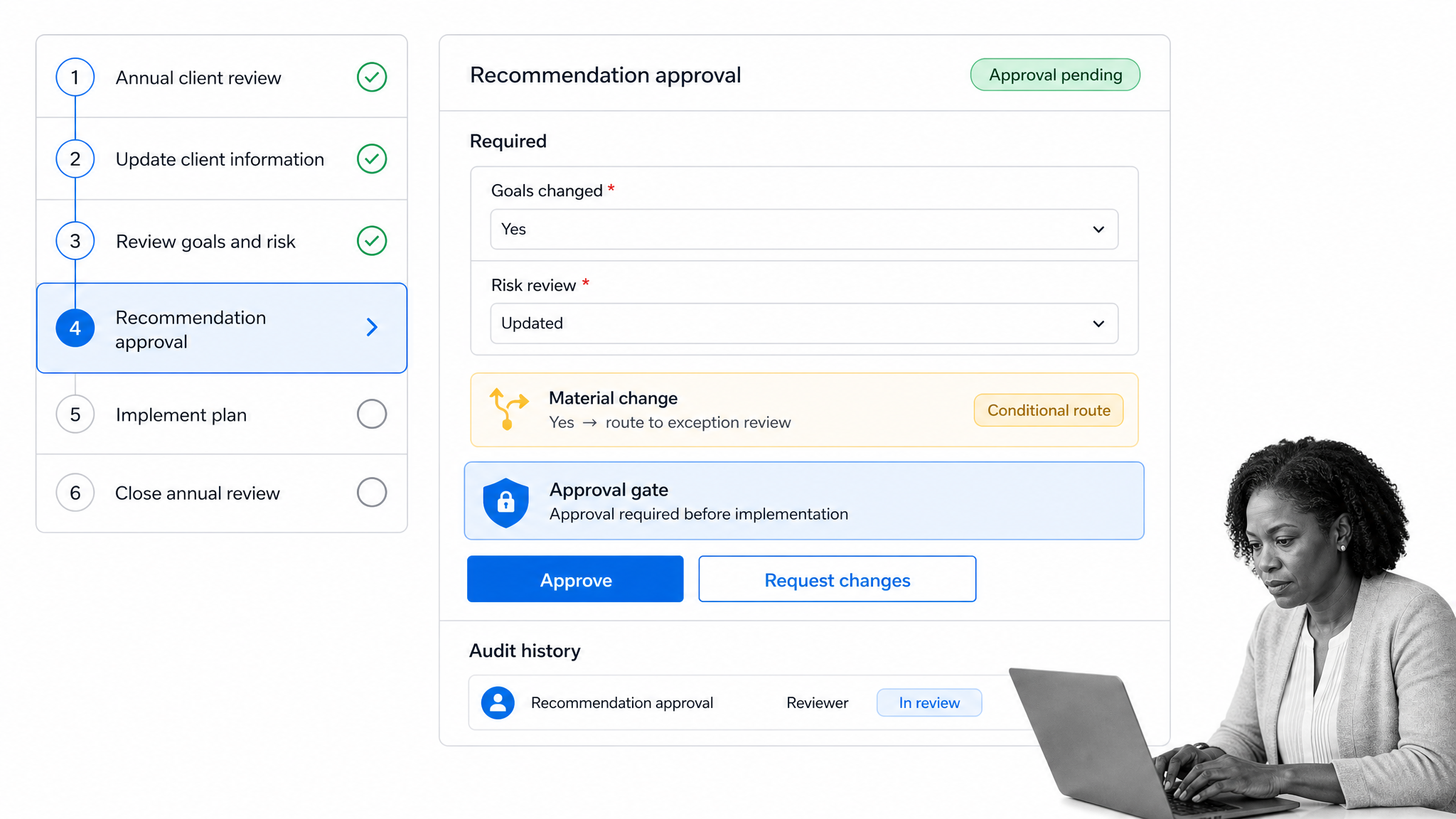
Process Street is a Compliance Operations Platform that turns wealth planning procedures into assigned, controlled workflows. The planner becomes the place where discovery, review, action, and proof move together.
Run repeatable planning workflows
Teams can build workflows for new-client discovery, annual planning reviews, account changes, document collection, investment policy reviews, beneficiary updates, retirement transitions, complaints, and compliance attestations. Each run carries its own client context and history.
Require the right information
Required fields and files prevent the workflow from moving forward with an incomplete planning record. Advisors and operations teams can capture goals changed, risk review status, evidence received, outside-professional dependency, and the next action in a consistent format.
Route material changes
Conditional logic can send a routine review down a standard path while routing a material change, missing evidence, or higher-risk scenario to a specialist or compliance reviewer. The workflow adapts without losing the standard.
Hold work for approval
Approval tasks can prevent implementation until the accountable reviewer accepts the recommendation or requests changes. The decision and comments remain attached to the workflow run.
Connect the planning stack
Process Street has direct, universal integrations to 5,000+ systems. Need a new one? An AI agent builds it on the fly. That lets the planning workflow coordinate CRM, portfolio, document, communication, and reporting systems while keeping the control path visible.
Create proof while work happens
Task history, field values, files, comments, approvals, and completion states create an operating record as the team works. This supports faster supervision and a cleaner response when someone needs to understand what happened.
A financial planning firm case study shows how a financial planning firm used structured workflows to increase advisor capacity, while the wealth management workflow case study shows the accuracy gains possible when client and planning work follows a defined process.
How to evaluate a wealth management planner
Evaluate a wealth management planner by the quality of execution it creates. A polished dashboard is not enough if the firm still relies on memory, email, and manual follow-up.
Does it cover the whole planning loop?
The planner should support discovery, analysis, recommendation, approval, implementation, monitoring, and review. If it stops at a report, the operating work remains fragmented.
Can the firm adapt the route?
Look for required fields, conditional paths, role-based ownership, approvals, evidence, deadlines, reminders, and exception handling. The system should support controlled variation by client segment and event.
Does it preserve decision context?
A reviewer should be able to see the relevant inputs, recommendation, rationale, acceptance state, supporting evidence, open actions, and last material change without searching across several tools.
Can operators improve it?
Advisor operations and compliance teams need to update the workflow as policies, services, systems, and client needs change. A planning system that requires a long development project for every change will drift away from real work.
The strongest option behaves like a workflow management system for recurring client service and connects to compliance management software where regulatory or internal controls require added governance.
FAQs
What is a wealth management planner?
A wealth management planner is a structured system for organizing a client’s goals, constraints, risks, recommendations, actions, evidence, and review schedule. For a firm, it also coordinates the advisor, operations, compliance, and specialist work required to keep the plan current.
What should a wealth management planner include?
It should include the household profile, planning scope, goals, priorities, constraints, current position, assumptions, recommendations, decision rationale, action owners, approvals, evidence, exceptions, and the next review trigger. The exact depth should match the firm’s service model and the client’s complexity.
How is wealth planning different from investment management?
Investment management focuses on portfolio decisions and oversight. Wealth planning connects those decisions to cash flow, taxes, insurance, estate intentions, business interests, family needs, major life events, and the actions required across the client’s financial life.
How often should a wealth plan be reviewed?
Use a regular review cadence that fits the service model, then add event-driven reviews for material changes. Retirement, inheritance, marriage, divorce, business sales, job changes, relocation, health events, and changed goals can justify an earlier review.
How do you build a wealth management planning workflow?
Start with one planning event, map the required inputs and systems, separate facts from analysis and decisions, add gates where risk concentrates, assign every accepted recommendation, and design the next review loop. Test both normal and exception scenarios before rollout.
How can Process Street support wealth management planning?
Process Street can run planning work as assigned workflows with required fields, conditional routes, approvals, evidence collection, integrations, reminders, and task history. That helps firms coordinate client service while preserving a clear record of review and follow-through.