Turn every policy into automated workflows with built-in enforcement and audit-ready proof.



8 Best LogicGate Alternatives & Competitors in 2026

LogicGate alternatives give risk and compliance teams different ways to connect controls, evidence, assessments, audit work, reporting, and remediation. LogicGate Risk Cloud is a flexible no-code GRC platform, but the best replacement depends on whether the real need is enterprise IRM, audit and controls, technology governance, connected reporting, or enforceable recurring execution.
This comparison ranks eight credible options. Process Street is first for teams whose central problem is recurring process execution: making sure owners complete the right steps, evidence is captured, approvals happen, exceptions route correctly, and every run leaves proof. ServiceNow, Optro, Archer, MetricStream, OneTrust, Hyperproof, and Workiva can fit better when a broader or more specialized GRC domain is the priority.
The list is editorially maintained by the Process Street team and was verified against current vendor pages on August 25, 2026. No ratings, customer counts, acquisition commentary, or private commercial data are used. Pricing cells reflect only what vendors publish openly; where no figure is public, the table says so.
The practical question is not which platform has the longest feature list. It is which operating model matches the work your team must govern. A risk platform can be excellent at organizing registers, taxonomies, controls, and assurance while still leaving business users to complete procedures elsewhere. An execution platform can make recurring work reliable without providing the specialized data model required by a global enterprise risk function. Treat those as different jobs before comparing products.
Use the at-a-glance table to narrow the field, then read the tradeoffs in each ranked review. The ranking is deliberately conditional: Process Street leads for recurring process enforcement, while the other tools are named honestly when enterprise IRM, audit, technology governance, security compliance, or connected reporting is the better center of gravity. That framing should produce a smaller, more defensible shortlist than a generic GRC feature checklist, with clearer ownership and measurable evaluation criteria.
In this guide:
- What is LogicGate?
- LogicGate alternatives at a glance
- How we picked these LogicGate alternatives
- How to evaluate your shortlist
- 1. Process Street
- 2. ServiceNow Integrated Risk Management
- 3. Optro
- 4. Archer
- 5. MetricStream
- 6. OneTrust
- 7. Hyperproof
- 8. Workiva
- Which LogicGate alternative fits your use case?
- FAQs
What is LogicGate?
LogicGate Risk Cloud is a no-code governance, risk, and compliance platform. Its official platform and pricing pages describe applications made from rules and workflows, a graph-based data model, automated evidence monitoring, reporting and analytics, risk quantification options, and role types for program administrators, standard participants, and external questionnaire users.
LogicGate is the incumbent in this comparison, not a ranked alternative. It is the baseline for evaluating configurability, GRC program breadth, workflow flexibility, evidence handling, reporting, user participation, and commercial fit. Teams commonly investigate alternatives when they need a different balance of implementation effort, specialist depth, enterprise platform alignment, business-user simplicity, audit-to-report connectivity, or recurring process enforcement.
Its public pricing model is application-led. Buyers select the Risk Cloud applications they need and pay for Power Users who build and manage the program, while standard and external user access is described separately. Exact prices are not published, so any serious comparison has to look beyond a headline license figure and evaluate implementation, administration, integrations, data migration, and ongoing program ownership.
LogicGate alternatives at a glance
The strongest LogicGate alternative is the one that matches the program’s dominant operating gap. Process Street leads for recurring controls and SOP execution. ServiceNow fits platform-standardized enterprises. Optro fits audit and controls teams. Archer and MetricStream fit complex enterprise IRM. OneTrust fits broad technology governance. Hyperproof fits common-control security programs. Workiva fits connected assurance and reporting.
| Tool | Best for | Standout feature | Free plan | Starting price |
|---|---|---|---|---|
| Process Street | enforceable, trackable, recurring process and SOP workflows | workflow runs with assignments, required fields, approvals, conditional routing, evidence capture, and audit history | No public free plan listed | See pricing page |
| ServiceNow Integrated Risk Management | enterprises already standardizing work on the ServiceNow platform | connected risk and compliance across IT, cyber, and business operations with remediation routing | Not publicly listed | Contact sales |
| Optro | audit, controls, risk, and compliance teams seeking one connected GRC intelligence platform | risk management, regulatory compliance, IT risk, audit and controls, reporting, and continuous monitoring | Not publicly listed | Request a demo |
| Archer | complex enterprise risk programs requiring configurable, multi-domain IRM | audit, resilience, enterprise risk, IT risk, compliance, and third-party governance on one configurable platform | Not publicly listed | Request a demo |
| MetricStream | large organizations connecting risk, compliance, audit, cyber, third parties, and resilience | federated risk data, configurable applications, continuous control monitoring, APIs, analytics, and reporting | Not publicly listed | Contact sales |
| OneTrust | technology risk, compliance, policy, and third-party programs on a broad governance platform | actionable compliance tasks, risk assessment, control management, policy workflows, and third-party lifecycle work | Not publicly listed | Get pricing |
| Hyperproof | security and compliance teams connecting common controls to risk and audit work | centralized compliance, risk, security, vendor risk, reporting, and common-control operations | Not publicly listed | Request a demo |
| Workiva | finance, audit, risk, and controls teams that need connected assurance and reporting | audit management, controls management, risk management, testing workflows, linked evidence, and connected reporting | Not publicly listed | Contact sales |
How we picked these LogicGate alternatives
We evaluated each tool on five criteria: fit for the target use case, ability to connect risk and control data, workflow and remediation model, participation outside the core GRC team, and the transparency of public product and pricing information. The ranking gives the most weight to enforceable execution because a control only works when the underlying procedure is followed.
- Core capability fit: recurring execution, IRM, audit, technology governance, common controls, or reporting.
- Workflow model: how work is assigned, routed, reviewed, and proven.
- Data model: whether risks, controls, assets, policies, vendors, evidence, and issues share context.
- Adoption model: whether business users can participate without becoming full program administrators.
- Commercial transparency: whether free access, entry pricing, or only a sales-led quote is published.
A mature shortlist should distinguish GRC software from a workflow management system. GRC platforms organize risks, obligations, controls, and assurance. Workflow systems make repeatable work run. Some organizations need one. Many need both, with the GRC system governing the program and the execution layer running the human procedures that produce evidence.
How to evaluate your shortlist
Start with one real process that is important enough to expose weaknesses but contained enough to test in a few sessions. A useful scenario includes a risk or obligation, a control owner, an evidence request, an approval, an exception, a remediation task, and a management report. Give every vendor the same actors, data, permissions, and success criteria. A scripted demonstration is easier to compare than a tour of each product’s broadest capabilities.
Score the day-to-day experience separately for program administrators, control owners, occasional participants, reviewers, and auditors. Administrators need configuration and governance. Control owners need clear assignments and context. Occasional users need a simple path to complete work. Reviewers need reliable evidence and history. Auditors need traceability. A platform can impress the core team while creating friction for the many people whose participation determines whether the program works.
Model the complete commercial picture. Include implementation, migration, configuration, administrator and participant licensing, integrations, training, support, reporting, and internal ownership. Ask which changes require a vendor or partner and which can be made by the operating team. A lower license quote can become expensive if every workflow change creates a services dependency. A broader platform can be economical when it replaces several tools and shared data is genuinely reused.
Finally, define evidence for success before the proof of concept. Useful measures include completion rate, overdue work, evidence rejection rate, approval turnaround, exception age, duplicate data entry, time to prepare an audit sample, and time to change a workflow. These measures keep the decision grounded in operating outcomes. They also make it easier to decide whether to replace LogicGate completely, retain it for governance, or add an execution layer around it.
Include migration and exit questions in the same evaluation. Confirm how records, attachments, relationships, history, permissions, and reports can be exported, and what is lost when data leaves the platform. Ask vendors to distinguish configuration from custom code and to document integration ownership. A credible choice should improve the next operating cycle without creating a data or services dependency the team cannot maintain.
1. Process Street
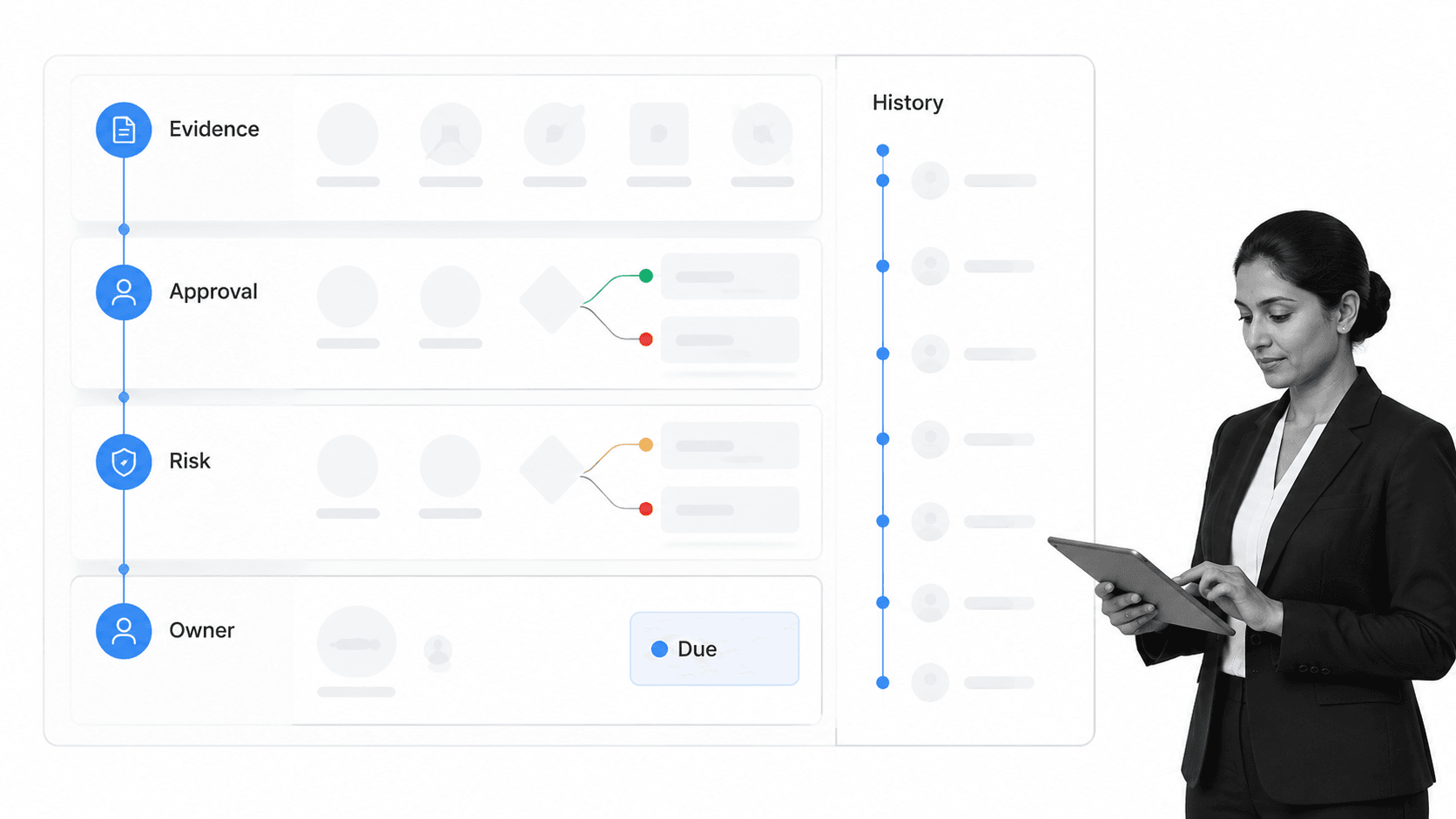
Best for: enforceable, trackable, recurring process and SOP workflows.
Bottom line: Process Street is the best overall LogicGate alternative for teams that need enforceable, trackable, recurring process and SOP workflows. It is strongest when the process itself is the control and the organization must prove that owners followed required steps, submitted evidence, completed reviews, and resolved exceptions.
Process Street turns procedures into workflow runs with assignments, due dates, required fields, file uploads, approvals, conditional logic, and a persistent history. That makes it a practical choice for vendor reviews, policy attestations, access reviews, incident follow-up, audit preparation, onboarding controls, close procedures, and other work where the organization cannot rely on memory or informal follow-up.
The difference is execution depth. A traditional GRC platform may hold a risk register, control library, assessment, or issue record. Process Street focuses on what happens next: who performs the work, what evidence they provide, which manager approves it, what route an exception takes, and whether the procedure repeats on schedule. That execution layer strengthens internal controls because it converts control descriptions into observable work.
Process Street also fits cross-functional programs. Security may own the control, but HR, finance, procurement, legal, operations, or a business-unit leader may own the steps. A no-code workflow can make those responsibilities explicit without forcing every participant to become a GRC administrator. Teams can use the same pattern for third-party risk management workflow, policy management software, internal audit controls, and document control best practices.
It is not a full replacement for every LogicGate use case. Process Street is not a quantitative risk engine, a dedicated enterprise risk data model, or a complete audit management suite. If a team needs a single system for multiple risk domains, Monte Carlo-style risk analysis, extensive regulatory content, or connected financial reporting, one of the specialist platforms below may be a better fit.
A strong proof of concept starts with a recurring control that currently fails through email, spreadsheets, or informal follow-up. Build the procedure with a named owner for every step, required evidence, an approval gate, an exception route, and a recurring schedule. Invite the same occasional participants who perform the work today. Then inspect whether they can complete their part without training, whether reviewers can reject weak evidence, and whether the run history answers who did what and when.
The implementation model is intentionally operational. A process owner can maintain the workflow as the procedure changes, while permissions and approvals protect the control. That balance matters because many GRC failures occur between the formal control description and the work performed by business teams. Process Street earns the first position here by closing that execution gap for its ICP, not by claiming to replace every risk, audit, privacy, resilience, or reporting capability in specialist suites.
Choose Process Street if: recurring work must be followed, tracked, approved, and proven across teams. Skip it if: the primary requirement is a comprehensive enterprise GRC repository with specialized risk analytics across many formal domains.
Key features
- Recurring workflow runs with owners and due dates
- Required form fields, files, and evidence capture
- Approvals, stop points, and conditional routing
- Run history and accountability for every completed step
- Direct, universal integrations to 5,000+ systems, with an AI agent that builds new integrations on the fly
Pros
- Excellent for recurring controls and SOPs
- Fast ownership by operations and compliance teams
- Easy participation across departments
- Strong evidence and approval trail
- Useful alongside a GRC system when execution is the missing layer
Cons
- Not a dedicated enterprise risk quantification platform
- Not a complete audit, financial reporting, or technology asset governance suite
Pricing is sales-led and current packaging is available on Process Street pricing. The official site does not list a permanent free plan.
2. ServiceNow Integrated Risk Management
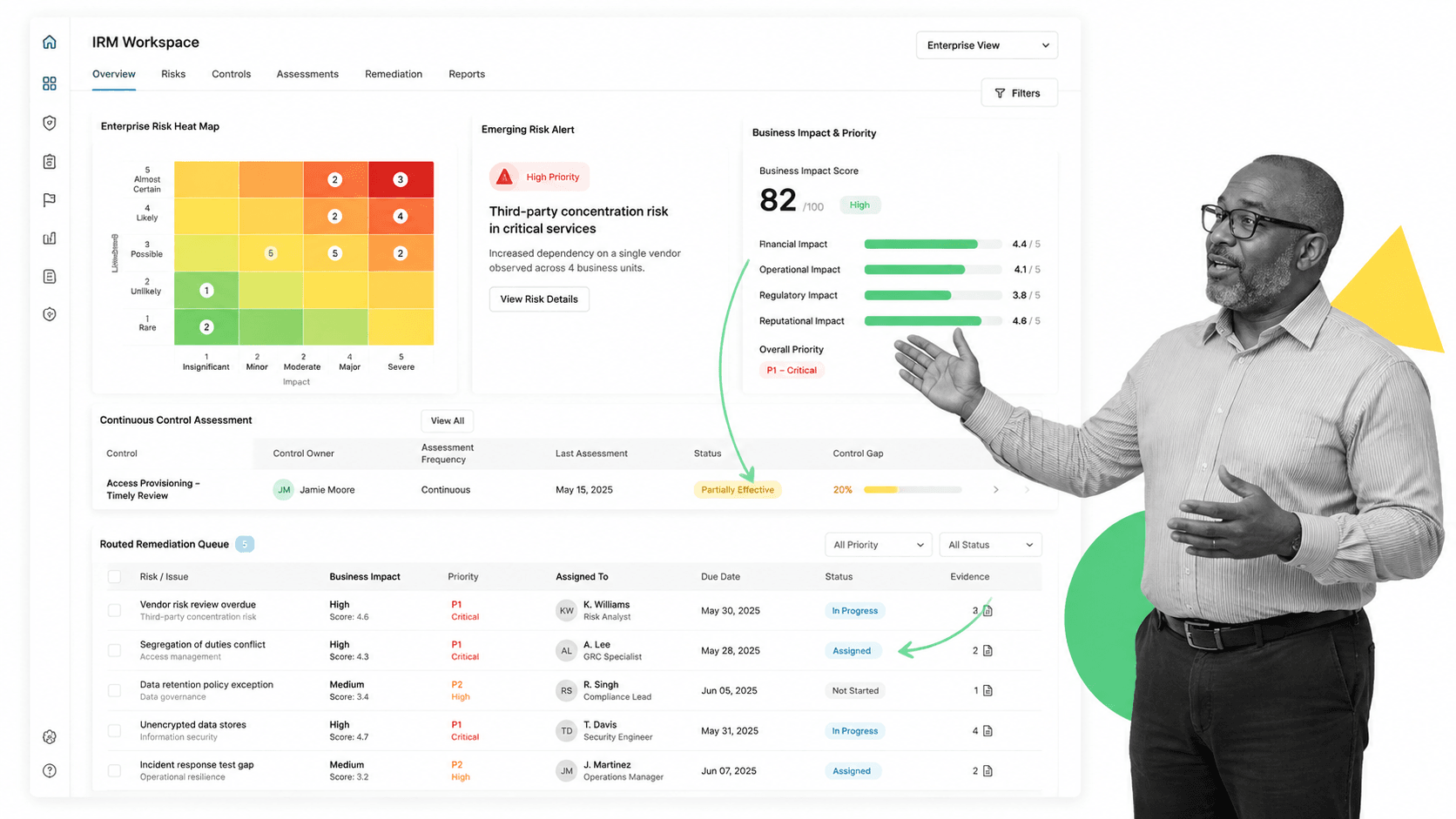
Best for: enterprises already standardizing work on the ServiceNow platform.
Bottom line: Best for enterprises that want IRM embedded in the same platform that coordinates technology and business work.
ServiceNow Integrated Risk Management connects risk and compliance across IT, cyber, and business operations. Its official product page emphasizes continuous control assessment, emerging-risk monitoring, gap identification, business-impact prioritization, remediation routing, centralized audit evidence, and compliance inside daily workflows.
This tool beats Process Street when its specialist use case is the center of the buying decision. Choose it when ServiceNow is already the system of action and IRM should use that shared data and workflow layer. Process Street remains stronger when recurring cross-functional execution, operator ownership, and proof of completed steps matter more than the specialist GRC surface.
Skip it when the main requirement is a fast, operator-owned recurring SOP runtime without a broader platform program. A disciplined evaluation should test a real scenario: one risk or control, one evidence request, one exception, one approval, one remediation action, and one management report. That reveals whether the platform improves the daily operating model or only produces a polished demonstration.
During a proof of concept, ask ServiceNow to use live configuration items, business services, risk statements, control results, and remediation assignments from the environment you already operate. Confirm which data is native, which must be integrated, and how occasional business participants complete work. The value is highest when IRM inherits useful platform context. If the demonstration depends on duplicate records or a separate operating model, the platform advantage is less compelling.
Key features
- Connected enterprise risk view
- Continuous control assessment
- Risk and control gap identification
- Business-impact prioritization
- Remediation routing and centralized evidence
Pros
- Strong fit for organizations already using the ServiceNow platform
- Broad connection between technology risk and business operations
- Clear path from risk signal to remediation work
- Enterprise ecosystem, training, and partner support
Cons
- May be more platform than a smaller team needs
- Implementation and commercial scope require a sales process
Choose ServiceNow Integrated Risk Management if
Choose it when ServiceNow is already the system of action and IRM should use that shared data and workflow layer.
Skip ServiceNow Integrated Risk Management if
Skip it when the main requirement is a fast, operator-owned recurring SOP runtime without a broader platform program.
Pricing model: Contact sales. Check the ServiceNow Integrated Risk Management official product page for current packaging and product details.
3. Optro
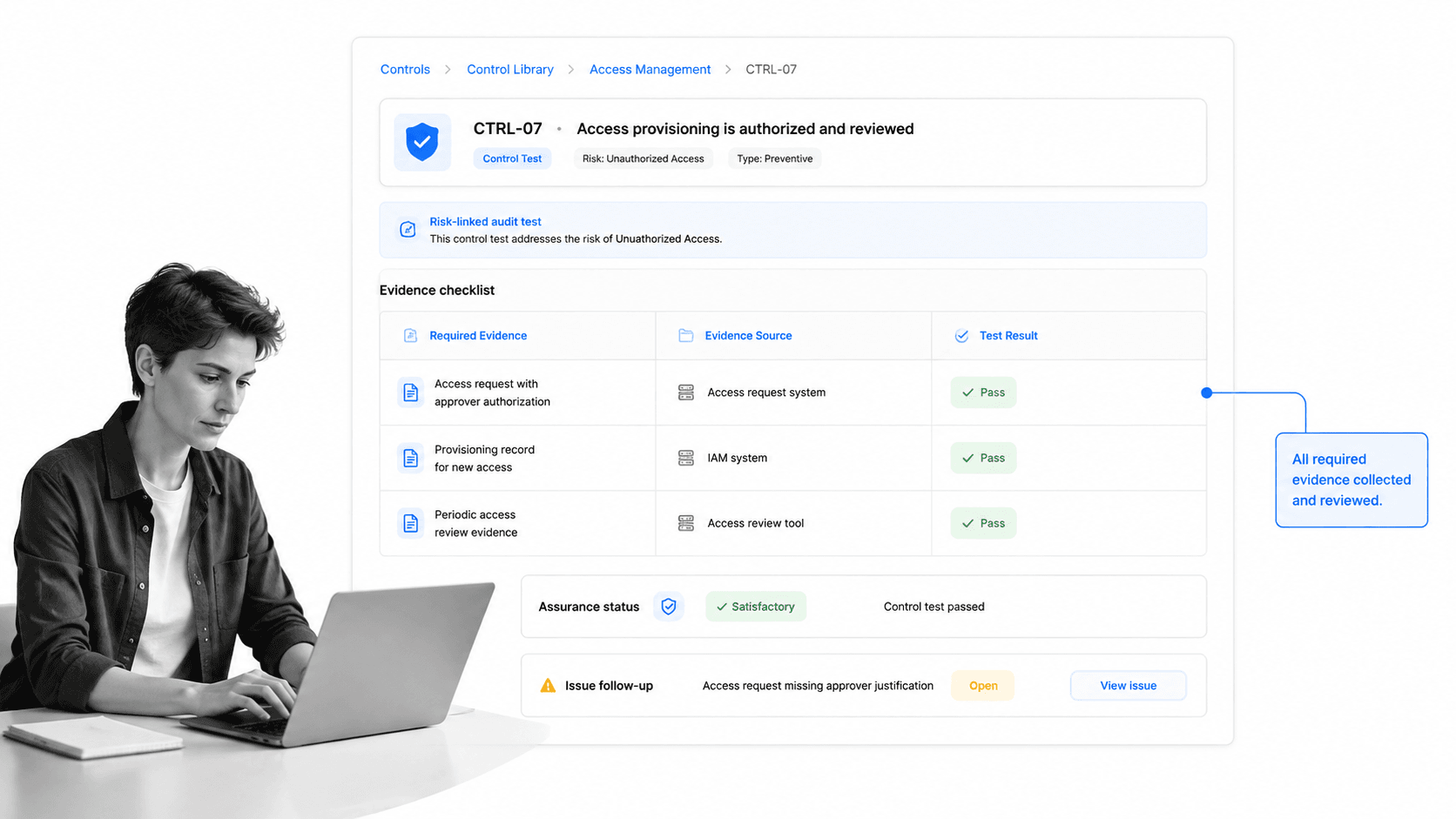
Best for: audit, controls, risk, and compliance teams seeking one connected GRC intelligence platform.
Bottom line: Best for connected audit, controls, risk, and compliance programs with practitioner-focused GRC workflows.
Optro presents an AI-powered GRC intelligence platform spanning risk management, regulatory and ESG compliance, IT risk and compliance, audit and controls management, reporting, continuous compliance, integrations, and analytics. The platform is especially relevant when audit planning, control testing, assurance, and risk reporting need to share one operating model.
This tool beats Process Street when its specialist use case is the center of the buying decision. Choose it when internal audit, SOX, control testing, and connected risk intelligence sit at the center of the program. Process Street remains stronger when recurring cross-functional execution, operator ownership, and proof of completed steps matter more than the specialist GRC surface.
Skip it when the core job is running repeatable cross-functional procedures outside a formal GRC function. A disciplined evaluation should test a real scenario: one risk or control, one evidence request, one exception, one approval, one remediation action, and one management report. That reveals whether the platform improves the daily operating model or only produces a polished demonstration.
Use a control-testing scenario to evaluate Optro: build a risk-based audit plan, request evidence, document a test, create an issue, assign follow-up, and produce an assurance report. Pay attention to how easily audit, controls, and risk teams share the same record without losing their specialist views. Also verify the governance around AI-assisted features, because the public platform positioning emphasizes AI but each organization still needs its own review and approval controls.
Key features
- Risk management and regulatory compliance
- IT risk and compliance
- Audit and controls management
- Flexible reports and dashboards
- Continuous compliance and analytics
Pros
- Strong audit and controls depth
- Connected view across multiple GRC teams
- Reporting and testing capabilities are central
- Useful for assurance programs that need practitioner-specific workflows
Cons
- Public pricing is not listed
- Broader than teams that only need recurring process enforcement
Choose Optro if
Choose it when internal audit, SOX, control testing, and connected risk intelligence sit at the center of the program.
Skip Optro if
Skip it when the core job is running repeatable cross-functional procedures outside a formal GRC function.
Pricing model: Request a demo. Check the Optro official product page for current packaging and product details.
4. Archer
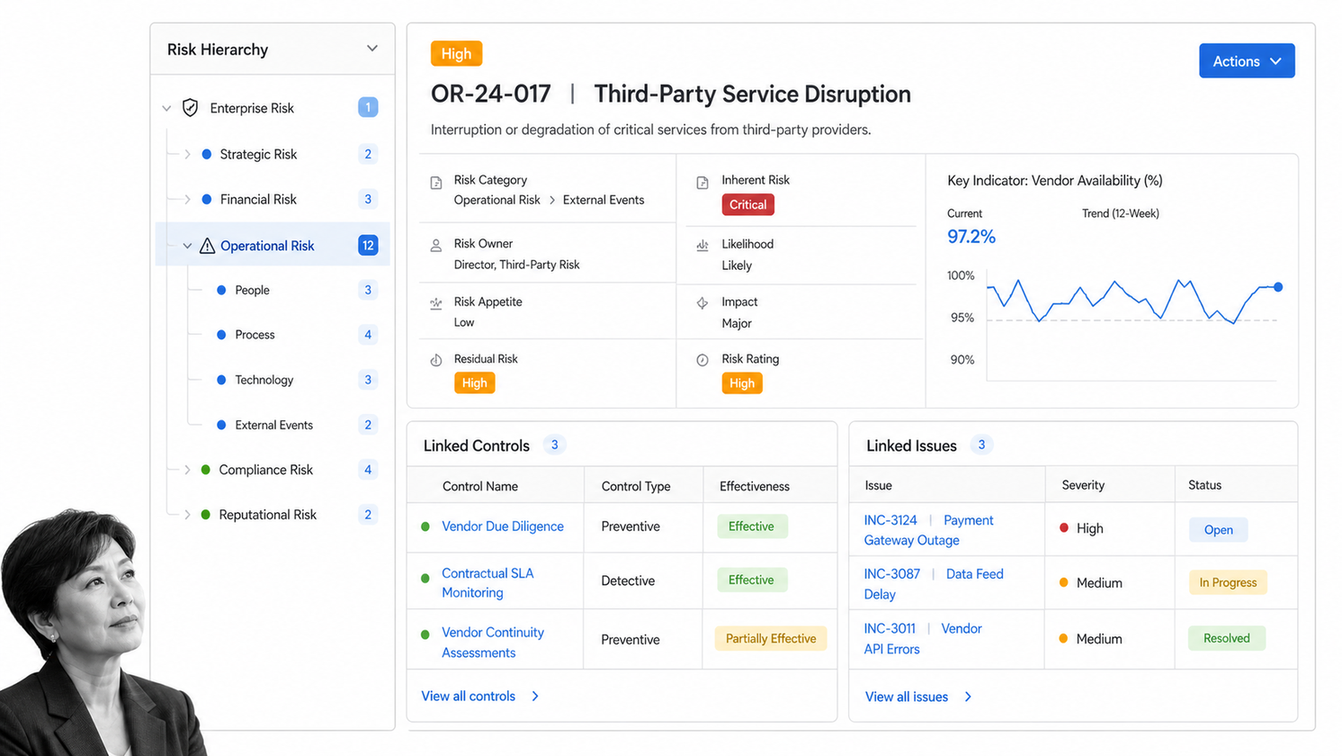
Best for: complex enterprise risk programs requiring configurable, multi-domain IRM.
Bottom line: Best for complex enterprises that need configurable applications across multiple dimensions of risk.
Archer provides integrated risk management on a configurable platform. Its official solutions portfolio covers audit management, business resiliency, enterprise and operational risk, IT and security risk, operational resilience, regulatory and corporate compliance, third-party governance, and other risk domains.
This tool beats Process Street when its specialist use case is the center of the buying decision. Choose it when the organization needs a durable multi-domain risk architecture with extensive configuration. Process Street remains stronger when recurring cross-functional execution, operator ownership, and proof of completed steps matter more than the specialist GRC surface.
Skip it when ease of rollout and business-owned recurring workflows matter more than a comprehensive IRM model. A disciplined evaluation should test a real scenario: one risk or control, one evidence request, one exception, one approval, one remediation action, and one management report. That reveals whether the platform improves the daily operating model or only produces a polished demonstration.
Test Archer with a representative hierarchy rather than a simplified demo. Model one enterprise risk, its indicators, related controls, a third party, a business service, an issue, and a resilience dependency. Then change one relationship and observe reporting impact. This exposes the benefit and the administration cost of configuration. The platform is most defensible when the organization genuinely needs a shared risk architecture, not merely a long control checklist.
Key features
- Configurable integrated risk platform
- Audit management
- Enterprise and operational risk
- IT and security risk
- Third-party governance and resilience
Pros
- Broad multi-domain IRM scope
- Configuration supports complex enterprise models
- Central risk aggregation and shared taxonomy
- Strong fit when several risk functions must share data
Cons
- Can be heavier than a focused process workflow tool
- Public pricing is not listed
Choose Archer if
Choose it when the organization needs a durable multi-domain risk architecture with extensive configuration.
Skip Archer if
Skip it when ease of rollout and business-owned recurring workflows matter more than a comprehensive IRM model.
Pricing model: Request a demo. Check the Archer official product page for current packaging and product details.
5. MetricStream
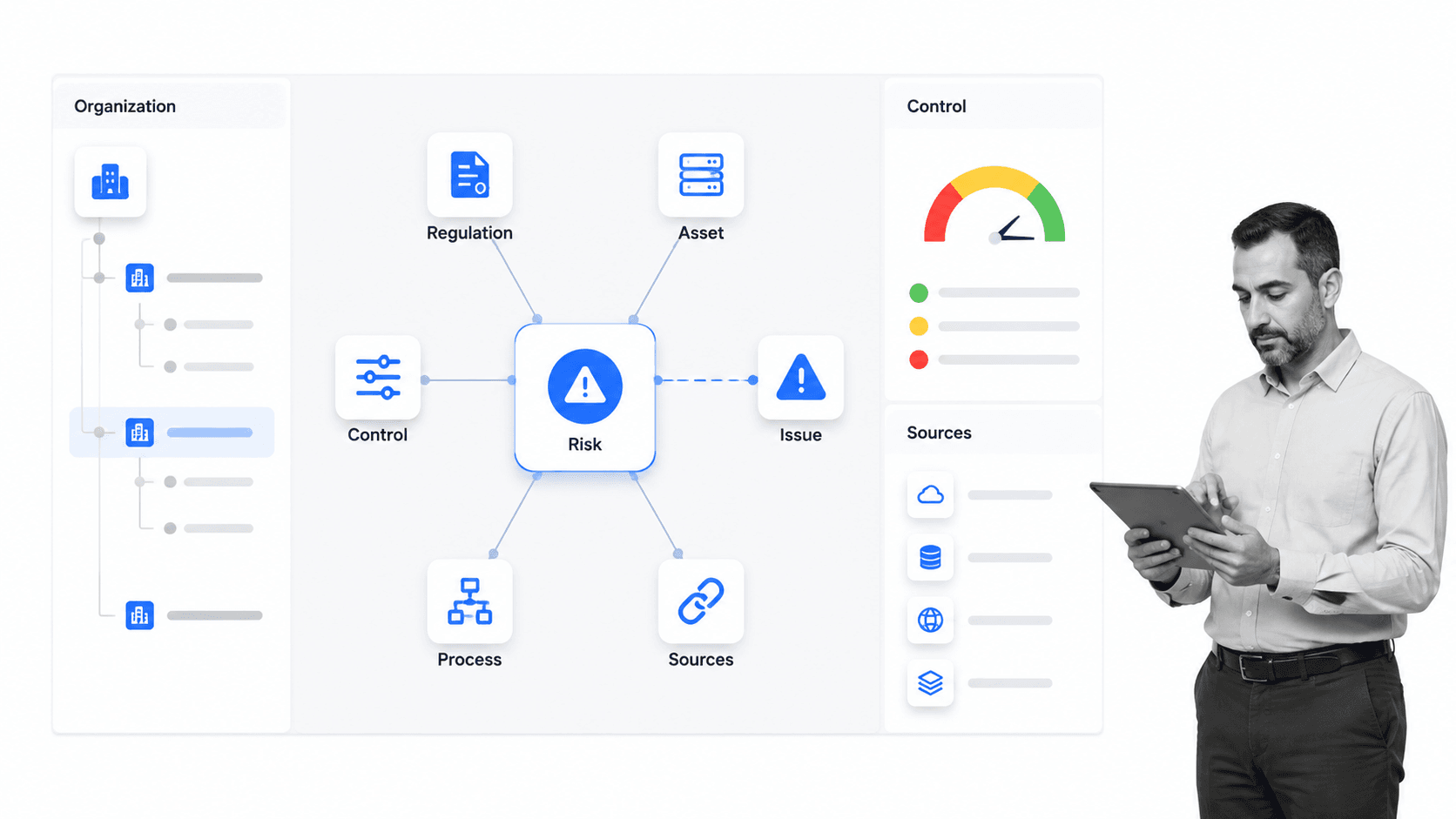
Best for: large organizations connecting risk, compliance, audit, cyber, third parties, and resilience.
Bottom line: Best for global enterprises connecting risk, compliance, audit, cyber, third parties, and resilience through one data model.
MetricStream describes an AI-first Connected GRC platform for risk, compliance, audit, cyber GRC, third-party risk, and resilience. Its platform page highlights a federated data model, configurable AppStudio, APIs, continuous control monitoring, analytics, reporting, and multi-dimensional organizational structures.
This tool beats Process Street when its specialist use case is the center of the buying decision. Choose it when a large, distributed program needs shared taxonomies and connected intelligence across every major GRC domain. Process Street remains stronger when recurring cross-functional execution, operator ownership, and proof of completed steps matter more than the specialist GRC surface.
Skip it when the biggest failure mode is simply that people miss recurring steps, approvals, or handoffs. A disciplined evaluation should test a real scenario: one risk or control, one evidence request, one exception, one approval, one remediation action, and one management report. That reveals whether the platform improves the daily operating model or only produces a polished demonstration.
Ask MetricStream to demonstrate one risk and control relationship across the relevant business unit, regulation, asset, third party, issue, and monitoring signal. Confirm how data arrives through APIs, how conflicting records are governed, and how local teams see only the context they need. A federated model is valuable when the source systems and taxonomies are understood. Without that governance, a connected platform can reproduce the same silos at a larger scale.
Key features
- Federated GRC data model
- Configurable applications
- Continuous control monitoring
- APIs and integrations
- Analytics and organizational hierarchy
Pros
- Extensive enterprise GRC breadth
- Designed to connect otherwise siloed risk data
- Strong analytics and reporting foundation
- Supports complex organizational structures
Cons
- Likely too broad for a lightweight SOP requirement
- Commercial packaging requires direct evaluation
Choose MetricStream if
Choose it when a large, distributed program needs shared taxonomies and connected intelligence across every major GRC domain.
Skip MetricStream if
Skip it when the biggest failure mode is simply that people miss recurring steps, approvals, or handoffs.
Pricing model: Contact sales. Check the MetricStream official product page for current packaging and product details.
6. OneTrust
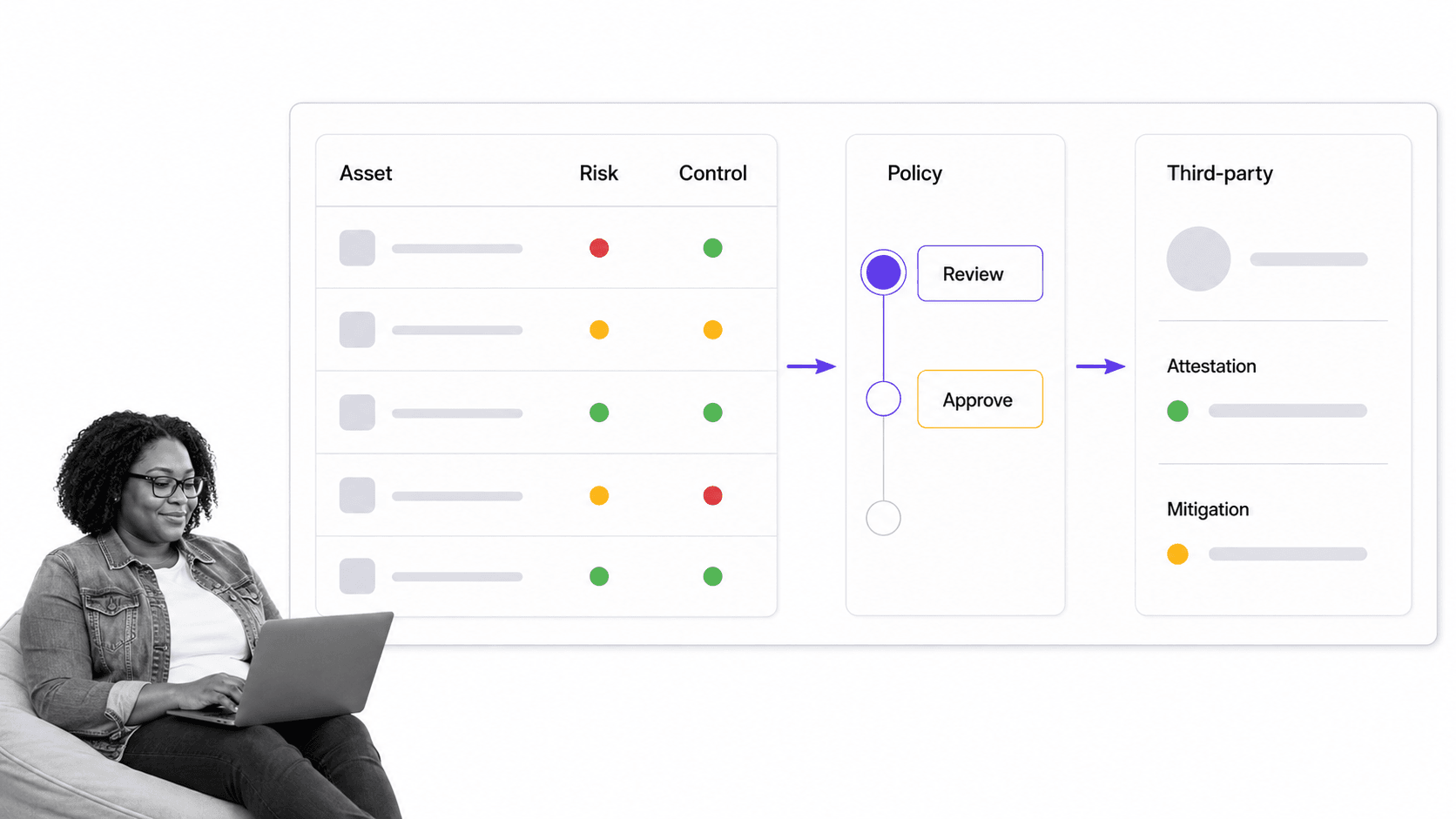
Best for: technology risk, compliance, policy, and third-party programs on a broad governance platform.
Bottom line: Best for technology risk and compliance programs that also need policy, third-party, privacy, data, or AI governance adjacency.
OneTrust Tech Risk and Compliance combines actionable compliance tasks, risk identification across technology ecosystems, risk standardization, assessments, control management, policy lifecycle workflows, and broader third-party governance. Its pricing page says relevant solution packages are metered by admin users and the inventory managed by the solution.
This tool beats Process Street when its specialist use case is the center of the buying decision. Choose it when technology risk must connect with policy, third-party, privacy, data, or AI governance. Process Street remains stronger when recurring cross-functional execution, operator ownership, and proof of completed steps matter more than the specialist GRC surface.
Skip it when the need is a focused, execution-first workflow runtime rather than a governance inventory platform. A disciplined evaluation should test a real scenario: one risk or control, one evidence request, one exception, one approval, one remediation action, and one management report. That reveals whether the platform improves the daily operating model or only produces a polished demonstration.
Evaluate OneTrust with the domains you will actually license. Start from a technology asset, identify a risk, map a control, assign an assessment, route a policy approval, and connect a third-party action if that adjacency matters. Confirm which inventory meters drive cost and which users need administrator access. The broad portfolio is an advantage only when shared context reduces duplicate work across governance teams and does not create unnecessary scope.
Key features
- Actionable compliance tasks and guidance
- Technology asset and risk inventory
- Assessments and control management
- Policy review, approval, and attestation
- Third-party lifecycle workflows
Pros
- Broad governance portfolio
- Strong fit for technology risk and compliance
- Policy and third-party work can share context
- Useful when several governance domains need one platform
Cons
- Breadth can add complexity
- Pricing is usage-based and requires a quote
Choose OneTrust if
Choose it when technology risk must connect with policy, third-party, privacy, data, or AI governance.
Skip OneTrust if
Skip it when the need is a focused, execution-first workflow runtime rather than a governance inventory platform.
Pricing model: Get pricing. Check the OneTrust official product page for current packaging and product details.
7. Hyperproof
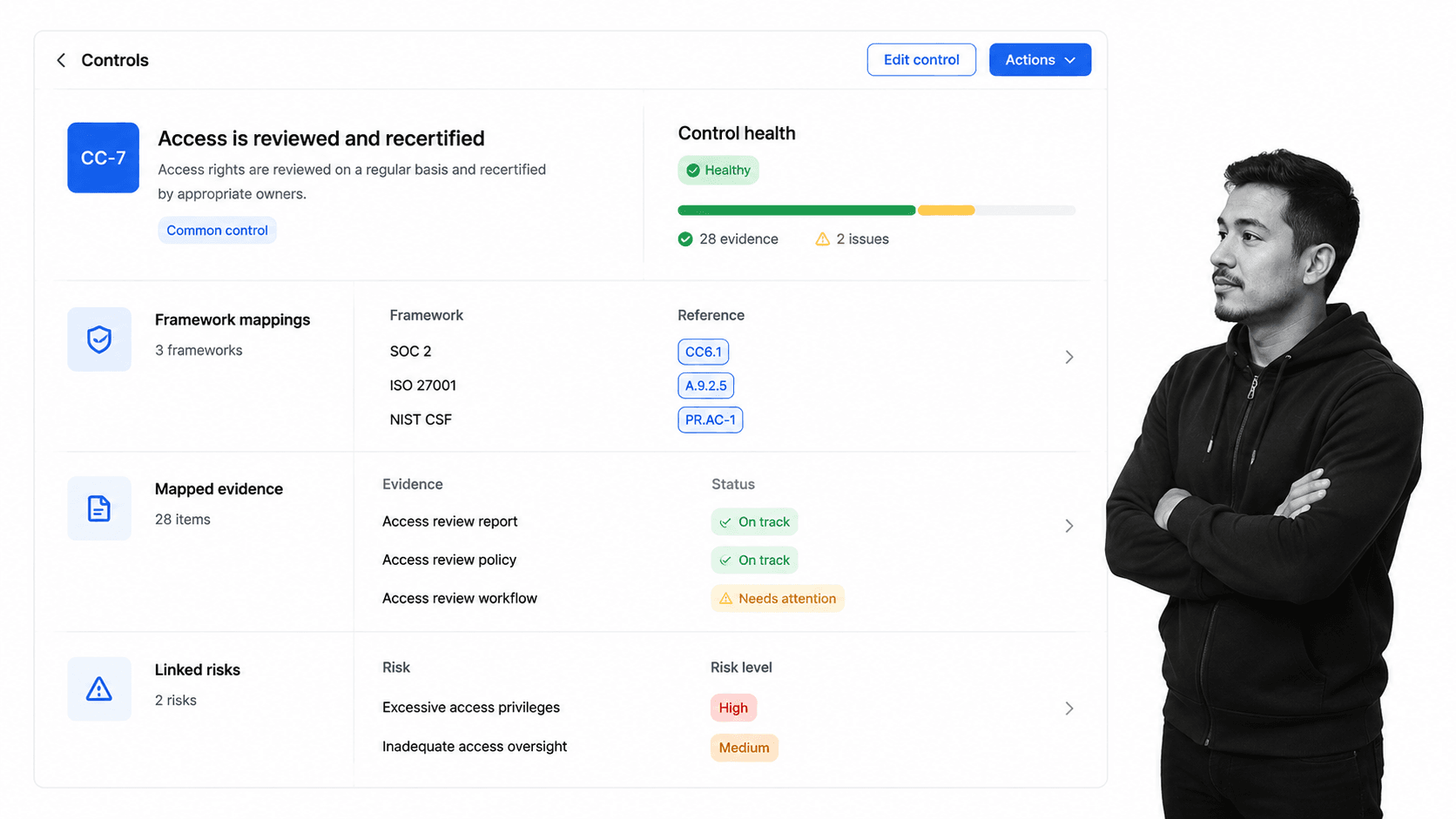
Best for: security and compliance teams connecting common controls to risk and audit work.
Bottom line: Best for security and compliance teams building a common-control operating model across frameworks and risk registers.
Hyperproof describes an AI-powered GRC platform that centralizes compliance, risk, and security workflows. Its product page highlights common-control operations, compliance tasks in existing tools, risk registers, vendor risk, consolidated reporting, permissions, and enterprise security controls.
This tool beats Process Street when its specialist use case is the center of the buying decision. Choose it when common controls, security frameworks, and risk registers define the program. Process Street remains stronger when recurring cross-functional execution, operator ownership, and proof of completed steps matter more than the specialist GRC surface.
Skip it when the workflows extend far beyond security and compliance teams into general operations. A disciplined evaluation should test a real scenario: one risk or control, one evidence request, one exception, one approval, one remediation action, and one management report. That reveals whether the platform improves the daily operating model or only produces a polished demonstration.
Run a common-control exercise in Hyperproof. Map one control to two frameworks, collect evidence once, connect it to a risk register entry, assign a remediation task, and show the resulting report to an auditor. Verify how tasks reach users in existing tools and how permissions separate sensitive evidence. This test reveals whether common controls will genuinely reduce duplicated work or whether the team still maintains parallel framework-specific processes.
Key features
- Compliance and common-control operations
- Risk registers and control health
- Vendor risk records
- Consolidated reporting
- Roles, permissions, SSO, and MFA
Pros
- Clear security and compliance focus
- Common controls can reduce duplicated framework work
- Risk and vendor context sit close to compliance
- Good fit for expanding security programs
Cons
- Public pricing is not listed
- Less general-purpose than Process Street for company-wide procedures
Choose Hyperproof if
Choose it when common controls, security frameworks, and risk registers define the program.
Skip Hyperproof if
Skip it when the workflows extend far beyond security and compliance teams into general operations.
Pricing model: Request a demo. Check the Hyperproof official product page for current packaging and product details.
8. Workiva
Best for: finance, audit, risk, and controls teams that need connected assurance and reporting.
Bottom line: Best for finance, audit, risk, and controls teams that need assurance work connected directly to reporting.
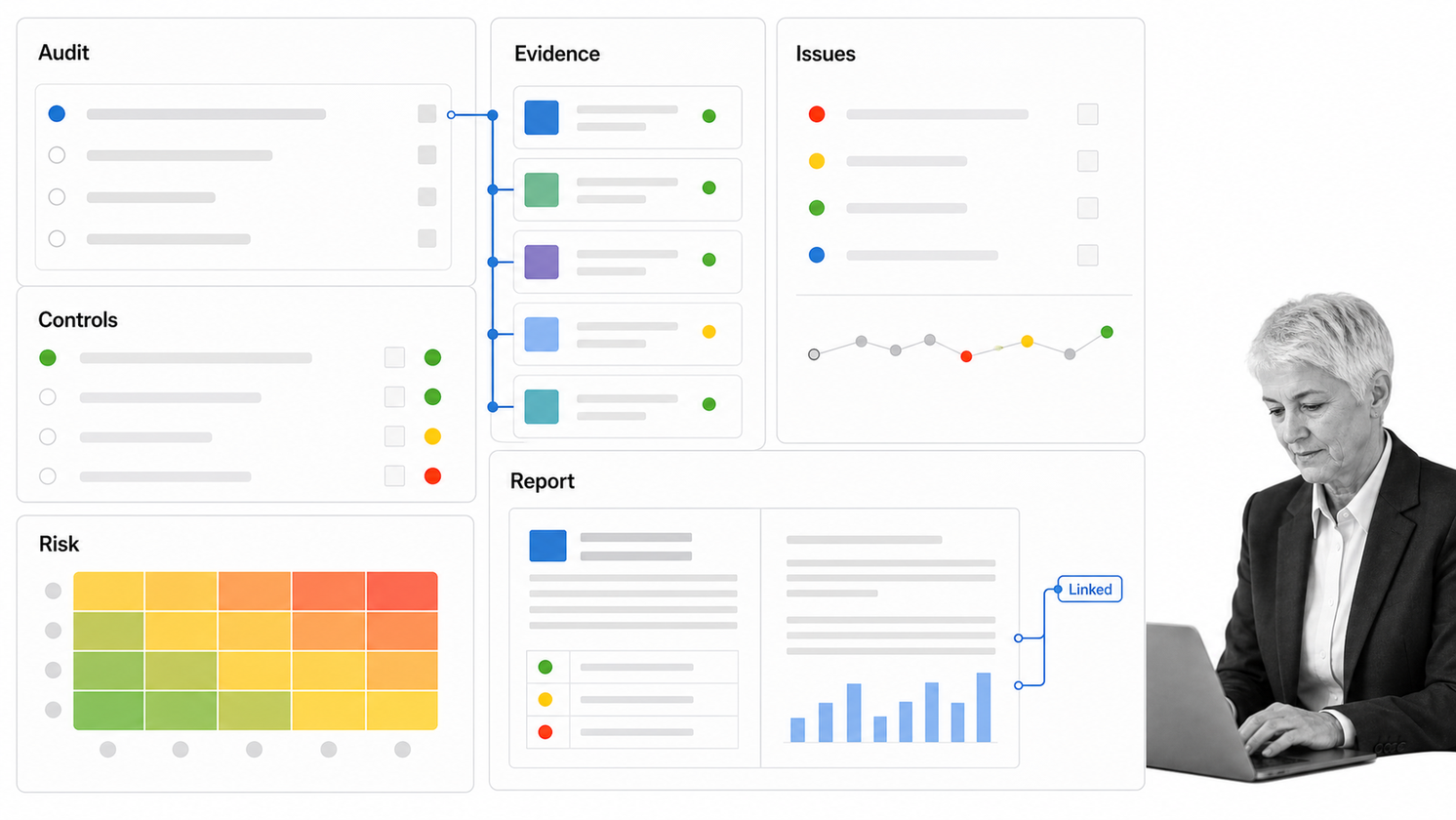
Workiva connects audit, risk, controls, evidence, and reporting in one platform. Official Workiva materials describe audit management, controls management, risk management, testing automation, linked evidence, issue management, dashboards, secure collaboration, and an audit trail that carries source data into reporting outputs.
This tool beats Process Street when its specialist use case is the center of the buying decision. Choose it when assurance, financial controls, and reporting must share linked data and documentation. Process Street remains stronger when recurring cross-functional execution, operator ownership, and proof of completed steps matter more than the specialist GRC surface.
Skip it when the program is mainly about recurring operational workflows rather than assurance and reporting. A disciplined evaluation should test a real scenario: one risk or control, one evidence request, one exception, one approval, one remediation action, and one management report. That reveals whether the platform improves the daily operating model or only produces a polished demonstration.
Use a complete audit-to-report thread in Workiva. Start with an audit plan, perform a control test, attach evidence, raise an issue, update a risk view, and trace a source-linked value into a report. Confirm how changes propagate, how reviewers see history, and how access is controlled. Workiva is most differentiated when connected data improves the final reporting product, not when the requirement ends with task assignment.
Key features
- Audit planning and workpapers
- Controls testing and evidence
- Issue management
- Risk dashboards and analytics
- Connected reporting and source-linked data
Pros
- Strong audit-to-report connection
- Useful for Office of the CFO workflows
- Linked data reduces reporting handoff risk
- Controls and assurance can share one workspace
Cons
- Not a general-purpose SOP runtime
- Pricing requires direct sales engagement
Choose Workiva if
Choose it when assurance, financial controls, and reporting must share linked data and documentation.
Skip Workiva if
Skip it when the program is mainly about recurring operational workflows rather than assurance and reporting.
Pricing model: Contact sales. Check the Workiva official product page for current packaging and product details.
Which LogicGate alternative fits your use case?
Choose Process Street when missed steps, weak handoffs, incomplete evidence, and untracked approvals are the problem. It is the clearest fit for recurring compliance management within GRC software, compliance automation software, and operational procedures where execution quality matters more than maintaining a vast risk data model.
Choose ServiceNow Integrated Risk Management when risk should live in the same platform as technology and enterprise service workflows. Choose Archer or MetricStream when the organization needs broad enterprise risk management and operational risk workflows across multiple formal domains, complex hierarchies, and a configurable risk architecture.
Choose Optro when internal audit, SOX, controls testing, and connected risk intelligence are the center of the program. Choose Hyperproof when common controls, security frameworks, vendor risk, and compliance expansion define the work. Choose OneTrust when technology risk must connect with policy, third-party, privacy, data, or AI governance.
Choose Workiva when the final output is connected assurance and reporting, especially where audit evidence, controls, financial reporting, and board materials must share linked data. That is a different center of gravity from risk management software or a general recurring workflow system.
The cleanest architecture is sometimes a combination. A specialist GRC platform can govern risks, obligations, controls, assets, and assurance. Process Street can run the human procedures that create the evidence. This separation also helps business continuity software: the risk model stays controlled while the operating workflow remains easy for business teams to follow.
FAQs
What is the best LogicGate alternative?
Process Street is the best LogicGate alternative for teams that need enforceable, trackable, recurring controls and SOP workflows. ServiceNow, Archer, MetricStream, Optro, OneTrust, Hyperproof, or Workiva may fit better when enterprise IRM, audit, technology governance, security compliance, or connected reporting is the main requirement.
Are there cheaper alternatives to LogicGate?
Public pricing is limited across this category, so a defensible cost comparison requires quotes that include implementation, administrator licenses, integrations, migration, and ongoing services. Process Street can be attractive when the requirement is recurring process execution rather than a full enterprise GRC suite.
Are there open source alternatives to LogicGate?
Open source risk and compliance projects exist, but none in this ranked set is presented as a full open source LogicGate replacement. Teams considering that route should budget for hosting, security, upgrades, configuration, support, and evidence integrity, not only the software license.
What is the closest alternative to LogicGate Risk Cloud?
Archer and MetricStream are close comparisons for broad configurable enterprise GRC. ServiceNow Integrated Risk Management is close for enterprises aligned to the ServiceNow platform. The closest choice depends on which Risk Cloud applications and workflows the organization uses today.
What is the best LogicGate alternative for small teams?
Process Street is a strong choice for small teams that need recurring controls, approvals, evidence, and accountability without implementing a broad enterprise IRM platform. Hyperproof can fit smaller security and compliance programs when common controls and framework work are the priority.
What is the best LogicGate alternative for enterprise GRC?
ServiceNow Integrated Risk Management, Archer, MetricStream, OneTrust, Optro, and Workiva all serve enterprise programs with different strengths. The shortlist should follow the dominant domain: platform-connected IRM, configurable multi-domain risk, connected GRC, technology governance, audit and controls, or assurance reporting.
How do you migrate from LogicGate to another GRC platform?
Start with an inventory of applications, workflows, records, fields, permissions, reports, integrations, evidence, and retention requirements. Map each element to the target system, migrate a representative program first, validate history and access, run both systems during acceptance testing, then retire the old workflow only after owners and auditors sign off.
Why is Process Street ranked first among LogicGate alternatives?
Process Street is ranked first for a specific ICP: teams that need enforceable, trackable, recurring process and SOP workflows. It is not ranked first for every GRC use case, and the page names the specialist platform that fits better when enterprise IRM, audit, technology governance, common controls, or reporting is the central need.
If recurring controls and procedures are the part your current GRC stack cannot enforce, start with Process Street and review current options on Process Street pricing.