Turn every policy into automated workflows with built-in enforcement and audit-ready proof.



What Is an Agentic AI Workflow?
An agentic AI workflow is a goal-driven process in which an AI agent interprets context, plans steps, uses tools, evaluates results, and adapts its next action within defined boundaries. Unlike a fixed automation, the exact path can change while the work is running.
The useful unit is not the model alone. It is the whole operating loop around the model: inputs, instructions, tools, permissions, workflow state, approval gates, evidence, evaluation, and escalation. That structure turns a clever answer into controlled execution.
This guide explains how the loop works, which components it needs, how it differs from traditional automation, where it fits, and how to govern it without removing the flexibility that makes it valuable.
In this article, we are going to cover:
- What is an agentic AI workflow?
- How an agentic AI workflow works
- Components of an agentic AI workflow
- Agentic AI workflows vs traditional automation
- Agentic AI workflow examples
- How to design and govern an agentic AI workflow
- How Process Street supports agentic AI workflows
- FAQs
What is an agentic AI workflow?
An agentic AI workflow combines a structured business process with one or more AI-driven decision points. A workflow supplies the goal, sequence, state, controls, and completion criteria. The agent supplies contextual judgment: it can decide how to reach the next valid state when the route cannot be fully specified in advance.
Google Cloud describes agentic workflows as dynamic processes where agents reason, plan, use tools, and adjust to runtime conditions. IBM similarly emphasizes iterative, multi-step work. The practical definition is simpler: the workflow says what must be true, while the agent decides how to move the case forward inside those rules.
A workflow, not one long prompt
A long prompt may ask a model to produce several outputs, but it does not necessarily preserve state, call tools, validate results, or route exceptions. An agentic workflow separates the job into stages. Each stage has an input, an allowed action, an output, and a check before the next stage begins.
Bounded autonomy, not unlimited freedom
Agentic does not mean uncontrolled. The agent can have freedom over low-risk choices while fixed rules protect permissions, required evidence, external communication, financial impact, data changes, and legal or compliance decisions. The boundary is part of the workflow design.
A process that changes at runtime
Traditional workflows usually choose from branches designed in advance. Agentic workflows can create or revise a plan after reading new evidence, receiving tool output, or encountering an exception. The goal and control conditions remain stable even when the path changes.
How an agentic AI workflow works
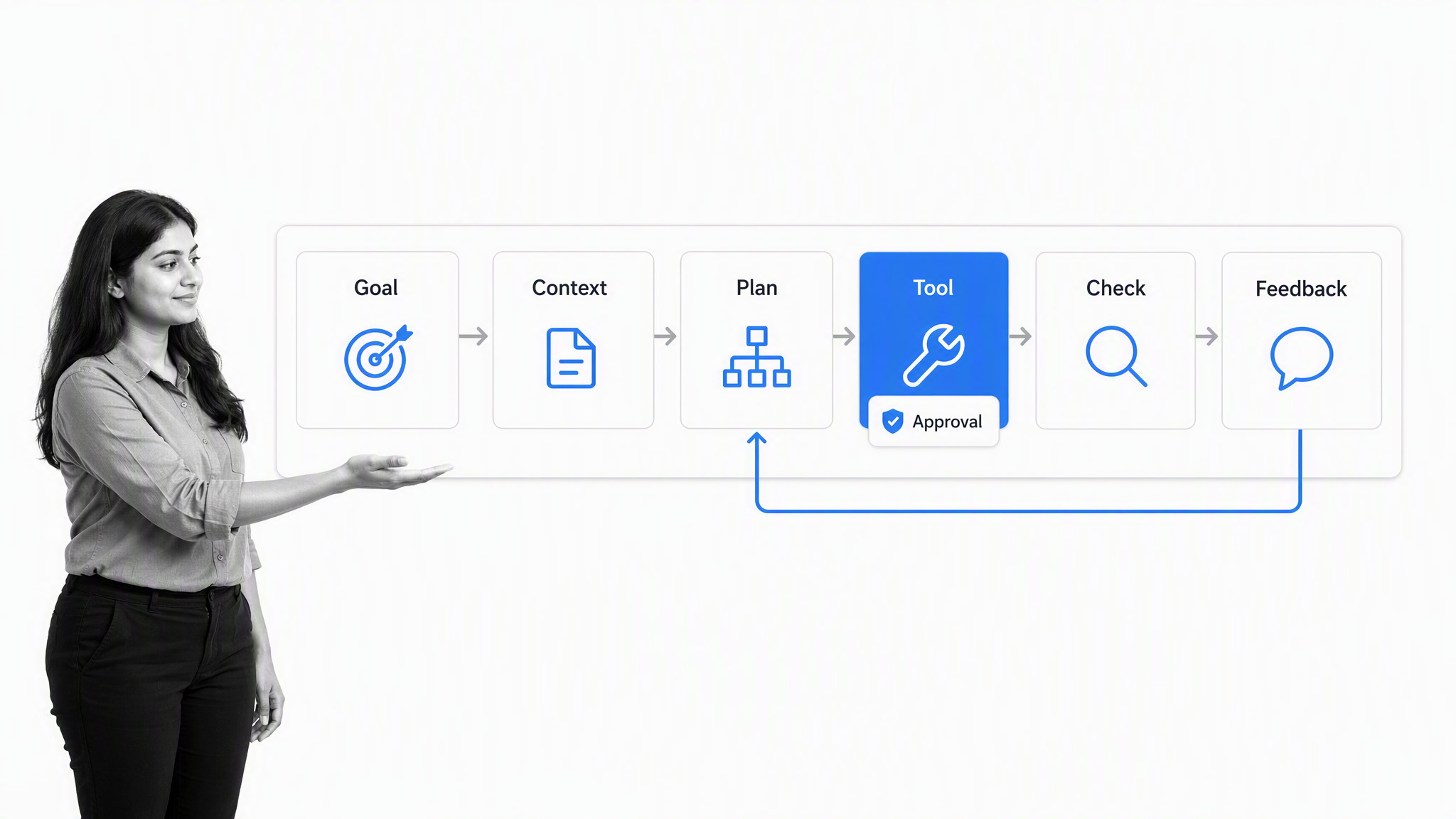
Most agentic workflows follow a recurring loop: receive a goal, gather context, plan, act through a tool, check the result, and feed that result into the next decision. A person steps in when the action crosses a risk boundary or the system cannot determine a safe next step.
1. A trigger supplies the goal
The workflow can start from a form, message, schedule, document, database event, or human request. Strong intake states the desired outcome, who requested it, relevant deadlines, risk factors, and what completion means. Weak intake gives the agent an open-ended instruction that is hard to evaluate.
2. Context grounds the decision
The agent receives the information needed for the current stage: policies, records, prior actions, customer or vendor data, workflow history, and approved knowledge. Context should be current, relevant, and traceable. More context is not always better because irrelevant material can hide the rule that matters.
3. Planning chooses a route
The agent decomposes the goal into a small set of actions. It may decide to retrieve a record, compare evidence with policy, request missing information, update a system, draft a response, or escalate. The plan can be revised when the environment changes.
4. Tools change the state of work
Tools turn reasoning into execution. They can read a database, browse a system, create a task, update a record, start another workflow, or prepare a message. Each tool needs explicit permissions and a clear rule for whether the agent can use it automatically or only after approval.
5. Evaluation closes the loop
After acting, the agent checks whether the result moved the case toward the goal. It can validate structured output, compare evidence, inspect tool responses, or ask a reviewer. If the result is incomplete, the workflow returns to planning. If it is unsafe or ambiguous, the workflow escalates or stops.
Components of an agentic AI workflow
A production system needs more than an AI model. Reliability comes from the supporting components that constrain, observe, and coordinate the model’s decisions. The distinction becomes clearer after separating the broad idea of agentic AI from the workflow that executes it.
Goal and completion criteria
The goal should describe an outcome the system can verify. A vague instruction such as manage vendor risk is not enough. A better goal is to collect required evidence, classify the request, route high-risk findings to the assigned reviewer, and close only when the approval and record update are complete.
Orchestrator and workflow state
The orchestrator coordinates stages, tools, retries, owners, and handoffs. Workflow state records what has happened and what remains. This is closely related to AI agent orchestration, but the workflow also carries business accountability and completion rules.
Tools and permissions
Each tool should expose the smallest useful action surface. Read actions can have broader autonomy than writes. Sending messages, deleting data, changing access, approving spend, or making external commitments usually require a stronger gate than looking up a record.
Memory and context management
Short-term memory keeps the current case coherent. Long-term memory can preserve approved facts, decisions, or prior outcomes. Neither should become an uncontrolled dump. The workflow should define what is stored, where it came from, how long it remains valid, and who can correct it.
Guardrails, approvals, and evidence
Guardrails define allowed behavior. Approval tasks hold consequential actions for a person. Evidence shows which input, rule, tool, output, and reviewer produced the result. Together they make the workflow inspectable rather than magical.
Agentic AI workflows vs traditional automation
Traditional automation and agentic workflows belong on the same spectrum. The right choice depends on whether the route is known, how much context changes, how costly mistakes are, and whether the output can be checked. Salesforce Architects uses the same decision lens when comparing agentic and traditional workflow patterns.
Traditional automation follows predetermined logic
A workflow automation executes known rules: when X happens, do Y, then route to Z. It is fast, predictable, and easy to test. It is the right choice when the input and path are stable and every meaningful branch can be specified.
An AI workflow may use models without being agentic
A fixed workflow can call an AI model for extraction, classification, summarization, or drafting, then continue through predetermined steps. The model contributes judgment, but it does not decide the plan or choose the next tool. This hybrid pattern is often enough.
An agentic workflow chooses some steps at runtime
The system becomes agentic when the model can select actions or revise the route based on context and feedback. That flexibility is useful for high-variation work, but it also increases the need for permissions, evaluation, observability, and stop conditions. The broader agentic process automation model applies that pattern across complete business processes.
Use the least autonomy the job needs
If a deterministic rule can handle the step reliably, use it. Add model judgment where the input is unstructured. Add agent planning only where the route truly varies. This keeps cost, latency, testing, and operational risk proportional to the problem.
Agentic AI workflow examples
Good use cases combine a repeatable outcome with changing context. They also have identifiable systems, owners, evidence, and decision boundaries.
Vendor and third-party review
An agent can extract facts from submissions, compare evidence with policy, request missing documents, and prepare a risk summary. A vendor due diligence checklist supplies required reviews and approvals, while the agent handles document variation.
Employee and customer onboarding
An onboarding agent can interpret role, location, product, or account context and prepare the right downstream work. The employee onboarding checklist keeps required tasks consistent while the agent personalizes the route and handles exceptions.
Compliance evidence collection
An agent can locate evidence, classify it, identify gaps, and assemble a review package. The compliance audit checklist defines owners, deadlines, approvals, and proof so collection remains part of a governed process.
Incident and exception response
An agent can gather signals, draft a timeline, recommend the next runbook step, and update the case as new facts arrive. An incident management process keeps severity decisions, escalation, ownership, and closure evidence explicit.
Research and operational preparation
Agents are useful for gathering information, comparing sources, drafting a recommendation, and preparing the system updates that follow. The workflow should separate research from consequential action so a weak source does not silently become an external commitment or permanent record change.
How to design and govern an agentic AI workflow
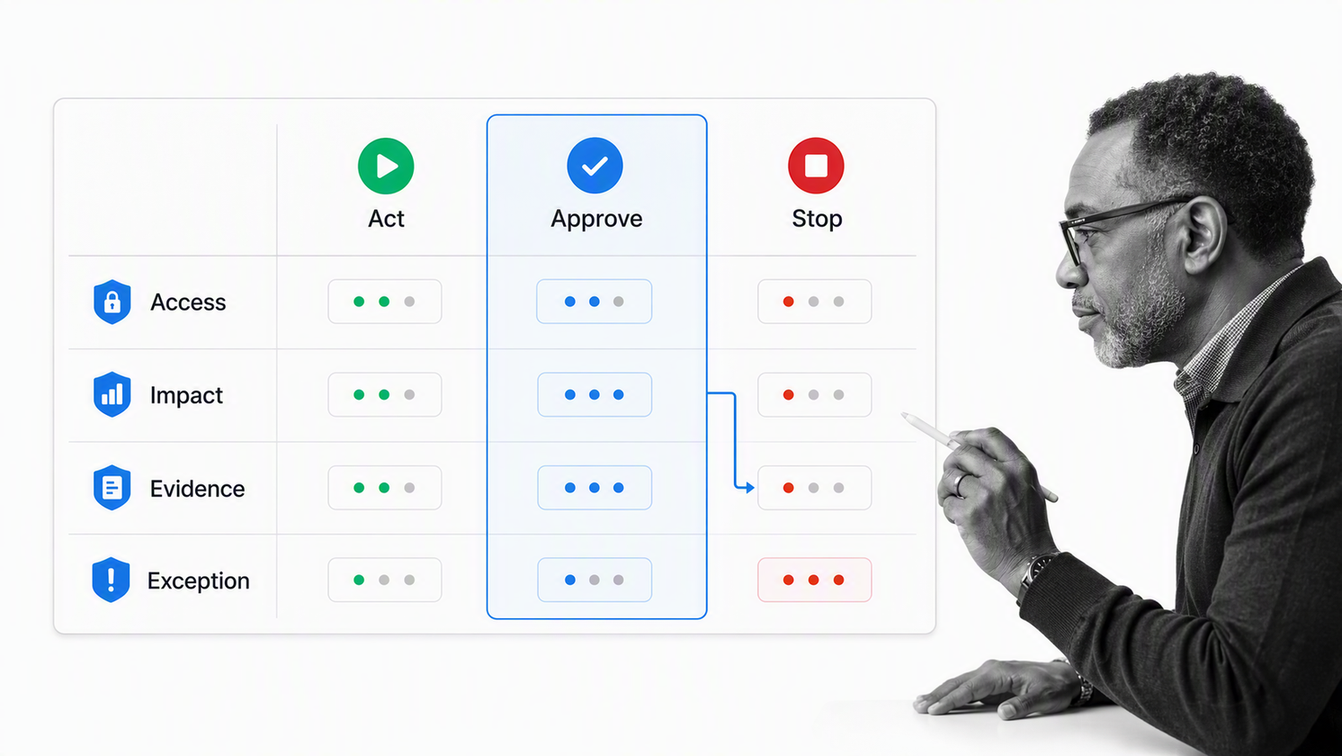
Design begins with the process, not the agent. Map the normal path, exception path, control points, and proof requirements before deciding where AI should act.
Start with one bounded outcome
Choose a process that repeats, has an accountable owner, and ends in a verifiable result. Avoid a general mandate to improve operations. A bounded pilot such as preparing a vendor review or assembling an evidence package creates a real test surface.
Separate fixed controls from flexible judgment
Keep permissions, required evidence, separation of duties, approval thresholds, retention, and stop conditions deterministic. Use the agent for classification, extraction, comparison, planning, drafting, and exception handling where fixed rules become brittle.
Define the agent contract
Record the goal, approved context, available tools, allowed and prohibited actions, required output, evaluation method, escalation triggers, and owner. The contract should be understandable to the operations leader responsible for the outcome, not only to an AI engineer. AWS Prescriptive Guidance provides additional architecture patterns for teams translating these controls into a deployed system.
Test the failure path
Test missing evidence, conflicting instructions, unavailable systems, rejected approvals, unusual values, tool timeouts, and unsafe requests. Confirm that the workflow pauses, routes, or stops correctly. A successful happy-path demo does not prove production readiness.
Monitor outcomes and expand deliberately
Track cycle time, manual touches, exception rate, approval changes, rework, tool failures, and evidence completeness. The NIST AI Risk Management Framework provides useful governance context, while the workflow record provides the operational evidence needed to decide whether autonomy should expand.
How Process Street supports agentic AI workflows
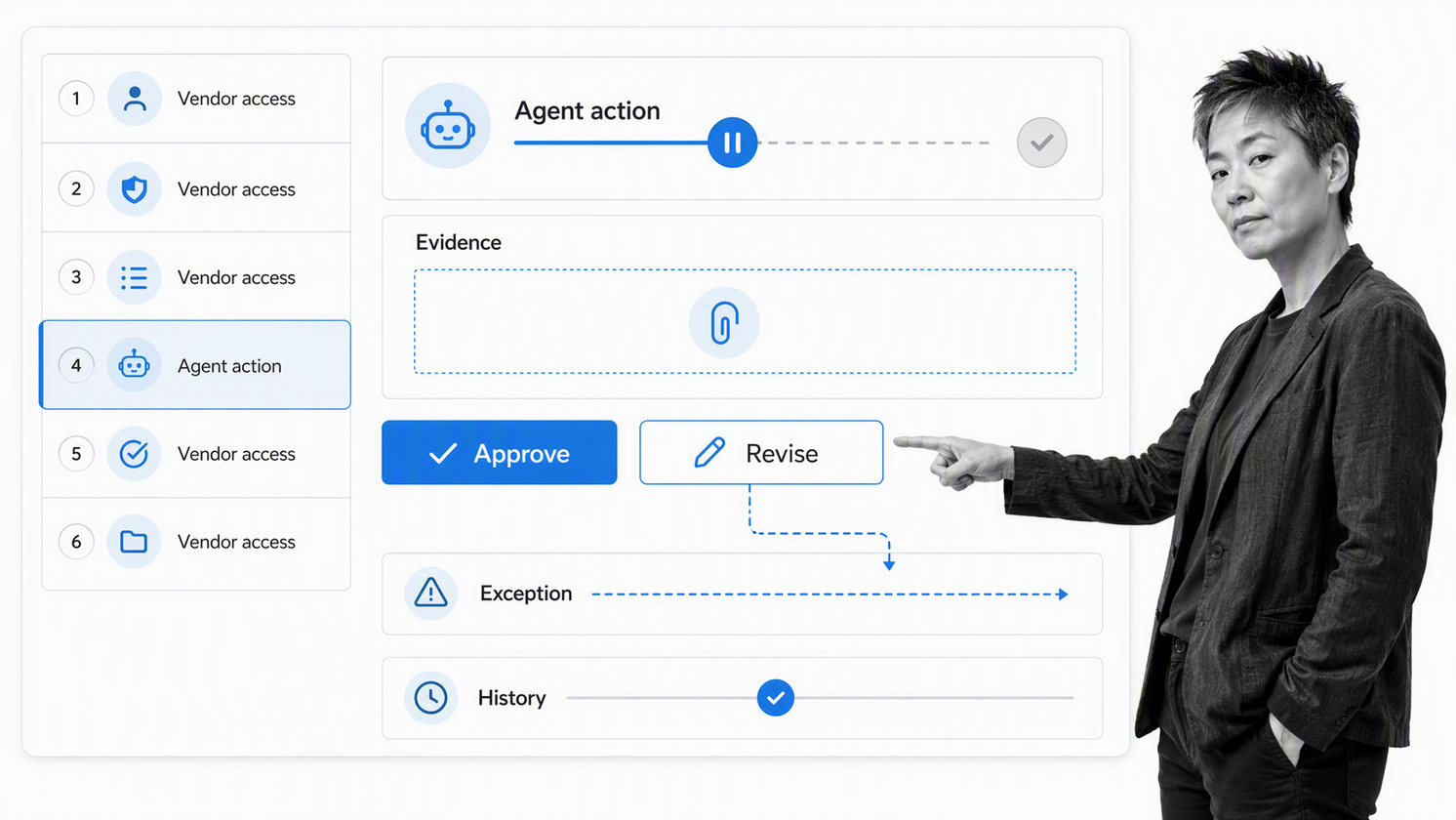
Process Street gives agentic AI workflows an executable process spine. Tasks, owners, approvals, forms, conditional routes, integrations, evidence, and history stay connected to the same workflow run.
Structure the work before adding autonomy
A Process Street workflow defines required tasks, inputs, ownership, decisions, and completion conditions. AI can handle variation inside that structure without making the operating model disappear.
Put review where consequences change
Approval can sit directly before an external message, record change, access decision, financial action, or policy exception. Reviewers see the request, proposed action, evidence, and process context together, which supports a real decision instead of a blind yes or no.
Route exceptions without side channels
Conditional logic can reveal different tasks or instructions based on form data and earlier outcomes. Exceptions remain visible inside the process instead of moving into untracked email or chat coordination.
Connect the systems where work happens
Process Street has direct, universal integrations to 5,000+ systems. Need a new one? An AI agent builds it on the fly. Tool actions remain attached to the workflow stage, control, owner, and history around them.
Let execution create proof
Required fields, files, decisions, approvals, comments, and task history create an audit trail as the work happens. This is the operational bridge between AI governance and daily execution: control is built into the run rather than reconstructed after the fact.
FAQs
What is an agentic AI workflow?
An agentic AI workflow is a goal-driven process in which an AI agent interprets context, plans steps, uses tools, checks results, and adapts its next action within defined boundaries. The workflow supplies state, permissions, controls, owners, and completion criteria.
How does an agentic AI workflow work?
It works as a loop: receive a goal, gather context, plan, use an approved tool, evaluate the result, and continue, revise, escalate, or stop. Strong implementations add approval gates and evidence capture around consequential actions.
What is the difference between an AI workflow and an agentic workflow?
An AI workflow can call a model inside a fixed sequence, such as extracting data and then routing it through predetermined rules. An agentic workflow lets the model choose some actions or revise the route at runtime based on context and feedback.
What are the main components of an agentic AI workflow?
The main components are a goal, context, an AI model, an orchestrator, workflow state, tools, permissions, memory, evaluation, guardrails, approval gates, exception routes, and an execution record. The exact mix depends on the use case and its risk.
When should you use an agentic AI workflow?
Use one when the outcome repeats but the inputs or route vary enough that fixed logic becomes impractical. Good candidates have clear owners, available evidence, identifiable tools, and decision boundaries that can be tested.
How do you govern an agentic AI workflow?
Govern it by limiting tools and permissions, keeping required controls deterministic, placing human approvals before consequential actions, defining stop conditions, testing failures, and preserving evidence for every important decision and system change.