Turn every policy into automated workflows with built-in enforcement and audit-ready proof.


Headless Compliance Software
Last updated:
Headless compliance software separates compliance logic from a single fixed user interface. Applications, portals, services, and AI agents call the same governed control layer through an application programming interface, while people still own approvals, exceptions, and policy decisions.
That separation gives teams one place to enforce authorization, workflow rules, evidence requirements, escalation paths, and audit history. It does not remove human judgment. It makes human judgment explicit, callable, and observable across every channel that initiates regulated or high-risk work.
This guide explains the architecture, control model, evaluation criteria, use cases, and implementation path. It also shows how Process Street can provide the governed workflow layer behind custom interfaces and agent workflows without forcing every user into the same front end.
In this article, we are going to cover:
- What is headless compliance software?
- How headless compliance software works
- The architecture of a headless compliance layer
- Headless architecture vs a fixed compliance portal
- Headless compliance use cases
- How to evaluate a compliance control plane
- Build headless compliance with Process Street
- A practical implementation plan
- Headless compliance FAQs
What is headless compliance software?
Headless compliance software is a compliance execution system whose core controls can be invoked independently from its native interface. A client sends a structured request, the system authenticates the caller, evaluates policy, starts or advances governed work, captures evidence, and returns a structured result. The same control can serve a customer portal, an internal application, a command-line tool, or an AI agent.
The word headless describes the architectural separation between presentation and execution. It does not mean uncontrolled automation. In a sound design, the compliance layer is more controlled because every channel must pass through the same decision rules. Teams can use a replaceable interface while keeping one source of truth for policy, approvals, task state, and evidence.
The difference between an interface and a control plane
An interface collects intent and presents state. A control plane decides what is allowed, what work must happen, who must review it, what proof is required, and what result can be returned. When those responsibilities are mixed inside one portal, every new channel risks duplicating policy logic. A headless design keeps the interface thin and the control plane authoritative.
This is why the category overlaps with compliance automation software, but the emphasis is different. Automation asks whether controls can run faster. Headless architecture asks whether the same controls can be called safely from many clients without being rewritten in each one.
What headless does not mean
- It does not mean API access alone. A useful API must expose governed actions and state, not just records.
- It does not mean removing approvals. High-risk requests should pause for the right accountable person.
- It does not mean hiding compliance. People still need clear status, evidence, reasons, and remediation paths.
- It does not mean every control is automated. Some controls are deterministic, some require evidence, and some require judgment.
How headless compliance software works
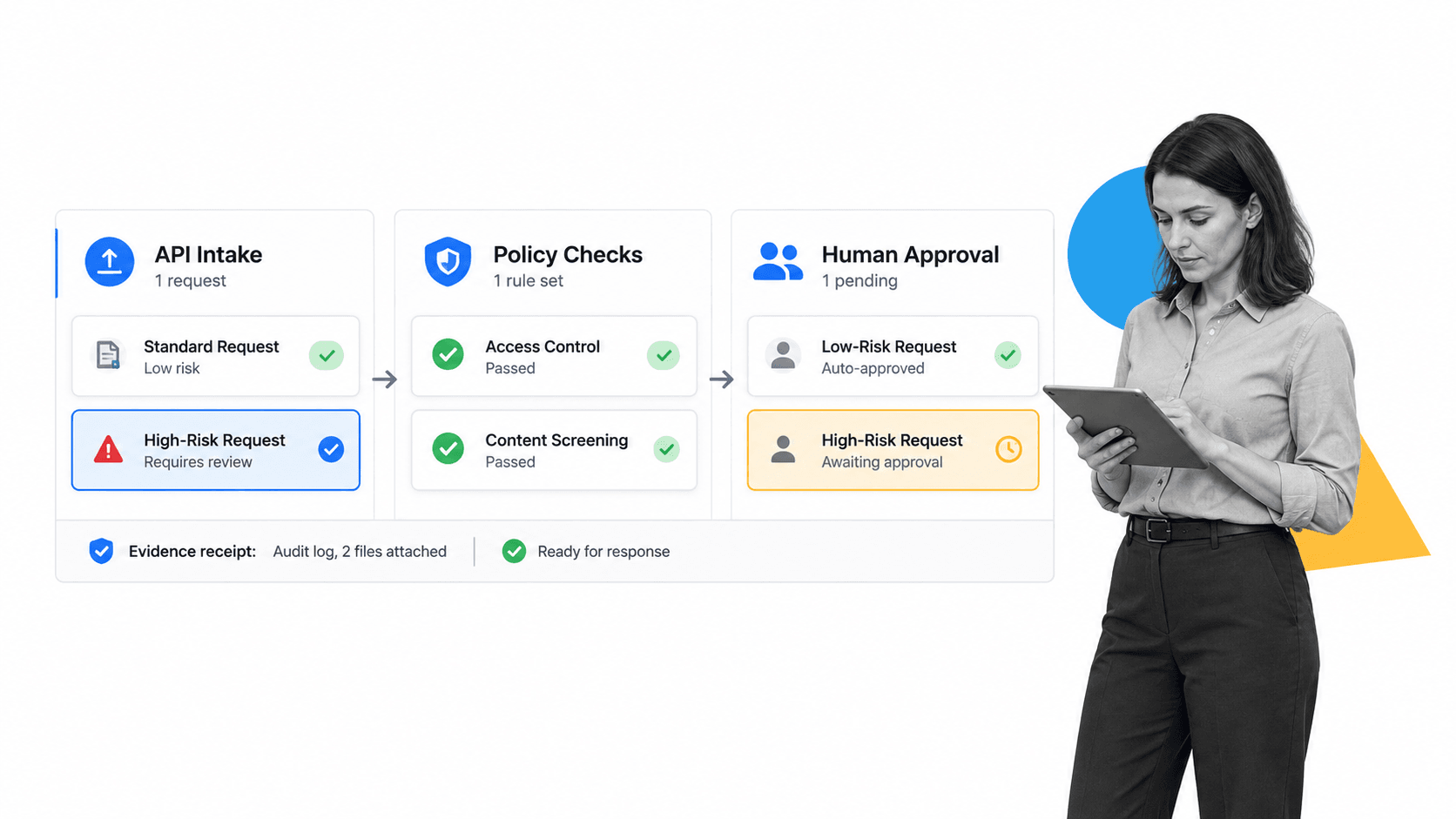
A typical headless compliance request moves through six stages. The client submits intent and context. The control layer verifies identity and permissions. Policy rules classify the request. A workflow coordinates automated checks and human work. Evidence is attached to the decision. The system returns a result with durable identifiers so the client can retrieve status and prove what happened.
1. A client submits structured intent
The client should send the action it wants to perform, the subject of the action, relevant business context, and an idempotency key that prevents accidental duplicate execution. The OpenAPI specification gives teams a standard way to describe HTTP-based interfaces, but the contract still needs domain semantics such as request type, risk class, evidence reference, and responsible owner.
2. The platform authenticates and authorizes
Authentication proves who or what is calling. Authorization decides whether that caller may request this action for this subject. Treat an AI agent as a service identity with bounded permissions, not as a trusted employee. The OWASP API Security project documents common failure patterns around object authorization, authentication, resource consumption, and unsafe API use. Those risks belong in the architecture review from the start.
3. Policy classifies the request
A policy decision can allow, deny, request more information, route to a human, or start a remediation workflow. Keep the decision reason with the result. A bare yes or no is hard to explain and hard to audit. A reason code, policy version, matched rule, and decision timestamp make the result useful to people and machines.
4. Governed workflow executes the control
The workflow assigns work, applies deadlines, follows conditional paths, pauses for approvals, and requires evidence before completion. This is where workflow automation for compliance becomes operational rather than decorative. The control is not merely a rule evaluation. It is the full chain of accountable work needed to reach a defensible outcome.
5. Evidence and events are recorded
Store the request, decision, workflow state, human actions, evidence references, exceptions, and final outcome as linked records. Event-driven clients can subscribe to state changes. The CloudEvents specification provides a common envelope for describing events, which helps when many systems consume the same compliance state changes.
6. The client receives a durable result
Return a stable request identifier, current status, next required action, decision reason, and links or references to evidence the caller is allowed to see. Long-running work should not hold one connection open. The client submits, receives an identifier, and checks status or listens for events until the governed workflow reaches an outcome.
The architecture of a headless compliance layer
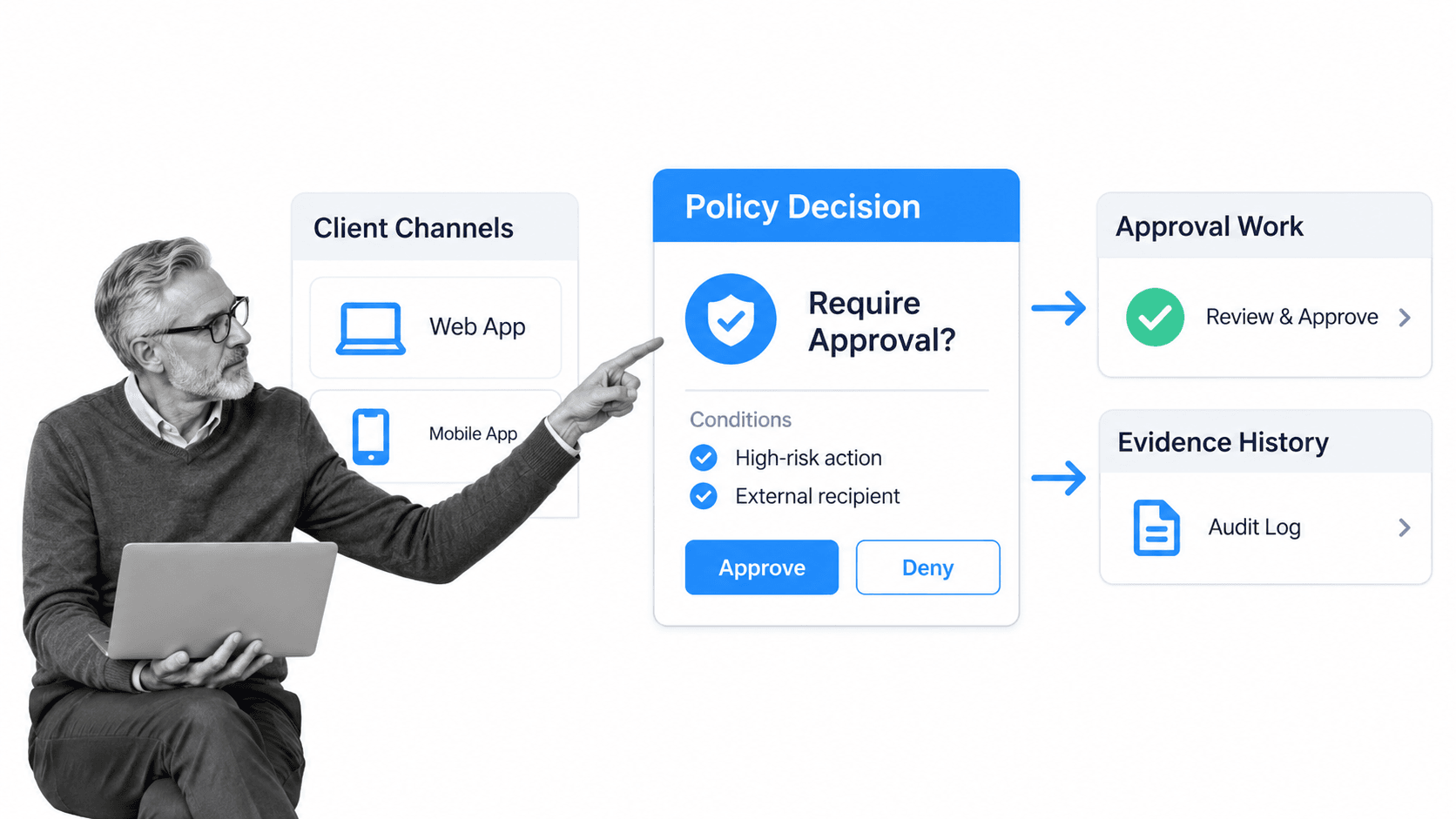
A reliable headless compliance layer has clear boundaries. Clients express intent. An identity layer establishes the caller. A policy layer evaluates rules. A workflow layer coordinates automated and human work. An evidence layer preserves proof. An observability layer explains current state and failure. Each boundary should be independently testable.
Client adapters
Client adapters translate a portal form, internal application action, agent tool call, or command into the canonical request model. They should not contain policy decisions that belong in the shared layer. If two clients calculate risk differently, the architecture has already split its source of truth.
Identity and authorization
Use separate identities for people, applications, and agents. Scope each identity to the smallest set of actions it needs. Authorization should consider the action, subject, business unit, data sensitivity, and current workflow state. A caller that may create a request should not automatically be able to approve it or read every attached record.
Policy decision service
Policy needs versioning, effective dates, test cases, and change approval. A request should be evaluated against an identifiable policy version. That makes replay and investigation possible when a rule changes later. The NIST security and privacy control catalog is one example of structured control families that organizations map into their own implementations and evidence requirements.
Workflow orchestration
Workflow orchestration turns a policy outcome into accountable execution. It assigns tasks, applies conditional logic, waits for external events, enforces approvals, and records completion. Teams exploring broader orchestration patterns can use the guide to agentic process automation software to compare how governed workflows interact with agents and human owners.
Evidence and audit history
Evidence should be linked to the request and control, not scattered across email, chat, and storage with no common key. Store references rather than copying sensitive data into every system. Preserve who supplied the evidence, when it was captured, which requirement it supports, and whether it was accepted or rejected.
Observability and recovery
Operators need to see queued, blocked, approved, denied, failed, and retried work. Every failure path should have an owner and a recovery action. A system that can enforce a policy but cannot explain why a request is stuck creates a new operational risk. Pair technical metrics with process metrics such as approval age, missing evidence, exception volume, and repeated remediation.
Headless architecture vs a fixed compliance portal
A fixed compliance portal can work well when one audience performs one predictable process. It becomes restrictive when customers, employees, partners, internal services, and agents all need to trigger the same controls from different environments. Headless compliance software keeps the control model stable while letting each audience use an interface that fits its job.
Choose a fixed portal when
- One small user group performs the work directly in the vendor interface.
- The process has limited integration needs and little channel variation.
- The portal already provides the right evidence, access, and review experience.
- Speed of initial setup matters more than future interface flexibility.
Choose a headless layer when
- Several applications or agents must invoke the same controls.
- A customer-facing experience must remain inside your product or portal.
- Policy logic must stay consistent while interfaces change independently.
- Long-running approvals and evidence collection must be visible to machines.
- You need one audit history across automated checks and human decisions.
The most practical design is often hybrid. Compliance owners use a native interface to author policies, review queues, and investigate exceptions. Other users stay in the systems where they work. The headless layer connects those experiences to the same governed workflow and evidence model.
Headless compliance use cases
AI agent action gates
An agent proposes a high-impact action, such as changing a record, releasing a payment, approving a vendor, or sending a regulated communication. The compliance layer checks scope, collects context, and routes the request through the correct approval and evidence steps. The agent receives a pending, approved, denied, or remediation-required result. Teams planning this pattern should also define AI workflow automation governance so tool permissions, human authority, and audit expectations are explicit.
Embedded customer compliance
A software company can place a compliance request inside its own product while a separate control layer handles policy, reviewer assignment, evidence collection, and history. Customers experience one coherent product. Compliance teams retain a governed backend and can update the control without rebuilding every client screen.
Vendor and third-party onboarding
A procurement portal can initiate due diligence, collect documents, route risk exceptions, and track approval. The same backend can serve an internal purchasing tool and an agent that prepares the request. A vendor onboarding compliance checklist helps define the questions, evidence, and approvals that the callable workflow must enforce.
Access and change requests
Internal applications can request access, configuration changes, data exports, or privileged actions through a standard control contract. Low-risk cases may pass automatically. High-risk cases pause for review. Every outcome retains its inputs, policy version, approver, and evidence, which supports internal control testing and exception analysis.
Continuous control monitoring
Monitoring services can open remediation workflows when a control signal changes. The headless layer converts a machine-detected exception into assigned human work, evidence collection, and closure. This connects automated detection with continuous compliance instead of leaving alerts in a separate queue.
How to evaluate a compliance control plane
Evaluate the operating model before the endpoint list. The best headless compliance software is the system that keeps policy, human authority, evidence, and recovery coherent under real failure conditions. A broad feature checklist can hide the hard questions about identity, state, replay, versioning, and accountability.
Control model
- Can one control combine deterministic rules, automated checks, human approvals, and required evidence?
- Can policy versions be tested and approved before they affect new requests?
- Can the system explain why a request was allowed, denied, paused, or escalated?
- Can exceptions enter remediation without losing the original request context?
Interface contract
- Are create, inspect, approve, deny, cancel, and retry actions explicit and permissioned?
- Does the request model support idempotency, correlation identifiers, and long-running status?
- Can clients receive events without polling every record continuously?
- Are errors structured enough that a person or agent knows the next safe action?
Security and governance
- Can each application and agent receive a separate identity and narrow permission scope?
- Are secrets, sensitive fields, and evidence access controlled independently?
- Can approval authority be separated from request creation and system administration?
- Can operators revoke access and trace every privileged action?
Operations and resilience
- What happens when a client retries, an external system times out, or an approver is unavailable?
- Can a workflow resume without duplicating the regulated action?
- Can operators inspect blocked work and apply a documented recovery path?
- Can the platform export evidence and history in a form auditors and internal reviewers can use?
Run a proof of concept with one real high-risk process. Include an allowed request, a denied request, a missing-evidence request, an approval timeout, a client retry, a policy change, and a downstream failure. The result will reveal more than a polished demo. If you need a vendor shortlist, the best headless compliance platforms comparison applies these architectural criteria to several options.
Build headless compliance with Process Street
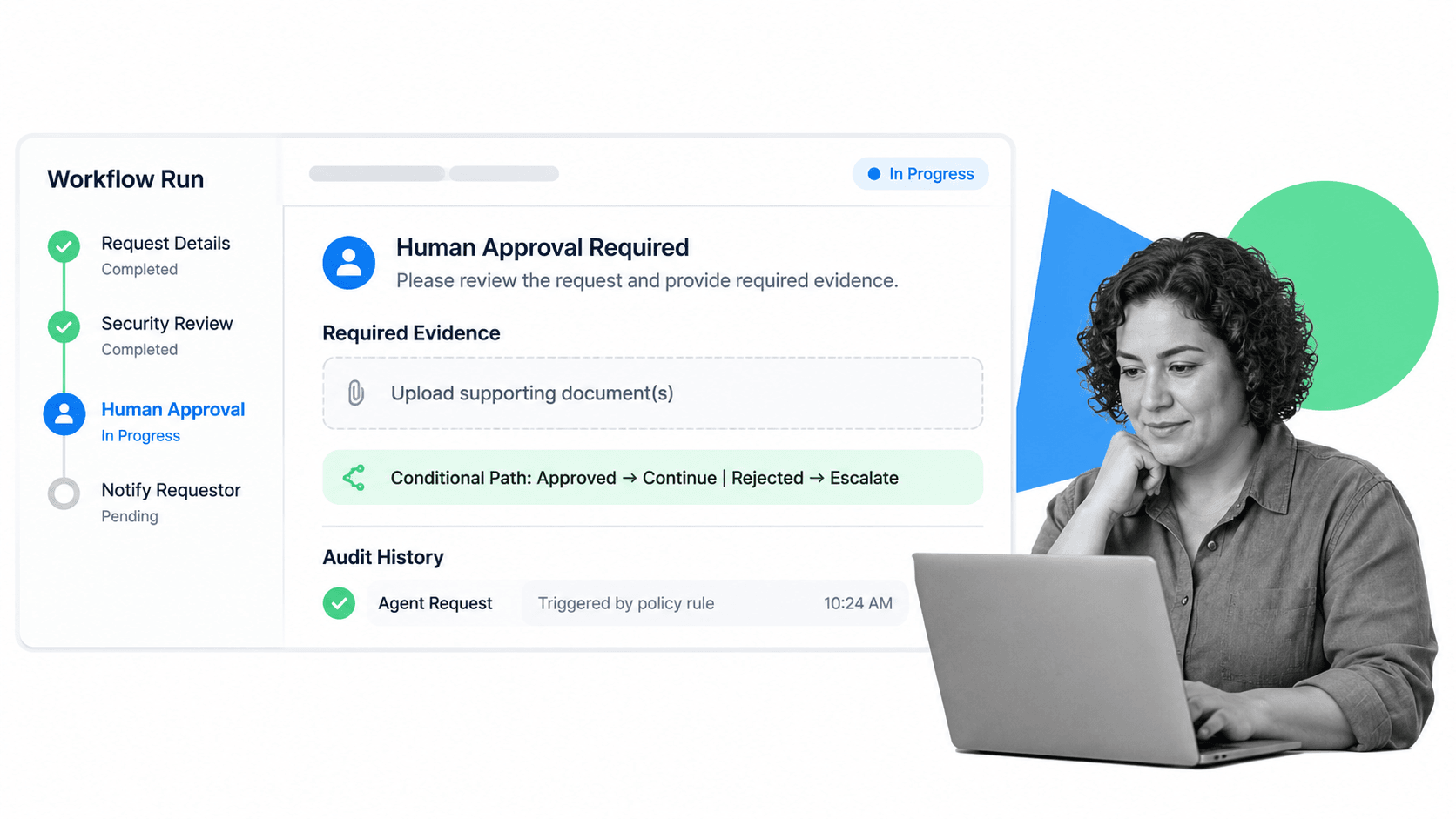
Process Street can act as the governed workflow layer behind applications and AI agents. The public Process Street application programming interface exposes workflow and run operations for software clients. The Process Street Model Context Protocol server gives compatible AI systems a structured way to work with Process Street. Model Context Protocol, or MCP, is a standard interface that lets an AI system call external tools with defined inputs and outputs.
The important distinction is that the callable surface connects to governed Workflows. A request can start or advance work, but the Workflow still owns task order, assignments, required fields, conditional paths, and completion state. The Approvals feature keeps human authority inside the execution path, and conditional logic routes different risk and evidence scenarios through different steps.
Keep the agent or app as the client
The client proposes intent and supplies context. It should not silently become the policy engine. Keep durable rules, approval authority, required evidence, and remediation in the Workflow. This lets a portal, service, or agent change without changing the compliance outcome every user must satisfy.
Design the Workflow as the control
Define the trigger, owner, risk classification, evidence fields, approval thresholds, escalation timing, exception paths, and final outputs. Link each requirement to the task that enforces it. A risk assessment process can provide the first structure, while a structured internal audit procedure helps define sampling and review work.
Return state the client can use
Give the calling system a durable run identifier and a small set of meaningful states. Pending approval, missing evidence, remediation required, completed, denied, and failed are more useful than a generic in-progress flag. Expose only the fields that client needs, and keep sensitive evidence behind its own authorization checks.
A practical implementation plan
Phase 1: choose one control
Start with a process that crosses at least two systems, includes one human decision, and produces evidence. Avoid the most legally sensitive process for the first build, but do not choose a trivial demonstration. Good pilots include vendor intake, privileged access requests, policy exceptions, content approval, and control remediation.
Define the canonical request
List the required fields, optional context, identity claims, idempotency key, attachments, and expected response. Define what each client may supply and what the compliance layer must calculate itself. Write example requests for the allowed, denied, pending, and invalid cases.
Phase 3: build and test the governed workflow
Implement the control as tasks, checks, approvals, evidence requirements, deadlines, and exception paths. Test every branch with synthetic records. Confirm that a client cannot skip directly to approval or completion. Use a change management workflow to govern future updates to the control itself.
Connect one client
Connect a single portal, service, or agent. Keep the adapter thin. Instrument request creation, authorization failures, workflow transitions, approval age, evidence gaps, and final outcomes. Do not add the next client until retry behavior and recovery paths work under failure.
Phase 5: expand with a control owner
Assign a named owner for policy, workflow behavior, access, evidence, and operational health. Review exceptions and failed requests on a fixed cadence. Add clients only when they can reuse the canonical request and state model. That discipline preserves the value of the headless design as usage grows.
Headless compliance FAQs
What is headless compliance software?
Headless compliance software exposes governed compliance controls through APIs or agent tools instead of requiring every user to work in one fixed interface. The shared control layer still manages authorization, workflow state, approvals, evidence, exceptions, and audit history.
How is a headless compliance layer different from GRC software?
Governance, risk, and compliance software often centers on a native portal for policies, risks, controls, and assessments. A headless compliance layer emphasizes callable execution, so custom applications and AI agents can invoke the same controls while the backend preserves human authority and proof.
Can AI agents use a headless compliance layer?
Yes. An AI agent can submit a structured request, retrieve status, supply permitted evidence, and respond to remediation. The agent should have a separate identity and narrow permissions, while high-risk decisions remain behind explicit policy and human approval gates.
What should a headless compliance API return?
Return a durable request identifier, current status, reason or policy reference, next required action, and permitted evidence references. Long-running controls should also expose events or a status endpoint so clients do not assume immediate completion.
Does a headless architecture remove the compliance user interface?
No. Compliance owners still need an interface to author controls, review queues, investigate exceptions, and inspect evidence. Headless architecture lets other audiences use their own interfaces while all clients share the same governed backend.
How can Process Street support headless compliance?
Process Street provides callable interfaces for software clients and compatible AI systems, connected to governed Workflows. Those Workflows can coordinate assignments, conditional paths, human approvals, evidence fields, and durable execution history behind a custom client experience.