Turn every policy into automated workflows with built-in enforcement and audit-ready proof.


AI Agent Audit Trail
Last updated:

An AI agent audit trail is a chronological, correlated record of what an autonomous system was asked to do, what it considered, which tools it used, which controls applied, and what happened next. It gives people enough evidence to reconstruct an agent run without relying on the agent’s own summary.
That record matters because an agent can take several actions across several systems in seconds. A normal application log may show isolated technical events. An agent audit trail connects those events to identity, intent, permissions, approvals, data access, tool calls, outputs, and business outcomes.
A useful trail is not a transcript dump. It is a structured evidence chain that supports operations, security, compliance, incident response, and continuous improvement while protecting secrets and personal data.
In this guide, you will learn:
- What is an AI agent audit trail?
- Why AI agent audit trails matter
- What an AI agent audit trail should capture
- How to design a trustworthy event model
- How to set retention and review rules
- How to implement AI agent audit trails
- How Process Street makes agent actions reviewable
- FAQs
What is an AI agent audit trail?
An AI agent audit trail records the decisions and actions that make up an agent run. Each event has a timestamp, actor, action type, target, result, and correlation identifier. Together, those events explain how a request moved from intent to execution.
If you are new to AI agents, think of the trail as a flight recorder for work. It does not merely say that the run succeeded or failed. It shows which agent identity was active, what task it received, what data and tools were available, where human approval was required, and which system changed.
Audit trail, activity log, and observability are related but different
An activity log tells you that events occurred. Observability helps operators understand system health and behavior. An audit trail adds accountability: it preserves enough context and integrity to support a review, investigation, control test, or evidence request.
The OWASP AI observability guidance describes trace logging as a way to capture tool calls, sequence, parameters, and results. That is essential raw material. The audit layer adds business identity, authorization, policy decisions, approval records, and retention rules.
A trail follows the whole agent run
Agent work is often distributed. A single request can trigger planning, retrieval, a model call, an API request, a browser action, an approval, and a database update. OpenTelemetry traces use trace and span relationships to connect units of work across services. The same correlation idea is useful for an agent run: one run ID, many linked events.
The audit trail should let a reviewer move in both directions. Starting from a business outcome, they should be able to find the run and its events. Starting from an event, they should be able to find the request, owner, policy, approval, and resulting change.
Why AI agent audit trails matter
AI agent audit trails matter because autonomous systems compress work and risk. A person might take ten minutes to move through a sequence of screens and approvals. An agent can do the same work in seconds, repeat it at scale, and cross system boundaries that used to slow the process down.
They make accountability possible
When an agent changes a customer record, sends a message, updates access, or triggers a payment, teams need more than a generic service account in the log. They need to know which agent instance acted, which person or workflow initiated it, what authority was delegated, and whether the action stayed inside that authority.
That is why an audit trail belongs inside AI agent compliance. Policy defines the boundary. The trail proves how the boundary was applied during the run.
They support incident reconstruction
An agent incident can involve a bad prompt, poisoned context, excessive permission, a compromised tool, a missed approval, or a correct action applied to the wrong target. Without correlated records, investigators see fragments. With a complete trail, they can reconstruct the sequence and isolate the control that failed.
The NIST Generative AI Profile connects documentation, logging, incident analysis, version history, and metadata with stronger AI risk management. The practical lesson is direct: capture evidence while the system runs, not after someone notices a problem.
They turn governance into proof
Governance defines roles, risk decisions, and monitoring. The NIST AI Risk Management Framework Core emphasizes systematic documentation and regular monitoring. An agent trail makes those practices reviewable by connecting the policy decision to the actual execution event.
For covered high-risk systems, Article 12 of the EU AI Act requires automatic event recording to support traceability and monitoring. Legal obligations depend on the system and jurisdiction, so teams should map requirements with counsel. The operational principle still travels well: record the events that explain risk, control, and outcome.
What an AI agent audit trail should capture
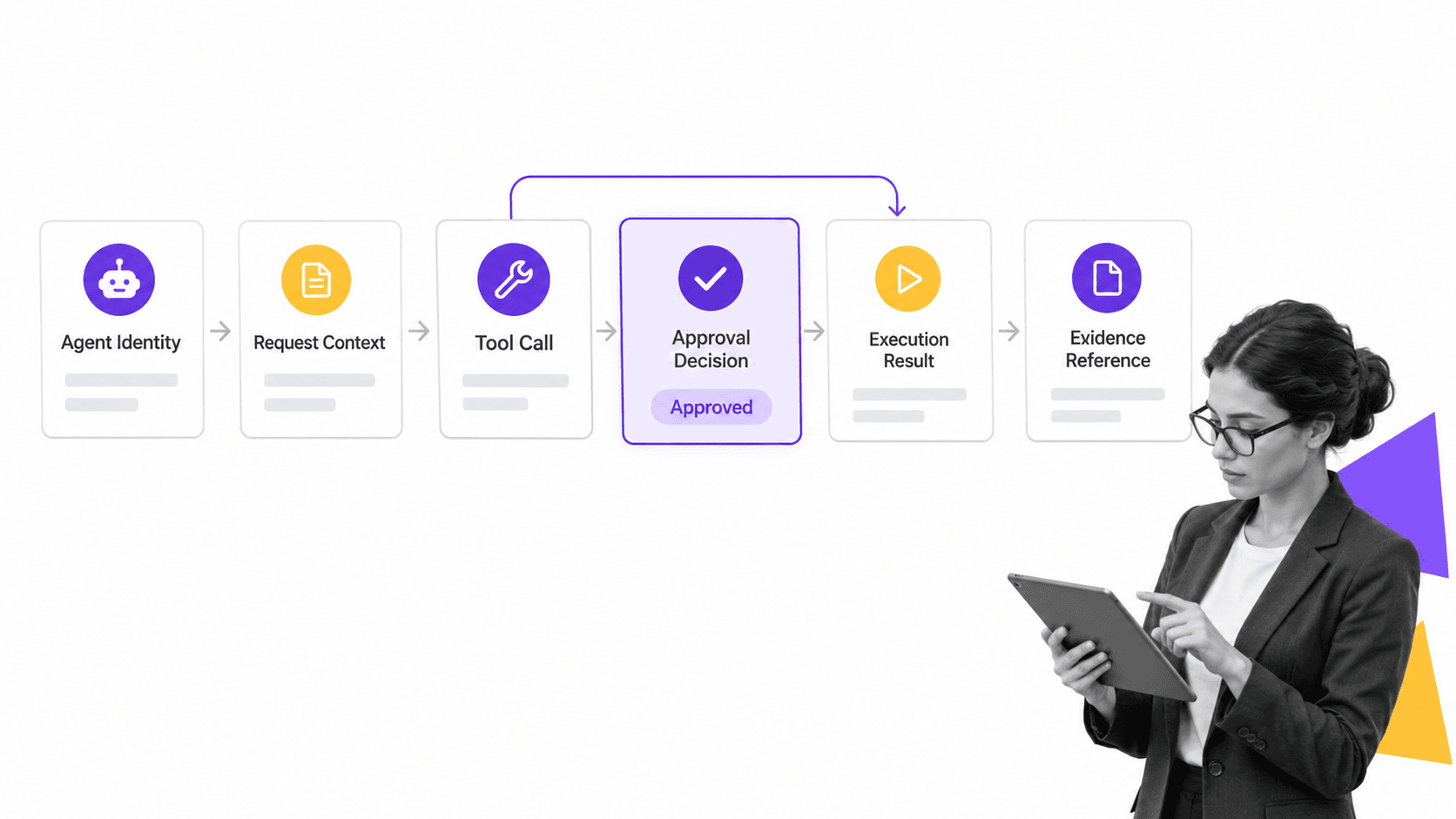
A useful AI agent audit trail captures enough context to answer who, what, why, how, where, and with what result. The exact fields vary by use case, but the evidence model should be consistent across agents.
Agent and initiating identity
Record a stable agent identifier, agent version or configuration reference, the initiating user or workflow, the tenant or environment, and the delegated role. Avoid treating a shared API key as identity. The record should distinguish the human requester, the orchestrator, the agent, and the downstream credential used for a tool call.
Request and business context
Capture the requested task, business object, target system, case or workflow ID, risk tier, and the policy version in force. Store a safe representation of the request when the raw content contains secrets or sensitive personal data. A hash, reference, classification, or redacted excerpt can preserve evidence without copying the full payload into every log.
Permissions and authorization
Record what the agent was allowed to do at the time of execution. Include the permission scope, resource boundaries, expiry, approval requirement, and any exception. This lets a reviewer separate an authorized but harmful action from an action that exceeded its authority.
Planning and decision checkpoints
Do not depend on hidden chain-of-thought or expose private reasoning. Record the operational decision instead: selected action, policy evaluation, confidence or validation status where relevant, alternative path rejected by a control, and the reason code for escalation. The goal is reviewable decision evidence, not a verbatim internal monologue.
Tool calls and data access
For every material tool call, record the tool name, operation, target resource, sanitized parameters, response status, duration, and correlation ID. Record data categories and object identifiers rather than copying sensitive values when possible. Include retries, timeouts, and partial failures because they can explain duplicate or inconsistent outcomes.
Human approval and intervention
When a person reviews an action, capture the reviewer identity, decision, scope, reason, and evidence shown at the time. Workflow approvals should block the controlled step, not simply add a comment after execution. If a human edits the agent’s proposed action, record the before-and-after relationship.
Execution result and evidence
Record whether the action completed, failed, rolled back, or produced a partial result. Link the business outcome to system evidence such as a changed-record ID, message ID, file hash, workflow task, or downstream receipt. A success flag without a target and evidence reference is too weak for an audit trail.
Model, prompt, and dependency versions
Keep references to the model, system instructions, tool schema, policy bundle, retrieval source, and agent configuration used for the run. Versions matter because the same request can behave differently after a prompt, model, tool, or policy change. Use immutable configuration references where possible.
How to design a trustworthy event model
A trustworthy event model is structured, correlated, minimal, and difficult to alter without detection. It should work for engineering teams during an incident and for business reviewers who need a readable account of what happened.
Use one run ID and linked event IDs
Give each agent run a unique trace ID. Give each event a unique event or span ID and a parent relationship. Carry the trace ID across the orchestrator, model gateway, tool layer, approval workflow, and downstream systems. This creates a causal chain instead of a pile of timestamps.
OpenTelemetry logs can correlate log records with trace and span IDs. Teams can reuse that plumbing for technical correlation, then add the business and control fields an agent audit trail requires.
Separate payloads from evidence metadata
Logs become dangerous when they copy every prompt, response, token, secret, and customer record into one searchable store. Keep the audit event small. Store references, classifications, hashes, and redacted values. Put sensitive payloads in a protected evidence store with separate access controls and a clear deletion policy.
Make integrity visible
Use append-only storage, restricted write paths, immutable retention controls, event signing, or hash chaining where the risk justifies it. Record who can administer the log system. An audit trail is weak if the same agent or operator can silently rewrite the record after an incident.
Design for review, not just collection
Define views for operations, security, compliance, and case owners. A reviewer should be able to filter by agent, user, workflow, tool, target, risk tier, approval state, and outcome. Alerts should identify unusual patterns without replacing the underlying evidence.
How to set retention and review rules
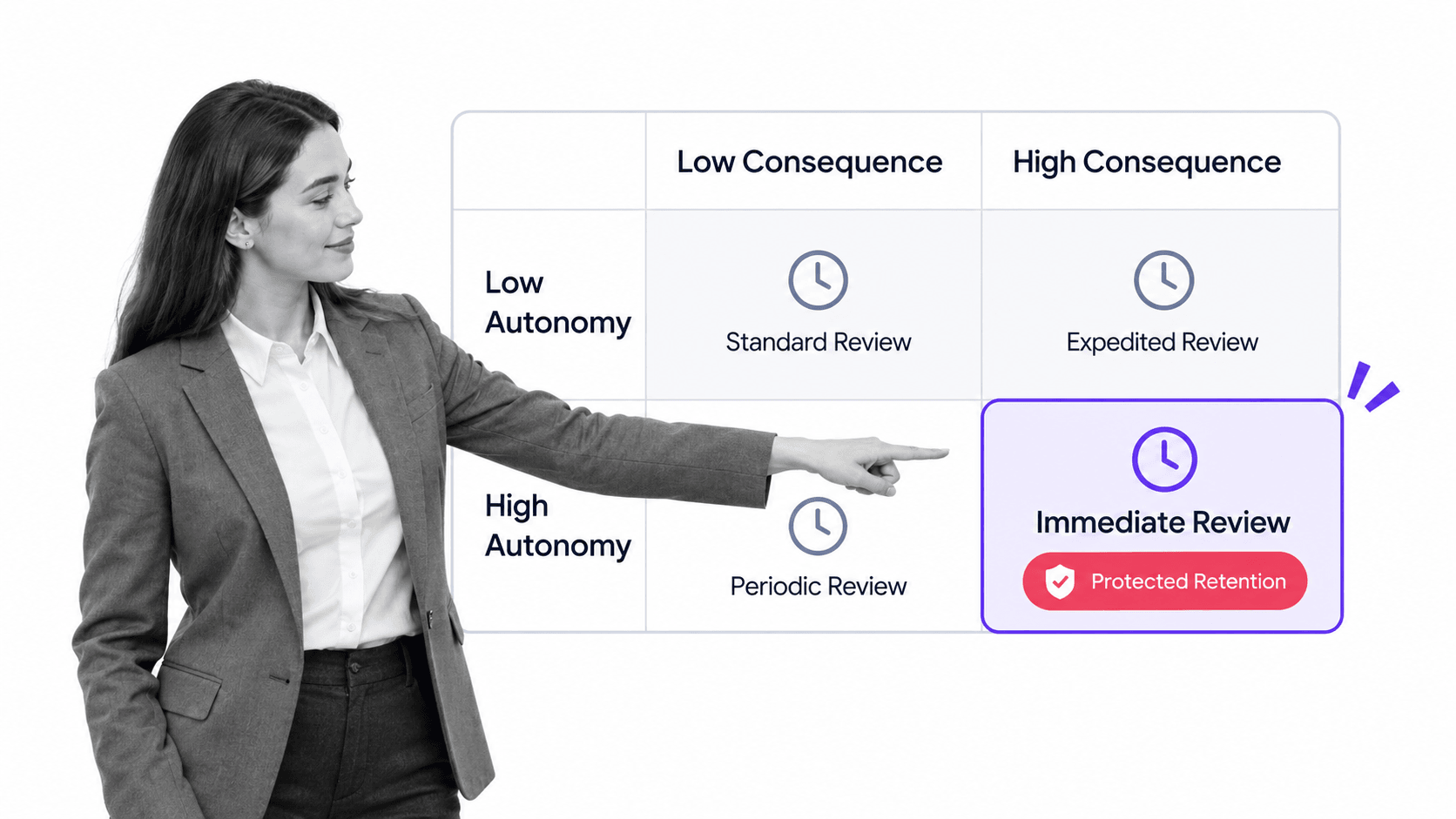
Retention and review rules should follow risk, not convenience. The more autonomous the agent and the more serious the possible outcome, the stronger the record, protection, review frequency, and retention requirement should be.
Classify runs by autonomy and consequence
A research assistant that summarizes public information may need short operational retention. An agent that changes access, moves money, updates regulated records, or communicates with customers needs a stronger evidence set and more durable retention. Add data sensitivity and reversibility to refine the tier.
This risk-based approach fits the logic of an agentic AI workflow: controls should change with the action, not merely with the model name.
Define review triggers
Review high-risk runs promptly. Also trigger review for denied actions, approval overrides, repeated retries, unusual tool sequences, permission changes, large data access, policy exceptions, partial failures, and rollback events. Sample lower-risk runs so silent drift does not go unnoticed.
Set retention by purpose and obligation
Write down why each event class is retained, who uses it, and when it expires. Align the period with legal, contractual, security, financial, employment, and operational needs. Do not keep sensitive payloads forever just because storage is cheap. Retain the evidence you need and delete what no longer serves a defined purpose.
Protect access to the trail
Audit records can expose prompts, customer data, system structure, errors, and credentials. Apply least privilege, encryption, separation of duties, access logging, and monitored exports. Reviewers should see the evidence they need without receiving broad access to every raw payload.
How to implement AI agent audit trails
Implementation starts with one high-value agent workflow. Do not wait for a universal schema that covers every future system. Build a minimum evidence contract, test it against real incidents and audits, then extend it deliberately.
Step 1: Map the agent action path
List the components from request to outcome: user, workflow, orchestrator, model, retrieval source, policy check, approval, tool, credential, downstream system, and evidence store. Mark where identity or context changes. Those boundaries are where correlation is most often lost.
Step 2: Define the minimum event schema
Start with timestamp, trace ID, event ID, parent ID, actor, initiator, action, target, permission scope, policy decision, approval state, result, evidence reference, configuration version, and integrity metadata. Mark which fields are required for each event type.
Step 3: Instrument every material boundary
Emit structured events at the orchestrator, model gateway, tool gateway, approval workflow, and downstream action. Pass correlation context through each call. Fail closed or raise an alert when a high-risk action cannot write its required audit event.
Step 4: Redact before storage
Classify fields before they reach the log pipeline. Remove secrets, tokens, authentication headers, and unnecessary personal data. Use references to protected evidence rather than duplicating sensitive content. Test redaction with adversarial prompts that attempt to place secrets in ordinary text fields.
Step 5: Add approval and exception evidence
Connect the technical trace to the business control. Record who approved, what they saw, what scope they approved, and whether the executed action matched it. Route exceptions through a named owner and capture the compensating control.
Step 6: Test reconstruction
Run tabletop exercises using an information security incident response workflow or your own incident process. Give a reviewer only the business outcome and ask them to reconstruct the agent run. Missing links become schema or instrumentation fixes.
Step 7: Review changes like code
Changes to prompts, tools, permissions, policies, and retention can change the audit story. Route them through a change management process with owners, testing, approval, and rollback. Keep version references in the trail so old runs remain understandable.
Step 8: Measure coverage
Track the percentage of material agent actions with complete traces, the number of orphan events, approval-to-execution mismatches, redaction failures, delayed log delivery, and reconstruction success. Coverage is more useful than raw event volume.
How Process Street makes agent actions reviewable
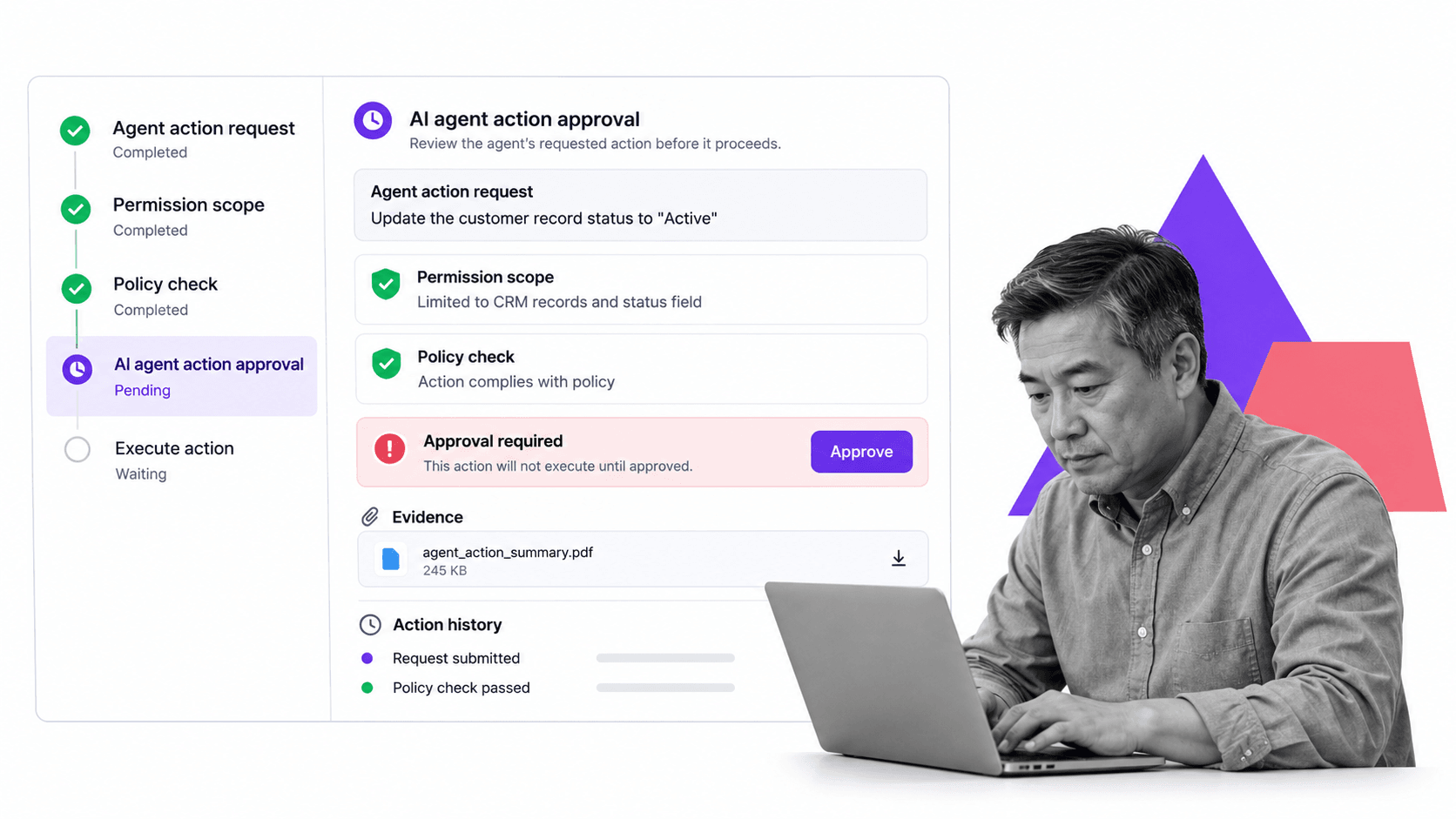
Process Street makes agent actions reviewable by putting policies, permissions, approvals, evidence, and execution history inside the workflow that governs the work. The audit trail is attached to the business process, not left as an isolated engineering log.
A workflow can capture the requested action, assign a risk tier, limit permitted tools, run a policy check, require a named approval, collect evidence, and record the final result. Each step has an owner and state, so a reviewer can see both the control and the execution record.
Controls run before the action
For high-stakes work, the important question is not whether someone can find the log later. It is whether the workflow checked the rule before the agent acted. Required tasks, conditional paths, and approvals create enforceable gates around the action.
Evidence stays connected to the case
A workflow keeps forms, approvals, attachments, comments, task history, and outcomes in context. That supports compliance operations because the proof is created as work happens rather than assembled during an audit fire drill.
The same pattern supports continuous review
Recurring checks can sample runs, recertify permissions, review exceptions, and surface gaps. This turns the trail into part of continuous compliance and operational improvement, not a passive archive.
Start with one controlled agent workflow
Choose a process with a clear owner and measurable outcome. Use a risk management process template, vendor risk assessment checklist, or internal audit checklist as a starting point for the review and evidence structure. Then adapt the fields to the agent action and its systems.
The result is a practical bridge between AI governance, AI agent orchestration, and the real work people must approve, investigate, and improve.
FAQs
What is an AI agent audit trail?
An AI agent audit trail is a structured, chronological record of an agent run. It connects identity, request context, permissions, tool calls, policy checks, approvals, execution results, and evidence so a reviewer can reconstruct what happened.
What should an AI agent audit trail include?
It should include a trace ID, agent and initiating identities, timestamps, request context, permission scope, policy decisions, human approvals, tool calls, target resources, results, configuration versions, and evidence references. Sensitive payloads should be redacted or stored separately with controlled access.
How is an AI agent audit trail different from a normal application log?
A normal application log often records isolated technical events. An AI agent audit trail correlates those events with business intent, delegated authority, policy evaluation, approval, and outcome, which makes the record useful for accountability and review.
How long should AI agent audit records be retained?
Retention should follow the purpose, risk, data sensitivity, legal obligations, contracts, and incident-response needs of the use case. High-consequence autonomous actions usually need stronger and longer-lived evidence than low-risk internal assistance, but unnecessary sensitive payloads should not be kept indefinitely.
How do you protect AI agent audit logs from tampering?
Use restricted write paths, append-only or immutable storage where justified, separation of duties, access logging, event signing or hash chaining, and monitored exports. The agent performing the work should not be able to silently rewrite the evidence of what it did.
How does Process Street support AI agent audit trails?
Process Street connects agent requests, policy checks, approvals, evidence, task history, and outcomes inside executable workflows. This keeps the operational control and its audit evidence in the same reviewable process.